
The Project Gutenberg eBook of It Takes Practice Not To Die
Title: It Takes Practice Not To Die
Author: Elizabeth Bartlett
Release date: June 11, 2019 [eBook #59739]
Language: English
Credits: Produced by Al Haines, produced from scans provided by Steven Bartlett
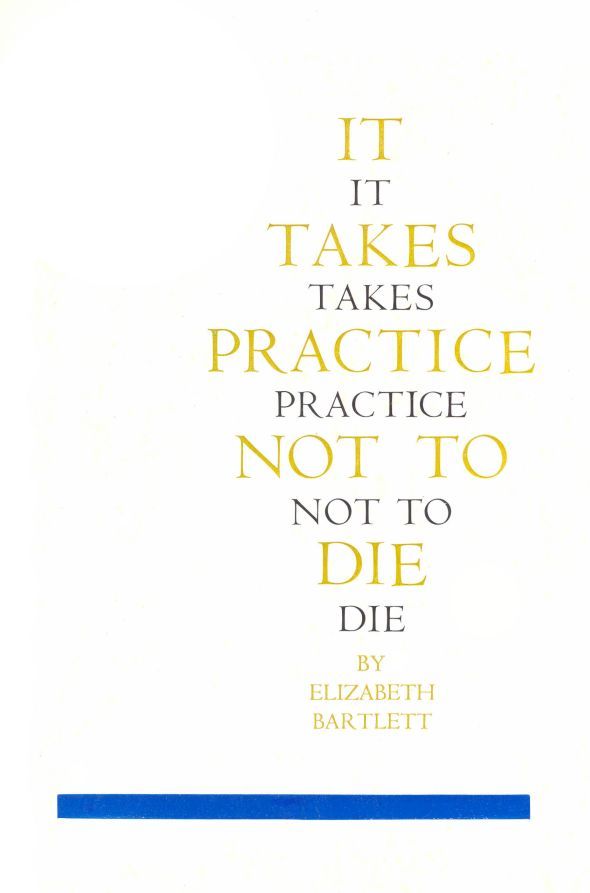
IT TAKES PRACTICE NOT TO DIE
Elizabeth Bartlett
It Takes Practice Not to Die was originally published in 1964 by Van Riper and Thompson in Santa Barbara, California. The book is now out-of-print and the publisher no longer exists. The author's literary executor, Steven James Bartlett, has decided to make the book available as an open access publication, freely available to readers through Project Gutenberg under the terms of the Creative Commons Attribution-Noncommercial-NoDerivs license, which allows anyone to distribute this work without changes to its content, provided that both the author and the original URL from which this work was obtained are mentioned, that the contents of this work are not used for commercial purposes or profit, and that this work will not be used without the copyright holder's written permission in derivative works (i.e., you may not alter, transform, or build upon this work without such permission). The full legal statement of this license may be found at:
http://creativecommons.org/licenses/by-nc-nd/4.0/legalcode
IT TAKES PRACTICE NOT TO DIE
IT
TAKES
PRACTICE
NOT TO
DIE
BY
ELIZABETH
BARTLETT
VAN RIPER & THOMPSON, INC.
SANTA BARBARA 1964
ACKNOWLEDGEMENTS
Some of these poems appeared in the following anthologies: The American Scene, The Golden Year, New Poems By American Poets II, New Voices 2.
Thanks are also due to the Beloit Poetry Journal, Chelsea Review, Commentary, The Critic, Dalhousie Review, ETC., Fiddlehead, Harper's, Harper's Bazaar, Literary Review, New Mexico Quarterly, New York Times, Odyssey, Poetry Dial, Queen's Quarterly, Quixote, San Francisco Review, Saturday Review, Tamarack Review, Yale Literary Magazine.
Library of Congress Catalogue Number: 64-22731
Copyright 1964 by Elizabeth Bartlett
First Edition
All rights reserved, including the right to reproduce this book or parts thereof in any form, except for review purposes.
Printed in the United States of America
TO
PAUL AND STEVEN
OTHER BOOKS BY THE AUTHOR
Poems of Yes and No
Behold This Dreamer
Poetry Concerto
CONTENTS
Existence=multiple conditions2
HOMO ELASTICUS
I tell you it is inside,
a substance no one has yet identified
or described
as something natural to flesh,
a glutinous secretion in the cells
that can harden and melt.
Milky, it clings to the gums
with a stickiness that fastens on the tongue
to be dumb,
or else stretches and winds a band
around the heart so tight, it has to snap
or loosen, springing back.
Fluid, it waxes the bones
to ease their impact and recoil as they bounce
over stones,
except when the latex thickens,
becomes too crude, more fat than resin,
and freezes in the sun.
BALANCE
My head has no affinity with my feet.
When I stand on one heel and lean
on my axis spine, I reel to the floor;
I can not turn on a fixed orbit.
My shadow divides me by day and escapes
me at night, a trait apparently made
to confuse me, since I follow a course
without regularity or recurrence, my cosmos
inclined to alternation at moments
evident to no one, not even myself.
Who is reasonable? A tightrope walker,
perhaps, builders of bridges, sailors,
mountain climbers—those whose direction
is indicated by their opposition
and held in a careful equilibrium
like a golden pendulum, its means,
each according to some counter force.
Lacking such moderation, I look for
wisdom in safety, and safety
in wisdom—and dangle between.
A two-legged creature, whose symmetry
goes paired from ear to foot, I find
duality a natural condition; a Chang
and Eng existence united in fact
but separate in fulfillment. Parted,
we die, and together compromise
our right and left, depending which has
the stronger influence. Made as I am,
the wonder is not that I sway or spin,
but manage to stay inside my skin.
SIMPLE WITH COMPASS
Consider the circle.
It is a miracle
of completion,
end and beginning one.
Reduced to a point or
expanded to a sphere,
its ratio
is unchanged by ego.
Compare it to the line,
that matter of fact sign
of direction
started but never done.
Whichever way it moves,
how far or long, it proves
distance can go
only so high or low.
I think we should rejoice
there is no other choice
than straight or round—
makes life easy, I've found.
ACHILLES HAD HIS HEEL
And still the arrows fly
in all directions.
No one is safe. The wind
has no armor.
Strength, beauty, valor,
whatever we find
and name perfection
is target to the eye.
Who is immune?
Either we aim—and miss,
or ourselves become
the victims hit.
Even a hermit,
locked inside his room,
remembers St. Francis
sang often out of tune.
We learn to die
from a thousand wounds,
each scarred inside
till the final failure.
Meanwhile we endure
and suffer with some pride
that we can be so human—
enough, if we must, to cry.
The point is inevitable.
Whether heel or head,
who is invulnerable
is already dead.
ASCETIC
Be whatever you like,
close your eyes:
on the desert a burnished stone,
in the murky sea a jewel.
Go wherever you wish,
bind your feet:
through the night where a wing has flown,
towards dawn where a leaf drops cool.
Live however you would,
stay your blood:
with the sky over earth as friend,
at peace with the mind and breath.
Speak whenever you will,
seal your lips:
of this life proclaim time an end,
in the next cry Nazareth.
I WOULD REMEMBER
I have walked from river's end to end,
a slow companion to the light seagulls
that circle overhead
and I have stood still above the bend
that separates the foot from distant hulls,
to fill my eyes with flying sails' wings spread.
I have watched them many times repair
the far shore's curve around the sun
and hold it there ensnared
until provoked they drop midair,
instinct with seaward gravitation
and angry claws declared—
their mutiny a gold crazed rout
that tears the cargo from its hold
and scatters it about.
I am not old
and yet, when night brings me to town,
I forget their wings and drown.
AFTER THE STORM
That morning, after the storm,
everyone gathered about the tree
and marveled at its fall:
the body leaning gently on one arm,
its mighty head now cushioned by deep
branches, seemingly asleep.
"You wouldn't think a storm," one said,
then broke off, staring at the fruit
that never would be eaten red
and sweetened by the sun, or set
in jars and slowly left to cool,
the ripening years ahead gone, too.
"It was the wind." "The rain." Each spoke
a part of truth out of his own mouth
with words that could not make it whole
because the naked roots showed
how much there was to doubt,
the secret in the darkness crying loud.
Even a tree, she thought, biting her tongue
and bringing her childish thoughts down,
remembering the climbs, the stout swing hung
on rafters soaring to the sun,
a tree built like a tower
so you could visit God and talk for hours.
The men sawed logs and timber all that day
until there was nothing left, not
even a shadow where you could wait
and hide to see if it would wake,
then they buried the hole and forgot
what else they might have covered with the sod.
Dead trees tell no tales, she thought,
nor empty nests, nor little girls who see
how helpless all things are when caught
by storm, no matter how big or
strong or secure, and she walked quietly
into the house to help with the next meal.
THE CAGE
Thoughts like an empty cage
receive the morning
through the windowpane
and quietly swing.
No flutter brings my eye
to a meaninged core
for the waking light,
the door transparent.
Held blind by the mirror
and deaf by the bell,
I must search my mind
by taste, smell, and touch.
Bars silhouette a wall
to enclose the noon
where images halt
and the night soon comes.
O bird that set me free
to try my own wings,
how this false spring tree
clings that I perch on!
MENTAL HOEING
Breaking the soil of her mind
was an old habit as she plied
the hoe back and forth over the year
to see its design, the cut and stripped
images of reason stacked in rows
of answered arguments. She swore
at the stones, the matted grass
and stubborn clay that held her back
as though to a winter still unprepared
for spring. Was she never to be spared
from questions rooted in the past?
She attacked the clods with wrath
until there were holes in the ground,
then her thoughts crumpled down,
taking her strength with them.
Aching from remembered resentment,
she turned to the struggle within herself,
but moved lightly now and penitent,
trying to ease the rebellious soil
and soften it, to make it pliable
to the new seeds, the new demands
of the changing season, knowing plants
thrive better in kindness than bitterness.
And suddenly the year stood plain, at rest.
HUNGER
Hunger, I have known your pangs,
the gnawing urge, the ceaseless demand
from beginning to end;
inevitable as air and light,
as rain and seed and soil, as tides
and seasons; the perpetual cause
of all that moves and is moved; the force
that flows through stars and men.
We are born hungry. Begins
the appetite with warmth and tit,
with wombskin quivering yet
from cry replying cry, then another sense
commands another hunger fed
to feed the next and the next, each heir
and progenitor of this past,
that future, and the cycle reset.
Hungry pilgrims, we can not rest.
Distance is but another nearness,
as soon met, then shorelines bend
and we must home again
to other journeys, our Eden
faith a continual repetition
of arks and floods from which none
returns invulnerable, the apple bitten.
Creed, color, race, we have all sworn
allegiance, fought bitter wars,
tasted glory and gall
for insatiable gods deified
by our own hungers; with rites and sacrifice
made bread and wine from flesh and blood
that we might have eternal food
here and hereafter, immortal.
We are fed by desire
and consumed like the fire
on our tongues, in our hearts;
a flame forever unappeased
by our words, symbols, deeds
or monuments; the phoenix, man himself,
recreated from his own ashes
out of hungering dreams and parched.
We live with hunger always,
that fearfilling, painpinching cave
wherein we hide like hunted stags,
lips dry, but tasting heroically
of miracles... Who has not seen
visionary lions fall to dust
and, scornful of the world's ambition,
left the hunters truth in rags?
Fish, birds, beasts, all are prey
to the same illusion, all wake
to the hunger that stalks and prowls.
Sands thirst for unquenchable seas,
plains thrust toward implacable peaks,
time moves unfulfilled and blind
from plans unrealized to those surprised.
We die hungry even while hyenas howl.
VOLUNTARY, EXILE
The day to day commitment to failure
that judgment daily argues against me
condemns me to despair. I am guilty
of more than silence. At times words fail your
wisest men and then, intentionally.
But my silence, like all my secrecies,
has no defense, none conventionally,
my personal idiosyncrasies
no social crimes. When pride is pain and shame
an agony too keen for reason, I
had no other weapon. Who is to blame?
There was no intent to deceive or lie.
My absence is sufficient evidence,
voluntary exile, not providence.
THE FOURTH CATEGORY
Of vegetable, yes,
but amorphous
by analogy
to stem
leaf
root
not a flower
nor a seed
and no use as fruit.
Of animal, too,
but understood
independently
of cry
growl
purr
not a fish
nor a fowl
and no good as fur.
Of mineral, besides,
but disinclined
organically
to heat
break
pour
not iso-
nor meta-morphic
and no worth as ore.
THE CHANGING WIND
Now there are great numbers of people
coming and going with the wind,
and the wind seems changed;
its voice is never still
and its eyes are strange.
Once, we remember, it was possible
for the wind to move on two feet
and formulate a philosophy
of life and death by reason
of environment.
Then the wind that blew around us
was a familiar one;
we knew which side of the house was open
and what grew from our hand
each season of the year.
When it was far, we could gaze
beyond mountains, across seas,
over days and miles of distances
to twisted deserts and vast plains,
bridging there with here.
Wind voyageurs, we knew
what a man puts into his mouth
he eats, where he lays his head
is shelter, that the clothing
he wears, covers him.
Then we had no illusions
about customs or differences,
since the wind was the same wind,
whether it came from the north, the south,
the east, or the west.
Time was a place, we remember,
where the wind was able
to look a man in the face
and remain long enough to hear
what he had to say.
Now there are great numbers of people
coming and going with the wind,
and the wind seems changed;
its voice is never still
and its eyes are strange.
JINXED
I went to the orchard
where the trees were ripe
and found a hard
lemon.
I went to the meadow
when the grain was bright
and heard a crow
sermon.
I went to the valley
which was hidden from wind
and saw a bleached
galleon.
I went to the mountain
whose peak showed no print
and met a lame
stallion.
I went to the desert,
the jungle, the shore,
and always some cursed
omen.
I went to the city
at last for the source,
and there in the streets
were men.
ALONG THAT ROAD
A stranger came one day along that road
and looked out on the field, the barn,
the house set by itself against the woods,
the air as empty in its fence
of silence, as the hour of light.
Alone,
clothes torn, his hands streaked by the cuts
of glass through which he came like hurtling stone
to sudden halt, he searched the bluff
of easy miles for signs of God on wheels,
then limped some more and paused, the bills
in his pocket less a commodity
of exchange for another man's good will,
than a threat of violence that was worse
for being secret.
Car wreck found.
Driver missing. He saw the headline words
small on a page, his name announced
in an obituary column.
Twice
he glanced back over his shoulder
to see whose shadow was following behind,
while at a darkened window, its owner
stood with gun upraised, remembering Job.
A stranger came one day along that road.
THE REFUGEES
After the burning nights and the barren speech,
after the dry wind through stony streets,
we found our little green where lilies were,
and knee-deep oxen stood watching us
triumphant under trees. For this was peace
as nature meant nature's peace to be,
with fruitful soil made ready by its need,
with instincts tamed in gentler ways than fear,
with freedom measured freely as the sky
measures breath. We lay there side by side
breathing kisses, feeling the wet and cool
of bodies grassed in loving, each a groove
within a groove, seeking counterpart,
with close-open-close, with light-in-dark
and waves lapping. We heard the overflow
of lake down buttressed dam and sluiced walls
making music in ditches, singing birth
to seed in spike, to trunk in root, one surge
alike in all. Then, happily, we chose
which way, and barefoot climbed the gold
to tip the rim of that day's widened
cup, before the darkness could descend
to cheat our purpose. Together, all of us swam,
caught in a shower of light that fell on hands
and hoofs, on flesh and hide—the rainbow now
a shore towards which we moved with one accord.
And the sun ceased fire and lowered its arms,
promising new terms for our tomorrow.
SHIP OF EARTH
This earthship, which we now sail on seas
of time and space, aware of other tides
and stars and winds than move about us here,
is smaller than we dreamed. Once, its high
mountain masts pierced infinity,
as we rode, bow into future, and past
at our stern, a vessel without peer
in the universe, the first, the last!
The sails gave way to engines, the spars to wings,
the continental coasts to cosmic shores,
and still we see no end to journeying.
Although our rocket shrinks, we keep our course.
We watch, we sleep, our dream a toylike thing
that wakes and wonders—-whose will, which force?
AMONG THE PASSENGERS
1
Through the window of the bus, he combs a field,
close-shaves the bristling oats, straps in a fence line,
pockets adjoining timber, then rides into the morning,
pleased.
Now retired and let out to pasture, he
does not mind the clouds, the rain that fogs the highway—
his eyes are patched with blue.
Hands leathered and roped,
knees astraddle, boots shined, he is seated beside
as neat a filly as any in the herd he used to lope
in season.
With stallion gallantry, with sweets, he holds
the miles to coffee stops and anecdotes ... till memory
spurs his old man's hopes ... and the night stampedes.
2
Separated by long years and the visibility poor,
her mood reflects the weather, darkening within.
Dishes, diapers, sighs, and pills ... roof by roof,
she hears the monotone of wheels recite the gloomy
catechism, and prays for a different kind of virgin
miracle.
Nervously, she rubs her good luck stone,
then wraps her thoughts in cellophane as a heroine
of film and fashion, glad to forget home, school,
and all the lost-girl tales they tell of Hollywood,
She listens, nods, and smokes. She does not mind his boasts,
only too aware how the ashes cling to his coat.
(1 x 1)n
I can accept
the being born
and the dying,
in doubt, alone.
I do not reject
or, seeing, scorn
anyone's crying
about the unknown.
And yet. And yet.
How the being alone
in the living
makes me mourn.
I can not forget
the breathing in stone,
unforgiving
and forsworn.
AIR BRIDGE
Together we talk of parting
and are drawn out from the shore
across a running sea
that was not there before.
Cautiously we lay our bridge
in air, island to mainland,
and wonder will it reach
beyond the tide or stand.
Already our eyes are widened
by the miles that split us here
as we turn at the bend
and pause. Dark reefs appear.
Together we mark the distance
between words and waves, the wind
swinging our cables. Chance
moves forward—we, behind.
AS YOU MAKE IT
Your bed
they said
so shall you lie on it
But I found rocks
were kinder than clocks
and did not cry for it
They meant
content
without a sigh in it
But I liked stars
much better than bars
and kept the sky on it
No crown
or down
held me in tie to it
But I dreamed jewels
in the deepest pools
where none could spy on it
They thought
I ought
so I could die in it
But I learned ends
do not make amends
and did not try for it
Some day
I may
know the how and why of it
CITY GAME: MARBLES
Like gods competing for the universe,
they shoot the planets between their fingers
with trigger thumbs that scale the speed of light
to intervals of space-colliding time.
Ping! and fiery constellations leap apart,
bright spheres of whirling suns and moons that mark
the checkered squares of sidewalks, heaven's zone,
and hell, the sewer curbs where lost stars roam.
FREE-FALL
Having lost my terror of the air
and learned, by dropping hard, a pity for
the grass, I grow used to the ways of cats.
It takes practice not to die in the act
of living, whether climbing up a tree,
walking a fence, or coming to a brink,
springing free. The ninth time can't be worse
than the first. Meanwhile, there are birds,
sunshine, roofs, and kind old ladies.
The grass itself is innocent with sleep.
Existence=multiple conditions2
You who would be mathematicians in your living,
remember Einstein
The problem
is not always immediately apparent:
it does not become one
until the response to a given condition
fails to satisfy
the need that a continuance implies.
Whether conscious
in amoeba as well as hippopotamus
or unaware
as in water, earth and air
there is evidence
that each continues to be present.
The process
by which we seem to choose or guess
solutions
based on inference and conclusion
regarding what is
and what is not suggests both as hypotheses.
For the nature
of questions is to question nature
since its design
is reciprocal by reflection of the mind
as the rainbow
to its image or crystals to snow.
Perplexed by reason
reality itself dissolves in the sun
while the question
remains above and beyond all consideration
of doubt and fog
a bubble suspended in the hands of God.
THE UNDERSTANDING
What is it you want? he asked.
Looking at him. As though she thought he had something to say and could find the words to say it. The words no one else had yet found or said.
What is it? he repeated.
Her eyes an open darkness. Leading to a corridor of black mirrors. As though at the end was a locked door and behind it the final secret.
What?
Within that hallway of silence, her breathing, the beating of her heart. As though echoing his questions. Waiting, hoping for the answers.
If you would tell me, he said.
Pinpoints of light straining towards the threshold through a soft warm mist. As though they would help him to see, to slip across barriers of being.
If I knew—
Blind beams behind opaque windows. As though in an act of desperation, a man might hurl a stone. The shuddering tinkle of shattered glass.
Here, he said, you take the stone.
Placing it in her hands so that she could feel it, roll it between her palms, sense it through her fingers. An ineffable, tangible continuum.
I give it to you, it's yours.
The whole, beautiful truth, God helping. Love solidly immured within its mineral heart. Ticking away the centuries, immune to change.
WOOLEN DIGNITY
The needle between her fingers
came to a pause as she smoothed
the seams of her life and lingered
over old threads of truth
she had stitched with her own hands
and bitten off her with her own mouth,
noticing how these had blended
with and become part of the cloth,
until her dimmed eyes could not tell
in the fading light which was which.
There was not much of the garment left
to mend, although the remembering hid
what there was and changed the facts
of dark wool to the brighter silk
of summers past, when she had matched
her wardrobe to her hopes and risked
the need for later alterations,
unmindful how both would grow outstyled
and she herself become a pattern
of an age more pitied than admired.
Again the needle swayed and she sighed
at its impatience, as though it cared
that wool wear a rocking-chair pride
with dignity, as though an air
of mutual warmth existed between
her and the winter which would help them
keep what little vanity remained,
and the thread grew taut again,
leaving the stitches along the seam
smooth and even as her last defense.
THE COAT
Joseph had his coat,
a different color
for each brother,
and it was bright.
What happened, we note,
was seventy times seven
their debts were forgiven
till his coat turned white.
Jesus, for his part,
preferred to begin
in the newborn skin
of a lamb, instead.
We know that his heart
devoured all sin
like a lion,
then spilled and bled.
ON A ROCK OF ATLANTIS
Five. Between each the ages
that separate, yet unite
the pillared span.
The oldest leads and guides
as the short, crooked thumb
of long experience.
The others follow. Up and down
to the last small boy
trailing behind.
Unevenly they stride
through the gray, silent dawn
toward the sea
where the waves still breathe
of sleep, and empty miles
unwind the shoreline.
Five figures probe the wind,
the tide. They pace their length
along the sand
and pause. No light breaks.
The stillness keeps, as though
the current
deserted, had suddenly ceased.
With poles, hooks, bait in hand,
the five move on.
Heavy with clouds, the sky
broods behind a mist,
leans on cliffs
and frightened by its dream
of a dead world's beach,
begins to slip.
Until five fingers rise
on the promontory's tip
and lift their poles.
Upheld, the morning wakes,
pours gold! Fish leap!
The land's alive!
EVEN IF WE DID
If we could unwind that brain,
discover its world, the response
of sense from A to Z, the place,
time, weather, and human
condition
If we could trace the course
of its myriad streams
to the first rain, the slow
gathering of waters
in pools and springs
If we could collect the whole
evidence grain by grain,
the words, numbers, symbols
that shaped the color and sound
of mountains
If we could record the dreams,
the chain of centuries from dusk
to dawn, those testings of beliefs
that broke the link and shook sparks
from the sun
If we could model its twin
as a lasting monument,
a brain with all our findings,
long after men, their myths,
wonders, gifts
SELF-EVIDENT
Some birds there are that do not like a cage,
that want the whole world free to come and go
as seasons do, despite drought, heat or snow;
that feel their liberty a heritage
no bars can shut in or no masters assuage
with pretty bribes and warning threats of foe;
the wilder ways of chance they choose to know
with wings against the wind as surest gauge.
Eagle, crow, skylark, jay—no matter what
the size of beak, how sharp the claw or small—
each finds his own nest feathered best for him
alone, on tree, rock, shore or grassy plot;
there he can hear his own answered call,
aware of baits that snare, of shears that trim!
THE SACRAMENT
All the breadlong day she moved about the house
and nibbled at its crust, until she saw Carl
walking griefwards with his shadow to the barn,
whereless in his step and heedless of the cows,
and she wondered how he could be so thoughtbound.
What sad, whyful thing could make a man so lost
within his world that he had no fisthold on
it to demand a moreness for his account?
She turned from that window to the hopeside one
where she had reseeded a world of her own,
a garden like the days of her truthhood—green,
and fenced in its innocence, flowering trust,
where flowers became their dreams when they woke up.
Reminded by the sky hanging out the moon,
she hung hers in the doorway, then lit the room
and hurried to her oven's tomorrow crumbs.
He came in quietly and guilt-rubbed his face,
seeing Jen's waiting at the table. "Ev'ning,"
he said and heard her reply creak underneath
as he woodenly walked to the sink and draped
a towel around his neck, unwishing the blame.
If soap and water clean could make a man feel
holy, what use would the devil's mirror be?
He felt no such deception while she said grace.
They ate their silence from faithworn plates and spoons,
swallowing the forgiven coffee used twice
each day and aware of the greater trespass
they shared in this house which was their staybetween.
Cracked like their hands and cups, who knew when its seams
would give? In the fearwhile, the question unasked
kept their lips still, as though words tempted a risk
beyond their strength to mend should the seams be loosed.
The meal done, she freed the table from its chore
and brought him the county's weekly paper, their
footnotes to other people's answers and prayers,
then bent to her needlework, seeking accord.
Lost by, he stared unseeing at the words poured
through his eyes as though, shuttered against exposure,
the negative in his mind could be immured
in its acid and yet bring some meaning forth.
For a hurt away and far as a man might walk
on a friendly day to a neighbor's door, lay
Nielsen's farm, a credit to God had He made
it with His hands, but none to the man whose straw
grew luckside up as though his plow left a spore
of gold in every furrow. It was a trade
so many seasons back, the reasons became
changestricken at this stranger who sat absorbed.
Touched to the slow, Carl paused and tested the bowl
of his pipe, needing a valid doubt to prod.
Had he pawned his soul to find refuge in rocks
and let a waterfall drain in a sinkhole?
Through the smoke, he traced the wry and twisted road
down whenless years that had plunged him here to rot—
and yet, of Nielson he had required no bond
of hate, for this neither one had bought or sold.
Torrent to trickle, not friendship had reversed
the law, but an unnatural love of worm for bird,
of plant for weed, of a sterile man for Merle,
a woman he could not wed and mark as cursed
without destroying the very universe
that had mothered her and which she owed rebirth.
"You take the farm and Merle. I'll make my own world
over." The words had been all too well observed.
He had not known how close hell was to heaven,
not then and not while he lived in it alone,
watching Merle's seed grow beyond his graveyard slope
from buried dreams she never guessed were even
there, living as she did within her children's—
not until another came to share his ghost
and made him see that death was not like a coat
one wore and had mended by a wife named Jen.
All the thought round, he gnawed on the bitter rind,
hungerwhelmed for a taste of Nielsen's larder,
that orchard whose fruitening he had bartered
for peelings, and dry angered at the two mice
who squeaked in their chairs, each resigned
to his own corner of an empty cupboard,
but mostly ashamed because he could not convert
thorns into leaves, grapes from stones, thirst into wine.
He cleaned his parched pipe from its ashes and stood
to wind a watch with broken springs, setting it
for tomorrow when his shadow would be hitched.
"I'm turning in, Jen. You come before you cool."
His footsteps made the attic cling to the roof
as she folded her needlework's piece of silk
in a sewing box made like an infant's crib,
then raised herself and blew its darkness on the room.
PROLOGUE TO OLD AGE
Not the mirror ages our reflection
but the other faces that we see
looking at us
Not the calendar changes our season
but the other voices that we hear
speaking to us
Not the memory troubles our silence
but the other sleepers whom we meet
dreaming of us
Not our living suffers the violence
but the other beings whom we feel
dying in us
ALL THIS, BEFORE
I raced, I rushed, I ran,
to catch the empty hand of time,
before the wind, the blowing wind—
this breathless gift.
I willed, I worked, I wept,
to melt the frozen face of time,
before the sun, the burning sun—
this frenzied bone.
I drank, I danced, I dared,
to tempt the stony foot of time,
before the rain, the driving rain—
this raptured flame.
I leaped, I laughed, I loved,
to ease the burdened heart of time,
before the dust, the settling dust—
this flesh, this blood.
THE EARTH AGE
On the caves of time
again they draw their lines
and circles. Earthmen. Born to prove
that they can reason and compute
a way to survive.
Now primitives in space,
they hunt with atom spears
the bright eye targets of the night,
and cry their mammoth victories
across the cosmic waste.
There they create anew
high mysteries and truths,
with satellites as shrines, and wire
the electronic brain they use
to command the light.
NEGATIVE ABSOLUTE
Any day now you can expect
the age to come together
in its own fixed image.
There will be no broken glass.
The jigsaw cracks, painted black,
will make a Roualt mirror.
Then we will truly see ourselves
as the headlines say we are,
creatures of disaster.
The No. 1 Song in the Hit Parade
will be I Hate You, and ugly
the keyword in fashion ads.
Children will hug their witch dolls,
blow atom bubbles in glee
and play the most exciting games.
Punishment will be their only
reward and all the villains
heroes in their goblin tales.
Every man will be Satan
of his own dungeon
and no place like hell.
Machines pretending to be
human will evoke what's left
of our pity and laughter.
Manquakes, nightmares and fallout
will lead to our final triumph.
Only the worst will survive.
To prevent immunity
strict controls will be enforced
against pure food and drink.
Anyone caught sober or happy
will be exiled to the upper air
and banished from darkness.
Mentally accelerated
ones will be confined to wards
in quarantine hospitals.
Our most ardent wishes will be
for illness, failure and misery.
We will wear bad luck charms.
There will be more solutions
than problems in the race
for non-existence.
Traffic will be by tunnel
and invariably fatal
to minimize upkeep.
All-risk benefits will be
socialized on a single
pay-as-you-go tax plan.
To save time and expense
cemeteries will provide
one-room efficiencies.
Everything will be reduced
to simple essentials.
We will need very little.
Books will be easy to read
backwards or upside down
and even without looking.
Music will be produced by noise
in various degrees
and ingenious combinations.
A few zoos and museums
will be allowed to preserve
some relics of art and nature.
As a change from monotony,
schools and churches will be open
on special anniversaries.
We will be too busy dying
the rest of the time to think
or believe in anything else.
We can hardly wait for that day.
It should be coming soon.
The news is getting worse and worse.