
When Zyl perceived that Jack was awake, he came into the loft, and taking out of his pocket a kind of pop-gun he had been making, he showed it to him. A sort of pantomime sufficed to explain its working. It made Jack laugh to see how easily Zyl shot off a volley of peas at the opposite wall. It was all the better for Jack, now the three days with the books were exchanged for three weeks of wild liberty, in which the young Boers delighted. They were checkered with spells of real work in the garden and with the men. But these only increased Zyl's happiness, who was longing for the time when Jack could share it with him. He stowed the pop-gun away under Jack's pillow with a smile, and gathering up his spent ammunition, poured it into the thin white hand that was softly pressing his own.
"All right," cried Zyl, imitating his brother. And the brief sentence Otto had taught them became a sort of watchword between the two boys.
Zyl slid down the ladder with a tremendous boohoo, and took himself off to the sheep-kraals.
But Jack was not forgotten by the rest of the family. Tante Milligen herself ascended the ladder, puffing and perspiring, for her exceeding stoutness rendered the ascent a matter of difficulty. She dropped down on the foot of Jack's bed, and regarded him anxiously. After feeling his head and his hands, and even pushing a finger into his mouth (Jack manfully resisted the temptation to bite it), she gave a satisfied smile, and departed in her turn, for she heard the rumble of cart-wheels entering the gate.
The ugly old Hottentot brought him his breakfast, and with it the light-gray overcoat Mr. Algarkirke had promised to send. It was tied round with a bit of string, and a card was dangling to it, on which was printed, "Sandford Algarkirke," in tiny letters. "For Mr. Treby" was written in pencil, just above the printed name.
Oh, how pleased Jack felt to see it; but what a pity his father was gone. As soon as he was left alone, he sat up and untied the string. He took off the card and examined the minute copperplate. He had no idea it was an English gentleman's visiting card, for he had never seen or heard of such a thing in his life. He thought he would put it in the breast-pocket of the coat, to take care of it, to show his father; but he found there was a slit in the bottom of the pocket, so he tied it up in the clean pocket-handkerchief his father had found for him in his mother's chest. Then Jack thought he would hang up the coat on a nail which he saw at the other end of the loft. He tried to put his feet to the ground; but he was so weakened by the fever that his head swam round, and for a few minutes he could hardly tell where he was.
"Oh dear, oh dear! What shall I do?" he moaned. "I do want Tottie."
If his Dutch friends heard him, they did not understand the piteous cry; but Vickel, lying on her breast in the sand, with her head touching the ground, recognized the dear familiar voice she had been missing. With a bound and a scream she struck upon the door Tante Milligen had so carefully closed, and burst it open. The wooden latch flew off, and stretching her long neck into the loft, she discovered her beloved Jack half-buried in the coat. Vickel snatched at the heap of gray with beak and claw, and pulling it off Jack's face, she looked at him with her large, luminous, human-like eyes welling over with love behind their long dark lashes. Up came the Hottentot herdsman and drove her away.
But she had found out her master's retreat, and she watched over him night and day. There was no fear of Vickel straying from Jaarsveldt whilst Jack was in the loft. Ostriches are often called stupid, because they hide their heads under their wings at the approach of danger; but this is really a sign of their great intelligence. Their strong and powerful limbs can resist the attack of a buffalo, whilst a slight blow on their graceful, tender heads kills them in a moment. They know this, and so they use their short wing, with its splendid curling feathers, as a shield.
Of course Vickel's last escapade was duly reported at head-quarters, and an ill-looking Kafir, who had been wounded in the fight in which she had been taken prisoner by the Boers, was told off to watch the sick child.
Jack dreamed of her scarred face, and wakened in a fright, believing she was about to cut off his ears. But in spite of these drawbacks, his strength was slowly returning. Genderen was permitted to bring him grapes, and feed him with huge spoonfuls of a coarse but strengthening jelly, not many removes from liquid glue.
Before Van Niepert departed, he too mounted the wooden ladder about half-way, until his head was level with the door in the gable. Rejoicing in a veritable tribe of children and grandchildren, he had had much experience, and his dictum was usually received as final. He pronounced Jack out of all danger, and bade him cheer up, for he would soon be on his feet again.
Jack started up in horror for fear he should be once more consigned to the oven-like slaap-kamé when the old grandfather had departed. Van Niepert had spoken to him in English, and this emboldened Jack to prefer a very earnest petition that he might be permitted to keep his little bed in the loft. It was curing him, he urged; he had been getting better ever since he had been there.
With a hearty laugh at English tastes, Van Niepert persuaded his daughter to let the little fellow have his way. Tante Milligen was the more willing to indulge him because, like a thrifty housewife, she had been secretly chagrined at being obliged to put a strange boy in her best bed.
Walt was saddling his grandfather's horse; Van Immerseel was dutifully receiving a little parting advice; the whole family were gathered on the steop to watch the departure, when the eldest of the stolid uncles slowly mounted Jack's ladder, and taking out a leathern bag, deliberately looked over its contents, selecting an English sixpence.
Jack wondered what was coming, when he saw it spinning round and round between the thumb and finger of the younger Niepert's big hand.
This was done to attract Jack's attention. When the Boer was satisfied the English boy was looking at him, he tossed the sixpence towards him with so good an aim, it alighted in Jack's palm.
X.
THE BANK-NOTE.
"SLOW and steady" was assuredly the Boer's motto. The formal leave-takings, the blessings and the charges delivered by Van Niepert to every member of his daughter's family before he set a foot in the stirrup, took up so much time that Jack grew tired of being alone. His pop-gun was his first resource, but his ammunition was soon exhausted, and Zyl did not appear to gather up the scattered peas; so he waited until the scarred Kafir put in an appearance with his bowl of milk. Not understanding what it was he wanted, she brought him his father's coat. As she held it out to him, Jack saw for the first time that Vickel had torn the lining.
He took it from her hand in much dismay, wondering whether he were man enough to mend it. As he turned it over, a letter fell out from between the cloth and the lining. It had never been opened; but it must have been shaking about in the inside of the coat a long while, for the edges of the envelope were worn through and let the contents fall out. The letter was addressed to the "Rev. Astley Bourke," and that was all. Jack unfolded the note, and found a flimsy piece of paper folded in it, on which was printed, "Bank of England."
"Can this be a bank-note?" thought Jack, for he had seen one when his father sold his wool. He felt now he was making a grand discovery, and read the note very carefully.
"The Honourable Mrs. Featherstone presents her compliments to the
Rev. Astley Bourke, and in answer to his application encloses a bank-note
for £50.
"HAWKSWOOD HALL, NOTTINGHAM."
Of course it was the word Nottingham caught Jack's eye, for it made him think of his grandfather. But he did not consider it wise to let the Kafir see the bank-note, so he slipped it under his pillow until he was left alone. But unfortunately Jack's precaution failed, for the Kafir would not have known what it was if she had seen it, but Otto did; and just as Jack had taken out the note and spread it before him on the sheet to examine it more thoroughly, Tante Milligen, happening to meet Otto, sent him to set Jack's mind at ease.
Walt had gone with his grandfather part of the way, so the German was once again the only English-speaking individual on the farm.
As he poked his way into the loft to deliver Tante Milligen's message, he caught sight of the note, and watched Jack slip it out of sight. He said nothing, but "Bank of England," "fifty pounds," rang in his head for days.
VICKEL AND HER MASTER.
The German did not stay long. When Jack found himself alone once more, he packed up his treasure very carefully, knotting it in the handkerchief with Mr. Algarkirke's card and the sixpence the younger Niepert had given to him.
"I must keep it very carefully till father comes back," he thought. "I wonder whom it belongs to? Fifty pounds is such a lot of money; wouldn't father be glad if it were his?" Then he turned over and tried to sleep; but the responsibility of so large a sum of money under his pillow would not let him rest.
The very wind seemed singing "the Rev. Astley Bourke." At last he sat upright, and once more taking out his treasure, looked for the date. He could read it clearly in the brilliant moonlight, and counting the intervening months on his fingers, satisfied himself that the letter was written nearly two years ago.
"How odd that Mr. Algarkirke never found it," reflected Jack, "for it must have been in the lining of the coat all the while he had it. I wonder where he is now. Father did not altogether like him; but he said he could trust Van Immerseel, for he took such care of everything in the waggon, all the more because father was a stranger to him, and I must do the same."
After Jack had cleared up his mind and decided what he ought to do in the matter, sleep became possible once more. He dreamed of running over the sea with the bank-note in his hand, to ask his grandfather if the Rev. Astley Bourke lived at Nottingham.
The next day Jack was dressed by the Kafir in the grotesque garments the Black Antelope had found for him. Then she got him on her back and carried him down the ladder into the sit-kamé, and laid him down on Sannie's sheep-skin. He had found a bit of string in the loft, and tied his treasures round his neck under the blouse.
Everybody came and looked at him, and spoke encouragingly in Dutch. But he had nothing to do but to count the plum-stones in the floor and the beams in the ceiling, for the other children were sent out of the way to keep him quiet; but this did not last long.
Little Sannie was the first to make her way to him. She came waddling in like a fat little duck, with both hands full of sweeties, which she wanted him to share.
The next morning Zyl stood at the foot of the ladder with a look of business about him, waiting for Jack's appearance. Jack was looking much better and feeling stronger. He found he could dispense with the old Kafir's services, and walked down the ladder himself.
Having at last got hold of Jack's hand, Zyl led him off in triumph to the three-cornered seat in his own little garden. The grassy thatch on the old umbrella had been well watered, thus adding a refreshing coolness to the quiet nook. A pile of newly-cut sods were prepared for a footstool, and a heap of juicy oranges for their mutual enjoyment.
A few such days brought back the colour to Jack's cheek, and the sparkle of returning health to his hollow eyes. Then Zyl and Genderen laid their heads together and evolved a grand scheme.
A little hand-carriage was constructed with Walt's help, very much resembling a wash-trough on wheels. A pillow and an old cloak of Tante Milligen's were placed in it, before Jack was asked if he would like a drive.
Zyl was horse and Sannie driver, whilst Genderen walked sedately by its side with a branch of a milk-bush in her hand, flicking away the flies with its long waxen leaves.
"Ah! Neu yah trek!" shouted Zyl, and away they went towards the sheep-kraals.
Now and then they stopped to rest, when Sannie played in the waving tambouki grass, and gathered bunches of the yellow bitto flower and bright bluebell; and Genderen pointed to the tiny black insects with red stripes which made that bunch of yellow flowers their mimic city. Then Zyl discovered a veritable ant-palace, out of which the valiant inhabitants were marching to make war on their encroaching neighbours. So eager was he to watch the pitched battle which ensued, that he approached too near the insect squadron, and got a sting for his temerity.
How odd it seemed not to be able to talk in the same language to each other. Genderen, in her slow, quiet fashion, was trying to teach Jack the Dutch names of the different things they passed, and to repeat his English ones. Their mutual mistakes called forth such bursts of laughter that there was no lack of fun amongst them. That was obviously intelligible all round. Jack had recourse to pantomime, in which he was growing very expert, imitating what he wanted to describe just as children do in the game of "dumb actions."
Then Zyl once more began his shout of "Ah! Neu yah trek!" And the little cavalcade again set forward, until they came in sight of Otto's hut and the vast multitude of sheep dotting the red karroo.
As they drew nearer, the shepherd's dogs came leaping and bounding towards them with short, joyous barks of welcome.
Zyl was for harnessing them to Jack's car, and rushed off to borrow a rope of Otto. But Genderen shook her head, and reminded him they were to rest in the shepherd's hut, where a basket of fruit and roaster-cakes would be waiting for them.
Otto himself came trotting up on his shaggy pony. He had locked the door of his hut when he left it in the morning; but the basket Genderen expected to find had been duly left on the step by one of the Kafir boys. The German pressed them to enter, and lifted Jack out of his carriage.
The hut was built of wattle and clay, with a fireplace and one window. Jack was eager to go in, for he thought perhaps his father could build them such another; it could not cost anything so much as their house which was burned down.
Genderen began to unpack the basket, and spread its contents on Otto's little table. As a matter of course, he was invited to take his share. But to find seats for so large a party was more than he knew how to manage, seeing he could boast of but one chair, and that he offered to Genderen. He had no bedstead, but a sort of hammock swung across the end of the hut. He began to clear the top of his box, which usually served him as a side-table.
Jack suddenly stepped forward, for there lay his lost knife.
"Please, Mr. Otto," he began.
But the German turned to him with a frown. "I'll have no meddling with my things," he answered in a threatening tone.
Jack was silent; he saw it was useless to remonstrate, for the German would give his own version to Van Immerseel.
"And, I am sure," thought Jack, "a man who would take my knife would not be above telling a lie; and I could not explain to anybody it was mine any more than I could about the poor Black Antelope."
Still Jack had one more question he wanted to ask the shepherd, so he said quickly, "We are not going to meddle with any of your things, Mr. Otto," with an emphasis on the "your" that made the German bristle all over like a porcupine setting up its quills.
But he was a little disarmed when Jack continued undismayed, "But please, Mr. Otto, can you tell me when the schoolmaster will come again?"
This was a vital question for Jack, and he waited breathlessly for the answer. But Otto either could not or would not tell him.
After a while Zyl set up his unearthly shout of, "Ah! Neu yah trek!" and although Otto flatly refused to let his dogs be transferred into post-horses, the return journey was as blithe as the outgoing.
Of course, the dogs obeyed their master's whistle, and accompanied him until they had a good view of the sheep. Perceiving that their customary charges were all right, and that nothing particular was required of them, they rushed back to the children with one accord, feeling themselves in duty bound to see their young friends well on their homeward way. Up they came, with their curly ears well back and their bushy tails wagging with delight. Their eyes were bright with the pleasure of stolen liberty, as they bounded round the children, saying as plainly as dogs always can to those who try to understand them, "We know we shall catch it if we are caught, but we'll risk it just this once for you, you dears."
Then hands were licked and shaggy heads were fondled, and hairy and rosy lips exchanged their mutual kisses, Jack at last becoming emboldened to take his share in this overflow of caressing love.
Suddenly the oldest of these curly guards laid his keen head to the ground, and catching the echo of a far-off whistle, gave a look to his companions. Away they flew, raising a cloud of sand behind them, and leaving the children breathless with laughter.
The next day they made an excursion in an opposite direction, towards the rocks. All thought of danger from the free Kafirs was now set at rest.
"It was proved the thieves had come from civilized, not from savage life. More shame to them!" thought Jack. "If I had only been big enough to shoulder a rifle behind father, we should have been a match for them. Next time we'll see."
Away he walked, resolved to try his strength and make Sannie ride. By dint of persistency he carried his point, but was glad to compromise the matter and make frequent exchanges, which Genderen approved, observing, "Des is wohl" (that is well), as she felt proud of the success of their experiment, for Jack was getting well now as fast as he could.
They ate their fruit and cakes in what the Dutch children called a "kloof,"—that is, a narrow cleft in the nearest mass of rock, down which in time of rain a dashing cataract thundered, fed by a mountain stream. But the burning sunshine of that African summer had dried-up the fall to a few trickling drops.
A deep indented line of whitening sand divided the bottom of the valley. High overhead the precipitous rocks arose like the walls of a giant stronghold; and the tiny water-drops which oozed so slowly from their fractured sides fell with a musical sound on the smooth, flat stones at their feet—stones which had been polished to their present smoothness by the drip of ages. In this cool retreat, beneath the grateful shadow of the rocks, there grew a quivering tree. There was no one to tell Jack its nature or its name, but he gazed upon it in an ecstasy of delight and wonder. Lower down the bank of the dried-up stream a clump of young mimosas gave shelter to a covey of wild guinea-fowl.
As the children advanced, running and shouting to each other in their glee, the shy and timid guinea-chicks were frightened, and rising from the flat-crowned bushes, took their flight to the safer shelter of the rocks.
Off went Genderen and Zyl on the quest for eggs, creeping on their hands and knees where the tangle of underwood would have barred their progress. To such bird-nesting Jack had been a stranger; but after Genderen had shown him the first nest she had discovered, with its circle of dark pointed eggs, he comprehended their object and joined in the eager pursuit. Sannie was left to enjoy a nap in the little carriage, which they had drawn up beneath the shadow of the quivering tree.
Again and again Jack put his hand to his breast to be sure that weighty responsibility, the Bank of England note, was safe in his handkerchief. He was growing tired with the scrambling and the scratches, so he went back to the sleeping Sannie, and gathering a handful of rushes which grew upon the margin of the dried-up stream, plaited them into a small flat basket, just big enough to hold his treasure. He sewed the top together with a long and flexible rush, so that no one could catch a glimpse of even the white handkerchief, in which the letter and its important contents were wrapped up. Then he tied it round his neck once more, and satisfied at last that he had made it really safe, lay down by Sannie to rest. He had no idea that the little snoring bundle had slept with one eye open, and was very curious as to his proceedings, until she stretched out both her fat baby hands and pulled his shirt, inquiring with an infantine lisp that was almost irresistible to Jack, "Was is das?"
He took her on his knee, and with the remains of the rushes wove her a basket for her very own.
In that cool retreat the summer hours flew swiftly by, and the children never thought of returning; for Genderen had found a nest of tiny guinea-chicks, and Zyl had lined the empty luncheon-basket with soft dry grass to receive them. Genderen placed them in it with a careful hand, delighted with the prospect of carrying home so excellent a find.
As she extricated herself from the thicket, she saw a little bit of a scarlet blanket clinging to a mimosa leaf. A sudden thought struck her. She turned back, parted the branches, and looked eagerly between them. She saw a heap of gathered grass, crushed and pressed, as if it had been the sleeping-place of some wild animal. Genderen brushed her hand across her eyes, and stooping down, picked up a brass-headed pin she herself had given to the poor Black Antelope.
Here, then, was her retreat. Could she be hiding here still?
"No; she was on her way to her own country," persisted Zyl; "but they could not leave the kloof without a search."
Up and down the dried-up bed of the watercourse, on to every accessible ledge to be discovered on its rocky sides, went Zyl, prodding with a broken branch from the quivering tree into every hole and crevice, where it was possible and even where it was not possible for their hare-like friend to hide; but all in vain. The cold, hard rocks only echoed back the much loved name Zyl persisted in shouting at the very top of his voice.
"It is of no use," said Genderen sorrowfully. "When we get home, father will send the men with the dogs, and perhaps they will hurt her."
"They must bring me back with them," interposed Zyl, "to show them where she slept. Mind you don't describe it so that they can find it without me, Gen; and if they flog her, they will have to flog me first, that's all."
Having reached this decision, they ran across to Jack, who recognized the bit of scarlet blanket and the brass pin in a minute. He had felt too weak to take part in the search, but shared their grief at its failure. Zyl pointed out one source of comfort: poor Blackie would not starve with guinea-fowls' eggs to suck and the pure rock-water to drink. This was their consolation.
Zyl insisted upon Jack riding home, although Jack was sure Sannie could not walk so far; but there were the eggs to be conveyed, and Sannie might break them. Zyl was dogged, so Jack gave in and let Zyl tuck him up in his carriage. Then the Dutch boy brought an armful of grass, which he kneaded into a sort of nest on Jack's lap, and in this the eggs were piled. Genderen placed her precious basket of living chicks in his right hand, for she had a heavier task to perform in carrying Sannie.
Under such circumstances, their progress was of the slowest; and before they had progressed half a mile, they encountered Otto, who had come in search of them.
He had gone up to the house by chance, and finding Tante Milligen in a state of great anxiety because the children had not returned, he volunteered to ride round and look for them. He took up Genderen behind him and Sannie before him; but he left the boys to their own devices, knowing well that no power on earth could make Zyl quicken his pace and risk his eggs.
Sannie was delighted to find herself on the neck of Otto's horse, with his arm round her waist, holding her safe and fast. So she chattered on in her innocent way, half to herself and half to him. He was thinking more of Genderen's heavy sighs (for he knew she was dreading her mother's anger) than of Sannie's prattle, until she asked him to give her letters and paper to put in her basket like those Jack Treby kept in his. Then he lent a very earnest ear, asking her many questions.
XI.
OTTO THE SHEPHERD.
ZYL drove home his load in safety, but he thought it prudent to stop at one of the Kafirs' huts. Here he left Genderen's chicks in charge, and sent up his glorious find of eggs to the farm-house. Then he took fast hold of Jack's hand, and led him round by the back of the farm-buildings until they reached the foot of the ladder leading to the wool-loft. Jack did not often now resist his good-natured but self-willed friend. He had taken a leaf from Genderen's tactics, so they got on together admirably. Zyl insisted upon undressing him and putting him to bed. Jack could guess the reason why. Zyl meant to take the whole of the blame and its consequences upon his own shoulders.
Jack looked round the sloping roof and white-washed wall of his loft, with a sort of home-feeling he had never experienced before at Jaarsveldt, when it suddenly struck him it was looking more untidy than usual. Yes, he was certain all the things his father had packed up so neatly under the slope of the roof had been pulled about. Who could have done it? The loft had not been cleaned, for the floor was littered all over. He was too hungry to sleep and too anxious to know what sort of reception Zyl had met with, to rest anywhere.
Then he heard a noise as of horses' feet, and jumping up in bed saw the "oom" himself, on his great black horse, with Zyl behind him, and Walt on his fastest hunter at his side, with all the dogs and four or five of the Hottentots, starting for the rocks—in search of the poor Black Antelope, he could not doubt. Jack's heart ached for her; and he lay down and covered his face, thinking what it must be to wander forlorn and homeless in these wilds.
In a little while the ugly Kafir brought him a calabash of ox-tail soup, and after that he sank into the sound sleep of healthy childhood. Nothing less than two awkward hands pulling at the collar of his shirt would have wakened him that night. But there they were. He felt the knuckles pressing on his throat, and almost thought it was a dream. He put up his own to push them away, and took hold of real hands—the rough, strong hands of a man clutching at his treasure. He was wide awake in an instant, fighting them off. Something was over his eyes. He struggled hard, and freed himself for a moment. He felt a man's hot breath upon his cheek, and screamed out with all his might as he recognized the face of the German shepherd.
Would anybody come to his help? Could he even make himself heard in the dead of night? He remembered Van Immerseel and his sons were away. Yes, their absence had given Otto his opportunity. Jack saw it all, and grew cold with fear as he felt himself powerless in Otto's grasp. Then came the thought,—
"God sees, and he is ever more ready to help than we to ask."
But thought itself soon became impossible, for Otto was cramming the corner of the pillow into his mouth to stifle his cries. Jack tried hard to throw himself on his face. Somehow he managed to get the precious letter under him, and not all Otto's blows or low-voiced menaces could make him stir from this position.
Vickel, who was roosting, as usual, at the foot of Jack's ladder, had lifted a sleepy head when Otto passed her; but as she was now familiar with every one about the farm, she let him go up the ladder un-molested.
Jack's scream aroused her vigilance, and two bright eyes were watching every movement; for Vickel was quite tall enough, when she drew herself to her full height, to peep in at the door of the loft, which Otto had left wide open to gain light enough for his search. She could not see Jack, who had rolled himself in the bed-clothes, until Otto lifted him by main force from the pillow to which he still clung. Then Vickel sprang upon the ladder with a cry of mingled love and rage, and struck the intruder so fierce a blow with her closed beak that it sent him headlong on the floor. Before he had time to recover his feet she seized him by the leg with beak and claw, and dragged him out of the loft.
"Call her off! Call her off! Or she'll kill me," roared Otto as she once more lifted her formidable talon, ready to gore his flesh from the bones.
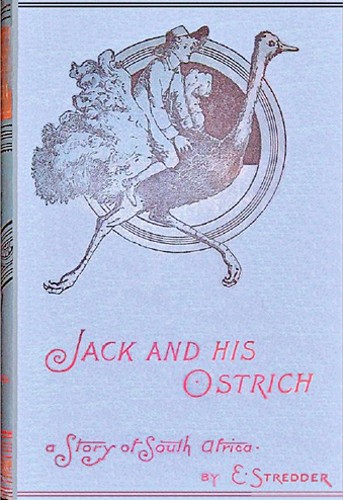
When Jack, as white as ashes, and with scarcely voice enough to make himself heard, called, "Vic, Vic, Vic!" just as he had called her at feeding-time all her life. He snatched up some of the peas which were lying by his pop-gun and flung them towards her. With the beautiful docility of an ostrich, she turned and dropped her foe. The angry eyes grew eloquent with love, and the beak that was dealing death to Otto was stooped obediently to peck the peas in Jack's trembling hand. He leaned against her faithful breast, for the loft swam round, and he thought he must have fallen. But with the comprehension love alone can lend, Vickel spread her feathery shield above his head, and drawing him to her, brooded over him as a hen broods over her chicks.
Jack peeped between the soft gray plumes of her sheltering wings, for he heard Otto groan, and now he saw him, a dark heap at the foot of the ladder. He had been stunned by his fall; but he soon began to move and mutter threats of vengeance on Jack and his ostrich.
"It was your own fault, Mr. Otto," said Jack firmly. "What did you come here for to pull me out of bed in the middle of the night? Vickel would have killed you if I had not stopped her. You know that as well as I do."
The German got up stiffly. "You made me cross," he grumbled. "You snored like a pig, and you would not answer me. I came to fetch that bank-note. It is not safe for a child like you to carry so much money about with you. Come, hand it down, or you'll be robbed and murdered some of these days with all those coloured fellows about. If I have given you a fright, it was to show you your danger."
"Oh indeed, Mr. Otto," retorted Jack with a laugh. "I have no need to be afraid of anybody. You see what good care my ostrich takes of me. You had better talk about this to my father. I daresay he will be home in the morning."
Jack's words were brave and bold, for he looked upon Otto as a beaten enemy. The German said no more, for Vickel made an angry dart at his uncovered head, and in his terror at the thought of a second attack, he turned and fled away as fast as his hurt leg would permit.
Jack lay cuddled by his darling Vic until the strange coldness had passed over, and his manful little heart had ceased to beat so wildly. The glorious brightness of the moonlight had given place to a chill creeping mist. It was the dreariest hour of all the night, but it was bringing back the day. After a while the mist began to lift, and the morning sun arose in all its splendour. Then Jack knelt down by Vickel's side, and clasping his hands together, poured out the fulness of his heart in prayer. The joy of his thanksgiving for his hair's-breadth escape, and the earnest cry for help and guidance, scarcely found utterance in words, for blinding, choking tears came at last to his relief.
The broken words, the gasping sobs, touched the heart of the Kafir groom, who had risen at daybreak expecting his master's return. As soon as the humming, droning song of the black dairymaid announced her presence among the milk-pails, he went across and told her "that poor lamb without a mother" was very sore at heart—wailing over the fate of the Black Antelope, he doubted not, for the white lamb from the fold was much loved by the dark hind from the upper veldt, as they both knew.
Then the dairymaid came and listened, and picked up a man's hat at the foot of the ladder. Gorya the groom took it and hid it in the back of his stable with a grin. He knew the owner of the hat at a glance, and muttered to himself, "What's he been up to here?"
Much pleased with Jack's sympathy for their fellow-countrywoman (for they both knew well how earnestly he had pleaded for her on the night of her offence), the two Kafirs would have gone to him at once but for Vickel's menacing glances, for she had settled herself in the doorway, and refused to stir for any one.
When Jack found the farm-servants were about, his spirits returned, and he began to think over his night's adventure. How was he to explain what had happened to the Immerseels? In truth, he dare not say a single word to any one of them, for he could not make them understand, and then they would send for Otto to tell them what he was saying.
"Yes," thought Jack, "Mr. Otto sees this just as clearly as I do, and so he thinks he can do as he likes, as much wrong as he likes, and carry all before him with a high hand; but he cannot deceive me. He is a bad man. He came to steal this bank-note; I'm sure he did."
Jack's reflections were cut short by the sound of horses' feet, and looking out of the door of his loft, he saw the "oom" ride in, with Zyl behind him. He watched the party dismount, but the Black Antelope was not with them. To make quite sure that he was not mistaken, Jack ran down his ladder and seized his friend by both hands, looking earnestly in his face. Zyl knew well enough what he wanted to ask, and replied to him and to Genderen, who was signalling the same inquiry from the window of her slaap-kamé, with a shake of his head, repeating the pathetic Dutch word "verloren" (lost).
Genderen burst into tears. She did not appear at the early breakfast prepared for the search-party.
Jack went indoors with his friend, and breakfasted on mutton-chops, listening attentively to the conversation, and gathering its sense more from tone and gesture than from actual words.
Yes, the search had been fruitless. Zyl was sent off to bed, grumbling and weary. Feeling himself safe indoors, with the "oom" nodding in his huge arm-chair just opposite, Jack coiled himself up on Sannie's sheep-skin, and was soon asleep. He was wakened by the sound of Tante Milligen's voice, and a very solemn voice it was. He looked up and saw her standing in the doorway leading to the kitchen, with all her maids gathered round her, listening open-mouthed whilst she narrated something which had happened to herself in the night.
Jack caught the words "Das ein nacht" (this very night), and was up in a moment. Had Tante Milligen sent Mr. Otto after all? Jack had become very skilful at pantomime by this time, so he ran up to her and asked, by looking very earnestly in her face and taking hold of her hand, if she wanted him? Tante Milligen shook her head.
"Das ein nacht," repeated Jack.
She held up her hands and turned to her eager, interested auditors, who echoed back their mistress's exclamation, each in her own peculiar fashion.
The truth was Tante Milligen had heard a noise in the night—a noise like thunder, she averred. It was just as if a heavy weight had been thrown down suddenly over her head. Like most of the females among the Dutch Boers, Tante Milligen, although a brave woman, was fearfully superstitious. A noise outside the house would not have frightened her half so much, even if it had proved to be another Kafir scare. But this mysterious noise inside the house, what could it mean?
When Jack came up to her with the traces of the night's excitement still visible in his pale cheeks and circled eyes, she only thought he had heard it too, and of course any child must be frightened. She was pleased that it confirmed her own experience, for one of those shameless Hottentots had positively suggested that she must have been dreaming.
"Slaap wohl?" she asked Jack, who shook his head most decidedly. Having had that question put to him every morning during his illness, he knew what it meant, and did his best to make her understand he had not slept at all.
Overcome with compassion, Tante Milligen sat down on the nearest chair, and took the little English boy on her lap, giving him a motherly hug and calling her maids one by one to notice the blackness of the circles under his eyes. This was indeed treating him like a baby; but Jack was not so aggravated by it as he had been when Walt laid him down on Sannie's sheep-skin, because it convinced him Tante Milligen would have interfered if she had had the least idea that Otto had been trying to frighten him.
Then Genderen came to fetch him. Tante Milligen said he would be better out of doors; besides she wished to keep the house quiet until her sons should awaken. Jack took Sannie's hand and wandered about with her, keeping very near the farm-gate, for fear of meeting Otto. Genderen was seated on the steop, shelling pepper, ready for one of the maids to pound. Jack would willingly have helped her, but he was looking for Vickel.
His giant fairy was far too stately a creature to be overlooked, yet she seemed to have vanished. He thought of the day when he lost her before; but Genderen's fluffy charges were all safe with their respective mothers. Everything was as usual, only his own ostrich was nowhere to be seen. Could anybody have hurt his Vickel? Jack's blood was boiling at the thought. He rushed back to Genderen, and showing her a dirty feather his bird had dropped, repeated her own mournful word, "verloren" (lost).
But Genderen smiled reassuringly, and pointed in the direction of their own ostrich camp.
At that moment the shepherd came out of the granary, and apparently thinking the farm-yard was deserted, began to pull about the loose straw at the bottom of the stack where Jack had taken his siesta on that unlucky day when he fell ill with the fever. The children saw him through the open gate, and the Kafir groom watched him behind the stable door. His movements were awkward, for he was stiff and sore, and his hat was pulled over his eyes—his Sunday hat!
The girls began to laugh at the incongruity of his appearance. At the sound of their merriment, Otto left his search, and limping up to them, turned to Jack with a scowl, saying,—"The 'oom' has ordered that vicious bird of yours to be shut up as long as it is here. The cow-keeper has been telling him how it flew at Sannie."
"Zyl can tell him more about that than the cow-keeper, and perhaps I could tell him more about last night than you did, Mr. Otto," retorted Jack.
"See if I don't take your English impudence out of you some of these days," growled Otto.
Jack's blood was up, and his prudence was nowhere, so he answered hotly, "Then you will just rouse the British bull-dog. Don't you know he would die rather than let you or any man touch a rag that was in his care."
"Oh, oh!" sneered the German. "And where is the brute to be found?"
"Here," returned Jack proudly, laying his hand on his own heart. "I don't imagine English boys were made of poorer stuff than a dog in his kennel; do you?"
XII.
WRITING TO GRANDFATHER.
IN another minute Jack's arm was round Genderen's neck, coaxing and entreating for something, she could not tell what. He took up one of the peppersticks and pretended to write on her pinafore.
"When would the schoolmaster come again?" was that it? Genderen counted the number of days upon her fingers. Ten more, and he would be due. But Jack persistently shook his head and wrote on. Thinking he wanted to borrow a slate and pencil, she led him into the sit-kamé and touched the door of the cupboard where their books were kept. This was right.
Jack murmured a grateful "Jah."
Genderen unlocked the door, and waited for him to point to what he wanted.
Jack's eye roved over the motley contents for a moment, and then his finger touched the inkstand.
Genderen gave a smile of intelligence, and putting her own pen in his other hand let him carry them off in triumph.
He knew that Otto was gone by this time, and that Zyl was still asleep, so he slipped unperceived into the garden and made a writing-desk of his friend's three-cornered seat. The hedge round Zyl's garden had grown luxuriantly, thanks to the diligent use of his watering-pot, so that no one could see what Jack was doing behind it.
He sat down on the grass and took out his treasure. It was all right, but the edges were wearing away. He read the lady's note again. It only covered one page of the sheet of paper. Jack's eyes grew bright: with three pages of blank paper he could write a letter to his grandfather, and send the note and its contents to him.
"He can find the lady. They are both living at Nottingham. Tomorrow is the day for the post-cart to pass," thought Jack, feeling his spirits rise like a bird at having found such a good way out of his difficulty.
Jack had never written a letter by himself before. He had often put a little note to his grandfather into his father's letters. But then there was always his father to tell him if it were all right. Now he must do it all; for if he wore the bank-note round his neck another week, it would drop to pieces, and if he tried to hide it anywhere else Otto would get it. So Jack wrote on as well as he could:—
"DEAR GRANDFATHER,—Some thieves burned down our house, and father
burned his coat getting me out of the fire, so he had to buy one of
a stranger—a young Englishman, who said he had got a coat he did not
want. It was too big for him. It had belonged to a friend of his, and
it was put with his luggage by mistake, for he left England in a great
hurry. His friend said it was not worth while to send it back. Father
and I went to the nearest farm, and he was to send the coat there.
Father was going away with the waggon, but as I was ill, he left me
behind.
"The coat came too late for him to wear it on the journey, so I was
taking care of it for him. And one day when I was ill in bed my ostrich
tore it, only because it was in the way, and she wanted to come to me.
Then I found there was a letter between the lining and the cloth, with
a bank-note in it. I thought at first I had better keep it until father
came back; but I can't. The people here are very kind to me; but they
speak Dutch, so I cannot tell them anything.
"There is only one man who can speak English, and he is a bad man, and
tried last night to steal the bank-note. I do not know what he would
have done to me if my ostrich had not come to my help and knocked him
down. She is the dearest, loveliest bird in all the world. I can't tell
you how I love her. I have just found out this horrid man has got my
ostrich shut up. I know what that means. He thinks he shall get the
bank-note away from me when I have no big bird to fight for me. But he
is making a mistake, for I am going to send it to you by the post.
"And please, grandfather dear, will you give back to the lady it
belongs to, if she is still at Nottingham; and if she is not there now,
you will be more likely to find her than father; and anyhow it will be
safe. I will put all in this letter; the card that was tied to the coat
too, for I am afraid I should not write the names plain. I have no more
paper, so good-bye, dear grandfather.
"Your affectionate grandson,
"JOHN TREBY."
Jack dried his letter in the sun, and then folded the bank-note in it once again, and slipped it into the ragged envelope. He looked well at the card, thinking that if he were the schoolmaster, he should not like to have such a difficult name to spell every time he had to write a letter. Then he packed both card and letter in a sheet of his "Illustrated London News," and tied it up with the precious piece of string he had found in his pocket after the fire.
Oh, was not it a wonderful thing that he should actually have money enough to pay the postage. It was good of Zyl's uncle to give him that sixpence. Oh, how true it is that with the trial God sends the way of escape, that we may be able to bear it. Jack thought of the night when his father had explained that to him—a Sunday night years ago. He had listened and remembered then; he was living by it now.
Next the thought of what Otto might do to him in his exasperation, when he found himself baffled, came over Jack like a cold shadow; but he threw it off, exclaiming, "I comforted father when I reminded him of Christ's own words,—
"'Let not your heart be troubled, neither let it be afraid.'
"And ought not they to comfort me? I won't be made afraid." He put back his precious letter into its case of rushes, and marched into the house with Genderen's pen and ink.
Zyl was just out of bed, and laughing heartily at the idea of beginning his day with dinner; but for all that there was a cloud on his brow, for like Genderen and Sannie, he was secretly fretting for his Kafir nurse, and sullenly resenting his father's harshness to her. So Jack's excitement passed unnoticed.
Van Immerseel himself was sorry for them all; and hoping to divert his children's thoughts from the lost Intombi (as a Kafir girl is usually called), he told them he was going down to the ostrich camp to collect the eggs, and that they should go too. Zyl should drive them in the cart.
The girls ran off for their sun-kappjes, whilst the boys packed the egg-baskets in the back of the cart. Jack was delighted, for he expected to find his Vickel there. He had often seen the Boer's men loading this cart with barley quite early in the morning, and he guessed very shrewdly that it was to feed the ostriches.
Jack's great question now was how to get his letter to the post-cart. And in this discovery, he found a key to unlock his difficulty. Van Immerseel was mounted on his favourite cob. Like most African farmers, he preferred riding to walking when he visited his ostriches, because the presence of a horse has a very quieting effect upon these feathered giants. He rode slowly, whistling a favourite tune, whilst the cart rumbled over the stones at a little distance.
When they reached the camp, Van Immerseel left the girls outside, but he took Jack upon his horse and showed him Vickel, very happy and content in the midst of her feathered kin. Zyl marched boldly after them with a basket on his head, until they came to the nests. Here the Van dismounted, and was soon in high good humour with the number of beautiful eggs he was able to collect. Jack was very quiet and very attentive, watching eagerly everything that went on around, not a little pleased that Van Immerseel trusted him to hold the bridle of his horse whilst he was busy after the eggs.
When they returned, Van Immerseel let both the boys ride at once, whilst he led the cart himself very carefully. Jack was happy, for he had worked out his plan, and not one of his Dutch friends imagined for a moment that his joyous laugh, as he rode behind his friend, was the effervescence of such a desperate resolution.
When they reached home, Jack employed the rest of the evening in making a hood for Vickel out of his pocket-handkerchief—something after the fashion of a carriage-hood, so that it might let up and down. He had saved a handful of the strongest rushes they had found in the ravine. Genderen supplied him with a needle and thread. He folded his handkerchief cornerwise, and made runners for the rushes across it at even distances. It was easy to draw it into shape and sew the rushes firmly together at the ends. He had torn off the hems of the handkerchief to serve for strings, and when these were sewn on his work was completed.
When one of the Hottentot maids fetched him indoors to supper, he took the opportunity to entreat Tante Milligen to let him sleep indoors. She was quite prepared for this, and understood him easily. So she put him in bed with Zyl. And when Walt joined them, an hour or two later, a nice time they had of it. With fever and fretting Jack was as thin as a little skeleton—a perfect shrimp in Walt's eyes, who insisted upon putting Jack between them, for fear he should kick him out of bed in his sleep without knowing it. When sleep visited his two Dutch friends it was banished from Jack's eyelids; for snoring followed in its train, and every time the two young giants stretched themselves or rolled over, he thought he should be crushed. So he passed the greater part of the night sitting cross-legged on his pillow.
With daybreak Walt arose, and Jack followed his example, for he was gasping like a little fish for air; but Zyl, who had not yet recovered his lost rest, was sleeping heavily. Walt perceived poor Jack's condition, and did not wonder at his determination to escape to the fresh, cool morning air outside; so he let the English boy accompany him to the garden, where Walt was soon too hard at work to take much heed of his restless companion.
As soon as the farm-yard gate was open Jack went in, and seating himself at the door of the granary, waited for the arrival of the ostrich-cart. When he heard the droning hum of the dairymaid's song, he ventured to her door and begged a cup of milk. The balmy air of the African dawn was breathing new life into every vein. It seemed an easy thing to him then to scamper over the veldt on Vickel and meet the post-cart; yes, and be back again almost before anybody could miss him.
The cart was coming for the barley. Jack was at his post in a moment. The "oom" himself had taken him to see his bird the night before, so the men about the yard, who had found Vickel guarding the door of the loft morning after morning, thought it quite natural Jack should want to go and feed her.
The drive through the morning air raised Jack's spirits, and he joined merrily in the Kafir's song, catching the lilt and humming the tune when the queer-sounding words escaped him.
A deafening scream from the ostrich camp greeted their arrival. The hungry birds were crowding round the gate, crying their loudest for breakfast. A hundred open beaks and as many impatient claws scratching up the sand looked somewhat formidable. Jack filled the crown of his hat with barley, and as soon as the gate was unlocked, he waved it high in the air, flinging the grains of corn far and wide. The feathered phalanx was dispersed in a moment. The tall, towering necks were bent to the ground with a meek gobble, gobble.
"They are nothing but big poultry after all," laughed Jack.
The Kafir laughed too, and invited Jack to enter; but he preferred remaining by the gate, whilst the Kafir went in with his sack of barley on his shoulders.
While the man was thus engaged, Jack called, "Vic! Vic!" but at first there was no answer. Jack raised his voice, and looked around. He soon found her, for the other birds would not suffer the stranger to eat with them at present; so Vickel was hovering round and round the busy group, fain to content herself with a solitary grain or two snatched desperately between her companions' feet. At the sound of Jack's call she ran towards him with a crow of delight.
He had kept some barley for her in the crown of his hat. A few grains flung towards her again and again soon separated her from the other ostriches. Jack softly opened the gate, and by showing her the barley still left in his hat, he tempted her to follow him out. He shut the gate behind them, emptied the remainder of the barley on the ground, and whilst Vickel devoured it eagerly, he sprang upon her back.
Away on his winged steed, away like the wind, across that sea of glowing sand they flitted like a light-gray cloud, circling round and round in their rapid flight. Never before had Vickel tasted the full delight of perfect liberty on her native veldt. She arched her graceful neck and shook out her curling plumes to the morning breeze in a whirl of mad delight, as if she were a willing participant in her master's daring scheme.
Pursuit was impossible; nothing could overtake them now. Vickel scarcely touched the ground as she skimmed across the mighty plain, balancing herself with her outspread wings, with an easy, graceful movement that was neither running nor flying, but swifter than the swiftest racer that ever won the Derby. The speed at which they travelled almost took away Jack's breath.
He was delighted with the success of his manœuvre. The ease with which he had been able to manage the starting encouraged him mightily. Through the clear African atmosphere Jack could see for miles. He had so often watched for the post-cart by his father's side, and had been the first to perceive the little cloud of dust darkening the horizon line, he could not miss it now.
XIII.
HOW THE LETTER WAS POSTED.
JACK did not miss it. After an hour or more of anxious watching, the rolling cloud of dust appeared, but it was going from him. In an agony of desperation, he put his hand to his head to try to think. Yes, there was the post-cart almost out of sight, and altogether out of hearing,—nothing but a moving speck of cloud. No one but himself, thought Jack, would have been sure that it was the post-cart. No power on earth could make Vickel run in a straight line. He saw it now, as she circled round and round, he had lost his way.
His heart beat wildly, his breath was almost gone with the terrific speed, when a crystal gleam in the glowing sand attracted Vickel. Easy as it is for an ostrich to go without water in her native deserts, she loves it all the same; and now of her own accord, Vickel stopped to drink. Jack got down and drank also: the water was warm with the growing sunshine. Then he sprang upon her shoulder once again, and she waded through the little stream with infinite satisfaction.
When she stepped out again on the opposite bank, she shook the water from her wings, and covered Jack with a light and glistening shower, which both steed and rider felt infinitely refreshing.
Jack took the hood he had made out of his pocket and tied it on his ostrich. It answered well; he could let it down over her eyes and stop her when he liked. He gave up all thought of trying to make her run after the post-cart. But he had watched the way it was going, and now he started his ostrich in another direction, hoping as she circled round, he should fall in with it further on.
Away went Vickel with renewed speed, taking a wider sweep as she felt her capabilities expand with this unwonted exercise. The pace at which they were going was frightful. Mr. Wilton and his powerful grays crept like snails in comparison.
Jack was dizzy and sick, when suddenly he found himself, not behind the post-cart, but before it. Vickel was turning from the storm of dust it raised, when Jack let the hood drop over her eyes. She stopped at once, and Jack hung round her neck, more dead than alive. But he knew the critical moment had come; yet it was a mercy he had a breathing-space, or he might have fainted quite away. Vic was frightened at finding herself in the dark, so she lay down and ran her head in the sand, trying to rub her hood off. Jack stretched himself on the ground beside her and slowly rallied.
Great was the postman's astonishment when he perceived the little fellow, covered with dust and white with fatigue, sitting by the wayside waiting.
Jack got up as the tramp of the horses drew nearer and nearer. He waved his hat in the air and held aloft his precious letter. The postman drew up. Jack put the letter and the sixpence into his hand; but his voice was weak and faint, as he asked nervously, "Please, sir, is that enough for the postage?"