
CHAPTER VII.
HASELTINE MAKES HIS DÉBUT.
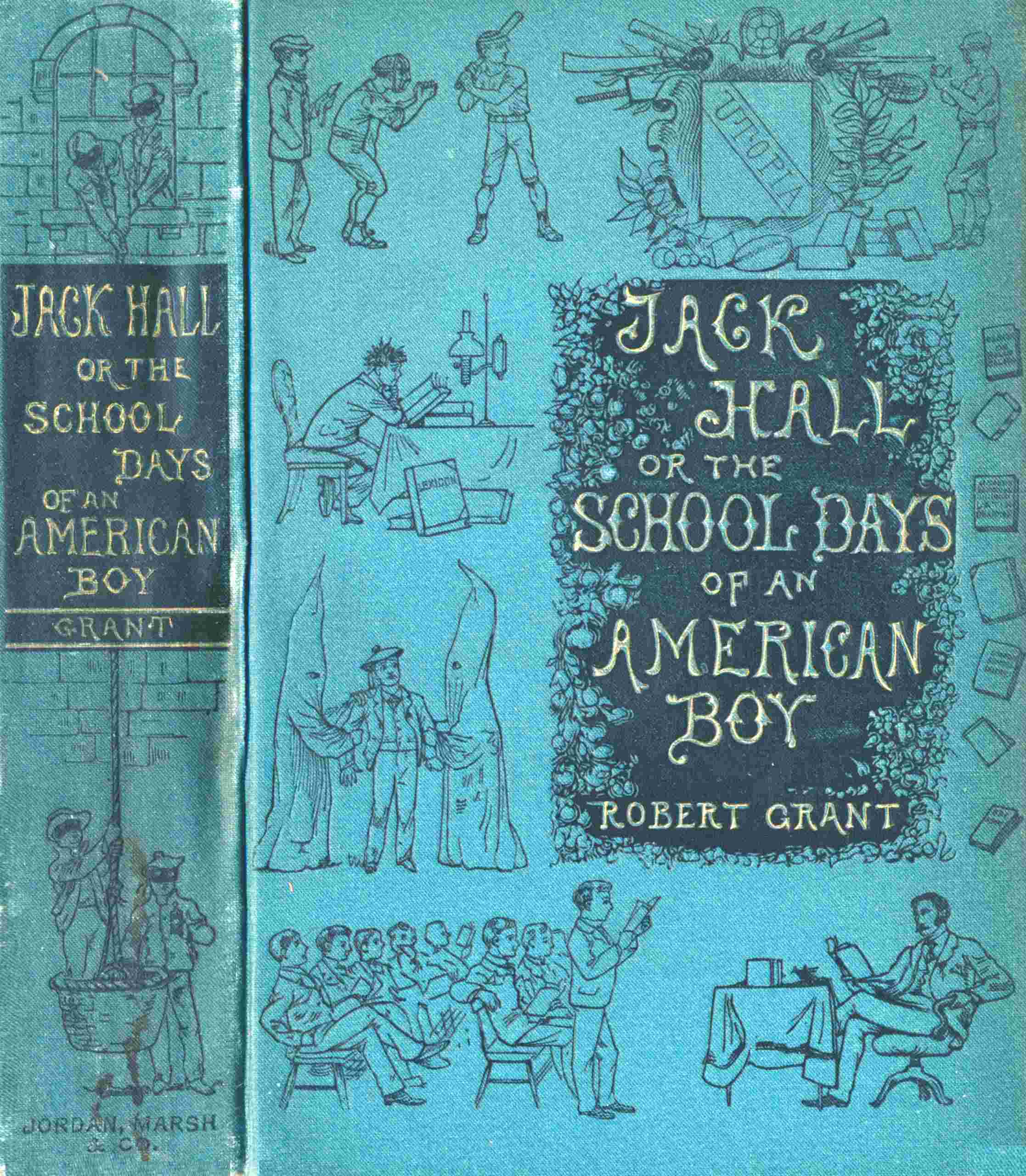
It has been, and still is, the fashion in certain circles to decry base-ball, and to hold up to the youth of the country the superiority of cricket, as a pastime. The arguments, such as they are,—chief among which is the plea that cricket is a more gentlemanly game, for the reason that one can play it with exceeding comfort after leaving school and college as well or nearly as well as before,—need not be reiterated, inasmuch as there is no longer room for argument. The case is closed. The boys have heard what was to be said on either side, and have come to a final conclusion in regard to the matter. Base-ball is undeniably the national sport from one end of the land to the other, and no amount of chafing on the part of those who think the decision unwise can make the long cherished cricket of our English cousins widely popular on this side of the water. And after all, if we examine the reasons, the boys are not far out. Be it said with bated breath and yet clearly and unequivocally, that it requires more skill, far more skill to excel at base-ball, as it is played to-day, than at any other sport. Talk of muscle, nerve, wind, quickness and correctness of eye, fleetness of foot, temper, bottom, and grit,—what one of these qualities is not put in training when two closely matched nines meet to play ball? Try it, gentlemen of England, for yourselves and see. You will have to come to the conclusion—take my Yankee word for it—that there is more in our game than you think; and what is more, you will know in your hearts, though you will never acknowledge it, that an all-day cricket match under the trees, relieved by respites for beef and beer and dawdled the whole time,—for you take things pretty leisurely after every “over,”—is a tame affair, though a very gentlemanly and delightful one, compared with what we are able to show you under the head of ball-playing. Don’t mistake us, gentlemen of England: we know that cricket is a grand old game, we have watched it often (though it is a trifle dull to watch), played it, too, and we continue to play it at times, but when you come to talk about muscle and nerve and temper and bottom and grit, and all that, as we have said already, we are ready to back our national game against the world.
Chalmers and Hackett, the captains of the rival dormitory teams, are tossing up to see which nine shall go in first, as the two new boys arrive on the scene. Fullham wins and sends its opponents to the bat. “Game called!” cries the umpire, and Haseltine has just time to throw off his jacket and get into position at third base before Rainsford, who is to pitch for the Fullhamites, enters the box. Rainsford is known as “the kid” because of his slight appearance. He is only in the fourth, but his drop balls have proved successful teasers ere this.
See how every player on the fielding nine has his nerves taut as Billy Douglas steps to the home plate to lead off, and poises his bat! They are boys, of course,—they have not the experience and sinew of professional or college teams,—but they are sturdy fellows for all that. They mean business: so does Billy; there is blood in his eye; he hopes to start off with a three bagger.
“One ball!” cries the umpire.
“Two balls!”
That won’t do, Rainsford; you can’t afford to let him get his base on balls. Carefully now.
“One strike!”
Ah, that’s better; the kid is settling down to his work. Now another! A hit, a palpable hit! Away scuds Douglas with all the vim of his Scotch forefathers, to get to first before the ball. No use, Billy; Goldthwaite has it at second easy enough and pops it to Maitland, who, as every one knows, is pretty sure to hold on to anything that comes within his reach. A shout goes up from the Fullhamites, who to the number of a score or more, including Jack, are grouped together on one side of the catcher, which is answered by a bracing cheer from a similar posse from the rival dormitory at the other side.
Pousland, the next striker, makes a base hit, but not to much purpose, since Hackett knocks up an easy fly for the kid to absorb without difficulty, and Johnson succumbs on a foul tip to Chalmers catching under the bat in his iron mask and padded gloves with an eye to second which Pousland is hoping to steal. But the third out settles that question, and down goes a goose-egg for Rogers.
The formidable Bedloe is a brawny lad to look at, and he has to back him Bobby Crosby at left field and Harry Ramsay at first, making three of the school nine against only Chalmers and Goldthwaite on the side of Fullham. Chalmers goes to the bat to give his team courage, and sends a sky scraper to centre field which is captured cleverly. The kid falls a prey to an easy grounder to short stop, and it looks as though the innings would pan out poorly for the Fullhamites. But one can count on nothing at base-ball until the last man is out; in testimony to which Hamlen, who comes next in order, is given his base on called balls, steals second by a judicious slide, and is sent to third on a fumble of a hot liner,—a corker,—which Jackson hits to second, getting his base thereby. Then Goldthwaite comes to the bat amid great applause, and some one cries out, “Now for a grass-mower, Goldy!”
Goldthwaite proves worthy of the confidence reposed in him. Two strikes are called on him while he waits for a ball just in the right place. He gets it at last, when Bedloe, hoping that the umpire will call another strike (for until this year you know three strikes was the limit), eases up and throws in a slow one. Goldthwaite swipes with all his might and sends the ball between left and centre field, but clean out of reach of Crosby and Plympton. A home run! No, not quite, only a three bagger. Goldthwaite holds his third, but Hamlen and Jackson have scored. Two runs to a goose-egg; not bad to start with. But there is Ogden out on a foul and the innings over with Goldthwaite still on third.
Three innings more on either side do not vary the lead, for while Rogers gets a run in the third, Fullham caps it with a single in the fourth, and the score is three to one. No chance now for a complete whitewash, which some of the enthusiasts among the lookers-on, encouraged by the start, have hoped for. On the contrary, the shrewder mind knows that it will be all Fullham can do to hold her lead. Rogers has been settling down to work. Bedloe is in fine form, and is being backed up bravely. They are getting on to the kid, too, and pound him for a run and two base hits in the fifth, being prevented from tying the score only by a magnificent double play of Goldthwaite and Maitland. Then they put the Fullhamites out in one, two, three order.
Haseltine has been doing fairly well, though as yet he has had but two chances in the field, the first of which, a fly, went up a moderate distance and fell so plump into his hands that he did not have to budge. The other, a gently ambling grounder, shot between his legs just as he thought he had it; an error which elicited from Horton, who was sitting beside Jack, the unflattering exclamation, “Beastly butter-fingers!” However, there is a style and general air of knowingness about him which has attracted attention, and Chalmers has so far continued his own confidence in him as to fling twice to third in order to frighten men who were off their bases, on each of which occasions Haseltine got on to the ball, and once came very near putting the too daring adversary out. He is evidently no green hand, as he has further shown by the way he handles the bat. Though apparently too small to be a very formidable willow-wielder, his first whack sent the ball far to right field, where it was taken into camp very prettily, it must be owned. The second time he got his base on balls, but was put out trying to steal second, in spite of a most admirable slide on his stomach for several feet. The decision of the umpire displeased the crowd of Fullhamites, who manifested their resentment by crying “Not out, not out!” vociferously, and applauded Haseltine as he came in from the base crestfallen and covered with dust. It had been in the next innings that he muffed the grounder, and he was now feeling very much dissatisfied with himself and eager to wipe out these spots on his record by some brilliant stroke.
The sixth innings adds another goose-egg to each score, in spite of hard hitting on both sides, and the seventh begins amid a hush of suspense. Jack can scarcely sit still, he is so nervous with excitement, and he is hoarse with spelling out at the top of his lungs, after every favorable play, “F-U-L-L-H-A-M! Fullham!” which is the dormitory yell. It is anybody’s game, as Rainsford, the kid, well knows, and he plants his feet in the box with the air of one aware that the least let-up or carelessness will be fatal. Pousland is at the bat again, and whacks at the first ball. It flies whizzing in Haseltine’s direction, but out of reach, and a shout from the Rogers crowd rends the air. But it is short-lived, for the umpire, who is watching carefully, cries, “Foul ball!” Whereupon Pousland, who is halfway to first, has to retrace his steps in a melancholy fashion. Had it but struck just the other side of the line, it would have been good for two bags. He poises his bat again viciously.
“One strike,” calls Prendergast, the umpire, who is captain of Dudley.
There is a roar from Fullham, and the striker, glancing round at the umpire sulkily, strikes the tip of his bat against the ground and grits his teeth as he makes ready for another ball.
“Foul,—out!”
The tick is plainly audible, and Chalmers’ gloves have closed firmly on the ball. Pousland drops his bat and walks away in disgust. His place is taken by Hackett, who strikes at the first two balls without hitting either, but sends the third over second base skimming to centre, where Ogden jumps a little and holds it above his head,—a pretty but not very difficult catch, whereat the welkin rings.
“Here come Dr. and Mrs. Meredith,” says Horton to Jack, as the uproar gradually subsides.
Sure enough, they are close at hand, having come down expressly to see the end of the match, and are given good seats on one of the few benches supplied for such celebrities. Several of the masters have been watching the contest since the beginning, but the presence of the head of the school is evidently a new incentive to every player to good work, if any were still needed.
Johnson is the third man at the bat. Prendergast calls one ball on the kid, and Johnson swipes the next. It somehow or other gets past Goldthwaite, and before Hamlen can field it to Maitland the striker is safe at first. It is now the turn for Rogers to howl, which it does with a vengeance,—“R-O-G-E-R S! Roger-r-rs!”
Ferguson is to strike now. He is third base and one of Rogers’ heaviest sluggers. Hackett goes down behind first to coach Johnson and tell him when to try to steal second.
“One strike!”
“One ball!”
“Two balls!”
Johnson, meanwhile, is bobbing up and down hesitating whether to run or not. The kid, just as he looks ready to pitch the fourth, turns and makes the gesture of hurling to first.
“Look out!” bawls Hackett, and Johnson rushes back to the base and plumps one foot on it.
There is no need for so much exertion, as it happens, for Rainsford’s throw is make-believe. He has only pretended to fling the ball. Whereupon he turns and pitches rapidly.
“Go!” holloas Hackett, excitedly. “Go-o!”
“Three balls!” cries the umpire.
Johnson is scooting for second at the top of his speed. Although the pitch was a trifle wild, the padded gloves are in the right place, and Chalmers slams it to Goldthwaite, who claps it on to Johnson, and holds up his hand claiming an out. But Prendergast, who has run forward nearly to the pitcher’s box in order to see distinctly, shakes his head and waves Johnson to hold his base, amid deafening cheers from the Rogerines, and groans from the Fullhamites.
Let me say right here, boys, that the trick of “downing” umpires is cowardly, and smacks of the blackguard. Be careful, to begin with, whom you select to act; but when your choice is made, be men enough to keep your temper and accept his decisions without kicking. It has come to be the fashion among the great crowds that attend base-ball matches over the country, to abuse umpires in language worthy only of Billingsgate, and even to threaten them with personal violence. It is a mean and contemptible method of bullying a man in a position where he is powerless to defend himself, and at a time when he needs to have all his faculties bent on the game, and no gentleman will take part in it.
Johnson holds his base, and the kid prepares to pitch again.
“Four balls!”
Rainsford must be getting nervous.
“Five balls!”
This will never do.
“Two strikes!”
Ah, there! Now or never!
“Six balls! Take your base.”
Ferguson trots leisurely to first, and his place at the diamond is filled by Plympton, the centre field, who hits the first ball for a clean single between short and second, letting in Johnson, and advancing Ferguson a base. The score is tied, and the hubbub is very disheartening to the backers of Fullham.
“Looks sort of sick for our side,” Jack hears some one say to Carlisle, who is squatting not far from him.
“Game’s young yet,” is the cheery answer.
It is Bedloe’s turn now. He advances confidently, and in imitation of Plympton’s example lifts the first ball and drives it to left field, where Jackson gets under it, and—sad to chronicle—drops it. Ferguson comes in, of course, and Plympton too, although he should have been out; but Chalmers fails to hold Goldthwaite’s swift throw from second. Five runs to three! Those muffs were very costly.
Bobby Crosby hits an easy grounder to Haseltine, which the little fellow picks up neatly and throws to first. Maitland holds it, and the Rogerines are out at last.
Jackson is at the bat first. He hits hard, anxious, doubtless, to atone for his error; but Hackett is on deck at second and fields beautifully to Ramsay. There is a flutter of anticipation as “Goldy” steps to the front. Like several of his opponents he swipes at the first ball pitched. “Hurrah! Look—look—is it a home run?” Everybody is on his feet following the ball to left field. Bobby Crosby, there’s your chance. Gently now, or it will be over your head. It is going faster than it seems. Oh, well caught, well caught, youngster, and well judged, too, which is more than half the battle! Right over your left shoulder and on the full run, too! O-U-T! Everybody is cheering, for even Fullham can afford to applaud a play like that, and the Doctor, shouting as loud as any one, waves his hat and cries, “Well caught, Crosby!” Hard luck, Goldthwaite. It was a good crack, but not quite elastic enough. Who’s the next victim?
It is Ogden, who pops up a fly which falls into Bedloe’s hand, snug as a bug, and the side is out.
“Confound it!” says Horton, a sentiment which Jack echoes at heart.
Ramsay begins the eighth with a single to right field. Pousland goes out on a foul tip once more. Hackett takes a base on balls. Johnson hits to Jackson at left, who does not muff this time. Ferguson, the slugger, swipes hard and misses.
“One strike!”
“Two strikes!”
Ramsay is on third and Hackett on second, so that if Ferguson can make a safe hit there is a good chance for two more runs.
“F-E-R-G-U-S-O-N! Ferguson-n-n!”
The kid examines the ball and puts down his head to pitch. The slugger does not move.
“Three strikes!” cries the umpire. “Out!”
This is better, and revives somewhat the drooping courage of Fullham. Carlisle proposes three cheers for the kid, which are given with great enthusiasm.
“Now, Maitland,” says Chalmers.
Charley Maitland waits for two called balls and one strike before he gets the one he is hoping for. Then he hits with all his might a driver to the inner centre field, where there is no one to catch it, and takes his first. The kid, who receives another round of applause as he steps to the plate, knocks one to Johnson at short, who lets it by him this time.
There are two on bases, Merriman. A good deal depends on you. Pshaw! straight into Ramsay’s hands. Run, Rainsford; run, if you do not wish to be cut off at second. Safe! but only just in time. If Ramsay had not waited so long you were a sure out. The Rogerines are taking a turn at muffing. Next striker.
It is our friend Haseltine. He glances across at Jack as he goes in.
“One strike!” calls Prendergast, though Haseltine has not moved.
“Don’t get flustered; take your time, youngster,” says Chalmers kindly.
“One ball!”
This gives the ex-Rising Sun hero courage. Charley Maitland and the kid are edging off their bases ready to proceed the instant the ball leaves the bat.
All of a sudden there is a terrific roar, and every one starts up again, craning forward to see the third base line.
“Run!” bellows Chalmers to Haseltine, who cuts away for first. But before he reaches it, the umpire, who has shaded his eyes with his hand so as to make no mistake, cries “Fair ball!” and on Haseltine dashes to second and again to third. Here Chalmers stops him with an emphatic “Hold your base!” Meanwhile, Maitland and the kid have come home. The score is tied again, and the uproar is prodigious. Panting but thoroughly happy, Haseltine waits at third, and Captain Chalmers takes his turn at the bat.
We are viewing the game through Jack’s eyes, to whom every safe hit and every good bit of fielding seems marvelous; but though the standard of play may be higher among some of you older boys, there can be no denying the absorbing interest inspired at Utopia by these yearly contests for supremacy between the respective dormitories, second only to the occasional contests with nines from other schools. The thrill felt by Jack as Chalmers takes his position to strike is shared by every one of the two hundred boys and their masters present. For by this time there is scarcely a soul in the school who is not a spectator. Even Horace Hosmer is squatting at the further end of the field beyond the possible reach of the ball, and Jack can see him clap his big hands in honor of Haseltine’s three bagger.
But Chalmers is at the bat.
“One ball!”
Haseltine evidently has it in mind to try to steal home, for if Chalmers does not get his first the side will be out; but “Goldy,” who has taken the captain’s place as coach, cautions him with “Steady now,” and “Bide your time, youngster,” not to stray too far from the base.
“One strike!”
Pousland, the catcher, hurls to third to intimidate Haseltine, who dodges back in time to get his foot on the bag before Ferguson can touch him.
“Two balls!”
Well done, Chalmers! Another shout, this time louder and more star-striking than any yet evoked, bursts forth from the Fullhamite ranks. There is ample reason for it, too. Both Bobby Crosby and Plympton are in full career after the ball, which is bounding beyond them at a fearful pace. They make superhuman efforts to overtake it, and Bobby returns it magnificently, but to no purpose, for Chalmers has made a clean round of the bases and is safely home. As for Haseltine, he has trotted in comfortably and is sharing with the captain hand-shaking and back-slapping from a score of palms. He knows that the score is now seven to five, and that he has wiped out his early errors. His happiness, already complete, is made ecstatic by the congratulations of the Doctor, who comes up to him just as he is on the point of going over to Jack and says, “You’re beginning bravely, Haseltine; if you go on at this rate you will be in training for the school nine before long.”
“The school nine!” Could there be a more enviable compliment to a new boy on his first day at Utopia? He sees Mrs. Meredith smile at him from her seat and clap her hands. He touches his cap in sheepish fashion, and with cheeks aflame is glad to get down beside Jack and, riding his bat, watch Hamlen strike.
“Ah!”
This time the cry of triumph is premature. The ball goes afield grandly, but Billy Douglas is under it before it falls, and Hamlen makes the third out.
The Rogerines are rather quiet. They have only this inning in which to win the game. But the nine is not going to give in without making a hard fight for it, you may be certain. Two runs will tie and three put them ahead. Not so very many to get, if fortune favors them and they can work in a batting streak.
Plympton is the first on the list of strikers. He is a determined-looking fellow, with a bull-dog sort of jaw.
“One strike!” cries the umpire.
The Fullhamites shout, but the batsman, whatever his feelings, never winks an eye. He is dangerously cool.
Whack! One can hear the sound all over the field. The bat is split as completely as ever oak was riven by the lightning. But now Rogers has a right to shout. Another home run just in the same place as Chalmers’, and just as perfect. The din is deafening, and the prospects for a tenth inning look very favorable.
“One more in the same spot will tie them,” exclaims Hackett, as Bedloe nods at the kid to show he is ready.
“One ball.”
“Two balls.”
“One strike.”
“Three balls.”
“Four balls.”
“Five balls.”
“Six balls; take your base.”
Rogers howls once more. Bedloe has a level head, and knows enough to play a waiting game. Perhaps he has reasoned that the kid is young, and may lose his head in a tight place. It looks a little like it, now; if he does, there are sluggers enough on the nine to knock him out of the box.
It is Crosby’s turn next to have a hack at him.
“One ball.”
He hits the second. It is a scorcher to short stop, which strikes one of Merriman’s feet and bounds into the air. Merriman looks in one direction and the ball comes down in the other. Before he can collect himself Bedloe is safe at second and Crosby at first.
Now, Harry Ramsay, captain of the school nine, is your chance. A rattler from you like that you struck yesterday, ought to win the game. One could hear a pin drop, it is so still. The excitement is almost painful.
“One ball,” calls Prendergast.
“One strike.”
“Ah-h-h!”
That cry is because Bedloe has stolen third and Crosby second. Chalmers, a little bewildered it may be, has hesitated until too late which to throw to.
Ramsay has hit the third ball. What a paste! Where is it? Where has it gone? He is tearing to first. Great heavens! what is the matter? Is the game over? Everybody on the Fullham side is dancing and screaming and waving like mad. The crowd is mixing with the players, and Crosby and Bedloe and Harry Ramsay are coming in from the bases with a shamefaced air.
“What is it? I don’t understand,” asks Jack of Horton, who is shouting loud enough to burst a blood-vessel. Jack knows that Haseltine has stopped the ball and done something big, but it was all so quick, he cannot quite make out what.
“A triple play—all three out,” Horton answers.
“H-A-S-E-L-T-I-N-E—Haselti-n-n-n-e!”
A moment later Jack understands it all. The ball from Ramsay’s bat had gone straight into Haseltine’s hands, and though it had almost knocked the little fellow over, he had managed to hold it, to step on to third before Bedloe, who had started for home, realized the situation, and then, keeping his wits still about him, put it in to Goldthwaite, at second, with all his might, just in time to cut off Bobby Crosby, who was between the bases. Three out—side out at one fell swoop. Bull luck, as the Rogerines said, in speaking of the game afterwards.
It was luck, of course, that the ball went just where it did, making such a combination possible; but many an opportunity in life, no less favorable than Haseltine’s, is lost every day by the inability of man or boy to avail himself of it. The ex-third base of the Rising Suns was equal to his emergency when it came; though, between ourselves, it was always a wonder to him that the ball had stuck in his hands. He had caught it before he knew it.
So the dormitory match was over, and Fullham champion for another year, by the close score of seven to six. It was a proud moment for Haseltine when Harry Ramsay, the great school captain, went out of his way to shake him by the hand and tell him that he was sure to make a strong player in a year or two. He received quite an ovation, and made the acquaintance on the spot of most of his own dormitory, and many from Rogers and Dudley. Jack stood by thoroughly satisfied with his friend’s success and proud to be the bearer of his jacket. Really, to rejoice at another’s triumphs is quite as sterling a trait of character as to bear modestly one’s own.
As the two boys were returning to their dormitory in company with several others, they were overtaken by Carlisle, who, after a few words of congratulation on Haseltine’s play, brought a host of fears, which the excitement of the afternoon had banished, back to the minds of both of them by observing in a low tone,—
“I’m sorry to say Jack Spratt and his Wife will be all the more down on you after this. They are Rogerines, and it’s the cockiest thing a new boy has done for a dog’s age.”
This was very depressing, and took the edge decidedly off the happy frame of mind in which they would fain have remained. The game had consumed most of the afternoon. There was an hour and a half of recitation remaining before supper, the practice at Utopia being to have recitations from nine until half-past twelve, and from half-past four until six, during all but the last two months of the school year, in order to let the boys have the best hours of sunshine on the playground. In another week the rule was to change, and study would follow dinner, as the afternoons were growing long and favorable for sport.
When supper was done there was singing twice a week, and this was one of the evenings. All the school gathered informally in the big schoolroom, where, sitting round anyhow and anywhere, masters and boys mingled together, chatted, and listened to songs supervised by the singing-master, Mr. French, but entirely spontaneous. After the singing was over, there was a short lee-way before bedtime, and every one was left to his own devices. Most of the boys went back to their dormitories, but the sixth class had the run of Mrs. Meredith’s parlor during half an hour, where there were quiet games and puzzles of various kinds to amuse them.
In returning to Fullham from this last-named entertainment, it was necessary, of course, to traverse the quadrangle. When Jack and Haseltine were about fifty yards from Granger, proceeding without suspicions, they became suddenly aware of several figures in masks and long cloaks, looming up ahead. At the same moment their feet were tripped up from behind, a rope quickly and strenuously twisted around their bodies, and a large hand compressed upon each of their mouths. They had no time to cry out. After a few frantic, futile efforts to get free, Jack ceased to struggle, and permitted himself to be bound by his captors, whom he assumed with a sinking heart to be no other than the notorious Spratt and Wife. A bandage had been fastened over his eyes almost immediately, and, helpless as a dead man, he was borne along in silence for a considerable distance, as it seemed to him, at a slow jog trot. Presently the procession stopped, confronted by some obstacle, and Jack was able to distinguish the voice of Carlisle remonstrating with his persecutors. He heard him say distinctly, “They are good fellows, both of them, I assure you; let them off this time.”
“They’re too beastly cocky,” was the reply, in a shrill, hyena-like tone.
“That’s so,” broke in another with a no less bloodthirsty modulation, whom Jack judged to be Wifey. “I vote we smash every bone in their bodies.”
“On to the torture chamber,” continued the first speaker, a sentiment which was received with an approving Ah-h-h! by the others present.
“I’ve done all I could to save them,” observed Carlisle, with a gloomy sigh of resignation.
Jack, who had been laid upon the ground during this interlude, now felt himself being carried up a flight of winding stairs and along a corridor, to an apartment where, after some whispering on the part of those about him, he perceived that he was being lowered into a narrow box. This, it suddenly occurred to him, was a coffin. A fear which brought the perspiration out in cold patches seized him. At its height the cover was pressed down, and he was left to his own gloomy reflections, which included the expectation of stifling. But though the space was contracted and the air hot, he experienced no real difficulty in drawing breath.
Here he lay for what seemed an eternity, listening to the preparations which were evidently going on around him. He could hear the hum of conversation and occasionally a smothered laugh, but the voices had all the shrill, fiendish pitch of those which had replied to Carlisle’s protestations. What were they going to do with him? Was he dead already, and was this his funeral? He stirred one of his legs a little and pinched himself to make sure that he was alive. Yes, he was still in the flesh. The torture, then, was yet to come. Well, whatever happened, he would die bravely. Not a groan, not a cry for mercy, would he utter. He would be game to the last, and his tormentors should not have the satisfaction of seeing him funk while they were breaking his bones. A tear did come to his eye as he thought of his mother, and how she would miss him; but he braced his nerves as he felt it trickling, unwilling to be guilty of weakness, even under the shelter of the coffin-lid.
At this moment he was lifted, box and all, and placed on what might be a table. Immediately the cover was raised, and in spite of his bandage the fact that the room was lighted became apparent to him, while a low chorus of groans suggestive of animals eager to slake their thirst in human blood vibrated on his imaginative and frenzied hearing. Then there was a hush preliminary to the dreadful remark which proceeded from the foot of the coffin, “Are the irons red-hot?”
“They are, your Mightiness.”
“Let the neophyte’s arm be bared.”
Jack, though ignorant as to the meaning of the word neophyte, did not doubt for an instant that he was referred to. He was seized straightway on either side and raised to a sitting posture. The rope was unbound from his right arm and those in charge of him were about to roll up the sleeve of his jacket, when the voice of his Mightiness enjoined,—
“Let the left be seared instead of the right, for in case the neophyte chance to survive the operation he will thus not be disabled in his base-ball arm. It is fitting that mercy should temper justice.”
This piece of executive clemency was scarcely reassuring to poor Jack, for the reason that there was evidently occasion to believe that he would not outlive the torture about to be inflicted on him. He gritted his teeth to avoid trembling, and tried to show no signs of fear, while the assistants bared his forearm well up to the elbow. Just when they had completed their task there came a loud knock at the door, and whoever went to answer it announced, after a moment’s delay, with a chuckle of exultation, “The other neophyte is dead.”
A savage yell of pleasure followed this announcement, which was a dagger, as it were, in the bosom of our hero. Haseltine dead! He had been tortured, doubtless, in another chamber and had not been able to endure the agony.
But there was no time for reflection. A powerful wrist had grasped his arm and was holding it out at full length. Then something which felt like a glowing coal was pressed down on it with force and imbedded in his flesh. Jack knew that it was the red-hot iron. The pain was terrible and he was tempted to cry out, but by biting his lips he managed to restrain himself. Somehow or other the suffering did not increase after the first few moments, and as he was wondering at the circumstance he was astounded to hear, “Let me go! let me go!” uttered in a voice of agony close at hand. The conviction that it was Haseltine’s voice eclipsed the consciousness of pain, and in another instant his arm was let go, the bandage snatched from his eyes, and Jack found himself in a blaze of light, surrounded by a host of laughing countenances which greeted him with a roar of laughter.
At first he was completely dazed and unable to credit his senses; then, as he gradually took in the situation, he perceived that he was sitting upright in an old shoe box lined with a shawl and supported by a table. Not more than a yard away sat Haseltine in a similar predicament, with his left sleeve rolled up, and looking extremely sheepish. On a throne—an arm-chair surmounting a pile, the component parts of which were concealed by a table-cloth—was perched Jack Spratt, wearing a paper crown, bearing a cricket bat as a sceptre, and sharing royalty with Wifey at his side in female attire, intended to simulate a queen, but suggesting to practiced eyes a gown borrowed for this occasion only from Mrs. Betty Martin. A row of Apollinaris bottles, in each of which was a lighted candle, blazed along the edge of the dais, at either wing of which stood a score of schoolboys shaking with merriment at the appearance of the two unfortunates.
Jack’s first reflection was one of self-congratulation that he had not cried out. Then it occurred to him to glance at his arm, a proceeding which was the cause of another burst of laughter. To his surprise, there was no mark of any sort beyond a slight redness which was scarcely noticeable. But his skin looked somewhat wet, as though water had been brought in contact with it.
After a moment, his Mightiness, having induced silence by a wave of his sceptre, exclaimed with great seriousness, “The chief executioner will read the indictment against the neophytes.”
Whereupon, to Jack’s intense surprise, that functionary stepped forward in the person of Louis Carlisle, fantastically attired in a black Oxford gown and carrying a meat chopper as the symbol of his office. Having bowed to their majesties, he gravely drew forth a manuscript and addressed the two bewildered lads as follows:—
“Know all men by these presents, that you, John Hall, of Boston, Massachusetts, and you, Frank Haseltine, of St. Louis, Missouri, are greener than the grass when it flourisheth in the early days of summer, fresher than paint just after it is spread on the door of a mansion, more guileless than the kid which gambols in the pasture beside its female parent. You have been sent here with your mouths wide open and ready to swallow anything that is stuffed into them. Such innocence is praiseworthy in the extremely youthful, but a time comes in the experience of us all when it is meet to be undeceived even at the expense of dire mortification.
“Learn of me and be wise. Firstly and foremostly, you have been made sport of—victimized—fooled, or, to speak more succinctly, sold. You have been made egregious asses of, and led to believe that you were to be the victims of physical violence, to have your bones broken, your heads punched, and what not. You expected to be hazed and we did not like to disappoint you; hence the midnight seizure, the rope, the bandage, the coffin, the red-hot iron, the branding. You have been taught to tremble at the blood-curdling names of Jack Spratt and Wifey. Behold them in the flesh and bow before them! You came here stuffed with old women’s yarns, and Horace Hosmer has loaded you up to the muzzle with a fresh supply. Poor little lambkins!”
As Carlisle paused in his sarcastic peroration the audience broke into another shout of laughter, which caused Jack to blush vividly. He appreciated now for the first moment that he had been the victim of a huge practical joke.
“Secondly,” continued the orator, with a wave of his hand, “let whoever will search the universe from one end to the other, and I defy him to produce two more thoroughly mild and amiable specimens of the genus homo than Tobey and Donaldson, who have been made to figure as monsters of cruelty for your edification. In justice to them, neophytes, I bid you approach them. Exhume yourselves, so to speak, and go up to examine them. You will perceive that they are perfectly harmless, and even unusually good-natured fellows. You may touch them without fear that one of your bones will be dislocated. Approach, neophytes, they are prepared to embrace you.”
Again everybody laughed, while Jack and Haseltine looked at one another, at a loss, not unnaturally, to know whether the order to leave their coffins was to be taken seriously. But this uncertainty was solved when his Mightiness reiterated, at the same time removing his crown and assuming an exaggerated expression of meekness, “Approach, neophytes, we are prepared to embrace you.”
In a shamefaced manner, but doing their best to enjoy the laugh against themselves, which now made the room ring, the two boys clambered down from their boxes and walked toward the throne. Its grinning occupants sat for a moment enjoying the confusion evinced by the poor lads before them, then Jack Spratt put out his hand and said,—
“Shake, neophytes. My bark is worse than my bite.”
“Me, too,” piped Donaldson, in semblance to a female falsetto, which elicited a roar.
“Thirdly and lastly,” exclaimed Carlisle, after Jack and Haseltine had finished this hand-shaking and been relegated to their coffins, on the edge of which they were permitted to sit,—“thirdly and lastly,” he repeated, “there is a moral to all this, without which our efforts in your behalf might be misunderstood, and that is, don’t be too English. You boys—for I address you no longer as neophytes, but as Utopia boys—must get out of your heads that an American school is just like an English one, for it isn’t. You’ve come with the idea that we have fagging and hazing and all that sort of thing, but it’s a mistake. There isn’t a fag at Utopia, and if a big boy wants anything done he has to do it himself. Every tub stands on its own bottom here, and a sixth-class boy is just as good as a first. No running errands—no cleaning out studies—no cuffing! That may be English; but it isn’t American, is it, fellows?”
“Not much,” answered several voices.
“We’re all equals here. There may be a bully or two,—I don’t say there is,—but there may be in any school. There’s no system of bullying, though, and no boy thinks he has the right to order others round. If he tried it on he’d soon find out his mistake.”
“That’s so.”
“And now, fellows,” continued Carlisle, whose satirical tone had changed to a pleasant seriousness, “I tell Hall and Haseltine, in all our names, that we’re glad to have them at Utopia; and some day they’ll bring credit on the school, for they are both plucky boys. Hall didn’t whimper once to-night; he was game from the word ‘go’; and we Fullhamites haven’t forgotten that triple play of Haseltine’s, and we shan’t for a good while to come.”
Whereupon the chief executioner, having divested himself of his robe of office, emphasized the plaudits of the roomful of boys by coming forward in easy, smiling fashion to grasp the two victims of his oratory by the hand, in which example he was being followed by every one, when a knock at the door introduced Mr. Sawyer, the dormitory master, who had come to ascertain the cause of the merriment. He stood on the threshold looking round the small study—it was Carlisle’s own—packed with boys, quite unable, it was evident, to explain the signification of the boxes, blacking-bottles, and various paraphernalia of royalty which met his sight. Some of the participants seemed rather disconcerted by his appearance, but there was a general disposition to laugh, and one boy exclaimed,—
“You ought to have heard Carlisle, Mr. Sawyer; he was really as good as Dr. Meredith.”
This necessitated an unfolding of the whole affair, which was listened to somewhat dubiously until it appeared to the master’s satisfaction that no real harm had been done, and that the moral deduced to justify the high jinks was not without its value. Mr. Sawyer was fain to laugh himself at the villainous traits ascribed to Spratt and his Wife, and took occasion to clinch the lesson imparted by saying, as he patted Jack on the head by way of sympathy for his discomfiture,—
“So you expected to be a fag, did you, my little man? We have nothing of that sort here, you may take my word for it. Come,” he added, “it is time for prayers and bed.”
While they were undressing, half an hour later, Haseltine whispered to Homer, “What was it they put on my arm which stung so?”
“A lump of ice, you loony.”