
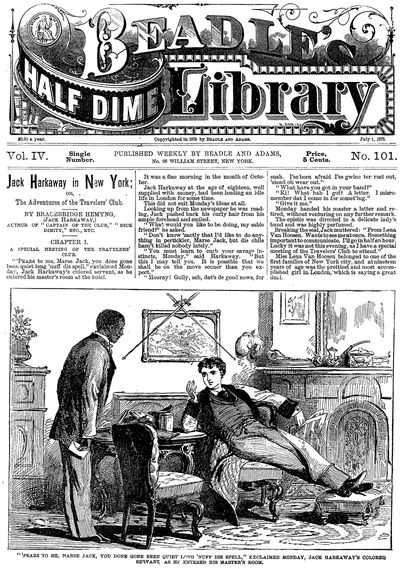
CHAPTER VI.
THE ABANDONED SHIP.
The crafty Italian, however; was not so easily disposed of.
He was perfectly at home in the water, and had, by diving, kept himself concealed from view, his intention being to swim toward the abandoned vessel, which he had seen as soon as he came on deck.
He knew that a long term of imprisonment awaited him, if he was taken to New York, and he deemed any risk, no matter how desperate, preferable to that fate.
This decided him in jumping overboard.
In time, he succeeded in reaching the water-logged ship, which rolled uneasily upon the heaving bosom of the deep.
Climbing up the chains, he got on board and found himself the sole master of a fine vessel.
She was partly laden with timber, which accounted for her keeping afloat, in the disabled condition in which she was.
His first task was to examine her cabins, which were free from water.
In the forecastle he found everything in disorder, as if the vessel had been abandoned in a hurry and without sufficient cause.
Probably the ship was overwhelmed by the fury of the storm in the dead of night, and the crew, seized with a panic, had lowered the boats.
Her figure-head had been washed away and the name on her stern was not decipherable.
Bambino could only make out the letters, "v—r—e—a—n—d—ris."
Going aft, he descended the companion-ladder, and entered the captain's cabin, where the same indications of haste were noticeable as in the forecastle.
Everything had been thrown about in reckless confusion, and many articles of value were piled up, as if to be carried away.
In various lockers he found provisions in plenty, unharmed by the saltwater. Cans of meats, sardines, biscuits and fruits, as well as bottles of wine, brandy and beer.
His spirits rose at this timely discovery, and his elation increased as he reflected that the ship would keep afloat for some time, unless engulfed by another storm, of which there was no indication at present.
Sitting down, he placed on the table of the cabin an excellent repast, of which he partook with a good appetite, washing it down with copious draughts of wine.
His satisfaction culminated when he found a box of fine cigars, which he promptly began to smoke, a box of matches affording him all the light he wanted.
While he was congratulating himself upon his good luck, he heard a peculiar sound.
This came from what appeared to be an inner cabin, the door of which was locked.
The sound resembled the moaning of some human being in deep anguish.
Somewhat superstitious, Bambino crossed himself and muttered a prayer.
Again the sound was repeated.
Bambino's hair began to erect itself, and he advanced to the partition, inclining his head in a listening position.
CHAPTER VII.
THE MYSTERY OF THE DESERTED VESSEL.
After listening at the partition for some time Bambino became convinced that a human being was confined in an inner cabin.
Frequently he heard sobs and groans mingled with exclamations in the French language, with which he was well acquainted.
A further examination showed him a door, against which several pieces of furniture were jammed, they having evidently been thrown against it during the progress of the storm.
This had effectually prevented the egress of the unfortunate person inside.
Being a powerful man, the Italian exerted himself to the utmost and succeeded in removing a bureau, some chairs and a heavy table which were piled up in confusion.
Then the door flew open, and he beheld a lady lying on a bed, and it was easily observable that she was in a state of complete exhaustion, having been many days without food.
Had not help come when it did, she could not have survived much longer.
Though the face was very beautiful, the cheeks were sunken, emaciated and hollow; her long silken hair hung in disheveled masses over her shoulders, and in her deeply expressive eyes there was the glare of incipient insanity.
No sooner did the girl see Bambino than she endeavored to rise, but was compelled to fall back again by weakness.
"Who are you?" he asked, tenderly.
"I am an angel now," she replied. "Death has held me in his arms. I do not suffer any more, though it was hard and bitter to die."
Her voice was faint and feeble. There was that in her words and manner which indicated that her mind was wandering. Reason had tottered on its throne, until it had finally given way beneath the weight of her sufferings.
Seeing that she was in want of nourishment, he procured some food which he administered with a spoon, afterward compelling her to drink some wine.
Toward night she improved considerably, and fell into a refreshing sleep.
Bambino went repeatedly on deck to look out for a sail, but did not see one.
His position was a precarious one, for should another storm arise, there was little doubt the vessel would either capsize or break her back.
He drew some consolation from the fact that he was in the path of the steamships which were constantly crossing and recrossing the Atlantic ocean.
Two days passed, during which the lady remained in a comatose state; but, as he continued to feed her at intervals, she gradually regained her strength, and on the third day was able to get up and converse.
Her mind, however, was gone. She talked incoherently, persisting that she had died during the storm, and that she was a spirit.
"When I was alive," she would say, "I lived in France and I married an English nobleman. When he dies and comes to the land of spirits, he will not deny that I am his wife, though on earth, he drove me from him and broke my heart."
"What was his name?" asked Bambino, who became interested in her random utterings, he scarcely knew why.
"Lord Maltravers; you see I remember that, though I cannot recollect all things that happened before I died. I was called Adéle."
Bambino started and visibly changed color.
He had heard his master speak of this girl, and it appeared to him that he had made an important discovery.
Maltravers had admitted to this confidential villain that he had legally married the girl, and he hoped that she was dead, as she might give him some trouble if she lived.
Slave as he was, bound hand and foot to his titled master, Bambino felt that, with this girl in his possession, he would have a powerful weapon to use, should he ever come into open conflict with him.
He determined to say that she was his sister and that the captain and crew of the ship had left them behind in their hurry to quit, while he could easily add that Adéle had become crazed with terror.
A week went by; and though Adéle grew stronger, there was no amelioration in her mental condition.
She was quiet and even childish. Never did she utter any threats against Lord Maltravers. She loved him in a sweet, innocent way that was very affecting.
In a locket, which she wore around her neck, she had a faded photograph of the handsome, bad man, who had made her the plaything of an idle hour and ruined her young life. This she would take from her bosom where she concealed it and kiss with the greatest rapture, pressing her lips to it and murmuring words of purest affection and despairing love.
It was a sight to make the hardest heart feel, and bring tears to the eyes of the most callous man of the world.
Even Bambino, wretch that he was, had known what it was to love, and he sighed for her misery.
At length the wished-for sail hove in sight, and the Italian contrived to attract the attention of the crew, who lowered a boat to come to their rescue.
He went below and roused Adéle, who was bending over the photograph of the loved one, very much as a little child plays with a pretty toy.
"Come, mio caro," he exclaimed, "we are going on board another ship, which will take us to a great city. Put that thing away."
Adéle held up the picture, while a smile overspread her countenance.
"Isn't he lovely?" she asked.
Bambino set his lips firmly together, while the dark eyes—peculiar to the Latin race—flashed forth their fire.
"I can't say anything against him," he replied, "for I owe him much; but, cospetto! you and he will go to different places when you die."
"I am dead. You know that," said the simple-minded girl. "But will he not come to me in time and ask my pardon? Will he not fold me in his arms as of old and call me his darling?"
"Possibly."
"Oh, yes," said she, as her eyes rolled in an ecstasy of unbounded affection. "It must be so. There must be some recompense for the pure in heart, hereafter."
Bambino was touched.
He patted her beautiful hair with the air of an affectionate brother.
"Would to God, my child," he said, "that I had won your love instead of the woman's who—but no matter; my hand is red with her blood."
Adéle looked at him in dread surprise.
"Did you kill her?" she asked.
Bambino laughed, in a harsh, metallic tone.
"She is dead," he replied. "Ay, and—Corpo di Baccho! the man is in the grave, too."
"Man! what man?" inquired Adéle.
"Ask me no more questions, unless you want to madden me," cried Bambino. "I thought the wound was cicatrized, but you, with your childish questions, set my blood on fire. I loved that woman."
"Maltravers loved me once, yet I did not kill him when he deserted me and afterward drove me from him, when I laid my heart at his feet. How can you kill those you love?"
Bambino could say no more. He led Adéle gently but firmly up the companion-ladder, and in a few minutes the boat from the steamer was alongside.
They were taken off the ship. He told his story and excited much sympathy, especially when he reached the vessel, which was bound to New York.
Adéle and he were given berths in the intermediate part of the ship, which is amidships, and in five days they found themselves in New York.
Bambino was careful to conceal his right name, as he knew the log would be published in the papers, and might reach Harkaway's eye.
The Italian resolved to keep Adéle in his charge, as a counterfoil to any ill-treatment he might receive from Lord Maltravers.
When the steamer arrived, he went to a hotel and having secured attendance for Adéle, cast about for some place where he could place her.
In a paper he saw an advertisement to this effect:
"Astrology.—Madame Vesta Levine, the only real fortune-teller in the city—electric baths—galvanism. Boarders taken. W. 32d St."
The morning after his arrival he called upon Mme. Levine, who was a middle-aged lady, with an intellectual face.
She did not look like a charlatan, and exhibited a diploma from a medical college, which proved that she had some knowledge of the healing art.
He was received in her office, which contained only a few chairs, a table and some books on a shelf, having no skulls, stuffed snakes and the ordinary stock in trade of a fortune-teller.
"What can I do for you, sir?" she demanded.
"I have a sister," replied Bambino, "whose mind is affected through a disappointment in love and a subsequent shipwreck at sea. She is young. I do not wish to put her in an asylum. I have great faith in electricity and I will place her in your care, paying three months' board in advance, if you will receive her."
"I shall be glad to take her as a patient," answered Mme. Levine.
"You will try to cure her?"
"Undoubtedly."
"I must warn you that she imagines she is a departed spirit."
Mme. Levine smiled.
"That is nothing," she answered. "I have had worse cases than that. When shall I expect your sister, sir?"
Bambino promised to bring her round that evening, and took his departure.
Later in the day he made his reappearance with Adéle, who evinced no attachment for him and seemed only to care for being alone.
For hours she would talk to herself and occasionally press her hands to her head, as if it hurt her.
Mme. Vesta Levine had a room at the top of her house prepared for her and detailed a colored woman to wait upon her.
"Beware," said Bambino as he left the house, "how you treat my sister. I shall demand a strict account of you."
The madame smiled scornfully, for she glanced from the swarthy Italian to the fair-haired daughter of France, and she knew in one instant that they were not related.
"Sir," she replied, "your 'sister' is perfectly safe in my hands, and when you require her I shall be perfectly ready to deliver her."
Bowing politely the Italian took his leave, feeling that Adéle was in good hands, and that he could find her whenever he wanted her.
While returning to the hotel at which he was staying, he beheld two gentlemen walking together on Broadway.
No sooner had he seen them than he drew his breath quickly and drawing his hat over his brows, darted into a doorway to allow them to pass, without perceiving him.
It was Jack Harkaway and his friend Harvey.
"We must hurry," exclaimed Jack, "or we shall be late for Miss Van Hoosen's reception, and you do not know how my heart longs to see that girl once more."
Harvey laughed lightly.
"It seems to me," he replied, "that you are very much smitten in that quarter."
"I don't mind acknowledging it," said Jack. "She is just about the sweetest, prettiest, most charming young lady that I ever met in all my travels."
"So she is," answered Harvey. "She is worthy of you and you of her."
"If it had not been for the superlative attraction that she has for me I should not be here now."
"Well! You can congratulate yourself on one thing."
"What is that?"
"You have cut Lord Maltravers out of the game entirely. He has no show now. Ha! Ha!" laughed Harvey.
"Ha! ha!" laughed Jack. "You are right there, but the fellow is dangerous."
"Yes, indeed."
"Fancy his sending a fellow to assassinate me. It was lucky I got the best of him."
"Between you and the fishes of the Atlantic there cannot be much left of the villain," remarked Harvey.
This conversation was distinctly audible to Bambino, as the two young men had paused to light their cigars.
"We shall see!" muttered the crafty Italian. "Let those laugh who win."
At this moment an elderly gentleman, passing by in the dim light of the evening, drew out his pocket-handkerchief; and, in doing so, a large wallet fell on the sidewalk.
He did not notice his loss.
Bambino, however, saw it, and a sudden idea came into his head, upon which he did not hesitate to act.
Starting rapidly forward, he picked up the wallet, and pushing against Jack, dropped it into the pocket of his overcoat.
"Here, you, sir!" exclaimed Jack. "Where are you coming to?"
"Beg pardon," answered Bambino, in a gruff voice.
"Don't do it again, that's all," rejoined Jack. "There is lots of room for both of us."
Bambino retired as quickly as he came, and walked after the elderly gentleman who had lost the wallet.
"Sir," he exclaimed, touching him on the shoulder.
This man was a merchant connected with the Produce Exchange, very wealthy, but very mean.
"I've nothing for you," replied Mr. Cobb, for that was his name.
"I want to speak to you."
"Not to-night, my good fellow. I can't give anything to tramps and beggars."
"Listen a moment," persisted Bambino. "Have you lost anything?"
Instantly Mr. Cobb's hands dived into his pockets, and a look of alarm stole over his face.
"Why, bless me, yes, my wallet!" he said. "Have you seen it?"
"Did it contain anything valuable?"
"I should say it did. Valuable! What's the man talking about? Where is it? Tell me at once, or I'll call the police and have you arrested."
Bambino pointed to Harkaway, who was only a few yards ahead.
"Do you see that person?" he asked.
"Which one—there are two together?"
"The stout one. It is he whom I saw take your wallet from your pocket."
"Then he is a thief?"
"Precisely," replied Bambino. "Good-evening. I hope you will recover your property."
Lifting his hat politely, he turned down a side street, leaving Mr. Cobb to go after his money.
Harkaway was perfectly unconscious of the trick that had been played upon him.
As for Harvey, he was a little uneasy.
"Jack," he said, "did you notice the face of that fellow who pushed up against you?"
"Not distinctly; why?" replied Jack.
"I did, and the features reminded me of that Italian scoundrel of whom we were talking."
"Bambino?"
"Yes. The hired assassin of your sworn enemy, Lord Maltravers."
"Absurd!" exclaimed Jack. "The fellow perished at sea. We know that very well."
"Never mind; the face haunts me."
"You shouldn't indulge such silly fancies, Dick. I tell you the rascal is as dead as a doornail," replied Jack.
Just then, Mr. Cobb rushed up and seized Harkaway rudely by the arm.
"Hello!" exclaimed Jack. "What's the matter with you? Has every one got a mania for jostling me to-night?"
"My wallet, my wallet!" cried Mr. Cobb.
Jack shook off his grasp and drawing himself up proudly looked him sternly in the face.
"My good sir," he said, "be kind enough to explain yourself."
"You have stolen my wallet. I saw you do it."
This was a stretch of imagination on the part of the produce merchant, but he relied on what Bambino had told him.
"Do I look like a—a thief?" inquired Jack, not knowing whether to get angry or not, and feeling inclined to regard Mr. Cobb as a harmless lunatic.
"No," admitted the merchant, "but gentlemanly thieves are the most dangerous."
Jack turned inquiringly to Harvey.
"Dick," he exclaimed, "ought I not to knock this man down?"
"Under the circumstances, you would be justified," replied Harvey. "But, my dear boy, he is old and we should respect old age."
"True. Pass on, sir, and do not presume to annoy me any more with your ridiculous charges," said Jack.
"My money. I want my money, robber. You shall not escape me thus," persisted Mr. Cobb.
Again he laid his hand on Jack, who this time flung him violently against the window of a store.
A small crowd of idlers began to collect, and the attention of one of the Broadway squad was arrested.
"What's all this?" asked the officer, coming up.
"Arrest this man," cried Mr. Cobb.
"What for?"
"Robbery. I charge him with having stolen my wallet, containing a large sum."
"Who are you?"
"Richard Cobb, of the firm of Cobb and Co. Every one knows me in South street."
The officer seized Jack by the elbow.
"I arrest you," he said. "Come along."
"Allow me to explain," exclaimed Jack.
"You can do that at the station."
Jack shrugged his shoulders.
"This is a queer country," he replied; "yet I make it a rule never to resist constituted authority."
"You wouldn't find it much use if you did," answered the officer, swinging his locust club.
Harvey was much annoyed.
"Let me assure you, policeman," he said, "that you have made a mistake."
"Can't help it," was the stolid reply.
"This is my friend, Mr. Harkaway, of England. We are stopping at the Fifth avenue Hotel."
"I guess the pair of you will stop somewheres else to-night," answered the policeman, smiling at his own joke.
It was useless to argue the point, and the officer conducted his prisoners to the station, where Mr. Cobb made his charge.
Jack indignantly denied the accusation, and demanded to be searched.
Imagine his dismay, when the searchers produced the missing wallet from the pocket of his overcoat.
"That's mine!" cried Mr. Cobb, exultantly. "What did I tell you?"
"Lock 'em both up," said the captain.
"I will send for the British Consul," exclaimed Jack. "This is some infamous plot."
"Bambino," muttered Harvey.
"Right, Dick; your eyes were better than mine. I ought to have known that the fellow was never born to be drowned," replied Jack.
"Put them in different cells," continued the captain.
They were conducted below and locked up, feeling very indignant, but unable to help themselves.
The charge looked very grave against them, and Harvey was as much implicated as Jack, because he was regarded as an accomplice.
Mr. Cobb promised to appear in the morning, and went home.
As he left the station he did not perceive a man who was hiding in the shadow of a house.
This was Bambino, who had watched the arrest, and finding that the game was securely bagged, turned away with a chuckle.
"Five years in State's prison for highway robbery," he muttered, "will please his lordship."
Repairing to a telegraph office, he sent the following dispatch by cable to Maltravers:
"Come over as soon as you can. The coast is clear. The lady can be yours, as Jack will not be likely to cross your path for some time to come.
"Bambino."
CHAPTER VIII.
A LOVERS' QUARREL.
Professor Mole was very much surprised at the failure of Jack and Harvey to return to the hotel, and he was still more astonished, when at midnight he received a note informing him of their arrest on a false charge of robbery.
He at once proceeded to the station and had an interview with them, and afterward procured bail in the person of the proprietor of the hotel.
The next thing was to see Mr. Cobb, who, now that his money was recovered, was in a happier frame of mind, and being satisfied of Harkaway's respectability, consented to withdraw the charge.
How the money got into Jack's pocket it was not easy to explain, and the affair remained a mystery.
It was unfortunately necessary for Harkaway to appear in court, but on Mr. Cobb's application he was discharged.
The case, however, was reported in the papers; and Jack, to his mortification, read a paragraph entitled:
"SINGULAR CHARGE AGAINST AN ENGLISH GENTLEMAN.
"Mr. Jack Harkaway and Mr. Richard Harvey, two English gentlemen of means and respectability, residing at the Brevoort House, were charged at the Jefferson Market police court with stealing a wallet containing three thousand dollars in cash and securities, from the person of Mr. Cobb, a well-known member of the Produce Exchange. The money was found on Mr. Harkaway, but Mr. Cobb, feeling assured that there was a mistake somewhere, refused to prosecute and withdrew the charge, whereupon the prisoners were discharged."
This was intensely annoying to Jack, because it stabbed his reputation and cast a slur upon his honor.
There was no possibility of explaining the matter, and he felt that his character was blackened, though his friends did not attach the importance to the occurrence that he did.
The villain, Bambino, had not succeeded in his purpose, which was to put Jack out of the way in a prison, so as to make the coast clear for his noble employer.
Yet he had inflicted a wound on a most sensitive mind, and he chuckled inwardly at the chagrin which he knew Harkaway must suffer.
With cat-like stealth he watched and waited for an opportunity to deal him another blow.
The effect of the publication above referred to was soon apparent.
Jack determined to show himself everywhere, for he thought that to hide himself would be to tacitly admit that he was guilty and felt ashamed.
Consequently he drove out nearly every day.
Mr. Mole, Captain Cannon and Mr. Twinkle were occupied in searching New York and its vicinity for buffalo; but, much to their disappointment, they could not find any.
The professor prepared an elaborate report for the club which had sent out the expedition, in which he stated: "After a prolonged investigation, I am inclined to think that the buffalo, like the mastodon and the dodo, is an extinct animal, as I can discover no trace of a living buffalo so far, though I am in hopes that when we visit Long Island, which I am told is wild and savage, we may meet with some specimen of this almost mythical beast."
There was going to be a steeple-chase at Jerome Park, and Jack sent Miss Van Hoosen an invitation to ride to the grounds.
This led to the first severe mortification he received, after the report in the papers, for Lena refused in the following brief note:
"Miss Van Hoosen presents her compliments to Mr. Harkaway, and begs to thank him for his invitation, which she is reluctantly compelled to decline."
On receiving this, Jack showed it to Harvey.
"Look at that, Dick," he exclaimed, "and tell me what is the meaning of it."
Harvey read it, and replied, "It is laconic enough, and it means, simply, that the lady will not go."
"What would you do, under the circumstances?"
"Call upon her and have an explanation."
"I shouldn't be surprised, if she has seen that paragraph about Mr. Cobb's money."
"More than likely."
Jack bit his lips with vexation and his face reddened.
Without losing any time he visited Lena, and was shown into the reception-room.
Presently Lena entered, looking more than usually sweet and charming.
There was some slight embarrassment in her manner, as she held out her hand and requested him to be seated.
"I am so sorry you cannot come with us," he said.
"So am I," she replied. "But I am glad to have an opportunity of explaining. There is no gentleman of my acquaintance whom I esteem more than I do you."
Jack bowed politely, and felt that he could have laid down his life for her, for saying those words.
"My brother," she continued, "has read something about you in a journal, and he says I ought not to receive your visits. I feel that there must be some mistake. If you could only see my brother and explain—"
A tall gentleman, a few years older than Jack, entered the room at this moment.
"No explanation is necessary," he exclaimed.
Jack flushed indignantly.
"I presume," he said, "I have the honor of addressing Mr. Alfred Van Hoosen?"
"That is my name," replied the new-comer, stiffly.
"And the brother of this lady?"
"Precisely, sir."
"In that case, your relationship prevents me from taking the notice of your words which I otherwise should."
"Oh, sir," said Alfred Van Hoosen, as he smiled sarcastically, "pray do not let that stand in your way."
"I was simply desirous of assuring your sister that there was absolutely no foundation for the report to which she alluded."
"The case speaks for itself."
"Am I to understand that you do not consider me a proper person to visit at your house?"
"That is what I intended to convey to you, and I have to thank you for saving me the trouble of expressing myself."
Jack turned to Lena, regarding her almost with an imploring glance.
"Do you concur in your brother's opinion?" he asked.
She would not trust herself to speak, but inclined her head.
Burning with mortification, Jack quitted the house with despair in his heart, for it seemed as if Lena was lost to him forever.
In order to regain her good-will it would be necessary to satisfy her brother, and as he would listen to no explanation, this course seemed impossible.
For some time he was inconsolable, but he determined to go to the race all the same, hoping that he might at least see Lena there.
It was a lovely day, and all the wealth and fashion of New York was hastening toward the Park.
On Eighth avenue they passed an open carriage, in which were seated Miss Van Hoosen and her mother.
In spite of his dismissal of the day before, Jack ventured to raise his hat, but Lena did not bow, though he fancied her eyes appeared to seek his.
"Fine girl that," remarked a gentleman who sat by Jack. "You appear to know her."
"Yes," replied Jack, "I met them in Paris—that is—her mother and herself."
"Fine family. Best in New York. Regular Knickerbocker stock. Are you acquainted with her brother?"
"I have met him," said Jack a little confused.
"He rides to-day."
"Indeed! I was not aware of that."
"Yes, he mounts a horse called Warrior. The knowing ones are betting two to one on him, and I heard him say at the Union Club last night, that if he won he would give the cup to his sister."
Jack was not of an uncharitable disposition, but some how or another he hoped that Alfred Van Hoosen would not win.
At length the course was reached, and Jack took a walk to the starting-place to have a look at the horses.
He was an excellent cross-country rider himself, and he loved a horse dearly.
All at once he saw a gentleman drive up to one of the stables, and alight hurriedly from his buggy. In doing which he slipped from the step and fell heavily to the ground.
A cry of pain escaped him.
"Confound it," he exclaimed. "I've sprained my ankle."
It was Alfred Van Hoosen.
Leaning on the arm of his trainer, who hurried up to offer his support, he entered the stable.
Jack lingered around the spot to see what the result of the accident would be, for it appeared as if Mr. Van Hoosen would be unable to ride his horse that day.
While he was waiting, Harvey met him and said excitedly:
"I have been looking for you."
"Anything happened?" asked Jack.
"Oh! no, but I want you to be upon your guard."
"What for?"
"Near the grand stand, I saw that Italian ruffian Bambino, whom Lord Maltravers hired to kill you."
Jack smiled incredulously.
"My dear fellow," he replied, "it is evident to me that you have got Bambino on the brain."
"I can trust my eyes, I suppose," answered Harvey, a little petulantly.
"Not in this case. You have seen a man who resembles Bambino, that is all."
"And I distinctly assert it is the assassin himself."
"Bosh!"
"All right. A willful man must have his way," said Harvey, shrugging his shoulders.
"I should like to argue the point with you, but you are such a confirmed skeptic, I fear I should be wasting my time."
"Oh, no, I am open to conviction," Harkaway rejoined.
"Well, now, is it not possible that when the assassin jumped overboard he might have gained the abandoned vessel?"
"Possible, but not probable."
"Granting the fact of his having gained it, could he not have been taken off and brought to New York?"
"Ah!" said Jack, drawing a deep breath.
"What do you think now?"
"I begin to believe in your Bambino."
"Shake hands on that. I think I begin to see how the money of Mr. Cobb came into your pocket; it was an attempt to blast your reputation. Having failed to kill you, he stabs your character and wounds you in your tenderest and most susceptible part. Here is another point—Lord Maltravers, this scoundrel's master, is your rival for the affections of Miss Van Hoosen."
"Undoubtedly!"
"Well, you call and are refused the house, simply on account of this alleged robbery. What is more calculated to please Maltravers!"
"True. I am willing to admit, Dick, that you are a genius, and I will be on my guard, as you suggest," said Jack.
The course was crowded with people and carriages. It was the most brilliant gathering of the year, and still the people came.
A bell rung to give notice that the start for the steeple-chase was about to be made.
There were a dozen entries; some of the horses were ridden by their owners, some by professional jockeys.
The horses and their riders began to show themselves on the track, and some took preliminary canters, exciting the admiration and criticism of the spectators.
Presently, the trainer of Warrior came out of the stable, looking very much disconcerted.
He approached two men who were standing near Harkaway, and the conversation which ensued was distinctly audible.
"Is the boss much hurt?" asked one.
"Yes, his foot has swelled so that I had to cut his boot off. He's lying on a bale of hay, and in great pain."
"Then he won't ride Warrior to-day?"
"He can't."
"What are you going to do about it?" asked the man.
"He wants you to take the mount and will pay you well. He knows you are a good rider."
"I'm not going to risk breaking my neck, by riding a beast with such a temper as Warrior," replied the man.
"You're a fool."
"Maybe so, in your estimation, but I'm not tired of my life yet. Why, I would not cross that brute's back in a flat race, let alone a steeple-chase. Mr. Van Hoosen is the only one who can manage him, and perhaps he'd come to grief at the first steep fence."
"Then we shall have to withdraw him," said the trainer sadly.
"That's all you can do."
"It's a pity, for I thought he'd win sure, and I have bet more money on him than I care to lose."
Impelled by an irresistible motive, and filled with a dare-devil spirit, which he could not keep down at times, Harkaway touched the trainer on the shoulder.
"Do you want some one to ride your horse?" he demanded.
"Yes, sir."
"I'll do it."
The trainer eyed him curiously, and the result of his inspection appeared to be satisfactory.
"How much do you want for it?" he inquired.
"Nothing at all. I am a gentleman, and will do it just for the fun of the thing."
"Beg pardon, sir," replied the trainer touching his hat respectfully.
"Get the colors, bring them into the stable, and I'll soon be in the saddle."
"Won't you come inside and see Mr. Van Hoosen, sir?"
"It is not necessary. I—I don't care to disturb him. Besides, there is no time to be lost. There goes the bell to clear the course, again, and most of the horses are in the paddock."
"Who shall I tell master is riding the horse, sir?"
"Say Mr. Smith," replied Jack, who wished to keep his identity concealed from Mr. Van Hoosen.
The trainer led the way to the stables; the jockey's dress was brought and put on; Warrior was led out. He was a powerful horse, well-bred and in every respect a magnificent animal. He threw his ears back and kicked out viciously as if to show his temper.
"What are you going to do, Jack?" asked Harvey.
"Ride the beauty," was the reply.
"He's no lamb, if I'm any judge. Look at his ugly eye."
Jack patted Warrior's neck, saying, "Soho! my lad. Steady!" When he sprung into the saddle, grasped the reins firmly and received the whip from the trainer.
"Be careful how you use the spur, sir," exclaimed the latter.
Jack nodded carelessly.
"Go and put your money on, Dick," he said. "I mean to win this race or break the horse's heart and my own neck, just to show a certain young lady and her brother what I can do."
Touching Warrior lightly with his whip, he cantered toward the inclosure, where the other horses had already assembled.
The Van Hoosen colors were, black cap and white shirt with large black bands. If not pretty, it was at least very conspicuous and calculated to attract attention.
CHAPTER IX.
THE RACE.
Going on the course, Jack gave Warrior a canter to see what he was made of, and found him a fast goer, well up to his weight, but inclined to be restive and have his own way.
In front of the grand stand, which was thronged with elegantly-dressed ladies and gentlemen, Jack stopped short in the canter and took a look at the sea of faces.
In the front row was Miss Van Hoosen and her mother. They had evidently heard nothing about Alfred's accident, for when they recognized the horse and the colors, they appeared much astonished.
Jack could not resist the temptation of bowing to Lena, who, quite perplexed, acknowledged his salutation by a slight inclination of the head.
Then he cantered gracefully back to the starting-place, taking his position among the other riders, to be ready for the start.
This was effected without much trouble, no time being allowed Harkaway for reflection.
He did not consider that he had undertaken a dangerous task in consenting to ride an animal he knew nothing of, but he had confidence in his own powers, and had never been much in the habit of calculating on consequences.
"They're off! they're off!" shouted the crowd, as the beautiful creatures dashed past, like so many arrows from a bow.
Jack was perfectly satisfied that Warrior had wind and bottom enough to stay, and he determined to ride a waiting race, feeling sure that several horses would tail off and that some would fail at the jumps.
The first jump was made of hurdles, and this Warrior took well, rising like a bird and going over without any more trouble than eating a measure of oats.
Although Jack held him well in hand his stride told in the first mile, and he had cut down the crowd considerably, there being only four horses in front of him.
The most dangerous-looking one of these was a long-barreled, long-legged black horse, with powerful haunches and a way of going that meant mischief.
At the second jump, which was made of branches of trees to represent a hedge, Warrior began to show his temper, for he flatly refused to take it.
Jack put him at it again, and gave him the spur, digging the rowels deep into his flanks, while he lashed him with the whip.
With a snort of mingled rage and pain, the horse rushed at the jump and cleared it; but he was docile no longer, for he dashed away in a manner which showed that he meant to have his own way.
"Go it, my beauty!" muttered Jack, "we'll soon see who is master."
Warrior was not at all backward in accepting this challenge, and made the running in fine style, taking leap after leap like a deer.
It required a strong hand and a quick eye to manage him. Jack's arms felt as if they would be pulled out of their sockets, but he kept his seat in the saddle as if he had grown there.
The course was a circular one. Two-thirds of the way round was an artificially-constructed water-jump, a hole having been dug, about twenty-five feet wide by forty feet long and ten deep. Owing to recent rain this formidable leap was full of water.
A large crowd had collected here, anticipating some sport, for it was correctly surmised that many horses would either refuse it or throw their riders.
Jack had not been over the course, which was a great disadvantage to him, yet he saw the gleam of the water and prepared for it. The black horse was leading, and behind it was a strong Kentucky bay.
Both cleared the water-jump successfully.
Jack now passed the fourth horse, which had weakened visibly. The third horse fell at the water-jump, breaking his rider's collar-bone and injuring itself so that it had to be shot.
This accident made Jack third in the race.
After the water-leap were three sets of hurdles; and then, for about a mile and a half, it was a straight run for home, over as nice a bit of turf as a horse ever galloped on.
Warrior approached his task and Jack plied him with whip and spur, fearful he might balk at the sight of the water, as many horses will, and determining to get him over if possible.
Loud cheers and cries of encouragement greeted him.
The edge of the water was nearly reached; he prepared to lift the horse; and with the breeze almost blowing the words down his throat, he stimulated the animal with his voice:
"Now, then, my darling," he said, "jump for your life and mine."
Suddenly a man in the crowd opened an umbrella and held it up near Warrior's eyes.
The effect was instantaneous, for the horse swerved, refused the jump, and rearing up, stood for a moment on his hind legs, pawing the air.
Jack was afraid he would fall on and crush him, but he was equal to the occasion, for he threw himself off, just as Warrior fell back.
Before he did this, he caught sight of the man with the umbrella.
"Bambino," he muttered.
The wretch had opened the umbrella, evidently on purpose to frighten the horse and make Jack endanger his life.
Harvey was right, after all.
The fall which Jack received was an ugly one; for a moment he lay stunned and bleeding from a cut on the forehead.
He had lost his cap, and his shirt was torn and muddy.
Kind and sympathizing bystanders helped him to his feet; willing hands caught his horse.
Harkaway looked about him in a dazed manner, but his indomitable pluck carried him through the trying ordeal.
His head was swimming and he was in pain, but he never faltered for a moment.
Bambino had disappeared.
Perhaps he dreaded the vengeance of the populace, for his cowardly trick could not fail to be noticed by some one.
"Give it up, boss," asked a man who had helped Jack to rise.
"No; I'll ride or die," was the answer.
He walked to the horse, mounted, and backing his steed, who was quivering in every limb, put him again at the jump.
The bystanders were delighted with his courage.
His phrase "ride or die" seemed to tickle the crowd immensely.
"Hurrah!" they cried. "Ride or die! Bravo!"
"Who is that?" asked some one. "He wears the Van Hoosen colors."
"It's Jack Harkaway," replied a stableman who had seen Jack's drag.
"He's got grit in him."
"You just bet you he has."
"Hurrah!" shouted the crowd, again. "Ride or die! Sail in! Ride or die!"
This time, Warrior, as if ashamed of himself for his former failure, made amends by taking the leap, with the velocity of a meteor.
He landed safely on the other side amid the applause of the spectators, and Jack gave him his head.
Away they went, the horse seeming to like nothing better.
The black horse was not so far ahead, as Jack had expected, for he had not been husbanded by his rider, and his strength was beginning to fail him.
The first set of hurdles was cleared; at the second, Warrior stumbled; but a vigorous hand on the reins and a sharp reminder with the whip, showed him his duty, and he went over.
At the third and last set, the second horse fell heavily, throwing his rider.
Harkaway was now second in the race, the leader being on the home stretch, and going in a somewhat labored manner.
Going over the last fence, Jack put all his horsemanship into requisition.
The grand stand was in view, and the hoarse roar of thousands of voices became audible.
"Ride or die!" thought Jack, "and by Jove I'll do it."
Whip and spur were not spared, and Warrior, now mastered and tamed, overhauled the black horse about half a mile from home.
Now ensued the most interesting and exciting part of the race.
The Kentucky thoroughbred, ridden by its owner, struggled gamely; and he and Warrior went along neck and neck.
Louder and louder grew the roar of the assembled multitude.
Jack knew he was drawing near the goal, but a mist came over his eyes.
How near it was he could not tell.
The black horse at last seemed to fall back, Warrior went on ahead. There was a shout of acclamation.
"Black cap wins! Van Hoosen! Van Hoosen!"
Jack reined in his horse; the trainer seized the bridle, and he dismounted at the stable-door; though how he got there, he could not tell.
"All right now, sir. Step inside," said the trainer.
The mist was deepening, and the dizziness in Jack's head was increasing.
He could only see objects indistinctly.
What was the matter with him? Could he have hurt himself more than he suspected?
Before him was a gentleman who sat on a bale of hay, and he seemed to have a bandage on his foot.
"Mr. Smith," began the gentleman. "Why! It's Jack Harkaway!—Mr. Harkaway, I mean, pardon the familiarity. How the deuce did you come to ride my horse, sir?"
"You're Alfred Van Hoosen?" said Jack, in a faint voice.
"Certainly, I am."
"Did I win the race?"
"Did you win it? Why, man alive! It was the finest race on record, they tell me. Every one is perfectly wild about it, and—"
"Excuse me," interrupted Jack. "I know I ought not to have ridden your horse, but I wanted your sister to have the cup, and if you'll accept my apology—"
It was now Van Hoosen's turn to interrupt Jack.
"Apology! my dear fellow," he said. "I don't know what you mean."
"You didn't treat me well the other day, and I know it was wrong to ride your horse."
"You have done me the greatest service one man could do another," replied Van Hoosen. "When I sprained my ankle, I hurt it badly, and I am told I shall not get out of the house for a month at least. At present I am suffering terrible torture. If you had not ridden my horse, I should have been a ruined man, for I don't mind telling you I had backed my mount heavily, and I stood to lose more than I can afford. It would have broken my heart to go to my mother and ask her to pay my debts of honor. You have saved me."
Jack's face lighted up with a faint smile.
It was the brother of the girl he loved who was talking to him.
"I'm awfully glad," he said. "It pleases me to help a man out of a bad place. If your man will give me my coat, I'll go home now, and send you the colors in the morning. I've got friends here—drove my drag down, you know, and I fear I have neglected them."
"Sit down a moment," replied Van Hoosen. "You're a fine fellow, Harkaway, and I'm sorry for what I said yesterday."
"Don't mention it, my dear fellow. I've forgotten it."
"I've sent for some wine. Won't you wait?"
"Well, yes. Just a moment—the fact is—I'm not well—I've got a sudden vertigo—I—I can't see."
He extended his arms and groped his way, toward the door; but ere he reached it he fell on the floor, and the blood flowed again from the wound on his forehead.
For a time his senses left him.
CHAPTER X.
A RECONCILIATION.
When Jack Harkaway came to himself he was in a strange room, and he did not know what to make of it.
The apartment was elegantly furnished; pictures of value hung upon the walls, and it was evident that he was in the house of people of taste and wealth.
"Hello! where am I?" he asked.
The heavy damask curtains were drawn around the windows, so that only a faint light penetrated to the bedside.
Yet in the imperfect light Jack fancied he saw a shadowy female form, exquisitely symmetrical, get up from a lounge and leave the room.
A bell-rope hung by the side of the bed, which attracted Jack's attention, and he rung it violently.
Raising himself up, he sunk down again as if unable to sustain his weight.
"I'm frightfully weak," he murmured. "Wonder if I've been sick?"
Presently a footstep sounded on the stairs and a man opening the door, entered the apartment.
Jack recognized Alfred Van Hoosen.
"Well, my boy," he exclaimed. "So you have come to, at last?"
"Have I been very bad?" asked Jack.
"Only brain fever, that's all."
"How was that?"
"When you threw yourself off Warrior—by the way, I sold him for fifty thousand dollars, yesterday. Thanks to you."
"To me?"
"Yes, indeed—you made his reputation. But as I was going to say—you struck your head against a stone, just before you made that famous 'ride or die' speech."
"Is it famous?"
"Well, I should think so. It's been in all the papers, and you'll be called 'Ride or die Jack,' as long as you live in this country."
"You don't say so?" replied Jack, while a smile of satisfaction stole over his countenance.
He was not vain, but he liked to be praised when he deserved it, and he knew he had ridden Warrior for all he was worth.
"Where am I?" he added.
"In my house. I took the liberty of bringing you here," replied Alfred Van Hoosen.
"Don't apologize."
"Oh! but I must," said Alfred, laughing. "You apologized for riding my horse to victory, don't you remember?"
"Have I been ill long?"
"About ten days—but don't excite yourself. The doctor says you'll be out in a week, if you keep quiet."
"Thanks. I'll be quiet. Who has been nursing me?"
"I am not at liberty to tell you."
"Was it your sister? I thought I saw—"
"Ask her yourself," interrupted Alfred Van Hoosen. "I must leave you now, as it is strictly against orders to talk to you. The nurse will bring up your beef tea in a few minutes; be good to yourself."
"One moment. Did you get the cup?"
"The steeple-chase cup? Yes, indeed. It adorns the family mahogany down-stairs, and mother is really proud of it. Good-by."
Alfred quitted the room, and Jack sunk back on the pillow in a doze, filled with pleasant reflections.
Soon the nurse, who had been engaged from a neighboring hospital, came up-stairs and sat down to watch the patient.
She was not in the best temper, for she had been disturbed while at supper and was lamenting the good things she had left below stairs.
"It's very odd," she murmured, "that a sick man can't be left alone for an hour. This one wouldn't die or jump out of the window. That buttered toast and those sardines I quitted were real elegant; my mouth waters at the thought of them."
Scarcely had the words escaped her lips than there was a knock at the door.
"Come!" she said, testily.
The door opened and a dark-haired man of swarthy complexion appeared.
"Please!" he exclaimed. "I've brought the medicine, from the drug-store, and they told me down-stairs to come up with it."
"You ain't the young fellow that came before," the nurse said, eying him critically.
"No, he's a friend of mine, and he asked me to come."
"All right. What's the directions?"
"You're to give the gentleman the white mixture right away, and at midnight, the red."
"Are those the doctor's orders?"
"Yes, ma'am."
"I wish you'd wait here, while I go and finish my supper; the folks are at dinner and no one will know."
The man's dark eyes flashed.
"Cospetto!" he muttered. "I'd like nothing better."
"What's that you said?" asked the nurse.
"Nothing, ma'am. I'll be glad to stay."
"What countryman are you?"
"Italian."
"Thought you were a foreigner. Well! you stay here and I'll give you ten cents when I come back. If he wakes up, call me, by ringing the bell."
"Yes, ma'am."
The nurse at once quitted the room, and the Italian advanced to the bed, looking intently at Harkaway.
"It is he," he said in a low tone. "I have tracked him to his lair. Now for the medicine, but how to give it him? He will know me. Perhaps I had best wait for the nurse."
He handled the bottle, which was an ordinary two-ounce vial, and regarded it affectionately.
"Let him once swallow this," he added, "and he will never wake up more."
Harkaway moved restlessly in his sleep.
Had he an intimation that Bambino was near him, preparing to carry out another iniquitous scheme generated by his fertile brain?
In sober truth, to give the fellow his due, he served his master well.
Lord Maltravers had no cause to be dissatisfied with him.
The daylight had faded away and there was but a dim twilight existing, which made it difficult to discern objects.
Everything looked shadowy and ghostly.
Bambino had seen Harkaway's insensible condition when he was carried off the course and he had tracked him to the Van Hoosens' house.
The white mixture in the vial was a subtle poison, and he had gained an entrance to the house by pretending that he was a clerk from the drug store.
Touching Jack on the arm, he saw him awake.
"What is it?" he asked, dreamily.
"Your medicine," replied Bambino.
"Give it me, and let me sleep. I am drowsy."
"It is to make you sleep," said the Italian, with a grim smile.
He took up a glass and poured out the colorless fluid, which in reality was a death draught. Harkaway sat up and extended his hand for it, and having received it, raised the glass to his lips.
At this critical moment the door opened and the doctor who was attending him made his appearance.
"What's this?" he said. "No light? and what have you got in your hand? I am the doctor, don't you know me?"
"Medicine!" answered Jack, replying to the first question.
"Eh? I don't understand," said the doctor, with a puzzled air.
"Some stuff you sent me, I suppose."
Bambino bent over the bed.
"Drink," he whispered.
Jack was about to do so, but the doctor snatched the glass out of his hands.
At the same time, he struck a match and lighted the gas.
"Now, let us see," he exclaimed.
Weak and sleepy as he was, this action on the part of the doctor roused Jack, whose eyes settled on the Italian.
"Bambino!" he cried, shuddering as if his gaze had rested on a black snake.
The doctor had removed the cork of the bottle and tasted its contents on the tip of his tongue.
"Strychnine!" he ejaculated.
Bambino, finding he was detected and his scheme frustrated, gnashed his teeth with baffled rage.
It was high time for him to endeavor to escape, and he made his way toward the door.
"No you don't, my friend," exclaimed the doctor, barring his exit.
Bambino, as we know, was a man of unlimited resources.
He drew from his vest a long, polished dagger which scattered a thousand flashes as he brandished it in the gas-light.
"Santa Maria!" he cried. "Steel talks, signor."
The doctor was in no way disconcerted, for he quickly produced a pistol.
"Yes, my good fellow," he rejoined, "and here is an iron dog that can bark."
Bambino made a rush upon the doctor, who fired, but his bullet missed its mark and he received the point of the dagger in his arm.
The coat was cut open, the skin slightly ripped and blood flowed, though no serious injury was done.
This was a fortunate miss for the Italian, who at once made his escape down the stairs, and into the street, where in the darkness he easily eluded pursuit.
"Are you hurt, doctor?" asked Jack.
"Only got a scratch, a mere flesh wound. Do you know the fellow?" was the reply.
"Unfortunately I do; he is a hired assassin."
"This in the bottle is a deadly poison, you have escaped by a miracle."
The pistol-shot had aroused the whole house, and every one came rushing into the room.
In a hurried manner the doctor explained what had happened, and having cleared the room, gave Jack a composing draught.
Alfred Van Hoosen was much chagrined that such a dastardly crime should have been attempted in his house, and notified the police.
No arrest was made, however, for every effort to find the Italian was unsuccessful.
Time passed on, and in ten days, Jack was quite well, though still a little weak.
His friends came to see him every day, and he determined to return to his hotel.
Having announced his intention to Alfred, he thanked him very warmly for his kindness. All traces of animosity had faded away, and he was in reality a friend of the family.
Lena smiled upon him, and was sincerely rejoiced at his recovery, which at first, with a woman's nervous anxiety, she had despaired of.
As he was going away, Alfred drew him on one side.
"You won't think me rude," he said. "But I should like to ask you a few questions."
"By all means," replied Jack.
"In the first place, who is this Italian and why does he persecute you?"
"He attempted my life on board ship; I have reason to think he put the wallet belonging to Mr. Cobb in my pocket; he frightened the horse and he endeavored to poison me."
"But why? It is incomprehensible to me."
Jack hesitated for a moment, and colored slightly.
"I will tell you, since you urge me," he replied. "Lord Maltravers and myself are rivals for your sister's hand."
"Ah! I suspected as much."
"Bambino, the Italian, is the paid spy and assassin of Maltravers."
Alfred Van Hoosen appeared confused, and a look of vexation crossed his face.
"I have heard of Lord Maltravers from my mother," he said; "of course I was prejudiced against you, at first, on account of that affair of Mr. Cobb's; now that is all removed."
"Thank you," replied Jack. "I am glad to hear you say so, because I want to stand well with you."
"We Americans are quite as punctilious and particular as you English," said Van Hoosen; "and I can tell you that the best families think as much of themselves as you aristocrats who are descended from the Normans."
"Why should you not?"
"Well, we are friends. You have proved yourself a man, Harkaway, and I shall always esteem you."
"May I beg one favor?" exclaimed Jack.
"Anything in my power, to grant, you can command," was the warm reply.
"It is useless to disguise the fact that I love your sister, and I have every reason to believe that she is not indifferent to me. Will you use your influence with her, on my behalf?"
The expression of vexation which Jack had previously remarked deepened on Alfred's face.
"I will do so," he replied; "but I fear it will not avail you."