
The children were loud in their lamentations over Jessie's leaving.
"Why can't you stop forever and ever?" Eva demanded.
"Because I've got a mother and father who want me back again."
"It's miles and miles away; we can't come and see you, can we?" said Jack.
"Oh, I don't know. We're three miles back from Wylmington Falls, where people come picnicing in summer time. If you came out there one day you might get on to us."
It did not sound very probable.
"When are you going?" he asked rather drearily.
"The day after to-morrow; they're sending the buggy to fetch me."
"We'll come to the corner at the bottom of the lane to see you and wave to you, won't we, Eva?"
"Yes, wave to you," echoed Eva, beginning to smile again, the prospect of active service consoling her for Jessie's departure.
So on the following Saturday two eager children, with flowers in one hand and handkerchiefs in the other, stood waiting at their corner. This time the waiting was a short one, for a buggy came slowly up the hill, and in front, supported by cushions, sat Jessie by her father's side, whilst her small belongings were packed in behind; and at sight of the waiting pair, Mr. Butler drew rein and Eva climbed up with Jack's assistance to give Jessie a parting kiss, and Jack lifted his cap and presented his flowers, holding himself very straight lest Jessie should offer to kiss him too; but she knew better, only shook him heartily by the hand, and thanked him for all his kindness and then the buggy moved on, followed by the shouts of the children.
"But I wish she hadn't gone," said Jack as the carriage and its occupants were lost to sight. "We'll miss her every day."
Tom came up to the farm that evening for he had something to discuss, and wanted Betty's counsel.
"You know what girls can do more than I," he said when he had settled down to his pipe in the verandah. "I've Jessie Butler on my mind. My time here now is short——"
"Oh, I didn't know you were leaving at any definite time," said Betty quickly.
"Nor did I until to-day, but I've a letter from the Bishop to say that your late vicar has resigned, and that he is going to put in a younger man who can compass the work better."
"Why not you?"
"Because I refused to take it," said Tom simply. "It's not what I came out for, although I've had a very happy time here."
"And the new man is coming soon?"
"As soon as the Bishop can find him. He has one or two that he would like to send here, but I'm wandering from my point. Before I leave, I should like to find something for Jessie to do. She's utterly unfitted for life on a back block. It's too rough for her, and the work too heavy. She can't do anything yet, but before the winter sets in I'd like to see her settled at work she can do, something fairly quiet and regular. What do delicate girls do? What are they fit for," and Tom glanced appealingly at Betty.
"Sewing would be too sedentary, and she would not get it either, living where she does," said Betty.
"That's just it; I want to move her from where she is, but she's not strong enough for service."
"She might help in an infant school where such help is needed. She has read a good deal and passed all her standards, and has picked up a good deal of desultory knowledge which, from what the children tell me of the way she talks to them, I should think she had a gift for imparting."
"The very thing," cried Tom, "and I believe there is an opening at Wylmington, which has the advantage of not being far from home in case of a breakdown. I was in the little school there the other day, and the teacher, Miss Armstrong, was saying that it was imperative that she must have help with the tinies, and that she had written to the department about it. Now, if I could only put an oar in and get the post for Jessie, she could spend her spare time in study, and in qualifying herself to pass the examinations necessary for her to become a certificated teacher. In years to come she might get quite strong enough to undertake the care of some country school."
Tom lost no time in getting into touch with the authorities, with the result that in a few weeks' time he had the offer of the post which he sought for Jessie.
Jessie's imaginings about the parson's first visit to her home only came partly true, for on one soaking wet afternoon as the light was beginning to wane, a dripping man, clad in waterproof from top to toe, came riding up to the door, and she could hardly believe her eyes when the rider turned out to be Tom. Her greeting was absolutely incoherent in its gladness.
"Mother, father," she cried flying to the door, "come, come quickly. Here's Mr. Chance, come to see us, and he must be soaking to the skin."
"Not a bit of it," said Tom, dismounting cheerily from his horse and shaking the rain from the brim of his hat, "thanks to my overalls. I have a proposal to make to your father and mother, the answer to which is urgent, and I could not wait for fine weather."
"Well, everything must wait until you are fed, and warmed, and dried," said hospitable Mrs. Butler, hastening forward, "Fred," to a tall boy behind—"Come, take the horse, will you? Come in, come in, Mr. Chance; it was good of you to ride through the bush on a day like this, for when it rains it means business in our country."
Ten minutes later Tom sat in the living-room before a log fire cracking cheerily in the open fireplace, which sent a leaping shower of flame and sparks up the chimney. The family, of varying sex and sizes, having accorded the visitor shy greeting, dispersed, leaving the space clear for Mrs. Butler and Jessie, who bustled round preparing a meal of the best viands the house could produce at so short a notice.
After the rough but hospitable meal, Tom resumed his seat near the fire and laid his proposal before them, that Jessie should become temporary assistant teacher in the little school at Wylmington, with the view of following teaching as her profession. Miss Armstrong had expressed her willingness to give her a helping hand with her studies, and Jessie could live at the school-house with her. Indeed, Miss Armstrong would be glad to welcome her there, as the life was too lonely a one for any girl to face.
Jessie listened to the plan as it unfolded itself with occasional exclamations of delight, but her father demurred.
"The lass isn't strong. I'd rather have her here under our own eyes for a bit."
"But it's the future we must look to, Harry. It's putting Jessie in the way of earning her own living. If anything ails her she's not far from home," said the more sensible mother. "I believe we must let her go."
"Thank you," said Tom, as if he were accepting a favour, rather than conferring one. "I wanted to feel Jessie had found her proper niche before I said good-bye."
Jessie's heart sank like lead, all the joy at the thought of the life of useful work which opened out before her dashed by the near prospect of losing the friend who had so greatly helped her, but she said nothing. Her regret was too deep for words. She simply turned imploring eyes upon the speaker as if making dumb appeal to him to reverse his decision.
"It seems a pity you should leave us," said the farmer with slow deliberation. "I don't profess to know much about parsons and their work, but it strikes me you are the right man in the right place."
"Thank you," said Tom, with a little laugh, "but I never came to stop. I came to fill a gap; I am leaving for the mainland almost directly."
"Never coming back?" said Jessie, with a choke in her voice.
"Never is a big word, Jessie. I hope certainly to revisit Tasmania before I go back to England, but it may be a long time first. I did not come to the colony with a notion of finally settling here."
Then he gave them a short sketch of the work he had been sent out to do.
"Humph!" said the farmer, "very good as far as it goes, but it seems to me a bit like lighting a fire and setting it in a blaze and then leaving it to die down to a heap of ashes."
"But we hope it may lead to an extension of the church's work."
"May be," said Butler, but his tone was incredulous.
Then Tom rose and said he must be getting on his way.
"You'd have some difficulty in finding it on a night like this," said the farmer with a chuckle. "Listen to it," and across the swirl of the rain upon the roof and windows came the roar of the wind through the bush. "Best stay here for the night. We can offer you a shake down in here, can't we, wife? And a sound roof to cover you."
Tom rose and went to the door before making a final decision, but the wild rush of wind and rain in his face made him close it again pretty quickly.
"Thank you; I'll stay, although I'm afraid I'm causing you some inconvenience, but it would take a more experienced bushman than I to find my way on a night like this."
"Seems to me," said Mrs. Butler a little shyly, "that having the parson here, we might have prayers to-night, before we settle in. It's not Sunday, but it's many a Sunday we have to do without 'em."
"Call the others in, then," said Butler, not altogether pleased by the innovation, so in trooped the boys and girls wide-eyed and smiling at the novelty of prayers in the middle of the week.
But they all felt there was something in it when Tom began. His manly earnestness was infectious and it was quite like church prayers after all, for he read a Psalm and then a few verses from the Bible, following on with familiar collects.
"Lighten our darkness, O Lord, and by Thy great mercy defend us from the perils and dangers of the night," he said, and the thunderous crash of a tree falling not far from the house reminded his listeners that the perils of the night were close about them—even at their doors.
"I should like us to sing a hymn together," said Tom as he rose from his knees, "something we all know. Shall it be 'Abide with me?'" and he started it in a strong clear voice and very soon the whole family joined in, not absolutely correctly perhaps, in time or tune, but with heartiness that made it effective.
"Thank you," said Butler at the end. "Some folks say that extempore prayers come more from the heart, but for my part I like those I've been used to from a boy."
Then the family slipped off to bed, and the sofa was pushed nearer the fire and a few rugs brought in and soon Tom was settled in for the night. With the first streak of dawn he was awake and pushed his way into the outer kitchen in search of soap and water, but there he found some one had been before him, and everything had been arranged for his comfort; and later Jessie appeared, carrying him his breakfast on a neat tray.
"It's kind of you to enable me to make an early start, and the weather is kind too. What a lovely morning after that wild night," but Jessie's heart was too full of other things to think of the weather.
"Mr. Chance, how will I keep good when you're gone?"
"No one keeps you good," said Tom, "except God's Holy Spirit, which is yours already and who will abide with you for the asking. And for the rest, Jessie, do your work lovingly and carefully, as in God's sight, and on Sunday you can give a helping hand in the school and teach the little ones about holy things. You can help along the church's work in the place if you have a mind to."
Then Mrs. Butler came in, and a quarter of an hour later Tom was wending his way back to Wylmington.
The following Sunday was his last in Wallaroo, and the little church was packed to hear his last sermon, and quite a number of people waited outside the church to shake him by the hand and bid him Godspeed, a send-off he much preferred to the social evening which it had been proposed to give him in the previous week, but which his many engagements had forced him to decline.
"Uncle Tom," said Jack, thrusting his hand into Tom's as they walked home together, "you will come back, won't you, as everyone's so sorry you're going away?"
"I don't suppose I shall come back as your clergyman, Jack, but I shall certainly come back before I go to England, in fact whenever a chance presents itself."
"But Eva and I won't watch for you on Saturday afternoons?"
"No, I'm afraid you won't, but some day, when you least expect me, I shall come popping in by the coach, or on my feet."
"And you'll come when I'm confirmed same as Jessie?" said Jack.
Tom smiled to himself, well pleased that Jessie's confirmation had made so deep an impression upon the little boy.
"I don't know even if I shall be in the colony then, but if I'm anywhere within reach I'll come when you are confirmed," said Tom.
"Aunt Betty," said Jack, as Betty tucked him into bed that night, "you need not cry any more, Uncle Tom will come back some day."
"But what nonsense you are talking. I'm not crying," was the reply.
"But you did cry in church, and I s'pose it's because Uncle Tom is going away. If not, what did you cry for?" said Jack, a question Aunt Betty did not think fit to answer.
CHAPTER IX
A SURPRISE VISIT
Four years had passed since Tom Chance had left Tasmania, and it was with a pleasurable quickening of pulse that he found himself back in the island and walking along the hilly road from the station towards Wallaroo. He had told no one he was coming, for he had planned once or twice before to pay a flying visit which pressure of work had made him obliged to defer, so this time he had determined to take his friends by surprise. His years of absence had been full of strenuous work, and he had travelled through many parts of the huge continent, up the Murray River, to New South Wales and Queensland, and wherever he had gone his strong personality and convincing earnestness had left behind a certain quickening of church life which in many cases proved permanent. And now he was conscious of brain fag, of a need for a holiday, and had made up his mind quite suddenly to take one, and it was natural that he should spend it with his sister and in revisiting some of his Tasmanian friends. The coach had not met the train by which he arrived, and he had left his baggage at the station and was walking the eight miles which separated the railway from Wallaroo.
And he commended himself for his decision as he strode leisurely along the zig-zag road which at every turn disclosed a wider and more beautiful view, and to his eyes, tired with the arid wastes through which he had lately travelled, the blue atmosphere and exquisite colouring of the island seemed little short of Paradise.
Indeed, in all his travels, Tasmania was the spot which had wound itself most closely round his heart. And from the land his mind passed on to the faces he was so soon to see again, Clarissa's joyous welcome, and that of his friends at the farm. Children's memories were short; he could scarcely hope that Eva would remember him, and of Jack he had heard not long since that he had developed from the delightful innocence and frankness of childhood, into a somewhat bumptious schoolboy, at least such was his sister's report.
"And Betty seems rather harassed with the care of him," she had said in her last letter. "She said the other day that she so wished he could have remained under your influence as he needs a man's hand, and his father is anxious that the boy should remain under her care until he is fourteen years old, when a sister of his will be returning for good from India and promises him a home."
It was this report that had made Tom decide to sail for Tasmania at once. If he could be of service to Betty in the absence of little Jack's father, he might turn his holiday to good account. Jack had been sent to the State school some six months ago, and the society of boys older than himself had probably gone to his head like wine, and made him lose his balance, in which case a little judicious snubbing might have good effect.
So thought Tom Chance as he breasted the last steep incline from the top of which he would catch his first glimpse of the township. Another mile and he would be at home, and very much at home he felt, as he walked through the straggling street, exchanging greetings with one and another who remembered him. Then came the turn into the familiar green lane, where so often two little friends had waited for him on a Saturday afternoon; but to-day no one was in sight, but just as he reached the gate of his sister's house a child with a bright face and a long plait of dark hair down her back, came running down the path whom Tom found it difficult to recognise as the curly-headed dumpling of five that he had left behind him. But no such great difference had the four years worked upon Tom himself, and Eva stood still for a moment, regarding him with startled wonder in her eyes; then as full recognition dawned upon her she came flying towards him with open arms.
"Mother, mother," she called back over her shoulder. "Here's Uncle Tom come to see us," and the next instant Eva's arms were round her uncle's neck.
And Clarissa, a younger, rosier, happier Clarissa, came hurrying up behind.
"But Tom, how naughty of you not to let us know you were coming," she said when the first greetings were over, "not to have given me the joy of anticipation and of preparation. Now you will have to take just what you can get. I've improved your prophet's chamber though, since you lived in it. I've added a little writing-table and an easy chair. Life has taken a different colour altogether since last you came."
And so she chatted on as she hurried on her preparations for tea, giving her brother no time for explanations.
"I hope you've come to stop a long, long time," she said at last.
"I've come to spend my holiday with you. I've not had one since I came to the colony, and suddenly felt in need of it."
"And that's six weeks and sometimes seven in the summer time," said Eva clapping her hands.
"I was quite flattered that you remembered me, Eva; you were such a tiny mite when I left, a round dumpling of a niece, and now you have grown into a little girl, with a pig-tail down your back."
"I couldn't forget," said Eva, "when mother talks of you every day and your likeness looks at me as I go to sleep. Why I say good-night to you, same as if you were there."
"I think I'll go over and see them at the farm," said Tom, when tea was ended. "I want to surprise them as I surprised you, and you can come with me, Eva, and see your chum."
Eva's head went down, and Tom fancied he saw tears on her long lashes. "I'll stay with mother, thank you. Jack isn't chummy any more. He doesn't want me now he has boys to play with."
"Oh, I expect he does," said Tom, consolingly, "but now he goes to school and has regular lessons he can't have so much time for play, nor should you have, by rights. I suppose Eva has lessons to learn as well as Jack?" turning to Clarissa.
"Oh, I don't let her go to the State school; there is a girls' school opened in the place by a rather nice Englishwoman, and Eva goes to her every morning and works at home in the afternoon, but it's out of school hours that she misses Jack. I don't know what has come over the boy. He says he has 'no use' for girls."
Tom laughed a little, but thought that Master Jack wanted bringing down a peg or two. However, he would go and see for himself.
It was getting dusk as he crossed the paddock, and no one seemed moving about the farm premises. He had half hoped that Jack might have been playing about somewhere, and that his first meeting with the boy might have been when he was alone. He let himself in gently by the garden gate and stood looking round him. Every window and door stood open, and in the verandah, lying back in a long wicker chair, was Betty. The attitude was such an unusual one that Tom divined at once that all was not well with her. There was weariness written on every line of the recumbent figure, not weariness of body only, but weariness of mind. And then Tom felt he had no right to watch her and went forward to speak to her.
"I'm a late visitor, Miss Treherne, but may I come in?"
Betty sprang to her feet with a glad cry of welcome.
"Isn't it odd? you were the very man I was wishing for. I wanted to talk to you about so many things, and now you are here. Father and mother have gone over to Wylmington to keep the Carltons' silver wedding day, and I don't expect them back until quite late."
"So that some of the things you want to say to me can be said here and now," said Tom, sinking down into a chair by her side. "But first, I must see my friend Jack. Shall I find the rogue round by the stables?"
"He's in bed," said Betty, shortly.
"So you keep him to early hours," said Tom. "I left Eva talking to her mother."
"He's in bed because he's naughty, and it's the only punishment I can inflict, and I should not be surprised any day if he refused to go, and what my next move would be does not yet appear. It's quite certain I can't beat him."
"But your father could. I'm no advocate for beating, but occasionally a boy in the puppy stage is better for it."
"Father is too old and too lenient. Besides, he's my responsibility," said Betty, with a little laugh that had tears behind it.
"You should send him home."
"I would if my brother-in-law had anyone there to mother him, although I should be sending half my heart with him."
"Well, depend upon it he's only passing through one of the rather tiresome stages of development, which every man-child experiences in a more or less degree."
"But which it needs a man's hand to guide him through."
"I'm not at all sure that a mother's or aunt's influence does not go further," said Tom consolingly, "but I shall be here for a few weeks now, and will do what I can. Besides, I'm so fond of the boy. I don't think little Jack the Englishman can have gone far astray. Does your present clergyman have much to say to him?"
"Mr. Curtis?" answered Betty. "He's quite a good man and a very hard worker, but he has no knack with children. He is shy of them, and the feeling is mutual."
"And does Jack ring the bell still?" Tom asked, with a little laugh.
"No, he got late one or two Sundays, and Mr. Curtis told him that if he could not be there in time he would rather ring it himself. The novelty and honour of the thing had worn off a little, and Jack would not go any more and I did not think it wise to force him."
"But he goes to church?"
"Oh yes, he goes with me, and to Sunday School also. He announced last Sunday that he was getting too old to go to Sunday School, but I promptly sat on him."
"To sum up the matter, Master Jack has grown a little too big for his boots."
"Metaphorically and literally," Betty answered smiling. "He's such a big boy for his age and very manly; he is always out-growing his suits. People often take him for twelve or thirteen, and he's only eleven, and as it has always been his ambition to be big, he assumes the airs of boys much older than himself."
Then Tom led Betty's thoughts to other channels, told her something of his own travels and experiences, and left her at last refreshed and soothed. But all Betty had told him about Jack troubled him rather. The boy must be summarily dealt with. Jack was terribly chagrined in the morning when he heard that Uncle Tom had arrived, and had asked to see him.
JACK, WITH HIS FACE SKYWARD, SMOKING A CIGARETTE. p. 109
"What did you say, Aunt Betty?"
"I had to tell him the truth, that I had sent you to bed because you'd been naughty," said Betty, quietly. "I'd run off directly after breakfast and find him, if I were you."
But Jack's conscience made a coward of him, and instead of seeking Uncle Tom he ran off to a far corner of the farm and threw himself behind a stack, angry with himself and all the world. Half-an-hour later, Tom, sauntering about the farm in search of him, saw a tiny thread of smoke blown round the corner of the stack, and, peering round the corner, discovered Jack stretched full length along the ground, with his face skyward, smoking a cigarette.
At the sound of a footstep Jack sprang to his feet, thrusting the cigarette into his pocket, turned scarlet and then very white, and came forward with a slightly sheepish expression.
"Oh, Uncle Tom, I'm jolly glad to see you," he said, stretching out a brown paw. "I'm——" and then he came to a pause, disconcerted by the smiling gaze fixed upon him.
"I'm afraid I disturbed you in the luxury of a quiet smoke," said Tom, seating himself with his back against the stack. "A new accomplishment, eh! Jack?"
Jack's face was sickly green now. "I was not smoking," he said, avoiding the scrutiny of Tom's eyes. "I was only going to light a bonfire."
The answer was more serious than Tom had believed. The boy lied, and Tom's heart was hot within him, but his voice was almost alarmingly quiet.
"Let's have a look at your pockets, old man. I would rather like to see what you've got in them."
"I won't," said Jack, stung into defiance. "You're not——"
"Not Uncle Tom, were you going to say?" went on Tom Chance. "It was a pretence relationship, just a baby's whim to call me so. All right, Jack, so be it, but it is not the welcome I expected from my friend, Jack the Englishman," and he turned to go, but Jack sprang after him, seizing him by the hand.
"Don't go, please don't go, Uncle Tom. I did not mean it, really. I'm truly awf'ly glad to see you, but it's treating me like a baby to tell me to turn out my pockets."
"Look here, Jack," said Tom, turning upon him a face nearly as white as his own, "you know quite well why I wanted to see into your pocket. It's because I wanted to prove that you've lied to me. You were smoking, which only showed you to be a silly little ass. That could soon have been mended by a straight talk, but you told a lie to cover it, and that can't be mended. You'll carry the stain of that lie to your life's end. I'm deeply, bitterly, disappointed in you, and if you were my real nephew I'd beat you with the greatest pleasure in life."
Jack lifted sullen, unrepentant eyes.
"Beat me," he said, "beat me, and have done with it."
"No," said Tom. "Even that would not make things level. You are neither sorry nor ashamed."
He watched the knot climb into the boy's throat, he could almost see the fight between the evil and good spirit in his heart, and doubted which would conquer. He could but admire the boy's outward appearance, his splendid physique, his handsome head set so firmly on his broad shoulders, but the charm of the child that knows no evil was his no longer.
"Jack," said Tom again, "if you are giving me a sore heart, what will you give your father? How will you look him in the face if you can't speak the truth and shame the devil?"
Jack's arm went up as if to ward off a blow; he tried to speak but choked in the effort, and then he threw himself face forward on the grass, and was sobbing as if his heart would break, and Tom gave a long sigh of relief, for he knew the evil spirit had departed. He suffered Jack to cry for quite a long time. At last he bent over him, and touched him on the shoulder.
"Sit up, Jack. Suppose we have a talk, and see what's gone wrong with you?"
"I can't," said Jack, still hiding his face. "I feel such a beast."
"But I want to find out what's making you feel like that."
"And you'll hate me for ever and ever," said Jack, disclosing one scarlet eye.
"God forbid," said Tom, solemnly.
"I didn't mean to tell—a lie"—Jack's tongue stumbled over the disgraceful word—"I thought you'd be angry with me for smoking and I said I wasn't, all in a hurry, but I wish I hadn't."
"So do I," interposed Tom.
"But you can have it, you can have 'em all," and Jack rose to his feet and fumbled in both his pockets, producing a dirty little pocket handkerchief, with which he mopped his eyes, a ball of twine, which he threw impatiently on the ground, and finally a box of matches and a half-smoked cigarette. He handed the cigarette and the matches to Tom with a shaking hand, who put them into his own pocket.
"Now tell me how you got it?"
"I bought 'em out of my pocket money."
"Then you've smoked before?"
"Yes, four times, but it made me—rather ill. I wanted to smoke until the chaps at school could see I could. They said I was a kid and couldn't. I wanted 'em to see I could do the same as they did."
"It seems to me you've been an uncommonly silly little boy, not a bit better than a monkey that tries to copy all its companions' silly tricks. Nothing seems to me quite so ridiculous as a boy who tries to be a man before his time, and it's wrong as well. You can spoil the splendid health and body God has given you by beginning to smoke too soon. And do the big boys you are so anxious to copy tell lies, too, and cheat at lessons? Are you learning that as well?"
Jack quivered as if Tom had hit him.
"I haven't lied until now. I wish you'd beat me."
Instead, Tom caught him in his arms, and held him fast a minute.
"Thank God for that. At least we can thank Him for that, that it is your first, and, let us trust, your last lie. I could not love or trust a boy whose word I could not believe, but you've got out of the right road, boy, and you must come back again. You've altered strangely from the little boy I left behind me."
"I've grown big," said Jack, a little resentfully.
"Yes, and you fancy yourself much bigger than you are. Lots of little things tell me that, although I only came back last night. You've thrown over your chum, you are troublesome to Aunt Betty, you fancy yourself too big for Sunday School—as if we were ever, any of us, too big to go on learning how to serve and please God! You've got to relearn that you're just a little boy, who, if he ever means to be of any good in the world and be a real man, must learn first himself to be obedient, brave; and truthful, and must keep his own course straight, however crooked other boys may go. Have you forgotten about your Confirmation, Jack? You were keen about it when I went away."
"I don't care so much about it now."
"What has made you change your mind?"
"Dick Chambers says it's all silly rot, only fit for girls, and does them no good. Mr. Curtis came after him and asked him about it, and he said he would not go to the classes for anything."
"Humph, and you'd rather take Dick Chambers' opinion than Mr. Curtis's, or mine, or Aunt Betty's. But we can leave the matter of your Confirmation alone at present. Come along, now, and take me over the farm, and show me all the changes since I went away."
Jack obeyed the summons readily enough. It was an enormous relief to talk of something else, and something of the misery of the morning faded in the fascination of Tom's companionship, but as they finally neared the house Jack drew back a little.
"Uncle Tom, shall you tell Aunt Betty?"
"No, the telling is yours, not mine."
"Whom must I tell?"
"God first and ask Him to forgive you, and your father, and ask him the same thing."
Jack winced. "Write it down; write down that I've smoked and told a lie?"
"Yes, put it down in black and white and look at it. It will make you remember, and I don't fancy you will do either again."
The letter to father was written next day, and Jack drank his cup of humiliation to the dregs as he handed the letter, as usual, to Aunt Betty with a crimson face.
"You can read it if you like," he said.
"You'll be very sorry to hear that I've told a lie and smoked four cigarettes, but I promise faithfully not to do it any more. Uncle Tom said I must tell you and God."
Betty laughed and cried over that letter at the same time, and thanked God that Uncle Tom had come back just in time to bring little Jack to repentance.
CHAPTER X
A BUSH TOUR
Tom did not propose to spend his four or five weeks of holiday in idleness. Whilst making his sister's house his headquarters, he determined to revisit such places as lay within reach, and would start off with his knapsack on his back, taking a two or three days' tour at a time.
"Why can't I walk with you?" Jack asked one day, wistfully. "I'm ever so strong on my legs!"
"Not strong enough for that," said Tom, but it set him thinking what to do to brighten Jack's holiday. The boy was manfully doing his best; had reinstated himself in Eva's good graces by a renewal of friendship and a demand for her companionship, but having tasted the strong drink of the fellowship of boys there was no question that to go back to a girl playmate was a little like sipping milk and water. His manner to Aunt Betty changed from the confiding affection of infancy to an obedient deference that she found distinctly attractive, for Uncle Tom was constantly impressing upon him by precept and example, that all women should command gentleness and respect from the masculine sex, so that not again had Betty to complain of rude answers or disobedience. What had passed between Jack and Tom she could only dimly guess, but the result of Tom's treatment was entirely satisfactory.
One morning Tom presented himself at the farm quite early in the day.
"I've a plan to unfold, and I want your consent before I speak to Jack about it," he said. He had followed Betty to the dairy where she was busy among her milk pans, and stood leaning against the door-post.
"Your treatment of him proves so entirely salutary that you have my consent before I even guess what your plan may be," she said, looking up at him with smiling eyes.
"That's good hearing. I have hired a horse for a week, and am going to take a riding tour to various townships and outlying farms that are beyond my reach on foot, and I should like to take Jack with me. Is there any pony on the farm that he could borrow?"
"Father has let him ride Tim lately. Tim has quieted with age, and though still full of spirit, seldom indulges in tricks. I don't know if the pony could be spared for so long, but it would be so big a joy to Jack that I feel as if father is certain to consent."
"Where may your father be found? I'll go and ask him. I want to get off quickly while the day is fairly cool. Meanwhile, will you put up in Jack's school knapsack such things as are absolutely needful for a few days' bush riding? Make it as light as you can."
"You are accepting father's consent as a foregone conclusion."
"I think so; it's his own fault that I do so. He never yet has refused me anything I've asked."
Jack was nearly wild with joy when, half-an-hour later, he and Tom were trotting down the green lane side by side. He turned in his saddle to wave his cap to Eva and her mother who stood watching their departure from the gate, then settled himself in his seat with a quivering sigh of enjoyment.
"It's just splendid of you to have thought of it. Just think of riding with you for a whole week. I wish it were for ever and ever."
Tom laughed over Jack's enthusiasm. "I expect we should both get pretty tired of it and of each other then, Jack."
"I shouldn't," declared Jack, stoutly, putting Tim into a canter. "I'd never be tired of being with you. You're the jolliest grown-up I've ever seen except father. I'd like to stay with you until I can go to him. It's queer he doesn't want me now. I keep on telling him in every letter how big I am. Where are we going to first?"
"I propose to ride first to Jessie's home. We shall drop in there just about dinner-time."
"How jolly! We've seen her several times since we saw you. She comes down here about once a year. She's left Wylmington School ever so long, and has gone as second teacher in a girls' school in Launceston, so I don't expect we'll find her."
"You forget it will be her holiday time too. I often hear from her, and she seems to have grown quite strong."
"Yes, and Aunt Betty says she's pretty," said Jack, who had no opinion of his own about girls' looks at present.
The ride for the first eight miles was entirely normal, along beautifully engineered roads which climbed ever up and up by zig-zag courses through the hill forests to Wylmington. Beyond were the falls which in summer-time were a favourite resort for picnic parties, but, leaving them to the right, Tom followed one of the bush roads bearing to the left, which was nothing more than a cart track, in some places almost overgrown, and in others, where more clearing had been done, opened out into a glorious view of surrounding hills. As they rode along Tom told Jack of his experience the last time he had passed that way in a gale of wind and rain, and how he had been weather-bound for the night at Woodlands, Jessie's home.
"We won't stop there to-night, will we?" asked Jack, whose one idea was to put as great a distance between himself and home as possible.
"Oh, no, I want to get on to the next homestead, about ten miles further on, but it will be slow going, as there is little more than a bridle-track to travel by, and we could easily lose our way."
"What fun! I hope we shall."
"I don't," said Tom. "It's no laughing matter to be lost in the bush. It's a very lonesome spot we are going to, and we shall probably sleep in a shakedown in the barn."
Jack gave a joyous laugh of anticipation, but here they were in sight of Woodlands, and he sprang from his pony to open the gate which separated the home clearing from the bush. Before they rode up to the door Jessie had caught a glimpse of them and came running towards them with a radiant face. She had changed from a girl to a young woman and a pretty young woman too, Tom thought, as he dismounted and one of the boys came forward to take his horse.
"We'll off-saddle them for an hour or two if we may," he said, "and we've counted on Woodlands hospitality to give us something to eat."
"But of course," cried Jessie joyously. "I told mother that the feeling in my bones meant something good was to happen to-day, but I never thought of anything half so good as this."
Then came the farmer and his wife to welcome their guests. The family dinner was over and the boys dispersed about the farm, but a meal of sorts should be ready in a brace of shakes, and the "nipper" looked ready for it, which the nipper was, for the ride had given him a hearty appetite. And whilst Jessie flitted to and fro in hospitable preparation, Tom noticed the stamp of refinement which illness had left upon her, but there was something more than refinement written on her face—a certain radiance which he accepted as the outward manifestation of an inward grace, a heart at peace with God and all the world.
"You found the right work for the girl," said the farmer, following the direction of Tom's eyes. "She just dotes on her teaching, and gets on well with it. We shall have her up here some day, I expect, setting us all to rights as school-teacher at Wylmington."
"Not yet, father," laughed Jessie, shaking her finger at him. "I want to know ever so much more before I try for a school of my own."
"And will it be a school in the bush when that time comes?" Tom asked. "Time was when you did not like the Bush much."
"I don't know; being away from them all makes you long to be back, though a town school, where I am now, teaches you a lot about discipline and such things, but sometimes now I think I'll get back to the country, where you can get to know all your children and love them and have care of them out of school as well as in it. And one can do something for the church in these country places. I'm learning to play the harmonium, and I could play perhaps on Sundays when we have service. There's no one to do it now, not even anyone who can lead the singing. Don't you remember how you said once that it was a clergyman's work to set the machinery in a place going, the spiritual machinery, and the work of the people to keep it alive and active?"
"Did I say that? You can't expect me to remember all I said four years ago."
"But I remember, because you were the first one to talk to me about the church's order. You said most people left their religion to chance and odd times, and we ought to be as careful over it as over our other work."
"You were an attentive pupil, it seems," said Tom, smiling at her.
"Because you put things clearly so that I could understand them," said Jessie simply. "When you went away and I could not talk to you any more, I wrote down a good many things you said, so as to teach them to my class in the Sunday School."
"Then you are a Sunday School teacher?"
"Oh, yes, for over three years now. I love it best of any of my teaching, and the Sunday School is all alive where I am now. Here I found it very difficult to get the children to care."
Jack had slipped away with Jessie's father to see a fresh brood of chickens, which gave Tom an opportunity of some talk with Jessie about her work, but presently he looked at his watch and said they must be moving on, but, before the horses were re-saddled, Mrs. Butler insisted upon a cup of tea, and sent them on their way with a well-filled wallet of provisions in case they got detained upon the road.
"Is Jessie pretty?" Jack inquired, as they rode upon their way.
"Yes, I think she is, but she's more than pretty: she's good."
"How d'you know?" Jack asked.
"By her look—goodness, like evil, writes itself upon people's faces, Jack—by her ways and by her words," said Tom.
The saying did not altogether please Jack.
"It's rather horrid people can tell whether you are good or bad by looking at you," he said.
"Then you must take care only to do and think such things as will give you a good face," said Tom, with a little laugh, and then he began talking about other things.
How the week sped, a week which Jack was old enough now to look back upon with pleasure all his days! It was an unusually hot and dry year for Tasmania, and the sun, beating upon the forests and rich undergrowth through which they rode day after day, brought out a pungent fragrance that acted like a tonic, preventing any consciousness of fatigue. There was a sense of adventure, too, in travelling by these unknown and little trodden tracks that was quite delightful to a boy, and delightful also was Tom's companionship, and in fuller measure came back his old ascendancy over Jack. Before it had been the affection of a little child, but now it took the form of a boy's hero-worship, the wish to grow into a man something like Uncle Tom or father. The mere fact that Tom could turn his hand to almost anything was a deep source of admiration, from lighting a fire to shoeing a horse. And Tom on his side grew deeply attached to the little boy, whose pluck and courage might have belonged to a boy twice his age, whose interest in all he saw or heard was so singularly alive, and quite unconsciously his influence for good over the boy almost every hour of the day was making itself felt. It was more from what he did than what he said, although with a man like Tom, whose first object and aim in life was to serve God himself and to teach others to serve, it was scarcely possible to live with him many days without some mention of higher things. The mention of such things might pass unnoticed, but the fact that when they passed one or two nights in a shed together, Jack saw Tom kneel down and say his prayers with absorbing earnestness before he crept into his bed of straw, was an object-lesson Jack could not well forget. And again, when they woke in the morning, Tom's hand searched in the knapsack which had served as his pillow for the Testament he always carried about with him, and he would read aloud to Jack some parable, or miracle, said or worked by our Lord, and invest it with an entirely new character, making Jack feel it a reality instead of something written in an old book that might or might not be true. On the last morning of their tour, as they sat together on the bole of a huge forest tree that had been felled and left lying along the ground until such time as it was carted away, Tom chose for the morning reading the account in the Acts of the churches that had not yet received any open manifestation of the Spirit, and of how the Apostles were sent for to bestow the great gift.
"And that is what we now call Confirmation, Jack, that is the Bible teaching about it. I wonder if anyone ever showed Dick Chambers that passage, or tried to make it clear to him. He might change his mind about its being all stuff and nonsense."
Jack coloured a little.
"But everyone who is confirmed isn't good, Uncle Tom."
"I don't say they are, Jack; I only tell you it is a great help, a gift of God that I want every boy and girl baptised in our church to look forward to and get ready for. If you use a gift it may help you immensely; if you neglect it or throw it away that is not God's fault: it's yours."
Jack did not make any answer; Tom did not know if he even understood, but from that day forward Jack renewed his determination to be confirmed some day, when he was old enough, "same as Jessie was." Perhaps it was Jessie's confirmation that helped to give her a "good face," in which conjecture there was more truth than little Jack was aware of.
And that evening found the companions at home again, Jack very bronzed and voluble about all his experiences of the different places they had stayed at, and of the almost wild children they had come across, of the snakes they had killed in the bush, of their picnic meals, etc.; but, of the things that had gone deepest, of his talks with Uncle Tom and of the way Uncle Tom said his prayers, he never spoke at all. They had sunk too deep to come up to the surface. But Eva, as he talked to her, bemoaned the fate that, in making her a girl, cut her off from all these delightful pleasures.
"Uncle Tom, we ought to have a blow-up for Eva before you go," Jack said one day soon after their return. "It is rather dull being a girl, you know. Could not we have a picnic a long way off on Thursday? It's my birthday; I shall be twelve years old, but we could pretend it was Eva's."
Uncle Tom was rather pleased at this budding thoughtfulness for Jack's chum, and caught readily at the notion.
"We'll talk to my sister and Aunt Betty and see what can be done," he said. "Has Eva ever been to Wylmington Falls? If not, we could hire a brake, get some of the neighbours to join us, and we'll call it Eva's party."
The notion caught on like wildfire, and Eva herself was in ecstasies of delight. She watched every cloudlet that flecked the sky with grave forebodings lest the longed-for day should prove wet.
"Not a chance of it," said Uncle Tom. "The farmers are all longing for rain to save their crops, which bush fires are constantly destroying," but that rain should fall on Thursday was more than he or any of the others could wish. And it did not rain! Never was a more perfect day for a picnic. The families at the farm and the cottage were early astir, for everybody was coming except Mr. Treherne, who had to stay behind for the task of looking after the animals, for it was to be a real long summer holiday, beginning with dinner directly they arrived, and closing with tea before their return, which would give the horses a nice long rest. So soon after eleven the brake started off with Mrs. Kenyon, Mrs. Treherne, Betty, and all the provisions packed in hampers, and behind came the pony cart from the farm driven by Tom, with Jack and Eva tucked in by the side of him, and various other vehicles joined them on the way, carrying invited guests, so that it was quite a cavalcade that wound its way along the circuitous road, and there was much laughter and rivalry as to who should take the lead, and who could keep it, and for one proud triumphant moment Tom and the pony led the way, to be superseded very quickly by the brake with its stout pair of horses. But for the long, long climb at the end, all were reduced to walking, and many of the passengers got out, amongst them the children, who plunged into the bush below and above them, bringing back handfuls of flowers and berries.
"And this afternoon, Eva, whilst the others are lazing about, you and I will go blackberrying in the bush. We'll make a surprise for Aunt Betty, who'll be awfully pleased when we bring back a lot of berries ready for jam," said Jack magnanimously, determined to make the day altogether delightful for Eva.
"How lovely!" said Eva. "Don't forget we're to keep it a secret. No one shall guess what we mean to do."
But now the carriages had turned into the rough track which led to the famous falls, whose nearness proclaimed itself by a distant roar of falling water, a sound which mingled with the swirl of the river under the bridge they had just driven over.
A quarter of a mile through the green overgrown track brought them to a large clearing, where open sheds had been built for the special benefit of picnicers, where a general halt was called, and whilst the men busied themselves in taking out their horses and giving them a rub down before securing them in the sheds, the women and children collected fuel for the fire, but Jack and Eva, fascinated by the sound of the falling water, stole off hand in hand to obtain a nearer view of the Falls. Arched over their heads was a long avenue of tree ferns, under their feet the rocks and stones which the winter floods brought with them, but now the river had withdrawn to its natural bed, and an exquisite undergrowth of flowers and maidenhair fern concealed the roughness of the way. More than once Eva would have lost her footing but for Jack's hand, but at last they reached the point where they could obtain their first full view of the falls, three separate cascades of foaming, sparkling water growing greater and stronger in its fall, until it lost itself in the turbulent river below.
"One would not have much chance if one fell in," said Jack.
"No, it's lovely, but it frightens me and makes me giddy to look at it. Take me back to the others," Eva answered.
Jack longed to linger, longed to scale the rough ladders set against the hill, which would lead him up to the higher falls, but the day was Eva's, and he turned and gave her his hand.
"It's a dreadful pity you're not a boy," was all he said.
CHAPTER XI
A NARROW ESCAPE
After the mid-day meal people agreed to separate and go their several ways. A goodly number proposed to climb up to the second and third falls, an impossible feat until lately, when the touring club had provided upright fixed ladders to scale the most inaccessible places, but the ladders were steep and slippery with damp, and it was only the younger and more venturesome of the party who proffered for the excursion.
"I shall want to take a few snapshots. They tell me the falls, viewed from the top, are simply magnificent," said Tom, slinging his camera across his shoulders. "Jack, you shall come with us. I'll answer for your safety," with a kindly hand laid on the boy's shoulder.
"I can't unless Eva is going too. I've promised to be with her this afternoon, as it's her day, you know."
"Eva!" laughed Eva's mother. "Eva won't go, will you, pussy? She's the most arrant little coward in the world, but, encouraged by Betty, I mean to venture, Tom, and it will take all your time to look after me. Betty can look after herself."
"I should think so," said Betty, with fine scorn. "I should be ashamed of myself if I needed help to climb a few ladders."
It was with eyes of longing regret that Jack watched the party start off through the aisle of tree ferns and heard their merry voices gradually dying away in the distance, but Eva's hand tugged at his.
"It was just splendid of you, Jack, to stay with me instead of going with them, and now, as mother and Aunt Betty are gone, we need ask no one's leave to go off by ourselves."
"Of course not," said Jack, a little shortly, still smarting with the pain of refusal. "I'm big enough to take care of a girl half your age."
Mrs. Treherne and various other matrons drew out their work and their books and settled themselves on a green oasis not far from the river, where they could catch a glimpse of it as it rushed in headlong impetuosity towards the valleys below, and the children slipped away through the trees towards the bridge which they must recross on their way to the bush track which Jack had traversed with Tom only a few days ago.
"But how lovely this is!" said Eva, peering into the recesses of the bush on either side. "We can pretend that all sorts of things are happening; that we've lost our way, you and I, and—and—the best of pretending things is that you've all the fun of things happening and never get frightened. We might pretend that it was night, and that we'd had nothing to eat all day."
But Jack, a matter-of-fact schoolboy, whose days of pretending were over, had little patience with all these fancies.
"But where's the good of pretending when we aren't lost, and when we've had tons to eat? I'll tell you what isn't pretence. If you went on along this track through a big clearing which we shall come to presently, you would reach Woodlands, Jessie's home."
"Could we get there?" said Eva excitedly. "I'd rather see Jessie than gather cartloads of blackberries."
"That's the worst of girls," retorted Jack. "You never know what they want! Which would you really rather do—get blackberries or go to Jessie, for it's flat we can't do both?"
Eva hesitated, moving restlessly from one foot to the other.
"Well, speak up! blackberries or Jessie? for, if you choose Jessie, we've no time to lose. It's a goodish distance."
"Could I walk it?"
"Yes, I think you could."
"Well, then, let's make for Jessie. She will be surprised to see us, more surprised even than when you went with Uncle Tom, because, you see, you were on horseback, and I'm only on my legs. She'll wonder how on earth I got there," and Eva gave an anticipatory chuckle at the thought of the astonishment her appearance would create.
It was rough walking through the bush, and Eva's legs began to ache a little.
"Is it a great deal further, Jack?"
"We're only about half way there. I believe we'd better go back, though we shall look rather fools having done neither one thing nor the other," but the suggestion of turning back did not please his companion.
"Let's rest a little, and then I'll get on all right. There's heaps of time before us," so they sat with their backs supported against the trunk of a tree, whilst Jack told stories of his late experiences. At last he sprang to his feet.
"And now if we mean to get there at all this afternoon," he said, "we must be getting on, unless you would rather go back."
"No, I'll go on; Jessie will be so surprised," reiterated Eva, and the children little knew that the decision, made so lightly, possibly saved both their lives. As they neared the clearing which was only about a mile and a half from Jessie's home, Jack became aware of a distant fitful roar that he could only imagine was the rising of the wind before a coming storm, and wondered within himself what he could do with Eva in such a predicament.
"The sun's gone in and the sky's all copper-coloured," said Eva, as they emerged into open country, "I believe it's going to thunder;" but Jack's quick eyes, glancing towards the horizon, saw flames partially concealed by smoke leaping and dancing through the bush, and knew that for the first time in his life he was within reach of a bush fire. He had watched many a one with delight from the safe distance of his grandfather's farm, but to see one racing towards him, urged on by a wind behind, was a wholly different matter, and it was the far-off roar of flames that he had heard, and even Jack's brave little heart quailed before the danger which threatened them, but it was of Eva's safety that he thought rather than his own, and the sense of responsibility weighed heavily upon him.
THEY RACED ALONG HAND IN HAND. p. 131
Two courses seemed open to him; either to turn back or to push on at all possible speed towards Woodlands, and once more he turned to see which direction the fire was taking, and was alarmed to find that retreat was impossible, for the wind was carrying the flames along the forest of ringed trees and dried undergrowth through which they had just come at such terrific speed that long before they could get back by the way they had come they would be caught in the flames. Not only so, but the whole fire was widening its course, creeping across the clearing to the half-felled wood on the other side, licking up everything that came in its way, so that they stood in a half circle of fire, and might find themselves surrounded unless fleetness of foot and coolness of brain could save them.
All this flashed through Jack's brain with the rapidity of lightning.
"Eva," he said, speaking as quietly as he could, "we must hurry up a bit; that fire is coming our way. Give us your hand! We must get along as fast as ever we can."
But Eva stood stock still, looking round with eyes dilated with terror.
"Take me back, Jack! Oh! how I wish we had never come."
"We can't get back," Jack answered with a little thrill in his voice. "You mustn't cry, Eva! There's no time to cry. Be a brick, do as I tell you, and don't be afraid! We'll get through all right."
Something of Jack's high courage gave Eva fresh heart, and they raced along hand in hand, but Jack though he spoke cheerily, was fully aware of their danger; the roaring of the fire drew ever nearer and nearer; clouds of smoke and sparks flew close on their heels, and the glowing heat of the wind was making itself felt very unpleasantly.
Presently Eva released the hand that dragged her along with a gasp.
"I can't, I can't," she cried, with sobbing breath. "I can't run another yard."
"You'll get your second wind in a minute," said Jack, almost in despair. "Look here!"—sinking on to his knees. "Climb up, climb up I say. I'll carry you on my back," and almost before she knew what he did he had hoisted her on to his shoulders, but with all the will in the world it was only for a very short distance that he could carry her. The perspiration was dripping from his head and face, and Eva saw it and knew he was nearly played out.
"Let me down," she said, struggling to free herself. "My breath is coming back. I'll run again now."
"All right," Jack said, slipping her gently to the ground. "Keep your pecker up! We shall beat the old fire yet! D'you see that it's coming up slowly this way and turning away from where Woodlands is yonder? Another few minutes, if we can keep up the pace, we'll be out of its reach," so half walking, half running, they hurried on again, casting fearful glances backwards and around to see if the flames were gaining ground. Presently Jack threw up his arms with a wild hurrah.
"We're through, Eva, we're through all right! I hear the cries of the beaters fighting back the flames," and true enough, at some distance from them were the farmer and his sons and a neighbour or two who had hurried to the rescue, beating back the flames which, snake-like, were creeping insidiously along towards the farmer's crops.
All danger of being surrounded now by the fire was over, and the wayworn travellers proceeded more leisurely to the homestead, which was close at hand, but as Jack's fingers wrestled with the latch of the gate, he found them trembling so much as to be almost beyond control. They were scarcely inside it, before Mrs. Butler and Jessie, who stood watching the progress of the fire in the verandah, recognised them and hurried down to meet them.
"Jack! Eva!" cried Jessie, and the surprise in her tone was even greater than Eva had pictured it, but the poor child was far too worn out with fatigue and excitement to understand anything but that she was with friends and in a place of safety. She threw out her arms to Jessie with a little cry, and the next moment was sobbing her very heart out on her shoulder.
"But where do you come from?" asked Mrs. Butler, looking down on Jack's quivering face.
"From Wylmington Falls. We came up there—a lot of us—for a picnic, and it suddenly came into our heads, Eva's and mine, that we'd walk on and pay you a surprise visit, but we've been racing the fire, and she's about done for."
"Poor lamb! Give her to me," said Mrs. Butler, stretching out her arms for Eva. "The child is half dead with terror and fatigue. We'll put her to bed at once, and she'll sleep it off."
But a fresh terror presented itself to Jack's mind. What would those they had left behind them think of their non-appearance? Aunt Betty was not one to make a fuss, but if he and Eva did not come that night, Jack, boy as he was, guessed something of the pain she would endure, and there was Eva's mother as well. Something must be done to let them know that they were safe, but what did not yet appear.
* * * * *
The party at the falls were detained much longer than they expected on their climb. First one or two of them were anxious to obtain the very best possible views of the upper cascades, and their companions were quite willing to rest whilst the photographers were at work, and then, in descending from the topmost fall, Clarissa slipped, wrenching her ankle rather severely, and first handkerchiefs were sacrificed to make a bandage, and then it was a matter of real difficulty to get her down the remainder of the way, so that it was nearly two hours before the company were reassembled for tea. Mrs. Kenyon, who was in considerable pain, was made as comfortable as possible in an improvised easy chair of cushions and brake fern, and the party scattered in different directions, collecting wood for the fire whilst Tom carried off the billy to the river to fill, in readiness for tea.
"Cooey for the children, will you?" said Betty, lifting a hot face from the fire she was coaxing into ablaze. "The idle rogues should have had this all ready for us. Jack is a famous boy for a fire."
So Tom returned to the river, looking up and down its banks for the children, who he felt sure were not far off, and sent a long cooey ringing down the water, but no answer came to his call.
"I can't see them anywhere," he said, returning to Betty.
"How tiresome of them to have wandered so far. I wonder what direction they have taken. Mother, did you see Jack and Eva go off together? Do you know what has become of them?"
"I fancy I caught sight of them hurrying off towards the bridge," said another lady. "Jack had a basket slung on his back, so depend upon it they were in search of berries of sorts. There are a good many ripening just now in the bush."
"Here, mother, put in the tea; the billy is boiling," said Betty. "I'll just run up towards the bridge and have a look for them."
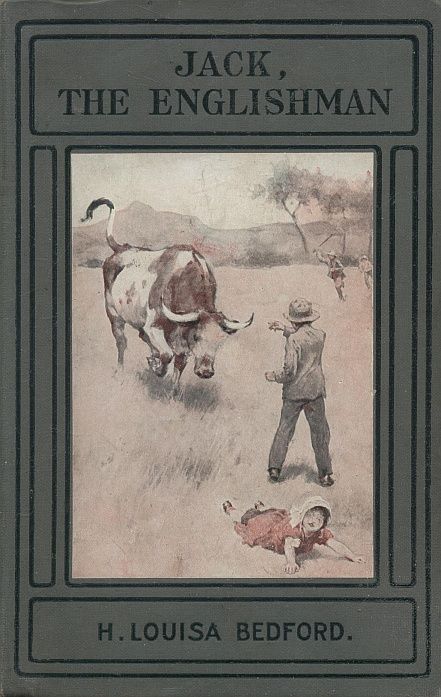
"I'd come with you if I weren't as lame as a duck," said Clarissa, "but ever since the bullock incident, I've always felt Eva as safe with Jack as with a man."
"I'll come," said Tom. "You shall look in one direction, and I in another. It's impossible that they can be very far away," and he took his place at Betty's side.
"How oppressive the day has become! or is it that I'm hurried, and a little flurried as well?" Betty said with an uneasy laugh. "I'm not a nervous woman, but I confess I'm rather frightened at the children not being here, and I'm blaming myself also for having left them so long."
"Depend upon it we shall see them coming over the bridge lugging an enormous basket of blackberries. Eva was full of importance over some secret scheme that she and Jack were going to carry out, and it may have taken longer than they calculated, as our expedition did this afternoon."
The commonplace suggestion soothed Betty without quite satisfying her. Tom threw up his head suddenly, scenting the hot air.
"The heat is explained also, I think, by the fact that there must be a bush fire not very far away. I smell the delicious pungency of its burning, and the coppery look of the clouds veiling the sun suggests smoke."
"A bush fire near here," said Betty, turning a white face on him. "You don't think that by any chance the children have wandered into the bush and——" her tongue clicked against the roof of her mouth, refusing to voice her fears.
"Oh, dear no," said Tom ready to bite out his own tongue at having hinted at the fire. "I feel that they have wandered far down the river, possibly to some haunt Jack thought a likely one for blackberries."
That suggestion did not comfort Betty greatly. What was more likely than that Eva, venturing too near the river, might have slipped in, and that Jack and she had drowned together in his effort to save her. and were they caught in the fire in the bush their fate would be no less horrible! The fear, kept to herself, was too terrible to bear.
"I'm frightened," she said, trying to smile off her terror. "I feel as if something frightful had happened to the children."
"It's scarcely like you to give way to nerves," Tom said with a smile. "You go along the road for a little way, and I will follow on by the river bank. Cooey when you want me to come back;" but he could not smother his own anxiety as he scrambled along.
Presently he heard a long cooey, and cooeyed an answer with a sense of triumph.
"And here we've been full of fears, like a couple of grandmothers, and she's found them coming back like a pair of puppies, a little ashamed of themselves for having run away," he said, with a joyous little laugh, but it was Betty alone he saw crossing the bridge when he arrived there.
"I thought surely you were bringing them with you."
"I've found—this," Betty said, holding out a large white ribbon bow. "It's Eva's bow."
"And where?"
"At the turning which leads to the bush."
Their eyes met for a moment. "That, at any rate, gives us some clue as to where to look for them. We ought to be thankful for the bow and its message."
"What message?" asked Betty.
"That they are safe somewhere, I feel certain of it. I was more frightened by the river than the bush. Strayed children can be found."
The sound of wheels from behind them made them look round, and they saw that already some of their party were on their homeward way.
"What are you about, you two?" said the man, drawing rein with a good-natured laugh. "Tea will be over and done with before you get back. I've got to be back with my missus to look after the farm. I'd advise you to hurry up if you don't want to miss your rations," and before they could answer, or explain the cause of their delay, he had whipped up his horses and had passed on his way, the grating sound of the brakes dying out in the distance.
"We must get back and tell them," said Betty, "and then we must set about a systematic search. I'm thankful those people did not stop to learn what was the matter."
Neither spoke as they hurried back to their companions. Clarissa Kenyon's terror when she heard the children were lost was absolutely ungovernable in its expression.