
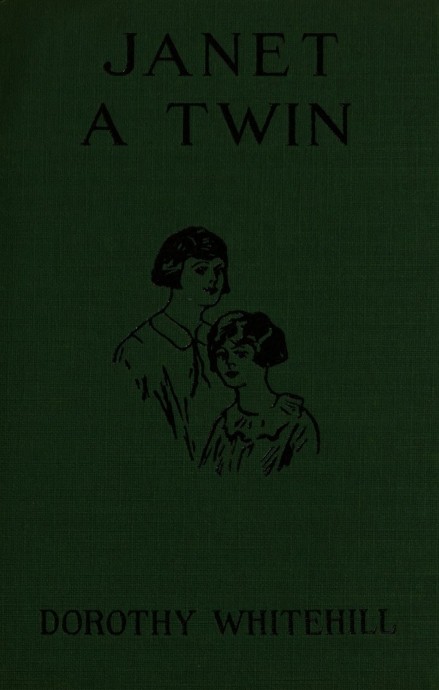
The Project Gutenberg eBook of Janet, a twin
Title: Janet, a twin
Author: Dorothy Whitehill
Illustrator: Thelma Gooch
Release date: March 30, 2025 [eBook #75755]
Language: English
Original publication: New York: Grosset & Dunlap, 1920
Credits: Al Haines
She jumped and looked up and directly into the grey eyes
of the mysterious boy. (See Page 68)
JANET
A TWIN
BY
DOROTHY WHITEHILL
ILLUSTRATED BY
THELMA GOOCH
GROSSET & DUNLAP
PUBLISHERS NEW YORK
Copyright, 1920,
by
BARSE & CO.
MADE IN U. S. A.
CONTENTS
CHAPTER
I A Glimpse of Janet
II On the Widows' Wale
III Mrs. Todd Intervenes
IV Janet's Kingdom
V Nor Like Other Girls
VI The Fair
VII A Stranger in the Kingdom
VIII Under Arrest
IX The Mysterious Owner
X Peter
XI Another Letter
XII Janet's Passenger
XIII The Greatest Surprise in the World
XIV A Long Day
XV The Day at Last
XVI A Day Together
XVII At The Rectory for Tea
XVIII A Full Cup of Happiness
XIX Twins Indeed
XX Good-By
XXI Conclusion
ILLUSTRATIONS
She jumped and looked up and directly into the gray eyes of the mysterious boy ... Frontispiece
"You're not teasing me, are you?" she asked, and her voice trembled
JANET, A TWIN
CHAPTER I
A GLIMPSE OF JANET
It was an every-day sort of a looking road, broad and dusty and flat. It ran straight across the landscape and ended abruptly in a merger of blue sky and sparkling sea. On either side of it sandy soil dotted with clusters of dwarfed scrub oaks stretched out into limitless space. There was an uninteresting sameness about its sunny dustiness that discouraged all hope of adventure.
But on a late September afternoon it was the setting of a little scene that marked the turning place in the life of Janet Page.
The drowsy quiet was broken first by the short, excited bark of a dog, a crackle of leaves and a snapping of twigs in the scrub oak, and then several things happened in quick succession.
A long snake scuttled into the road, a wiry little Irish terrier bounded after it, followed by a whirling fury of starched petticoats, long slender legs and an immense red bow.
This was Janet.
A tiny cloud of dust curtained them all for a minute; when it settled, it disclosed a rigid tableau. Janet held the dog's collar in one strong little brown hand, and with the other and the aid of one foot she grasped the snake.
"Do something!" she demanded excitedly, as she turned angry eyes toward a fat, roly-poly figure that still remained partially hidden by the scrub oak, watching the scene with an expression of fear and distaste in his pale blue eyes.
This was Harry Waters.
"What do you want me to do?" he asked sulkily.
Janet was too much occupied to look at him, but her voice expressed the contempt she felt.
"You might take Boru," she suggested.
Harry made a wide detour and, snatching the dog, retreated hurriedly back to the side of the road.
"You're not going to kill him," he said nervously, and he pointed a trembling finger at the wriggling snake.
For answer, Janet picked up a large stone. Harry turned his face away. He wanted to put his fingers in his ears so that he would not hear the soft thud that followed, but the frantic dog made that impossible.
"Come on back," Janet said at last; "he's quite dead, and I've thrown him into the bushes, so you won't even have to look at him." Her voice sounded very grown up and patronizing, and Harry justly resented it.
"Now look here, Janet Page," he exploded; "you needn't put on airs. It's not such a big thing to kill a snake anyway," he finished lamely. "I could have done it only I didn't see any sense in it; even if it had bitten Boru, it wouldn't have hurt him any." Harry was trying hard to justify an act that he hardly understood himself. He was a nice boy, two years Janet's senior, and until to-day he had never let her forget his advantage.
He tried to assert it now.
"You see, I'm older than you are and I've got lots more sense. I knew that a snake like that couldn't really hurt a dog and so I just—" He paused, and under Janet's cool gaze he blushed very slowly, right up to the roots of his hair.
"Why don't you tell the truth?" she asked quietly. "You know you are afraid of snakes."
"Well, what if I am?" Harry shifted his feet uncomfortably. "I can't help it, can I? Anyway, your grandmother says—"
"Never mind what my grandmother says," Janet interrupted angrily. "I know it all by heart. She says you are a very mannerly little boy; that's because you never forget to take off your hat when you go into her room. And she says you're respectful; that's because you always say 'yes, ma'm; no ma'm; thank you, ma'm,' and she says you always look tidy, and that's because you never climb trees and always wear shoes and stockings, no matter how hot it is, and—"
"Can't help it if my mother makes me, can I?" Harry blazed out.
Janet paused to consider.
"No, I don't suppose you can," she said at last; "only somehow I wish you were different." Her gaze traveled slowly from his round-toed boots to his neatly brushed hair; a dreamy look came into her eyes, and the little flecks of gold in the soft-brown iris caught the sun's rays and glistened. She sighed profoundly.
"But if you couldn't kill a snake," she said, speaking more to herself than to him, "why, you couldn't ever kill a dragon, you see; nor ride a coal-black charger, nor fight for your lady's favor—" Her brow wrinkled in a puzzled frown, but it cleared almost at once. "I was forgetting," she laughed; "you wouldn't want to anyway, so it doesn't matter; that is, not so very much."
She looked around her for Boru; he was busily investigating the remains of the snake in the bushes, but at her whistle he trotted obediently to her heel, and together they walked off down the road.
Harry, after a miserable minute of indecision, followed.
They walked in silence, Janet a little ahead, until they reached the road that ran along the waterfront and passed the white gate of the old Page house.
"Aren't you going to go with me any more!" Harry asked forlornly.
Janet stopped and looked at him.
"Maybe."
"When?"
"Don't know."
"Well, I don't care if you don't; you're just a girl anyway." Harry's lip trembled ever so slightly and he turned on his heel and hurried off, trying to hold his head high.
Janet swung on the gate for a few minutes and watched him until a bend in the road hid him from view, then she went up the long flight of stone steps.
The Page house crowned the terrace above. It was big, somber and very old. To Janet it seemed to be very tired, too, as though it had waited and watched a long time for the sea, whose waves beat incessantly on the shore below, to yield some secret now long forgotten by the living world.
Four stern columns guarded the square porch and the old-fashioned, ivory-white door with its leaded fan lights and heavy knocker. Janet slipped noiselessly into the wide hall that reflected the glow of polished mahogany and soft afternoon sunlight. Just as she tiptoed across the thick rag rugs and was half way up the stairs, the big grandfather clock boomed three, and as if in echo to it a voice, quavering but still clear and penetrating, called:
"Is that you, Janet?"
Janet had a sudden and unheard of wish not to answer, but she conquered it and replied at once:
"Yes, grandmother, it's me." Before the words had had time to float down the stairs she was conscious of her mistake. "Drat the personal pronoun anyway," she said to herself; "now I will catch it."
"Janet, I called you," the voice came again, and Janet started guiltily.
"I'm coming, grandmother," she answered, and walked primly back downstairs.
Mrs. Page's room was on the first floor at the back of the house away from the sea and overlooking a trim little garden. An old-fashioned sleigh bed stood between the windows, and in the very middle of it a little old lady, wearing an immense cap, sat propped up against half a dozen pillows.
This was Mrs. Page, Janet's grandmother. She was perhaps the most feared and certainly the most respected woman in Old Chester, and although she had been bedridden for as many years as Janet could remember she took a lively interest in the affairs of the community, and no important step was ever taken until Cap'n Page's widow was consulted. Her advice had a way of sounding very much like a command.
Janet knew the room by heart. She could have told the location of everything in it with her eyes blindfolded, so she wasted no time in looking about her but went straight up to the bed and sat down on the low chair, where all Mrs. Page's callers sat. It was placed so that she could see them without twisting her neck; a thing she particularly disliked having to do.
"You called me, grandmother?"
Two steely blue eyes opened slowly, and seemed to bore into the soft depth of Janet's brown ones.
"I did; there can be no doubt of that; nor, I may add, of your reply."
For perhaps the first time in her life Janet interrupted her.
"I know I said me instead of I, but I was thinking of something else and I forgot," she exclaimed impatiently.
"And may I ask what you were thinking of?" Mrs. Page inquired in surprise.
Janet frowned and shook her head. "It's not the slightest use to, for you'd never, never understand. You see, it was something entirely different from all this." She looked around the immaculate room and shook her head again, this time in despair.
Mrs. Page lifted herself on to one elbow and looked at her grand-daughter carefully for a full minute.
"Janet," she said severely, "what has come over you?"
There was a long pause, for Janet did not reply. She was watching a butterfly out in the garden and trying to decide what it was he was whispering to that big floppy rose.
Mrs. Page settled back into her pillows and pulled the coverlet well up under her chin.
"You may go," she said, pointing a bony finger toward the door. "I am about to write to your brother. I regret that I will have to tell him that you are not only careless but rude."
"Yes, grandmother." Janet stood up, and after she had carefully straightened the chair upon which she had been sitting she walked quietly out of the room.
Once in the hall, with the door closed, a tiny sigh escaped her. She leaned up against the old clock and stared at a patch of sunlight on the rug; Two big round tears rolled down her cheeks unnoticed.
Boru came over inquisitively from his place by the stairs and licked her hand. She dropped to her knees beside him and hugged him impulsively.
"Come along, old fellow," she whispered. "Let's go up to the 'widow's walk' and think it all out. I guess grandmother is right; something has come over me."
CHAPTER II
ON THE WIDOWS' WALK
"But just what is it?" she mused a few minutes later, as she settled herself comfortably and pulled Boru's shaggy head down to her knee.
The "widows' walk" was Janet's favorite place in which to think things out, for it was on the flat roof of the house, away from any possible interruptions. Martha, the old servant, had long ago given up attempting the rickety stairs that led to it. It was in itself a rather dangerous spot. Many of the boards that went to make the platform were broken or badly rotted from long exposure to wind and rain. The railing that ran around it was in the last stage of decay. But there was something about it, perhaps the feeling of being up among the tree tops, that made Janet disregard its dangers.
As a rule, she was content to sit and gaze out to sea and "pretend." The name, "widows' walk," opened up so many avenues of imaginings. She often saw the ghosts of the poor distracted women of long ago, pacing up and down, their eyes always turned toward the sea, searching for a familiar masthead. Old Chester had once been a famous fishing village, and the roof of every house along the shore was topped by some sort of observatory. Sometimes it was a square glass cupola, but more often it was a wooden walk, such as crowned the Page house, and because in so many, many cases the looked-for boats never did return to harbor, these walks unhappily came to be called "widows' walks."
To-day, however, Janet had no time for fancy. Something inside her head and her heart was demanding to be put into words.
"I wonder what is the matter with me!" she said again. "I feel awfully different. I suppose I'm unhappy. Am I, do you think!"
If any one had accused Janet of talking to herself she would have resented it hotly, but it was characteristic of her to pour out her troubles to the ever-patient and understanding Boru.
"I'm lonely, for one thing," she confided as she pulled one velvety soft ear. "Of course any one but you would say that was silly, for I have Harry to play with, and then there are the Blake children." Two well-behaved, very clean and very shiny girls filled her imagination for an instant, but she dismissed them with a frown. "They don't count, because they simply won't play the way I want to. Harry is a boy, and I do—no, I did like him a little better, but you know, old fellow, that after the way he acted to-day about the snake, I just—well, he is a scare-cat and that's all there is about it."
Boru's eyes, almost as brown as his mistress's, looked up in solemn confirmation of her last remark.
Her thoughts wandered for a minute and then came back to the original idea.
"I guess lonely isn't just exactly the word, but it's something a lot like it. I want some one to be with who is more like me—" She broke off suddenly, "I wish I had a sister," she whispered softly. Her arm tightened around Boru's neck, and she buried her head in his shaggy coat. Then quite suddenly she sat bolt upright, and her eyes flashed. "I'm mad, too; mad all the way through at everything and everybody except you,"—Boru acknowledged the exception with an affectionate lick—"and I think the person I'm the very maddest at is my big brother Thomas. He's not a bit the kind of a brother to have." She jumped up suddenly, and the breeze coming in from the water took the skirt of her gingham dress and flapped it as it would a sail.
"Boru, do you know what I am going to do!" she demanded very seriously.
Boru was a little surprised and disturbed at being so unceremoniously upset but he cocked one ear expectantly.
"I'm going to write and tell him so," she announced defiantly.
Her determination did not leave her even when she was seated at her big desk, where everything was arranged in perfect order for letter writing. Janet had written her brother at stated intervals during her thirteen years, but each and every letter had always been carefully read and corrected by her grandmother. Stiff and formal notes were the result. As for answers, she had never received any, as far back as she could remember, but a brief typewritten note reached her grandmother twice a year and stated, rather than said, that Thomas was well and that the ranch in far-away Arizona was as successful as could be expected under the conditions of the present year. True, he never forgot to send his love to Janet, but Janet, from early childhood, had had a very decided idea about that sort of love. To-day she meant to make that idea known.
With a great deal of care and precision she selected an especially clean sheet of paper and a square and very businesslike envelope, put a new gold pen in her penholder and set to work. The first words she wrote were "Dear Thomas," then she stopped. There were so many things she wanted to say. She looked to Boru for inspiration He was gazing thoughtfully at a fly that was crawling along the floor; the instant it started to fly he pounced on it. Janet laughed. "Thanks, Boru; that is just what I'll do myself; I'll gobble Thomas up all at once." She turned back to her desk and wrote under the "Dear Thomas:
"I have been meaning to write to you for ever so long and to say just what I wanted to, and so I might as well tell you right away that grandmother is not going to see this letter at all. It's just from me to you, and I'm not going to be particular about grammar or blots. The most 'special things I have to say are all questions, and then some other things that are not very nice. Perhaps I'd better start with those. The first one is that I think you would be a lot nicer if you called yourself Tom or Tommy, instead of Thomas. Of course I don't know what you look like, for the only picture we have of you is a baby one that I know you would perfectly hate, but I think you are short and frown a lot, and I hope you haven't a beard but I'm afraid you have. I just told Boru, that's my dog, but you probably wouldn't like him, that you were not a bit what a big brother ought to be, and I really don't think you are, and I might as well say that you would have been much more of a comfort to me if you'd been a sister.
"The questions I want to ask you are: What do you do in Arizona, and are you ever coming home, and do you ride horseback, and don't you like to be with lots of people instead of just with a few that some one else chooses for you, and what would you think of a boy who was afraid of snakes? If you say that he's a sensible boy—that's what grandmother would say—I'll never like you, never.
"If I only knew you and you were nice like the boys in the books I read, how many things we could talk over! I could ask you about all the things that really matter—the things that grandmother won't even let me mention. Thomas, I'm really not too young to be told things. I'd grow up all in a minute if I could be with girls my own age. But I don't expect you'll understand, so I won't write any more. I've said some of the things I wanted to and that makes me feel a little tit better."
She hesitated over the ending, and finally decided just to sign her name. Then without reading over what she had written, lest her resolve weaken, she folded up the paper and put it into its envelope.
Boru's tail thumping on the floor made her conscious of steps outside her door, and she hastily finished writing the address and slipped the letter into her pocket just as Martha opened her door.
"Now, Miss Janet, not dressed for your tea, and it almost six o'clock, and Mrs. Waters with your grandmother and wanting to see you! Tut, tut!" Martha shook her gray head in real despair. She was a kindly old woman, who had served faithfully all her life, but because it was so simple for her to do what was expected of her always she had never understood how hard it was sometimes for others; but she was never cross and usually contented herself with saying, "Tut, tut!" in her mild old voice at all Janet's failings.
"What does Mrs. Waters want me for?" Janet asked. A vision of Harry's mother retailing the afternoon's adventure with the snake made her heart sink.
"I couldn't say, my dear," Martha replied placidly. "Your grandmother sent me to get you. Here now, brush up your hair a bit. Are your hands clean?"
Janet submitted to being tidied up, and then hurried downstairs to her grandmother's room.
Mrs. Waters was seated in the visitor's chair, her back to the door, but she turned around as Janet entered and smiled a welcome. Mrs. Page spoke:
"Janet, what is all this I hear about your knowing how to take care of sick dogs?" she inquired crossly.
Janet hesitated. She did know a good deal about the care of all animals, but she was at a loss as to how to explain her knowledge to her grandmother.
"Well, do you or don't you know anything about them?" Mrs. Page insisted impatiently.
"Yes, I do know about them." Janet's reply came so quickly that it surprised herself.
Her grandmother looked at her for a long minute and then nodded her head. "Very well; go with Mrs. Waters and do what you can for her dog," she said sharply, and then to indicate that the interview was at an end she turned her back on her visitors.
Mrs. Waters took Janet's arm and hurried out of the room. She was a timid little woman, very easily silenced, and she still spoke in a half whisper when they were out of the house.
"It's Roy, my dear, our English setter; he has hurt his paw, and the veterinary is away," she explained.
Janet gave a mighty sigh of relief. Harry had not told tales. She smiled at his mother reassuringly.
"Poor old fellow. I hope I can do something to help him."
"Oh, I'm sure you can. Harry says you are wonderful with animals," Mrs. Waters replied. "Roy is such a valuable dog," she added.
They reached the Waters' cottage, just off the main street of the little village, and Janet followed Mrs. Waters around to the barn. Before the door was opened, she could hear the low moan of an animal in pain. Once inside, she knelt down beside Roy and patted him. He gave her the affectionate welcome, always awarded a true dog lover.
She examined his paw and found the trouble to be a deeply embedded splinter.
"May I have a darning needle? she asked. Mrs. Waters hurried to the house to get it. Janet busied herself filling a basin with clear spring water, and she took the towel from its roller on the kitchen porch.
"Here it is, my dear," Mrs. Waters said, "and a bottle of peroxide. You don't mind if I don't stay, do you! I'd be sure to faint."
Janet smiled. "No indeed. I can get along quite well alone," she said, and knelt to her task.
For the next few minutes she was absorbed in her work. The splinter was in deep, and it was hard to make Roy lie still. She was about to give up in despair when a voice, almost at her elbow, said:
"Here, let me help."
She turned quickly, startled, and saw a boy about fifteen, very shabbily dressed in old blue overalls and a torn straw hat. His hair, burnt by the sun, was almost red, and his eyes were a clear gray. Janet was too astonished to speak, but with a nod she accepted his offer to help, and they worked in silence until the splinter was out and the wound carefully bathed.
"I guess I'll let him lick it," Janet said, putting aside the bandage Mrs. Waters had given her. The boy nodded.
"Best way," he said. "Do you know horses as well as dogs!" he inquired slowly.
"No, we haven't any, you see," Janet replied, as she gathered up the things and started for the house.
"Too bad." The boy spoke with a drawl that had nothing of laziness in it but a good deal of dreamy calculation. He leaned over and patted Roy. "Good night, old fellow," he said, and without a word more to Janet he disappeared as quietly as he had come.
Janet went on into the house, wondering who he could be, but for some reason she did not ask Mrs. Waters, perhaps because that good lady was too busy thanking her.
"I think you are so clever, dearie," she said warmly. "I wonder where Harry can be. It's dark, and he ought to see you home."
"Oh, don't bother Harry," Janet protested. "I'll run all the way and I'll be there in no time. I'll be down to see Roy to-morrow."
As soon as she was out of sight of the cottage she did run. It was quite chilly, and the salt wind in her face made her blood tingle, and all the worries of the day faded away with the last glow of the sunset. It was not until she was undressing for bed, several hours later, that she remembered her letter. Her time had been taken up thinking about the strange boy who had come so quietly to her aid. When she went to the pocket of her dress to look for it, it was not there.
CHAPTER III
MRS. TODD INTERVENES
"What are you in such a hurry with your breakfast for, child?" Martha, her hands on her big hips, stood in the doorway between the dining-room and the kitchen, and looked at Janet with mild curiosity.
It was a gray, misty morning, with a salty taste and feel to everything. Janet looked up from her place where, with the assistance of Boru, she was finishing the last strip of bacon on her plate.
"I want to go over to the Waters' to see how Roy is," she explained only half truthfully, for her thoughts were almost entirely centered on the hope of finding the letter she had lost the night before.
"Well, dearie me, that's no reason for bolting your food," Martha protested, but she let the matter drop and went back into her kitchen.
Without waiting to stop at her grandmother's room, Janet hurried out of the house and started for the village. She kept her eyes on the road, but the Waters' cottage was reached without a sign of the missing white envelope.
Harry was lurking in the doorway of the barn, and Janet called a cheery greeting to him. There was no sign of the boy with the torn straw hat.
"How's my patient" she asked.
"Ah, he's all right." Harry was still a little resentful, for he was thinking of the snake. Janet had completely forgotten it.
Roy, at the first sound of her voice, got up from his place in the hay and wagged his tail. Janet knelt and inspected the paw.
"It's a whole lot better, isn't it, old fellow?" she asked as she patted him. "Keep it clean and don't walk on it," she advised seriously.
Harry, watching her, laughed.
"You'd think Roy was a human being to hear you go on. He doesn't know what you're talking about," he said.
Janet did not reply, but she smiled into the dog's eyes, and Harry had an uncomfortable feeling that they were both laughing at him.
As she talked, Janet made a careful search for the letter but it was nowhere to be seen, and with a sinking feeling at her heart she realized that some one must have found it. But whom? She knelt on the floor beside Roy, and the thought worried her brain. If Mrs. Waters had it she would, of course, take it to Mrs. Page and then—she shrugged her shoulders. It was foolish to worry over it anyway, until something happened. It would be a simple matter to write another, but somehow the spirit that had prompted her to revolt the day before was gone.
"What are you doing anyway?"—Harry interrupted her musings. She gave a characteristic little shrug and jumped up.
"Nothing much," she replied, laughing.
Harry had been doing some thinking himself for the last few minutes, and he had come to the decision that it never paid to get mad at Janet, for no matter how cross you acted she never even bothered to notice you. So it was with a very different tone of voice that he asked as she started for home:
"Do you care if I go along with you?"
"No, come on if you want to," Janet replied, and together they walked down the path.
"Let's stop at the post office," Janet suggested, her thoughts, in spite of her determination to forget it, still on the letter.
As they neared the little, low, red-brick building almost covered by dark green ivy that served as post office and general store for Old Chester, they noticed a horse and cart with bright yellow wheels drawn up at the curb. The harness was new and shining, and the horse, a beautiful sorrel with slender legs, tossed his head impatiently.
"Why, who does that belong to?" Janet exclaimed.
"Dunno," Harry was not particularly interested. "Guess it's Mrs. Todd's. I heard mother talking about her last night. She is visiting at the rectory, 'cause she's a cousin or something of Mrs. Blake's." The door of the post office opened and he lowered his voice. "Here she comes now."
Janet looked up and saw a tall, mannish-looking woman, dressed in a rough serge suit and heavy boots, coming toward them. She had on a soft gray felt hat without any trimming, and she carried a market basket over her arm. Her eyes were small but they were so very blue and penetrating that Janet felt they must be making holes in the back of her head.
"Hello, whose children are you?" she demanded rather than asked as she put her basket into the cart She turned to Harry. "You're Harry Waters. I know but you." She scrutinized Janet, and suddenly her face softened and she put one big hand on her slender shoulder.
"You're a Page," she said. "The Pages all have straight short noses. Wait a minute and let me think. Haven't you a sister?"
Janet shook her head and smiled. It was a merry smile, for she suddenly realized that she liked this queer, outspoken woman very much.
"No, I haven't a sister," she replied. "I wish I had. I have a brother and a grandmother, and I think that's all, except Boru." She looked down at the dog who was sniffing at the stranger's skirts. "Your horse is a beauty," she added shyly.
"Like him? So do I. Suppose you drive me home; that is, to the rectory. I am staying there, and my name is Ann Todd. Here you are! Jump in, Harry. If you can wind up those fat legs of yours you will just fit in the back."
Janet had hard work not to show her surprise, for it was even greater than her delight. She had never, in all her short life, met any one who out off their sentences as though they were clipping threads and who made up their minds so quickly.
They reached the rectory before she could think of anything to say, and then all she could stammer was, "Oh, thank you ever so much; it was simply thrilling."
Alice and Mildred Blake were sitting in the tiny little flower garden, both busy with yards of green bunting which they were sewing together in long strips. They looked up in surprise as they saw Janet and Harry.
"Oh, Janet, will your grandmother really let you; isn't that wonderful!" they exclaimed.
Janet was utterly bewildered. "What are you talking about!" she demanded. "Will my grandmother let me do what!"
Alice and Mildred looked at each other in confusion, and then at Mrs. Todd.
"We thought—" Alice began.
"Cousin Ann and mother said—" finished Mildred.
Mrs. Todd laughed heartily at their embarrassment and put her arm around Janet.
"Perhaps I can explain," she said. "The girls are talking about the church fair. Their mother said something last night about your grandmother's never letting you take any part in it, and I said that I would undertake to see that you came this year, and so I will." Her jaw snapped with such decision as she said these words that Janet almost jumped.
"That's awfully nice of you," she replied politely, "but grandmother's mind is rather hard to change. I never try."
"Why won't she let you?" Alice asked timidly.
"I hardly remember,"—Janet laughed. "It's so long since I ceased to come. I was ten then and I thought it would be such fun, but—well, I didn't, and I've never asked since. I think being out late was one of the reasons."
"Humph!" was all Mrs. Todd had to say, but a few minutes later she offered to drive Janet home.
"And I'll stop in and say 'how do you do,' too, while I'm there," she decided.
On the way, as they bowled along the soft sandy road, Janet worried a little. It was luncheon time, and her grandmother never saw visitors until after three o'clock, but it would be quite useless even to try to explain this to Mrs. Todd, for in her own way she was just as positive and determined as the eccentric Mrs. Page.
"Grim as ever,"—Mrs. Todd laughed as the house came into view. "It's twenty years since I opened that front door but, bless my soul, I know that everything is going to be just the same."
"Why, did you ever live here!" Janet looked at her companion in surprise.
"I did, and I was in this house almost as much as I was in my own. Your father and I were the best of friends."
"Oh!" was all Janet had time to say, before Martha appeared at the door.
Mrs. Todd nodded to her and tied the horse to the garden gate and walked slowly up the narrow, moss-grown walk, a whimsical smile on her thin face.
Martha was speechless, and Janet had to laugh as she watched her curl one end of her apron into a hard little knot.
"Well, Martha,"—Mrs. Todd held out her hand—"don't look as though you had seen a ghost."
Martha managed to say something, but she was quite powerless to stop the visitor from striding into the house and walking unannounced into Mrs. Page's room.
Janet sat down on the stone seat in the garden and waited. Boru stretched out on the path at her feet and panted after his run. Not a sound came from the house.
Janet did not try to imagine what was going on in her grandmother's room. She was conscious that a big change had come into her life, and she dimly realized that in the future she would spend more time in thinking than she had ever spent before. It seemed as though she was conscious of the world around her, and instead of just accepting it she felt that she was a part of it.
"Janet Page," she said aloud, and stared hard at the old sun-dial. Suddenly Boru barked, and she jumped as though she had been wakened from a dream. The dog rushed to the corner of the garden, and Janet looked up just in time to see the rim of a torn straw hat disappear over the wall.
CHAPTER IV
JANET'S KINGDOM
Janet did not have time to investigate further, for at that moment Martha beckoned her mysteriously into the house. It was plain to be seen that the old servant was greatly disturbed.
"What's the matter!" Janet inquired in a whisper, for she caught some of the suspense.
"Oh, Miss Janet, whatever shall we do?" Martha exclaimed. "Mrs. Todd walked into your grandmother's room, and they have been arguing ever since. Your grandmother will have a turn I know, and yet I don't dare to interrupt them. What shall I do?"
It was a proof of the Great Change to be consulted, and Janet smiled with something like pride.
"I shouldn't do anything if I were you," she replied quietly. "Perhaps they are not arguing any more. They may just be talking; they're old friends, you know."
Martha shot a quick glance toward the closed door. "Old friends," she said, and then, thinking better of it, she did not finish the sentence, but said instead, "Sit down to your luncheon, child, do; it's getting cold and there's no reason to wait."
Janet nodded and went into the dining-room. She took a long time over her chops and sweet potatoes, but she finished without hearing the door to her grandmother's room open.
Martha was almost in tears. "Your grandmother has had no luncheon," she protested. "Dearie me, what shall I do?"
"Take my advice and wait until she calls you," Janet advised. "You know she doesn't like to be disturbed. I'm going out," she added. "No, Boru, you can't come to-day; stay home, like a good dog."
Boru buried his head in his paws and with a very mournful expression watched her leave. He knew that there was one mysterious place to which he was never allowed to accompany his mistress, and he resented it. He was right in guessing that she was going there to-day.
Janet left the house by the door that led to the steps and down to the sea road. The water looked sparkling blue and inviting, and she hurried along until she came to a small dock, very much the worse for age. She untied a row boat and found two broken oars that were hidden in the tall grass beside the road. There was no one in sight as she pushed off, and only a few sails were visible flapping smartly out beyond the harbor.
Her cheeks were flushed as she sent the old boat skimming over the water, for she was on her way to her secret kingdom. Though she had sailed to it many times there was always the chance of discovery, and that added zest to the adventure.
The point of land toward which she was heading was quite a distance off, and looked to be rather a desolate island. It was, in reality, however, a part of the mainland, for the bay came in, and the land around it was shaped like a big hook. There were a few fishing huts along the shore, and farther inland low farms nestled into the hills.
Janet chose a certain cove to land in and pulled her boat safely up on shore, and then she started off at a brisk walk. At this particular point of the beach the sand dunes were very high, and she was screened from sight except from the water front. She walked for about a quarter of a mile and then began to climb. Up above her on a rising knoll of ground a little way beyond the sand dunes was an old gray house. It was large and very rambling, but it was tumbling down. The roof sagged at one end, and the two big chimneys were crumbling to ruin. There was not a sign of life anywhere about it or in the many ramshackled farm buildings that evidently belonged to it. All the windows were boarded up but one, a very small one that led into the cellar. Janet pushed it open gently and slid down as far as she could and then dropped. It was very dark and very musty. She groped her way to the rickety stairs as quickly as she could. The door at the top opened with a groan as she pushed, and she was in a long, low-ceilinged kitchen. Rain had come down through the leaky roof and rusted the stove, the furniture was covered with dust, and a forlorn china cup with its handle broken lay dejectedly on one corner of the table.
Janet glanced hurriedly about her, to make sure that no one had been in the room since she had, and then hurried into the front hall. Some heavy pieces of furniture were partly covered by torn and dirty sheets; they looked like ghosts in the dim light that filtered in through the boarded windows. Janet, in spite of the many times that she had passed them, could not repress a shiver, and she gave a sigh of relief as she closed the door of another room behind her. She was in her kingdom at last, and she surveyed it with sparkling eyes. It was a long room with a low ceiling that ran the length of the house. In the center along one side was a huge fireplace. Each one of the six windows had a broad window seat. There was very little furniture, and none of it was covered by dust sheets. In consequence, the stuffing was coming out of several of the chairs and a puddle of water had sopped into the big horsehair sofa. The only human looking thing in the room was a pair of gloves on one end of the table. They were badly mildewed and they looked very limp and lifeless, but they had belonged to some one of the mysterious owners of the house, and Janet always nodded to them with mock respect. It was the books that made the room a kingdom. Rows and rows of them lined the walls from floor to ceiling. Some of them were damp and moldy but they were all readable, and that was all that mattered to Janet, though she sometimes cried over a broken binding and patted it quite as she would have stroked a hurt puppy.
"Well, my darlings, I have come back to you," she said as she slipped to her knees before a corner bookcase, "and I want you to be very kind to me and take me far, far away to—" She let her hand wander over the backs of the books until it rested on one, "Greece," she finished, as she read the title.
She made herself as comfortable as possible in one of the window seats, and for an hour she was so engrossed in the old fables and the stirring tales of the gods that she forgot the time. It was only when the light through the chink of the boarding grew too dim to see that she realized with a start that it was getting late.
"And I never looked up about Roy's paw in that animal book!" she exclaimed. Had Mrs. Page heard her, she might have understood where she had learned so much about the care of dogs.
Janet hurriedly put her book back and went to the bookcase across the room to find what she wanted.
"That's funny," she said. "I thought I left it—why, I did; here's the place where it belongs." An empty hole on the bottom shelf confronted her, and looked as if the smiling row had lost a tooth.
Without exactly knowing why, Janet was frightened. She had looked upon this room as so particularly hers for so long that there was something uncanny in the thought that some one else had dared to trespass.
"Perhaps I put it back somewhere else." She tried to comfort herself with this thought, but she could not get rid of the queer feeling that some other hands were touching her loves, and that other eyes were seeing into her enchanted pages.
She puzzled over it as she rowed home, but it was impossible to come to any conclusion.
Martha was waiting for her in the hall; her face was even whiter than it had been earlier in the day.
"Miss Janet, you're back, thank goodness; your grandmother has been calling for you all afternoon."
"When did Mrs. Todd leave!" Janet enquired.
"She hasn't left at all," Martha gasped. "She's sat in there the whole blessed day. Only an hour ago she came into my kitchen as smiling as you please, and said she and Mrs. Page would have a cup of tea and some toast and jam. I took it in, and, well, Miss Janet, it's beyond me; indeed it is!"
"But, Martha, why shouldn't they have tea? Grandmother always has it for her guests." Janet laughed.
Martha sighed profoundly.
"If you knew all that I know of those two and then to see them smiling and laughing together," Martha shook her head, unable to give vent to her feelings in mere words.
Janet raced upstairs and changed her dress, and in a very few minutes she was knocking at her grandmother's door.
"Oh, it's you, is it, dear child!" Mrs. Todd called as she entered. "I was hoping you would get back in time to drive me home."
"Ann, don't presume too far," Mrs. Page said tartly. "Janet, where have you been?"
Janet decided that the change in her grandmother was not as great as Martha had led her to suppose, so she answered as she always did.
"I have been out most of the time."
"To whom are you speaking!" Mrs. Page inquired.
Janet sighed and blushed a little; it was not like her grandmother to find fault before people.
"I'm sorry, 'I have been out most of the time, grandmother,'" she corrected, but a second later she almost laughed aloud for she was sure she had heard Mrs. Todd say "fiddlesticks" under her breath.
"I wanted you all afternoon," Mrs. Page went on. "However, we will let that pass. Mrs. Todd wishes you to help this year at the church fair and I have given my consent under one condition—that you are home here by nine o'clock."
"Ten," corrected Mrs. Todd crisply.
"What did you say, Ann?" Mrs. Page's eyes flashed.
"I said ten," Mrs. Todd repeated. "Ten was the hour we agreed on. And now I must be going, as my eyes are not what they used to be and these new roads puzzle me. I must ask you to let Janet drive me home."
For a long minute there was silence, and then Mrs. Page did something she was rarely ever seen to do; she smiled.
For a long minute there was silence, and then Mrs. Page
did sometning she was rarely ever seen to do; she smiled.
"You are a very smart woman, Ann Todd, and I'm a very old one. Have your own way, but remember your promise," she said.
The drive through the twilight was wonderful, for Mrs. Todd let Janet do the driving while she sat back and talked.
"You're a funny youngster," she said when they were half way to the village. "You haven't asked me a single question."
"About grandmother, do you mean?" Janet laughed. "I didn't have to. You see, you made her let me go and that's all that matters."
"Aren't aren't you curious to know how?"
Janet shook her head.
"Well, I'll tell you. I bullied her.
"Your grandmother is a very remarkable woman," she added after a silence that lasted until they were turning into the driveway of the rectory grounds.
"I think she is too," Janet said loyally, "and every one is sure to like her when they know and understand her."
Mrs. Todd got out at the carriage block. "Bless the child," she said almost tenderly, but a second later, as she was going up the steps, she said in her usual brisk manner, "Come 'round to-morrow and see me; we'll have a chat."
Janet gave the horse over to the hired man and walked slowly home. She was so absorbed in her thoughts that she reached the end of the garden wall before she knew it.
The sound of an automobile made her hurry to the side of the road. Motors were not very common in Old Chester, for it was away from the beaten track and the roads were very bad. Janet was a little ashamed of her interest in them, but she could never resist staring at them. The one that was approaching now had powerful searchlights, and she watched them, fascinated. It looked as though they were sweeping right on to her very feet. Suddenly they fell across the corner of the garden wall. It was only for a minute, but it was long enough to illuminate a patch of ground and to bring out into sharp relief a torn straw hat and a thick book bound in dull blue, embossed with a gold dog.
CHAPTER V
NOT LIKE OTHER GIRLS
"My dear, you look tired out!" Mrs. Blake exclaimed the next morning, when Janet, very flushed and blown, presented herself at the rectory. "What have you been doing?"
"Oh, it's an awfully windy morning, but I'm not really tired," Janet replied.
"Yes, it's blowing a gale and it must be hard to walk," Mrs. Blake agreed. "It's bad enough down here, but it must be dreadful up at your house. I can't be glad enough that we are not on the shore; the sound of the waves would depress me so," she added as she gave a little shudder and held the door open for Janet to come in.
Janet did not bother to tell her that she had battled with those same waves in a leaky boat not half an hour ago, for she knew Mrs. Blake would not understand the importance of replacing a certain book in a certain shelf, nor would she see anything funny in the sight of a torn straw hat lying beside a pair of old gloves. But Janet had a very vivid imagination, and she had rowed over that morning to the Kingdom in order to replace the animal book and further to confuse the mysterious boy, she had left his hat on the library table. Her only regret was that she would not be there to see his expression when he found it. There could be no doubt now that he knew the secrets of the deserted house—the hat and book proved it. But Janet, remembering the look in his gray eyes and the way he had patted Roy, could not find it in her heart to be angry.
A bright fire burned in the rectory living room, and Alice and Mildred were sitting beside it. They were still working over the green bunting.
Janet's heart sank. She hated to sew, for her fingers, in spite of Martha's patient teachings, insisted on acting like thumbs.
"What would you like to do, my dear?" Mrs. Blake inquired sweetly. "Will you help the girls or would you rather do something else?"
"I'll do whatever you like," Janet said hesitatingly, "but I think perhaps I could do something else better than I could sew. I'm not very good at sewing, you see."
Alice and Mildred looked up in shocked surprise.
"Don't you like to sew?" Mildred said incredulously.
Janet flushed. "No, I don't," she said bluntly.
"How odd!" Mildred and Alice exclaimed together. "We love it."
"Daughters!" Mrs. Blake warned, for she had caught the suggestion of scorn in their voices, and she was quick to notice Janet's flush.
At that moment the door from the dining-room opened, and Mrs. Todd entered. Her cheeks were flushed, and her narrow little eyes seemed brighter than ever.
"Morning everybody," she greeted, smiling at Janet. "You look very cozy in here, but you also look very stuffy. What's the matter, Janet!"
"Nothing, only I'm afraid I'm not going to be much of a help," Janet confessed. "I don't like to sew, you see." Janet always said "you see" when she was embarrassed.
"Neither do I,"—Mrs. Todd laughed. "Had to do too much of it when I was a child."
"Perhaps we can find something else for Janet to do," Mrs. Blake interposed.
"Why, of course, we can. Come with me, Janet. We'll rig up the fishing pond."
Janet waited until she was well away from the library before she asked what a fishing pond was. She was used to doing all the explaining and all of the leading when it came to playing with other girls, she had played so seldom with them, and this new and scornful attitude of the Blakes made her unreasonably angry. She knew that if she were competing in climbing trees or rowing—anything that took courage—she would be their superior. But when it was a question of sewing, she had to admit herself beaten. The thought made her very unhappy, for above everything else in the world Janet wanted to be like other girls. Not the Blake girls, but the girl heroines she had read of and dreamed of as friends in her Kingdom.
Mrs. Todd noticed the worried expression on her face and did her best to dispell it by giving her something else to think about.
"A fish pond," she explained in answer to her question, "is a very easy way of making people spend money. You put up a screen and sell little wooden fish poles for ten cents. The buyer goes fishing over the screen and some one ties a present to the end of the line."
Mrs. Todd watched Janet closely, and laughed with delight as the frown deepened on her face.
"Well?" she inquired, "what do you think of it!"
"Not very much," Janet answered truthfully. "Isn't there a better way?"
"I should think there would be,"—Mrs. Todd chuckled. "If you can suggest one we'll change it and surprise them all."
"Why not let them really fish?"
"In water! What would you have them catch? Pincushions and tidies wouldn't be improved by a ducking."
Janet thought for a minute. They were in the Sunday-school rooms, and she was sitting perched up on the high platform.
"Why can't they catch things that come from the sea!" she suggested.
"What, for instance!"
"Oh, shells and coral and fishes and stones. They are every bit as sensible as pincushions and so much prettier."
"No doubt about that,"—Mrs. Todd laughed—"but where shall we get them?"
"Oh, we have just loads of them up in the attic; queer old shells from all over the world that my great-grandfather, I think it was, brought home with him."
"But, my child, you can't give those away," Mrs. Todd protested.
"Why not?"
"Your grandmother—"
"Oh, she wouldn't mind; she can't bear them. You know, she hates anything that reminds her of the water." Janet looked at her companion wonderingly.
"Queer, isn't it?" she said.
Mrs. Todd looked at her with a peculiar light in her steely eyes. "Not under the circumstances," she said softly, but though Janet waited she did not say any more.
"I asked grandmother once, oh, long ago, if I might play with those shells,"—Janet returned to the subject in hand—"and she said I might do anything I liked with them as long as I kept them out of her sight."
Mrs. Todd seemed to consider the idea. Finally she said,
"Well, bring them along with you this afternoon, and if they are of no value we'll use them and surprise the neighborhood."
"They certainly are beauties," she said, when after luncheon Janet had returned with a box full of queer old shells and rough bits of coral.
"They must have come a long way, to judge by the looks of them."
"Well, I think my great-grandfather used to sail all the way 'round the world," Janet replied. "Do you think they will do?"
Mrs. Todd looked at her. "Do, child! Why, they will cause so much excitement that our booth will be by far the most popular. The only reason I hesitate is that I am afraid that some day you will be sorry you were so generous."
"But how silly,"—Janet laughed. "These are only a few of what we have. There are heaps left in the attic."
"Settled,"—Mrs. Todd laughed. "And now, Miss Original, will you please tell me what other ideas you have lurking in the back of your brain?"
"Now you're teasing,"—Janet laughed. "There's nothing else to think of, except the pond itself, and that ought to be easy. A big tub of real sea water with pebbles and sand banked around it, and perhaps we could borrow some of Mrs. Blake's palms. She has so many, and, oh, well, we can make it look—now, you're laughing at me."
"Not a bit of it," Mrs. Todd denied emphatically. "I am laughing with you, and there's all the difference in the world between the two. But I would like to know just where you got all your imagination."
For a minute Janet was tempted to tell the secret of the Kingdom, but with a start she realized that it was no longer just her secret alone and that in telling it she would almost be guilty of betraying a confidence.
The Sunday-school room was gradually filling up with people. Janet knew them all and bowed politely to each in turn. For the most part the women from the farms, who were bringing in their donations of pies and cakes, stared at her with ill-concealed curiosity. Although she did not know it, Janet was often the topic of conversation and gossip at sewing bees. Women with daughters often spoke of her as "that poor lonely child," and thought of her as different from other girls. It was a decided shock to see her in eager consultation with Mrs. Todd—a most important person—her cheeks ablaze and her eyes sparkling, and having quite as good a time as any ordinary girl; and acting for the most part with far less affectation than their own children.
But though Janet did not show it, she was conscious of the eyes upon her, and it did make her uncomfortable. She was very much relieved when Mrs. Todd stopped in the middle of a sentence and said:
"Stuffy; let's go out and see about finding our landscape."
Once outside, Janet drew a breath of relief. Harry Waters was passing, and she hailed him with so much enthusiasm that he decided that he was forgiven and he responded joyfully.
"Want to help me this afternoon?" Janet inquired. "I want a big box of sand, and Mrs. Todd says we may drive her horse and cart to the shore. You get a box," she directed in her old manner.
Harry was too delighted to be back into favor again to make any objections and dashed off at once.
Mrs. Todd nodded her head slowly and laughed. "Boys are better fun than girls, eh?" she inquired.
"Heaps," Janet replied, as she disappeared into the barn to assist in the harnessing of Durward, Mrs. Todd's horse.
CHAPTER VI
THE FAIR
The Sunday-school room was packed with people, but to an observant eye it was noticeable that the greatest number were in the corner under a silk canopy that looked like an Arab's shelter. Hanging beside it on the wall was a sign, printed in orange and blue, that read,
COME AND FISH
IN THE INDIAN OCEAN
A SURPRISE FOR EVERYBODY
10 CENTS A LINE
Beyond the tent a group of high palms pointed the way to the beach, where a huge tub filled with water and reflecting myriads of little pebbles was surrounded by a stretch of sand. Sticks with strings and hooks attached stood ready, and to one side a mysterious mound covered by a silk scarf invited the curiosity of the passersby.
Mrs. Todd stood a little to one side and kept looking at her watch. Mrs. Blake came over to her, and it was plain to be seen that they were both worried.
"What do you suppose is keeping her?" Mrs. Blake exclaimed. "It is after four o'clock, and we must begin with the pond. Really, I think it is most inconsiderate of her to keep us waiting. Of course, if Mrs. Page has changed her mind—"
"Mercy Page never changed her mind in her life," Mrs. Todd snapped. "It is something very different than that, and I have a strong suspicion what it is." She looked at a group of giggling girls who were whispering to each other in one corner, and had one of them turned at just that moment they would have wanted to run away, for Mrs. Todd looked very stern and forbidding.
"Let some one else start it," she said. "I'll help them; she may come after all; who knows."
But Janet at that particular moment was rowing with all her might, and she was rowing in the opposite direction from the church fair.
Something glistened in both of her eyes and she stopped every now and then to brush it away. Nothing in the world could have induced her to turn around.
She was hurt and very angry, and the one thought in her confused little mind was to forget there ever was such a thing as a church fair.
This is what had happened. Harry and she had been busy in the early part of the afternoon putting the finishing touches to their work, when Janet found she wanted a pair of scissors. A number of girls were decorating a booth across the room and she went over to borrow theirs. She was hidden from them by a curtain of bunting. Just as she was about to speak, she heard one of them say,
"I don't care if she is Janet Page, I don't like her. She's not a bit like other girls." And another voice answered, "I don't either; she's so bossy." "Plain stuck up," a third voice added.
Janet flushed crimson and fled. Harry remembered that she looked awfully queer, he said, when he told Mrs. Todd later, "She said she was going and not another word," he finished.
Janet had indeed gone. She felt as though the world was falling about her ears. Try as she could, she could not keep the hot tears from coming.
The brisk row did her good, and she started up the sand dunes with her usual expectant step. By the time she was in sight of the house, she was laughing at herself.
"I may be different but I am not as bad as all that, and besides I don't like those girls any better than they like me, so we're even."
She decided to read about Mr. Micawber in "David Copperfield." He always cheered her up when she was downhearted.
The quiet of the old house soothed her feelings. She walked slowly around to the cellar window and opened it softly. Just as she was about to slip through it, a piece of tin hit her sharply on the nose.
She jumped and looked up and directly into the gray eyes of the mysterious boy. He was sitting on the edge of the sloping roof not fifteen feet above her.
"Hurt you?" he called down.
"Not much," Janet answered, rubbing her nose, for it smarted.
"Yes, it did; it's bleeding. Say, I'm awfully sorry. Wait a jiffy and I'll be down."
He slid near the edge and jumped to the ground almost beside her.
They looked at each other and then burst out laughing. Janet held her handkerchief up to her face and regarded him over the corner of it.
"What were you doing up there?" she inquired. "You nearly scared me to death."
"Well, I was kind of scared myself," the mysterious boy admitted. "I was fixing the roof up a bit. It leaks onto the books now you know, and I just happened to look down at you, I was so surprised that I let the tin drop.
"I found my hat," he added after a minute, and grinned sheepishly.
"Whatever made you leave it by our fence?" Janet inquired.
"Did you see me jump over your wall the other day?"
"Yes."
"Well, I was bringing it to you then—"
"And my dog barked at you."
"No,—that is, he did, but that isn't what scared me. Your dog and I are great friends. It was the woman that came out of the house. I couldn't explain before her so I bolted."
"Explain what?"
"I wanted to show you something about taking a splinter out of a dog's paw and a way to put on a bandage so that it won't come off."
Janet laughed, and he joined in.
"I was after the same book the other day and I couldn't imagine who had taken it and then I found it beside your hat and I knew you must come here too."