
Jerry had not been in town twenty-four hours before he found that he was decidedly a “lion,”—an object of general interest and attention. In the house, he could not stir without being followed by Emily and Harriet, who talked, thought, and dreamed of nothing but their wonderful brother Jerry. Their fondness was almost annoying to him. He was the hero, too, of all the town gossip. Everybody in that little community knew Jerry Preston, and his history,—how he grew up an idle and wayward boy, how he ran away to sea, and how he was shipwrecked, and, as everybody supposed, lost. And now almost everybody had heard of his sudden return. The good doctor distributed the news at several distant points, and from these it rapidly spread over all Brookdale. Jerry had several visitors the morning after his return, who came to satisfy themselves that the report was true. With these he chatted away the whole forenoon, relating his marvellous adventures and hair-breadth escapes. It was planting-time, and everybody was busy, otherwise his callers would probably have been more numerous.
Old Mr. Jenkins, who was Mrs. Preston’s man-of-all-work during the absence of her husband, was among the early callers. He lived in a little red house, a quarter of a mile distant, and usually came over every morning to take care of the cattle, and do any work that Mrs. Preston desired. He was in too great a hurry, this morning, to hear or tell any long stories, and seemed only to be thinking how he could turn Jerry’s arrival to some practical account.
“It’s too bad,” he exclaimed; “here are the folks all round got half through planting, and there isn’t a furrow turned in your father’s land, yet. I don’t see where he is. He never staid off so late before. Suppose he’ll be mad, when he gets home and finds nothing’s been done, but I can’t help it. I’ve had just as much as I could do to get my own land ready; I can’t shove off the work as I used to, twenty years ago. Besides, he didn’t say anything to me about ploughing or planting. It’s a great pity, though, to have things left so. I tell you what, Jerry, I don’t know but I might possibly squeeze out half a day for you, although I’m dreadful busy. You get the team ready, and I’ll try to run over, after dinner, and we’ll plough that lot on the side-hill, just beyond the brook, and manure it, and to-morrow you can put the potatoes in yourself. What do you say to that?”
“Perhaps father doesn’t intend to have potatoes there,” suggested Jerry.
“Well, I reckon he’d better have them there than have them nowhere,” replied Mr. Jenkins, not quite pleased with Jerry’s reluctance to accept his kind proposition. “But never mind,” he continued; “it’s nothing to me; I don’t care anything about it; I was only looking out for your father, that’s all;” and he hurried off to his work, without waiting for any further objections from Jerry.
The truth of the matter was, Jerry, with all his good resolutions, was not yet quite ready to go to work. It seemed to him a little too sudden a descent from the sublime to the ridiculous, to put his hands to the plough-tail and the manure-fork on the very day after he had astonished everybody by his return as of one from the dead. It was a little too soon to come down from his eminence as the “lion” of the day. He had rather be receiving congratulations and spinning sea-yarns, just then, than planting potatoes.
Among all the boys of Jerry’s acquaintance, there was no one he was so desirous of seeing as Clinton Davenport. Clinton was only a few months younger than Jerry, and had been his playmate almost from infancy. They were not much alike in disposition or character; but living near together, and there being no other boys of their age in the neighborhood, they became not only intimate, but strongly attached to each other. After dinner, Jerry went in search of Clinton. I have represented them as neighbors, but they lived half a mile apart. This distance, however, was thought nothing of in Brookdale,—there were few neighbors nearer than that. Jerry knew very well he should find Clinton at work somewhere on the farm, and he did. He was dropping corn, and his father was at work in the same field, covering the seed. They both gave Jerry a hearty greeting, and the two boys seemed about equally surprised at the growth and change which each marked in the other.
Clinton dropped his corn and chatted with Jerry until the last hill had received its seed; and then, with his father’s permission, he took a respite, and the two slowly walked off toward the house.
“I suppose you stick to work as closely as ever,” said Jerry.
“Well, yes, I don’t know but I do,” said Clinton; “but that isn’t saying a great deal. Take the year through, I suppose I don’t work much more than half the time. I fuss round in the shop a good deal, rainy days, and in the winter, but I don’t count that anything. I don’t believe I’ve done half the work you have the past year.”
“But you’ve got something to show for your work, while I haven’t got a cent,” added Jerry.
“That’s true,” replied Clinton; “I made out pretty well with my work last season,—put fifty dollars into the savings-bank in a single year.”
“You did!” exclaimed Jerry; “why, you must have quite a pile in the bank by this time; you had about a hundred dollars there, I believe, before I went off.”
“No; I haven’t got much in the bank; it’s less than two hundred dollars now,” replied Clinton.
“You’ll be a rich man, yet,” said Jerry, as if impressed with the magnitude of this nest-egg.
“I don’t know about that,” replied Clinton; “when I get a little more, I intend to spend the whole.”
“You do?” inquired Jerry; “what are you going to buy?”
“An education,” replied Clinton.
“Oh, going to college?” suggested Jerry.
“There, do you see that field, the next beyond the stone-wall?” inquired Clinton, suddenly turning the subject. “That’s my corn-field. I planted it last year, and raised over forty bushels of as handsome corn as you ever saw. Father gives me the use of the land, and helps me about the ploughing; and I do all the rest of the work, and find the manure, seed, etc., and have all I can make out of it.”
“Do you keep hens, still?” inquired Jerry.
“Yes; the hens and turkeys are mine, and I have all I can make out of them,” replied Clinton. “It’s almost six years since I began to take charge of the poultry. I make them pay me about twenty dollars a year.”
“I don’t see how you do it; father always said hens were more plague than profit,” remarked Jerry.
“It’s all in management,” replied Clinton. “They need considerable care and attention, and they won’t pay you any profit if you neglect them. But here we are, at the door; come in, and show yourself to mother.”
Jerry followed Clinton into the house, and was very cordially received by Mrs. Davenport. Clinton’s little sister, Annie, was also in the room; but, though she had once known Jerry, he seemed to have faded from her recollection, and she was rather shy of the big, brown-skinned boy.
“This is something new, isn’t it?” inquired Jerry, pointing to a neat trellis, in diamond-work, surrounding the back door-way.
“Yes; I made that last fall,” replied Clinton.
Jerry had seen too many evidences of Clinton’s skilful use of carpenters’ tools to be at all surprised at this statement. Mr. Davenport, who had formerly worked as a carpenter, had a great variety of tools, and there was a regular workshop in the rear of the house, where Clinton spent many pleasant hours. He and Jerry now directed their steps to the shop, where several other new specimens of Clinton’s mechanical skill, completed or in progress of manufacture, were examined.
“Did you go to school last winter?” inquired Jerry, after he had satisfied his curiosity.
“No; I had been through all the branches they studied, and father thought it would be of no use for me to go,” replied Clinton.
“I suppose you don’t have lessons to get at home, now, do you?” added Jerry.
“Oh, yes,” replied Clinton; “I study at home, just the same as ever. I’ve been through my arithmetic, grammar, and geography, pretty thoroughly; and now I am studying algebra, chemistry, natural philosophy, and composition.”
There was no school kept in Brookdale except during three months in winter. The population was so small and scattered that the people thought this was all they could do for the education of the children. Mr. Davenport, however, did not think this was enough. From the time Clinton was old enough to study, he had required him to commit a certain number of lessons daily, at home, when school did not keep, and to recite them in the evening. Clinton was a pretty good scholar, and in this way made considerable progress with his studies. He had actually outgrown the village school, when but little more than fourteen years old. There was not another young man in town, under twenty, who could boast of having done this. Jerry well remembered how he used to pity Clinton, because he had to study so much, while other boys were roaming about at their pleasure; and, at the mention of philosophy, algebra, and chemistry, something of the same old feeling came up in his mind. But the greatest wonder was, Clinton never seemed to know how badly he was used. He could not seem to understand that there was any hardship about it. He said he didn’t study any more than boys did who went to school the year round. Why, if you will believe it, he rather seemed to like his tasks! It was an enigma that Jerry never could comprehend.
“You said something, a little while ago, about my going to college,” continued Clinton, after a pause. “No; I don’t think of going through college, exactly; but one of these days, when I am old enough, and have got money enough to pay my way, I mean to spend a year or two in the Scientific School at Cambridge. That’s what I’m studying and saving up my money for.”
“I don’t see what you want to study so much for,” replied Jerry. “I’ve been thinking what I’d do with your money, if I had it. I’d buy a smart horse and a handsome wagon, and go round and peddle all sorts of things. I bet I’d make a good deal more money than you can here on the farm, and I wouldn’t have to work, either.”
Clinton could hardly help smiling at this remark, which so truly revealed the character of Jerry; but he merely added,—
“Well, that’s something I never thought of.”
“But I don’t believe that would suit you,” added Jerry. “I suppose you mean to be something more than common, don’t you?”
“Why, as to that,” replied Clinton, “I want to do the best for myself that I can, that’s all. I never expected to be a great character, or to cut a wonderful figure in the world, or anything of that sort; but I want to be a useful and intelligent man. To tell the truth, I can’t make up my mind what I do want to be, exactly. I used to think I’d like to be a merchant, if I could live in some great city, and do business on a big scale, and own ships and warehouses, and make plenty of money; but I’ve about given up that idea. I think now, sometimes, that I should like to be an architect, an engineer, or something of that sort.”
“What, an engineer on a railroad?” inquired Jerry, who supposed an engineer must be a man who runs a steam-engine.
“No; a civil engineer; a man that plans public works, such as roads and bridges and aqueducts and draining, etc.,” replied Clinton. “And then, again,” he added, “sometimes I think I’ll stick to farming; only I shouldn’t like to settle down in this little town. If I go into that business, I want one of those great farms out West, that we read about. But I don’t know; I can’t make up my mind what I do want to be. I mean to get the best education I can, though, and I’m not afraid but I can turn it to good account, when I do settle down in some business.”
It must be confessed that Clinton was rather ambitious. Though his preferences had not settled decidedly upon any profession, it was evident that he expected to make his mark in the world. His father sometimes tried to check this boyish ambition, so eager, exuberant, and all-confident; but, after all, he felt pretty sure that time would correct the fault, and that these ambitious dreams would, in a few years, be chastened down into a very proper and laudable spirit of thrift and enterprise.
“I suppose you’ve heard nothing from your father yet?” inquired Clinton, as Jerry was about leaving.
“No,” replied Jerry.
“Well,” added Clinton, “father and I were talking the matter over yesterday, and we came to the conclusion that if he didn’t get home this week, we’d go over to your place and put in an acre or two of corn and potatoes, just to get things started. Now you’ve come home, if we and Mr. Jenkins help you a little, perhaps you might get almost half the planting done before your father gets back. That would be a pleasant surprise to him, wouldn’t it?”
“Father’ll be home before next Saturday night; there’s no doubt about that,” was all the reply that Jerry made to this kind offer.
Clinton stood silent a moment, as if uncertain how to take these words, and then, calling after Jerry, who had now turned to go home, said,—
“If you should want any help, Jerry, let us know.”
FOOTNOTES
[1] For a fuller account of Jerry’s early career, and his flight from home, the reader is referred to the first and second volumes of this series, “Oscar” and “Clinton.”
[2] Probably Jerry’s “breaking-in” at sea was a little severer than it would have been if he had learned to obey at home. With his lazy and disobedient habits, no doubt it took some hard knocks to make him understand that no shirking was allowed on board the Susan, but that every order and every duty must be performed promptly and good-naturedly.
“Is this all?” we think we hear many an eager and deeply-interested, yet disappointed boy exclaim, as he arrives at this point of the volume. “Oh, it’s too bad to be cut short right in the midst of such an interesting story!”
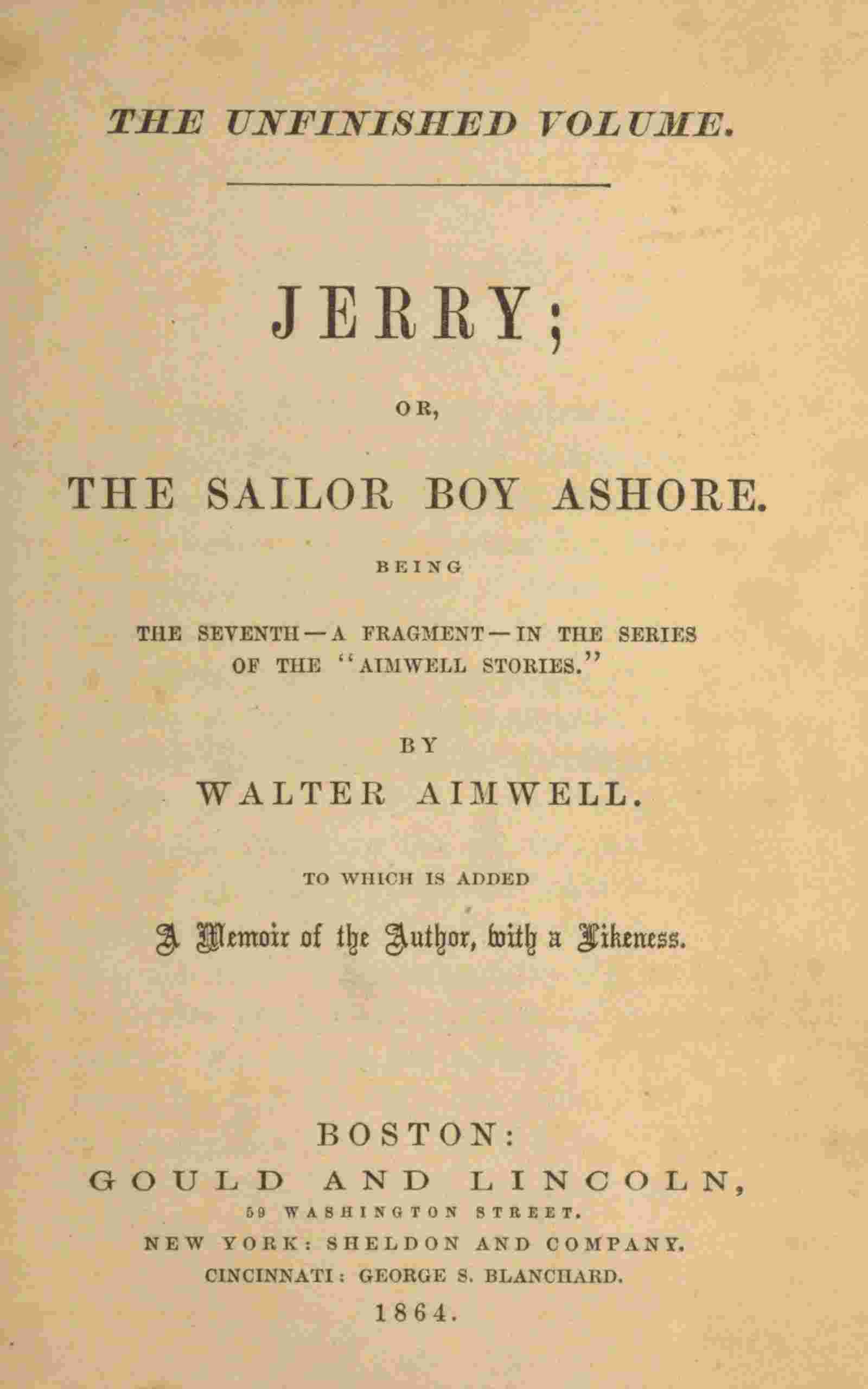
The only reply to be made is, “A wise Providence has so ordered it;” and you can only be thankful that you have so much. The author had proceeded thus far with the volume completing the history of Jerry, when death closed his useful life, and he was transferred from the toils of earth to the rest of heaven. To make up for this deficiency, a Memoir of the Author, with a fine likeness, is added, which cannot fail to interest all the readers of the “Aimwell Stories.”