
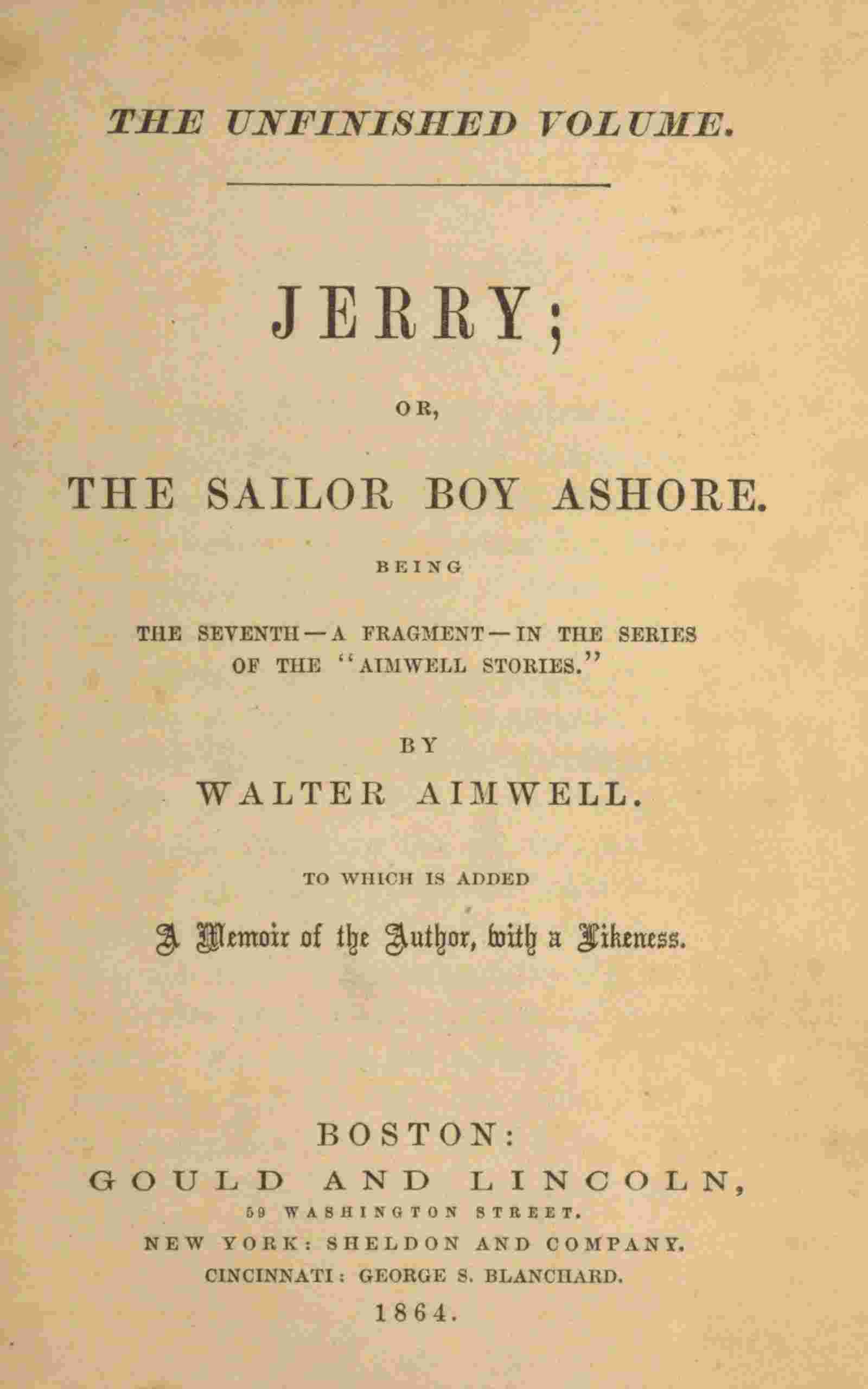
In the spring of 1840, Walter Aimwell commences a new note-book. Here is the
“PREFACE.
“In the fall of 1838, I commenced keeping a note-book, somewhat similar to this. As I was then a member of the ‘Mechanic Apprentices’ Library Association,’ and consequently read considerable, I thought it would be useful to keep a book in which to write down all that was valuable and interesting in the works which I perused. And I also thought it would afford a good opportunity to write compositions of my own, which I had never before attempted. And lastly, though not least, it would improve my handwriting, which was then quite bad.
“With these ends in view I commenced a ‘note-book.’ As to the first object, I found it very profitable and interesting. In the second I succeeded very well,—better than I expected; for I found such a taste for writing that now I find it almost impossible to restrain my pen. As to the third object, the book will show for itself. Although there is now much room for improvement, yet I made more in that book than I ever did at any school. This book will differ from the other in that it will be composed mostly of original compositions, including the lectures.
“Boston, April 15, 1840.”
Let young minds notice particularly the first paragraph in the new note-book. It introduces his report of a course of lectures.
“The following course of lectures was the only one which I attended during the winter of 1839-40. For I thought it would be better to attend one course, and take notes of what I heard, than to go every evening in the week, and get my head filled with a miscellaneous assortment of facts which, for want of arrangement, would soon be forgotten. The lectures were highly interesting; and, meagre and hasty as the sketches of them are, I feel that I have not lost the object for which I labored, and I doubt not these faint outlines will afford me much pleasure in their perusal.”
About three months after he commenced the note-book of which the above is the first paragraph, he began writing another little volume, which he entitled “Sunday Reading.” It is the most personal and the most interesting of all that he has written. From his boyhood until his death, his writings were always truthful, often frank; but in these pages he photographs his own consciousness, his own soul, for future reference and comparison.
In these two books it is pleasing and useful to see how the boy sets about improving his mind and sanctifying his heart, just as a sensible and practical person undertakes the accomplishment of any purpose. He does, indeed, seem to have been in moral communication with God from his earliest years; for he not only shows a practical spirit, but he proceeds with a ready faith in the laws of cause and consequence in the moral world, analogous to a child’s instinctive trust in physical laws.
But now listen to Walter Aimwell himself, as he speaks in the first article of his book of “Sunday Reading:—
“It is not only profitable and pleasant occasionally to look back upon all the way in which the Lord our God hath led us, but perhaps it ought rather to be considered as a duty. For if ever the heart is melted to gratitude, it ought to be when it is looking back upon its past life, and contemplating the various scenes through which it has passed. And if this is true of the common events of life, how much more is it of our religious experience, which reminds us of the manner in which God first called our attention to the subject of our soul’s salvation, and of our success in the Christian warfare. As I regard my religious experience as embracing by far the most important events of my life, I have thought it would not be altogether useless to preserve in writing a short account of it. If ever this heart should grow cold and stupid (which God forbid), may he grant that the perusal of these pages—containing an account of his providential dealings with me in times past—may awaken me from my ungrateful stupidity, and lead me to examine myself and see if my foundation is sure. However, I would remember that I am not to live on past experience or present hope, but to ‘press forward.’
“From my earliest childhood, I believe I have felt the influence of the Spirit of God. Well do I remember, when quite young, retiring with a younger brother to pray. And I recollect most vividly the ‘meetings’ I used to hold when left alone with him on Sabbath evenings. We would sing and pray, and then I would read an extract from some religious book, which we denominated the ‘sermon.’ And I remember the pleasure I took, still later, in going to meeting, even on week days. During this time I was a member of the Tabernacle Sabbath school in Salem, and was in the class of Mr. E. G., and subsequently of Mr. N. P. It is not to flatter my pride that I make these statements, or because I think I was an uncommonly good child; for I well remember many things of my childhood which I should blush to relate; besides, these things only serve to increase the guilt of my subsequent life.
“But, though I was thus blest with right sentiments in my earliest days, yet my heart gradually grew harder, until I began to lose all personal interest in the subject. I cannot recollect any special strivings of the Spirit until I began to reside in Boston, at which time I was about thirteen years of age. But few words are required to relate what took place from this time up to my seventeenth year. I attended no regular place of worship, and frequently spent my Sabbaths in strolling the city, or in reading and writing. I did not read a Bible once in two or three months, and, to tell the truth, I did not even own one. But, though I thus neglected the sanctuary privileges, I was frequently rebuked by my conscience, and I believe the Holy Spirit often strove with me, and I was determined to be a Christian when I had ‘a more convenient season.’
“In the year 1839, when between sixteen and seventeen years of age, I was frequently alarmed, and thought much on the subject of religion. Especially do I remember one occasion when I attended for the first time an inquiry-meeting. But there were so many present I had no opportunity for personal conversation, and my interest soon subsided.
“Again was my interest called up, and it seemed as if every sermon I heard had a serious effect upon me. I procured a Bible, and commenced praying. I think it was about this time that I made the following resolution, which I committed to paper in a secret handwriting, and laid in my trunk, that my eyes might frequently remind me of my promise:—
“‘Alone in the presence of my God, I solemnly declare it to be my intention, the rest of my life, to endeavor to do my duty to him, and to strive to enter in at the strait gate; and in order to do this I will no more neglect prayer, the reading of the Bible, and other exercises of a similar nature.
“‘May the God of all grace help me to keep the above vow!’
“But, alas! this resolution was soon forgotten. Again and again was I awakened, but only to sink again into stupidity. In July, my attention was again called up, and it resulted, as I hope, in my conversion to God.
“The circumstance which awakened my attention at this time I never could tell, unless it was hearing of the conversion of one with whom I was well acquainted. I determined not to let this opportunity pass without becoming a Christian; and I hired a seat in the Bowdoin-Street church and commenced prayer.
“Although I felt myself to be a great sinner and deserving of eternal punishment, still I did not feel the deep anguish on account of sin which many experience, and which I supposed necessary to conversion. And for no other reason but to raise these feelings, I purchased and read ‘Baxter’s Call to the Unconverted.’ Still I did not spend my nights in weeping nor my days in anguish, as I supposed I must in order to be a Christian. I prayed that God would break my hard heart and show me my sins in their true light.
“In thinking of the state of mind in which I then was, I have since thought I could not better express it than by saying I almost wept to think I could not weep.
“At length the thought occurred to me that I ought to dedicate myself to God, and let him do with me just as he pleased. I immediately retired to my chamber, and there gave myself to God.
“During all this time I had no conversation with any one on the subject of religion. I anxiously waited for an inquiry-meeting to be appointed, that I might become acquainted with the pastor of the church.
“Until this time my mind had been dark and cloudy, and I had no hope that I was a Christian; for I thought I had not yet repented of my sins. But one Sabbath morning in November, I happened to take up the ‘Young Christian,’ and in reading the chapter on ‘Confession’ I came to that part which speaks of the feelings I had been desiring. I immediately saw that they were unnecessary; and a ray of hope darted into my soul, and I retired to my chamber and again dedicated myself to God, and, as I hope, gave him my heart. This little, trembling hope began to increase, and with it my determination to serve the Lord.
“We often hear of those who, when they have obtained a hope in Christ, cannot contain their joy within themselves, and can find no rest until they have told their friends of the Saviour they have found. This was not the case with me. I felt greatly encouraged, but my hope was very faint, and I still feared that I might go back to the world.
“Shortly after I began to indulge a hope, an inquiry-meeting was appointed, which I attended. Mr. H—— conversed with me, and invited me to join the Sabbath school, which, after a moment’s hesitation, I promised to do. I was introduced to the Rev. Mr. Winslow, who appeared to take much interest in me. The following Sabbath I entered the Sabbath school and joined the class under Mr. P—— G——. After this, I attended several inquiry-meetings, and conversed with my pastor and my teacher.
“On the first of March I drew up a resolution, which, mostly from curiosity, I transcribe:—
“‘Whereas, I am sensible of many faults in my every-day character which ought to be removed; and, as I have reason to fear that were some of my intimate companions to hear that I contemplate becoming a member of the church, they would be surprised and astonished; and whereas the sins to which I am most prone are peevishness and sometimes anger, together with an unwillingness to surrender some of my rights that are not worth standing for, but which tends to produce anything but pleasant feelings in myself and others, therefore
“‘Resolved, That it is my duty to break off from these sins, and to set a good example to my friends, that they may know that I have learned of Jesus: And, further, resolved that this, the second day of March, I will strive, through the whole of the day, to behave with kindness and good feeling to all, avoiding the above-named sins, and showing to all an obliging disposition.
“‘Sensible of my own weakness, I make this resolution in the strength of the Lord, and earnestly pray that he will not permit me to break it.’
“Through the blessing of God, I was enabled to keep this resolution, not only through the day specified, but through the whole week. Accordingly I adopted it for life.”
And here the writer wishes to say that although Walter Aimwell wrote this when he was seventeen years of age, a very similar degree of success in controlling any natural fault he might have, crowned every succeeding year of his life. The writer, not being able to discover any practical faults of character, applied to several of his most intimate friends, to know what was his special sin, or what wrong disposition he indulged. No one could tell me of any fault that he indulged. I do not say that his natural disposition or actual character was perfect. It would be hard for us to believe that any one was complete in all the moral perfections of sinless manhood. It seems to me that to maintain such a character in this world, as it is, one need have great mental powers and much knowledge, as well as much conscience. What I mean to say of Walter Aimwell is, that he sharply watched his nature and his habits for every little perversity, and thought none too small to be daily guarded against and overcome. He early commenced training himself according to his understanding of the Bible standard of manhood, and he acquired a surpassing degree of self-control, such as none but a thorough Christian, and one who begins the Christian life in early years, can ever hope to equal.
But we resume the perusal of this lad’s manuscript:—
“This week I also commenced the plan of having a stated object for which to pray during every day in the week, which I have continued to this day, and think it a very good plan. Here is a specimen:—
“July 13th, Monday, for Friends; 14th, Tuesday, Revival; 15th, Wednesday, Missions; 16th, Thursday, Growth in Grace; 17th, Friday, Church; 18th, Saturday, Sabbath School.
“On Thursday, the nineteenth of March, in the year 1840, a meeting of the examining committee of the church was held, at which I was present.
“On Sabbath morning, July 5th, 1840, at the age of seventeen years and eight months, through the abounding but unmerited goodness of the Lord, I was permitted to unite with the Bowdoin-Street Church. It was the day to which I had been looking forward from my earliest years; for I always intended to become a Christian and unite with the church.
“Rev. Mr. Winslow preached an excellent discourse from the text, ‘Being confident of this one thing, that he which hath begun a good work in you will perform it until the day of Jesus Christ.’ Phil. i. 6.
“After the sermon, about fifteen were admitted into the church. It was the happiest day of my life, and I almost wished to be baptized and received into the church again on the next Sabbath.”
Oh happy youth! Oh genuine gladness! Earth yet has spots where the violets of Paradise bloom; time yet has moments that lie serene in the eternal sunshine of heaven.