
Early in February, 1853, Rev. Mr. Bullard called at the office of the “New England Farmer,” and invited Walter Aimwell to write a series of “Letters to Boys,” to be published in the “Well-Spring,” of which the former gentleman was editor.
This invitation was accepted; and the letters were so well received that, after their publication in the juvenile periodical for which they were originally written, they were collected and revised, and published in book-form, under the title of “Boy’s Book of Morals and Manners.”
Walter Aimwell always had a genuine love of children and youth, and felt a hearty interest in their real welfare, especially their moral welfare. This love and this interest were stimulated, no doubt, by the great and uniform success that attended all his writings in their behalf.
About the time of the publication of these “Letters to Boys,” he proposed to himself the pleasure of writing a continuous story “to please the young,” as he expressed it. The result was a story of considerable length, which he handed to a friend for perusal, asking an opinion. The friend gave a favorable criticism; and the author prepared it for the press, intending to offer it to the firm of Gould & Lincoln for publication. He called the story “Clinton.”
He took the manuscript with him to Boston, and twice he reached the door of the publishers, and each time passed on without entering. Finally, his modesty was so far overcome that he enclosed and sent it to them.
Soon he received from these gentlemen a letter, saying they had perused the manuscript, and were much pleased with it; but that it would make a book too small for their purposes. If he would add as much more, they would undertake its publication upon their usual terms.
He went home and immediately commenced complying with their suggestion. A plan for the extension of “Clinton” was laid out that very afternoon.
Other engagements interfering, he could not complete the book at once; but in the latter part of September he carried it to the publishers.
They seemed to be pleased not only with the book, but also with the man who wrote it; and they proposed plans and made offers which were quite tempting to him, and would have been accepted if his health had been as hardy as it once was.
“Clinton” was published on the day before Christmas, 1853. It hardly seems necessary to tell the readers of the “Aimwell Stories” how very fortunate “Clinton” was in pleasing the public.
It will be recollected that the scene of this book is laid in the State of Maine. On one of “Mitchell’s Pocket Maps” he has marked the very spot where the incidents of this interesting story are supposed to occur. It is on the eastern side of the central portion of the county of Franklin, near the head-waters of an unnamed branch of the Kennebec. On the map he used, there is no town located very near. Brookdale, no doubt, was a name of his own invention.
All the places and persons described existed in his mind with as much distinctness, apparently, as if the scenes had been long familiar to him, and the persons were those with whom he was intimately acquainted. To the only friend with whom he freely conversed upon the subject, he always spoke of them as really existing. Yet he never was very near the locality selected for his story, nor is it known that a single character was taken from among his acquaintances. He often expressed a determination to visit, at some favorable opportunity in the future, this part of Maine, that he might compare plain, unvarnished fact with fancy, which, indeed, was equally plain and unvarnished.
The welcome that “Clinton” received from the public was the crowning pleasure and success of the year 1853, which was, throughout, a year of prosperity to Walter Aimwell. There was no return of the hemorrhage of the lungs, and his general health appeared good. The condition of his pecuniary affairs was improving, and to whatever he put his pen, it prospered.
Of course, the praise which “Clinton” received from youthful readers and from critics of high standing had not the effect to dampen the ardor of Walter Aimwell’s interest in the young. In considering the amount and condition of juvenile literature, he was persuaded that authors had neglected the young far more than any other class in the community; and that there was really a deficiency of books calculated to be of use to them in the development of mind, and, above all, in the formation of good character. As does every other person sufficiently desirous of the improvement of society to think much about the means of accomplishing it, he believed that the best and most effectual method lay in the right training of the young. He could not conceal from himself the fact that his pen was capable of achieving much in this useful and somewhat neglected department of human labor. It was something he could undertake without fear of failing in his duty in regard to engagements already formed. For some time he silently revolved these facts in his own mind, and by and by he consulted his publishers upon the expediency of writing a series of books for the young, of which “Clinton” should be one. These gentlemen were pleased with his plans, and agreed to publish the series.
If Walter Aimwell had undertaken to write the actual history of a State, I do not know that he could have taken more pains to ascertain the essential truth. He made boyhood a serious study. Whenever in his reading he met any fact directly or remotely bearing upon the subject, he carefully noted it. Such facts casually came to his attention in the many newspapers and other periodicals which, as editor of the New England Farmer, it was his duty to read. Besides this, he seems to have searched biographies and histories for accounts of the childhood and youth of all persons in any way distinguished.
Under the study-window of his pleasant cottage at Winchester, in the long summer afternoons, little children often came to play. Never dreaming that their characteristic features were being sketched, or that the music of their voices was being echoed, in childish freedom they frolicked and chatted away the sunny hours; and when their remarks appeared peculiarly striking, their silent and unseen friend copied them word for word. With such wise, patient, and faithful effort, could one of such sound philosophy, and such cultivated power of clear and unaffected expression, fail to write a lifelike, salutary, and successful book?
And here again is suggested another lesson which Walter Aimwell would love to have his young readers learn from his life, as we know he endeavored to teach it in his writings. If one wishes to do anything good or sensible, he must have a definite purpose and work definitely for its accomplishment. Nobody carelessly blunders into writing a good book, nor into anything else of lasting value. Some young persons think a great deal of what is called genius. I have heard a great deal of talk about genius, as if it were something with which some persons are endowed, by means of which they were enabled, in some inexplicable manner, to do great deeds without thought or labor. I have known many different persons, and some whose performances very far excelled those of others in truthfulness and beauty of design and finish of workmanship; but I never had the fortune to see one of those human curiosities who succeed, as one may say, by accident, and without patience and effort. If a hearty love of truth, and a willingness patiently to work for it, is genius, no doubt Walter Aimwell had great genius; but so might have many a one who seems to be lying about the highways and byways of human society, apparently as useful as a loose pebble in the gutter.
At first, Walter Aimwell intended to call the proposed series by the name of the Right-Aim Stories; but he soon changed this title to the equally significant and more euphonious one of the “The Aimwell Stories.” His plan embraced twelve volumes, in each of which he intended to portray, with especial distinctness, some one character or peculiar species of influence, and in all of which instruction and amusement should be agreeably and inseparably united.
Although “Clinton” was the first written, the incidents of “Oscar” are supposed to occur previous to those of the former volume; so that, in the order of time, “Oscar” is the first of the series.
On Thursday, the second day of March, 1854, he came home at half-past two o’clock and wrote the first six pages of “Oscar.” The weekly paper of which he was general editor was published on Thursdays; and being more at leisure on the two following days than at any other time during the week, he wrote the principal portion of the “Aimwell Stories” on Fridays and Saturdays.
He formed distinct ideas not only of the characters of his young heroes and heroines, but also of their personal appearance. The date of the birth of each was carefully written in a little note-book which contained succinct accounts of their looks and moral and mental traits; and throughout that portion of the series which he lived to complete he continued to record the exact age of each, as well as the period at which each volume is supposed to commence and conclude. In this manner the stories became very real to him, every species of anachronism was avoided, and the characters and incidents seemed so lifelike to his readers that judicious critics were induced to believe that these books were in large part actual histories of what had transpired under the author’s observation.
Before “Oscar” was completed, that, with all other labors, was suspended by the appearance of that symptom, full of painful meaning, which had once before alarmed his friends. On the morning of the Fourth of July, after having spent a restless night in consequence of the unhappy fashion in which rude boys, and boys, too, who are not altogether rude, indulge during the night preceding our national holiday, he discovered the critical condition of his lungs. In this instance he was calm, as he always was; and the ordinary remedies finding aid in the steadiness of the patient, he soon recovered a degree of strength. Gradually he resumed his usual round of occupations, and “Oscar” was finished in season to be published on the 13th of December, 1854.
On the evening preceding the publication of “Oscar,” he began the third of “The Aimwell Series,” called “Ella,” which he succeeded in finishing before the end of the next May; and it was published in the latter part of August.
In the October following, he commenced “Whistler.” He wrote but fifty pages before the close of the year 1855; for in December, after an interval of a year and a half, his lungs were again found to be in a bleeding state. Again nature rallied, and he resumed his duties; but “Whistler” was not completed until about a year after it was begun.
His writings are in the hands of those who read these lines, and it is not necessary here to do more than remind readers of the faithfulness of Walter Aimwell’s portraiture of boy-life. He received commendations of the truth and general excellence of these stories from all hands, both in the public prints and in private letters from those whose good opinion he especially valued. Passages from them were quoted and inserted in valuable school-books, and repeated at the exhibitions of academies and public schools. But he never suffered himself to be flattered into any relaxation of endeavor. However well he might have satisfied his friends, he never thought he had reached his own standard.
Accordingly, about the time that “Whistler” was completed, we find him saying in his journal,—referring to a boy whom he had just taken into his family,—“In the management of him, and in the direction of his studies (for he is to devote a part of his time to study), I anticipate meeting to some extent a want which I feel as a writer for youth,—the want of an actual and intimate contact with childhood, and an opportunity to study its wants, tastes, feelings, etc., from real life.”
The want which the author himself felt, he never permitted his readers to perceive. Said a boy to one of Walter Aimwell’s correspondents, “I guess Walter Aimwell hasn’t forgotten when he was a boy himself.” Read Walter Aimwell’s reply to a letter from a friend of his young critic:—
“Winchester, Mass., Dec. 26, 1857.
“Dear Madam,—
“It was a very agreeable surprise that the sight of your familiar handwriting gave me, as I opened your note of the 22d; for your writing still has a familiar look, though I do not know that I have seen a scrap of it before for half a dozen years. I cannot tell you how much pleasure the contents of your letter gave me, or how grateful I am for this kind and flattering notice of my little books. In the case of such books, so far at least as to their power to interest, children are the best critics, and their simple and artless commendation is worth far more than the most fulsome newspaper ‘puff.’ I love children, and love to write for them, and, as your little neighbor shrewdly guessed, have not quite forgotten how I felt when I was a boy myself; and I may add that I have no higher aspiration, in this world, than to acquire an influence over the minds of the young, and leave upon them an impress for good that time shall not efface.
“I hope to extend the ‘Aimwell Stories’ up to ten or twelve volumes, and shall probably do so if my health holds out. I fully sympathize with you in sentiment, and shall take your suggestion into consideration. I have never thought much about the matter, for the reason that it would not comport with the design of these books to give special prominence to such a subject. Still it might be introduced incidentally.
“Please to give my respects to your husband; and tell your little boy that Mr. Aimwell will think of him when he writes his next book, and will try to put something into it that he can understand. And, for yourself, dear madam, accept the assurance of the sincere esteem of
“Your obliged friend,
“Wm. Simonds.”
In this connection, I transcribe a letter addressed by Walter Aimwell to J. O. B., a brother of the lad whom he had admitted to his family. I copy it not only because it proves the genuine interest he took in Edwin, but also because, on account of its general nature, each youth reading these pages may consider it addressed particularly to himself.
“Winchester, Feb. 24, 1857.
“Dear O.—
“Though I do not know that I ever saw you, my acquaintance with Edwin and the rest of the family leads me to feel quite an interest in you; and I improve the opportunity to enclose a word or two in Edwin’s letter. Knowing the value of a letter from home and friends to a young man among strangers, I have often urged him to write to you. Now that he has broken the ice, I hope you will encourage him to continue the correspondence by contributing to it your share. It will not only keep up a brotherly interest and attachment between you, but it will be a good intellectual exercise for both of you.
“You have reached an interesting, and, in some respects, critical age; and perhaps you do not sufficiently realize that the whole future direction of your life may be influenced by the bent you are now giving it. As I look back to my boyhood, I can now see that the whole course of my life was decided by purposes which I formed when about sixteen years old. I can assure you that the habit now acquired, of improving your leisure hours in study, and the reading of instructive books, and the frequent use of the pen, will prove of inestimable value to you hereafter; while it will keep you from many present temptations, and at the same time afford you more real present enjoyment than can be found in any of the frivolous amusements to which many young men resort for recreation. Such tastes and habits, united with purity of heart and life, fidelity to daily duties, an unbending loyalty to right, and reverence to God and his Word, constitute a better capital for a young man than gold, and a safer reliance than troops of rich friends.
“Your brother Edwin is getting along well, and has given entire satisfaction since he has lived with us. I trust that he and you and all your family will live to be useful and valued members of society.
“Yours truly,
“Wm. Simonds.”
On the third of January, 1857, Walter Aimwell made a beginning of “Marcus,” and finished it upon the fifteenth of September of the same year.
Carefully laid away among the materials he was gathering for the “Aimwell Stories,” is the following letter, received soon after he commenced writing “Marcus.” It was written to him as editor of the “New England Farmer.” It is a pity that the printer has not any types that will fitly represent the penmanship of “one of them kind of boys.” Notwithstanding his ignorance, the simple fact that he wrote the letter at all indicates that the lad possessed considerable mental force and independence of character. He addresses Mr. Simonds as Mr. N., thinking, I suppose, that the principal proprietor of the paper was the editor:—
“Salem, Feb. 9, ’57,
“Mr. N
“I now take my pen in hand to write to you before I begin I wish to tell you that I do not know you nor do you know me but I wish to tell you that I write to you for Advice. I want you to give me your advice to a boy like me. I am a boy 14 years old and I am one of them kind that dont like to go to school (but I am in school now) I always thought I should like farming. I have several times started to run away. I shall look for advice in your paper next Saturday night. (Be sure)
“I”
Walter Aimwell’s reply has so much practical excellence that I will not forbear copying it in this place, although so doing leads me a little aside from my purpose in writing this chapter:—
“A young correspondent writes to us for advice. He describes himself as a boy of fourteen, and ‘one of them kind that don’t like to go to school.’ He says he is now attending school, but always thought he should like farming, and has several times ‘started to run away.’ Our young friend has not told us enough of his circumstances, character, or tastes, to enable us to give him anything more than very general advice, and what we shall say to him will be applicable to many other boys who have become tired of going to school.
“‘I don’t like going to school’ is a very common complaint with boys. We remember to have been once afflicted with it ourself; but deliverance came to us before we were as old as our correspondent, and we have rued the day ever since. We have learned a good many things since that time. One of them is, that going to school is far from being the most disagreeable thing a boy or a man ever has to do. Another is, that neither boy nor man need hope to have everything just to his mind, but must put up with many things that he does not like. Another is, that nothing truly valuable is attained in this world without labor, pains, and self-denial.
“Our young friend’s uneasiness, we judge, arises from a too ardent desire for present indulgence and happiness, without sufficient thought of his future interests. He is unwilling to sow anything to-day which will not yield its harvest before night. He should endeavor to correct this habit of his mind. If he is in circumstances that will admit of his attending school for two or three years longer, he ought to be thankful for it, and try to make the best of his privileges. This is most certainly the course which he will hereafter wish he had taken. But if he leaves school half-educated because it isn’t pleasant, he will have an equally good reason for leaving any trade or profession he may afterwards adopt; and whatever he may become outwardly, he will never be a man, so long as he is guided by such sordid and short-sighted motives. Education is too precious a boon to be purchased without a struggle, but it is worth a thousand times all that it costs. The child that should prefer to go through the world toothless, rather than endure for a little while the pain of teething, would be less foolish than those children who would rather grow up in ignorance than subject themselves for a time to the labors and discipline of the schoolroom.
“We say, then, to our young correspondent, think less of making yourself happy, and more of doing your duty; or rather, try to find your happiness in doing your duty. Apply yourself diligently to your studies, and if you cannot find any present pleasure in the work, console and encourage yourself with the thought that you will hereafter be well paid for your pains. After two or three years, when your muscles have become sinewy and firm enough for hard labor, and your mind matured by discipline and study, choose your profession, and you will be able to pursue it in such a way that you will not always have to remain at the foot of the ladder. Your taste for farming is certainly a most hopeful feature in your case, and may be gratified and cultivated, even while you are at school, by reading, and in other ways. But do not ‘run away,’ unless you are abused beyond the limit of endurance. There are very few cases in which a boy is justified in taking this step; and even when justifiable, it may be far from wise.
“If our young correspondent desires further advice, and will send us a more particular account of his circumstances, giving us his real name, we will endeavor to meet his wishes, either through our columns or by private letter. Perhaps we ought to explain that the names of correspondents are considered confidential, and are not made public in connection with their articles or letters, unless they desire it.”
On the third day of October, 1857, the story of “Jessie” was begun; and on the eighteenth of September of the following year it was concluded. This was the last original book that he lived to complete.
During a part of the time that he was engaged upon this juvenile series, he compiled a volume intended particularly for the perusal of those parents who had been called to part with little children. It was entitled “Our Little Ones in Heaven.” It is a superior collection of prose and verse, and after being issued by his usual publishers in this country, it was republished in England.
Of the twelve volumes of which he intended to have the “Aimwell Stories” consist, only six had been published at the time of his death, namely:—
- Oscar; or, the Boy who had his own Way.
- Clinton; or, Boy-life in the Country.
- Ella; or, Turning over a New Leaf.
- Whistler; or, the Manly Boy.
- Marcus; or, the Boy-Tamer.
- Jessie; or, Trying to be Somebody.
The remainder of the series he had entitled
- Jerry; or, Young Jack ashore.
- Emily; or, the Young Housekeeper.
- Ralph, the Tip-Top Boy.
- Ettie; —— ——.
- Ronald; or, the Adopted Son.
- Annie —— ——.
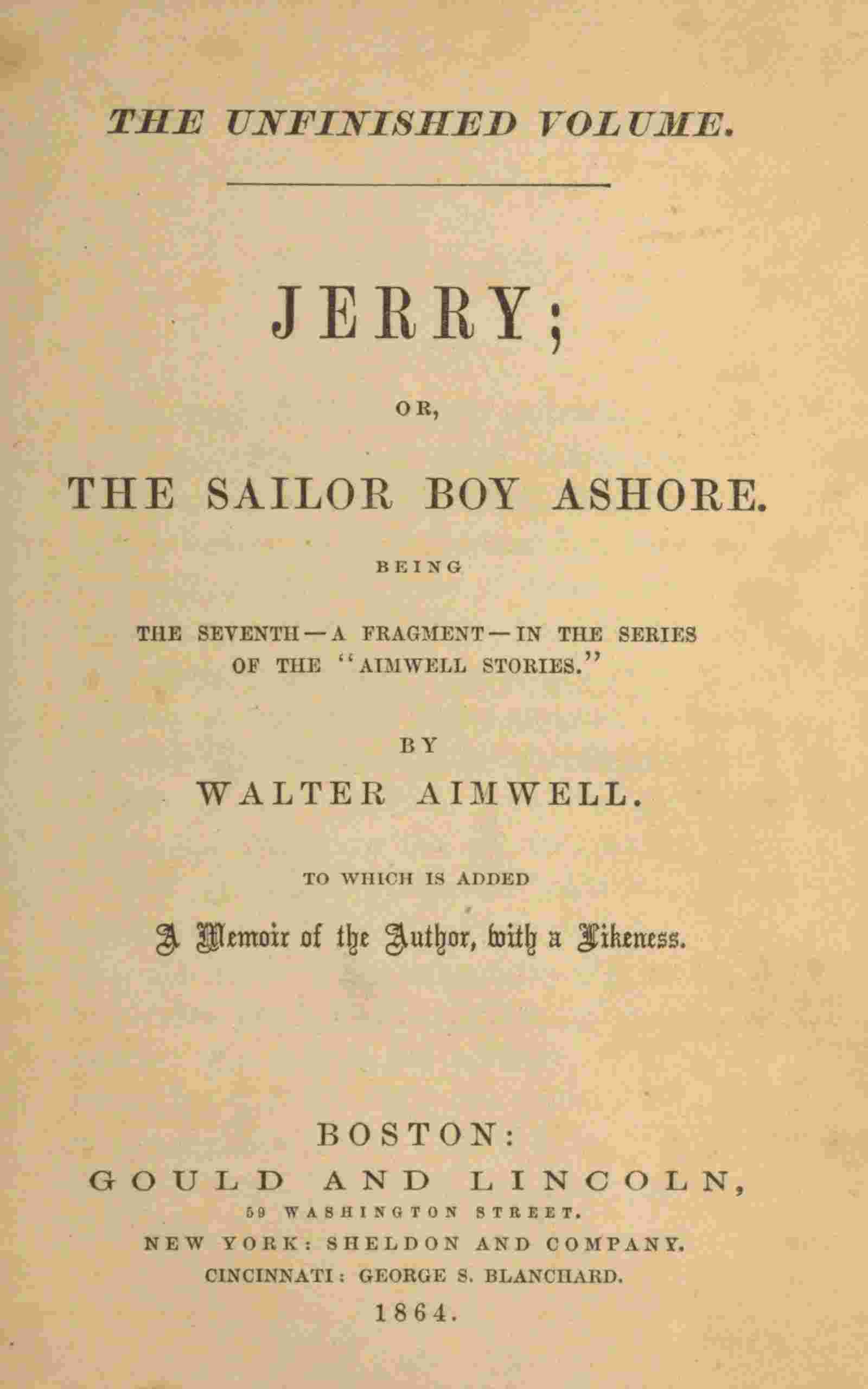
Although, among his manuscripts, he has left some vague hints of his intentions in regard to the unwritten volumes, they are such as none but himself could fully understand, and no other hand could venture to finish what he had commenced; therefore, the fragment of “Jerry,” which is published in this volume, must forever remain the last of the “Aimwell Stories.”
“Jerry” was commenced on the twenty-eighth day of November, 1858, and its last lines were written on the twenty-second of January, 1859. In view of his increasing infirmity, he resolved that if he were not otherwise able to finish “Jerry” in season for publication in 1859, he would resign his place in the “New England Farmer” office on the first of July. At the close of the first week in July, he had resigned everything that earth could give.