
Slowly but steadily the forces of life yielded before the results of the great efforts he made in those fearful years preceding the sale of the “Rambler.” It hardly seemed as though he were subject to any common disease, but he appeared to be dying for the reason that men of threescore-and-ten years die,—because he had done enough living, and because, happy as this life may become to a good man, he was prepared for enjoying a still happier one. And God did not long keep him from the heritage of saints.
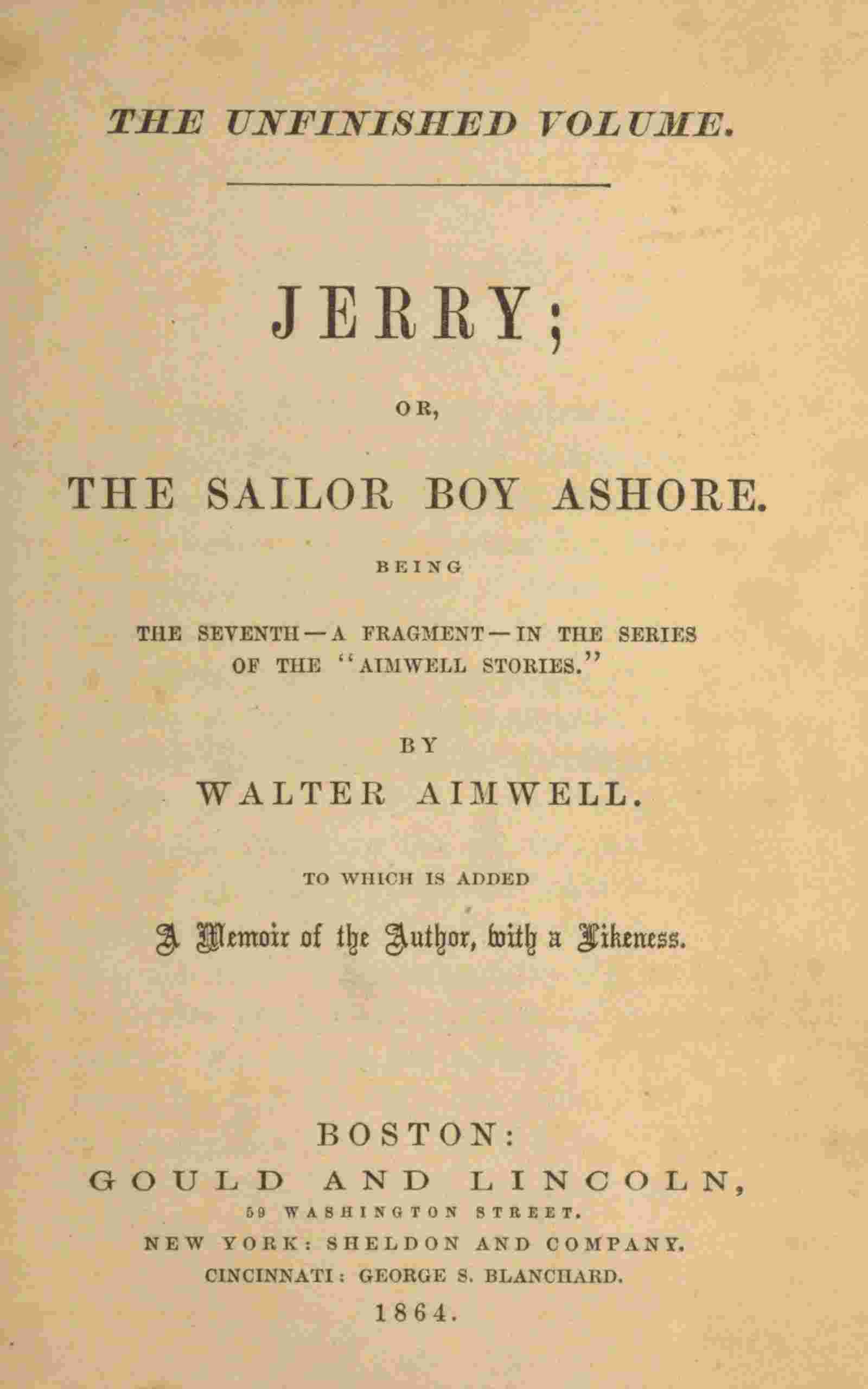
Through the month of January, 1859, he was very comfortable, and accomplished considerable literary labor. Probably it was during this month that he wrote the last twenty pages of “Jerry.”
When February came, fierce storms came also; and often Walter Aimwell was unable to go out for a day or two. Soon his visits to the office in Boston became very irregular; sometimes there were intervals between them of ten days, sometimes of three weeks. For more than a fortnight, he could not take a little ride about his own home. By and by, he cannot, for several days, even go out upon the piazza. Then, he leaves off going down-stairs, because it is “so tiresome to come up again.” To accommodate his swollen limbs, he lies abed all day. Occasionally comes a day when he feels better; and if it is a pleasant day, and if some one of his kind neighbors is at home to assist him in getting into his carriage, he goes to ride. He procures some assistance in his editorial duties. At last he resolves to do nothing for the paper more than to attend to the fourth page. He ceases to record any labor accomplished, but, instead, mentions the reception of a woodcock, a pair of robins, a basket of grapes and flowers, a box of wild strawberries, or some other token of the respect and sympathy of kind neighbors and friends. This change in the record is significant.
Evidently, he is passing away; but he observes the changes in his condition with the same unruffled tranquillity with which he watched the crimsoning of the leaves in the fall. He will soon leave pleasant employments and dear friends. If it were the will of God that he should stay, he would be pleased; yet he is wholly willing to go.
He is not going to die, to cease to exist; he has no fear of that. Happy in his glorious faith, he waits to see what his good God is going to do with him. Long ago he placed his hand in God’s; it is there now, as he is going down into the valley. He feels no fear, no agitation. He accepts the pleasantness of the day, the kindness of his friends. He welcomes the joys, and does the duties, of the hour.
The sixth of July is too cold for him to take a ride; but on the seventh, friends help him into his carriage, and that devoted one, who is ever his companion, takes the reins, and once more they pass through the scenes they have so often gazed upon together. It is the last time.
He returns refreshed and exhilarated by his little excursion, and entertains, with even more than his usual sociability, the friends who call upon him.
When all are gone, he retires to his bed. It is about ten o’clock. He coughs slightly. In a moment his wife is at his side. He cannot speak. In a few minutes he has ceased to breathe.
He has gone forever!
He is gone forever. Yet he has left behind pictures of himself, unwittingly sketched by his own faithful hand,—beautiful as they are true, as they are dear.
There is the innocent child, happy in Sabbath serenity and service; the good boy, delighting himself in the pretty shop of the jeweller, and writing to his mother to the accompaniment of the charming music-box; the lonely apprentice, tempted to spend the Sabbath in strolling about the city; the youth, suddenly stopping himself in the path he has carelessly taken, and retiring to the solitude of his own chamber, and there, with sane seriousness, contemplating the great issues of life, and deliberately choosing to be an educated Christian gentleman, and calmly taking all practicable methods that he deems likely to strengthen and discipline his powers for that character; there is the rapt young Christian, his whole being thrilling through and through with the divine harmonies of a soul at one with nature and with God; the willing mechanic, cheerfully fettering his faculties to the most earthly of all innocent things—the acquisition of manual skill; the devout worshipper “in the spirit on the Lord’s Day,” and on other days, loosening every thought of earth, and drifting away among infinite things on the waves of a church anthem; there is the profound thinker, unravelling the golden thread of eternal truth from the tangled conscience of a kitchen-maid; the enthusiastic worker gladly putting on the harness of the public journalist; the uncrowned martyr of the broker’s office bleeding to death in secret, rather than violate, openly or secretly, his moral sense; the genial gentleman, offering to the clasp of others the warm hand of friendship and the not empty one of charity; the mature Christian, in full armor straightening and steadying himself against the shock of ingratitude and dishonor; the wounded conqueror, tenderly borne from the battle-field by the hands of angels, visible and invisible, to heal and grow young again on the happy slopes of heaven.
Are not these life-pictures beautiful, glorious? Who would not rather such should be the history of his own life, than stand idly by while the years, one after another, drop away from his allotted time, even though he outlast the threescore and ten?
And yet, as has been before intimated, the whole secret of such a life seems to be the early adoption of, and unwavering adherence to, a complete system of Christian morals. Any New England boy of ordinary abilities, if he will, can compass all that. It is the dictate of common sense to do it. Look at it. Here you are, in existence; you cannot help that, even if you should wish to do so. Even if you should so mutilate your body that your lungs could not breathe nor your heart beat, you could not stop being alive. You are alive in a universe governed by certain laws. You did not make the laws, you cannot alter them. You may struggle against them; it will not make any difference; you cannot change them. You can break them, and make yourself contemptible and unhappy; you can obey them, and grow powerful and holy and happy. Walter Aimwell chose to obey.
He is gone forever. It is all over. The story is ended.
And some may say, What does it all signify? Is it not the same old legend of human life?—human life coming in like the new tide that swashes among the piers and slaps at the rocks on the shore, and, ebbing again, leaves all as before?
One day, many centuries ago, human lives looked so to the eyes of the royal Israelite. But I suppose Solomon knew, as every other one, whose soul is not in a state of insensibility, knows, that there is a meaning, mysteriously deep, to human passion and aspiration and endeavor. Man knows that, by touching the unseen chords of a subtle influence, he is joined to a remote universe; only, freer than the tide, he takes his choice of spheres, and, if he will, allies himself to worlds of brightness and of beauty.
Thus chose Walter Aimwell. And yet, to the casual observer, I think he did not usually seem to be a man of any uncommon grandeur of character, nor appear to be living a life of any special nobleness of purpose. He was one who did not allow himself to be too anxious about the estimation in which he might be held in regard to his abilities or the dignity of his motives. One might have carelessly met him many times, and never have surmised that he was a man of unusual worth; for, as there was nothing showy in his appearance, there was nothing ostentatious about anything that he did. His dress was plain and devoid of all that was merely ornament. His manners were exceedingly modest, and yet he had so much of the sturdy puritan in his composition that neither persuasion, menace, nor ridicule could dethrone his self-possession or change a well-considered intention. To be truly upright and manly was almost a natural instinct with him; and when the possibilities of sanctified manhood lay before his mind, bathed in all the glory that the Christian faith pours over it, he was thrilled with admiration, and pressed forward in silent earnestness and enthusiasm. Thus, if I may borrow a phrase from a recent writer, he lived freely and happily among the eternal realities.
His manner of living this earthly life brought essential freedom and happiness to him; what did it give to the world?
It gave an example of unblemished purity; it developed a man who, in the several common relations of life, never fell short of the expectations of his friends. As a son, he so excelled that a mother of very unusual keenness and penetration could say that, so long as he lived with her, he never seemed to have a fault. As a brother, he was sincerely kind. As a husband, he was true and tender. God never made him a father; but we know how he loved children, and how fervently he sought to benefit them. In friendship he was constant, and ready to sacrifice his own interests and add to his own annoyances that he might relieve the embarrassments of those he loved. As an editor, he was so fair and courteous that he escaped those unpleasant passages that to many seem almost unavoidable. As a man of business, he was forbearing and honorable. As a citizen, he was truly a patriot, strongly conservative in regard to whatever he esteemed good in government or society, safely radical among the roots of evil. As a professed Christian, he was fervent without being bigoted, and liberal without being lax; he was intellectual without losing faith, and grew in faith without the least appearance of shrivelling in matters of common sense.
His books were much like himself, marked by the same patient thoroughness and real value, without any pretentiousness of style. In building up his own character, and in exerting his influence upon the characters of others, the thought of the poet seemed ever present in his mind, and according to his opportunity, he expressed it in action:—
And yet, as I before intimated, all this was done so modestly that, of the many who had intercourse with him, few clearly perceived that there was moving among them a genuine artist in human living.
You who have lived near the shore have sometimes looked toward the sea when, its grandeur veiled by a mist from its own bosom, it lay all day vague and insignificant. But at evening, the rays of heaven rent the clouds, and revealed snowy sails and silvery smoke-wreaths and bright flags; and you knew that all day the veiled ocean had been bearing on its strong, steady billows—pulsating as though the great heart of God were in its bosom—ships from all shores, opulent with the best products of all climes.
There are human lives thus dim and vague. But at evening the veil is parted, and we know that through all the unglorified day, purposes, rich with the finest results of all civilization, have been upborne by pulses so strong and holy that we deem them throbbing with the life of God.
THE END.