
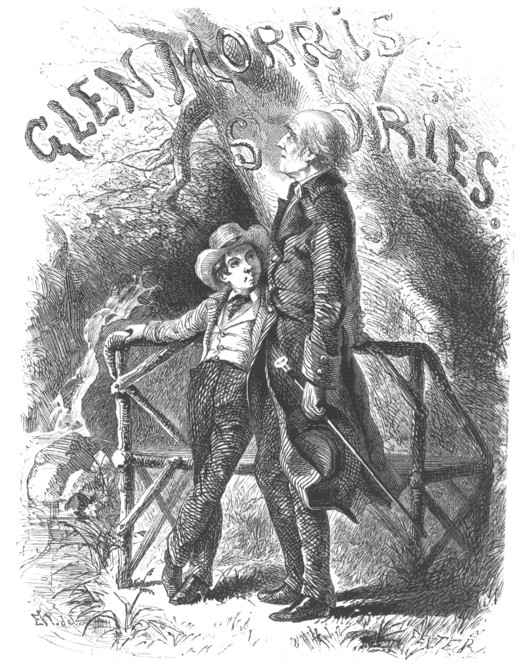
After Uncle Morris and Mrs. Carlton had consented to permit the self-willed cousins to remain a week longer at Glen Morris, the good old man led Emily into the library and talked with her for over half an hour, about the meanness and wickedness of lying. I cannot tell you exactly what he said to her, because I don’t know. That his words were weighty and solemn, I have no doubt; for when Emily left the library her eyes were red with weeping, and she went directly to her room and staid there alone until the bell called her to tea.
Before Emily slept that night, she did what she had not done before during her stay at Glen Morris. She kneeled at the bedside to say her prayers. When she arose, Jessie threw an arm around her waist and kissed her. This was done with so much tenderness, that Emily felt it to be a sign of her cousin’s sympathy with the new feelings and thoughts which were springing up within her heart. Returning the kiss, she said:
“I’m sorry I told that lie about you to-day, Jessie.”
“So am I,” replied the simple-hearted girl; “it is always best to tell the truth, and I hope you will never tell another story as long as you live.”
“I won’t, I’m resolved I won’t; I told Uncle Morris so this afternoon, and (here she lowered her voice to a whisper) I’ve been asking God to help me keep my promise.”
“That’s the way! That’s the way!” replied Jessie. “Uncle Morris says if we mean to be good we must go to school to the Great Teacher who will both teach us, and help us do the lesson.”
With such words as these did Jessie encourage her cousin to enter that beautiful path in which all the pure, noble, and good children in the world are found.
The next day Emily was very quiet. She spent the morning helping Jessie work on her famous quilt. Charlie was as rude and as ugly as ever; having teased his sister for a long time in vain, to play out of doors with him, the spoiled boy hissed at her, and said, “You are an ugly old cat!” Then slamming the door after him, he went into the barn-yard, where the screaming of the pigs, the gabble of the geese, and the clucking of the hens, soon proclaimed that he was venting his ill-temper on the dumb creatures who had their home there. Poor Charlie! the indulgence of his mother, and the almost constant absence of his father from home, had made him a very unhappy, mischievous boy, if, indeed, it had not wholly spoiled him. If Charlie had known what was best for him he would have said to his friends,
“Please don’t let me have my own way.”
Emily needed to make the same request, for she too, had long done pretty much as she pleased; and, as we have seen, she was pleased to do some very bad things.
Two days before the time set for the cousins to return home, they went to spend the day with Carrie Sherwood. Jessie, who was to join them after her morning’s sewing was done, sat down to her work in high spirits. The quilt had grown large within a few days, and as she took it up this morning, she said:
“The little Wizard hasn’t been able to catch me for ever so many days. I guess he won’t trouble me much more now. See my quilt! (here she stood up, and drawing the quilt from the basket, spread it out.) Two more rows of patchwork will finish it. Ha! ha! only two more; I’m so glad. And won’t Uncle Morris be pleased when he sees it spread over his bed some night! ha! ha!”
Here Jessie sat down and began to make her bright little needle fly almost as swiftly as if it had been in a sewing-machine. While she sewed she hummed the following words, which, as Uncle Morris said, had more truth in them than poetry:
|
“I love to do right, And I love the truth, And I’ll always love them, While in my youth. “And when I grow old, And when I grow gray, I will love them still, Do wrong who may.” |
Having finished her song, Jessie rested her hands on her lap a moment, and said:
“I love those words, I do. When I grow gray! ha! ha! Jessie Carlton a little old woman with gray hair! Won’t it be funny? I wonder if everybody will love me then as everybody loves Uncle Morris now. Why not? Everybody?—no, not everybody, for Charlie don’t love him, and our Hugh don’t love him much. That’s because they are naughty, though. Well, every good person loves Uncle Morris, because he is so good and kind; and so, if I am good and kind, when I am a little, gray old woman, everybody will love me. Ha! ha! Won’t it be nice to be called Aunt Jessie, and to be loved, oh, so well!—but I must go on with my sewing.”
Tap, tap, tap, said somebody’s knuckles on the door.
The door opened. Carrie Sherwood’s little, red, round, laughing face peeped in.
“O Carrie! is that you? Come in.”
Carrie tripped in, and while her eyes flashed with excitement, she said:
“O Jessie, we have found a nice slide out on the edge of the brook. It is the first time the ice has frozen hard enough to bear this fall, and we are having such a nice time. Come and see it, just for a moment.”
“A slide!” exclaimed Jessie, who dearly loved sliding. “Oh, I’m so glad. I’ll go with you just to look at it. I can’t stay, you know, because I must come back and sew until twelve o’clock.”
Dropping her sewing, Jessie ran to a closet, equipped herself in cloak and hood and, taking Carrie’s hand, trotted out to see this first slide of the season.
A short distance from Glen Morris Cottage a broad, shallow brook crossed the public highway. A bridge led over the brook. Along the sides of the buttresses of this bridge, the water had flowed back for several yards over the bottom of a ditch or hollow, and being only an inch or two in depth, the sharp frosts of the early days of November had frozen it solid, though the brook itself was still babbling as if in proud defiance of the frost-king.
To this ditch Carrie led Jessie. Emily and Charlie were already there enjoying themselves finely.
“Isn’t it nice?” said Carrie when they had fairly reached the spot.
“You shan’t come on to my slide,” growled selfish Charlie.
“Nor on to mine,” cried his sister.
“You will let us slide after you, won’t you, Emily?” asked Jessie.
“No, I want this slide all to myself,” replied Emily.
“You can go down the brook and find slides for yourselves. You shan’t use ours,” cried Charlie, as shaking his fist at the two girls, he added, “I’ll lick you both if you don’t keep off.”
“Well, I never saw any thing so selfish as that before, I declare,” said Carrie Sherwood, striking the ground with her foot, and looking very angry as she spoke. “The next time I invite them to spend the day at my house they shall certainly know it.”
“Oh, never mind, never mind,” said Jessie. “We can look at them, and that will be almost as good as sliding ourselves. Perhaps they will get tired presently, and then we can slide while they rest.”
“No, we shan’t get tired either, Miss Jessie,” retorted Charlie. “We mean to slide until dinner-time.”
“And then you expect to eat dinner at my house, I suppose. Really, you are a very generous boy!” replied Carrie, in a bitter tone of voice.
“’Taint your house. It’s your father’s. He!” said the ugly boy, grinning at his young hostess.
“Well, if you were not Jessie’s cousins, you should never step inside of my house again—but here comes my brother. He’ll make you let me slide.”
Walter Sherwood now came up to the spot where his sister and Jessie stood. Carrie told him the story of the selfishness of the two cousins, and ended by saying:
“Won’t you compel them to let us slide too, Walter?”
“If he touches me, I’ll throw this big stone at him,” growled Charlie, looking very ugly and holding up a large stone, which he had just taken up from the side of the ditch. Wasn’t he a selfish little fellow?
“Please don’t touch him,” entreated Jessie. “I don’t care much about sliding, and Carrie won’t mind waiting until to-morrow. Will you, Carrie dear. The weather is so cold, there will soon be plenty of ice. Please don’t hurt Charlie, Walter.”
“Don’t be alarmed, my sweet Jessie,” replied Walter, laughing. “I don’t want to touch your sting-nettle of a cousin. I’d about as lief grapple a hedgehog. Let him and his selfish sister have their slides all to themselves. You come with me. I know where there is far better sliding than this, and I came on purpose to tell you so. Come, let us go, and leave them to enjoy their slides, if such selfish creatures can enjoy any thing.”
“Please Walter, let my cousins go with us,” whispered Jessie in Walter’s ear, as he took her hand.
“No, no, Jessie, I can’t consent to that. They won’t be a whit happier there than here, and if we do take them with us, they will only spoil our fun. I never saw two such thorns in my life. You can’t go near them, but they scratch you right off.”
“They are going home, the day after to-morrow, and I’m glad of it,” cried Carrie, as she stepped up the bank after her brother and Jessie.
“So am I,” said Walter, “and I’m thinking there will be plenty of dry eyes at Glen Morris Cottage, when they go away. What do you say to that, Jessie?”
“I’m sorry my cousins are so selfish,” replied Jessie, “but Charlie is the worst. I think if Emily was here without him, she would soon be a good girl.”
“Perhaps so. Yet I’m inclined to think you’ll see apples growing on that old hickory yonder, before she becomes good, as you call it. But let us hurry into the pasture. Here, Jessie, mount these bars?”
As he spoke, Walter leaped over the rail-fence of a pasture, and giving his hand to Jessie, she mounted the top bar.
“Now jump!” cried Walter.
Jessie did as she was told. Carrie followed. Then Walter led them along the pasture, until they struck a bend in the brook where the water having flowed over a flat basin, was very shallow. Along the edge of this basin the water was frozen hard.
“Isn’t this nice?” shouted Jessie, as she slid over the glass-like surface.
“It’s perfectly beautiful,” replied Carrie, gliding along in an opposite direction.
Walter made a slide for himself, just in front of the girls, and being all brim-full of good-nature, they enjoyed themselves finely. But there were two shadows that flashed on Jessie’s joy now and then. The first was the image of the quilt she had left on the parlor-floor; the second was her regret that her cousins were so ugly. When the former image flitted before her, a little voice in her breast whispered,
“In the chains of the little wizard again, eh?”
Then Jessie would sigh, look very sober, and pause, saying to herself, “I really must go home and sew.”
Before her purpose was fairly formed, however, Walter or Carrie would cry out, “What, getting tired already! You are not half a slider.”
“Just once more, and then I’ll go,” Jessie would say to herself. But before that one more slide was through, she would purpose to add yet another. Thus time fled until the morning was almost gone, and the quilt, the little wizard, Uncle Morris, and even the ugly cousins, were nearly forgotten, in the excitement of this pleasant sport.
This delight was, however, brought to an end by a loud scream, followed by a shrill voice crying, “Charlie! Charlie! Charlie! You’ll be drowned! Oh dear! Oh dear!”
This was followed by another scream. Walter guessed what was the matter at once. He knew that near where the cousins were sliding, the trunk of a tree formed a sort of bridge over the brook, and enabled the cow-boys to pass dry-shod in summer. When the brook was low, it was a safe enough bridge, but when it was full as it was then, it was what the boys called “a pokerish place to cross.” He surmised at once, that Charlie was frightening his sister, by attempting to walk across the brook on this rough and narrow bridge. So he told the girls, and then they all ran towards the spot from whence the cry came.
A few minutes’ run brought them in sight of Master Charlie standing erect on the tree, right over the middle of the brook. Emily was standing at the water’s edge, screaming, and begging him to come back.
“Stop your screaming, you coward, or I’ll lick you till you are dumb,” shouted the wilful boy, shaking his fist at his sister, as Walter and the two girls came up, on the other side of the brook.
Emily seeing them approach, called out to Walter, and said:
“Do make him come off that dreadful log, will you?”
“I’d like to see anybody make me come off,” said Charlie. As he spoke, he turned round to see who had come. In doing this his foot slipped, and losing his balance, he fell backwards into the brook.
The girls both screamed, for they were in great terror. Walter, however, laughed heartily, and said:
“Don’t be frightened! The water isn’t deep enough to drown the little fury. I hope it’s cold enough to cool his courage, though.”
As he spoke, Walter rolled up his pants, and then kicking off his boots, he waded into the brook and led Charlie ashore. The little fellow spluttered and shivered, but said nothing. The water had cooled his courage, and for the present, his ugliness had all subsided. They led him back to Glen Morris as quickly as possible, to get a change of clothes.
This mishap broke up their plan of dining and spending the afternoon with Carrie Sherwood. Thus the selfishness of the two cousins, again robbed both themselves and their friends of a promised pleasure. As for poor little Jessie, she drew down her face and looked very sad, as she put her quilt into the basket, when the bell rung for dinner. Sighing deeply she said half-aloud,
“Conquered again. It is no use. The little wizard is my master, and I won’t try to resist him any more. What’s the use of trying?”
“Tut, tut, tut! No use in trying, eh? Who says so?”
Jessie looked up, and her eyes met the pleasant smile of Uncle Morris, who had entered the room, in his usual quiet way, unobserved by the dispirited girl. She gave him back no answering smile, but drooping her head, stood silently before him. Seeing her sadness and knowing the cause, Uncle Morris said:
“Jessie, will you please be a school-ma’am for a moment, and let me recite my lesson to you?”
Jessie smiled a faint smile, but said nothing.
“Well, silence gives consent, I suppose. So I will recite my lesson. It is a fable and runs thus:
|
“Two robin redbreasts built their nests Within a hollow tree; The hen sat quietly at home, The male sang merrily; And all the little robins said, ‘Wee, wee, wee, wee, wee, wee.’ One day—the sun was warm and bright, And shining in the sky— Cock Robin said, ‘My little dears, ‘Tis time you learn to fly;’ And all the little young ones said, ‘I’ll try, I’ll try, I’ll try.’ “I know a child, and who she is I’ll tell you by and by, When mamma says, ‘Do this’ or ‘that,’ She says, ‘What for?’ and ‘Why?’ She’d be a better child by far, If she would say, ‘I’ll try.’” |
When Uncle Morris paused, tears stood in Jessie’s eyes, and a bright smile played round her lips. Putting her hand into his, she said:
“And I’ll try, too, Uncle. I’ll try till I conquer.”
After dinner Jessie went to her room and sat awhile, on a cricket with her head leaning on a chair. She was thinking. I cannot tell you exactly what passed in her mind, while she was in that brown study, because she never told me. You can guess, however, when I tell you that after thinking some five minutes, she rose up, and going to her table, took a pencil and wrote these words in big letters, on a sheet of note paper:
“I will not go out to play again until I have finished my quilt. This is my strong resolution, and I mean to keep it, in spite of the little wizard that tempts me so. He has beaten me a great many times, but he shan’t do it again, as true as my name is Jessie Carlton.”
Taking the paper from the table, Jessie held it between her finger and thumb, read it, and then left the room, saying to herself—
“There, that’s a good resolution. I’ll keep it in sight all the time; and if the little wizard comes near me, I’ll spear him with it just as Uncle Morris says the fairies pierce the gnats with their bodkins. Let me see. How long will it take to finish my quilt? Only two more rows of squares to sew on. Well, I can sew one row this afternoon and the other to-morrow morning. Oh good! I’ll ask ma to get it into the quilting-frame to-morrow afternoon, and have it finished while I work the slippers. Won’t it be nice if the quilt and slippers are both ready by Christmas! Perhaps I can get the watch-pocket done too. Well, I’ll try, see if I don’t. I can conquer little Impulse if I try, and I will. You shall see if I don’t, you dear, good Uncle Morris, you.”
All this was said as Jessie walked down-stairs. She looked very pleasantly, and trod the carpet with a very firm step, as she went to her cosy little chair in front of the bright fire which glowed in the grate that November afternoon. She was slightly chilled through sitting in her chamber, but without stopping to get warm, she took up her work, and began to ply her needle in good earnest.
Half an hour passed and Jessie was still busy as a bee over her quilt. Then her uncle entered the room with his outside coat nicely buttoned up to his chin, and his hat in his hand. He was equipped for a walk.
“Jessie, will you take a walk with your poor old uncle this fine afternoon?” said he.
This was offering one of the strongest of possible temptations to Jessie. A walk with Uncle Morris was to her a very great pleasure. Impulse whispered “Let the quilt go, and accept your uncle’s offer!” Jessie’s arms were even put forth in the act of dropping her work, when her eye rested on her written resolution, which she had pinned on the top edge of the work-basket. “I will finish my quilt,” said she down in her heart. Then putting her work back into her lap, and looking up at her uncle, who was a little puzzled by her unusual manner, she said—
“I thank you, Uncle, but I can’t go this afternoon.”
“Not go! What does my little puss mean?” exclaimed Uncle Morris, greatly surprised that his niece should decline his invitation.
Jessie took the paper from the basket, gave it to him, and, while a loving smile played round her lips, said—
“Please, Uncle, read this.”
The old gentleman put on his spectacles, glanced at the paper, and, as he gave it back to her, smiled, and said—
“Ha, ha, I see! going to run the little wizard through the heart with the spear of Resolution! Very good. I would rather see you conquer your enemy, my dear Jessie, than to have your company, much as I love it. So good-by, and may the Great Teacher help you to keep your resolution!”
“Good-by, Uncle!”
I can’t tell you how happy Jessie felt at having resisted this strong temptation. A warm current of joy flowed through her heart, and bore away all regret which thinking on the loss of a pleasant walk might have otherwise caused her to feel. Her eyes sparkled with delight. Her fingers almost flew, and the quilt gained in size very fast.
But fifteen minutes more had not passed, when Emily and Charlie bounced into the room.
“We want you to play with us,” said Emily. “We are tired of playing together without company, and want you.”
“I want you to play horses. I’ve got some twine for a pair of reins, and you two girls will make a capital span. Come, hurry up, Jessie!” said Charlie, who had got over his ducking in the brook, and was as rude and ready for mischief as ever.
“I’m very sorry,” replied Jessie, “but I can’t go with you. I must sew on my quilt till tea-time.”
“Must, eh! Who says you must?” replied Emily with a sneer.
“I have made a resolution to punish myself for going out this morning when I ought to have stayed in,” said Jessie, firmly.
“Pooh,” said Charlie, “that’s all nonsense. She is too proud to play with us. She is a regular Miss Stuckup, and I won’t own her for my cousin any more;” and with this hard speech the boy left the parlor, walking backwards, and making mouths as he went.
“I do think you ought to play with us, Jessie,” said Emily. “You know we have only one day more to spend with you, and it’s very unkind of you to stay in here and leave me to amuse myself as best I can. As to your resolution, I s’pose you made it on purpose, because you didn’t want to play with us.”
This unkind speech made Jessie feel very badly. She doubted for a moment whether she had not erred in making her resolution before her cousins went home. She felt inclined to drop her work, and go out with her very ungracious cousins. But her second thoughts assured her that it was her first duty to conquer the habit which had caused her so much trouble. So looking with moistening eyes at her cousin, she replied—
“I’m sorry, Emily, that I cannot go out with you, but I really can’t do it. You know my ma requires me to spend my mornings in sewing or reading. I went out this morning without thinking, and without asking her consent. To make up for that, I must sew this afternoon. This evening and to-morrow afternoon, I will play with you as much as you please.”
“I say you are a very ugly creature, and I don’t like you one bit,” retorted Emily, as with pouting lips and flashing eyes she bounced from the room, slamming the door with a loud noise as she went out.
Poor Jessie felt wounded, and the big tears would flow from her eyes in spite of her efforts to restrain them. Smarting under the cruel words of her cousin, she felt an impulse to follow her, but again her eyes fell on the paper, and she resumed her work, saying to herself—
“Jessie Carlton, you must not mind the hard speeches of your cousins. Your resolution is right and good. Uncle Morris said so. Stick to it then, and by the time the quilt and a few other things are done, as Uncle Morris said, the little wizard will find Glen Morris Cottage too hot to hold him. I’ll keep my resolution.”
Just then, smash went some glass somewhere in the rear of the house. The crash was followed by a voice, which Jessie knew to be her cousin’s, saying—
“O Charlie, Charlie! what have you done!”
“I don’t care! It’s only the kitchen window,” was the reply.
Again did Jessie’s impulse move her to put down her work and run out to see what was the matter. But her purpose came to her aid again, and she kept plying her needle and saying:
“No, I won’t go out. It’s only that naughty Charlie throwing stones in at the kitchen window. What a bad boy he is. I’m glad he is going home soon.”
Another quarter of an hour passed without interruption, when the door opened and the bright face of Carrie Sherwood peeped in.
“Why, Carrie Sherwood!” exclaimed Jessie.
“Jessie Carlton!”
“Come in and sit down,” said Jessie.
Carrie stepped in but did not sit down. “I’ve come,” she said, “to invite you and your cousins to spend the afternoon, and to take tea at our house. Ma says that since no harm came to Charlie from his ducking, she would like to have you come as you meant to do before he fell into the brook.”
“I can’t go with you till nearly tea-time,” replied Jessie.
“Why not?”
“Because I can’t.”
“But why can’t you?”
“Because I’ve resolved to sew on this quilt until tea-time,” said Jessie; and pointing to the paper she added, “see! there is my resolution.”
Carrie read the paper and laughed. “Well, you are a queer girl, Jessie Carlton. You tie yourself up with a resolution nobody asks you to make, and then say you can’t move.”
“But I made the resolution because I thought it was right,” said Jessie, solemnly.
“Oh! did you? Well, that alters the case, I suppose. But please break it for once; only this once, just to please me, you know. Come, there’s a dear, good Jessie; do come over to my house this afternoon.”
Oh! how Jessie did long to drop her sewing, and go with her friend. There was a mighty struggle in her heart for a few moments; but her purpose triumphed at last, and in a calm, firm voice, she replied:
“No, dear Carrie, not until nearly dark. I must finish my quilt to-morrow morning. You go and get my cousins and take them with you. I will come over just as soon as it is too dark to see to sew without a light; and that won’t be a great while, you know, this short afternoon.”
Carrie saw that her friend’s mind was made up. So turning to leave the room she said:
“Well, I suppose you are right; but mind you come as early as you can.”
“That I will,” rejoined Jessie.
Carrie left the room. The next moment she pushed the door open again, and peeping in, said,
“Jessie?”
“Well, dear, what is it?”
“Ask your ma to let you stay till half-past nine, will you?”
“Good-by.”
“Good-by till dark,” replied Jessie, laughing at the idea of her friend bidding her good-by just for an hour.
Jessie now felt very strong in her purpose. She had resisted no less than four temptations to yield to her impulses in about an hour and a half. This was doing nobly, and Jessie felt more self-respect than she had ever felt before. She was certainly doing battle in real earnest with her old enemy, the little wizard, as Uncle Morris facetiously called him. And she had her reward for all her self-denial in the glad feelings which bubbled up in her heart like springs of water in some cosy mountain nook.
Nothing else came to tempt Jessie the remainder of that afternoon. She sewed until it was too dark to see in front of the fire; then she took her seat close to the window, and it was not until she could no longer see to take a stitch neatly that she began to put up her work.
“One more morning will finish it,” said she, after taking a glance at her work. “Oh! how glad I shall be when I have taken the last stitch. And won’t I be glad when it comes out of the quilting-frame, and is spread upon Uncle Morris’s bed. It’s been a long time doing—Oh! ever so long—thanks to the little wizard. But little wizard, little wizard, go away! go away! We don’t want you any longer in Glen Morris Cottage.”
In this cheerful mood Jessie tied on her hood and cloak, and tripped over to Carrie Sherwood’s, where she spent one of the pleasantest evenings she had enjoyed since the coming of her cousins to Duncanville. For some reasons unknown to me, it pleased that selfish brother and sister to put on their best and most approved behavior. Perhaps they caught a ray or two of the joy which beamed, like sunshine, from Jessie’s heart.
The next morning after breakfast, filled with the idea of finishing the quilt before dinner, Jessie found a parcel in her work-basket directed to Miss Jessie Carlton.
“What can it be?” said she, as she hastily untied the string, and unfolded the wrapping-paper.
“A pair of ladies’ skates! Oh, how glad I am! I wonder who sent them. Oh! here is a piece of paper. What does it say?”
Holding the paper to the light she read as follows:
“From a fond father to his beloved daughter.”
“From pa! Oh, how good of him! It’s too bad he didn’t stop to let me thank him. But I’ll thank him to-night. I’ve been wishing all this fall for a pair of skates, because all the girls are going to have them. Suppose I just step out and try them a little while.”
Thus did Jessie talk out her thoughts to herself. Thus did the impulse come over her to leave her morning’s duty and repeat the fault of the day before. It was fortunate, perhaps, that her cousins, knowing she meant to sew, had rushed off to find a slide before she discovered her new skates. Their persuasions, joined to her own impulse, might have overcome her and brought her into bondage to the little wizard again. Without their presence, I confess, the temptation to try the skates was a very strong one. Jessie was getting ready to go out when her eye fell on the paper which was still pinned to the basket’s edge. She paused, blushed, put down the skates, and said aloud:
“No, no, little wizard, I won’t obey you. The quilt shall be finished, and the skates shall wait until the afternoon.”
“Three cheers for my little conqueror!” shouted Uncle Morris, who, coming in at that moment, overheard this last remark.
“O uncle! I was almost conquered myself,” said Jessie.
“Never mind that, for now you are quite a conqueror,” rejoined her uncle, smiling and patting her head.
Need I say that the quilt was finished that morning? It was; and before Jessie sat down to dinner, she had the pleasure of seeing it put into the quilting-frame by Maria, the seamstress of the household. And thus did our sweet little Jessie win her first really decisive victory over the little wizard which had hitherto been to her like the fisherman’s wife, Alice, in the fairy tale—the plague of her life.
Scarcely had Jessie feasted her eyes on her quilt, snugly fixed between the bars of the quilting-frame, before the dinner-bell rang out its pleasant call. The happy girl skipped down-stairs with a light and merry step. In the hall she met her brothers.
“O Guy!” she exclaimed, “I have finished my quilt! Aren’t you glad!”
“To be sure I am,” said Guy, kissing her rosy cheek, “and I expect you will be so well-pleased with my old friend, Never-give-up, who helped you finish it, that you will never give him the mitten again.”
“Pshaw!” cried Hugh with a sneer, “I’ll bet my new knife, that she gives him the mitten before the week is out. Jessie isn’t made of the right stuff for your famous Try Company, any more than I am. She hasn’t got the perseverance of a kitten.”
“And yet she has more of it, than Master Hugh Carlton, for he has never finished any thing but his dinner, and she has finished her quilt,” said Uncle Morris, who as he was crossing the hall to the dining-room, heard Hugh’s unkind remark.
“There, Hugh, you are fairly hit now,” said Guy, laughing.
“They who live in glass-houses shouldn’t throw stones, should they, my little puss?” said Uncle Morris, leading Jessie into the dining-room.
“Hugh is always teasing me,” replied Jessie, “I wish he was more like Guy.”
Dinner was waiting, and taking their seats at the table, they all sat in silence, while Uncle Morris reverently craved a blessing. He had hardly finished, before Charlie and Emily rushed into the room, leaving traces of their feet on the carpet, at every step.
“My dears, where have you been to wet your feet so?” asked Mrs. Carlton, seeing that their boots were soaked with water.
“Oh! it’s been thawing, Aunt, and we got our feet wet, sliding,” said Emily, as she took her seat at the table, panting and pushing the ringlets back from her face.
“You had better put on dry socks and boots, before you eat,” observed Mrs. Carlton. She then touched the bell. The servant entered.
“Mary,” said the lady, “take these children to their rooms, and change their socks and boots!”
“Yes mem,” said Mary, looking daggers at the two cousins.
“Can’t I wait till after dinner, aunt?” asked Emily.
“No, my dear. You must go at once, lest you get cold by sitting still so long with wet feet.”
Emily pouted, but knowing her aunt would firmly enforce her command, she rose, and taking her brother by the wrist, said:
“Come, Charlie, let us go up-stairs!”
“I don’t want to,” growled Charlie, pulling away his arm, and putting it round his plate.
“Charlie!” exclaimed Mrs. Carlton.
“I want my dinner!” was his surly reply.
Mary had now drawn near the ugly little fellow. Placing her heavy hand on his shoulder, she seized him with a grip, which made him feel like a pigmy, in the grasp of a giant. Having had a taste of Mary’s anger, once or twice before, and catching a glance from the kindling eye of Uncle Morris, he yielded, and was led out of the room.
“The worst child of his age I ever knew,” observed the old gentleman with a sigh, as he proceeded to carve the chickens, which were smoking on the hospitable table before him.
Jessie’s face had clouded a little during this scene. The thaw of which Emily had spoken, cut off her hope of trying her new skates. Leaning towards Guy, who sat next to her at the table, she whispered:
“Is the ice all gone, Guy?”
“I expect it is pretty much used up by the fog we’ve had all day.”
“Oh dear, I’m so sorry!” said Jessie with a sigh.
Judging of her thoughts by her looks, Uncle Morris said, “Never mind, Jessie. There will be plenty of ice to skate on, in a week or two.”
“Skate! How can she skate? She hasn’t got any skates!” said Hugh.
“Yes, I have,” replied Jessie, smiling. “Pa sent me a beautiful pair this morning.”
This statement led to various remarks about skating, and winter weather in the country. Meanwhile, the cousins came back to the table. Jessie soon grew cheerful again, and the dinner passed without any other occurrence worthy of notice.
After dinner, the fog having grown into a fine, drizzling rain, the children found it impossible to go out of doors in search of amusement. It was therefore agreed to invite Miss Carrie Sherwood to tea. Guy promised to go after her. To add to the pleasure of the occasion, Jessie had her mother’s permission to use a sweet little tea-set of her own, and to have tea with her cousins and Carrie by themselves in the parlor.
Carrie arrived in due time, snugly wrapped in hood and shawl. Her feet were protected by rubbers. She declared that Guy was a capital beau. Guy laughed at her compliment, and repaid it by saying that she was a nice little belle, and then he ran off to school.
The afternoon passed rapidly, because, on the whole, it was pleasantly spent. Emily, knowing it was the last day of her visit, seemed anxious to do away with the bad impression she had previously made upon the mind of her cousin and her friend. Charlie, too, was in his best mood most of the time. Once, indeed, he came very near breaking up the harmony of the party. Seeing a strap of Jessie’s new skates peeping from beneath the what-not where she had hidden them, he seized it, pulled out the skates, and began to put them on.
“Please, Charlie, don’t do that,” said Jessie. “You can’t skate on the carpet, you know; please give them to me?”
“I won’t!” retorted the wilful boy.
“Please do give them to me?” implored Jessie.
“I want to skate on the carpet, first,” said Charlie, still trying to buckle on the skates.
“Do ask him to give them to me?” said Jessie, addressing Emily.
“There, take your old skates!” cried the boy, throwing them violently across the room.
The fact was, he did not understand the mystery of straps and buckles in which the skates were involved. Hence his desire to try the skates was borne away upon the current of his impatience, and thereby the little party escaped a scene for the time being.
But it was only for a time. Charlie had been so used to have his own way and to oppose the wishes of others, that he seemed to find his pleasure in spoiling the delights of others. Hence, when the hour for tea arrived, and Jessie’s sweet little china tea-set, with its ornaments of gold and flowers, was spread out upon a little round table, he drew near to it and taking Jessie’s seat, said:
“I’m going to play lady and pour out the tea.”
“Nonsense, Charlie!” said his sister. “Take the next seat and let Jessie have hers.”
“I won’t,” muttered Charlie.
“Come, Charlie, do get out of your cousin’s chair! Young gentlemen don’t pour out tea for ladies, you know,” said Carrie in her most coaxing tones.
“I don’t care! I’m going to play lady and pour out the tea,” replied the boy in his most dogged manner.
“I never did see such a boy in all my life,” whispered Jessie to her friend.
“Nor I,” rejoined Carrie; “my father says he’s a young hornet.”
“Oh dear! what shall I do?” sighed Jessie.
“Why don’t you sit down?” said Charlie, as he began to handle the little teapot.
“Charlie, get up!” exclaimed his sister, as she snatched the teapot from his hand.
“Don’t touch him. I’ll call my uncle; he’ll make him move,” said Jessie, moving towards the door.
She was too late; Emily’s act had roused the fiery temper of the boy. Placing his hands on each side of his chair, he leaned back, and lifting up his feet to the edge of the table, kicked it over and sent the tea-set crashing to the floor.
“Oh dear! Oh dear! He has broken my nice tea-set all to pieces!” cried Jessie, pausing, gazing on the wreck, and bursting into tears.
The crash of the falling tea-things was heard by Uncle Morris. He entered the room with a grave face. Charlie still sat on the chair, looking surly and wicked at the ruin he had wrought.
“See what Charlie has done, Uncle!” exclaimed Jessie, sobbing. “I wouldn’t care if it wasn’t poor Aunt Lucy’s present that he has broken.”
Aunt Lucy was dead. She had given this charming little tea-set to Jessie only a few weeks before her death.
“How did he do it?” asked Mr. Morris.
“He kicked the table over, Sir, because we wanted him to let Jessie sit in her place, and pour out the tea,” said Carrie.
Just then Mrs. Carlton, and Mary the waiting-maid, both of whom had heard the noise, entered the parlor. Turning to the latter, Mr. Morris said:
“Mary, put that ugly boy to bed!”
Charlie, frightened at Mr. Morris’s manner, yielded to this command without a word, and was led out of the room.
“I didn’t know that so much ugliness could be got into so small a parcel before that boy came here. He goes home to-morrow morning, however, and we shall all witness his departure, I guess, with very dry eyes,” said Mr. Morris.
“He needs somebody to weep over him, though, brother,” interposed Mrs. Carlton, “for otherwise he will grow up into a very wicked and dangerous manhood.”
“Very true, sister. He is a spoiled child. I must write to sister Hannah about him. If rigid training, and the rod of correction, be not soon applied to him, he will become a spoiled man.”
After telling Mrs. Carlton the cause of this disaster, the girls with her aid began to repair the ruin wrought by ugly Charlie. Having replaced the table, they picked up the pieces, and were relieved to find that, with the exception of the knob of the teapot lid, and the handles of two cups, which were off, nothing was broken. Uncle Morris said he had a cement with which he could fasten on the knob and the handles. This relieved Jessie very much. She smiled, and said:
“Oh, I am so glad! I want to keep that tea-set, for dear Aunt Lucy’s sake.”
Of course the tea was all spilled, and the food scattered over the carpet. These, however, were soon replaced from the well-supplied closets of the kitchen and dining-room. In half an hour, the table was reset, and the three girls were seated, quietly eating their supper.
Did they enjoy their feast? A little, perhaps, but the upsetting of the table could not be forgotten. It chilled their spirits, and checked the flow of their joy. Thus, as always, did the evil conduct of one wrong-doer, act, like a cloud in the path of the sun, on the joy of others.
Carrie Sherwood left early in the evening, and Jessie went to her chamber with Emily to assist her in packing her trunk, so that she might be ready for an early start in the morning. When the last stray article was nicely packed, Emily threw herself back in the big arm-chair, and with a long-drawn sigh, exclaimed:
“Oh dear!”
“What’s the matter?” inquired Jessie.
“Oh! nothing. Only I’m glad I’m going home.”
“So am I,” was the thought that leaped to Jessie’s lips. She was, however, too polite to utter it, and too sincere to say she was sorry, so she sat still and said nothing.
Several minutes were passed in silence, a very unusual thing, I believe, where the company is composed of young ladies. But Jessie did not know what to say, and Emily was thinking, and did not wish to say any thing. At last she looked up and said:
“Jessie, I’m afraid I haven’t behaved well since I came to Glen Morris.”
Jessie again thought with Emily, and again her politeness and sincerity kept her silent. Emily went on.
“You have been very kind to me and Charlie. I’m sorry we haven’t made ourselves more agreeable to you.”
“Oh! never mind that,” said Jessie. “I hope you will come and see me again, one of these days.”
Emily then went on to tell Jessie about her thoughts and feelings. She had not forgotten the advice of Uncle Morris, nor had Jessie’s example been without its influence over her. True, her old habits of self-will and falsehood, had acted the part of tyrants over her. Yet she had been secretly wishing to be like Jessie. These wishes, frail as they had proved themselves to be, showed that good seed from Jessie’s example had been sown in her heart. Now that she was about to return home, all her better feelings were awake, and she begged forgiveness of her cousin, promising to do her best, hereafter, to be a good, truthful, affectionate girl.
All this and much more, she said to Jessie, before they slept that night. These confessions and purposes did Emily good. They also cheered Jessie, by causing her to hope that after all, she might be to her cousin, what Guy had been to Richard Duncan.
The next morning, directly after breakfast, the hack drove up to the door, and the cousins were borne away to the depot in care of Mr. Carlton. As the carriage left the lawn, Uncle Morris patted his niece on the head, and said:
“As vinegar to the teeth, and smoke to the eyes, so are self-willed guests to those who entertain them.”
“O Uncle Morris!” exclaimed Jessie, with an air of mock gravity, which showed that, harsh as her uncle’s remark sounded, she felt its justice. In fact, the departure of the ungracious cousins was to the inmates of Glen Morris, like the flight of the angry storm-cloud to a company of mariners, after weary weeks of squalls and tempests.