
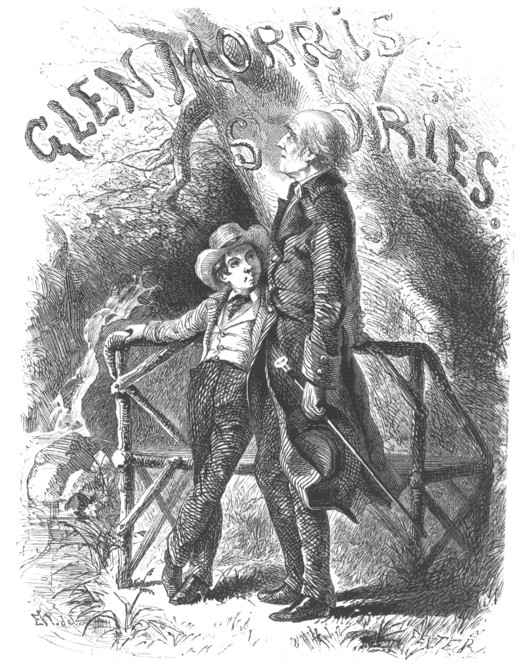
After breakfast the next morning, Jessie sat down to her work with a resolute will. Her impulse, was to spend the hours playing with Madge. But her purpose to act by rule was strong, and it conquered. Guy went out for the brown worsted, which her meeting with Madge, kept her from buying the previous evening. So giving her protégé a seat on a cricket by her side, she worked merrily, and with nimble fingers, on her uncle’s slippers. The tongues of the two girls, you may be sure, were as nimble as Jessie’s fingers.
While they were thus happily employed, Uncle Morris was out, looking after the young outcast’s mother.
Jessie had not been seated more than an hour before her brother Hugh, with his friend, Walter Sherwood and his sister Carrie, came in, each armed with a pair of skates, and well wrapped up, as was fitting they should be, on a cold day in November. Carrie bounded into the room like a fawn, and kissing her friend, exclaimed:
“O Jessie! this is a capital morning for skating! Walter has found a nice safe place, and we have come to take you with us.”
This was a strong temptation. Perhaps a stronger could not have been offered, to incline her to break her purpose, and drop her work. There had been no day since her skates had been given her, in which there had been ice enough to try them. It was a new amusement, too, and her heart was set upon it. Hence, an impulse came over her, to pitch the slipper into the basket, seize her skates, and hurry away to the desired spot. In fact, she half rose from the chair, and words of consent were rising to her lips, when she thought of the little wizard, and reseating herself, replied:
“I would like to go ever so much, Carrie, but I must stay in until dinner-time, and work on uncle’s slippers.”
“Bother the slippers! Who cares about them! Uncle don’t need them, and why should you be fussing over them,” said Hugh.
“It’s very pleasant to work for your good old uncle, I dare say, Miss Jessie, but you can do that in the afternoon. We very much wish you to join our party this morning,” observed Walter.
“I know I could,” replied Jessie; “but mother wishes me to sew or study every morning until dinner-time, and I have resolved to do it. I have broken my purpose a great many times, but I must keep it now, much as I want to go out skating. Can’t you put off your party until the afternoon?”
“Not a bit of it!” said Hugh. “Come Walt, come Carrie, let us be off.”
“I think I will stay with Jessie this morning,” replied Carrie; “and I invite you, young gentlemen, to beau us to the skating-ground, this afternoon!”
“If you won’t go now, you may beau yourselves for all we,” retorted Hugh in his usual ungracious way, when treating with his sister.
“Don’t say so, Hugh,” responded Walter. “It’s hardly polite. ’Spose you and I go without the girls this morning, and with them this afternoon? Eh?”
“As you please!” growled Hugh, swinging his skates; “only let us be off quick.”
The boys now left, promising to go with the girls at half-past two in the afternoon. Carrie laid aside her hood and cloak, which Jessie took, and laid in a heap upon the table.
“My dear!” observed Mrs. Carlton, who looked into the room just at that moment; “is that the place for Carrie’s things?”
A blush tinged Jessie’s cheek. As I have said before, a want of regard for order, was a fault which grew out of her impulsive nature. She did most things in a hurry, and usually with some other object before her mind at the same time. While her uncle had been trying to cure her of the habit of yielding to her impulses, her mother had also been endeavoring to stimulate her to cultivate a love of order. No wonder, then, that she blushed as she went to hang her friend’s hood and cloak on the stand in the hall.
All this time, poor Madge had sat almost unnoticed. So taken up were they all with their skating party, that they had overlooked the quiet maiden, sitting so demurely on her cricket. But now the boys were gone, and the two friends took their seats, Jessie’s thoughts came back to the young outcast, and turning to Carrie, she said:
“Carrie, let me introduce you to Madge Clifton.”
“How do you do, miss?” said Carrie, bowing.
Poor Madge did not know much about introductions, and was unused to company. So she only blushed, hung down her head, and replied:
“Pretty well, thank ye.”
Jessie now took Carrie aside, and in whispers told her poor Madge’s story, after which they resumed their seats. Carrie’s warm heart soon melted away the poor outcast’s fears; and while the two young ladies were merrily prattling away, Madge listened with wonder if not with delight. In fact, her life since last evening seemed more like a dream than a reality to her. She was still in fairy-land.
Presently the postman came to the house bringing a letter addressed to “Miss Jessie Carlton.” The servant took it to Jessie on a small salver.
“Is it for me?” cried Jessie, taking it up and examining the address.
“Whom can it be from?” asked Carrie, leaning over to her friend’s side to see the handwriting.
“Oh, I know!” exclaimed Jessie. “It’s from cousin Emily.”
The letter was opened, and Jessie read aloud as follows:
Morristown, N. J., November 18, 18—.
My Dear Jessie:
I got home nicely from your house. Ma was very glad to see us, and so was pa. Charlie said he was glad to get home. I was some glad and some sorry. It was pleasant to see pa and ma again, but I missed you, oh! ever so much! When I went up to my room that night, I sat down and cried. I thought over all the naughty things I had said and done to you while I was at Glen Morris, until it seemed to me I was the most wicked girl in the world. I thought of you and of dear Uncle Morris and his good advice, until my heart seemed broken. Then I kneeled down and asked God to make me a good girl like you. I begin to believe he will, for I have been trying hard to be good ever since. Mother says I am a very good girl already; but she don’t know what passes in my thoughts, nor how hard I have to strive to keep down my ugly, wicked temper. Charlie is not quite so wicked as he was, either, and I am trying to make him a good boy. I wish you would come to Morristown and make me a good long visit. With much love to yourself, and your good Ma, Pa, and Uncle Morris, I am
Your affectionate cousin,
Emily Morris.
To Miss Jessie Carlton.
“What a beautiful letter!” said Carrie. Jessie was silent. She was thinking. She was secretly rejoicing, too. Such a joy was in her young heart as had never welled up in it before. She had done Emily good. As Guy had led Richard Duncan into right paths, so she had led Emily. Happy, happy Jessie!
Just then she heard Uncle Morris’s night-key lifting the latch of the hall door. Away she bounded from her seat, almost overturning poor Madge in her hurry. Rushing to her uncle as he was closing the door, she seized his arm with one hand while she held up Emily’s letter in the other, and in a loud, earnest whisper, said:
“O Uncle! Cousin Emily is trying to be good. She says so in her letter.”
Uncle Morris stooped to imprint a kiss on the upturned lips of the eager child. Then patting her head gently, he said:
“It is not every sower of good seed that finds his harvest sheaf so quickly as you have done. Perhaps the Great Husbandman has given my Jessie hers to encourage her to sow, and sow, and sow again—but Jessie, I have found your Madge’s mother.”
“Have you, truly?” asked Jessie, feeling her interest suddenly revived in her protégé.
“Yes. Come with me to your mother’s room and I will tell you all about it.”
This “mother’s room” was up-stairs, and up they went. Finding Mrs. Carlton there with her seamstress, they sat down, and Uncle Morris told his story. Said he:
“I have seen Mrs. Clifton. She is sober this morning, and is quite a well-bred, intelligent woman. She has been respectable; was well married to a reputable man. But foolishly forsaking their quiet country home, they went to the city in the hope of acquiring property. There her husband, failing to get work, took to drinking and died. Mrs. Clifton buried him, and, dreading to go back to her old home because of poverty, tried to support herself by needle-work. In an evil hour she took to drinking; first as a stimulant to labor, and then as a cordial to soothe her griefs. Of course she soon sank very low, and made poor Madge go out to beg. At last, stung with remorse, she resolved to quit the city, and, seeking work in the country, become a sober woman again. Filled with this purpose she travelled as far as Duncanville with her child, when her appetite for drink came upon her. Leaving Madge at the Four Corners she sought the tavern. The rest you know. We found the child, and she spent the night in the lock-up.”
“Poor thing!” exclaimed Mrs. Carlton.
“Poor little Madge!” cried Jessie, who very naturally felt more for the unfortunate child, than for the unhappy, but guilty mother.
“Yes,” said Mr. Morris, “but pity alone won’t do them much good. The question is, what shall be done with them?”
“True,” rejoined Mrs. Carlton, “but are you sure the woman’s story is true?”
“It agrees with the account Madge gave of herself, so far as the affair of last evening is concerned. Being true in one thing, I hope it is in all. She has, however, given me references to her old friends in the country, and professes to be very anxious to live a reformed life. I will write to her friends, but, meanwhile, what shall we do with her?”
“Let her come here, and stay with Madge?” suggested Jessie.
Mrs. Carlton looked at her brother, and read in his eyes an approval of her daughter’s suggestion.
“Be it so,” said she, “if you think best. I can keep her busy with her needle, until we hear from her friends, and something offers. Perhaps a few days spent in our quiet home, will confirm her in her feeble purposes to reenter the way of sobriety.”
“Spoken just like yourself!” said Mr. Morris, with an expression which showed how greatly he loved and admired his sister. “I will go after the poor creature directly.”
“Oh, I’m so glad Madge’s mother is coming here to live!” cried Jessie, clapping her hands, and running down-stairs to tell the good news to her protégé.
The outcast child looked a gratitude she did not know how to express, after hearing what Jessie had to say. She fixed her large, black eyes, swimming in tears, upon her friendly hostess, and silently watched her every motion.
“I think it’s very kind of your mother, to take a stranger into her house so,” whispered Carrie.
“So it is,” replied Jessie, who was now busy with her embroidery on the slipper. “So it is, but my Uncle Morris says that it is godlike to be kind, and that if we are kind and loving to poor people, the great God will honor us, and care for us.”
Carrie looked at the sweet face of Jessie with admiration for some time, without saying a word. At last, to break the silence, she said:
“Won’t we have a good time, skating this afternoon?”
“I hope so,” said Jessie; “and we will take Madge with us, shall we?”
“Can you skate, Madge?” asked Carrie.
Madge shook her head. The child was nervous and uneasy about the coming of her mother. She was afraid she might come to the house tipsy, and so offend the friends who loved her so well.
“Can you slide on the ice?” asked Jessie.
“Yes, ma’am,” replied Madge, evidently getting to be more and more absent-minded.
“She is thinking about her mother,” whispered Carrie.
“Yes, don’t let us trouble her,” replied Jessie.
Quickly sped the bright needle, with its beautiful worsteds, along the slipper, and quickly grew into shape the flowers which were to form the pattern. A happy heart and a resolute will, make her fingers both nimble and skilful.
By and by, Uncle Morris’s night-key was heard opening the door-latch again. Jessie started, listened a moment, then dropped her work, and taking Madge’s hand, said:
“Your mother is come!”
“Where is she?” asked the child, looking anxiously toward the door.
“Come with me, I’ll show you,” said Jessie, taking her by the hand.
They went into the hall. Uncle Morris was there, and so was Mrs. Clifton. She was a short, slender, well-formed woman, with large, dark bloodshot eyes. Her face was pale, her cheeks hollow, and her hair uncombed. She was poorly dressed, and yet there was something about her, which told of better things. As soon as she saw Madge, she ran to her, folded her nervously to her bosom, and exclaimed:
“Oh! my child! pity your poor, wretched mother!”
Madge, finding her mother to be sober, grew cheerful. Her mother, after being taken to the bath-room, and furnished with some changes of raiment, was installed in the room with the seamstress, and then, as waters close up, and flow on smoothly again, after a little disturbance, so did affairs at Glen Morris move on once more, in their wonted quiet course.
“Now you can go skating with me, can’t you?” inquired Carrie Sherwood, as she pushed her little round face in at the door after dinner.
“Yes, now I can go,” replied Jessie. “I did ever so much on my slipper this morning, and shall get it done by the last of the week.”
“If you stick to it, but I know you won’t,” said Hugh, interrupting his sister.
Jessie felt a little anger stir in her heart on hearing this fling at a habit she was trying so so hard to overcome. But saying to herself, “never mind, I deserve it,” she merely gave Hugh a glance of reproof, and was silent.
“I say, that’s ungenerous, Mister Hugh,” observed Guy, taking up his sister’s case. “You know Jessie is learning to stick to her purposes, and that is more than anybody can say of you.”
“Don’t be too hard upon a fellow just for a joke,” replied Hugh, wincing under his brother’s hit.
“Well, don’t you throw stones at Jessie; at least, not so long as you live in a glass house yourself,” said Guy. Then turning to the girls, he added: “Come girls, get ready, and I’ll go with you to help Jessie try her new skates.”
“Oh, thank you, you dear good Guy!” replied Jessie, running to her brother and giving him a sweet sisterly kiss.
“I think I’ll go, too, if you’ll let me,” said Hugh.
“You may if you’ll promise not to poke fun at us if we fall down,” replied Jessie.
“If you do poke fun, master Hugh,” said Carrie, shaking her head at him, “we will never consent to let you join our party again!”
“That will be terrible!” exclaimed Hugh, with mock gravity. “Why I’d rather be drummed out of our Archery club than be turned off by the ladies.”
“Well, you may go this time, if you will carry my skates,” said Jessie.
“Of course I will; and is there any thing else, in the small way, that your most humble servant can do for you?” asked Hugh, bowing almost to the ground.
A laugh greeted this act of mock humility, and then all parties prepared to face the keen breeze in search of recreation on the ice.
“Where is Madge? is she ready?” shouted Jessie, as she stood at the foot of the stairs, warmly muffled for her walk.
“Yes, Miss, here she is,” replied Madge’s mother, as she came to the top of the stairs, leading her daughter by the hand.
Madge was dressed in an old plaid cloak, which had become too small for Jessie, and in a scarlet hood which had been laid aside for the same reason.
“A regular little red riding-hood, isn’t she?” whispered Hugh, to his brother, after taking a survey of the prim, little black-eyed miss before him. Then looking sour and angry, he added, “But why does Jessie take the beggar’s brat out with her?”
“Hugh! Hugh! Don’t talk in that way,” replied Guy, putting his hand playfully over his brother’s mouth.
“Get out!” cried Hugh, pushing his brother’s hand away and walking off in high dudgeon, in search of Walter, who, for some reason, had not come with his sister. His foolish pride had kindled anger in his breast.
Madge, with the usual quickness of girls of her age, had caught enough of Hugh’s words, and of the meaning of his act, to perceive that he was disposed to treat her with scorn. A cloud flitted across her brow, and her eyes flashed. It was clear that the proud, thoughtless boy had wounded her feelings.
“Hugh! Hugh! Don’t carry off my skates!” shouted Jessie, as her brother turned into the main road, from the lawn.
Whirling the skates over the fence, he kept on without a word. The skates, fortunately, fell on a heap of dry leaves and were picked up uninjured by Guy, who, with the three girls, soon found the way to some hollows, in the pasture, near the brook. These hollows, filled with shallow pools of water, now solidly frozen, were excellent places for young misses to slide and skate in.
Madge was not cheerful this afternoon. Hugh had wounded her pride, and stirred her sleeping passions. It was very ungenerous conduct, in a lad of his age, to treat an unfortunate child with scorn. Madge ought not to have allowed her temper to be ruffled. But, alas, poor child! she had not been taught to keep her evil temper under control. So she brooded over Hugh’s conduct. The more she thought of it, the more chafed and angry she felt.
Guy helped Carrie and his sister put on their skates. Jessie had never had a skate upon her foot before. Carrie had learned to use them a little the previous winter. Hence, she glided off something like a swan, while Jessie hobbled and slipped, and tumbled for a long time in vain attempts to keep upright on the ice.
Carrie was so taken up watching the laughable attempts of her friend, that she took no notice of poor Madge. Guy and Jessie were so busy, the former teaching, and the latter learning, that they too forgot her. Poor child! this neglect stung the wound which Hugh’s act had caused, and so, with many a frown and pout, she quietly stole from the hollow to a deeper one in which, by seating herself on a low stump, she could remain unseen.
“They is all proud,” mused Madge, half aloud. “I heard that You, or Hugh, whatever they call him, say ‘beggar’s brat.’ I know he meant me, and I know he went off cause I was with ’em. And there’s them gals; they don’t care for me a bit. Drat ’em! I wish mother would go away from here.”
This was very foolish talk for Madge. Had she looked on the kind side of her new-found friends, and thought of their gifts to her, and of the pleasant home they had given her and her mother for the time-being, and of their gentle words, she would have seen so much to be grateful for, that there would have been no room in her heart for unhappy feelings. But Madge forgot all these things. She saw nothing but Hugh’s scorn and Jessie’s neglect. With these she tortured herself. It was just as foolish as if she had taken some sharp thorns and scratched her arms and cheeks with them.
While Madge was thus making herself miserable, Jessie was making rare progress with her skating. After a few awkward falls and a few bumps and bruises, she learned “the how,” as Guy called it; and then, though still awkward, oh! how joyously she sped across the little pond chasing after Guy and Carrie, and shouting until the welkin rang again.
“Capital fun, isn’t it?” said she, gliding ashore, and sitting down on a stone almost out of breath.
“I call it nice sport for girls,” replied Carrie, pausing on the edge of the bank; “but you aren’t tired yet, are you?”
“Yes, a little. Besides, too much of a good thing, as my uncle says, destroys your relish for it. I guess I’ve skated enough for once,” said Jessie, stooping and unbuckling the straps of her skates.
“Pooh! Jessie’s not half a skater!” rejoined Carrie; “but what has become of your friend Madge?”
“Sure enough! Where is she? I had forgotten all about her.”
But Madge had wandered still farther off, and was nursing her bad feelings in a small grove which skirted the pasture. She was not visible from where the girls and Guy were.
“O Guy! Madge is gone. Won’t you please come and help me find her?” said Jessie, putting on a very long and sorrowful face.
“I’ll call her. She’s not far off, I’ll bet,” replied Guy.
Then placing his hands to his lips as a sort of speaking trumpet, he shouted—
“Madge! Ma-adge! Ma-a-adge!”
“Adge! Adge! Adge!” said an echo from the distant grove.
“Where can she be!” cried Jessie, now relieved of her skates and standing on a hillock, peering eagerly all over the pasture.
“I guess she is only gone home. Never mind her,” said Carrie. “She ain’t worth worrying about.”
“Yes, she is,” replied Jessie. “She is a poor unhappy girl, and I want to make her good and happy. Uncle Morris says everybody that God made is worth caring about, and I do care for Madge. Oh dear, I wish I knew where to find her.”
“See there?” cried Guy, pointing to a group of boys near the distant grove. “I think I see Madge among those fellows. I’ll lose my guess if that isn’t Idle Jem and his crew. There’s a girl among them for certain, but how could Madge stroll all up there and none of us see or think of her?”
“Let us go and see,” said Jessie.
Quickly as their nimble fingers could loose the straps, Carrie and Guy removed their skates. In a minute or two more, the three were hurrying across the pasture toward the boys and girl, whom they saw.
Madge was, indeed, one of that group. Idle Jem and his crew, while wandering across the pasture in search of the hickory-nuts which were hidden under the dead leaves, had found her in the grove. They began to jibe at her at once. The girl long used to the rough news and beggar boys of the city, and out of temper, withal, jibed back at them with interest. They goaded her with harsh words; and when Guy and the girls came within hearing, she was using language such as the pure-minded Jessie had never heard before.
“Hush, Madge!” said Guy, putting his hand on Madge’s shoulder. “Don’t swear! It’s wicked to talk so. You go home with Jessie and Carrie, I’ll take care of these boys.”
That last phrase was an unlucky one for Guy. The wicked boys took it up as a defiance.
“Take care of us, eh? That’s the talk is it? How will you do it, old fellow?” said Jem, sneering and chucking Guy’s chin.
“Keep your hands off me, if you please,” said Guy; “I want nothing of you only to let that poor girl alone.”
“It’s none of your business what we say to that gal,” said Noll Crawford.
“Yes, it is my business to see that you let her entirely alone,” replied Guy firmly. “So stand off, and let us take her quietly a way.”
“Shan’t do nothin’ of the kind,” said Peter Mink, running toward Madge, whose eyes flashed fire.
Guy grasped him by the collar and hurled him back from Madge, amidst the tears and cries of Carrie and Jessie who were both very much frightened.
“Oh! oh! a fight is it you want? Come I’ll fight with ye!” said Idle Jem, slipping up to Guy, and raising his fists as if for a battle.
“I never fight!” replied Guy. “Besides, we have nothing to fight about. I only wish you to let my little friend, Madge, alone.”
“She!” retorted Jem, “that swearing cat your friend, Master Guy Carlton. Pooh! You don’t have swearing gals among your friends, I know. That gal is some beggar’s brat, and we only want to have some fun with her.”
Jem’s tone was much lowered toward the latter part of his speech. His hands, too, fell as if by instinct to his pockets. Peter Mink and Noll Crawford drew back, the latter saying as he did so—
“Come, Jem, let’s leave the spunky little gentleman and his friend, Madge, to themselves. I’d rather pick up hickory nuts than listen to his gab.”
“Discretion always is the better part of valor, as Uncle Morris says,” thought Guy, as he walked away with his sisters, patting the head of old Rover.
It was the coming up of old Rover which had cooled off Idle Jem and his crew. The dog had been strolling about the pasture while Jessie was skating. Having missed his young master and mistress on returning to the pond, the faithful fellow had followed them. He came up just at the right moment. His rows of big white teeth, and his low growl, taught the idlers the discretion which Guy praised and which led them to cease their angry jibes. With Guy alone they might have contended. But Rover was an enemy they had not courage to face.
To the wounded pride and the ill temper of Madge, shame was now added. The kind and gentle Jessie had heard her swear, had seen her face flushed with passion, had had a glimpse into the dark corner of her evil nature. Poor Madge! She sullenly refused to speak or to permit either of the party to take her hand; but lagging behind the rest, she silently followed them home.
Jessie bade her friend, Carrie, good-by in front of Mr. Sherwood’s cottage. As they kissed each other, Carrie put her mouth to Jessie’s ear and whispered—
“Jessie, shall I tell you what I think about Madge?”
“Yes.”
“I wouldn’t trouble my head about her any more, if I were you. She is a terribly wicked creature!”
Jessie sighed, but said nothing. On reaching home finding no one at liberty to talk with her, she went to her chamber and getting her writing materials and her portfolio, went down into the parlor and wrote the following answer to her cousin Emily’s letter:
Glen Morris Cottage, Duncanville, Nov. —, 18—.
Dear Cousin:
I was glad to receive your letter, and to learn that you were all well at Morristown. I cannot tell you how happy it made me to hear that you are trying to be good. I wish I was good all the time, but, as Uncle Morris says, it is so much easier to do wrong than it is to do right. I can’t tell you how much I love our dear uncle, for he is always helping me to be good. He says a good heart is God’s gift, and that we must ask him to give it to us for the sake of his dear Son. Well, I ask for a good heart three times every day, and if you do so too, God will hear you and bless you.
What do you think? Yesterday I found a poor girl named Madge in the road near the pump at the four corners. You know the place. Well, I asked Uncle Morris to take her home and he did. Her mother is here too. I thought Madge was so nice, and would learn to be good so easy, that I began to love her dearly. But to-day, she swore dreadfully and wouldn’t speak to me. Isn’t it fearful? I’m afraid I shan’t be able to love her as I want to any more. Oh dear! I’m so sorry. Well, you and I must try to be good. Give my love to uncle and aunt, and to Charlie, and believe me to be
Your affectionate Cousin,
Jessie Carlton.
P. S. I’ve almost finished Uncle Morris’s slippers. J. C.
“Well, Jessie, how do you like your black-eyed protégé?” asked Uncle Morris, a few days after the events recorded in the last chapter.
“Pretty—well—but—but—”
“But what?” said Uncle Morris, with an arch glance, for he saw that Jessie was loth to speak the thought that lingered in her mind.
“Well, I like Madge, Uncle, but as ma says, she is not quite an angel,” and Jessie laughed as if there was something funny in her mother’s saying.
“I suppose she is not. Did my puss ever hear of angels being found, as we found Madge, dressed in rags, and shivering under a stone wall?”
“No, uncle, but, but—”
“There you are but-ing again,” said Mr. Morris. “Why not out with it at once, and say that you did not expect to find so many faults in poor Madge, as you have found?”
“Because I don’t like to speak evil of her, and yet I do wish she wouldn’t have those ugly spells come over her. Sometimes she is so gentle and grateful, that I begin to love her dearly. Then all at once, she will be so cross and ugly, that I begin to repent having asked you to bring her home with us.”
Mr. Morris looked at his perplexed niece in silence for nearly a minute. He was thinking how to impress her mind with the moral taught by her disappointment respecting Madge. At last he very gravely said:
“Jessie!”
“What is it, Uncle?” asked Jessie, surprised at her uncle’s manner.
“Shall I tell you plainly, why you feel so much disappointed in poor Madge?”
“Yes, Sir.”
“Well, it is because your kindness to her was mixed with a good deal of selfishness.”
“O Uncle Morris!” exclaimed Jessie; “how can you say so?”
“Because I really think so;” replied Mr. Morris.
“Well, you are a funny man, if you think so, Uncle! How could I be selfish, in wishing you to bring that poor child home? I’m sure I didn’t expect to gain any thing by it.” Here Jessie pouted a little, for she was really piqued by what her uncle had said. Seeing this, Mr. Morris replied:
“I hope my little puss is not going to be angry with her poor old uncle, because he seeks to tell her the truth.”
“Well, no; but really, I don’t see how you can think me selfish, just for wishing you to bring a poor, freezing child, to our house,” and with this remark, Jessie forced back the smile which usually played round her lips, while she looked earnestly into her uncle’s eyes.
“Will my little puss answer me a question or two?”
“Yes, Sir.”
“Tell me then, my dear child, did you not expect to derive a great deal of pleasure from Madge’s gratitude, and love, and obedience to yourself? Did you not look upon yourself as her benefactor, her teacher, her superior, and as having a right to claim such conduct from her, as would, in some degree, pay you for your trouble and kindness? You expected her, poor thing, to behave like an angel, for your sake. Instead of that, she has, at times, let her evil nature and her bad habits break out, in a way to give you trouble and pain, and to cause you to feel disappointment. Are not these things so, my sweet little puss?”
“Yes, Sir. But—but ought not poor people to be grateful and obedient to those who help them?” asked Jessie, who, though she began to perceive that a regard for her own pleasure had been mixed with the kindness to Madge, was not quite ready to plead guilty to her good uncle’s charge.
“They ought certainly, and when they do, it is very right for those who help them, to take pleasure in their gratitude. But that is a very different thing, from doing good for the sake of the pleasure or profit we expect to derive from the conduct of those we benefit.”
Uncle Morris then went on to show Jessie, that really good people were kind to the poor and wretched, because it is their duty to be so; that they seldom found their reward, either in the gratitude of those they helped, or in the smiles of men; that instead of finding such rewards, they were often blamed and treated harshly by the public, and ungratefully by their protégés; but that they had a rich reward, nevertheless. They felt, he said, a very sweet satisfaction in themselves; they were smiled upon by the Father and Saviour of men; and they would, in the better land, be more than rewarded with mansions, robes, crowns, and honors, which selfish people would forever envy but never enjoy.
This talk with her uncle did Jessie good. She afterwards bore Madge’s outbreaks of temper with more patience, and tried to set her such an example as would make her feel her own faults far more than by scolding or fretting.
Madge, who was very quick-witted, saw and felt the change in Jessie, and she, too, tried to overcome herself, that she might not grieve a friend, who loved her so truly and so well.
One morning Jessie awoke, and was surprised to see the lawn, the trees, and the fences all white with snow. It was a beautiful sight. She had never seen snow in the country before. Having dressed herself, she ran down-stairs, and going to the piazza, clapped her hands, and cried:
“Oh, how pretty those evergreens look! That pine-tree is perfectly beautiful!”
“Ah, Jessie, is that you?” said Guy, as he came round the winding path, plunging through the soft snow with his thick boots, and dragging his sled after him.
“Yes, I’m here,” replied Jessie. “But where have you been with your sled before breakfast?”
“Been coasting, to be sure. There’s a capital place in the lane that runs past Carrie Sherwood’s cottage. We couldn’t do much this morning but tread down the snow; but after breakfast, it will be fine. Will you go with me then, Jessie?”
“I should like to, ever so much, but—”
“But what?”
“Well, I must work all the morning. That’s my rule, you know. I’ll go with you in the afternoon, Guy.”
“I don’t want to tempt you to neglect a duty,” replied Guy, knocking the snow off his boots against the step of the piazza, as he spoke, “but really, I’m afraid the coasting won’t be worth the heel of an old shoe, by the afternoon. You see, the sun is very bright, and the snow isn’t apt to stay long, so early in the season.”
“I’m sorry,” said Jessie, looking very downcast, “but I must give it up, I guess. You see, I’ve finished uncle’s slippers, and have almost done his watch-pocket. I want to finish it ever so much before Thanksgiving, which is to-morrow, you know.”
“That’s right, stick to it, Sister Jessie! I won’t train in the little wizard’s company, so I advise you to lose this coasting treat, if the snow does go, and thereby gain a victory for which Corporal Try would promote you if he knew it.”
With these words, Guy kissed his sister, placed his sled in the back-hall, and went to the breakfast-room, to which he was shortly followed by Jessie.
At breakfast, the boys discussed the question of the weather, and the snow very earnestly. They wanted the snow to last, first, that they might enjoy the sport of coasting, and then, that they might have a sleigh ride.
“How I should like a sleigh-ride,” exclaimed Jessie, with brightening eyes.
“Guess you won’t have it just yet,” said Hugh. “The sun will melt the snow from the roads before noon, I guess, and its too light and loose for good sleighing this morning.”
“I’m sorry, for I do want to coast, and to ride in a sleigh, so much—ever so much,” said Jessie, sighing, and looking very sober—for her.
“Can’t you coast this morning, with the boys?” inquired Mr. Carlton.
“We don’t want her,” said Hugh, snappishly. “Girls are always in the way when coasting is going on.”
“Ill-natured as ever, I see, Master Hugh,” observed Uncle Morris.
“I want her,” said Guy, “and will take her this afternoon, if the snow don’t melt.”
Jessie looked at her brother with eyes that seemed to say, “What a dear, good brother you are!” Mr. Carlton asked:
“But why not take her this morning, Guy, before the snow melts?”
“Because she thinks it is not best to go, Sir,” replied Guy.
“Ah! ah! Not best to go, eh? What’s going on at home this morning, Jessie?” asked Mr. Carlton, looking at his daughter, whose face was now red with blushes.
“Because Corporal Try won’t let her,” replied Guy, laughing and coming to her help. “He has given her a task which he wishes done before Thanksgiving, and she means to do it, too, in spite of the little wizard, who sits perched on my sled, in yonder hall, and saying, ‘Come, let’s have a good time together, this morning.’”
“Bravo! If this was the proper place, I would propose three cheers for Jessie Carlton, and her friend the Corporal,” said Uncle Morris. Then turning to Mrs. Carlton, he added, “By the way, sister, do you know that I expect to hear of a wedding before long?”
“Indeed! Who are going to be married now?”
“No less a personage than that pesky little dwarf, who has given my little puss so much trouble. I learn that he has popped the question to Miss Perseverance, and if nothing happens, they will soon be joined in wedlock, by Parson Good-Resolution.”
Of course this quaint way of praising Jessie for her self-denial and self-conquest caused a good hearty laugh all round the table. Jessie’s cheeks bloomed like roses, and her heart went pit-a-pat with joy-beats. A happier breakfast party could scarcely have been found that morning in or out of Duncanville.
To increase the flow of Jessie’s delight, shortly after she had taken her seat in her own pretty little chair, her uncle entered the parlor with merriment in his eyes, and said:
“Sew away, my little puss. The north wind is on your side, and in spite of the bright sun will keep the snow from melting, so that you may coast after dinner with Guy and your friend Carrie, and take a sleigh-ride, too, at three o’clock with a funny old gentleman named Morris. What do you say to that my puss, eh?”
“I’m so glad, I don’t know what to say, Uncle. But, see here! (and Jessie held up a purple velvet watch-bag, ornamented with steel beads.) I shall have it all done by twelve o’clock!”
“If the little wizard don’t hinder,” suggested her uncle, laughing and looking roguishly at her.
“Well, he won’t,” said Jessie, shaking her head. “He is too busy courting Miss Perseverance to trouble his head about me. Ha! ha!”
Mr. Morris laughed heartily at Jessie’s ready use of his quaint fancy about the little wizard. He had no doubt about her firmness. But shaking his finger at her he said, “Take care! the little wizard is a cunning fellow, and knows how to ensnare little misses who have tasks to perform,” and left the room.
Strong in purpose, and cheered by the hope of the afternoon’s pleasure, Jessie worked with such vigor on her watch-pocket, that she had put on the last bead, sewed the last stitch, and trimmed off the last loose thread before the clock struck twelve. Then she felt happier far than any child ever did in the enjoyment of pleasures gained by the neglect of duty. She had conquered a difficulty, had won a victory, had done a duty—had she not a right to be happy?
I could almost wish myself a child again for the sake of tasting that fresh, perfect, unmixed delight which welled up from Jessie’s heart on the afternoon of that clear December day. First came the play of coasting. Taking her on his sled—“The Never-say-die”—Guy drew her to the lane near Mr. Sherwood’s cottage and amused her until the merry sleigh-bells caused her to turn round. Then she saw a splendid sleigh drawn by two noble horses, and driven by a man who, from the way he handled the whip and reins, seemed born to be a coachman. Her mother and Uncle Morris were in the sleigh. She stepped in. Carrie and Guy followed. Having wrapped themselves up well in the buffalo robes, word was given to the driver, and away they dashed down the road.