
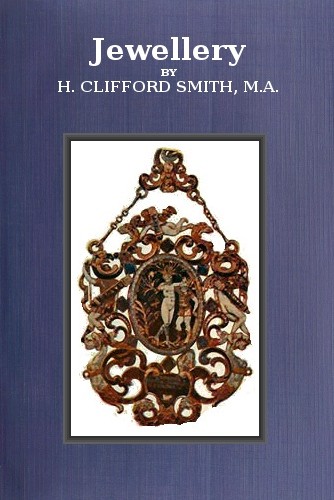
Collar of the Order of the Golden Fleece, made in 1432 by John Peutin of Bruges, jeweller to Philip the Good, Duke of Burgundy. (From the portrait of Baldwin de Lannoy by John van Eyck at Berlin.)
CHAPTER XII
MEDIÆVAL ENGLAND
A FEW brooches and finger rings are almost the only surviving examples of English jewellery of the eleventh to the fifteenth centuries. Yet there is evidence from existing records of an abundance of the most beautiful objects as accumulated in the ecclesiastical treasuries, and the great shrines, like that of St. Thomas of Canterbury, or of Our Lady of Walsingham Priory, which not even the Santa Casa at Loreto, or the shrine of St. James at Compostella, could surpass in renown, or equal in the reception of rich and costly gifts. Vast quantities of jewelled objects, which must have been in great part native productions, have also been tabulated in the inventories of our monarchs, princes, guilds, and corporations. Judging from extant examples of English painted glass, sculpture, and particularly embroidery, some estimate can be formed of the high quality of the goldsmiths' work, which was scarcely excelled in the Middle Ages by that of any other country in Europe. The English goldsmiths, in fact, after the Norman Conquest seem to have lost none of the skill which is displayed on their earlier productions.
TN: no footnote marker in the text - footnote reads:
De Mély and Bishop, Bibliographie générale des
inventaires imprimés, 1892-95.
A love of finery seems to have characterised the Court of William the Conqueror and his successors. The jewellery of the ladies became exceedingly extravagant, and is bitterly inveighed against by the religious satirists. Neckam, an Anglo-Latin poet, towards the close of the twelfth century, accuses them of covering themselves with gold and gems and of perforating their ears in order to hang them with jewels.
Henry I had the tastes of a collector. That he collected gems is known from a letter written by a prior of Worcester to Edmer, Anselm's biographer, in which he suggests that for money Henry might be persuaded to part with some pearls.[35] King John was greatly attached to his jewels, and their loss in the Wash is commonly supposed to have hastened his death. The record is preserved concerning the loss on an earlier occasion of certain of his precious stones "which we are wont to wear round our neck." The stones must have been credited with miraculous powers, for their finder was very liberally rewarded.[36] Henry III, one of the most indigent of monarchs, made such extravagant presents of jewellery to his wife, that he was afterwards obliged to pawn not only his regalia, but a considerable portion of the jewels and precious stones accumulated at the shrine of Edward the Confessor at Westminster Abbey.
Dating first from about this period are a number of inventories of personal ornaments; and it is by a perusal of the inventories of the most wealthy, and particularly those of sovereign princes, that an estimate can be obtained of the nature of every type of ornament in use at the period, in its most elaborate form. Among the earliest and most important royal inventories that have been published are those preserved in the Wardrobe Account (Liber Quotidianus) of Edward I, for the year 1299.[37] The jewels (jocalia) include a large number of morses or clasps (firmacula) given by the king to bishops, and restored after their deaths, and similar objects offered by the king or queen to various shrines; while among other jewels are brooches or nouches (noucheæ), many rings (anuli), a pendant (pendulum), belt (zona), bracelet (braccale), and baldrick (baudre). About this time masses of precious stones, the spoils of the Crusades, began to find their way into this country, and to be employed for "broidering" or sewing upon the garments. Edward II and his extravagant favourites, such as the worthless Piers Gaveston, loaded themselves with precious stones. Lists of jewels belonging to Gaveston on his attainder in 1313,[38] and to the king in 1324, show the magnificence of their ornaments, and the vast sums at which they were valued. The king's jewels,[39] described in considerable detail, are inventoried under the following headings: (a) Stones and other objects, (b) Crowns of gold and silver, including cercles and chapeletz, (c) Brooches (fermails) of gold, (d) Fleures de liz, (e) Rings (anelx) of gold, (f) Girdles (ceintres) and diadems (tressoures). From this time onward there is an increase of such documents and of wills, and also of sumptuary laws specially connected with personal ornaments.
The brilliant reign of Edward III[40] was favourable to the full display of jewellery. New luxuries were imported in great abundance, and there was hardly a lady of position who had not in her possession some portion of the spoils of plate and jewels from cities beyond the sea; while those who, like the Knight of Chaucer, had been at Alexandra "when it was won," returned with cloth of gold, velvets, and precious stones. In the thirty-seventh year of this reign (1363) the Parliament held at Westminster enacted several sumptuary laws against the extravagant use of personal adornment. These state what costume is suited to the various degrees of rank and income, and are of value for the information they supply on the prevailing fashions in jewellery. Restrictions of this kind, re-enacted from time to time, and apparently of little effect, seem to have been intended not so much to prevent the gratification of an instinctive desire for bravery and splendour, as to make different classes proclaim their rank and station by their dress.
Chaucer in the Prologue of his Canterbury Tales affords in a charming manner additional information about the personal ornaments of the different grades of English society of his time. He gives detailed description of the brooch of the yeoman and the nun, and pictures the merchant with his richly clasped shoes, the squire with short knife and gypcière (purse) at his girdle, the carpenter's wife with her collar fastened by a brooch as "broad as the boss of a buckler," and various tradesmen who, in spite of sumptuary laws, wore pouches, girdles, and knives of silver:—
But all with silver wrought ful clene and wel
Hir girdeles and hir pouches every del.
The passion for personal ornaments, or "bravouries" as they were termed, reached its zenith in England during the reign of the elegant and unfortunate Richard II, whose courtiers outvied one another in such extravagances. An anonymous writer of the period quoted by Camden in his Remaines concerning Britain speaks of hoods, even those worn by men of moderate means, as commonly set with gold and precious stones, while "their girdles are of gold and silver, some of them worth twenty marks." The king, in constant want of money, was obliged on several occasions to deposit the royal jewels with the Corporation of London as security for loans, and detailed lists of the objects selected for the purpose are preserved in the inventories of the Exchequer, and among the city archives.
In spite of attempted restrictions, and notwithstanding the disastrous Wars of the Roses, immense demands appear to have been made upon the productive powers of the jewellers throughout the whole of the fifteenth century. The remarkable list of Henry IV's jewels in the inventories of the Exchequer, and the most important of royal English inventories of the Middle Ages, that taken after the death of Henry V in 1422 (Rotuli Parliamentorum, IV, pp. 214-241), serve to show that until the end of the century, which may serve as the termination of the period, extraordinary extravagance in the style and nature of ornaments as well as of costume was the order of the day.
Every one who had acquired wealth, or even a modest competence only, displayed a magnificence far beyond his means. It was a time when wealth was required in a compact and tangible form. Owners did not hesitate to melt down their jewels when desirous of employing them for other purposes. The change of taste which shortly came about tended towards similar destruction; while the Wars of the Roses involved the breaking up of much that was most sumptuous in material and beautiful in workmanship.
Throughout the whole of the Christian Middle Ages the highest efforts of the goldsmith were directed to the enrichment of the Church and the adornment of its ministers, and the magnificence which the ritual of the Church fostered found expression in the jewelled ornaments of ecclesiastic vestments. In Norman times ecclesiastical jewellery was extremely luxurious and costly, and the illuminations of the period show the cope and chasuble richly bordered with precious stones. St. Thomas à Becket wore an extraordinary profusion of jewels, and descriptions are preserved of the magnificence of his own person and of his attendants during a progress he once made through the streets of Paris. Innocent III, memorable in this country as the Pope to whom the pusillanimous John surrendered his crown, is recorded to have commented on the richness of the costumes and ornaments of the English clergy, with a hint at the possibility of extracting further sums for the increase of the papal revenue. The early inventories all record the splendour of the vestments used in public worship, and show how pearls, precious stones, and even ancient cameos, all rendered more beautiful by exquisite settings, were employed for their enrichment. No bishop, indeed, was suitably equipped without a precious mitre with delicate goldsmith's work and inlaid gems, without a splendid morse or brooch to fasten his cope, and without a ring, set with an antique gem or a stone en cabochon, to wear over his embroidered glove.
Of all these rich ornaments scarcely any examples have survived save a number of rings recovered from the graves of ecclesiastics. All the more precious, therefore, are the jewelled ornaments bequeathed in 1404 by William of Wykeham, Bishop of Winchester, to New College, Oxford, where they are still preserved as relics of its munificent founder. These unique examples of mediæval jewellery date from the closing years of the fourteenth century—the period of transition from Decorated to Perpendicular architecture: a time when Gothic art had reached its climax; and not only the architect, but the painter and the goldsmith were still devoting their utmost efforts on behalf of the Church, the centre of the whole mediæval system.
The New College jewels originally decorated William of Wykeham's precious mitre (mitra pretiosa). Portions of the groundwork of the mitre sewn with seed pearls, and its original case of cuir bouilli or boiled leather, stamped with fleurs-de-lis and bound with iron straps, are still preserved in the College. Among the jewelled fragments are hinged bands of silver gilt, formed of plates of basse-taille enamel representing animals and grotesques, which alternate with settings of dark blue pastes and white crystals surrounded by radiating pearls. These bands probably went round the lower part of the mitre, and also perhaps ran up the middle of it, before and behind. The crests of the mitre were edged with strips of exquisitely chased crocketing in gold. The other fragments include two rosettes of beautifully executed Gothic foliation set with white crystals, together with two quatrefoils in silver gilt and a cruciform gold ornament set with turquoises.
The chief treasure of the New College collection is an exquisite gold jewel, a monogram of the Blessed Virgin, the patron saint of the "College of St. Mary of Winton in Oxford." It is a crowned Lombardic M; and might be the rich capital of some mediæval manuscript, with its gorgeous colouring faithfully translated into gold, enamel, pearls, and precious stones. In the open parts of the letter are figures of the Virgin and the Angel of the Annunciation in full relief, the angel's wings being covered with enamel of translucent green. The space above the head of each figure is occupied with delicate architectural work of open cuspings. In the centre of the jewel is a large ruby in the form of a vase, from which spring three lilies with white enamelled blossoms. On each side of the vase are three small emeralds. Remarkable taste is shown in the arrangement of the precious stones: fine emeralds and rubies, en cabochon, mounted alternately in raised settings round the jewel. Two stones, a ruby on the left and an emerald on the right, are missing. The rest of the mountings are Oriental pearls somewhat discoloured by age (Pl. XV, 1).
It is generally considered that the jewel adorned and occupied a central place on the mitre, and its dimensions (2 by 2¼ inches) render its employment in that position probable. As, however, there are no indications of such an ornament on contemporary representations of mitres, and above all on the mitre figured on the founder's own tomb at Winchester, there remains the possibility of the jewel having been employed as a brooch or nouche on some other part of the vestment.
This remarkable jewel stands quite alone in point of excellence. It goes far to justify the contention that English jewellers at this period, as well as in Saxon times, equalled, if they did not outstrip, the craftsmen of other nations in the successful cultivation of the goldsmith's art.
From Kreuterbuch (Frankfort, 1536).
CHAPTER XIII
THE MYSTERY OF PRECIOUS STONES
ONE of the most curious and interesting facts in connection with the jewellery of the Middle Ages is the peculiar respect which seems to have been paid to precious stones. "In a scientific age," says Mr. Paton, "it is difficult to apprehend and sympathise with the state of mind which endowed natural objects with the properties of charms and fetiches. Before it was the habit to trace phenomena to natural causes, faith in occult powers was strong, and credulity exercised a marked influence on the habits and actions of the people."[41] Precious stones, on account of the mystery and romance attaching to most things of Eastern origin, had long attracted to themselves a superstitious reverence; so that their choice and arrangement, which appear to us merely arbitrary nowadays, had in the Middle Ages a distinct meaning consecrated by traditions dating back from very ancient times. Every stone, like those which enriched the breast-plate of the High Priest, and those which in St. John's vision formed the foundations of the Heavenly Jerusalem, was supposed to possess special powers and virtues. Abundant proof of this is exhibited in the mediæval inventories, where the beauty or rarity of a stone counted for infinitely less in the estimation of its value than the reputed talismanic virtue, such as the toadstone, for example, was supposed to possess. The mediæval literature of precious stones,[42] wherein is expounded their medicinal virtues or their supernatural powers in baffling evil spirits, is based on a classical poem of about the fourth century a.d., entitled Lithica, which claims to be a statement of their magic properties made by the seer Theodamas to the poet Orpheus. Similar belief in the virtues of precious stones was still in existence in the sixteenth century, and finds an exponent in Camillus Leonardus, physician to Cæsar Borgia, in his work entitled Speculum Lapidum, published at Venice in 1502. Even as late as the following century the use of precious stones as charms was more than half sanctioned by the learned, and in his Natural History Bacon lays it down as credible that "precious stones may work by consent upon the spirits of men to comfort and exhilarate them." The learned lawyer and philosopher, indeed, was not in this much superior to the plain and simple folk who still imagined that every precious stone had some mystic value communicable to the wearer. About the same time De Boot, or Boethius, the learned physician to the Emperor Rudolf II, published his famous Lapidary, which Mr. C. W. King recommends as a work worthy of especial study for the properties of stones, and mentions how it "draws a distinction that curiously illustrates the struggle then going on between traditional superstition and common sense."[43]
With the advance of Christianity the representation of the subjects of pagan mythology was forbidden by law; but the old ideas were retained for many years, and small objects like cameos or intaglios were carried about concealed upon the person. Later on, when all knowledge of classical art had sunk into oblivion, such stones became prized not only for the subjects engraved on them, which their mediæval owner seldom understood, but also for the fact that they were supposed to possess special talismanic virtues. The majority of these gems were mounted as rings or as seals of secular and ecclesiastical personages of rank.
Preserved among the Harleian MSS. in the British Museum is a thirteenth-century MS. (quoted by Mr. Wright in Archæologia, Vol. XXX), which contains instructions for the wearing of various stones, and for the composition of the different metals of the rings in which they were to be set. A proof of the firm establishment of the Romans in Britain is afforded by the number of their gems brought to light in mediæval times; while the decay of the art of gem-engraving in the Middle Ages is shown by the fact that the Harleian MS. always refers to these gems as objects "to be found and not made.... A stone engraved in one manner you should suspend about the neck, as it enables you to find treasures, the impression in wax of another stone will cause men to speak well of you." The engraving of a dove with a branch of olive in its mouth should be mounted in a silver ring, and another gem should be placed in a ring of lead.
From these and similar writings it is clear that one of the objects aimed at by the mediæval authors was to define the different virtues of the sigils engraved upon precious stones. Such ideas, not previously unknown, as, for example among the Gnostics, were no doubt stimulated by the Crusades, whereby the study of alchemy and the interest in Oriental mysteries became spread throughout Europe. Leonardus, as late as the sixteenth century, observes that stones "if engraved by a skilful person or under some particular influence, will receive a certain virtue.... But if the effect intended by the figure engraved be the same as that produced by the natural quality of the stone, its virtue will be doubled, and its efficacy augmented." We see thus that the talismanic ideas respecting precious stones were attached as much to their engraving as to the stones themselves.
Owing to the complete decline of the glyptic art in the Middle Ages, antique cameos and intaglios, on account of some fancied assimilation in subject or idea to Christian symbolism, were occasionally used for devout subjects. Together with the general ignorance of classical art, and the consequent attempts that were made to give the pagan representation upon antique gems a Christian signification—frequently in a very forced and curious manner—there appears to have been a certain appreciation of their beauty. When small relics, such as particles of the wood of the cross, or larger relics, as bones of the saints, were enclosed either in portable reliquaries or in costly shrines, such receptacles were not infrequently encrusted with ancient cameos and intaglios, as representing the very choicest objects which the fervent devotion of the age could select for this sacred purpose. The Shrine of the Three Kings at Cologne[44] and the Treasure of Conques[45] are still enriched with many fine examples of the gem-engraver's art, and the magnificent gold shrine of Edward the Confessor in Westminster Abbey, long since despoiled, was formerly mounted with numerous cameos, all probably antique.[46]
The history of the glyptic art has been sufficiently encroached upon here to demonstrate the prominent place occupied by antique gems in the personal ornaments of the Middle Ages. Their use for signet rings will be referred to again; but attention must be drawn to the three most remarkable examples of their application to other articles of jewellery—the Jewel of St. Hilary and the Cameo of Charles V in the Bibliothèque Nationale at Paris, and the Schaffhausen Onyx, preserved among the archives of the town of Schaffhausen in Switzerland (Pl. XVI).
The Jewel of St. Hilary contains a fine cameo head in profile of the Emperor Augustus on a sardonyx. It is enclosed in a frame of silver gilt set with large rubies, sapphires, and pearls. The jewel was formerly employed as a pectoral or breast-ornament upon a silver reliquary bust of St. Hilary preserved in the Treasury of St. Denis. On the dispersal of the Treasury in 1791, the jewel was removed to the Bibliothèque Nationale. The framework dates from the twelfth century. It measures 3½ by 2½ inches.[47] The Cameo of Charles V of France, a sardonyx of three layers, dating from Imperial Roman times, represents a full length figure of Jupiter. It is mounted in the gold frame in which it was presented to the Treasury at Chartres by the King. Such prophylactic verses[48] as are found frequently side by side upon amulets and in cabalistic formulæ of the Middle Ages, are inscribed round its edge on a ground of blue and red enamel, together with the opening words of St. John's Gospel, which were supposed to serve as a protection, particularly against demons and thunder. The figure of Jupiter with the eagle probably passed for a representation of the evangelist. At the lower part is a crowned escutcheon bearing the arms of France, and on the crown is an inscription recording the presentation of the jewel by Charles V in the year 1367.[49] This beautiful example of French jewellery of the fourteenth century is 6 inches in length and 3 in width.
Of slightly later date than the Jewel of St. Hilary, and of far more elaborate workmanship, though perhaps less well known on account of its somewhat remote situation, is the Schaffhausen Onyx. The stone, a fine sardonyx, is a Roman cameo of a female figure carrying a cornucopia and caduceus, and intended to represent Peace. Its setting, a superb specimen of mediæval goldwork, is mounted with figures of eagles and lions, chased in full relief and arranged in regular order between high bezels set with garnets, sapphires, pearls, and turquoises. The outside measurement of the jewel is 6 by 5 inches, and that of the stone 3½ by 3.[50]
The large part played by superstition in the ornaments of the Middle Ages need not be further enlarged on. The virtues of charms were not only associated with gems and precious stones; for mystic letters, cabalistic inscriptions, and other devices were among the chief features of mediæval jewellery. Such devices lingered long after the Renaissance of learning had partially dispelled the mysticism of the Middle Ages; while similar superstitions in respect to precious stones are even now not entirely extinct, in spite of the assurances of modern science.
Gold ring engraved and enamelled with figures of the Virgin and Child and St. John the Evangelist. Scottish, fifteenth century (Nat. Mus. of Antiq., Edinburgh).
CHAPTER XIV
MEDIÆVAL HEAD-ORNAMENTS AND NECKLACES
HEAD-ORNAMENTS from the tenth to the sixteenth century belong for the most part rather to the general history of costume than to that of jewellery proper; and it will be unnecessary to follow those extravagances of fashion which, especially during the fifteenth century, were presented by the head-dress of women. More germane to the subject are the fillets, bands, and chaplets worn throughout the Middle Ages by women when their heads were uncovered, and during a more limited period by men also. The original form of these was a ribbon, which encircled the brow, held back the hair from the face, and adjusted the veil; while wreaths, either of natural flowers or of plain gold, were a frequent decoration for young women. Hence the bands or chaplets, which took their motives from those more simple ornaments, were made either wholly of metal (cercles), or of gold flowers sewn upon an embroidered band (described in inventories as chapeletz), both forms being enriched with pearls and precious stones. The fillet later on became a heavy band composed of separate pieces of metal joined by hinges, and showed such close resemblance to the broad belts of the knights, that in the inventory of Edward II, quoted above, tressoures and ceintures are entered together under one heading. The wearing of such head-ornaments was not confined exclusively to the nobility, for the receipt of a sale of jewels by Agnes Chalke, spicer of London, to a certain John of Cambridge in 1363, includes a "coronal of gold, wrought with stones, that is to say, with rubyes, saphirs, emeralds, and pearls."[51] Exquisite circlets set with these gems are worn by the choir of singing and music-making angels on the wings of the Van Eycks' famous "Ghent Altar-piece" in the Berlin Museum. The fillet, whether a complete circle or hinged, received about the fourteenth century additional enrichments in the form of trefoils, fleurs-de-lis, crosses, and foliations, erected on cuspings upon its upper edge. A simple but charming example of a circlet, dating from the fourteenth century, is preserved in the Musée du Cinquantenaire at Brussels. It is of silver gilt, formed of hinged plaques, each mounted with from three to four collets set with pearls, and with pastes in imitation of precious stones, while additional ornaments in the form of fleurs-de-lis are fixed erect upon it (Pl. XVII, 9).
From the diadem of this character originated the coronets worn by those of high or noble rank; the use of these, amid the ceremonies of later courts, crystallised into a system of class privilege. Such diadems or coronets approach the form of the regal crown, which in England, as early as the eleventh century, was enriched with rays and floriations. The regal crown, with which we are not immediately concerned,[52] by the addition of arches, was converted about the fifteenth century into what is technically known as the "close" crown.
Round the helmets of knights in the fifteenth century ornamental wreaths called orles were worn; these, originally composed of two bands of silk twisted together were afterwards richly jewelled. One of the most famous of jewelled hats was that of Charles the Bold, thickly encrusted with huge pearls and precious stones, which was captured by the Swiss after his death at the battle of Nancy in 1477.[53]
Of female ornaments of the same period it need only be stated that the elaborate head-dresses, such as the cornette, escoffion, and henin—it is sometimes difficult to imagine how women had sufficient strength to keep them balanced on their heads—were profusely adorned with pearls, gold spangles, and precious stones, and in some cases with crowns or crown-shaped combs of elaborate goldwork enriched with gems. The Italians, with more refined taste, seem, as will be observed (p. 171), to have escaped from such extravagances sooner than the rest of Europe, and to have been content for the most part with a simple bandeau encircling the forehead.
Among the most interesting varieties of personal ornaments in the Middle Ages are certain jewels or brooches worn in the hat and known as enseignes. From the lead signs or ornaments worn by pilgrims there was gradually evolved a special class of jewels on which the great artists of the fifteenth and sixteenth centuries exercised their utmost skill, and which at the present day are among the most highly prized of all early articles of personal jewellery.
Rivers near large cities have supplied us with much of the knowledge we possess of the manners and habits of those who in former times dwelt upon their banks. Whenever dredging or digging disturbs the beds of such rivers, objects of antiquity, which seem to have gravitated there, are sure to be discovered. The municipal museum of many a city of ancient foundation preserves choice works of antiquity recovered from its river's bed.
Among the most remarkable objects brought to light in this manner are certain curious mediæval ornaments, which belong to the age that has bequeathed exceedingly few examples of articles for personal use. The ornaments referred to are the small badges or signs of lead, given or sold, as tokens, to mediæval pilgrims to the shrines of saints or martyrs, and known as "Pilgrims' Signs." They were obtained from the attendants at shrines and exhibitions of relics, who kept ready a large variety bearing the effigy or device of some particular saint, or the symbol that had reference to his acts of worship. Each sign or token was pierced with holes, or more frequently had a pin cast in one piece with it, making it available as a brooch. It was thus fastened to the hat or other portion of the pilgrim's dress as a testimony of his having visited the particular shrine indicated by the token. These badges, which date from about the thirteenth to the fifteenth century, were manufactured at the churches or monasteries to which pilgrimages were made. Moulds for casting them are preserved in the British Museum and the Guildhall Museum; and a forge was found at Walsingham Priory where the sacristan melted the metals employed for their manufacture.[54]
It will be outside the present purpose to enumerate all the varieties of form assumed by these interesting and historically most valuable objects. Important collections of them are preserved in the British Museum and Guildhall Museum in London, and in the Musée Cluny, Paris (Pl. XVII, 1-4).
In England the most popular relics were those of Our Lady of Walsingham Priory, and particularly those of St. Thomas of Canterbury, whose signs, according to a statement of Giraldus Cambrensis, were worn as early as the twelfth century. The anonymous author of the supplement to Chaucer's Canterbury Tales speaks of the purchase of signs by Chaucer's party on the occasion of their pilgrimage to Canterbury, and remarks that on their departure from the Cathedral "they sett their signys upon their hedes, and som upon their capp." And Erasmus, in his Colloquy of the pilgrimage for religion's sake, notes that pilgrims were "covered on every side with images of tin and lead." Judging from the number and variety of the badges relating to the murdered archbishop, Becket, his shrine must have enjoyed a widespread popularity, though the scallop-shell of St. James of Compostella was perhaps more universally recognised as a pilgrim's sign than any other.
These signs or signacula were worn not only on a pilgrimage, but also formed a customary decoration for the hat. Some, even in early times, perhaps as early as the thirteenth century, though partaking of a religious character, do not seem to have had reference to any particular shrine, and referred simply to incidents in popular religious legends. Others were merely symbols or emblems; yet, like the majority of mediæval trinkets, they nearly all displayed religious motives and were supposed to possess talismanic powers. Louis XI, the cruel and superstitious King of France, commonly wore such signs, particularly those of the celebrated Notre-Dame d'Embrun, stuck round his hat; and on a visit to Henry, King of Castile, he wore, so Philip de Comines informs us, a very old hat with leaden images upon it.
It is very evident that we have here the origin of the hat-ornaments or enseignes of gold and silver, and enriched with precious stones and enamels, which, coming first into use in the fifteenth century, became extremely popular in the sixteenth, and were worn on almost every man's hat, and sometimes on those of women, until the middle of the seventeenth century. Like those obtained at the shrines, they bore at first the figure of a saint—generally a patron saint—or a figure of the Virgin. Of signs such as these, some came to represent the actual badge of the wearer or of some one to whom he was affectionately attached, while others took the form of badges of livery, and were worn in the hats of the retainers of great families. Philip de Comines records that Lord Bourchier, Governor of Calais, 1470, wore a ragged staff of gold upon his bonnet. This was the badge of the Earl of Warwick, and all his attendants had ragged staves likewise. A leaden enseigne of a bear and ragged staff (the House of Warwick), a crowned ostrich feather (Duke of Norfolk), a hound (Talbot, Earl of Shrewsbury), and a dolphin (badge of the Dauphin—afterwards Louis XI—and his faction, the Armagnacs), together with others of a similar nature, are in the British Museum (Pl. XVII, 5-8). The badges of the Kings of England were employed in the same manner: and among the British Museum collection is a hart lodged—the badge of Richard II, and in the Guildhall a broom-pod (genista) of the Plantagenets, and a crown of fleurs-de-lis—the badge of Henry V.
A considerable number of small shield-shaped bronze and copper pendants, enamelled with coats of arms, and having a ring above for suspension, seem also to have served as badges. There is the possibility that some were worn by the servants of nobility as enseignes upon the hat, or perhaps on the left arm or breast. But the majority appear to have been employed for the decoration of horse-harness.[55]
Mediæval hat-badges of gold are of extreme rarity. The Franks Bequest in the British Museum contains a choice example. It is a fifteenth-century Flemish jewel of gold, representing a "pelican in her piety" standing upon a scroll, and set with a ruby and a small pointed diamond (Pl. XVII, 11). In the Victoria and Albert Museum is a circular gold enseigne of open-work enriched with Gothic foliations. The outer rim is set with seven small rubies. In the centre is an antique onyx cameo representing a lion. It is Spanish work of the second half of the fifteenth century (Pl. XVII, 10).
These two jewels are clearly hat-ornaments; but it is often difficult to distinguish between a brooch or nouche intended to be worn upon the dress and a hat-brooch, though the latter can, as a rule, be distinguished by its form or by its subject. The enseigne was sometimes employed like a brooch for fastening a plume decoration, but as a rule served as an independent ornament, and appears on the paintings, sculpture, and tapestry of the fifteenth century attached to the side of the head-gear. It became a jewel of still greater importance in the sixteenth century, and will be further dealt with among the jewellery of the Renaissance.
The talismanic properties associated with the signacula procured at the shrines were extended to many objects of base metal, as brooches and finger-rings, which had been placed in contact with relics of saints, or blessed at their shrines. Brooches and rings also of gold and silver bear talismanic inscriptions. A common inscription is the names of the Three Kings—as on the Glenlyon brooch—which originated in pilgrimages to the shrine of the Kings of the East in the church of Sant' Eustorgio at Milan, or more probably to that in Cologne Cathedral. The names of the "Three Kings of Collein" were considered to be a charm against epilepsy or the "falling sickness." Many personal ornaments of base metal, however, are quite unconnected with any religious practice or with pilgrims' signs; for objects of pewter are often merely replicas of more precious jewels in gold and silver, and must have been worn by the poorer classes. The fact that several are plated or washed with silver shows that they were intended to pass for the real objects. Yet they are of considerable importance, since we find among them types of ornaments which do not exist in the precious metals. It may be suggested that some were made as models for real articles of jewellery; but we are, unfortunately, not in possession of evidence (such as can be produced in connection with the jewellery of the Renaissance) which can offer any likelihood that this is actually the case with these mediæval ornaments.
EARRINGS
Though common in the Merovingian and Carlovingian epoch, earrings appear to have been worn only to a limited extent, and that at the commencement of the period at present under discussion. Pendants formed of quadrilateral prisms set on each side with cabochon garnets and hung with small strings of garnet beads are attached to the ears of the tenth-century figure of St. Foy in the treasury at Conques; though it is not impossible that these, like many of the gems that adorn the statue, may be of earlier workmanship. That the Byzantine style of earring, of crescent form, was worn during the eleventh and twelfth centuries is evident from a twelfth-century bronze ewer, in the shape of a head of a woman, of Flemish work, in the Museum of Budapest.[56] Earrings, however, enjoyed no great popularity during the Middle Ages, and the cause of this must be traced to the fashion which prescribed for women a style of coiffure by which the hair fell down at the sides, or was covered by a veil, which would have effectively hidden any ornaments for the ear. It was only at the end of the fourteenth century that fashion again allowed the hair to be worn high. Pendent rings of gold for ladies' ears are mentioned in the Roman de la Rose, and statues occasionally exhibit short earrings, pearls attached to the lobe of the ear, or stones in the form of drops. Earrings, indeed, did not come into very common use until the close of the fifteenth or the beginning of the sixteenth century.
NECKLACES AND COLLARS
The custom of wearing necklaces and neck-chains was much more limited during the Middle Ages than it had been in antiquity and at the time of the great migrations. Women's necklaces can hardly be proved to have been in general use before the end of the fourteenth century, and during the Middle Ages seldom attained the exaggerated style they exhibited at the period of the Renaissance. They consisted mostly of plaited cords of gold wire, and probably of single or double chains of pearls. These originally encircled the throat, but at a later date were worn more upon the breast. Though many forms of personal ornament are mentioned in early wills and inventories, we rarely meet with a reference to the necklace until the fourteenth century; nor is it pictured on monumental effigies or brasses until the beginning of the century following. If worn at all prior to this date, it must simply have served the purpose of supporting pendants of various forms known as pentacols.
These neck-chains, or collars as they were termed, soon began to receive additional enrichment, and the inventories of the fifteenth century contain frequent descriptions of necklets adorned with enamels and precious stones. Eleanor, Countess of Arundel (1455), bequeathed to her daughter "a golden collar for the neck, with a jewel set with precious stones hanging thereat." The fashion for rich necklaces was especially in vogue at the luxurious Court of the Dukes of Burgundy; nor had the Court of Richard II been behindhand in the display of this species of ornament, for the magnificent wedding presents of his wife, Isabella of France, included a collar of gold set with precious stones of immense value.
The word carcanet seems to have come into use about this time for rich necklaces of precious stones, and to have been applied a little later to the bands of jewels commonly entwined in ladies' hair.
Though never so generally worn as in the sixteenth century, a considerable number of these jewelled ornaments are represented in the exquisite paintings of the fifteenth century. One of the most elaborate of all is the superb gold necklet, brilliantly enamelled with small and many-coloured flowers, shown on the portrait of Maria, wife of Pierantonio Baroncelli, in the Uffizi Gallery at Florence, by an unknown Flemish painter of the latter part of the fifteenth century. Close by, in the same gallery, is Van der Goes' celebrated triptych, presented to the Spedale di Santa Maria Nuova by Tommaso Portinari, agent of the Medici in Bruges. Upon the right wing is Maria, wife of the donor, with her daughter. The former wears a magnificent necklace of exquisite design, its interlacing goldwork shaped into the form of roses enamelled red, white, and blue, each set respectively with a sapphire, a ruby, and a large pearl. The latter is adorned with a necklace composed of a double row of pearls connected by oval jewelled ornaments; beneath is hung a trefoil-shaped pendant set with rubies, to which is attached a large drop-pearl (p. 117). A precisely similar ornament is seen in another work by Van der Goes, painted about 1473—the well-known portrait of Margaret, queen of James III of Scotland, now at Holyrood.[57] This picture was probably executed in Flanders from material supplied by the donor, and the artist appears to have adorned Queen Margaret with the same beautiful necklace, probably of Florentine workmanship, which he had seen round the neck of Signorina Portinari.
Jane Shore, the beautiful and unfortunate mistress of Edward IV, and wife of the rich jeweller of Lombard Street, is represented in her two portraits, one at King's College, Cambridge, and the other at Eton, wearing elaborate necklaces. Around her throat are two strings of pearls, with a necklet below of circular pieces of Gothic pattern, supporting a lozenge-shaped pendant of similar design adorned with pearls. Among sculptured representations of the necklet the most interesting is that on the monument of Sir John Crosby (d. 1475) and his wife in St. Helen's Church, Bishopsgate, where the latter wears a very handsome necklace of roses, to which is attached a cluster of three roses with three pendants below. Sir John's collar is somewhat similarly formed of rosette-shaped ornaments. An early instance of a heavy neck-chain of gold, worn upon the breast, is to be seen upon the famous tapestry, considered to represent Henry VI and his Queen, in St. Mary's Hall, Coventry.
Collars of extraordinary richness seem to have been worn by Henry IV; for among the miscellaneous documents preserved at St. Paul's Cathedral[58] is a list of various jewels set with diamonds both large and small, with balas rubies, sapphires, and clusters of pearls, which were to be employed for making collars for the king and queen. The Inventories of the Exchequer contain frequent reference to what is termed the Iklyngton Coler. This magnificent collar, which was frequently pawned by Henry VI, was enriched with four rubies, four large sapphires, thirty-two great pearls, and fifty-three pearls of a lesser sort.[59]
In addition to the purely ornamental necklaces, collars or chains of "livery"—bearing the heraldic devices of the day—were assumed by various royal and noble families, and were bestowed as marks of favour or friendship on persons of various ranks, and both sexes, who wore them as badges of adherence to those families. An instance of the bestowal of a chain of this kind occurred in 1477 after the siege of Quesnoy by Louis XI, who, witnessing a great feat of gallantry on the part of Raoul de Lannoy, is reported to have placed on his neck a chain of great value, and to have thus wittily addressed him: "Mon ami, vous êtes trop furieux en un combat; il faut vous enchaîner, car je ne veux point vous perdre, désirant me servir encore de vous plusieurs fois."
Richard II, as shown by the Earl of Pembroke's remarkable picture of that monarch at Wilton, wore, in addition to his device the white hart, a collar of broom-pods. Henry IV employed the well-known collar of SS, derived from his father John of Gaunt. The collar of Edward IV was composed of two of his badges, the sun in its splendour, and the white rose; while a third, the white lion of March, was added as a pendant. Richard III retained the Yorkist collar, substituting for the lion pendant a boar.[60] Private family collars were also worn, and an early instance of one occurs in the brass of Thomas Lord Berkeley (1417) in the church of Wootton-under-Edge, Gloucestershire; the band round the neck being charged with mermaids, the badge of the Berkeleys.
The SS collar is the best known of all. It is composed of the letter S in gold repeated indefinitely, either fixed on velvet or some material, or forming the links of a chain. The letters are generally united by knots; they sometimes terminate with portcullises and have a pendent rose. The collar is still worn by the Lord Chief Justice, the Lord Mayor of London, and the chief heralds—that belonging to the Lord Mayor being an original and beautiful example of English jewellery of the sixteenth century. Despite all that has been written upon the SS collar no conclusive explanation has been offered as to its origin and meaning.[61] Several representations of livery collars appear upon monumental effigies of the latter half of the fifteenth century, and there is frequent mention of them in the inventories of the same period, but, with the exception of the SS collar, they are not met with at all in the sixteenth century.