
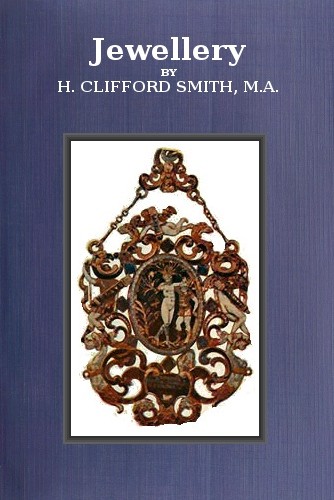
Necklace worn by the daughter of Tommaso Portinari in Van der Goes' triptych in the Uffizi Gallery, Florence.
CHAPTER XV
MEDIÆVAL PENDANTS, ROSARIES, AND POMANDERS
THE wearing of religious emblems in the form of pendants by the Christians of the Middle Ages was possibly, in the first place, the unconscious perpetuation of pagan superstition. The demand for a convenient mode of carrying a reliquary may account in some degree for the use of necklaces in early times.
Relics of the saints and of the Passion of our Lord were most eagerly sought after by mediæval Christendom, and whenever a relic of unusual importance was obtained, all the resources of the art of the time were employed to give it a worthy setting. The most famous of early pendent reliquaries was that worn by the Emperor Charlemagne, which contained relics from the Crown of Thorns and the True Cross, presented to him by Haroun al-Raschid. The reliquary was buried with him in 814, and found at the opening of his tomb at Aix-la-Chapelle in 1169. In 1804 it was given to the Emperor Napoleon by the clergy of Aix, and was afterwards the property of Napoleon III; but it disappeared during the troublous times that terminated the Second Empire. The relics were enclosed under a large sapphire magnificently set in gold and precious stones[62] (Pl. XVIII, 4). Another historical relic of the early Middle Ages was the enamelled gold cross suspended from a chain, which was stolen from the tomb of Edward the Confessor in Westminster Abbey in 1685 and given to James II. It was only lost sight of in the early part of the nineteenth century.[63]
Portable reliquaries in former times were often made of two plates of rock crystal or other transparent stones hinged together so as to form a box. An exquisite example of this style of ornament, and one of the most remarkable mediæval jewels, is the so-called reliquary of St. Louis in the British Museum. It is of gold, set with two large bean-shaped amethysts which act as covers to an inner case with a lid, enclosing what purports to be a spike from the Crown of Thorns. The back of this receptacle, as well as the insides of the covers, is enriched with minute translucent enamels representing the Crucifixion and other scenes from the Passion and the life of Christ (Pl. XVIII, 5). The jewel is said to have been given by St. Louis (who bought the Crown of Thorns from Baldwin, King of Jerusalem) to a king of Aragon, but the style of the work is somewhat later than the time of St. Louis, and dates from about the year 1310. It was formerly in the collection of Baron Pichon, and was presented to the British Museum by Mr. George Salting in 1902.
The pendent ornaments of the Middle Ages not only served as receptacles for relics but also took the form of crosses, medallions, votive tablets, and monograms. Though these do not attain the same importance as the pendants of the Renaissance, their extraordinary variety is proved by the inventories of the thirteenth to the fifteenth century, while their beauty is attested by the few examples that have fortunately been preserved. Small votive tablets, that is to say diptychs or triptychs with hinged wings, were exceedingly popular as personal ornaments, judging by their frequent occurrence in the inventories under the title of tableau or tabulet. They were suspended from the girdle or neck-chain. Some are painted with delicate translucent enamels, others contain figures in high relief wrought in metal, or carvings in boxwood of minute dimensions. The last are generally Flemish, while the others of which there are several splendid examples in the Victoria and Albert Museum, are mostly of French or of English workmanship. A very remarkable silver-gilt pendant in the form of the Devil of temptation, with the forbidden fruit in one hand and a crozier, signifying power, in the other, is shown on Plate XIX, 9. It is Burgundian work of the second half of the fifteenth century, and is the property of Mrs. Percy Macquoid.
An interesting class of pendants is formed by a somewhat extensive series of silver and silver-gilt ornaments produced by German craftsmen of the fifteenth century. The National Museum at Munich, where several fine examples of this kind are preserved, possesses one of more than ordinary interest. It is of silver-gilt, about five inches in length, composed of elaborate Gothic tracery, in shape not unlike the tall Gothic tabernacles of South Germany, of which that by Adam Kraft in St. Lawrence's Church at Nuremberg is perhaps the finest example. A niche on each of its four sides contains the figure of a saint and above, half hidden among the tracery, are four female figures. The jewel is surmounted by the Virgin and Child, and has three rings above for suspension and one below (Pl. XIX, 1). Other examples of South German goldsmith's work of the fifteenth and early sixteenth century take the form of small pendent charms picturing some religious theme. The figure of a saint was naturally a favourite subject, since it was supposed to possess special prophylactic powers. The variety of the subjects thus represented can be admirably judged from an important series of such pendants at South Kensington. In addition to these, which are mostly of cast silver, other pendants of the same period include silver plaques, nielloed, engraved, or in relief; and likewise fine cameos or reliefs of mother-of-pearl, and carvings in ivory and wood, set in coronets of silver-gilt.
Mediæval neck-pendants were, as has been observed, known as pentacols. In the inventory of Edward III in 1339[64] we find a pentacol composed of a large Scotch pearl (perle d'Escoce) and an image of Our Lady in enamel; and "un pentacol dor od. iiij. petites ameraldes et iiij. petites rubies environ, et une camahue en mylieu." In mediæval inventories and wills the Latin word monile signified not only a necklace, but jewels hung at the neck. The same term was also employed for the morse, particularly when the latter had a ring for suspension. Many pendants generally provided with quatrefoil rings, come from South Germany (like one shown on Plate XVIII, 1) and especially from Bohemia—there is a good collection of them in the cathedral treasury of Prague.[65] The majority are silver-gilt, and set with a plaque of mother-of-pearl or crystal, and are usually hollow, to contain relics. The term monile was further applied to brooches or nouches; and the nouches described in such detail in the English inventories of the fifteenth century, which will be mentioned later when the subject of brooches is dealt with, may in part have been employed as ornaments for the necklace.
Various monilia or pendants, containing small relics, verses from the Bible, the names of Christ or the Virgin written upon vellum or upon metal, and perhaps also ancient magic spells—all possessing the virtues of talismans, were worn by chains or cords round the neck, and in some instances very likely hidden under the upper garment. The early Church, in many an edict, declared itself against this form of superstition, yet such pendants or phylacteries—a term applied to any amulet worn about the person against evil of all kinds—appear to have been extensively used. Another and popular pendant from the fourteenth to the sixteenth century, which is frequently cited in inventories, but now rarely met with, takes the form of a small circular box or capsule bearing in front an Agnus Dei in niello or repoussé, surrounded by a corded edging. Such boxes were intended for the preservation of a roundel of wax moulded from the remains of the Paschal candle at Rome with an impression of the sacred Lamb, and blessed by the Pope for distribution to the faithful. The cases, of silver-gilt, have occasionally a covering of transparent horn on the back and front. An example of this kind, of fifteenth-century German workmanship, is in the Victoria and Albert Museum (Pl. XIX, 3). The wax it contains bears the name of Pope Urban VI (1378-1389). An original stamp of bronze, of Italian origin, dating from the fourteenth century, which was used for making these wax impressions, is preserved in the British Museum along with other moulds for casting medals and small articles of jewellery.
In addition to the precious and semi-precious stones already mentioned, other objects, accounted specially efficacious for certain purposes, were worn. The peres de eagle, also called ætites, supposed to be found in the nest of the eagle, were particularly valuable during childbirth. Glossopetræ, the fossilised teeth of certain kinds of shark, which passed as serpents' teeth, were much used, as well as primitive arrowheads. They were hung round the neck of infants in the belief that they assisted dentition and kept off frights. Of great value also was the bezoar stone, which, like glossopetræ, at one time occupied a prominent place in pharmacopœia. Coral, which has always been popular, is first mentioned in English wills and inventories in the fourteenth century. It was used for rosaries, and, above all, as a charm—a ring of gold or silver being attached to its stalk. The Romans tied little branches of it round their children's necks to ward off the evil eye; and the infant Saviour in many an early Italian picture is represented wearing a piece of coral in a similar manner.[66]
A fear of poison, common for centuries in royal courts, was responsible for the custom of testing meats and drinks by methods founded upon certain ancient and groundless beliefs. In order to neutralise or detect the presence of poison, certain objects were placed in contact with food or were dipped into liquids. The touching-pieces (tousches) or proofs (espreuves) employed for the purpose, and considered especially efficacious against poison, were toadstones, glossopetræ, serpentine, jasper, agate and particularly the unicorn's horn. What was foisted upon the credulous public as the horn of the fabled animal was in reality the horn or tusk of a fish—the narwhal or sea-unicorn of the northern seas. Being an object of very great value, the horn was only occasionally kept entire, like the one preserved to this day at New College, Oxford. It was more usually cut into pieces and used as "proofs."
Charge with too swift foot a jeweller
That watched him for the treasure of his brow,
And ere he could get shelter of a tree,
Nail him with his rich antler to the earth.[67]
These and other objects, when worn upon the person, as was generally the practice, were mounted at one end, or surrounded by a claw-like band of silver.
Another object which occupied an important position in the Middle Ages and often received special attention at the hands of the goldsmith was the rosary. It was suspended occasionally from the neck, but was more often worn upon the wrist, at the girdle, or attached to a finger ring, and was formed of a string of beads of various sizes and materials representing Aves, Paternosters, and Glorias: each bead receiving the name of the prayer it represented. The rosary, as at the present day, was divided into decades of Aves, each decade being preceded by a Paternoster and followed by a Gloria. The materials of which they were composed are well illustrated in the inventory[68] of the jewels belonging to Adam Ledyard, a London jeweller in 1381. It includes: "4 sets of paternosters of white amber; 16 sets of paternosters of amber; 5 sets of paternosters of coral and geet [jet]; 6 sets of aves of geet, and paternosters of silver-gilt; 38 sets of aves of geet, with gaudees of silver-gilt; 14 sets of aves of blue glass, with paternosters of silver-gilt; 28 sets of paternosters of geet; 15 sets of paternosters of mazer; and 5 sets of paternosters of white bone for children."
The makers of these beads were termed paternosterers; and Paternoster Row and Ave Maria Lane were so called from the "turners of beads" who resided there. In Paris, as early as the thirteenth century, the commerce in rosaries was a most flourishing one, and it was customary there to divide the makers or dealers in these articles into three categories—paternosterers of bone and horn, of coral and mother-of-pearl, and of amber and jet. In England the rosary makers do not seem to have been so specialised.
The larger beads were sometimes of gold, silver, and silver-gilt, of open-work, beautifully chased and engraved, and of boxwood and ivory exquisitely carved. The "gaudees" or "gauds" in the above quotation, the ornaments or trinkets attached to the rosary, were commonly in the form of a crucifix, while the small German charms mentioned above (p. 120) were mostly employed for the same purpose. Of the spherical-shaped gauds or nuts pendent to the rosary, called in French grains de chapelet and known in Germany as Betnüsse, many fine examples exist in boxwood. They have often an open-work case which opens with a hinge, and displays two hemispheres filled with a number of carved figures of minute proportions.
Among the many forms assumed by mediæval pendants were those of fruits—generally apples or pears. These fruit-shaped pendants, containing either figures or relics, were exceedingly popular. They were carried in the purse or attached to the rosary or to the girdle, or in the case of men, were hung from the neck by a cord or chain; and were constructed so as to be opened during devotions. One of the most remarkable examples is in the Waddesdon Bequest at the British Museum.[69]
The use of perfumes prevailed at all periods of the Middle Ages. They were enclosed in various receptacles, and especially in those shaped like a pear or apple. These pendent scent cases or pomanders, worn like other pendants of the same form, were in general use throughout the whole of the period extending from the fourteenth to the seventeenth century. Pomander in early inventories is often spelt pomeambre, indicating its derivation from pomme d'ambre, a perfume apple or ball; the word pomme being used for any object resembling an apple in shape, and ambre[70] for perfume in general. Primarily the pomander seems often to have designated a ball composed of various highly scented substances which served the purpose both of counteracting the smells which must have been particularly general and offensive in olden days, and also of protecting against infection. It was enclosed in a rich metal case, opening across the centre, and perforated so as to allow the scent to escape. The title "pomander"—originally meaning simply a scent or perfume ball—was given to the case which contained it. In many instances, the perfumes, instead of being mixed together into a ball, were placed in the pomander case each in a separate compartment, the lids of which are found inscribed with the names of the contents. These compartments, varying in number from four to as many as sixteen, are formed like segments of an orange. They are hinged below, and united at the top by a screw or pin, which being removed, allows the segments to open out (Pl. XVIII, 3).
From Kreuterbuch (Frankfort, 1569).
CHAPTER XVI
MEDIÆVAL BROOCHES—THE RING-BROOCH
THE brooches or fibulæ hitherto considered have been constructed either with a spring pin or acus, which was held in its place by a hook or catch, or with a hinged acus, which, having pierced the material, was fixed similarly by a catch, and prevented by the weight of the garment from becoming unloosened. The term fibula, generally employed by archæologists to denote all early brooches, has so far been applied only to the dress-fasteners of classical times; and though the word brooch (from the French broche, meaning a spit) was not introduced into England until after the Norman Conquest, it is for the sake of clearness used here to describe what are generally known among Anglo-Saxon ornaments as fibulæ.
In later Roman times, and among the Irish and Anglo-Saxons, the ring-brooch was sometimes formed with an opening on one side, and the pin or acus, which was not hinged, but moved freely to any part of the ring, having been passed through the tissue, was brought through this opening. The ring was then turned till the pin rested upon its rim.
At the time of the Norman Conquest the opening of the brooch is closed, the ring becomes flat and has a pin of the same length as its diameter. Instead of running loosely, the pin is hinged upon a constriction of the ring and it either traverses the tissue which has been brought through the latter, or a band is passed over it from beneath the sides of the ring. When the portions of the garment thus connected are drawn back, the pin falls across the front of the ring and is held securely in its place. This ring-brooch was known as the fermail (Latin firmaculum, signifying a clasp)—a term employed both in old French and old English inventories.
The ring-brooch was worn by both sexes. It appears on the monumental effigy of Richard Cœur de Lion at Rouen, on that of Berengaria his queen at Le Mans, and on several of the thirteenth-century sculptures on the west front of Wells Cathedral. It served to gather up the fulness of the surcoat on the breast of the knight, as shown by the effigy, known as that of William Mareschel the Elder, Earl of Pembroke, in the Temple Church; but was generally used to close the opening in the robes at the throat of either sex and is seen thus on many effigies of the thirteenth and fourteenth centuries.[71]
Among the few examples of mediæval jewellery that have survived, brooches and finger rings predominate. Brooches differ slightly according to the nationality to which they belong: those of English origin forming of themselves a class of considerable variety and extent. The earliest were circles of small diameter and narrow frame, either plain, or decorated with simple designs. Mystic words and letters were subsequently added; but as the brooch became larger, amatory mottoes took their place. Religious formulæ were also employed, particularly in the thirteenth and fourteenth centuries, when the brooch reached its full development.
The various inscriptions and designs engraved on mediæval brooches are of great interest. The majority of inscriptions are mottoes in French, such as were frequently employed as posies upon rings and other love-gifts. An inscription which occurs more than once is io . svi . ici . en . liev . dami. Another chanson, reading thus in modern French—Je suis ici, à toi voici, is found on several brooches in the British Museum.
The dainty Prioress, Madame Eglentine, in the prologue of Chaucer's Canterbury Tales wore—
On whiche was first y-written a crouned A,
And after, Amor vincit omnia.
The popularity of this last motto on the personal ornaments of the Middle Ages may be attributed to its supposed influence as a love-charm. A considerable number of legends are of a religious character, with allusions to the Virgin and Saviour while a few are talismanic, and contain inscriptions such as the names of the Kings of the East.
Ring-brooches, though generally circular, show a variety of other shapes, such as hearts, trefoils, lozenges, etc. A heart-shaped brooch of fine workmanship in chased and engraved gold is in the Victoria and Albert Museum. It appears to be French and of the fifteenth century. Upon its back is the inscription—Nostre et tout ditz a vostre [d]esir.
The brooches worn by the wealthy are often magnificent examples of jewellery, enriched with gems set in delicate goldwork. A number of the existing brooches are of such diminutive size—less than half an inch in diameter—that they could only have been employed for fastening the very thinnest tissue. The larger gold ring-brooches, of fine workmanship and set with precious stones, are of great rarity. In the British Museum are several choice specimens: the finest, formerly in the Londesborough Collection, dates from the fourteenth century. It is mounted with pearls, cabochon sapphires and emeralds, arranged in a variety of settings, and further enriched with four bosses carved and pierced in the forms of dragons and cockatrices. A remarkable brooch of the thirteenth century, also from a well-known collection, that of Baron Pichon, is preserved in the Victoria and Albert Museum. It is a circular gold ring two inches in diameter, enriched with four sapphires and six rubies in high cone-like settings formed of simple sheets of metal wrapped round the stones. The bases of these collets are hidden on the inner side by an encircling wreath of vine leaves delicately cut and stamped in gold. The back is ornamented with a leaf design in niello. There is a somewhat similar brooch, though only a fragment, in the Gem Room of the British Museum.
A gold brooch also dating from the thirteenth century, and, like the majority, of French workmanship, is in the Carrand Collection in the Museo Nazionale (Bargello), Florence. This fine example, formerly in the Debruge Collection, is decorated with exquisite Gothic foliage in naturalistic style, and with figures of two lions in full relief. It is set with two large rubies and four small emeralds. In the same collection is an extremely interesting brooch, likewise French, and of the fourteenth century. A flat ring of gold 1¼ inches in diameter is ornamented with concentric rings of enamel, the two outer being blue and the inner white. Upon the latter, in letters reserved in the gold, is the inscription iesus autem traisiens per med.,[72] which occurs also on the cameo of Charles V at Paris, and was held by those who bore it to possess a prophylactic virtue. The brooch is further ornamented with four vernicles[73] engraved with exquisite feeling at equal distances upon its surface (Pl. XX, 2).
Though comparatively many existing brooches are of gold, a great quantity were formerly produced not only in silver, but in baser metals, such as iron, copper, and lead or pewter. How large was the demand for brooches of these materials can be gauged from a French writer of the thirteenth century, Jean de Garlande, a poet and grammarian, who in his Latin vocabulary refers to brooch-makers as a special class of craftsmen, who, apart from goldsmiths, were sufficiently numerous to bear the title of fermailleurs[74]—makers of fermails. To about the end of the fifteenth century belongs a satirical poem printed in London with the title Cocke Lorelles Bote, where "latten workers and broche makers" are specially mentioned among the London crafts or trades. The manufacture of the finest brooches, however, was always reserved for the goldsmiths—a fact indicated by the quartering of brooches on the arms of the Goldsmiths' Company.
There would be no justification for any general reference to mediæval ring-brooches that omitted to give some account of those worn in Scotland. Brooches formed an indispensable accessory to the Highland dress of both sexes, in that they served to fix upon the shoulder an invariable article of clothing of the Highlanders—the Scottish plaid. In the latest development of the Scottish brooch of the Celtic type, the pin, as has been observed, is hinged upon the ring, and after piercing the garment is held in its place by a catch at the back of the brooch. Upon the introduction of the ring-brooch with a pin equal to the diameter of the ring, this mode of fastening was only in very few cases retained, and preference in general was given to the English manner of adjustment.
The earliest form of the Scottish ring-brooch, which dates from about the thirteenth century, is a flattened circular ring, upon which talismanic inscriptions in Latin, generally of a religious character, almost invariably appear. These, together with some traces of Gothic design, last throughout the fourteenth and fifteenth centuries. After this period the knowledge of Latin seems to decrease, for it is rendered so barbarously on the sixteenth-century brooches as to be almost unintelligible. On the later brooches the decoration is purely ornamental, with interlaced work and foliaceous scrolls, and brooches of this type, on which the character of an earlier period is retained, were made as late as the eighteenth century. The designs of the silver brooches were produced by engraving accompanied by niello work; those of the brass brooches usually by engraving alone.
The National Museum of Antiquities at Edinburgh possesses a large and important collection of Scottish brooches, while a few Highland families have preserved for many generations massive silver brooches of elaborate workmanship. Formerly in the possession of the Campbells of Glenlyon, and now in the British Museum, is a brooch known as the Glenlyon brooch. It dates from about the fifteenth century. It is about 3½ inches in width, and is formed of a flat ring set with pearls on tall cone-shaped turrets, alternating with crystals and pieces of amethyst. Across the centre is a richly decorated bar, upon which rest the points of two pins attached to the edge of the ring. On the back of the brooch, in black-letter, is the favourite inscription of mediæval amulets: caspar . melchior . baltazar . consumatum. The last word, the declaration of the dying Saviour, "It is finished," was often inscribed upon brooches and other ornaments of the Middle Ages, as were likewise the Angelic Salutation, the titulus i.n.r.i., and other so-called caracts, all of which were considered to possess some talismanic efficacy.
In many cases the open space in the middle of the ring, as in modern brooches, was filled up, and in the early examples was sometimes occupied by a turret-like ornamentation set with a crystal, while obelisks rising from the ring of the brooch were set with polished stones such as cairngorms (still popular on Scottish jewellery), or with Scottish pearls.
The finest examples of this type of brooch are known as the "brooch of Lorn," the "Ugadale brooch," and the "Loch Buy brooch." The brooch of Lorn, still in the possession of the lineal descendants of the Macdougals of Lorn, dates from the fifteenth century. It consists of a disc of silver 4½ inches in diameter, enriched with filigree. In the centre is a raised capsule crowned with a large rock crystal, and round the ring of the brooch a circle of eight obelisks. The Ugadale brooch, the property of the Macneals of Firfergus, is of somewhat similar nature, save that the turrets, eight in number, are towards the centre of the brooch and arranged close round the raised crystal. The Loch Buy brooch, of more elaborate workmanship, is likewise surmounted by a cabochon crystal on a raised dais. On the ring, within a low border, are ten tall turrets, each surmounted with a Scottish pearl. This famous brooch, long in the possession of the Macleans of Loch Buy in the Isle of Mull, came later into the collection of Ralph Bernal, one of the first and most eminent of latter-day connoisseurs, at whose sale in 1855 it was purchased by the British Museum.
In addition to the Highland circular brooches, a considerable number in the shape of hearts have been found in Scotland, sometimes surmounted with a crown, and in a few instances set with jewels (p. 165). They were mostly love-tokens and betrothal gifts, and many of them bear on the reverse the word love. Brooches of this form are known as "Luckenbooth" brooches, from their having been commonly sold in the Luckenbooths, the street stalls around St. Giles' Church on the High Street, Edinburgh.
The use of the word Luckenbooth calls to mind the fact that the goldsmiths of Paris also worked and dwelt in booths, which as late as the fourteenth century were situated on the Pont du Change and the Pont Nôtre Dame. In this connection it is worth noticing that in England, as well as in France and Scotland, the working goldsmiths, like the followers of other trades, occupied distinct quarters by themselves, and they had in London one part of the Chepe set apart for them to dwell and trade in. The custom of the various crafts thus confining themselves to particular quarters, which is of remote antiquity, greatly facilitated the formation and government of trade guilds.
From Ortus Sanitatis
(Strasburg, about 1497).
CHAPTER XVII
MEDIÆVAL BROOCHES (continued)—PECTORALS
ANOTHER species of brooch peculiar to the Middle Ages is the pectoral, an article for fastening on to the middle of the breast. It is similar to our modern brooch, but differs in that it did not always serve to hold the dress together. In earlier centuries it was often sewn on the garment, and was only occasionally supplied with a pin. It was worn by both sexes, as well as by ecclesiastics, who appear to have borne in mind the chief ornament worn by the Jewish High Priest.
The earliest and most remarkable example of this class is the great gold pectoral—the Eagle Fibula it is termed—found in 1880 at Mainz—that ancient and historical Rhenish city, known in former times from its commercial prosperity as "Goldene Mainz," which has proved extraordinarily rich in discoveries dating from classical and early mediæval periods. This famous jewel, both on account of its size (4 by 3⅝ inches) and good state of preservation, probably deserves to rank first among all golden ornaments that have come down to us from the early Middle Ages. "Its composition," says Herr Luthmer, "is extremely clear and conscious. An eagle, of heraldic form, it is true, but not with any of that unnatural emaciation peculiar to the later style of heraldry, fills the inner circle of a flat ring of stamped gold enriched with beaded filigree, which at its upper end—in order to give space for the head of the bird—is not closed, but connected by a curve in the circle of wire. The eight flowers inserted in the open-work of the ring, as well as the whole form of the eagle with the exception of the claws, are filled with cloisonné enamel which unfortunately has disappeared from the body of the eagle, where only the punctured outlines of the feathers are perceptible upon the plate of gold. Otherwise the enamel, made of translucent green and blue, turquoise-blue, white and yellow, has been preserved in all its freshness."[75] This pectoral dates from the commencement of the twelfth century, and is one of the chief treasures in the rich collection of antiquities preserved in the Mainz Museum.
Jewels of this species and of this period are of the utmost rarity. Another very beautiful example was discovered at Mainz just five years after the Eagle Fibula, and is now in the collection of Baron von Heyl zu Herrnsheim at Worms. It is formed of repoussé gold, and represents an eagle standing upon a branch rolled up at both ends. A fine sapphire occupies the middle of the breast, in the centre of the wings are emeralds, the tail is set with lapis-lazuli, and the eye of the bird with a small ruby. This exquisite jewel dates from the early part of the thirteenth century. It measures 2⅛ inches in height and 1⅝ inches in width.[76] The most remarkable among jewels of about the same date (the twelfth century) are the splendid antique cameos already described—the Cameo of St. Hilary in the Bibliothèque Nationale, Paris, and the Schaffhausen Onyx—both of which were originally employed as pectorals or brooches.
A few brooches are attached, as was once the jewel of St. Hilary, as ex voto on the breast of reliquary figures, like that of St. Foy at Conques, which still exhibits an ornament of this kind. A brooch or fermail (for this latter term is not confined to the ring-brooch), 1¾ inches in diameter, which once formed part of the ancient jewels of the French Crown, is in the Galerie d'Apollon of the Louvre.[77] Two exceedingly fine brooches of about the end of the twelfth century, found at Mainz in 1896 and now in the treasury of the cathedral, are described by Dr. Schneider in the Jahrbuch der Königlich Preussischen Kunstsammlungen (Vol. XVIII); and a pectoral or brooch of a similar form, a large stone in the centre, surrounded by smaller ones—to take only one among many examples—is represented on the twelfth-century statue of a queen, probably intended for the Queen of Sheba, from the west portal of the church of Our Lady of Corbeil, and now at Saint-Denis.
In the case of original jewels of this kind, it is not always easy to determine whether they were articles of adornment for the clergy or the laity, and though those for ecclesiastical use probably predominate, it is only when they contain the figured representation of some religious subject that they can with certainty be identified as cope-clasps or morses, the French equivalent for which is mors de chape.
Morses were frequently of extraordinary size. Monumental brasses and tombstones, especially in Germany, exhibit many examples. Adalbert of Saxony, who was administrator of the archbishopric of Mainz, and died in 1484, is represented on his tombstone in the cathedral with one measuring more than 7 inches across. Existing examples vary from 5 to 7 inches in breadth.
The jewellers of the Middle Ages delighted in lavishing their utmost taste and skill on morses, which were of a variety of shapes, and were composed of every material. Some were enriched with precious stones, including ancient cameos, and others rendered attractive with coloured enamels.
Several lists of English morses are preserved. In the inventory of Sarum,[78] of the year 1222, gold, silver, and jewelled morses, firmacula, pectoralia, or monilia (as they were variously termed in the Middle Ages) are described at length; in that of St. Paul's,[79] drawn up in 1295, there are no less than twenty-eight; while the inventory of jewels (jocalia) preserved in York Minster[80] in 1500 includes an extraordinarily rich collection of these ornaments.
Though some were clearly made fast to one side of the garment, and were hitched to the other by hooks, or by a pin, like a brooch, they were not always employed to unite the two sides, but were sometimes used simply as a decoration upon the front of the vestment, and perhaps hung there by a chain round the neck.[81] Examples to be found in many museums are pierced with holes, or have loops behind them, showing that they were sewn to the vestment with purely decorative purpose.
From the close of the twelfth century champlevé enamel upon copper was much employed for the decoration of morses. In the fourteenth century champlevé was largely superseded by transparent enamel on silver relief (basse-taille), many of the finest specimens of which were produced in Italy. Two fine morses displaying this species of work are preserved; the one in the British Museum[82] and the other at South Kensington.
The use of ancient cameos as personal ornaments has already been mentioned; and there is in the British Museum a mediæval intaglio, the finest of its kind, which was used as a morse. It is known as the Crystal of Lothair, since it was made, in all probability, for Lothair II, King of the Franks from 855 to 869. It is a lenticular plaque of rock crystal, 4½ inches in diameter, engraved in intaglio,[83] with the history of Susanna.[84]
Public collections at home and abroad possess a variety of examples of Gothic morses of exquisite design. One of the most remarkable of German workmanship of the fourteenth century is in the Musée Cluny at Paris;[85] while among the finest German jewels of the fifteenth century must be ranked a morse of beautiful execution in the Victoria and Albert Museum.[86] Other noteworthy examples are, three in the treasury of the cathedral of Aix-la-Chapelle, one of them[87] containing a representation of the Annunciation—a subject which, judging from the inventories, appears to have been a very favourite one for the purpose, particularly in England. Three more are in Paris: one—the beautiful morse of St. Louis—in the Galerie d'Apollon,[88] a second in the Rothschild Bequest[89] in the Louvre, and a third in the Dutuit Bequest.[90] In the Kunstgewerbe Museum at Berlin is a silver-gilt morse which was made in the year 1484 for Albert von Letelen, canon of Minden, by the goldsmith Reinecke van Dressche of Minden. It is a circular disc 5½ inches in diameter, filled with three elaborate Gothic tabernacles, each containing a figure. Entirely symmetrical in composition, it follows a design commonly found on the seals of the same date (Pl. XXII, 3).
An excellent idea of the extraordinary beauty of the morses in use at the close of the Middle Ages can be obtained from fifteenth-century paintings, particularly of the Flemish school. Few of the latter can surpass what is one of its finest examples in the National Gallery—Gerard David's beautiful picture of the "Canon and his Patron Saints," in which are displayed, in almost all their pristine freshness, some of the most magnificent representations of the jeweller's art.
Besides these pectorals, which sometimes served a practical, but often a purely decorative purpose, there were various other ornaments that acted as clasps (agrafes). These agrafes are similar to those still made use of in our day, working on a system of a hook fitting into a loop. Clasps for mantles were sometimes made of massive loops fastened on either side of the border of the mantle, like parts of a hinge, which could be clasped by a pin being thrust through them, or by a cord or strap.