
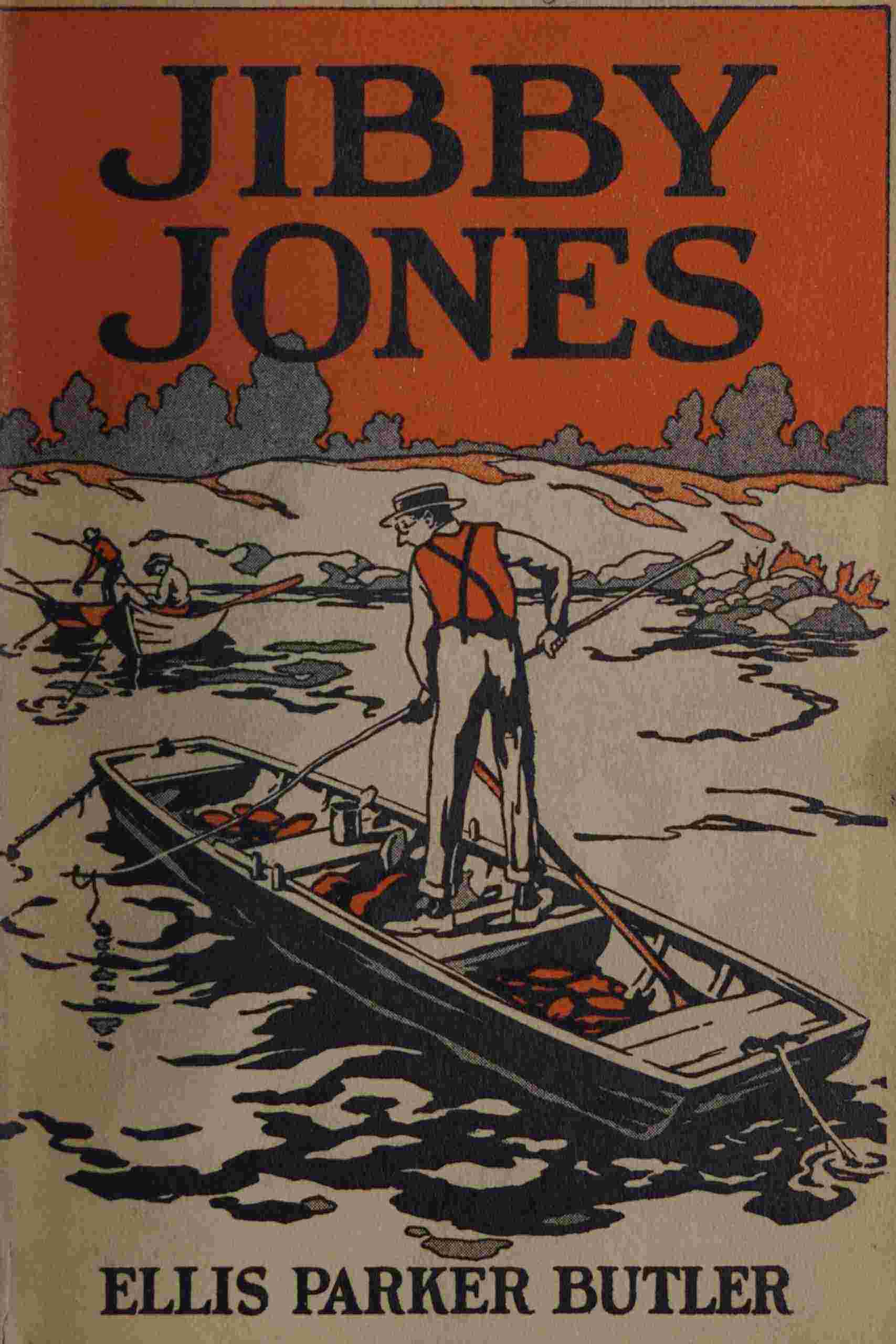
The Project Gutenberg eBook of Jibby Jones
Title: Jibby Jones
A story of Mississippi River adventure for boys
Author: Ellis Parker Butler
Illustrator: Arthur Garfield Dove
Release date: July 22, 2025 [eBook #76547]
Language: English
Original publication: Boston, MA: Houghton & Mifflin Company, 1923
Credits: Roger Frank and the Online Distributed Proofreading Team at https://www.pgdp.net (This file was produced from images generously made available by The Internet Archive)
“THIS IS MY BIG SUIT.”
JIBBY JONES
ADVENTURE FOR BOYS
HOUGHTON MIFFLIN COMPANY
The Riverside Press Cambridge
| CONTENTS | |
| I. | Oliver Parmenter Jones |
| II. | The Pearl-Diggers |
| III. | The Climbing Rabbit |
| IV. | Do Fish Climb Trees? |
| V. | The Fishing Prize |
| VI. | The Prize-Winner |
| VII. | The Tough Customer |
| VIII. | The Red-headed Bandit |
| IX. | The Abduction of Rover |
| X. | The Treasure Hunt |
| XI. | Where is Greenland? |
| XII. | The Worm Mine |
| XIII. | The Viking Ship |
| XIV. | Uncle Beeswax |
| XV. | The Grape Tree |
| XVI. | Congo Magic |
| XVII. | Grains of Sand |
| XVIII. | Pirate’s Treasure |
| XIX. | The Tough Customer appears |
| XX. | Orlando |
| XXI. | Winged Enemies |
| XXII. | A New Swimming-Hole |
| XXIII. | Treasure Trove |
| XXIV. | The Treasure |
- “This is my big suit”
- “I guess he’s got a real nose for fish”
- Slapping our knees and chanting away like lunatics
- Skippy and I threw an end of the rope into the well and pulled the Tough Customer out
CHAPTER I
OLIVER PARMENTER JONES
Everybody knows that the Mississippi River is just about the biggest river in the world, and we boys who live on the shore of it are mighty proud of it—proud of the river and proud of living on the edge of it, where we can swim in it and look at it and fish in it and row boats on it. If we wanted to we could say to each other, “Come on! Let’s go down and swim awhile in the biggest river in the world, or, anyway, the almost biggest!”
We could say that, but we don’t. I guess the reason is that, when a boy wants to go swimming, he thinks about swimming and not about the bigness of the river he is going to swim in, because that is sort of geography and he gets more than enough geography in school, without thinking about it when he wants to go swimming. So we generally just hold up two fingers and whistle, and, if the other fellow says he can’t come, we say, “Oh, come on, why don’t you?” and leave the length of the old Mississippi and where it rises and where it empties and what States it bounds, and all that sort of nonsense, until some other time.
But, anyway, I guess we Riverbank boys have the very best of the old Mississippi River, because there must be pretty near a thousand miles of it above Riverbank and more than a thousand miles of it below Riverbank. So we must be about the middle of it. And that ought to be the best, any way you look at it.
Now, it isn’t very often that we boys can find a boy we can brag about the Mississippi River to. The reason is that not many new boys come to Riverbank and all of us Riverbank boys have an equal share in the river—as you might say—and it doesn’t do me any good to brag about the river to Tad Willing or Skippy Root or Wampus Smale, because they know as much about the river as I do, and they would laugh at me. So, in one way, it was fine to have a new boy—one that had never seen our part of the river—come to town. That was Jibby Jones.
I am not exactly right when I say Jibby Jones came to town, because he did not exactly come to Riverbank. He did not stay in Riverbank. He got off the train at Riverbank, with his father and mother and his twin sisters and his little brother—and two or three trunks—but the whole caboodle went right down to the Launch Club float and got aboard Parcell’s motor-boat and went up to Birch Island. Birch Island is four miles up the river. There are about twenty cottages on it and some of the Riverbank folks spend the summer there. Our folks do—mine and Tad’s and Skippy’s and Wampus’s folks.
The cottages on Birch Island stand along the edge of the island and they are all set up on stilts. In the spring the old Mississippi is apt to get on a rampage and flood over the whole island, and that is why the cottages are on stilts. If the cottages were on the ground, the river would come in at the cottage windows when it was high, or wash them away and destroy them.
This year all our folks—Tad’s and Skippy’s and mine and Wampus’s folks—went up to the island early in July. Our folks own cottages there and we all love it; we get up there as soon as we can; we have been up there every summer for I don’t know how long.
Well, we hadn’t any more than got settled—got the boats out from under the cottages and the mosquito screens patched and the tall grass and weeds cut—than the Joneses came, and this funny-looking Jibby Jones with them. They took the two-story cottage that is called Columbia Cottage. It stands on eight-foot stilts and it is a pretty good cottage—as good as any on the island.
Tad and Skippy and Wampus and I were down by the river in front of Wampus’s cottage trying to see what was the matter with the motor of Wampus’s motor-boat when this Jibby Jones came walking up along the path and stopped to look at us.
“Good-morning,” he said, in a sort of lazy drawl, and we looked up and decided we did not like him. We thought we hadn’t much use for another fellow, anyway, because we four were enough. We four always hung together and had good enough times by ourselves. So we looked up and thought, “Well, we don’t want you around!” but he had said “Good-morning!” so we had to say something. So we said “Hello!” but not as if we meant it. We thought we didn’t want to have anything to do with a fellow that said “Good-morning!” when he might just as well have said “Hello!” in the first place.
We went right on fixing the motor-boat. We thought we would let him stand there until he was tired of it, and then perhaps he would go away. By and by he said:
“Are you mending the motor-boat? Doesn’t it go?”
We wondered what he thought we were fussing with it for. It seemed about as foolish a question as any question he could have asked us. So I said:
“Sometimes it goes; what do you think a motor-boat is for?”
Jibby Jones did not answer right away. He seemed to be thinking that over. It seemed to take him quite a while to make up his mind what the answer was, and we had a good chance to look at him.
He was queer-looking. That is about the only way I can say it—he was queer-looking. He was about as old as we were, but at first you thought he was quite a lot older. That was because he was so tall; he was almost six feet tall; he was taller than my father or Tad’s father and almost twice as tall as Wampus’s father, who is short and fat. He was just about as tall as Skippy’s father. I never saw such a tall boy for his age.
Another thing that made him look oldish was his spectacles. He wore spectacles with big, round glasses in them and tortoise-shell rims and handles—if the things you put behind your ears are called handles. But the thing that made him look the queerest was his nose. It was the biggest nose I ever saw in my life, or that Tad or Skippy or Wampus ever saw. They said so. It was bigger than any nose I ever saw on a man, and the funniest thing about it was that when you looked right straight at Jibby Jones from in front it did not look like a big nose at all; it only looked like a big nose from the side. This was because his nose was not thick or wide, but only long and much. It was straight enough, but it started too far up on his forehead and went so far out into the air in front of him that it was a long way back to his face again. The thing it made me think of was a rudder, or the centerboard of a boat, only, if it had been a rudder, it should not have been on the front of his head, but on the back of it.
So this Jibby Jones stood thinking, because I had said: “What do you think a motor-boat is for?”
After a while he nodded his head as if he had thought enough and said:
“That’s a good question. I never thought of that question before, but, when you think about it like that, motor-boats are used for different things, aren’t they?”
“Yes; for climbing church steeples,” Skippy said, joking him.
Jibby Jones looked at us thoughtfully.
“I think you’re teasing me,” he said. “A great many people tease me. It is because I look stupid. But I am not as stupid as I look.”
Wampus nudged me.
“Who told you that?” he asked Jibby Jones.
“My father told me,” Jibby Jones said, and he did not even crack a smile. He was in dead earnest. “My father has said to me, several times, ‘Son, you are not as stupid as you look.’”
“Well, he ought to know,” Tad said.
“Yes, that’s what I think,” Jibby Jones said. “I always think my father ought to know, because he is an author and writes books. An author who writes books has to know a great many things.”
Well, Tad put down the wrench he was using then and looked at Jibby Jones again, and I guess we all looked at him. We had heard that some author man was coming to Birch Island, and we knew this must be the author man’s boy. So we took a good look at him. I don’t know what we would have said next, or whether we would have said anything, but Jibby Jones spoke:
“What I was thinking, when I said motor-boats were used for various things, was that I saw one used on the Amazon as a coffin. A man father knew was bitten by a snake and died and the natives used his motor-boat as a coffin to bury him in. That was what I meant. I have never seen a motor-boat used to climb church steeples. I mean actually to climb them. The nearest I have come to seeing that was in Nebraska when they used a motor-boat to ring the fire-alarm bell.”
Tad was just going to pick up his wrench again, but he did not do it. He let it lie. He looked right straight at Jibby Jones.
“To ring a fire-alarm bell!” he exclaimed.
“It was at Europa, Nebraska,” said Jibby Jones, as if he was saying the commonest thing ever, “when the Missouri River went over the levee and swamped the lower part of the town. They used the bell in the steeple of the Methodist Church as a fire alarm and a house in the upper part of the town caught fire—up on the hill, you know—and they had to give the alarm, because it was at night. And the church was entirely under water, except the bell and the steeple. So my father and another man took a motor-boat and went to the church steeple and rang the alarm bell. But I never really saw a motor-boat used to climb a steeple.”
We couldn’t say anything. We were stumped. He was too much for us. But he went right on:
“I don’t mean to say it could not be done,” he said. “I suppose a motor-boat could be fixed with cog wheels or claws so it could be used to climb steeples. I expect that is what you meant.”
“Oh, yes!” Skippy said. “That’s what we meant, of course!”
He said it as sarcastical as he could, but this Jibby Jones did not turn a hair.
“I suppose so,” he said. “I make it a rule never to doubt anything any one says, because such strange things can be done. I remember when I was on the St. Lawrence River—”
“Don’t you mean the Nile?” interrupted Skippy. “Don’t you mean they used motor-boats to hunt hippopotamuses on the Nile?”
“I suppose they do,” said Jibby Jones, “but I did not see them doing it when I was on the Nile. I was only going to say I saw them use a motor-boat to save one ninth of a cat on the St. Lawrence.”
“One ninth of a cat!” cried Wampus, and began to laugh. “How would you save one ninth of a cat?”
“It was starving to death,” said Jibby Jones, quite seriously. “We were at Clayton and some one brought news to father that a cat was on one of the Thousand Islands. They said it was so wild no one could get near it, but father loves cats and cats love father, so he said he would go in a motor-boat and save the cat from starving. So he did. He got the cat and brought it back to Clayton.”
“But that was the whole cat,” said Wampus.
“No,” said Jibby Jones quite seriously, “it was only one ninth of a cat. You know a cat has nine lives. And father said there was no doubt that cat had already lost eight of its lives by starvation, so, of course, what he saved was only one life, and that was only one ninth of the cat. I am sure that is right because we kept the cat for years and we always called it Ninth. That was the name father gave it, because it was only one ninth of a regular cat. We kept it until it was drowned in the Rio Grande.”
He pronounced it Ree-o Grandy, but we knew what he meant. It is the river that is between Texas and Mexico. Tad drew a deep breath.
“You must think you have been on nearly every river in the world, don’t you?” he asked.
“I have, nearly,” said this Jibby Jones. He did not say it in a bragging way, either. He said it as if it was so.
“Have you ever been on the Mississippi before?” Tad asked him.
“Not this part,” Jibby Jones said. “I’ve been on the upper Mississippi, and on the lower Mississippi, but father saved this middle part of the Mississippi until last.”
Tad picked up his wrench and tapped on the side of the motor-boat sort of carelessly.
“Well,” Tad said, winking at us, “I’ve not seen many rivers. I’ve seen the Cedar River and the Iowa River and the Rock River, and that is about all, but I’ll tell you one thing. I’ll tell you this: this middle part of the Mississippi is the greatest old river in the world. That lower Mississippi is too big, and that upper Mississippi is too little, but this middle Mississippi is just right. And it don’t make any difference what you think you know about other rivers, it don’t do you any good when you come to our old Mississippi. This is a real river. It’s different.”
“So father said,” said Jibby Jones.
“Yes,” said Tad, “and this is no river for a raw boy to monkey with until he learns about it. What is your name?”
Then Tad winked at us again, but Jibby Jones did not see him wink and he answered as sober as a judge.
“My name,” he said, “is Oliver Parmenter Jones, but nobody calls me that. Nearly every one calls me Jibby. They call me that because of my nose; it is like the jib on a sailboat, you see. Don’t you think it is?”
He turned sideways so we could see that his nose was like the jib of a sailboat! I never saw such a fellow! He did not merely pretend to be proud that his nose was like the jib of a sailboat; he really was proud of it. Later we learned he was proud of his nose because it was like his Grandfather Parmenter’s nose. Jibby was the only one in his family that had the Parmenter nose. I thought it was a queer thing to be proud of.
“So you can call me Jibby, if you want to,” Jibby Jones told us, just as if he did not doubt we would want to call him something. “I rather like Jibby,” he said; “it sounds nautical. But you can call me Main Mast if you’d rather. Quite a few call me Main Mast. That’s because I’m so tall. Father and mother call me son, but you wouldn’t like to do that. And the twins and brother call me Wally. I don’t like that so much. It suggests a walrus. Do you mind if I help you with the motor-boat? I know quite a little about motor-boats.”
Well, he did! He came down the bank and in two minutes he had the motor-boat chugging away like an old-timer!
“Father says I have a nose for motor troubles,” he told us.
After that we let him be one of us. We couldn’t be really mean to a fellow like that; he was too good-natured and willing, and too much fun, too. He was the queerest boy we ever knew. One day he came out in an old suit that was so small for him that the pants came halfway to his knees and his sleeves came only about halfway to his wrists. He did look funny! But we did not say anything; a fellow don’t care much about clothes. Jibby Jones said it. He said:
“I don’t like this suit any more. I like my small suit better.”
We could not believe we heard him correctly.
“Your small suit!” I said. “You mean the big one you have been wearing. I should think you would call that your big suit and this one your small suit. That one is twice as big as this one.”
“No,” he said, “this is my big suit. I got this suit two years ago and we all call this my big suit because when I got it it was too big for me. And the other was a little small for me when I got it this spring; so it is my small suit.”
That was how he figured it out, and nobody could make him believe the small suit should be called the small one. It had been the “big suit” once, and that was the name of it, so it was always the “big suit.” We thought he was stupid. But he wasn’t. Not when you came to find out. He looked at things a different way from the rest of us, that was all.
CHAPTER II
THE PEARL-DIGGERS
Well, it took us quite a while to learn that Jibby Jones was not as stupid as he looks, and that when he looks stupidest and says the queerest things is when he is farthest from being stupid. That is when that old brain of his is working hardest. It took us a couple of weeks to learn that, and to get to liking Jibby the way we did, and I don’t know that Wampus ever did think, in the bottom of his heart, that Jibby was anything but stupid and lucky.
And at first we did try to “string” old Jibby good and plenty. We told him things about our river that would not have fooled a mud-cat or a carp. And when we told those things to Jibby, he would look at us through his spectacles in that serious way of his, and sometimes we were sure he believed the nonsense, and sometimes we were not so sure.
One thing we told him was about getting mussel shells out of the river. That is quite a big business around Riverbank because there are so many pearl-button factories in Riverbank and they have to have shells to cut the buttons out of. The shells they use are mussel shells—a sort of clam shell—and hundreds of men dredge for the shells. Some of the men rake up the shells with long two-handled rakes and others drag for them with dull hooks strung on a long cross-bar. The mussels sort of bite the hooks and hang on and the dredgers pull them up.
Jibby Jones knew all this; we couldn’t fool him about it because his father had told him; but we did try to fool him about another part of it. That was about getting mussel shells that had real pearls in them—the pearls the women wear for jewelry. Tad was the one that tried to fool him about that. I guess Jibby asked Tad how they got the pearls, because Tad’s father was a pearl-buyer.
“Well, that’s a pretty hard job, Jibby,” Tad told him. “Not many people want to try diving for pearls in the old Mississippi, I can tell you! No, sir!”
“Why?” Jibby asked. “I never heard of sharks in the Mississippi, or alligators this far north.”
“Well, I should say not!” said Tad. “If there were sharks and alligators here, too, nobody would ever dive for pearls. No, sir! It isn’t sharks or alligators, it’s mud!”
“Mud?” Jibby asked.
“Yes, sir! Mud!” Tad told him. “Common old Mississippi River mud. That’s why so few hunt pearls; that’s why pearls are so high-priced. The mud is awful. The mussels with real pearls in them don’t lie right on top of the mud like common button-shell mussels; they burrow down in the mud. The minute a mussel feels a pearl beginning to grow in it, it begins to burrow.”
Of course, Skippy and Wampus and I could hardly keep from shouting out loud when Tad said all this nonsense, because there wasn’t a true word in it, but Jibby Jones just stared at Tad through his spectacles and believed it all. Or we thought he did.
“I should think they could dredge a little deeper and get them,” Jibby said.
“Dredge deeper?” said Tad, because he did not know just what to say to that.
“Pshaw!” Skippy put in. “Dredge deeper! That would be a nice thing to do, wouldn’t it? And the minute the mussel felt the dredge, it would spit out the pearl and that pearl would be lost forever. You can’t dredge for pearl mussels, Jibby.”
“Of course not!” said Tad. “You have to dive for them. You—you—”
Tad had to think quick to think up some ridiculous thing to tell Jibby, but Tad was a good one at that and he did it! Yes, sir!
“You have to do the only way it can be done, if you want to get pearls,” he said. “You have to nose them out.”
He stopped short and looked at Jibby’s nose.
“Why, you’d make the finest kind of pearl-diver yourself, Jibby,” he said. “You’ve got a splendid nose for it. You’ve got the best nose I ever saw for pearl-diving in the Mississippi.”
“Do you think so?” Jibby asked, as pleased as pie.
“I know so,” Tad told him. “You’ll know so, too, when I tell you how the divers have to get the pearl-bearing shells. There’s only one way. The pearl-bearing mussel is the scariest thing in the world; a rabbit is brave alongside of a mussel that has a pearl in it. The slightest hard thing frightens a pearl mussel half to death and starts it digging deeper into the mud, and then you never can get it.”
“They’re timid?” asked Jibby Jones as if he understood.
“Timid and tender,” said Tad. “When a mussel is bearing a pearl its shell is ten times as tender as a deer’s horns when they are in velvet. The least touch of anything hard hurts the mussel and makes it drop its pearl. That’s why the pearl-divers root them out with their noses.”
“Is that the way they do?” asked Jibby.
“Of course! You can’t use a hook, because it is too hard; and you can’t use a rake because it is too hard; and you can’t even use your hands, because of your finger nails. The only way you can root out a pearl mussel is with your nose. The end of a nose is soft and does not hurt the mussel. They like the feel of it.”
Jibby Jones felt the end of his nose.
“It is soft, isn’t it?” he said, as if he had never discovered that before.
“Of course, it is soft!” said Tad. “And that is why the pearl-divers of the Mississippi use their noses. The only trouble is that they can’t keep at the job long; they wear their noses down so that they are not fit to dig with. Then they are of no more use in rooting for pearl mussels. A man with a bunty nose, or with a pug like Wampus Smale’s nose, is no good at all.”
“I expect my Grandfather Parmenter—” Jibby began, but we all knew what he was going to say. He was going to say his Grandfather Parmenter would have made a good Mississippi pearl-diver. Jibby did not finish saying it. He thought of something else.
We were in the motor-boat, back in Third Slough, fishing for bullhead catfish. They were not biting very well, which was why we had so much time to talk; bullheads do not mind talk; they’re stupid.
Well, we knew there was not much use fishing just then. The river was too high and too low; too much both and too much neither. But we had come because Jibby had wanted to come. It was the last chance he would have to fish with us. The reason was that his father had decided they must leave Birch Island sooner than they had expected and go back to New York. And the reason of that was that Mr. Jones had been asked by a publisher to write a book about spending a summer on an island in the Mississippi and the publisher had suddenly decided he did not want that book. So Mr. Jones thought he could not afford to spend any more time on the island. The publisher had expected to send Mr. Jones a thousand dollars, but now he would not, and this was the last day we were apt to spend with Jibby, fishing together and things like that.
“How do they do,” Jibby asked Tad, “when they dive for mussels and root them out?”
“Why, it is as simple as pie if you have the right kind of nose,” Tad said. “You dive from a boat in a slough or some other muddy place—some place with a muddy bottom—and when you reach the mud you take hold of the mud with both hands. That is to hold you down. Then you begin rooting in the mud with your nose. You root here and you root there, as fast as you can, and if you don’t find a mussel you come up for breath.”
“Of course. One would do that,” said Jibby, as serious as an owl. “But if one roots out a mussel?”
“Oh! Then you have to open your mouth and grab it quick,” said Tad, nudging me. “Like mumblety-peg. When you root up a shell with your nose, you open your mouth and grab the shell and then come up as quick as you can; but you have to be sure you don’t open your mouth until you get in the boat. If you do, the mussel will open its shell and spit out the pearl.”
Jibby Jones looked over the side of the boat.
“Do you think this would be a good place to dive for pearls?” he asked, sort of wistfully.
“This? This is one of the finest places in the Mississippi,” Tad said. “I’m surprised there is no one diving right now.”
I had to turn my head away and grin. The water was not five feet deep where we were.
“I am going to dive for a pearl,” Jibby Jones said suddenly.
“That’s a good idea,” Tad said. “The bullheads are not biting, anyway. That’s always a good sign; bullheads hardly ever bite where there are mussels. And there couldn’t be a better day to get a pearl. The sun is just right. It is low enough to slant on the water and not dazzle the mussels. When they are dazzled, they go deeper in the mud. They ought to be near the top of it now.”
“I can stay under water quite long,” Jibby said as he began to take off his clothes. “I stayed under water so long once, in the River Niger, that father was afraid I was drowned. So don’t worry if I stay down long.”
“We won’t,” Tad said.
It took Jibby quite a while to get ready; he was always slow. Then he stood on the gunwale of the motor-boat and put his palms together and dove. He did not have far to dive; he must have run his head into the soft black mud up to his ears, for he was up in a second, shaking his head and holding onto the boat.
“It isn’t as deep as I thought it was,” he said as he wiped the mud from his face. “I did not do that dive very well. I’ll have to try it again.”
“We would go in with you,” Skippy said, “only our noses are so blunt it is no use.”
Jibby climbed into the boat and made ready again. This time he took a slanting dive. We could see him under water; he looked yellow under all that yellow water. We could see his arms spread out as he dug his fingers into the mud to hold on, and we could see his head move as he ploughed into the mud with his nose. We laughed like fury. It was the funniest thing I ever saw.
He did stay under water quite a while. He had not fibbed when he said he could stay under a long time.
Wampus got frightened. “We’d better get him out,” he said. “He’ll drown, with his nose and mouth full of mud that way.”
Tad was watching pretty close. “No, he’s all right,” he said, as well as he could for laughing. “As long as his head keeps bobbing that way, he is all right; watch him nose-digging for the great pearl mussels of the Mississippi! I hope a mussel don’t bite his nose off!”
Just then Jibby started to come up. He wiggled and squirmed himself onto his knees and staggered to his feet. After he began to wiggle, we could see nothing but muddy water, and when he stood up his face and head were one mass of soft mud. It dripped from him and ran from him, but he just put his face over the side of the boat and opened his mouth and let a mussel shell fall inside.
“Catch it!” he gasped; “catch it!”—as if it was a rabbit or something that could jump and run, and then he ducked down and sloshed water over his head until he was as clean as any one could ever get in that old slough water. He came up smiling.
“Well, I got one!” he drawled triumphantly. “I hope it is a big pearl. I hope it is big enough to sell for enough money to let father stay here the rest of the summer. That’s what I want it for. Because I like you fellows. You are all so helpful and friendly.”
I’ll say I felt ashamed then. So did Tad and so did Skippy. I guess Wampus did, too. We all did. We did not know what to say.
But Jibby, naked as could be, was in the boat now and he picked up the shell.
“I hope it did not have time to get rid of the pearl,” he said. “I hope I did not frighten it too much; I hit it rather hard with my nose. Let me have your knife, Wampus.”
Wampus had a big knife, a regular frog-stabber.
“Jibby—listen!” Tad said, but Jibby was opening the mussel. He seemed to know how. I suppose he had opened oysters in the Seine or somewhere; he never told us. He slid the knife between the two valves of the shell of the mussel, and cut the muscle part, and the shell fell open.
“It looks like quite a good one,” was the next thing we heard Jibby Jones say, just as matter-of-fact as if he was talking about a dictionary or an apple.
We all stood up, then, and looked.
“Merry Christmas! Mer-ry Christmas! And a Hap-py New Year!” Tad exclaimed. “Well, what do you know about that!”
Right there in the shell was the biggest, pinkest, glisteningest, roundest pearl I ever saw in my life! No, I’ll say it was twice as big as any pearl I ever saw!
“A thousand dollars!” Tad cried. “That’s worth a thousand dollars if it is worth a cent! I know! My father buys them.”
We were all crazy with excitement except Jibby Jones. He took it quite calmly.
“I’m glad it is a thousand-dollar one,” he said. “Now father can stay on Birch Island the rest of the summer.”
And that was about all he ever said about the pearl, even when Tad’s father paid twelve hundred dollars for it. Wampus did ask Jibby if he didn’t expect to go back and dive for a lot more pearls. We thought he would say he meant to.
“I think not,” Jibby Jones said. “You see, Tad says the pearl-divers are apt to wear their noses down to a snub, bumping them into the shells, and I wouldn’t like to do that. My nose is the only nose in our family that is like Grandfather Parmenter’s and I wouldn’t like to wear it down to a pug.”
CHAPTER III
THE CLIMBING RABBIT
Maybe feeling sorry that Jibby had to go away was what made us feel so glad he had found that pearl and did not have to go. Teasing him had come to be part of the fun we counted on having, and, when we saw old Jib come out of his cottage, one or the other of us would nearly always say: “There’s Jibby—let’s go tell him something about the river.” And between-times we thought up things to tell him. But all the time we were getting to like him more and more.
A couple of days after Mr. Willing had bought the pearl, Skippy and Wampus and Tad and I were under my folks’ cottage, because it was raining. There was always plenty to do on the island, enough kinds of fun each summer to keep us busy ten years, and on rainy days we could always sit under one of the cottages and whittle or talk or make mud statues. The rain was coming down in regular slats, as if it meant to rain all day and all night, and we were talking about one thing and another when Jibby Jones came dodging through the rain and looked in at us.
“Hello, Main Mast,” Skippy called out to him; “lower yourself and blow in out of the rain.”
Sometimes we called him “Main Mast” and sometimes we called him “Jibby”; he never cared what we called him. So he came in out of the wet and sat on a box. For a minute or two he watched us making mud animals, or whittling, or whatever we were doing. Then he said:
“Do you know whether anybody named M’rell ever lived in Riverbank, or down below Riverbank, or up here above Riverbank? A man named M’rell?”
“No,” I said, and Tad and Wampus and Skippy said the same. None of us had ever heard of anybody named M’rell.
“Nobody named that ever lived around here that I ever heard of,” Tad said. “Why?”
“I thought maybe you did know of somebody named M’rell that had lived somewhere around here,” Jibby said.
“Orpheus Cadwallader might know,” I said, for Orpheus was the caretaker of the island and knew nearly everybody up and down the river. And then we talked about something else, and that was a pity, for if we had asked Jibby another question about M’rell just then, we might have saved a lot of time in starting our hunt for the land pirate’s treasure. If we had asked him how he spelled M’rell, we might have saved weeks and weeks. So, after half an hour or so, Jibby spoke of M’rell again.
“When I was down on the St. Francis River—” he began, and we all yelled, because the rivers Jibby had been on were getting to be a joke. You couldn’t mention a thing but it reminded Jibby of some river he had been on—the Nile or the Hudson or the Amazon or some other river. It was all true enough, too, because his father wrote books about rivers and had been on most of the rivers in the world, and had taken Jibby there; but it was a sort of joke the way old Jibby was always dragging in a river, no matter what we were talking about. So he waited until we stopped hooting, and then he went on.
“It occurred to me,” he said, “that it was selfish of me to keep what I know about M’rell to myself, because you boys are so good to me. When I was down on the St. Francis River with father, there was an old negro named Mose, who said he was over one hundred years old. He used to paddle us around in a skiff when we went fishing for bass and he told us about M’rell.”
“Who was M’rell?” Wampus asked. “What has M’rell got to do with us?”
Now, I want you to notice, right here, that Jibby said “M’rell” and that we all said “M’rell” because he did. And the reason Jibby pronounced the name that way was because that old negro Mose had called it that. The name was really Murrell, when we came to find out. If we had seen that name written or spelled out, we would not have called it “M’rell”; we would have called it “Murr-ell” more as if it was “Murl.” But Jibby called it “Mur-rell,” more as if it was “M’rell.” And “Murl” and “M’rell” don’t sound at all alike. His way was as if it rhymed with “tell,” like:
A wonderful story about M’rell.”
The way we pronounced that name was as if it rhymed with “squirrel,” like this:
That was owned by John A. Murrell.”
Anyway, Wampus asked, “What has M’rell got to do with us?” and Jibby went ahead and told us, sitting there under our cottage out of the rain.
“It’s about a land pirate’s treasure,” he said. “Father says it is probably nonsense, and that there are a million chances to one that there is no treasure, and that if there ever was any I could never find it.”
“What is a land pirate?” Skippy asked. “I never heard of one.”
“Neither had I until I was down on the St. Francis River,” said Jibby. “That river is in Missouri and Arkansas, and it empties into the Mississippi just above Helena, Arkansas. Father was in Helena, Arkansas, studying that part of the Mississippi River, and that is one of the parts of the South where the land pirate did his pirate work—around Helena and thereabouts.”
He stopped to chuckle.
“What are you laughing about?” I asked him.
“Why, about the Helenas,” Jibby said. “When father and I were on the Yellowstone River, at Billings, Montana, we happened to mention Helena, Montana, and the folks said, ‘Up here in Montana we don’t call it Hel-e-na; we call it Hel’na. The town in Arkansas is Hel-e-na, but ours is Hel’na,’ and when we got to Helena, Arkansas, and called it Hel-e-na, they said, ‘Down here in Arkansas we don’t call it Hel-e-na; we call it Hel’na. The town in Montana is Hel-e-na; but ours is Hel’na.’
“At any rate,” Jibby went on, “the Mississippi at Helena is mostly muddy and not good for bass fishing, but the St. Francis is clearer, so we went up to the St. Francis to see what it was like and to catch some bass. And the old negro named Mose told us about this John A. Murrell, who was the greatest land pirate that ever lived, and had ten times as many men as any sea pirate that ever sailed the seas. He pirated all the way from Tennessee to Mississippi and Arkansas—”
“But what has that to do with Iowa and us?” Wampus asked. “That’s about a thousand miles from here.”
“That is what I am coming to,” Jibby said. “It was away back in 1835, and around then, that John A. Murrell was a land pirate. And you want to remember that John A. Murrell was not a one-horse horsethief; he was a big land pirate. He had about one thousand men helping him. They stole slaves and horses and carried them away and sold them, and robbed and stole and broke every law there was. There were two sorts of Murrell’s men. Two hundred and fifty of them were the Grand Council, and did the planning, and furnished the brains, and seven hundred and fifty others did the mean work—stole and robbed. But that was not all. There were hundreds and hundreds of people who seemed respectable who helped John A. Murrell. Some were in the gang and got part of the loot, and some were just afraid of him and helped him because they thought he would murder them and steal their slaves and cattle, and burn their houses and barns if they did not help him.”
“That don’t mean there is any treasure anywhere where we could get it,” said Wampus, who was always objecting to things.
“That’s what I’m coming to,” Jibby Jones said. “All through that country there were people who were afraid of John A. Murrell and his gangs, and they sheltered the pirates and fed them and hid them when the pirates were in danger. They were willing to hide the negroes and the horses the gang stole. And the sign that a man was a friend was one lone pine tree planted in the corner of a yard or of a farm or plantation. That was the sign of a friend’s place. Whenever any of the Murrell gang saw a lone pine in a corner, they knew it was safe to go there and ask shelter or food or a hiding-place. The land piracy was so huge and successful that John A. Murrell grew so bold he planned a gigantic uprising of negroes and Murrellers all over the South, to make a new nation and grab everything, but the news of it leaked out and he was caught and jailed. And not a cent of his money was ever found.”
“But how does that prove—”
“Wait!” Jibby drawled. “The old negro Mose, when he was paddling us up and down the St. Francis River, said he wished he was young and spry again, because if he was he would go up the Mississippi to Iowa, and hunt for the land pirate’s treasure. He said his father had been John A. Murrell’s slave and bodyguard and private servant. He said he had a map hidden away in a safe place—a map John A. Murrell’s own brother drew with his own hand and sent to John A. Murrell by a safe messenger, when John A. Murrell was in prison. But the messenger could not reach John A. Murrell, so he gave the map to Mose’s father.”
“What was the map?” I asked.
“Well, Mose said it was a map to show where the land pirate’s treasure was hidden,” Jibby said. “He said John A. Murrell’s brother came up North here, where he would not be known, and hid the treasure. And this is what old Mose said: ‘Riverbank—that’s where all that money is hid away at. That’s what the map say—Riverbank.’ And this is Riverbank, isn’t it? You’d call this ‘up North,’ wouldn’t you?”
I was excited right away, but Skippy whittled a few shavings off the stick he was whittling.
“Yes,” he said then, “but you didn’t see the map, did you?”
“No,” Jibby said.
“Well, I think it is mighty slim,” Skippy said. “Most likely it is just some negro talk. If the map does say ‘Riverbank,’ it may mean ‘river bank’—the bank of any river anywhere. And anybody would be foolish to send all his treasure a thousand miles away, to be hidden. A man wouldn’t do that; it don’t sound reasonable. You might as well look for fish in the tops of trees as look for that pirate treasure anywhere around here.”
“Or rabbits,” I said, and Skippy and Tad laughed, but Wampus did not laugh.
“Rabbits do climb trees!” Wampus said, ready to get mad in a minute.
Jibby looked at Wampus in that solemn, slow way of his.
“I don’t believe rabbits climb trees, Wampus,” Jibby said.
We had been talking about rabbits before Jibby came in out of the rain, but I don’t remember what started us. I guess maybe I started it by saying it looked as if it might rain all day, and then Wampus said he remembered a worse rain—the one when we had the school picnic. Then Skippy said he had to laugh when he thought of how Sue Smale’s black straw hat sort of melted in the rain that day, and the black ran down her face and on her yellow hair, because she had blacked the hat with shoe polish. Then Tad had said girls did things like that: they were silly. And I said, “Yes, you bet they’re silly, why, Sue says rabbits climb trees.” Then Wampus got mad and said, “Rabbits do climb trees; I know they do, because my Uncle Oscar saw one in a tree.”
So now Wampus told Jibby his Uncle Oscar had seen a rabbit up a tree.
“I guess it was a squirrel,” said Jibby. “Squirrels climb trees; rabbits don’t.”
“I guess my Uncle Oscar knows,” said Wampus, ready to get mad in a minute at anybody that said his Uncle Oscar did not know. “He told me, and he told Sue, and that’s why she said so. He was over in the Illinois bottom land last spring, when the river was high, rowing around in a skiff, and he saw a rabbit in a tree. It had climbed there. Uncle Oscar said so.”
“I don’t want to dispute any conclusion your Uncle Oscar drew from the fact that a rabbit was in a tree, Wampus,” said Jibby Jones, “but couldn’t it have been a squirrel? Squirrels climb trees.”
Tad shouted. It was too funny to see Jibby sitting there like a wise old owl telling us that squirrels climb trees. He might as well have said water was wet, we knew it so well.
“Aw!” said Wampus; “I guess my uncle knows a rabbit from a squirrel. It was a rabbit. It was a regular cottontail.”
Jibby blinked his eyes and thought this over.
“Perhaps it didn’t climb the tree,” he said. “Perhaps the water had been higher and the rabbit had been floating on a board and hopped off the board into the tree, and then the water went down and left the rabbit in the tree. Then, if your uncle saw a rabbit high up in the tree, he might have thought it had climbed there.”
“No,” said Wampus, “because the water was as high then as it had been; it was higher than it had been.”
“Did your uncle see the rabbit climb the tree?” Jibby Jones asked.
“No, it was there when he saw it,” said Wampus. “It was high up in the tree; twice as high as he could reach from his boat. He said it was the first tree-climbing rabbit he had seen, but that he understood just what had happened. The river had come up and surrounded the rabbit and the tree, and as the river got higher there was no place for the rabbit to go but up the tree. It just had to climb, so it climbed. So rabbits do climb trees. Because my uncle doesn’t tell lies, and I can lick any two that say he does.”
That seemed reasonable to me. I thought Wampus had proved it pretty well, and so did Tad and Skippy. When an uncle sees a rabbit up a tree and that uncle don’t lie and his nephew can lick any two that say he does lie, it seems a pretty sure thing that rabbits do climb trees. We admitted it. Tad and Skippy and I admitted it, but Jibby Jones was not that sort of admitter.
“It may be so,” he said, “because a lot of things that do not seem so are so. I never thought crabs could climb trees until father took me to Tahiti. I saw crabs climb trees and throw down coconuts there.”
“Oh, come off!” Wampus laughed. We all laughed.
“But I did,” said Jibby. “They climb trees and pick the coconuts, and throw them down, to break them open. And if the coconuts don’t break open, they carry them up the trees again and drop them again, until they do break.”
We thought he was trying to fool us, but he was as sober as a judge. Of course, we didn’t believe him; not until I asked my father and he said it was true. Then I had to.
“There is also,” said Jibby, “a fish that climbs trees. I have never seen one, but my father has. I think it was in Liberia. Perhaps not. And some fish fly.”
“Of course! We’ve all heard of flying fish,” said Wampus. “What do you think we are? Ignorant?”
“But here,” said Jibby Jones, “fish do not fly, and fish do not climb trees, and crabs do not climb trees. And I am not so sure rabbits climb trees.”
“You don’t mean to say my Uncle Oscar says what is not so, do you?” Wampus demanded, as mad as he could get.
“No, Jibby,” I said, “you must not say that, because Wampus’s Uncle Oscar isn’t that kind. He doesn’t tell lies.”
“I wasn’t saying he did,” said Jibby. “I don’t know him, but I believe he tells all the truth there is. I only say he saw the rabbit in the tree, but he did not see it climb the tree. The rabbit might have got into the tree some other way.”
“How, I’d like to know?” Wampus demanded.
“I don’t know,” said Jibby. “I wasn’t there. I only mean to say things sometimes seem to be so when they are not so. If there was such a tree as one that grows up in a night, and if that was a tree of that kind, the rabbit might have stepped on it without thinking it was that sort of tree. Then the tree might have shot up in a hurry, with the rabbit in its top. Then anybody, seeing the rabbit in the top of the tree, would naturally think it had climbed the tree.”
“There are no such trees,” said Wampus. “Trees don’t grow in a night.”
“And if there were such trees,” Skippy said, “it would not prove anything. If the rabbit stepped on a limb one inch from the ground that limb would still be one inch from the ground when the tree was a hundred feet high. Tree limbs don’t slide up the tree like that. If you hang a horseshoe on a limb five feet high to-day, and nobody touches it, it will be on the same limb and only five feet high a hundred years from now.”
Of course, this was true and we all agreed with Skippy, and got to talking about trees and why so many have limbs only high up. It is because the tender little first limbs die and break off. They get too much shade or animals eat them or something. Then we got to talking of what animals eat, and about caribou and elk, and about one thing and another, and we forgot all about rabbits.
About half an hour later, Orpheus Cadwallader came along in his rubber coat and rubber boots. He is the man that is watchman on the island and he is plump and pleasant and can tell some great stories of the river. We tried to coax him to come under with us and talk, but he said he had a trot-line he wanted to run and couldn’t stop. He said the rain was about over; that it would be sunny in an hour. And it was. Somebody suggested that we go fishing, and we went.
CHAPTER IV
DO FISH CLIMB TREES?
In the summer, when we are up there on Birch Island, we fish in quite a few places and in quite a few ways, but we don’t do much fishing on our own island; it is about as poor a place as there is in the whole Mississippi River. Once in a while, though, we do go across the island to where the slough is, and try it. If the river is high enough, and not too muddy, we catch a few fish there, and sometimes we try it because it is so near—only a few hundred feet from the back doors of our cottages. So, this day, we got our cans of worms and our fishpoles and went back through the woods and weeds and nettles to see how the fishing was there.
All our cottages set on the bank of the “chute” or what is now the main channel of the river, but Orph Cadwallader’s cottage sets back a couple of hundred feet or so, because he is the caretaker, and we went to the part of the slough back of Orpheus Cadwallader’s cottage because we thought the fishing would be best there, but when we got there it looked pretty bad. Along the edges of the slough the weeds had grown tall and thick and beyond them was nothing but mud—just soft, slushy mud, slanting down to the water of the slough like the edge of a dinner plate.
We tried to throw our lines far enough out to get to water deep enough to have fish in it, but it couldn’t be done—the lines would not reach. We tried putting some driftwood on top of the slush mud, to walk out on, but that was no good either. When we put a foot on a stick of driftwood, it went right down in the mud, as if there was no bottom.
“Aw, come on!” Wampus said. “This is no good. If there are any big carp in there they can stay there, for all I care. We can’t get out to where they are, and they can’t come in to us. Let’s go home.”
We all thought the same. But Jibby Jones stood still.
“Wait a minute!” he said. “When I was in the North Woods with father, I saw them catching fish through the ice with saplings.”
“Ice!” Wampus shouted. “Ice! I’d like to see some ice! There’s not much ice around here that I can see.”
“And a sapling wouldn’t reach as far as our fishpoles do,” said Tad.
“You don’t understand,” said Jibby. “What I mean to say is that they bent the saplings down and tied their lines on the tips of them. Then they set the saplings with a sort of trigger, so that when the fish bit at the bait the sapling sprung up and pulled the fish out.”
“Come on; let’s get home!” said Wampus. “The mosquitoes are eating me alive.”
But Jibby aimed his nose toward a tall, thin elm sapling near the edge of the weeds and followed his nose.
“This tree will do,” he said, and he took hold of it as high as he could reach and threw his weight on it. But his weight was not enough to bend it down.
“Come on, you fellows, and help,” he said; “perhaps we will catch a good fish.”
We laughed, but we all took hold of the tree. We began to bend it toward the slough.
“No, please!” Jibby said. “Not that way. Bend it in the other direction. Bend it along the shore. We have to bait it first.”
So we shifted to another side of the elm and bent it down. We held it down, with the top touching the ground. Jibby looked at it doubtfully.
“It is too bad it isn’t nearer the slough,” he said; and then he said: “I’ve got it!”
He got the longest of our fishpoles and tied it to the top of the tree.
“That will give just that much more length,” he said, and then he baited the hook with the nicest lot of worms you ever saw and set the bobber at what he thought was about the right height and told us to ease up on the tree.
We eased up until the end of the tree was about twenty feet from the ground, and then Jibby told us to swing it around, out over the slough, and we did it. We lowered away until the bait was in the water and the bobber floated. They were out in the deeper water, where fish ought to be if there were any. We tried to hold the tree steady, but it wabbled a good deal, and Jibby got a sound piece of driftwood and propped it under the tree.
“Now,” he said, “you can all sit on the tree and hold it down. I’m sorry we haven’t an automatic trigger to hold it, but we haven’t had time to make one. Perhaps this will do as well. You sit on the tree and I will watch the bobber, and when we get a bite I’ll say ‘Jump!’ then everybody jump lively, and we’ll have our fish.”
So we sat there and nothing happened.
And we sat there longer and nothing happened.
“There are no two ways about it,” Wampus said, “this is the craziest idea I ever heard of. Nobody but Jibby Jones would ever think of anything like this. Four boys and a complete tree, and a fishpole, and Jibby Jones, all trying to catch one fish. We won’t catch a fish. But if we do catch a fish, you know what kind it will be—it will be a mud-cat as big as your little finger or a perch as big as your thumb.”
“Or a minnow, maybe,” said Skippy.
“Surely! A minnow,” I said. “Using a whole elm tree to catch a minnow!”
“We could sit here a hundred years,” said Wampus, “and we wouldn’t catch anything.”
Jibby did not hear us. He was keeping his eagle eye on the bobber.
“I think we had a nibble just then,” he said now. “You fellows want to be ready to jump when I say ‘jump.’”
“We’ll be ready,” Wampus said. “Don’t worry, Jibby; we’ll be ready, in about one hundred years. If anybody can catch a fish this way, I’ll—”
“Jump! Jump! Oh, jump!” Jibby Jones shouted just then, waving his hands and jumping himself for all he was worth.
I don’t know whether we all jumped at once or not. All I know is that I got off the tree and it whacked me in the back of the head as it went on up and all four of us were on our backs in the weeds just in time to see the biggest carp I ever saw go sailing up into the air like a shot out of a cannon. I’ll bet the carp was the most surprised fish in the Mississippi Valley right then. There wasn’t any playing with him, as an angler does; one moment he was wondering where that nice bunch of worm bait came from and the next moment he was yanked out of the slough at about sixty miles an hour as that tree snapped up like a whip. There was enough strength in that tree to pull an ox out of the water, almost, and it spent it all on that one carp and all in one second, too.
“Whoop!” was all Wampus had time to say, and then the tree and the pole at the top of it did what any tree and pole would have done in the same circumstances. They snapped that carp off the hook like a giant throwing a mud ball from the end of a switch. We saw the carp sail up and up, twice as high as the tree itself and come down and down, inland from the slough.
I scrambled to my feet and Tad and Wampus and Skippy scrambled to their feet, and we made a rapid break for the direction the carp had taken.
“Stop! Listen! Hear where it falls!” Jibby Jones shouted, but we were too excited for that. We rushed into the woods and began beating through the weeds and nettles and looking up into the trees, and Jibby had to join us. We hunted for an hour, I guess, and then we gave it up. It was time to go home, anyway.
We went back to the slough to get our poles and things, and we got them and started home. The first house we came to was Wampus’s, because that is nearest to Orpheus Cadwallader’s cottage, which we had been almost back of, and when we got there Mr. and Mrs. Smale and Sue Smale were on the little front porch and Orpheus Cadwallader was standing at the foot of the porch steps with one foot on the bottom step and the biggest carp I ever saw was in his hands. It was a beauty.
“Y-e-s, M-i-s-t-e-r S-m-a-l-e,” he was drawling in that slow, lazy way of his, “I always did think a carp was more of a land animal than most fish, and now I know it. This proves it. I’ve often seen carp wiggle across sand bars on their bellies, and I’ve often said I was sure they came up to my garden at night and ate the young vegetable tops, but now I know more than that. They climb trees, and I know they climb trees because this carp was in the maple alongside of my house, sitting in a crotch of a branch, eating maple leaves. There are some in its mouth now.”
Sure enough, he showed us that there were leaves in the carp’s mouth.
“But that doesn’t quite prove it climbs trees, does it?” asked Mr. Smale. “It might have got in the tree in some other way.”
“How could a carp get in a tree except by climbing it?” Orpheus Cadwallader drawled. “Of course, you needn’t believe me, if you don’t want to, but I’ll believe carps climb trees as long as I live.”
We knew, of course, that that carp had not climbed a tree. We knew exactly how it had got into that tree—our fishing tree had slung the carp so high in the air that it had alighted in the top of the maple tree. I nudged Wampus and grinned.
It was then Jibby Jones turned to us and spoke.
“Rabbits,” he said, and then repeated it: “Rabbits, and carp, may climb trees, but you cannot be sure rabbits and carp do climb trees just because you happen to find rabbits and carp in trees.”
Orpheus Cadwallader turned and looked at Jibby.
“Rabbits, hey?” he said. “I don’t know about rabbits. I never saw a rabbit climb a tree, and I never saw a rabbit in a tree, so I say nothing about rabbits. But I do know about carp. I know carp can climb trees, because I saw this carp in the tree, and it was still alive and kicking. I saw that with my own eyes. And if the carp did not climb that tree, how did it get up that tree?”
“Maybe it leaped from the water to the tree,” said Jibby.
“Foolishness! Nonsense!” Orpheus Cadwallader said. “I know better than that. A carp can’t leap that far.”
But we knew better, because that was just what that carp had done. It had made one jump from the slough to the tree. But had we helped it a little.
So Orph went waddling home with his tree-climbing carp, pretty mad because nobody would believe it had climbed the tree, but Jibby stood looking after him. When Orph had gone out of sight, Jibby turned to Skippy.
“Skippy,” he drawled, with a twinkle in his eyes that sometimes came there, “you don’t want to hunt for pirate’s treasure, do you? A little while ago you said we might as well look for fish in the tops of trees as for pirate’s treasure around here. I don’t say there is pirate’s treasure everywhere around here, but there does seem to be a fish in the top of a tree now and then.”
Skippy grinned.
“All right!” he said. “Tell us about the land pirate again, Jibby. Anybody that can throw a carp into a tree-top has a right to believe in a land pirate’s treasure being a thousand miles from where he got it.”