
X
A PAPER CHASE
Sam Stone did not hold out very long. Jill pursued him everywhere, and was never tired of dilating on his selfishness and greediness, in refusing to give up a tenth of his weekly wage.
She was beside herself with delight one day, when he came to her with a two-shilling piece.
"That be my portion for that there scarlet bag, missy," he said. "I'll stick to it for a bit an' give it reg'lar every week, but if-so-be that I be wantin' of it, well I must have it. That's all I can say, an' I hope fayther won't miss his comforts through it!"
"You must never go back from it," said Jill looking up at him solemnly. "It's a vow! You can't break a vow, it's a much more solemn thing than a promise!"
"But I don't mean to make no vow!" said Sam.
That would not suit Jill at all. She talked away to him, and finally threatened that she would get Miss Falkner to come and see him and explain it to him.
"She'll make you see you ought to do it."
"I'll do my best, missy, but 'tis the prayer you say I must make, stumps me. I've been a-looking through the chapter, an' Jacob he spoke up very certain-like about the Lord being his God. I don't set up to be a religious man myself, and I don't want to make no promises that I bain't a-goin' to keep!"
Jill insisted upon getting her Bible and reading the verses through to him.
"Jacob doesn't promise anything wonderful, Sam. He only says if God will be good to him and take care of him, he will make Him his God, and give his tenth to Him. Why the Lord is your God, Sam, isn't He?"
"I don't know what the words mean rightly," said Sam dubiously.
"They just mean that you must belong to God, and He will belong to you. You do belong to Him already, Sam, you know you do!"
"I bain't so sure."
"Oh, Sam! God made you, and keeps you alive every day, and Miss Falkner says it isn't only what God does for us, but Jesus died for us, so that ought to make us belong to Him doubly sure!"
"Well," said Sam after long thought, "I'll come to 'Bethel' to-morrow."
So the next day saw him go through the little ceremony with great feeling and earnestness of purpose, though the effort cost him a good deal.
"I've done it fayther," he said when he went home, "I've tooken the vow for good and all. I thought it were a kind o' game when Miss Jill first brought it up, but I've been readin' the Bible, an' it do seem very plain, an'—an'—well—we do be ungrateful creatures to the good God!"
The scarlet bag grew heavy with coppers as time went on. Norah and Rose Beecher came over to tea one day, and were persuaded to join "Our Tenth Society!"
Jill got to calling it grandly the "O.T.S." and soon had the satisfaction of enrolling Annie the school-room maid as one of its members.
Then came talk of summer holidays. Mona came into the school-room one evening to consult with Miss Falkner about it.
"I suppose you must go home?" she asked. "You would not be able to take the children to the seaside?"
"I am afraid not," said Miss Falkner. "I have a mother who lives quite alone, and who looks for me to come to her whenever I can."
"Ah," said Mona with a little sigh. "You have something that I have not."
Then she added in a different tone—
"I don't know what to do with the children. They play such pranks, and they're too old for nurses. Jack and Jill are quite beyond them."
Miss Falkner could offer no suggestion. Mona went on—
"Miss Webb has offered to look after them, but I want her to come abroad with me, and she cannot do both."
"I suppose you will have to leave them here for their holidays?"
"I see the look in your eyes, Miss Falkner! You think me a selfish wretch for letting my claims on Miss Webb come first. Perhaps you are like Mrs. Errington, who at once saw a solution out of the difficulty. 'Take them to some comfortable farmhouse and look after them yourself!' I told her I should be worn out in twenty-four hours. I often wonder how you can stand it!"
"It is my life-work," said Miss Falkner quietly. "But I am so fond of children that they do not tire me."
"Well," said Mona giving an impatient sigh, "my life-work at present is to amuse myself. I find it hard work sometimes. But as you won't make it easy for me to carry off Miss Webb I suppose I must leave her behind."
And so it was settled. Miss Webb resigned herself to her fate. Mona went to some of her numerous friends, and Miss Falkner took her departure.
The children hovered about her as she packed the day before she went, and hindered rather than helped her.
"Just tell me what your mother and your home is like," said Jill. "I'm going to shut my eyes and pretend I see you. Make yourself saying 'How do you do,' to her."
Miss Falkner smiled.
"Shut your eyes then. A narrow street, and a terrace of small houses with little balconies above. A cab stops at the door, and a young woman—shall I call her?—hurries up the narrow steps. Some one has been watching at the door. A gentle, sweet-faced woman with a bright smile and tired body, comes forward to greet her. Then she takes her to a little upstairs drawing-room, which is full of sweet-smelling flowers, and a canary bird and a big tabby cat—both the best of friends—are also waiting to greet the home-comer. Tea is waiting. A little rosy-cheeked maid brings the kettle in. The windows are open, but the small balcony is full of flowers, and the scent and sight of them makes one forget the narrow, dingy street outside. Can you see my home, Jill? Can you see me sitting down by my mother's side, and saying, 'No more lessons, and no more children for six weeks'?"
"Yes," said Jill with tightly closed eyes, "I can see you; but, oh, Miss Falkner," and here she flung her arms round her governess's neck as she was stooping to put some things in her travelling trunk, "promise on your word and honour that you'll come back to us!"
"Indeed I hope to do so, dear."
"And don't, don't like your mother better than us!"
Miss Falkner could not help laughing. When the very thought of her mother brought a light to her eye and a lump in her throat; when the anticipation of her mother's kiss and greeting was now the first waking thought, how could she explain to a motherless child the strong tie between an only daughter and her mother!
"You must be a good child, Jill, whilst I am away. Let me find you when I come back steadily going forward towards the Golden City. God will help you, darling."
Jill nodded soberly.
"And we'll go on filling our bag. And perhaps the mission church will be built by the time you come back."
Miss Falkner did not damp her hopes. She parted with her little pupils with sincere regret. Bumps sobbed audibly when she wished her good-bye, and Jill crept up to her room to have her weep out in secret. Jack appeared stolidly unconcerned, but when the carriage had taken Miss Falkner away, he went straight to the stables, a forbidden resort.
"Here, Stokes," he called out to one of the grooms, "I've come out here because it's so beastly dull, and I don't care who finds me here; for there isn't a person left in the house that I care about at all!"
For the first few days the children missed their governess very much, then the delights of the holidays took full possession of them. Miss Webb was valiantly trying to do her duty. She took them for drives and for picnics in the woods. She went into the nearest town and bought them outdoor games and story-books; and if she saw them safely to bed at the end of the day without any serious mishap having taken place, she heaved a sigh of relief and said—
"One more day got through safely!"
Jack was her greatest trial. Jill was really trying to be good, but Jack's spirits were hard to restrain, and whatever he did, and wherever he went, Bumps was sure to follow.
One afternoon after their early dinner, Miss Webb retired to her room with a headache. It was a hot, sultry day in August. She left her charges playing a game of cricket on their lawn, and hoped they would stay there till tea-time.
Jill was the first one to give up cricket.
"I'm going to write a letter to Miss Falkner," she said. "You go on playing without me."
"Bumps can't bowl," complained Jack; "she throws the ball up into the sky as if she's aiming at the sun."
"I'll bat," suggested Bumps cheerfully.
"Yes, and I'll put you out, first bowl. There you are, you little stupid!"
Bumps stared blankly at her wicket, then at Jack.
"What shall we do next?" she inquired.
"We'll have a paper chase," suggested Jack, who was never at a loss.
"And where shall we get the paper?" asked Bumps in great glee at the prospect.
"Oh, come on into the house. We'll find it somewhere."
Jack was not particular where he got his paper. Miss Webb's waste-paper basket was first seized, then The Times of the day before and sundry magazines in the drawing-room, then the library was invaded and various papers and circulars abstracted from the writing-table.
"I shall be hare, of course," said Jack as he sat down on the floor with Bumps, and rapidly began to tear his various papers to pieces. "You must give me ten minutes' start, Bumps, by the clock, and then you must follow the paper, and never stop till you catch me up."
"You won't go twenty miles away?" said Bumps very anxiously.
"Of course I won't! And get Jill to come with you. It will be much greater fun if she comes."
Tearing the papers up kept them quiet for a good half-hour, and then Jack started, first taking off his jacket, and making Bumps promise on her honour not to look which way he went.
She waited her ten minutes and then went to Jill.
"Jill, do come and be the other hound. Jack has gone, and oh! he has gone through the thtable, I thee the paper!"
Bumps was too excited to wait. Jill was lying flat on the grass and hardly turned her head. She murmured, "It's too hot," and went on with her writing.
The afternoon wore on. Miss Webb was roused by the tea-bell and went down-stairs congratulating herself upon the quiet behaviour of the children. She found Jill deep in a storybook.
"Where are the others?" she asked.
"Paper-chasing," said Jill. "Aren't they stupid, this hot afternoon?"
"But I hope they have not gone far?"
"I don't know. The last time I did it, I was the hare, and I climbed a wall, and fell through a greenhouse the other side, and I was ill for three weeks; the gardener said I might have killed myself."
This was hardly comforting. Miss Webb looked anxiously out of the window.
"If they do not come soon, we must go and look for them. I hope they have not gone outside the grounds!"
"Oh, they mayn't be back till bed-time," said Jill.
"You ought not to have let Bumps go," said Miss Webb sharply. "She is far too small. You ought to have looked after her better!"
Jill did not appear moved in the slightest. She ate her tea and wondered at Miss Webb's concern; but as time went on, and there was no sign of the hare or hound, she began to share Miss Webb's anxiety.
"I'll go and look for them."
Out she ran, and Annie was made to accompany her. They followed the paper down the drive out into the road and across two fields, then it went through a farm-yard up into a loft, down again, and out at a small back gate. The farmer's wife came out and said she had seen both the children, for Bumps had tumbled down in the yard and grazed her knees.
"An' I took her in, an' gave her a piece of plaster, but she were dead set on following the young gentleman."
After going up the lane and going through another field, Annie said she could go no further.
"'Tis getting dark, and they'll most like be home by this time. Come back, Miss Jill. Master Jack ought to be ashamed of himself leading us this chase!"
So they turned back, but when they came in they found that Miss Webb had ordered the gardeners and grooms all out, for they had not returned.
Jill's bed-time came. It grew quite dark, and then at last voices were heard in the hall and Miss Webb rushed out. It was Bumps in the arms of a big farmer.
"I found her in a ditch," he said; "my mare shied as I were-a-drivin' home, and I seed somethin' white by the roadside, and then I seed it were a child. She have hurt her foot, poor little 'un. She must have failed a-tryin' to get over a fence above!"
"Is she dead?" cried Jill, pressing forward, for Bumps hung a limp and apparently lifeless bundle over the farmer's arm.
"Bless 'ee, no! Her be faint an' exhausted, but put her to bed an' she'll be all right in the mornin'. Leastwise if her foot be not injured!"
So poor Bumps was put to bed, and her little swollen foot bathed and bandaged, and after a good deal of petting and feeding, she was able to look up and speak.
"It wath my short legs," she said sadly, and somehow or other this old excuse of hers, which was always brought forward when she had failed to do what the others did, brought the tears as well as a smile to Miss Webb's face. Not a word of blame or reproach was uttered. But when she had dropped into a sound sleep, Miss Webb left her, and her thoughts were now centred on the missing Jack.
The gardeners and grooms failed to trace him, and returned to the house between ten and eleven that night without having found any sign of him. Miss Webb passed a sleepless night, and early in the morning the search was continued.
But Jill was the first in the field. She got up at six o'clock, and with determination in her small face, she trotted off following the paper track.
Over the same ground as the day before she went, but now in the sunshine it was a different matter, and though in some places the paper had disappeared, her sharp eyes tracked it out again, and she went on with renewed vigour.
At last she came to a standstill. The paper was to be seen close to a private plantation. And then it went no further. Jill climbed a low fence in spite of a board with "Trespassers will be prosecuted," and looked in every direction for signs of more paper. But none did she find.
"I'll go through the plantation," she said to herself, "and see where it leads, for I believe that Jack must have come to an end of his paper."
She followed a little beaten track; and presently with joy saw lying in a bush a white cotton pillow-case. It had been missing from Jack's bed the night before and was the bag he carried his paper in. Jill took it up and found it—as she expected—empty. Then she pressed forward, and at last came to the other end of the plantation. A deep and rather wide stream ran between it and a green field, in which there were several horses grazing. She looked down at the stream, then taking off her shoes and stockings she boldly splashed across. She was in the act of putting her stockings on again, when a gruff voice startled her.
"Now here's another of 'em!"
Looking up she encountered the gaze of a stout, red-faced old gentleman.
"Have you seen Jack?" she asked eagerly.
He shook his fist at her.
"Didn't you see my board?" he shouted. "How dare you come on in the face of it, and disturb my birds! If it isn't poachers, it's children now-a-days. I hate 'em both!"
"I'm very sorry," said Jill; "but please where is Jack. He has been away all night, and we can't find him."
"If that impudent boy I caught and thrashed yesterday was Jack, you had better follow him, and if you aren't quick about it you'll get what he got!"
He brandished his stick so fiercely, that Jill fled in terror across the field. Out of a white gate and down a lane she ran, and never stopped till she reached a small cottage. Here she pulled up and breathlessly asked a woman if she had seen her brother.
"Were he a small boy with flannel shirt and trousers, and a straw hat? Then yestere'en 'bout seven o'clock, he came runnin' down the road an' Mike the tinker were in front with his old cart. I seed the boy speak to 'im, and then up he climbed, and away they drove, and I'm afeered that Mike was the worse for drink."
"Where does Mike live?" asked Jill with a sinking heart.
"About four mile from here, but he were a-goin' on his rounds, and his next stopping-place was at Thornton."
Thornton was the nearest town. Jill knew it well, but it was beyond her walking powers.
"I can't think why he hasn't come home," she said half crying. "I don't know what to do."
"Here's some un comin'," said the woman shading her eyes with her hand. "'Tis a man on a hoss."
Jill looked down the road, and when the rider drew near, she saw to her intense delight that it was Sir Henry Talbot.
He stopped his horse directly he saw her.
"What!" he said; "another of you straying. Are you still looking for widows?"
"Oh no," Jill cried; "I'm looking for Jack. He is lost, and I've come out to find him, and a drunk tinker has driven him away!"
Sir Henry nodded gravely.
"I know all about it," he said; "I've sent Jack home in my carriage."
Jill's face brightened at once.
"Oh, I am so glad; why didn't he come home?"
"He couldn't very well. I was driving home last night from a dinner party between twelve and one, and I came upon the tinker and Jack under the cart and horse by the old bridge. It's a wonder they hadn't fallen into the river. The tinker had his ribs broken, and Jack a nasty cut on the head, but my housekeeper plastered him up, and he's quite himself this morning. What scamps you are! How are you going to get home? I think you had better come up on my horse. He'll carry us both."
So in a very short time Jill returned triumphantly to the house riding in front of Sir Henry.
Miss Webb saw them from a window and hurried out.
"How can I thank you, Sir Henry? He has arrived safe and sound. I feel I shall be a white-haired old lady by the time Mona comes back. And now you've brought Jill home. I do feel so grateful."
"But I haven't been lost," said Jill in an aggrieved tone.
And then she ran indoors to find Jack.
XI
A DONKEY RIDE
Both Jack and Bumps were on the sick-list for the next few days. Bumps had sprained her foot, and Jack's cut on his head was a deep and painful one.
When he recovered, he told his adventures to his sisters with much relish; but for once Jill took Bumps' part, and told Jack he had treated her very badly.
"You ought to have stopped when your paper came to an end, and come back to her. How could she follow you, especially when you drove in a cart? It wasn't fair."
"It was that old brute's fault. He nearly broke his stick over my shoulders. I'll pay him back when I get a chance. I've got the marks now. I can feel them. I couldn't walk home, I was so hurt. So I told Mike to drive me into Thornton, and then I was going to our butcher, I knew he would take me home."
"That was rather clever of you," admitted Jill, "but did you forget all about Bumps?"
"Oh, I knew she would never come on so far. If you'd been with her it would have been all right. And I thought you were. I told her to bring you; so it was really all your fault."
This was turning the tables upon Jill.
"I suppose," she said slowly, "I ought to have looked after her."
But Bumps breathlessly protested:
"I wath all right. I runned ever so fatht. And I thaw the paper, and never wath frightened of the cowth, and I would have catched him, Jill, I really would, only I couldn't get over the palings, and my legs thtuck where they oughtn't to, and then I tumbled on my head and—and——"
Bumps came to a stop; then she added piteously, "I'll do better next time, Jack. I really will."
And Jack replied with a patronising air. "Oh yes, you'll do, when you grow bigger."
"Mona is coming back, children," said Miss Webb one morning as she opened her letters at the breakfast-table. "She does not say why she is coming home so much sooner than she intended, but I suppose she will tell us. She will be here this afternoon."
The children were delighted. Mona was a constant source of interest and admiration to them. When she was in the house, there was a stir and bustle; the very servants seemed to go asleep in her absence.
Miss Webb had tea out upon the lawn that afternoon, and when Mona arrived, she seemed struck with the children's orderly dress and behaviour, and the quiet peacefulness of the old garden.
"There is no place like home after all," she said as she sat in a low wicker-chair with Bumps on her lap.
Miss Webb looked at her with keen eyes.
"You are tired and worried about something," she said. "Didn't you enjoy your visit?"
"Very much till yesterday," and Mona gave a little shiver. Then she bent her lips, and touched Bumps' golden head with them caressingly.
"I had a full programme," she said with a little laugh. "The Tambourne Races to-day, the Regatta to-morrow, and Lady Donald's ball next Monday, followed by her village theatricals and concert. There was an awfully nice girl staying with us. Maud Crichton was her name. She used to come into my room every night to have a chat, and I was going to bring her back here to stay with me. She was rather seedy a few days ago, and we thought it a heavy cold. Only last night she was sitting up with me, and though her head was very bad, we were making wonderful plans. This morning she was covered with a thick rash. I heard she had almost been light-headed in the night. The doctor came and pronounced it scarlet fever. Of course there was a general stampede. I'm terrified lest she should have infected me. What do you think, Miss Webb?"
Miss Webb looked grave, then quietly took Bumps off Mona's lap and sent her indoors, telling the others to follow.
"You don't think of the children," she said a little reproachfully.
"The children? Good gracious! You're taking it for granted I am going to get it! Why, Miss Webb, it drives me frantic to think I may! What can I do? Shall I send for a doctor for some preventive?"
Miss Webb saw the girl was thoroughly frightened and unstrung, so she spoke very quietly.
"You are not a weak, hysterical girl, Mona. Do for pity's sake control yourself. It is not very likely you will take it; but if you did, there are many things worse than scarlet fever. What makes you so frightened?"
"Oh," said Mona, covering her face with her hands, "I might die. It is so awful to think about it. And wasn't it strange, Miss Webb, we had a sermon last Sunday with the gruesome text: 'Prepare to meet thy God.' Now don't let us talk any more about it. Give me another cup of tea. I call it ridiculous to send the children away."
Mona pulled herself together with an effort. After that one revelation of her frightened soul, she did not touch upon the subject again, but Miss Webb watched her anxiously, and would not let the children be much with her. A week afterwards, Mona was taken ill with the disease she so much dreaded. Her extreme nervousness about herself did not help her. Miss Webb promptly telegraphed to Miss Falkner—"Scarlet fever in house. Can you take children to seaside?"
And though Miss Falkner had only had a month's holiday, instead of six weeks, she replied at once—
"Certainly, will return to-morrow."
"It's rather exciting!" said Jack to Jill as they stood at the school-room window watching for the arrival of their governess. "I don't want Mona to be ill, but I'm jolly glad we're going to the seaside."
"I'm glad Miss Falkner is coming with us, but I rather think I'd like to have scarlet fever. It must be so nice to have the doctor and a nurse, and jellies and beef-tea, and everybody fussing over you."
The arrival of the carriage stopped further discussion, and in another moment all three children were flinging themselves upon their governess, nearly choking her with their eager embraces.
They went the next day to a small seaside place about three miles from Chilton Common. There was a nice sandy beach, a row of lodging-houses, a stone pier and fishing-wharf; and the children were perfectly content with their lot. Annie came with them, and their landlady knew them well, for it was not the first time they had been there.
"Miss Falkner, can't we go and see Chilton Common one day?" asked Jill, soon after they had arrived.
"Why, you funny child!" said Miss Falkner, smiling. "The only reason you liked to go to Chilton Common was because you could see the sea in the distance; and now you are actually at the sea, you want to go to the Common."
"Ah!" said Jill, "but I want to find the place where our mission-room is going to be."
"I forgot that," admitted Miss Falkner. "But it is too far for you to walk, Jill. We must wait till we get home, I think, and then we can drive there."
So Jill tried to be patient, and she was very fond of mounting a small hill close to the town where she could get a fine view of the Common, and one day Miss Falkner found her there, shaking her red bag wildly in the air at it.
"There!" she was saying, "do you see the place you are going to build upon! The fatter you get, the better for Chilton Common!"
They heard from Miss Webb, but her letters always smelt of carbolic, and Miss Falkner burnt them directly she had read them. Mona was very ill, and one morning Miss Falkner got a letter that rather startled her. It was as usual from Miss Webb.
"Dear Miss Falkner,
"I remember you told me that you were not afraid of scarlet fever, having had it a few years ago. Would you be afraid of coming to Mona? She is crying out for you incessantly day and night, and I do not think it is mere delirium. She says you would help her to get well, and the poor girl seems in terror lest she should not do so. Dr. Forbes says if her mind could be eased there would be more chance of her recovery. Leave the children with Annie. I am sure they will be good, when they know that Mona needs you. And nothing seems to matter in comparison with Mona's life. If you feel you can come, come at once."
Miss Falkner went straight to her room, and put up a few things in a portmanteau. She called Jill to her, and told her about the letter.
"I am going to trust you, Jill, to keep the others out of mischief, and ask God, dear, to make your sister better, if it is His will."
Jill looked rather blank at the news.
"You are always leaving us now," she said; "and Jack won't do what I tell him. He never would. Mona has got Miss Webb, she doesn't want you too!"
This was very much Annie's opinion.
"Miss Baron doesn't ever think of anybody but herself," she confided to Mrs. Pratt, the landlady. "If she took a fancy to see one of the children, she'd never think of the risk to them, but she'd insist upon them coming to her. She's a nice young lady to speak to, but she's always had her own way, and poor Miss Falkner must go to help nurse her now!"
When Miss Falkner came softly into the sick-room, she was shocked at the change in Mona.
She lay with crimson cheeks and parched, dry lips upon her pillows, restlessly turning her head to and fro; her beautiful hair had all been cut off; her eyes were dull and vacant; her voice husky and indistinct.
A gleam of recognition lit up her face as Miss Falkner stooped over her and spoke to her.
"Is it Miss Falkner? You are good, you know how to pray. I am not ready to die. Pray for me. It is cruel to take my life so soon, and he will keep preaching, 'Prepare to meet thy God.' Do stop him. Of course it is Cecil Arnold; I laughed at him, but I knew I was wrong, and he was right. I can't prepare. I don't know how to. And why should I give up a tenth of my money?—even little Jill is laughing at me—she and Cecil Arnold putting their heads together, and he won't look at me, he doesn't care for me any more. Oh, if only you will help me!"
This and much more in the same strain she poured forth.
Miss Falkner soothed her for the time, and the next day when she was lying weak and exhausted, but fully conscious, she spoke again.
"Do you think I shall get over this, Miss Falkner!"
"I think—I hope you will," said Miss Falkner brightly. "I am praying that you may."
"I know I have lived only for pleasure, but if, oh, if God spares my life, I will give Him some of my money. It has worried me so. Even the children are giving now more than I do."
"There is something God wants more than your money," said Miss Falkner gently. "It is of more value to Him than that."
"What is it? Oh, if I get well I will give it. Life is everything to me."
"It is your soul."
The words were spoken in a soft whisper, and there was silence in the room for some time after that.
At last Mona put her wasted hand out.
"I will give it to Him, if He spares my life."
"Jack, Mona is going to get well. Miss Webb has written to tell us so. Oh, do let us do something jolly to-day."
"We'll have a donkey ride. There's a man just come along the road with four of them. Come on!"
But, alas! When purses were produced, only eightpence could be collected, and the donkey man shook his head.
"I wish," said Jack discontentedly, "that we needn't always be giving to the Bag."
Jill got hot and indignant at once.
"You greedy, wicked boy, after your vow too. Remember Ananias and Sapphira!"
"But they took the money; I haven't."
"No, but you're almost wishing to!"
"I'm not," said Jack sullenly.
"What's the matter, my boy?" asked an old lady, who was sitting on a sheltered seat on the beach, and who had overheard a part of this conversation.
"We want a donkey ride," said Jack bluntly; "and we haven't got enough money."
The old lady quietly drew out a rusty black bag from her pocket.
"I used to like donkey rides when I was a little girl," she said, "so I'll treat you to one. Where would you like to go?"
The children could hardly believe their ears. But Jill's one thought came uppermost at once.
"To Chilton Common," she said. "Oh! we should love to go there."
The old lady spoke to the man.
"Where is your nurse?" she said. "Will she like you to go so far?"
"Oh, Annie won't mind. We always play out here till dinner-time."
So in a few minutes, four donkeys were going at a steady trot towards Chilton Common; the man himself riding on one of them. It seemed a long way to the children, but Jill enlivened the way by telling the man about their tenth bag, and the room that they hoped to build on the Common.
"You might help if you like," she suggested. "You could give a tenth out of what the lady is going to give you this morning. It's going to be a tenth room or church, because it's going to be built out of our tenths."
"Don't believe in parsons or churches," said the man emphatically.
"Do you mean you don't like them?" questioned Jill. "Don't you go to church yourself?"
"Never been inside a church since I were a Sunday-school brat."
"Oh! that sounds dreadful!" said Jill, eyeing him with severity.
"Fact!" said the donkey man, giving Jill's donkey a vicious whack with his stick, and making her start off at a gallop. But Jill could stick to her donkey and to her point at the same time.
"Well, if you don't want to go to church, other people do; and they can't do it on Chilton Common. You wait till we get there, and then you will see what it is like! And I'm sure you would like to give God some of your money, wouldn't you? You must get a lot of money by your donkeys. Everybody likes to ride on donkeys!"
"I'm a poor man, an' has a hard job to get my vittles," was the response. "Let rich folk build churches and such like. Let 'em throw away their money on such foolery, but a hard-workin' man has better to do with his'n."
"But," argued Jill, who from her long discussion with Sam was quite prepared for these sentiments, "you aren't as poor as we are. If no one gives me a present I get threepence a week, but it doesn't matter how little you have, the first ten pennies you get, you put one aside for God. Now do, won't you? You really ought to, for God gives you your donkeys and your money. Supposing if your donkeys broke their legs, or you broke yours! Then you wouldn't be able to get any money. And if God takes care of you and your donkeys every day, I expect He's very disappointed that you don't give Him a little money!"
This and much more Jill eagerly poured forth, and at last her driver took refuge in silent chuckles and shakes of his head. He would not be drawn out any more. They arrived in due time on the Common. It was a lovely day, and a few women came out on their doorsteps to watch the little cavalcade.
The children dismounted, and began earnestly disputing about the best site for the mission-room. Jill took into her confidence one of the women who seemed greatly interested.
"You see," she said, "Mr. Errington and us are going to build a church here when we can get enough money. Where would you like it put?"
"We bain't church-goers," said the woman laughing.
"No, but you will be when you get a church."
"Now," said the donkey man, getting bolder when he saw he would be supported by a majority; "will 'ee tell us, little miss, what good a church does 'ee?"
He raised his voice, and several lads and women drew near to listen.
Jill climbed back on her donkey. She did not like the look of the rough boys, but she bravely held her ground.
"It's a place where you can hear about Jesus," she said reverently, "and where you can ask Him what you want. Miss Falkner says He is always there to meet you."
"And what good do He do?" asked a lad with a mocking laugh.
"He helps you to set out, and keep on going to the Golden City," said Jill, looking at him with shocked disapproval. "You wait till you get your church, and Mr. Errington comes out to tell you all about it. You'll wish when you hear about it, that you'd been told hundreds of years ago!"
There was loud laughter, but one of the women came forward and looked at Jill somewhat wistfully.
"Your Golden City reminds me of a hymn I used to sing in Sunday school," she said. "It began, 'Jeroos'lem the golden'!"
"Yes, I know it," said Jill, nodding; "and when you get your church I'll ask Mr. Errington to let you have that hymn every Sunday if you like."
"Shall we have hymn singin'?" questioned a boy, with a white face and dark shock of hair. "Who'll do the moosic?"
"Mr. Errington will do it all," said Jill with proud emphasis. "And when the church is open, I shall come over, and Jack, and Bumps, and Miss Falkner. And we'll be in our Sunday clothes, and you will be in yours, and the church will be crammed! And there'll be lots of music and singing, and we shall all enjoy it awfully! And after it's over"—here her imagination ran away with her—"we'll all shake hands, and say how glad we are, and then we'll have flags waving and bells ringing, and a lovely tea which we'll sit down to all together, with cakes and buns, and tea in urns, like a schoolfeast!"
Jack, who had been listening in silence, broke in now with enthusiasm.
"And then we'll have three cheers for the King, and three cheers for Mr. Errington, and three cheers for our red bag that got the money, and we'll finish up with a bonfire and fireworks!"
Jill pulled out her red bag which she had stuffed into her pocket, and wildly waved it in the air.
"Hurray for Chilton Common Church!" she cried, and the children and rough lads round joined in her cheer with a hearty good-will.
"Now," she said, relapsing from enthusiasm to business, "where would you like us to build it?"
There was a little silence. Some of the women went indoors. The group thinned. Jack looked round wisely.
"I think we'll let Mr. Errington choose the place," he said. "I'm sure it's time to go back."
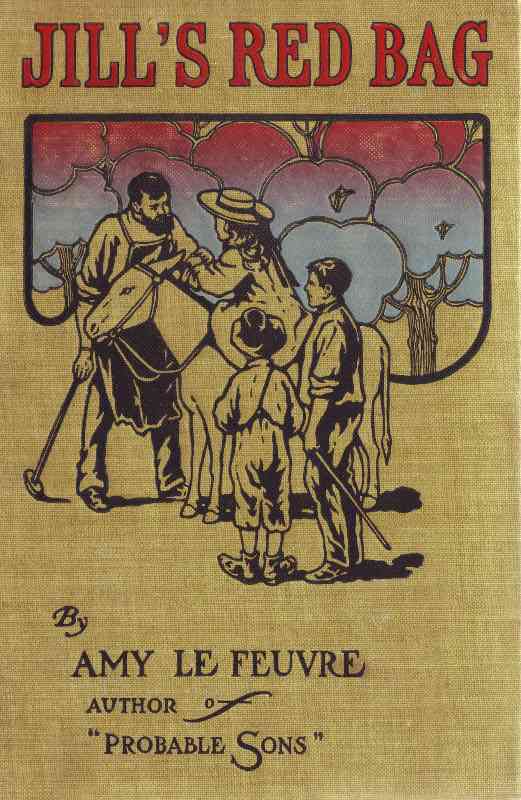
"Well," said Jill, turning to the blacksmith, who had left his forge and had come out to know what the cheers were about, "I've told you what is going to happen, and if you like to give a tenth of your money and give it to God, I will take it and put it in my red bag and give it to Mr. Errington."
The blacksmith put his hand in his pocket and brought out sixpence.
"There be my mite towards it," he said. "I always did say a parson up here would be the thing!"
Jill thanked him profusely, dropped the sixpence in her bag, and the children rode away, followed for a short distance by a screaming crowd of small boys and girls.