
The Indians near Vincennes must have heard about Clark’s gifts, because early one morning several of them came to the fort to receive presents from Chief Long-Knife. Jim was helping to distribute these when he recognized Wahbunou in the group.
“Here’s Wahbunou, Colonel Clark,” he said as the Indian boy approached them.
Colonel Clark smiled and extended his hand to Wahbunou. “You’ve come to be paid for that buffalo meat and corn, I suppose. Well, boy, I’m glad to pay you. They saved our lives and made it possible for us to take Vincennes.” The colonel himself looked through the supplies and brought out two magnificent blankets. “Can you use these blankets, Wahbunou?”
Wahbunou’s eyes shone as he took the blankets. “These are very good, Chief Long-Knife. I have been paid plenty. I am glad my people could help Jim’s people. Jim is my friend.”
Jim took Wahbunou to one side. “My parents are here, Wahbunou,” he said. “They were Hamilton’s prisoners, but now they are free. Won’t you stop and see them?”
Wahbunou beamed. “I’m glad you are with them. I can’t stop now, but Wahbunou will see your mother when he comes to Vincennes again soon. Your mother was very kind to me.” Then he turned and went back to the other Indians.
Before Colonel Clark led his men back to Kaskaskia, he took Willie Watson to make a call on the Hudsons. Pa Hudson wanted to return to his farm in Kentucky and asked Colonel Clark if he would advise going.
Clark was silent for a few minutes, then shook his head. “Not yet, Hudson. Why don’t you stay here until summer? If everything is favorable then, you and your family can return to Kentucky. I’ll be back in June as we intend to march on Detroit.” Then he turned to shake hands with Jim.
“You’ve been a good soldier, Jim Long-Knife. They don’t come any better than you. I’ll say good-bye now and expect to see you when I return.”
Jim’s eyes misted as he said, “Thanks for everything, Colonel. I’ve learned a lot from you.”
Willie had been unusually silent during the call. Now he said, “Good-bye, Jim. Take care of yourself. I’ll miss you more——” his voice broke and he could not finish what he wanted to say.
Jim clapped Willie’s shoulder affectionately. “Good-bye, Willie. You stay with Colonel Clark and the Long-Knives and you’ll be all right. See you in June.”
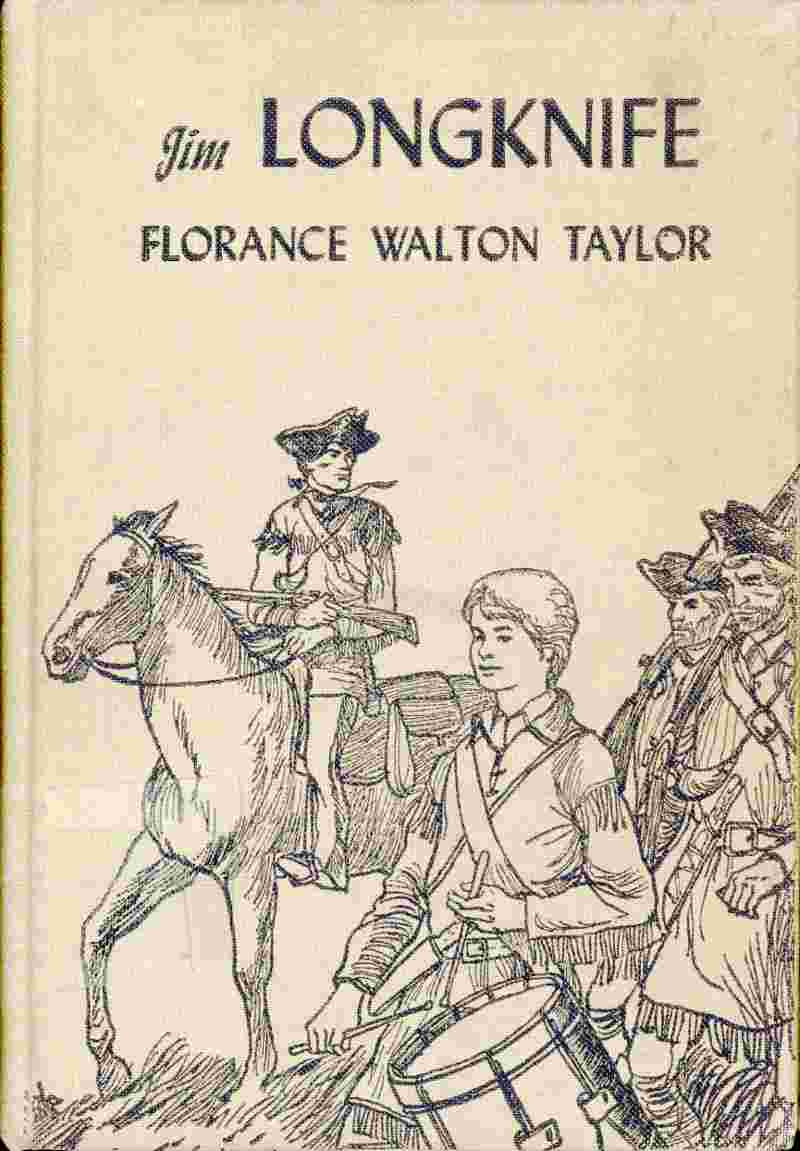
Jim Long-Knife
By
FLORANCE WALTON TAYLOR
Illustrated by
DIRK GRINGHUIS
Boys and girls living at the time of our War of Independence, took an active part in that struggle. Out West, they not only fought the British, but the Indians as well. Kaskaskia and Vincennes were not just towns, but stood for hard battle and hard won victory.
Jim Hudson, named Jim Long-Knife by Chief Minnemung is a pioneer boy living in Kentucky. How he is separated from his parents, how he lives with the Indians, and how he fights alongside George Rogers Clark, is a story filled with suspense and courage. Jim has good friends, including the Indian boy Wahbunou, but it is his drum that, many times, keeps him from danger.
Shemolsea—Long-Knife is an important part of early western history—and Jim helped make it so.
Transcriber’s Notes
- Silently corrected a few typos.
- Retained publication information from the printed edition: this eBook is public-domain in the country of publication.
- In the text versions only, text in italics is delimited by _underscores_.