
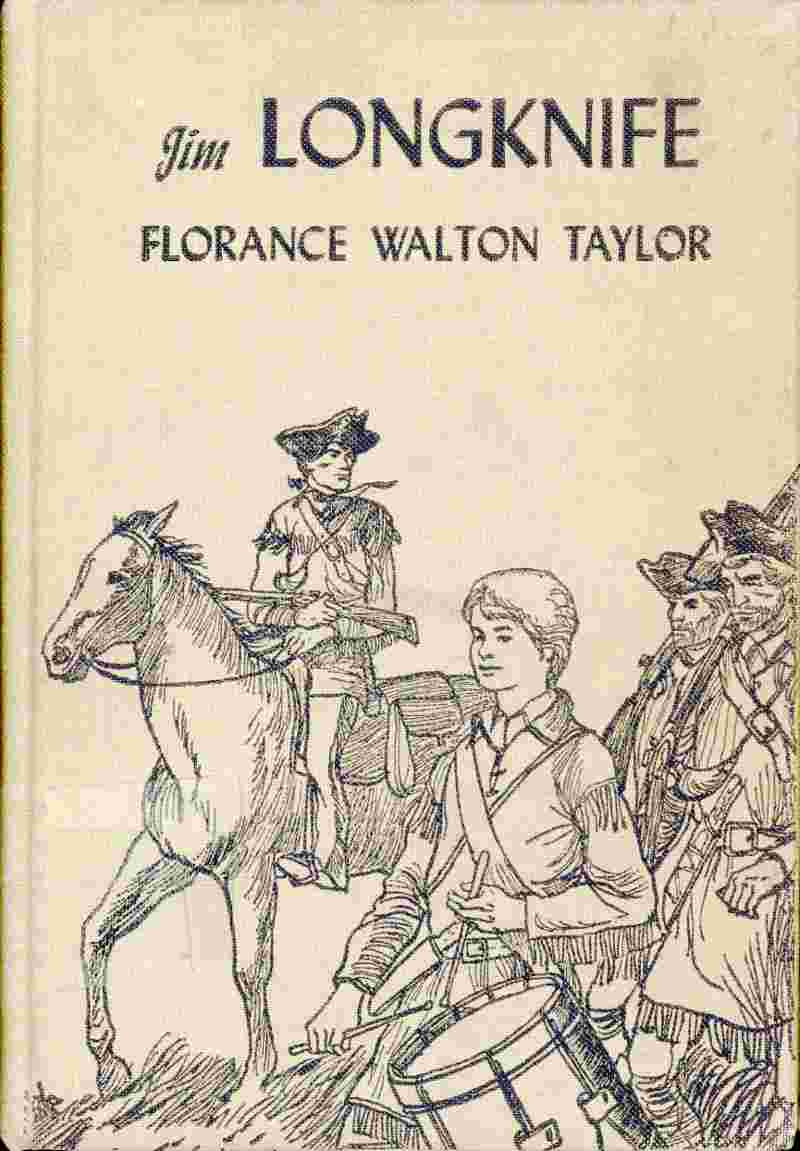
Jim sprang up, his eyes shining. “Oh, you’re the Shemolsea—the Long-Knives.”
“Never mind who we are,” the man said crossly. “Who are you in that Indian outfit? What are you doing here?”
“I’m Jim Hudson. I escaped from the Indians last night and I’ve been trying to find you all day.”
“A likely story,” muttered the shorter man. “Probably you’re some spy sent out by the Indians.”
Jim shook his head. “No, sir. I saw a big band of Long-Knives yesterday and I’ve been trying to find them.”
“Let’s take him to Colonel Clark,” the shorter man suggested.
Jim’s eyes sparkled. “Clark, did you say? George Rogers Clark? Is he red-haired?”
The tall soldier spoke again. “Say, boy, you know too much. Come on, get going.”
As they walked single file through the woods, they made Jim walk between them. After stumbling over fallen trees and brambles for about a mile, they came upon a group of ragged men sitting and standing in the dense shade along a river.
“Colonel Clark, sir,” began the tall soldier, “we’ve found a white boy; he says he was a prisoner of the Indians. But he knows too much. Must be some trick here.”
A ragged, commanding figure with red hair turned from the men and walked over to Jim. His stern, hazel eyes seemed to penetrate Jim’s whole body as he said, “Well, lad, who are you? What are you doing here?”
Jim was so excited he could scarcely talk. “Colonel Clark, I’m Jim Hudson. I don’t suppose you remember me, sir, but I remember your red hair. I met you late last year with my father at Coon Hollow. We had been hunting and had bagged a deer. You advised my father to go to Harrodsburg until the Indian scare was over.” Jim looked hopefully at the colonel.
Colonel Clark seemed to be turning something over in his mind. Finally he smiled. “I remember. But how do you happen to be out here in the Illinois country?”
Then Jim told the long story of how he and Pa and Ma had been captured by the Shawnees on the way to Harrodsburg; how later he had been traded to the Potawatomis, with whom he had spent the winter. When he was telling of seeing the column of Long-Knives, Colonel Clark interrupted him.
“Just a minute, boy. Did the Indians with you see us?”
Jim shook his head. “No, sir, only Wahbunou. We had stayed behind the rest to eat more berries. Wahbunou promised me he would not tell he had seen the Long-Knives.”
Colonel Clark looked puzzled. “That’s hard to believe, Jim. I wouldn’t trust an Indian not to warn his people of an army of white men near them.”
The tall soldier scowled, as did several others. But no one spoke a word.
“But, sir,” Jim replied, “we saved Wahbunou’s life, so he promised not to tell about the Long-Knives. He knew of my plan to escape.” Jim explained how the Hudsons found Wahbunou near their clearing and of Chief Minnemung’s decision to adopt Jim. “That’s why I ran away, sir. I didn’t want to be a Potawatomi. I hope to find my parents, but I don’t know if they’re alive.”
George Rogers Clark nodded. “I trust they are, Jim, and I can’t blame you for not wanting to be a Potawatomi. For the present you’ll go with us and be a part of my volunteer army. We’re crossing the river tonight and marching on Kaskaskia.”
“I see you have a drum. Perhaps we’ll need a drummer before this night is over.” He turned and motioned to the tall soldier. “This is Simon Kenton, Jim. You are to go with him and do whatever he says.”
“Yes, sir.”
Simon Kenton inclined his head toward the river bank. “Come on, Jim. We’ll have a look at Kaskaskia from this side of the river. Have a care though. We don’t want any of those Frenchmen over there to see us.”
As Jim and Kenton approached the river’s edge, Kenton dropped to the ground. “We have to crawl now, Jim, so’s we can see without being seen.”
At the edge of the bank they could see the little town of Kaskaskia. It lay in a kind of amphitheatre of woods and bluffs. They could also see the fort with a stockade built around it, the steeple of a church, and some thatched roofs and stone houses shining in the afternoon sun.
“Gee, it’s bigger than the settlements I’ve seen in Virginia!” Jim exclaimed.
“Yep,” Kenton replied. “This is one of the oldest and best of the French villages. I’ve heard it called the Paris of the West. See that British flag flying above the fort? Tomorrow, God willing, it’ll be flying the American flag.
“You see, Jim, Colonel Clark has to take this country from the British to make our Kentucky settlers safe from Indian attack. Commander Hamilton at Detroit has been stirring up the Indians against our people.”
“Yes, sir, I know. I think that’s how my parents and I happened to be captured.”
For a while they watched the town. Nothing unusual was going on, so Simon Kenton told Jim he thought no one there suspected the presence of Clark and his army directly across the river. Then they crawled back to the main group of soldiers.
Jim didn’t think the men in this motley, exhausted army could capture a town during the night. Several of them had taken off their shoes and were nursing their painful, swollen feet. They were suffering from scald foot, a wilderness malady brought on by dampness, heat and too much marching.
Jim wondered if they could put on their shoes when it came time to cross the river. All of them were hungry besides, as they had eaten nothing but berries for many days. Could such an army capture a well-fed town like Kaskaskia?
Chapter VI
ON TO KASKASKIA
When night fell, Colonel Clark ordered his men to march. Led by two soldiers who had been scouting the woods all afternoon, they followed the bank of the Kaskaskia River until they came to a farmhouse. Here several boats were moored at the river bank. Clark ordered some of his men to surround the house and others to seize the family living in it.
A very frightened Frenchman, his wife and their several children came out of the house, holding their hands high in the air. The soldiers brought the father to Colonel Clark who began questioning him about the town of Kaskaskia.
The man said the town had been expecting an attack from the direction of the Mississippi River. This alarm had died down, he thought, because now there was no extra militia at Kaskaskia. He also said most of the Indians loitering there had left and gone to Cahokia.
Jim shivered at the mention of Cahokia and wondered if Chief Minnemung and his Potawatomis had arrived there, or if they were still searching for him.
When Clark got the information that the town was quiet, he permitted the French family to return to their home, and ordered his men to start ferrying the army across the river. Since he had well over a hundred men, they must make many trips back and forth in the few boats on the river bank. Jim and Simon Kenton were to go with the first group.
As Jim climbed into one boat, he stumbled over a boy about his own age who was trembling and cowering in the bottom. Kenton, just behind Jim, pointed his rifle at the boy. “Who are you?” he asked gruffly. “What are you doing here?”
The frightened boy did not reply but stared up at the rifle.
“Come, boy,” Kenton repeated, “what are you doing here?”
The boy scrambled to his feet and stammered, “I——I was just going home. I came from Kaskaskia this morning in this boat. I was hunting beeswax for Father Gibault. He needs more beeswax for the church candles. When I saw all your men I hid here. I hoped you would go away so I could go home.”
Kenton sneered. “A likely story. You’ve been spying for de Rochblave no doubt.”
“Oh, no, sir. I only know the commandant by sight, sir. I tell you true, I was hunting beeswax. And I found a bee tree, too.”
“Well, you’ll go back as our prisoner. Sit down in the boat.” Simon Kenton turned to Jim. “Sit beside him, Jim, and keep your eye on him. Don’t let him get away.”
“Yes, sir,” Jim replied, making room for the boy.
The boat was now filled and the men began rowing across the river toward Kaskaskia. Jim could feel the boy trembling beside him. He whispered, “Don’t be afraid. Colonel Clark will see that no harm comes to you. What’s your name? I’m Jim Hudson.”
“Willie——Willie Watson,” the boy replied.
As soon as all soldiers were ferried across the river and assembled in their respective companies, Colonel Clark stepped out in front of them. It was too dark to see this erect, commanding man, but there was no mistaking the stern authority in his voice.
“Men,” he said, “our first objective is to take this town. By seizing Kaskaskia, we’ll be protecting our countrymen in the western country. You all know the British have been inciting the Indians to war against our settlers. By controlling this French settlement, we’ll cut off all supplies from New Orleans and the west to Hamilton at Detroit, so tonight it’s win or lose everything. Now, I’ll make three divisions of these companies. Captain Bowman.”
“Yes, sir,” and Captain Bowman stepped forward.
“You are to command one division. Take your men to the far quarter of the town. Captain Helm, command the second, and take your men to the other end of town. I’ll lead the third division.”
The men assembled quickly according to orders. Jim and Willie were assigned to Captain Bowman’s division.
“Kenton,” Colonel Clark continued, “you’re to go with me. Now, men, if we take the fort and capture de Rochblave without resistance, you’ll hear three shots. The shots will be my signal of victory. Then all of you are to yell and shout as loudly as you can. And Jim,” Colonel Clark peered into the darkness, “where’s Jim Hudson?”
“Here, sir.”
“When the men start yelling, you beat your drum as hard as possible. Run through the town from one end to the other beating it. That will help make the French think we have a large army. Keep beating it. Do you hear?”
“Yes, sir.”
“If any of you men speak French, step forward.”
Several soldiers stepped forward from the ranks.
Willie whispered to Jim, “I can speak French, too.”
“Step forward then,” Jim urged, so Willie stepped out with the others.
“After I give the signal,” Clark continued, “you are to run through the streets telling the people in French that the Long-Knives have taken Kaskaskia. And tell them to stay inside their homes. If they venture outside they will be shot.” Clark’s voice became sterner than before. “Now then, not one of you is to talk to any of the inhabitants. I want no conversation with them. Is that clear?”
“Yes, sir,” the men answered in chorus.
Immediately Colonel Clark set out, leading his own division through dark, silent streets toward the fort. The two captains started with their men for the assigned positions. For Jim and Willie it was an eerie experience to march through the dark streets, then wait—wait in silence for the hoped-for signal.
After what seemed an endless time to the boys, three rifle shots rang out from the fort. These meant that Colonel Clark and his men had captured Commandant Philip de Rochblave and his fort without any resistance.
Then what yelling and screaming went up in all parts of the town. Those men speaking French tried to out-yell other Long-Knives shouting Clark’s orders in English. As Willie ran through the streets shouting his orders, Jim kept beside him, beating his drum with all his might.
Jim thought he’d better keep track of Willie so he wouldn’t escape. Willie, however, showed no signs of wanting to leave the Long-Knives, but kept shouting Clark’s orders over and over. They kept up this din all night and were so excited they never thought of sleep.
The next morning the streets were deserted save for Clark’s troops now doing guard duty in various parts of town. Jim and Willie were still together and Jim was surprised to see what a beautiful place Kaskaskia was.
In the center of town was a large grass-covered square, with narrow streets leading out from it. From here Jim saw the American flag was indeed flying from the old fort. There were a few stone houses here and there, but most of them were wooden with pointed, thatched roofs and chimneys at either end.
While Jim was admiring the town, someone called, “Come on, boys. Breakfast is ready.”
Jim and Willie didn’t need to be called the second time. They dashed to join the men just sitting down to breakfast; it had been prepared by spies Colonel Clark had sent into town ahead of his troops.
Meantime the terror-stricken residents of Kaskaskia remained indoors, not knowing what was to become of them. Father Pierre Gibault asked Colonel Clark if the people could assemble in the church to pray. They feared they were to be separated and taken away by Clark’s soldiers. Clark granted Father Gibault’s request and the people walked solemnly into the church.
Some time later Colonel Clark spoke to them, telling them not to be afraid. He said the king of France had joined the Americans against the British and now they could all work together. He asked only that the residents of Kaskaskia swear allegiance to the Long-Knives, who represented the Continental Congress and Virginia.
Immediately the gloom and fear of the people melted away. They rang the old church bell in jubilation, giving thanks for their freedom, weeping and laughing for joy.
No one was more astounded at this news than little Willie Watson. He clapped his hands and turned handsprings down the street. He had expected to be thrown into chains and taken far away. Now he was as free as Jim. He looked at his friend. “Colonel Clark is a wonderful man,” he said, his dark eyes shining.
Jim nodded. “Willie, were you really hunting beeswax across the river?”
“Of course I was, Jim. We have no wax for the church candles, so I went to hunt a bee tree. Now I’ll get someone to go with me to get the honey and wax.”
“Are you responsible for the candles, Willie?”
“Not entirely, Jim. I am a ward of Father Gibault and I help him in any way I can.
“My father was a river man on the Ohio. He worked for Boynton, Wharton and Morgan Company. They used to send boatloads of merchandise from Philadelphia down the Ohio and up the Mississippi Rivers to their store here. My father made many trips for them, but he was drowned in 1772. So Father Gibault found a house for my mother and me next door to him.”
“Then you live with your mother?”
“Yes, I do. She sews for some of the wealthy people and mends for Father Gibault. In the winter I work for Monsieur Gabriel Cerré.”
Jim’s face was sad for a moment. “My mother was a good seamstress, too.”
Willie was puzzled. “Say, where are your mother and father? How do you happen to be with Clark’s army?”
Then Jim told Willie about the last time he had seen his parents and what had happened to him since.
“That’s too bad, Jim,” Willie said. “Of course Indians do sometimes kill their prisoners, but it’s likely your parents are still alive. What are you going to do now?”
Jim sighed. “I hope I’ll find them some day. Maybe Colonel Clark will have a job for me. I’d like to stay with him and his men.”
Willie smiled. “If he doesn’t, Jim, I think I can get you a job working with me. Monsieur Cerré is a big merchant here and needs quite a few people in the fall. He’s away from Kaskaskia right now.”
Jim nodded. “I may ask you later, Willie, because I have to find something to do.”
“Guess I’d better go home now, Jim. Will you come home with me?”
“No thanks, Willie. I have to see what Colonel Clark has in mind for me.”
“Well, good-bye, for now,” and Willie ran happily down the street toward Father Gibault’s house.
Jim walked slowly over to Colonel Clark’s headquarters. When he arrived Captain Bowman and a few French citizens were just leaving. Clark was giving them last-minute instructions.
“Captain Bowman,” he was saying, “use all your persuasive powers and those of these good citizens,” he nodded toward the Frenchmen, “to get the people of Cahokia to swear allegiance to our Continental Congress. No violence, though.”
“Yes, sir,” Captain Bowman replied, saluting smartly. “I think I can win them over with the help of these men.” Then he and the Frenchmen left headquarters for their ride to Cahokia.
After they had gone Colonel Clark noticed Jim standing in the room. “Hello, Jim. What is it?”
“I wonder, sir,” he began, “if you have a job for me. You see I have no home here, as Willie has.”
Colonel Clark frowned for a moment and then smiled. “To be sure, I have a job for you, Jim. You can be my personal messenger. Now that we have won Kaskaskia, I have to deal with the Indian tribes camped in this neighborhood.”
“Yes, sir.”
“Are you a good penman, Jim?”
“I can write a good hand, sir. My mother used to be a governess in Virginia and she taught me to read, write and figure.”
“Good. I have a lot of letters to write and you can help me with them, too. You’ll sleep here at headquarters and eat with my men. Tomorrow you’ll have plenty of work to do.”
“Oh, thank you, sir.” Jim’s heart was singing. All would be well with him if he could stay with Colonel Clark.
Chapter VII
NO ADOPTION
George Rogers Clark’s sudden appearance in the French settlements with his army threw the Indians camping there into a panic. They thought the army larger than it was and expected to be attacked momentarily. Some tribes asked their French friends in Kaskaskia and Cahokia what they should do.
The French, who were now firm friends of the Long-Knives, advised them to call upon Clark and sue for peace. Then these same Frenchmen reported to Clark that the Indians had come to them for advice.
Colonel Clark was quick to take advantage of the Indians’ confusion. He prepared a letter to be sent to the tribes, telling them to lay down their tomahawks and ally themselves with him, or to fight like men for the English. Jim Hudson made several copies of this letter, which Clark sent by him and other messengers to the different tribes.
The Kickapoos and Piankeshaws signed treaties immediately with the Long-Knives. Other tribes, however——the Chippewas, Ottawas, Potawatomis, Sacs and Foxes——came into Cahokia and demanded a council with Clark. They wanted to see the chief Long-Knife and to hear what he had to say.
Colonel Clark sent word to them that he would attend their council, but he took his time about going to Cahokia to meet with them. He thought it would be well for the Indians to wait on him. After a while he took Jim Hudson, some of his officers and many of his soldiers to Cahokia, which had sworn allegiance to him through Captain Bowman.
Clark’s new headquarters were in a house beside the Cahokia River. In a few days a band of Winnebagos, often called Stinkers by the French, pitched camp in a Frenchman’s yard, just across the road from Clark’s headquarters.
When Jim Hudson saw the Indians he was frightened and said to Colonel Clark, “I don’t think those Stinkers should camp so near you, sir. They might attack us. We don’t have many soldiers here.”
The colonel’s eyes twinkled. “How right you are, Jim. I think they have something like that in mind. Perhaps they want to kidnap me so I can’t appear at the council.”
Jim shivered. “Oh, sir! Can’t you recall some of the men you have stationed around the town?”
“Jim, you have the mark of a military man,” Colonel Clark replied. “That’s what I intend to do, but I don’t want these Stinkers to know about my reinforcements. You go to my captains now and tell them to send several guard details to my headquarters as soon as it is dark. Tell them to come in one by one at the rear.”
“Yes, sir,” Jim replied, glad to have an errand and to know they were to have more soldiers at headquarters. He dashed out to find Captain Helm and Simon Kenton.
That evening fifty guards began filtering into headquarters, some to conceal themselves in the house, others to stand in the darkness outside. Although Clark walked alone about the yard, nothing happened.
The next night the guards again took up their same stations. Colonel Clark stayed up late, supposedly working on reports.
Jim couldn’t sleep, so he went to the window and stared out into the night. About one o’clock shots were fired across the river. In a few minutes Jim saw some skulking figures in the headquarters yard. He wanted to scream, but Clark himself gave the alarm.
Immediately the guards appeared from all sides of the building. They succeeded in capturing three of the Stinkers and hustled them into headquarters. The shots and ensuing racket awakened the town; some of the citizens hurried to headquarters to see what was the matter.
To Jim’s great surprise, the colonel asked these Frenchmen what punishment they thought these Stinkers deserved. In one voice they said these Indians should be put in irons. Then and there, Clark made this an order. Thus he maneuvered so that the French suggested the punishment for the Indians.
The next morning Colonel Clark went to the great Indian council, accompanied by some of his officers and townsmen. At the last minute he told Jim he might go. He also had the three Stinkers brought to the council in chains. How ridiculous they looked clanking along beside the officers.
Jim was amazed at the number of Indians awaiting Colonel Clark’s arrival. Jim looked over the crowd to see if he could see Chief Minnemung or any of his Potawatomis. If they were there he could not locate them in the vast throng.
He glanced at his colonel, wondering if he were not frightened among so many Indians. But Clark looked as if he were master of the entire council. Fear was not a part of George Rogers Clark’s character; and since the Indians had asked him to come to the council, he waited for them to speak.
After a few minutes a tall, erect, haughty chief, dressed in a handsome buffalo robe, came forward to stand directly in front of Colonel Clark. “Chief Long-Knife,” he began, “we hope the Great Spirit has brought us together for good and that we may be received as friends. The bad bird British ordered us to attack your countrymen.”
He turned and motioned for one of his tribesmen to bring something to him. When the Indian brought him a bloody belt, some red wampum and two British flags, the chief threw them to the floor and stomped upon them.
“We have received these emblems of war from the bad bird British and now we hope peace with you will take the place of the bloody belt of war.” Then the chief walked back to his people. Other chiefs came up asking for peace. Even the Winnebagos came up and offered the peace pipe to Colonel Clark.
He waved them away, however, because he knew it was best to keep the Winnebagos in suspense for a while about the fate of their Stinker relatives still in chains. Then he told all chiefs who had made speeches that he would consider their offer and give them an answer the next day. He left the council with his staff, and all the townspeople and Jim.
The next morning after the council fires were kindled anew, George Rogers Clark gave his answer to the waiting Indians. He told them why the Long-Knives were at war with the British, and that the British had become so weak they were forced to hire Indians to fight for them. He also told them the French king, father of all their French friends, had also joined the Long-Knives against the British.
Finally he said, “Now you can judge who is right, the Long-Knives or the British. Here is the bloody belt of war, here the white belt of peace. Take the one you please. Behave like men though, and choose the one you wish.
“I do not want you to give me an answer until you have time to counsel. We will part, and when you are ready, if the Great Spirit will bring us together again, let us prove ourselves worthy by speaking and thinking with one heart and one tongue.” Then Colonel Clark and his group left the council, not returning until the Indians sent for him.
They had assembled with their peace pipes, and many chiefs made flowery speeches about their intended friendship with the Long-Knives. Later they smoked their peace pipes and offered them to Clark, who went through the pipe-smoking ceremony with them.
Jim Hudson knew Indians did not always keep their word; how he hoped Colonel Clark knew it, too.
These council meetings went on for days until Jim grew weary of attending them. One morning, however, he was surprised to see two stalwart young Winnebagos present themselves in front of Colonel Clark, then fall to the ground and cover themselves with a blanket.
Jim did not know what to make of this and looked questioningly at the colonel. George Rogers Clark’s face did not change expression as he waited to see what would happen next.
One of the Winnebago chiefs stepped forward; he explained that these two young men were offering themselves as a sacrifice to atone for what their Winnebago relatives had done at Clark’s headquarters.
Colonel Clark did not reply at once, but kept staring at the blanket covering the two men. Jim and the rest waited anxiously, expecting the colonel to order the Winnebagos killed immediately, or at least to be cast into irons.
To everyone’s amazement, Colonel Clark rose and ordered the two Indians to stand. Then he took each of them by the hand as brothers and introduced them to his officers and the Frenchmen sitting with his group. A loud murmur of approval arose from the surprised Indians. Still more surprising to Jim was Clark’s order to free the Stinkers who had tried to kidnap him.
All during these meetings Jim had looked in vain for the Potawatomis with whom he had spent the winter; he wondered if they had ever arrived in Cahokia. The day after Clark had freed the Stinkers, Jim discovered Chief Minnemung and his clan sitting near the front of the assembly. For a moment he was afraid—would these Potawatomis try to capture him again? Then he glanced at Colonel Clark and realized he was safe where he was.
At this council meeting Big Gate, one of the great Potawatomi chiefs, spoke for the entire tribe, saying they were ready to sign a peace treaty with the Long-Knives. When the treaty was signed, Colonel Clark and his staff rose to leave. Suddenly Chief Minnemung barred his path.
“Big Long-Knife, chief of all the Long-Knives,” Minnemung began, nodding toward Jim, “this boy ran away from our clan. I planned to adopt him as my own son.”
Jim began to tremble when Colonel Clark turned to him, all the while pretending he had never known of Minnemung’s plan. “Jim,” he said sternly, “is this true?”
“Yes, sir,” Jim stammered, “but I didn’t want——”
Chief Minnemung gestured impatiently, as he interrupted Jim. “Big Long-Knife, I say Chief Minnemung no longer wants to adopt this boy. He not make good Potawatomi. He is Jim Long-Knife. Chief Minnemung is no longer interested in him. He now belongs to Big Long-Knife Clark.”
Jim sighed in relief as Clark said gravely, “So be it, Chief Minnemung. I accept this boy as Jim Long-Knife.” He extended his hand to the Potawatomi chief to seal their bargain.
Chief Minnemung shook hands with Clark without glancing at Jim. Then he walked proudly to his clan.
George Rogers Clark could be stern no longer. As he looked at Jim for a moment, his hazel eyes twinkled in fun. “I guess this makes you safe, Jim. You are now under my control and a real Long-Knife. Chief Minnemung has decreed it. Jim Long-Knife. That’s a fine name for you.”
Jim smiled. “Oh, sir, thank you. I’m so glad Chief Minnemung doesn’t want me. I saw him sitting with the other Indians today, and I was afraid he might have his men take me prisoner again sometime.”
Chapter VIII
A PEACEFUL INTERVAL
While Clark was counseling and making treaties with the different Indian tribes at Cahokia, he was also sending men on different missions throughout the western country.
For the most important mission he chose Father Gibault and Dr. Laffont, an influential citizen of Kaskaskia. They were to take a proclamation to the French settlers at Vincennes, asking them to renounce their fidelity to the British king, George III and swear allegiance to the Americans.
Since Father Gibault was well known and respected for his earlier good works among the people there and Dr. Laffont was a most persuasive man, the French settlers willingly took their oath of allegiance to the Americans.
Both men returned to Colonel Clark with this good news long before his negotiations with the Indians were completed. Then Clark dispatched Captain Helm to take charge of Fort Sackville at Vincennes.
Now that the three French villages, Kaskaskia, Cahokia and Vincennes were in American hands, about half of Clark’s volunteers returned to their homes in Kentucky and Virginia. Those who stayed acted not only as guards for the American headquarters, but reinforced the French garrisons at Kaskaskia and Cahokia against possible Indian attack.
Jim didn’t know how to occupy his time, now that Colonel Clark didn’t seem to need him. One evening he decided to ask the colonel about it. “I have nothing to do here, Colonel Clark,” he began. “I could go back to Kentucky to see what’s left of our farm. I wouldn’t be afraid to stay there alone, sir, and I could start clearing more land.”
Colonel Clark fidgeted in his chair. “I know you aren’t afraid, Jim, but I wouldn’t think of letting you go back alone. You’d be a perfect target for Indians. They haven’t all signed treaties, remember. Even so, I don’t trust these redskins too far. Now if your parents——”
“But, sir,” Jim interrupted, “I don’t know if my parents——”
“I know, lad. It’ll be time enough for you to go back to your farm when we locate your father and mother. I have asked every man who has gone out from here to be on the lookout for the Hudsons. They are to ask in every settlement if any one has seen or heard of them. It’s a slow sort of grapevine method, I know, but word gets around that way. We’ll find them, Jim, some day.”
Jim’s blue eyes misted with tears. “Oh, Colonel Clark, you think of everything. No wonder you’re such a good military leader.”
“You can stay on at headquarters with me, Jim. That will give you a roof over your head and three meals a day.” He stared at Jim for a moment and then grinned. “I’ll have to find a buckskin outfit for you too, lad. Even if you are Jim Long-Knife, that ragged blue outfit you’re wearing must be replaced.”
Jim laughed. “These are the clothes the Potawatomis gave me. I have no others. The Shawnees took the ones my mother was taking to Harrodsburg.”
“And you’ll need some work to do, Jim, to keep you out of mischief.”
“I can get a job, I’m sure. Willie told me he could get work for me with Monsieur Gabriel Cerré, the wealthy merchant here. Willie works for him.”
Colonel Clark frowned. “Willie? Who’s Willie?”
Jim seemed surprised. “Willie Watson, sir. The boy we found in the boat the night we took Kaskaskia.”
Clark nodded. “To be sure. I remember you told me about him, but I didn’t notice him that night. What does he do for Monsieur Cerré?”
“He sorts fur pelts and counts them. I saw him yesterday and he has already started the fall work.”
“It sounds like a good job, Jim. Ask Willie to take you to see Monsieur Cerré.”
“Yes, sir. I’ll go over now and see Willie.”
Jim started over to the fur depot to find Willie, but on the way he saw him coming. “Oh, Willie.”
“Hello, Jim. Still running errands for Colonel Clark?”
“No. I guess my work with him is over. I was just coming to see if you could get me a job with Monsieur Cerré.”
Willie smiled. “Sure. Just today the men were saying they needed another boy to sort pelts this fall.”
“Can we go tomorrow?”
Willie shook his head. “There isn’t going to be any work tomorrow. The men have to wait for some supplies coming up from New Orleans. I’ll be glad to take you as soon as the depot opens again. I’ve just been talking to Father Gibault about getting the beeswax and honey from that bee tree I marked for him.”
“Haven’t you been across the river since that night?”
“No. You see Father Gibault thought it would be easier to get later in the fall. But since there’s no work tomorrow he said I might go after it, if I could get someone to help me. Would you like to go along with me?”
Jim’s eyes sparkled. “Sure, if Colonel Clark says I may.”
“Come over about ten o’clock then. We can’t go too early as we have to wait until most of the bees are out of the hive.”
“I’ll be there, Willie.”
“Be sure to wear your moccasins—” Willie looked doubtfully at Jim’s thin, worn clothes, “and you’d better get some buckskin clothes to wear. Bees can’t sting through buckskin.”
“All right. See you tomorrow.”
Colonel Clark said Jim might go after the honey, but added he couldn’t go unless they found some buckskin clothes for him to wear. He hunted through some of the supplies at headquarters and found a buckskin outfit.
When Jim arrived at Willie’s house, Willie was ready and waiting for him. He handed Jim one large wooden bucket and carried another himself. “We’ll put the honey and wax in these buckets,” Willie explained. Then he picked up a gaily colored cloth bundle.
The two boys put out in one of Father Gibault’s boats and soon crossed the Kaskaskia River, landing near the house which Clark had surrounded the night he made his march on Kaskaskia.
Willie moored the boat to a tree along the bank. Then they started out to find the tree Willie had marked with Father Gibault’s initials. They wandered quite a way before Willie suddenly cried, “See, Jim, there it is!” He pointed to a tree with a large fork high above the ground.
Jim also saw the initials F. G. on the trunk; these Willie had carved the day the Long-Knives had found him in the boat. “Why did you put Father Gibault’s initials there, Willie?”
“Why, to show the honey belonged to Father Gibault. No one will steal honey from a marked tree,” Willie explained as he untied his cloth bundle. Out tumbled two blue capots or cloaks with hoods, two small scarfs and two pairs of mittens. Then he took out a long, sharp knife from the pocket of one of the capots. “Now we’ll get dressed to tackle the bees.”
Jim picked up the larger capot and tried it on. “I can’t wear this, Willie. It’s too small.”
Willie had already put on his capot and adjusted its hood over his head. “You can’t? Say, you’re bigger than I thought. That’s my mother’s capot, but I guess you need a man-sized one. Just put the hood over your head and let the cloak fly,” he suggested as he tied a scarf over his face.
Jim looked at the capot dubiously. “Why are we wearing all this stuff anyway, Willie?”
“To keep the bees from stinging us, of course.”
“We’ll smother, Willie, and we can’t see with the scarfs over our faces.”
Willie nodded. “That’s right. I’m a stupid ox not to think of that. Well, I’ll fix it.” He picked up the knife and cut two slits in each scarf. “Now we have peepholes. Put one on, and the mittens too, Jim. If the bees are in a bad mood, they can’t sting us through the buckskin and these winter clothes.”
Jim put them on and then asked, “Now what do we do?”
“I’ll climb up and start cutting the honey and wax away. It’s up there in a deep hole in the fork of the tree. You put your bucket at the base of the tree and I’ll try to drop the honey and wax into it. This is a beautiful day, so maybe most of the bees will be gone from their hive.”
Jim watched as Willie climbed the tree. What a ridiculous sight he was, with the blue capot flapping against his skinny legs.
Willie thrust the long knife into the hole and began turning it slowly around and around. Only a few bees emerged and buzzed around his blue hood.
“Fix the bucket, Jim,” Willie called as the honey began oozing down the tree.
Jim put his bucket under the tree and began slapping at a few bees that were buzzing all around him.
“Don’t fight them, Jim. It makes them angry. Just let them buzz and I don’t think they’ll sting you.”
Soon Willie had rolled out so much honey and beeswax that his bucket would not hold it all. When both buckets were filled, Willie came down from the tree. “Now you carry one and I’ll carry the other.”
Quite a bit of honey had trickled down the tree, so the bees stayed behind, instead of following Willie and Jim.
As the boys walked back through the woods, Willie looked admiringly at Jim. “I didn’t realize you’re so much larger than I am,” Willie said. “Why, you’re as tall as lots of men. How old are you?”
Jim smiled. “I guess I grew a lot while I was with the Potawatomis. I’m thir—why, Willie, I’m fourteen now. I forgot all about my birthday this year. But no wonder, I was fourteen the day after we captured Kaskaskia the fifth of July.”
Willie stood as tall as he could. “Why, I’m almost as old as you, Jim. I’ll be fourteen the second of January.”