
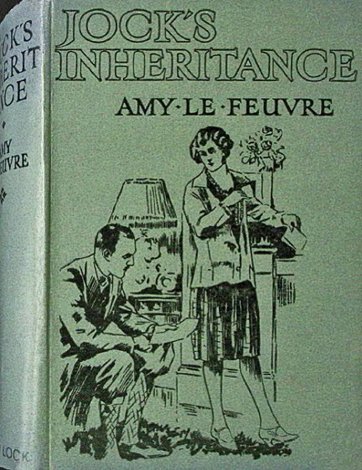
For a moment he looked at the bowed figure,
and longed to kneel down by her side.
Jock's Inheritance]
For one moment Jock's lips paled. Had the child already passed away from them? He made a quick step forward, and Orris looked up.
"Oh," she sobbed, "it's the joy—the relief! He says she has turned the corner—she is going to be spared to us."
"Thank God!" murmured Jock with real feeling. For a moment he looked at the bowed figure, and longed to kneel down by her side and comfort her in his own way, but there was some nice instinct within him that forbade him, at this juncture, to intrude himself and his desires upon her notice. So he smothered his feelings, and spoke in a peculiarly quiet grave tone. "I think I'll go and see your coachman's wife, and then, later on, perhaps the Elf would like to see me again. I won't excite her; I know how quiet she'll have to be kept."
Orris held out her hand to him.
"Forgive me for giving way like this. It has been such a strain. Yes, do go and fix up something with Mrs. Perkins. I must go up to Pippa again."
She rose and left the room, and Jock strode out of the house and down the drive on his errand.
For the next few days, Jock haunted Cudweed Chase. But so quiet and self-controlled was he, that Orris began to wonder whether his liking for her had died a natural death. He, as well as she, seemed entirely absorbed in the small invalid.
And as Pippa came back to them again, and day by day grew brighter and stronger, she insisted upon monopolizing Jock's society. She grew fretful if he was out of the sick-room for long at a time, and at length Orris began to protest.
"We are spoiling her," she said to him one afternoon, when he had announced his intention of going out fishing, and the laments of Pippa had made him give up the idea. "She is well enough now to be reasonable; you are making her selfish, and that will not make for her happiness."
"I shall not be here much longer," he replied, "so she can have as much of me as she wants."
The next day, after lunch, Orris asked Jock if he would like a ride with her.
"I am leaving Miss Raynor with Pippa for the afternoon. It will be our only opportunity if you leave us to-morrow."
Jock gave her such a look that Orris almost repented of her proposal, but she had felt sorry for him passing all his days indoors, and wanted to show him a little of their beautiful country. It was the first time Jock had seen Orris on horseback; he could not but help admire the ease and grace with which she sat her horse.
His spirits rose as they cantered down the drive and met the tang of the salt sea breeze full in their faces.
"This is a treat which I did not expect," he said to her. "I have been very good, have I not? We have both kept each other at arms' length, and the little Elf has taken all our time and thoughts. But now, as you say, this is our only opportunity for a quiet talk, you may be sure I will make full use of it."
Orris was silent for a moment, then she said pleasantly:
"Do. Tell me all about Veddon Weal. How are the Prestons? And the Misses Dashwood? And is Mr. Dane getting on with the villagers? Tell me all your local gossip. I shall love to hear it."
He fell in with her mood, and gave her details of every one and everything in his neighbourhood. Then he asked lightly:
"And when are you coming back to us?"
"Oh, I am settling in here very comfortably," said Orris. "I am really interested in Miss Lyle's philanthropy. I wish you could have met her. She is my ideal of what a rich woman should be. Just a steward—nothing more or less."
"It seems a most strange coincidence," said Jock slowly, "that you and I should be led into the same groove, though under utterly different conditions. I won't say it's extraordinary, because it has all been arranged, I believe, for a purpose. Dane and I have been putting our heads together, and the result is that I am not going to rebuild the west wing. I shall have the ground cleared, but in the big meadow below the kitchen gardens, I am building a roomy house in cottage style. Dane came from an East-End parish, and is great friends with his Vicar there. Relays of tired and delicate East-Enders are to be sent down for rest and change, and Miss Dashwood is going to be secretary and treasurer, and work it in conjunction with a matron who will be in charge. It's just a sop to Dane—and a pleasant job for Miss Dashwood, who thirsts for a little more occupation." Jock added this last sentence a little awkwardly, for Orris's glowing radiant face turned towards him embarrassed him.
"Oh, Jock," she said, "how delightful! It's the first bit of light and comfort that has come to me since that awful fire. You are bringing good out of evil."
"Let us dismount," he said suddenly, "and look at the view."
They were on high ground; a sloping bit of rough moor led to the edge of the cliffs; beyond was the blue ocean. A fleet of fishing boats were putting out to sea, and the sun was already slowly disappearing below the horizon, but it was sending its rosy rays across the water, and Orris drew a long breath of pleasure and appreciation as she watched it.
She was ready to fall in with Jock's suggestion. He tethered the horses to some iron railings, and then found a pile of granite slabs upon which they sat, facing the sea.
"You haven't answered my question yet," he said, laying his right hand over one of hers as he spoke. "When are you coming back to us?"
Orris could not answer.
"You'll never get away from me," Jock went on. "I'm positive that we are two souls who are meant to cleave together eternally, and you must know it too by this time. I have been getting the house ready for you as fast as I can; and I have a surprise for Pippa in it. I have waited patiently for your time, and now it has come. You are not going to send me home an unhappy man, are you?"
Orris looked up at him serenely, though her heart was throbbing painfully.
"But what is it that you want?" she asked. "I cannot come back to the Farm—my work is over at Pinestones."
"Your work at Pinestones is not begun. You know what I want, and the work there is to do there. You have to take rather an uncouth rough sort of a fellow, and mould him into a model husband. Oh, Orris, don't let us beat about the bush any longer. Put your dear hand in mine, and tell me that you'll come to me."
Orris did not move. She was gazing out over the sea. She was going to capitulate—she had no doubt about her feelings by this time—but she hesitated. Jock saw the hesitation. He took her hands in his, and made her look at him.
"Now then, my heart's dearest," he said, "be straight and true—you can be no other. Tell me that you'll be mine."
"I will."
The words were soberly uttered: they had as solemn a ring about them as if uttered in the marriage service.
And then Jock's arms were about her and their lips met.
It was some minutes after that, releasing herself from his embrace, she said a little playfully: "And you have never asked if I love you?"
"I don't need to," he said. "I'm not much to love, but my love for you is big enough for us both."
"Oh, Jock, dear Jock!"
Happy tears rose to Orris's eyes.
"Do you know what you are to me?" she said. "A tower of strength, a modern knight of chivalry, one whom I know I could test to the uttermost and who would never fail me. I think, of all combinations, the equal mixture of strength and gentleness is what I admire most, and these are what you possess."
"Spare my blushes," said Jock, and he had reddened slightly under his tanned skin, but the joyous light in his eyes deepened into a steady glow at her words.
They sat on there, oblivious of time, until the last golden rays of the sun had died away, and then in the dusky twilight they rode home together.
"You must let me tell the Elf the good news," said Jock, as they entered the house.
"Yes," assented Orris; "it will please her."
So Jock went upstairs, and found Pippa sitting up amongst her pillows with a small white face and big eyes.
She smiled her sunny smile when she saw him. "I've been wissing you were here," she assured him.
Then, as he stooped and gave her a kiss, she seized his hand.
"Master Jock, Miss Raynor says you're going away. You aren't, are you? I reely won't get well if you do—I know I won't! And I do want you to see me ride my pony."
"I promise you I shall do that one day."
Miss Raynor slipped out of the room.
Jock drew a long breath.
"Ah!" he said. "Now we're alone, I can tell you a secret. It's a stupendous one. I hope your eyes won't fall out of your head. I'm hurrying back to get Pinestones made clean and smart for you and Aunt Ollie. This is a very nice house, but it's not nearly so nice as mine. The dolls' house is fresh with paint and papering, and waiting for you to come to it. The powder-room holds a surprise for you. And I think there will be a little brown pony with a very long tail champing his hay in the stables, and waiting for a little Elf to ride him."
Pippa clapped her thin little hands.
"Are we going to live with you?" she asked.
"I hope you are. I've asked Aunt Ollie, and she has said 'yes.' We shall have to go to church first, so make haste and get well, for we shall want you there."
"Oh, Master Jock!" Pippa's eyes were dancing with joy. "And there'll be no Snuffy to be cross and turn us out; and I'll be able to go into the powder-room whenever I like. And you'll swing and see-saw me, and we'll both do lots of fun togever!"
"Lots," said Jock cheerfully. "But it's all a secret at present, remember. Only Aunt Ollie and you and I can talk about it in whispers."
Pippa nodded. This was after her own heart.
When Orris opened the door, two radiant faces were turned towards her.
"Aunt Ollie, Master Jock is going to belong to us. He's told me so," Pippa cried exultantly.
"I think it will be the other way about," said Orris, smiling.
And Jock, putting his hand on her shoulder, said:
"We're going to be one happy family; and if Pippa were only well enough, she and I would have a mad gambol together at the very thought of it. But we'll wait to have our rejoicings later, won't we, little Elf?"
"When my legs have left off shaking," said Pippa.
And then Orris sat down by the bed and drew her into her arms.
"We must thank God, darling, that He has made you better."
"Yes," responded Pippa, her eyes fixed on Jock's happy face; "and I'll thank God for making Master Jock come to us, for I was tired of waiting for him."
CHAPTER XIV
A VISIT TO VEDDON WEAL
CHRISTMAS found Orris and Pippa still at Cudweed Chase, and though Jock would have had it otherwise, he had to possess his soul in patience. Miss Lyle spent Christmas with them, and she and Orris were busy making the season bright to all around them.
Pippa was nearly well again, and able to take very short rides on her beloved pony.
Orris had been up to town for two or three days, and in that time she had made her engagement known to her friends. Dugald received her news in gloomy silence.
"It was an evil day," he said, "when you went off to Pinestones. I bear Mrs. Calthrop a grudge for taking you there."
"Now, Dugald, if I had never gone there, my feelings towards you would have been just the same. Be content to be my dear cousin and friend. You knew long ago that I could never be anything more."
"You'll turn into a mouldy frump!"
"Better that than a town gadabout!"
She saw Reyne Archer, for their visit to the Riviera had been delayed owing to Lady Violet getting a bad attack of 'flu, and received some news from her which astonished and delighted her. Mr. Dane had been up to town to see them several times, and on the last occasion had asked Reyne to be his wife.
"And mother likes him so much that she makes no difficulty about it at all," Reyne said. "Oh, Orris, you and I in the same parish! Think how heavenly it will be! But we are not going to be married yet. A cousin of mine is coming to be mother's companion when I leave her. The way has smoothed out so wonderfully, and I shall have the desire of my heart—to be a useful worker instead of an idler; and last and best of all, to have such a splendid man to guide and help me."
"And to love you!" Orris put in, smiling. "I am so very, very glad, Reyne dear."
She saw many of her old friends in town, but she was quite ready to leave it, and come back to the lonely grey house by the sea. She felt rather guilty when she saw Miss Lyle's extreme disappointment and regret that she was leaving her. But after a good deal of thinking, she came down to breakfast one morning with a bright idea in her head. And this was to suggest Miss Dashwood for the next Lady Superintendent of Cudweed Chase.
"Of course," she said to Miss Lyle, "I don't know that she would do it. She has an invalid sister, but she could be made very comfortable here, if you would extend your invitation to her. You would love Miss Dashwood. She is so clever and cultured and brimful of life and cheerfulness! And she has given up all her beloved work so happily and contentedly for the sake of her poor sister. I shall be truly sorry if she leaves our village, but for her sake I should be delighted, because it is work that she will love."
"It sounds feasible," said Miss Lyle. "Will you write to her? Is it too far for her to come and see me?"
"I am afraid she would not leave her sister. She is never away from her for a day. I will write at once."
Brisk correspondence ensued, but the matter was not clinched until Orris herself went down and stayed for a few days with the Prestons.
Jock was, of course, enchanted. He wanted to consult her about several alterations at Pinestones, and met her at the station, one bright frosty afternoon in January, with a radiant face.
"You are very bold in venturing here," he said to her, as he drove her to Lilac Farm in a new car in which he had just invested. "How do you know I will let you away again? I'm just feeling that the days are empty and useless without you. I've been wonderfully patient, I consider."
"Now, Jock, I haven't come down here on our own business, but on Miss Lyle's. Do you think I can persuade Miss Dashwood to make the venture?"
"I'm not approving of it. She's running, or going to run, my Rest Home, remember. I don't want to part with her."
Orris looked grave, then she laid her hand gently on his arm.
"Don't you think I could run that for you? We shall be only changing places."
He looked at her, laughed, then screwed up his lips.
"I want a wife to attend to me, first of all. Not to be a busybody outside her home." Orris said nothing.
"I wish I wasn't driving," Jock said irrelevantly. "It keeps me from doing what I want to do. Speech is too cold for my mood at present."
"Let us keep to our subject," Orris said with her quiet dignity. "I am not going to be your slave and chattel, am I? It isn't a chaffing matter. If I am going to be your wife, Jock, there will be many outside bits of work that I shall like to do. You built your Rest Home. Don't you think your wife is the person to be the secretary or treasurer of it?"
"I think my wife will be an adorable angel, and will be able to twist her poor inferior husband round her finger."
Then they both laughed.
"I shall be entranced for you to be boss altogether of my Rest Home, my house, and perhaps of me."
"That I should never be," Orris said; "I know my limitations. It is your strength and pertinacity that sometimes appals me. Shall we ever be on different sides I wonder?"
"Our conversation is not profitable," Jock said gaily. "We will be joyful in each other's company and let the future go hang!"
When they reached Lilac Farm, Mrs. Preston gave Orris a warm welcome.
"It's so delightful to know that you're coming soon to live amongst us," she said. "'Twas what Tom and I always hoped, but things seemed a bit contrary before you went away."
Jock was loath to leave.
"You're tired, sweetheart," he said, when a few minutes later he was saying good-bye to her in the old hall, and Mrs. Preston had discreetly left them. "I feel that the little Elf's illness took a great deal out of you, but it brought 'me' great happiness." Then, taking her in his arms, he said very tenderly: "I am longing to have you in my keeping. You have always been looking after other people, and now you'll have to take instead of give."
"I'd like to ask you something, Jock," said Orris, a little wistfully. "I wanted to do it when you came to us at Cudweed, but I was not brave enough!"
"Why? Are you afraid of me? Never!"
"No, but I am afraid of your cloaking your real feelings by a veneer of—of indifference."
"Now look here, you and I are on very intimate terms now; we're going to be one before long, instead of two. You may ask me any question you like. I will bare my soul to you. Never hesitate to scold me, question me, and advise me for my good. We have got to know each other through and through!"
"Are things different with you now? Can you and I talk together of the unseen world? Have you got your old faith back?"
Jock held her tighter in his arms, and looked into her eyes very earnestly.
"Do you think I'd have bothered over this Rest Home, and been such chums with Dane, if I hadn't had anything in common with him? I'm not going to have any barriers between us, sweetheart. Your God is my God, your faith is my faith, and your hope mine. You'll be my guardian angel, and help me along, I know. But I've made up my mind to say, as Joshua did: 'As for me and my house, we will serve the Lord!'"
Orris's eyes filled with tears, which tears Jock promptly kissed away.
"I shall have to go," he said. "This is a tantalizing visit of yours, but I invite you to tea to-morrow afternoon, just to see that my preparations indoors are according to your liking."
"I shall love to come," said Orris.
And then they parted, and she slipped indoors again with a happy heart. She had instinctively felt that Jock had changed, before she gave him her answer at Cudweed. She was assured of it now, and she thanked God in her heart for this assurance. She knew well that it would have only spelled disaster to link her life to his unless they had been of one mind upon the real and deep things of eternity.
The next morning she set off on her visit to Miss Dashwood, who was both surprised and delighted to see her.
But when she unfolded her plan, Louisa Dashwood demurred at taking part in it.
"Personally I should love to do what you want, but it is Grace who will object. She likes, if I may say so, to be my centre, and would not like other people to share my interest and care. Will you wait a moment? I will call her. It is better to discuss the matter fully before her. She likes you, and may be influenced by your wishes."
So Miss Grace came in, and, as Louisa had said, she vetoed the proposition at once.
"I am not strong enough to move. And from what you say, it is a lonely house in a lonely position. It is bad enough here, but we know a few people and have the village close to us, and Mr. Dane is a very pleasant Vicar."
"I don't think you would be lonely," Orris said, "for you would have very pleasant people in the house, and the village is not very far-away, and there is a low pony-chaise which Miss Lyle says she would put entirely at your disposal. I can't tell you how lovely the sea is. And the country round, and the air, is glorious. Miss Lyle would come and go, and to me she is a most fascinating personality."
Grace shrugged her shoulders.
"I do not care for strangers," she said. "No, it is a plan that I for one could not contemplate for a moment."
"But, Miss Grace, you are always complaining of this small cottage, and you do not care for the villagers. You would have many more comforts at Cudweed Chase."
"Are you wanting to get rid of us?" Miss Grace demanded sharply. "Is it because you are going to live here that you want us to go?"
"Oh, Grace!" expostulated her sister, seeing Orris's hurt look. "It is entirely on our account that Miss Coventry has come down to-day to tell us about this. It is a hard matter, as you know, for us to make both ends meet. If I had an extra two hundred pounds a year, and a comfortable house to live in, do you realize how many extra comforts you would enjoy?"
"I am feeling ill," said Grace suddenly, putting her hand to her head; "you are agitating me. I must go and lie down."
She left the room, and her sister accompanied her. Then she returned to Orris, who was looking disappointed and depressed.
Louisa put her hand upon her arm.
"Cheer up," she said. "It isn't easy to help us, is it? But Grace may think it over and alter her mind. Leave it an open question for a few days, will you? Grace hates changes, though she always says she is not happy here. But I don't think she would be happy anywhere—it is not her nature to be so. And sometimes she suddenly turns round and agrees to what is proposed, after I have given up hope that she will do so."
"I should insist upon the plan if I felt it would be for her good," said Orris.
"No, you would not," said Louisa, smiling, "if you knew that opposition of any kind really makes her ill. Persuasion, not force, is the only way to deal with her."
They talked together for some time, and then Orris left, her mission still unfulfilled. But Louisa promised to do her best to influence the fretful invalid, and Orris went back to the farm, wondering at the cheerful patience and serene calm of her friend.
Jock appeared directly the farm dinner was over, and he and Orris walked over the fields together. They first inspected the new building which was very nearly completed, and then stood together on the waste piece of ground upon which the west wing had once stood.
"It makes me very sad," said Orris. "Why did you not build it up again?"
"The house is big enough without it," said Jock cheerfully. "I've had, as you see, all the rubbish taken away, and we'll make this bit of ground into a sunk rose-garden. Truefitt, my new gardener, is wild to do it. Now come along into the house."
Orris was surprised to see how much had been done to the house when she entered it. Fresh paint and papering, and a general clearance of old worthless bits of furniture, and some really good bits of oak put in their place, gave the house a new aspect altogether. He took her into dining-room, smoking-room, and big drawing-room, and showed her the room upstairs that he was going to make into a private sitting-room for her.
"You must have some retreat where you'll be able to get away from me," he said to her lightly, and Orris assented at once.
"We can't sit in each other's pockets all day long," she said. "But I don't think you'll ever overburden me with your society, Jock. It will be the other way about. Yet I would not have you an idle man about the house. Out-of-doors is your sphere, and I'm old-fashioned enough to believe that indoors will be the sphere for me."
"It will be heaven on earth," said Jock in a low emphatic tone. "We're going to have tea in the hall now. Will you pour out? I'll sit opposite you and imagine we're already husband and wife."
His gay spirits infected Orris. Her dimples had free play. After tea was over, he and she took counsel over patterns of chintz and damask, as to the best material to re-cover the drawing-room furniture. Then Orris was shown the contents of the powder-room, and when she came out she said:
"I don't wonder at Pippa's infatuation for you. But you spoil her, Jock."
"I couldn't," he said. "I only hope she'll stay with us till she grows up."
Orris looked grave.
"I am anxious about her future, with such a mother. But I tell myself that I have her at the most susceptible age, so I shall have faith to believe that her character will be formed before she joins her mother again."
Jock was loath to let her go when the time came for her to return to the farm.
"I have all to-morrow," Orris said.
"Oh, do let us get married at once," cried Jock. "What is the good of waiting? You don't want a regular show, do you?"
"I should like," Orris replied softly, "to creep into a little quiet lonely church, and plight our troth before God, away from every one."
"And so should I. We'll do it. I'll get a special licence and we'll do it before you go back to Cudweed."
"No, no! What an impulsive creature you are! Miss Lyle has determined to give me a send-off. I have promised her to be married from her house."
"Well, let us settle the day. I shan't let you move from this house till you've done it!"
He was as good as his word, and though he chafed at the delay, Orris would not leave Cudweed till the end of the following month. They settled the day, and then he let her go. But he arranged to take her for a ride and show her round his farm the following day.
The following morning Orris had an early visit from Louisa Dashwood.
"My dear Miss Coventry, it's done. Grace has relented, and I am allowed to take up the post. It is Mr. Muir's doing. He came round last night after his dinner, and simply coaxed and wheedled Grace into acquiescence. What a power he has with his tongue! Will you be able to withstand him in anything. I wonder?"
"I wonder that, sometimes," said Orris, smiling. "But I hope such an emergency will not occur. I am very thankful for your news. Now I can return to Miss Lyle with a light heart."
"At the same time," said Louisa, "may I say that I have real regret in removing myself away from your society. We have not seen very much of each other, but when we have met I have always benefited."
"No," said Orris; "I think you have been my benefactor. I have taken heart again and again when I have seen your cheerful courage and patience. We must not be parted for good. I hope sometimes you may be able to pay us a visit."
And then, as she said, Orris returned to Cudweed with a light heart. Miss Lyle was pleased to hear about her successor, and Pippa was eagerness itself to hear all about "Master Jock" in his "real own home."
CHAPTER XV
WED
IT was Orris's wedding day, and though March had come in like a lion, it was going out, as proverbially it should, like a lamb. It was a still bright day. The sea lay serene and calm, with only a ripple of movement, as it lapped the shore.
Orris stood at her bedroom window looking out upon it with dreamy happy eyes. Life had given her a good share of its cares and anxieties. Now she faced the future, feeling that whatever the coming years might bring her, loss or gain, she could face them steadfastly, for Jock would be by her side.
It was, as they had both wished, going to be a very quiet gathering. Miss Lyle was in a comparatively empty house, for her last guests had departed, and she had purposely refrained from having any others till the wedding was over. Miss Raynor was the only outsider. Mr. Dunscombe, as best man, was staying with Jock at the village inn. Dugald had been invited, but would not come. His sister Marie had accepted her invitation, and was very comfortably ensconced in the best spare bedroom.
Orris had asked that she might be left undisturbed in her room till the carriage came to take her to church. Perkins had been allowed to get out the old-fashioned brougham, which Miss Lyle so seldom used, for the occasion.
At eleven o'clock she heard a soft knock at her door. It was Pippa, almost hidden by the big white bridal bouquet which she was carrying.
"It's for you, Aunt Ollie; it's all come out of the 'servatory. And, oh, how lovely you are!"
"And you, Pippa, are my sweet white Elf indeed."
For Jock had asked that Orris should be in the traditional white, and very queenly she looked in the soft white satin gown, with no trimming of any kind about her, except an Italian lace berthe and her veil, both heirlooms belonging to her mother. Pippa, in her tiny white frock and lace cap, with silver ribbon and a silver sash around her waist, was a dainty picture. Her cheeks were pink with excitement.
Orris stooped and kissed her.
"My darling!" she said. "What lovely flowers! Is it time to go?"
Pippa nodded.
"Miss Lyle is waiting, and the carriage is here, and Bess and Bones have real satin rosettes to their ears."
Then they descended the stairs, and Marie, at the bottom, gave Orris a quick kiss before she got into the carriage.
"It's a shame," she said, "that you should not be in town amongst all your friends. Who is there to admire you here, except a handful of fisher-folk?"
Her words sent Orris into her carriage with a smile. Miss Lyle followed her, for she was going to give her away. She had discarded her usual severe style of dress, and was in a powder-blue crêpe-de-chine gown, with black velvet hat and ostrich feathers, and black fox fur round her shoulders. She looked, as she was, a very handsome woman.
They were very silent as they drove to the little church. It was a painful occasion to Miss Lyle. She remembered, as a young woman, how she had hoped to come to that same church as a bride. Her wedding day had been fixed and she was within a week of it when the tragedy occurred that took her fiancé from her.
And Orris began to feel nervous. They found quite a little crowd collected in the church porch. The carriage which preceded them had been hired from the inn, and contained Marie and Pippa.
A few minutes later, and Orris and Jock stood side by side, taking part in one of the most solemn services in the Prayer Book.
Jock was very grave. His erect, stalwart figure evoked open admiration from some of the village women.
"Ay, he du be a praper man, sure 'nuff. He holds his head like a king! Vit to wed the dear lady!"
When it was over, and Jock was driving back in the brougham with his bride, he took her hand in his.
"My greatest moment in my life!" he said. "But oh, sweetheart, what a nervous opportunity it is! What a comfort to feel we shall never have to go through it again!"
And Orris's amusement at his speech took away her momentary feeling of shyness.
They had a pleasant informal meal at the house before departing for the tiny village in Cornwall where they were going to have a fortnight's honeymoon. At first they meant to dispense with that, but later Orris began to think differently.
"It will do you good to get right away from your farm, Jock. Let us have a complete holiday with nothing to distract us."
And so to Cornwall they went, and Pippa waited impatiently for the time when she should join them at Pinestones.
It was a lovely day in April when the bride and bridegroom came home. Pippa and her governess had arrived early in the afternoon, and the hall was decked with flowers when they appeared.
"Why, you little Elf," said Jock, seizing the child and swinging her up in his arms, "you've been stealing my flowers."
"They're mine too," cried Pippa joyously. "We all belong to each other. Aunt Ollie said so."
"Well, if you belong to me, I shall do what I like with you, and I'm going to lock you in the powder-room for theft! Come along!"
Pippa willingly obeyed. It had needed all her self-control to keep from entering her favourite room, but she had been strictly forbidden to go near it. Orris accompanied them, for she knew the secret.
When the door was opened, Pippa gave a gasp, then a shout.
For the little room was furnished now. A thick carpet was underfoot, and a child's suite of furniture was in it. There was a tiny round table, a miniature armchair, and two little wooden chairs with blue velvet cushions upon them. The window was draped with quaint old-fashioned chintz curtains. Against one side of the wall was the dolls' house, against the other was a small glass bookcase, holding children's books. There was a tiny rocking-chair, and a little white china stove with a miniature oven in it. On a little side table was a basket-tray, upon which was a pretty china tea-set.
"Well," said Jock, "does it suit Your Highness, wee Elf? It's to be your own room, and you can shut us all out if you like."
Pippa flung herself into his arms.
"I knewed there would be something lovely, but not half so good as this. You are the darlingest man in the world, Master Jock!"
"I think, Pippa," said Orris, smiling, "that you must forget that name. He is Uncle Jock now."
Pippa went round and round the room in ecstasy of delight. She sat in every chair, she drew them up to the table and spread out the tea-cups on it, and wanted to have tea there and then. She rocked herself in the rocking-chair, she looked at all the books, and then ran away to fetch Miss Raynor to see it all.
Jock and Orris went downstairs and found tea awaiting them in the drawing-room.
"You know how to give pleasure, Jock," said Orris, as she sat down at the tea-tray and commenced to pour out tea. "Pippa is a lucky child."
"Not so lucky as I am!" said Jock warmly. "This is what I pictured to myself over and over again: you and I having tea together in our own house. It has all come to pass as I told you it would. What do you feel like?"
"Very much at home," said Orris, laughing.
"Oh, say something nicer than that!"
"What can I say? We won't be always expressing our happiness in words, Jock. It is too deep for that."
"Yes," he assented more soberly, but letting his eyes travel over her slowly with radiant content in them; "it is deep and sure and lasting."
Orris could echo his words in her heart. She knew that life would bring shadows and trials, but she felt she could meet them contentedly if Jock were by her side.
When their tea was over, she wandered round the house with Jock, and interviewed the cook, a new importation and a great improvement upon Mrs. Snow.
Orris was amused at Jock's housewifely qualities. He had got a new staff of servants alone and unaided, had interviewed them personally, had told them that he was a stern master but, he hoped, a just one; and that their mistress was an "angel on earth."
"I shall never keep up my reputation," said Orris, laughing, when Jock told her this. He assured her gravely that she could not change her nature.
The room to which they drifted last was the smoking-room. Here on one side was a new glass bookcase made of dark oak, and on the shelves were the remnants of the burnt library. Jock had had a few of the volumes rebound, but, for the most part, the blackened and singed leather covers remained.
"Now, darling," said Jock, as he opened the door for her to inspect them, "we must have no sighs or laments for the books that are gone, only pleasure for those which remain."
Orris smiled at him, but an eager light came into her face as she fingered some of her treasures. "Oh, Jock, in the winter evenings we must make ourselves more acquainted with some of these old writers. How glad I am that so many of them have been saved! No, I won't lament over the past. I have put it from me."
"That's A 1! And do you know, I have an instinct that had my precious library remained, I should have found in it a formidable rival. You were getting absorbed in it. It would not have been pleasant to come home tired and hungry and find a wife absolutely indifferent to my needs, deaf to my plaintive voice, entirely buried in her books. You might have quoted your old philosophers to me all day long, until I should long to destroy their works. Now you are detached from that unlucky catalogue making, and have nothing in the world to take off your thoughts from your lord and husband."
Orris laughed at him.
"I warn you, I mean to lead my own life, and I claim my own individuality. And you will find me sometimes in this room enjoying some of the old authors whom I have learnt to love."
"Oh yes," assented Jock; "in my absence you can read as much as you like, but not when I am home."
"We shan't quarrel," said Orris contentedly. "Your bark is always worse than your bite, Jock. To hear you sometimes, one would think that you had a masterful, tyrannical temper, whereas I know to the contrary. Pippa can twist you round her finger."
Jock's eyes rested on his wife with a tender light in them.
"You and she together will coax the life out of me, but I have a streak of obstinacy in me."
Then he took his wife out into the garden. The peace and beauty of it brought stillness and sweetness into their souls. They talked of unseen things, and watched the sunset from the terrace overlooking the pine woods.
"Oh, Orris," Jock said, as finally they returned to the house, "at one time I had lost all interest in this place. But now you are going to make it into a home, I feel so differently. We'll emanate sunshine and content on all around—you see if we don't!"
"With God's help, we'll attempt it," was Orris's rejoinder.
Pippa was a happy child at all times, but this arrival at Pinestones, with the present of the powder-room for her own peculiar domain, almost turned her head. And when, the next morning, Jock came to the schoolroom door and said he wanted to introduce her to a little brown gentleman who was waiting to see her, her eyes nearly started out of her head.
"Is it anuver surprise?" she asked.
Jock nodded.
"What's he like?" she said in a delighted whisper, as hand in hand with him she danced down the stairs, eager expectation shining out of her eyes.
"Well, his hair is too long to please me, and he's rather fat."
"Oh!" screamed Pippa. "Is he a pixie or a brownie?"
"Come and see."
He led her out to the stable, and then she guessed; and she danced up and down in excitement.
In another moment she was standing by the dearest little brown pony that she had ever seen. He had come from Exmoor, and his mane and tail were flowing in the wind. In a moment, she had climbed upon his back.
"What's his name? Is he mine to keep? Can I ride on him whenever I like?"
"His name must be Pixie, I think. He's absolutely quiet, and a little boy has been riding him for over a year, so I think he'll carry you nicely. He is for your very own."
Pippa looked at Jock with unutterable gratitude.
"I do think you're the wonderfullest man in the world," she said, "better than Father Christmas or a fairy godmother. Can I ride him now?"
"Not without a saddle. In half an hour's time, you shall."
The happy child flew into the house. Miss Raynor saw that lessons must not be started that first day, so she gave her a full holiday, and Pippa spent the morning with her pony and the afternoon in her powder-room.
It took a few days to calm her high spirits and make her willing to settle down to her lessons again, but Miss Raynor understood her, had a fund of patience and of humour, and kept her happy.
Two or three days after their return, they had a visit from their Vicar. Orris thought he looked worn and weary. She asked him if he had been overworking himself.
He smiled at her.
"There's not much chance of that here. My days are only pleasantly filled. No, I have had an uncongenial task to do, and I think I have accomplished it."
"You began it over a month ago," said Jock, looking at him with interest. "Tell us the result."
"What is it?" asked Orris, scenting a mystery.
Mr. Dane drew a long sigh.
"Well, Mrs. Muir, I have not been at all happy about a certain house in my parish. You know it. Ivy Towers. I cannot tolerate superstition in any shape or form. Christians ought to be above it. I heard that some new tenants were going to take it, so when they came down to inspect it, I thought it my duty to warn them. Not against the house, but against the intense credulity and superstition of the villagers. The power of suggestion is great. I was afraid from what had happened before that they would soon be driven out of it. And they were most grateful to me.
"He is one of these invalided officers; she is quite young, and has a young family. But she besought me to use my powers of exorcism, and in the end I promised to do this: to live in the house myself for a good month before they came into it. My good old Susan was willing to come with me. Mother wanted to pay my married sister a visit, so I let the Vicarage, and Ivy Towers has been my home for some time now."
"And what have you seen or heard?" questioned Orris. "Is it only the power of suggestion that has proved so fatal to those who live there?"
Mr. Dane did not reply for a moment or two, then he said slowly:
"Our nerve, even our sight, is not always as reliable as it should be. But I can assure you with certainty now that the house will harm no one in future. If evil in the world is strong, God Almighty is stronger. I laid hold of His strength, and it has not failed me."
"It has been a strain," said Orris, looking at his white face and hollow eyes.
And Mr. Dane, looking at her with a smile, said:
"'This kind goeth not forth but by prayer and fasting!'"
He would say no more. But as far as Ivy Towers was concerned, the tide of misfortune was turned. The villagers knew what their Vicar had done, and expressed their satisfaction.
Major and Mrs. Latimer with their four little boys moved in at once; they brought their own servants with them, and peace and cheerfulness reigned there. Pippa was delighted to have small playmates near her, and she and they met frequently. Ivy Towers was now a home of merry children. The atmosphere of depression was no more.
In a few weeks' time, Orris had settled down into her new home. She found her days, like Mr. Dane's, "pleasantly filled."
Jock was out every morning, sometimes away for the whole day, but the evenings were always spent with his wife.
Orris visited the villagers, helped the Vicar in many of his organizations, and worked hard in making the Rest Home a success to those who would use it.
She heard from Venetia, who congratulated her warmly upon her marriage.
"I always knew you would pull it off," she wrote, "you couldn't withstand his determination to get you; and as it turns out, you have done remarkably well for yourself. I am still leaving Pippa under your care. I think she needs English training and education. Perhaps she will grow up a different stamp to her cosmopolitan mother. But I haven't given her to you altogether. When you get a family of your own, you may not want her. And when she gets a young woman, I shall be glad to have her with me."
Orris showed this to Jock.
"It makes me shiver," she said, "when I think of the day on which I shall have to hand Pippa over to her mother."
"We'll get her married first," said Jock the optimist.
"Marriage, with you, is a cure for all evils," laughed Orris.
"It's a cure for a good many, as far as girls are concerned," he retorted; "that is, if they get the right kind of husband who'll look after them and keep them from follies."
"You're very primitive," Orris said. "Don't you know that the modern girl will not be managed by anyone, least of all by her husband?"
"I thank God daily that you are not modern," said Jock.
"Even so," Orris said demurely, "I cannot always be managed, Jock."
He laughed.
"Our wills have never clashed yet, and I hope they never will."
Yet only a few days after this conversation, they had their first disagreement.
CHAPTER XVI
JOCK'S INHERITANCE
MARIE LAING wrote and asked Orris and her husband up to town for a week. She lived in a small house in Kensington Gore. She told Orris frankly why she wanted them both.
"You've been married in such a hole-and-corner style that your friends
in town are wondering what your husband is like. And I want them to see
that you have married a gentleman and one who can hold his own with
any. I think it is his due to be recognized by your relatives. I shall
give one or two quiet dinners and invite some of your old friends.
Don't lose sight of us, for I tell you that we expect to be entertained
by you later on. You must not seclude yourself in the country and get
out of touch with civilization."
At first Orris thought she would keep this letter to herself, but she had been so accustomed to tell Jock everything that she put it into his hand.
"We can afford to laugh at Marie and her fussiness," she said, "but all the same, I think we'd better go. I should like to have a week in town."
A dark flush mounted to Jock's cheeks as he read the letter; then he tossed it back to her.
"I don't see myself being dragged up to town to be shown off like a tame monkey," he said hotly.
"Oh, Jock, don't be so foolish! I wish I had not shown you the letter. We can afford to laugh at her. But at the same time, I should like to accept the invitation."
"Then you can accept it, but don't include me."
"I should not think of going without you."
They were facing each other now. Orris with a worried pleading look in her eyes, but with determination about her lips; Jock with grim-set mouth, and shoulders set taut and square, a sign of extreme obstinacy.
"You will not come if I ask you?" Orris said.
"Not if you go down on your knees to me," Jock snapped out.
And then very quietly, without another word, Orris left the room.
She went upstairs to her little sitting-room, and there, sitting in a low chair by the window, she cupped her chin in her hands and pondered over the situation.
Jock should not shut her away from her old acquaintances and friends. It would neither be right nor kind to do so. And it would be wrong to encourage him to shut himself away from his own kind. He might develop into a tyrant or a crank. Orris had seen both types amongst country squires, and she dreaded such a possibility for her husband. She considered that it was not a question of her own liking, so much as that it would be bad for both of them if they never left their country house, and if Jock refused to be friendly with any of her relatives. Yet how could she compel him to come with her against his will?
An hour passed, and still she sat there. The letter had come by the evening post. It was the hour that she generally sat with Jock in the smoking-room, between tea and dinner, but she felt that she could not go down to-night. She wondered if he would come and seek her, but he did not. She did not meet him again till dinnertime.
For the first time since their marriage, there was restraint between them. Orris talked cheerfully of different matters that interested them both locally, and Jock responded with a slight effort.
She went into the drawing-room afterwards and Jock shut himself up in the smoking-room.
About ten o'clock, with a weary sigh, Orris put aside the book she had been trying to read and resolved to go to bed. Then, as she was moving towards the door, Jock came in.
"We've got to have this out before we go to bed," he said.
"Come and sit down, then," said Orris very quietly.
Jock looked at her sharply.
"You've been crying," he said.
"A few tears," Orris said, striving to keep her lips from quivering. "You see, Jock, this is my first experience of your anger. And you are so rarely angry with anyone that I feel it all the more."
Jock stood over her on the hearthrug. He would not sit down.
"I've a raging hot temper when roused," he said; "and I'm proud, and I won't be made into a puppet and have to talk and dance for the edification of your cousin Dugald and other empty-headed noodles of his kin."
"Now, Jock, is that kind or just?"
He was silent. Then he burst forth:
"I wish I did not love you so much. It saps away all my determination and will." He was down on his knees by her now and his arms were round her. "Do you want this so much, sweetheart?"
Orris felt inclined to make an unconditional surrender, but her commonsense and right judgment saved her.
"Jock, dear, when I married you, I never knew that it would entail my giving up all my relations and friends. We are so sure of each other's love that jealousy cannot find room in either of our hearts. You know that I enjoy nothing without you. To go to London so soon after our marriage and leave you down here would evoke criticism from all I know. If you love me, make this sacrifice for me. I know your dislike to town, but it is only for a week. And oh, Jock, my dearest, I will be frank, I am so proud of my husband that I want my relations to know him and appreciate him."
"Don't flatter. I'll come with you. I have tackled hard jobs in my life and this will be the toughest. But I won't have you shed tears on my account." And he kissed her as if he could not let her go.
Orris said no more, but as they went upstairs together she murmured:
"I hope the next time it will be I that make the sacrifice, and not you, dearest."
They went to town and nothing happened to mar their visit there. Jock met two old friends, one—a Colonel Stacy, who had been at Oxford at the same college with him, and who was a great friend of Marie Laing's. The other was a Lord Denver, who had recently come into his title and property, and who had lived for two years with Jock at his farm in New Zealand. Both were delighted to see Jock again, and Orris was glad that their friendship had prevented him from feeling dull or lonely.
He did his best to make himself pleasant to his wife's friends, but after two dinners, three receptions, and two afternoon teas, he told Orris that he had done his duty and would go out no more.
She and he did a little sight-seeing together, and attended a service in Westminster Abbey, which Orris loved.
They did not see Reyne, as she was abroad with her mother, and Dugald had gone over to Paris. He did not wish to see Orris in the company of her husband.
When the day came for them to leave for home, Jock was as light-hearted as a boy.
"Give me the country," he said to Marie; "you're all frittering away your time and spending money like water without having anything to show for it. I can imagine girls and boys jigging round, but there are men and women well on the way to seventy who are as keen as the young ones on amusement."
Marie laughed at him.
"You earnest backwoodsman," she said; "if we make gods of our pleasure, you make them of your work! We use our brains more than you do. Agricultural labour exercises muscles, not brains."
"I beg to differ. If you were to drop in to a country inn on market day and hear a few farmers talking, it would make you sit up and teach you a bit."
"Oh," said Orris, laughing, "you will never understand each other, so don't argue any more."
They came home, but before they reached their gates they heard sad news. Mr. Preston had been carried home unconscious from the fields with a bad heart attack, and he was sinking fast.
"I must go to them," Jock said; and he went off to the farm at once.
Orris would have liked to accompany him, but she was afraid of intruding at a time when perhaps wife and husband wanted to be alone together.
It was late at night before Jock came back. He was very grave.
"He has gone," he said to Orris, when she met him in the hall, "and I've lost one of my best friends here."
"How is Mrs. Preston?"
"Wonderful, as she always is. I'm glad I went. He knew me—and said good-bye. And then he took his wife's hand.
"'Twon't be long before you come to me,' he whispered to her.
"And she looked at him with her brave smiling eyes. 'Ask God to make the time short,' she said.
"And he nodded, and then he murmured: 'A good wife from the Lord.'
"I came away, for Dane arrived, but I waited till his visit was over, and he came down just as Preston had breathed his last."
Orris's eyes were full of tears.
"I don't know how Mrs. Preston will live without him, but I know she will be comforted."
It was rather a sad home-coming, but when Orris met Mrs. Preston she found her resigned and calm.
"It's only a short time," she said; "and I 'know' he's happy, so how can I mourn?"
Jock had been left executor and trustee. He was over at the farm a good deal after the funeral had taken place. Mr. Preston had expressed a wish that Jock should take over the farm and work it with his. Mrs. Preston had enough to keep on the house and live there. She was pleased to have Jock still about the place, and he was as tender and considerate as a son might have been.
A fortnight after their return, Jock and Orris were on the terrace together. It was a lovely evening. The garden below them was full of the fragrance of late spring flowers. In the distance, a red sun was sinking behind the pine woods. Pippa had just left them and gone up to bed. She had been telling Jock a wonderful Norwegian legend that Miss Raynor had been relating to her.
"And so," she ended, "the king brought the peasant girl into the palace and made her his queen. And he made a big feast and told all his people that God had given her to him, and so she was to be called Queen Theodora, the gift of God. Did God give Aunt Ollie to you, Uncle Jock?"
"He did, indeed," said Jock, with deep feeling. He sat on silently with Orris after she had left them.
Orris was gazing at the fair scene in front of her.
"It is a beautiful inheritance, Jock," she said at last.
He looked up at her.
"Yes," he answered. "But you remind me continually that I am only a steward. The possession which I prize most is beside me. I was thinking of old Preston's words this morning. I knew they came from the Bible, so I hunted them up. 'Houses and possessions' we are told, come from our 'fathers.' A good wife, or a 'prudent,' as it puts it, 'comes from the Lord.' Pippa was perfectly right in her deduction just now. My inheritance from men is a matter of indifference to me. My inheritance from the Lord is my all in all."
And Orris, as she turned to meet his ardent tender gaze, could but pray that she might never fail or disappoint him.