
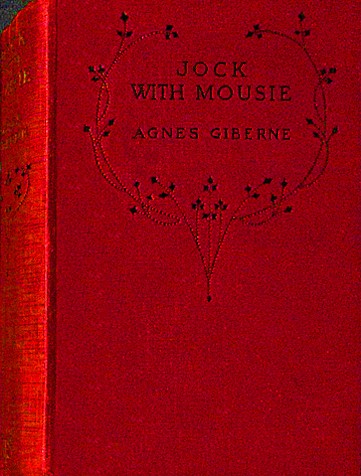
The Project Gutenberg eBook of Jock with Mousie
Title: Jock with Mousie
Author: Agnes Giberne
Illustrator: K. Kitson
Release date: September 5, 2025 [eBook #76826]
Language: English
Original publication: London: The Religious Tract Society, 1928
Transcriber's note: Unusual and inconsistent spelling is as printed.
BOTH WERE OVER THE WATER,
THE BOUGH SWAYING TO AND FRO
JOCK
WITH MOUSIE
BY
AGNES GIBERNE
WITH ILLUSTRATIONS IN COLOUR AND LINE
BY
K. KITSON
LONDON
THE RELIGIOUS TRACT SOCIETY
MANCHESTER, TORONTO, MADRID, LISBON
AND BUDAPEST
Made in Great Britain
Printed by Purnell and Sons
Paulton (Somerset) and London
CONTENTS
CHAPTER
ILLUSTRATIONS
Both were over the water, the bough
swaying to and fro .. .. coloured frontispiece
"What's your name?" demanded a shrill
little voice
She went rolling, rolling, falling, falling
down the whole descent
JOCK
WITH MOUSIE
I. IN THE FIRELIGHT
JOCK sat on a big square stool, nursing his right leg and earnestly staring into the dancing flames. Every moment they took fresh shapes, curtsying one to another, and winding about the lumps of coal. A green tip crept out from a cave of fiery red, and then a purple tongue shot itself forth. Jock wondered what made them do it.
Behind him lay a long narrow room, with pictures on the walls, dimly visible in the firelight. It was getting dusk, but blinds had not yet been drawn down. As the flames danced, they cast a long shadow of Jock on the floor, with its thick blue carpet, and Jock turned to watch it. He swayed from side to side to make the shadow sway.
How funny it was that some flames should be green and others red. And why did they keep always going up and up? And why should a lump of black coal catch fire and turn red and burn and burn away, only because it happened to be close to another lump already burning? These and other questions jumped into Jock's mind, and all but jumped out at his lips.
But he peered round again at his mother, lying on the sofa. She had lain there, with her eyes shut, ever since he came in. If only she would open her eyes, and would talk. He was bursting with new ideas, and during a whole quarter of an hour he had not spoken one single word. Such a time to wait!
Grown-up people were so funny—liking to sleep in the day-time. "He" never wanted to sleep, not even when bed-time came. His nights were too long and his days too short; for there was always such an immense amount of things to be done. He couldn't get through half of them.
At the end of the street, round a corner, was a school for small boys, where he went every day, partly for lessons, partly for games and walks with the other boys. So he had plenty of companionship and plenty of fun, and when he came home it was to the dearest of mothers. Jock was devoted to her.
Many months earlier she had been ill, and when her husband went to India with his regiment, she could not go with him. She had to stay in England with Jock, and he felt himself to be in charge of her. His father's last words had been—"Take care of your mother, old chap."
He really had tried hard, and through the weeks when she was ill, he had been wonderfully good and quiet for such a little fellow.
But she was well now, for she often said so, and he felt free to rush up and down stairs, and to leap about the room, and to shout and sing at the top of his voice. Except when, as just now, he found her lying down, and then often, though not always, he would think of his father's words, and would keep still.
This was Tuesday, and next day Jock would be eight years old. Last birthday his father was at home, and he well remembered all the fun and romping and laughter. Would it be quite the same this year? He thought not. He could hardly expect that Mummie would tear madly upstairs with him, three steps at a time, or would swing him down again like a sack of corn; or that she would gallop round and round the garden with Jock on her shoulders. No, that would not be possible.
He was a spare, slim boy, rather small in make, with curly chestnut hair and eager grey eyes. He glanced round again, and ventured—"Mummie—are you awake?"
She stood up in reply, and came to his side. Anybody might have guessed her to be his mother, for she, too, was slim in make, with curly chestnut hair and grey eyes.
"Did I wake you up, Mum? Oh, I'm glad you weren't asleep. I've got such heaps of things I want to say. Jane told me you wasn't to be disturbed—not on no account, she said. So I had my tea all alone, and then I painted and painted—ever so long, till I couldn't see. Mummie, shall we have lots of fun to-morrow?"
"Won't four boys to tea be enough?"
Jock nodded. "It'll be most awf'ly jolly. Only I do want to know what I'm going to have for my birthday presents. I mean—from you and Daddy. Couldn't you just tell me now?"
"I think not. Last year Dad said—No. And you will enjoy to-morrow the more for not knowing beforehand."
Jock was doubtful. "It's a whole night—a fearful long time to wait."
"You will be asleep most of the time."
"Shall I? Mummy—what is a salamander like?"
"A big lizard—black and yellow. Why?"
"Jane says salamanders can live in the fire. And I wonder if one of them could live in there—" he pointed to a little red cave amid glowing coals.
Mrs. Munro laughed. "I doubt if the salamander would enjoy it," she said.
II. BIRTHDAY PRESENTS
A VERY wide awake boy lay in bed, hoping each moment to hear the staircase clock strike six. He had been awake such an enormous time, and not once had the clock sounded, so he felt sure it must come directly.
Last year at six o'clock his father had come in from the next room, had picked up Jock bodily and had carried him off to his mother. And Jock had chattered happily till seven o'clock, when it had been decreed that the great business of presents might begin. But this year, being so much older, he was to jump up and go to her himself, only not until six. And Jock had promised.
So he waited and waited, and no sound came from beyond the closed door. Of course she was asleep.
He wondered and wondered what Mum's present would be. One thing he longed to possess, and that was—a real big man's pocket-book, like Dad's. But mother did not know this ardent desire of her little son. It meant so much and went so deep that he had not breathed it even to her. Perhaps he was afraid of being laughed at. Such a pocket-book could be of no possible use to a little fellow like him; none the less, he did want it, vehemently.
Then there was Dad, dear, kind, merry Dad, out in India. Most "certaintly" he would not have forgotten the birthday. And Grannie always sent something, and so did Aunt Judith—only from her it was commonly a book. And though Jock loved reading, there are books "and" books in the world. Aunt Judith's choice was not always the same that Jock's would have been.
"Dong—" came suddenly in a deep resounding tone. He lay still, and counted. "Dong—" that was two. "Dong—" that was three. "Dong—" four. "Dong—" five. One more—only one. It must "certaintly" be six.
But the one more "dong" failed to sound. He held his breath with listening, and soon he gave up hope. It was only five. Another whole long hour to wait. Jock kicked and squirmed and tossed to and fro in his disappointment, but nothing could alter the fact.
How to get through this terrifically long spell was the question. He had promised to stay in bed and to make no noise, but of course he couldn't lie there doing nothing.
First he tried counting. He counted up to a hundred, and then up to three hundred, and he was as wide awake as ever. Then he shut his eyes, and tried to see pictures and patterns, and still he was wide awake. Presently he started saying some of the multiplication-table backwards, which is no easy task, and even that failed to bring sleepiness.
Getting tired of figures he pranced about under the bed-clothes, and put his head where his feet were meant to be, while the said feet kicked about on the pillow.
This made a refreshing change, and he felt happy—till sudden fright seized him lest, under blankets and counterpane, he might fail to hear the clock. In a panic, he whirled himself right way round, and wondered if perhaps it had already struck. The time since five o'clock seemed enormously long; it almost "must" be past six now. This particular clock, unlike many big clocks, did not sound the quarters. Dire temptation arose to creep across the room, to open the door one tiny crack, and to whisper—"Mummie—are you awake?"
But what if it should be not quite six? And what of his promise?
He sighed like a grampus—if grampuses ever sigh—but he stayed in bed. And at last even that almost endless hour did come to an end. Again the deep-toned "Dong" sounded—six strokes. With one bound Jock was out of bed, racing across in the dark to the door, against which he banged.
"Gently, my boy—don't hurt yourself."
"Mummie—are you awake? May I come?" And in another instant he was cuddling down within her arms.
"God bless my own dear little son, and make him a good, true, brave man," she said softly. "Many, many happy returns, my darling."
"Mummie, it's been most awfully hard—waiting all that time. But I didn't disturb you, did I? Didn't you want my birthday to begin too?"
She held him fast and laughed a little. Had Jock been older, he might have heard in that soft laughter a note which told of tears not very far away.
"Must we wait till seven o'clock now?"
"Hadn't we better? You could see nothing yet. Daddy made us wait last year."
Jock agreed, and talked without a break till seven strokes boomed solemnly out. It was light enough now for him to see a small table close by, covered with packages.
"Are all those for 'me'? Oh, I say!"
Supremely happy, he drew the pile over on the bed, and set to work, not hurrying. With steady fingers he untied and opened one parcel after another, examining the contents of each with happy little murmurs, and sometimes a big "Oh!" of joy, glancing again and again at his mother for sympathy. She lay and watched him in silence.
Delight of delights—here was the very thing he most had wanted. A real big man's pocket-book, bound in Russia leather, with pockets and blank pages and pencil, all complete. How "did" Mummie guess? And what did it matter that he had not one single pocket into which it could go? He had his wish, and with a pocket-book of this size he felt himself already a man.
Then he found a grand box of soldiers, beautiful British-made soldiers in the uniform of the Guards. And a small railway-engine which, when wound up, would go by itself, drawing a string of little carriages. Both these were from his father.
A fine box of bricks had arrived from Grannie. Also, he found a puzzle from Jane, the housemaid, and a picture-book from the cook, and a knife from one of his school-fellows, and a bouncing india-rubber ball from another. And lastly, as expected, a book from Aunt Judith. Jock read the name aloud.
"'Fizzingcall Joggraphy.' What does 'Fizzingcall' mean?"
"'Physical Geography.' That means the part of geography which tells us about mountains and rivers and earthquakes. You will like to read about earthquakes."
"I don't like Joggraphy."
"Oh, I think you do—or you will some day. And it is so kind of Aunt Judith to send this. See—she has written inside the cover—'If Jock is not old enough yet to care for this interesting book, he will be glad to have it by-and-by.'"
Jock was quite content to wait for that doubtful future. He shoved the brown volume aside, and turned to the soldiers and the engine as much—oh, very much—more interesting. And he could hardly bear to have the big, lovely pocket-book for one moment out of his hands.
"You will have to write and thank Aunt Judith presently. She likes to hear quickly. No—I mustn't help you, darling. She always says she would rather have letters written entirely by yourself."
Jock looked serious, for spelling was not his strong point. Meanwhile his birthday had begun splendidly, and the rest of it, including a tea-party of school-fellows, proved a great success. Mrs. Munro seemed as full of fun as everybody.
And only one day later he did get his letter written to Aunt Judith:
"MY DEAR AUNT JUDITH,
"Thank you awfuly for the book. I think praps Id better read it when
Im older. I had lots of joly things, and we played games, and it was
awfuly joly. Please thank Grannie awfuly for the briks, and Im going to
write. I do like briks, and its awfuly joly having birthdays, and Mum
sends her love.
"Your afecshunit
"JOCK."
III. JOCK HAS TO BE A MAN
"JOCK, dear, I want you here."
Jock was hard at work, running his new engine and carriages round the room, one evening a week later. It was dusk, and lights had been lighted.
"'PARIS,'" shouted an eager voice. Then—"Yes, Mum. D'rectly minute. Mayn't I just go on to Edinburgh?"
"Yes, just that, and then come here."
Jock's notions of "Joggraphy" were vague. His engine contrived somehow to touch at Australia on the way to Edinburgh, and then to land its (imaginary) passengers in Ireland. Having accomplished this feat, he ran to his mother.
"Mum, I do love my new pocket-book. It's most awfully nice. How did you know I wanted it?"
"Mothers guess things sometimes. Jock dear, I have something to say, and I want you to be brave about it. Something that we can't quite like—and yet—it has to be." Jock waited expectantly. "I am thinking—" she stopped for a moment—"I am thinking of going out to Dad."
"Out to India!" Jock opened his eyes. "Why—Mum—but that'll be awfully jolly, won't it?"
She held his hand, speaking with a little shake in her voice. "You see, dear, I always meant to go as soon as I should be well enough. And I am well now."
"Dad 'll think me grown a lot. I s'pose he wants you there most tremenjously. Don't you want to go, Mummie?"
"Very, very much—to be with dear Dad. But—"
"Shall we start d'rectly? What a lot of things we'll have to pack."
"'I' must start in about two weeks. But—Jock, my darling—I can't take you with me."
Jock stared up in her face. That she should go and leave him behind had never entered his thoughts as the barest possibility. A year earlier, if she could have travelled, she would have left him, but since she could not, nothing was said about the matter. He had always had his mother; he could not imagine living without her. He had known vaguely that some day he would have to go to school, but that had lain too far ahead to be considered.
"You see, dear, you have to be in England. You must be brought up like other English boys. You must learn to think as Englishmen think—to be able to do your duty by-and-by to our Country and our King. You have to learn how to be fair to others—how to take a beating—how to serve and how to obey."
"Couldn't you and Dad teach me all that?"
"I'm afraid not. And the climate of India is bad for English boys; and the life would be bad too—in many ways. There would be no proper games for you—no boys to play with. So many things would be harmful—things you can't understand."
"And will you be gone only a very little while? Will you come back—very soon?" A choky feeling came into Jock's throat, but he held it down. Dad often said that British boys didn't cry.
"We shall both come back—as soon as possible."
"Will it be—six weeks?"
Her lips were trembling. Jock gave one glance up. Then he put his curly head down on her knees, and fought his battle out in silence. Her hand crept round him.
"Have I got to stop here—all alone?" he presently asked.
"No, this house will be let to strangers. And you will be with dear, kind Grannie. You know how fond she is of you."
"Will Aunt Judith be there?"
"Yes. She will take such care of my Jock."
"I don't want her. I want—want—you."
Another break, and Jock spoke again. "Will Aunt Judith teach me my lessons?"
"You will have lessons from a kind clever man who lives near Grannie—Mr. Moore, the curate. He has boys of his own, and you will learn with them for the present."
"A man!" This was promotion. Jock sat up, interested. Till now he had had only women-teachers.
"And you will have no end of games with the boys. Think what it will mean—being in the country, with fields and woods and flowers and birds. So different from a town like this. And you will write to me every week, and I shall write every week to you."
Jock spoke in smothered tones—"I wish—I wish—you hadn't got to go."
"But Dad has to be there. So many of our best and bravest men are wanted in India. Some day perhaps you will be there too; only you have first to learn lots of things—things that can only be taught properly in England. And—yes, in Scotland too. England and Scotland are one. And you have to be a man now, my darling—because it is right for me to go, and for you to stay behind."
Jock murmured—"I'll—try." Then he ran out of the room; and his mother knew him too well to follow.
IV. GOOD-BYE
THE fortnight slipped away like lightning; and the end came suddenly, taking Jock by surprise. He had been so busy, one way and another, that he had not known how near the parting lay. And just at last, things so happened that he would have to take his journey with strangers, to Lethmere West, where Grannie lived. Mrs. Munro had meant to take him there herself, before joining her ship, but she was not well enough for the extra fatigue. And Aunt Judith, who was to have come for Jock, could not leave home, Grannie being poorly.
Jock did not care about that. He was glad that Aunt Judith would not be in the house during the last day.
"Mind, Master Jock," Jane said more than once, as she packed his boxes, "you've got to be a good boy, and don't you go and get upset and worry your mother." Jock did his best, but the world felt very queer, and everything seemed upside down.
When the last evening came, Mrs. Munro was again resting on the sofa, and Jock had his station at her side. They did not talk about the morrow, but about everyday things, as if nothing were about to happen. Jock fell into his favourite occupation of watching the fire.
"I wonder what makes the flames go up and up," he said suddenly. "They do jump about so. It's funny."
"I'm not learned enough to explain puzzles of that sort. Some day you must ask Daddy."
"Daddy knows everything, doesn't he?"
"Why—no. Nobody knows everything. But he knows a great deal more than you and I do. I wish I could answer all your questions, but you haven't a clever mother."
Jock was indignant. "You 'are' clever. You're most awfully clever," he declared. "I know you are."
"Oh no, I'm not, darling. Not half so clever as Aunt Judith, for instance. I think I'm only clever at loving."
Jock fondled her hand. "I wish I could know everything. I wish I could find out lots of new things."
"Perhaps you may some day—if you work hard at lessons, and do your very best, and keep your eyes open, so as to notice things that go on. Think what a chance you will have in the country, where it will all be so fresh and new to you. You were such a little fellow last time we went. You can't remember much." For more than two years Mrs. Munro had been unable, from one cause and another, to visit her old home.
"Mummie—shall I like those people—to-morrow?"
"Mr. and Mrs. Royle? I hope you will. It is so kind of them to take charge of you for the journey."
Then both were silent, till it was time for Jock to go upstairs.
But when he was in bed, she knelt beside him, and he nestled into her arms. And presently, very softly, she spoke words which he would not forget—words about his great and loving Father in heaven, and about the mighty Son of that Father, Who long ago had come from heaven to earth to die on the Cross for men, Who would be with Jock always—always ready to hear, always ready to forgive, always ready to help. Would Jock remember, and pray every day, evening and morning, to that wonderful unseen Friend?
Jock gave a huge answering squeeze; and then they were both silent—till somehow, he dropped off sound asleep.
And in early morning came the waking, followed by a hasty breakfast. Mrs. Munro had wanted much to take Jock herself to his station, and to see him off, but her own train left at almost the same time from another station, and the two could not be fitted in. So he had to go in charge of Jane.
He kept saying to himself—"I mustn't cry. I mustn't cry." And he did not—even when the last good-byes had been said, and he and Jane were off in their taxi.
V. A STRANGE NEW WORLD
THAT drive was one long bewilderment to Jock. He saw the people and the houses, but noticed nothing. Jane was sorry for him, and said a comforting word, but he could only reply—"Don't."
At the station she gave him over to a tall, elderly gentleman, and a thin angular lady, and Jock just submitted to be given over. He heard them talking to Jane, and did not know what they said.
"Mummie wasn't gone," he kept repeating to himself. "She wasn't—wasn't—gone." He would go back presently, and would find her at home—just as usual.
"Come, my boy—get in," a kind voice said, and Jock got in.
It was a first-class compartment, already half-full of rugs, bags, shawls and papers. Jane stepped in also, and settled him in a farther corner, putting by his side a basket of sandwiches and fruit. She stole one good-bye kiss from the boy, and Jock didn't mind even that. He was still saying to himself—"Mummie isn't—isn't—gone."
But he knew that she was gone. For the train was moving, and they were off. Jane was out of sight.
Jock felt himself in a new world—new and lonely. He sat like a little image, gazing out on the rushing landscape, seeing and hearing nothing that went on. By-and-by it dawned upon him that the elderly gentleman, Mr. Royle, was seated in the corner just opposite himself, and that the lady at the opposite end of the carriage seemed to be scolding her maid. Jock vaguely wondered what it could all be about.
And—after what felt like a very long interval—he found himself looking up into the face of the elderly man opposite. He met a pair of eyes gazing quietly into his own, such very blue eyes, and such kind ones.
Mr. Royle leant forward. "Feel cold, my boy?"
Jock said "No—" without thinking. He was cold, very cold all over, and shivering, but he had not found it out.
"Feel queer?" Jock nodded this time. "Want something to eat?" Jock shook his head.
"Ah, well—never mind. You'll soon be hungry—a little chap like you! If you were seventy years old, now, that would make a difference."
Jock could not help smiling.
"Had to say a lot of good-byes this morning?"
One good-bye, not a lot. At least, the lot did not count. But Jock could not say this.
Mr. Royle stood up, letting his wraps slide down on the floor.
His wife called out—"What are you doing?"
But he paid no attention. He took hold of Jock, and made him lie flat on the cushioned seat, covering him with a thick travelling-rug and putting under his head a rolled-up shawl for a pillow.
"That's better," the kind voice said. "Now—mind—you are to go to sleep. Don't think and fret. Things won't be half so bad as they seem just now. It will all come right in the end."
He patted the boy's head and went back to his seat.
Jock gave one grateful look, and shut his eyes. The train made such a roaring that at first he could attend to nothing else. But soon he grew used to it, and began to lose himself in half-dreams. The night had been a short one, and he had eaten very little breakfast. Sounds grew distant, and soon he was off. For two full hours he never stirred. Then he woke up slowly, wondering at first where he could be, till recollection dawned, and he sat up.
"Better?" Mr. Royle asked.
"I'm quite well," Jock said.
"That's right. Now will you have some sandwiches?"
And Jock found that he actually could enjoy them. The queer sick feelings were gone, and, though the great sense of loss was with him still, he could meet it now with more courage.
VI. SOME PUZZLING THINGS
THE journey to Lethmere West was long and tiresome. After luncheon, they had to get out and to wait for an hour at a station for their next train. Mr. Royle gave Jock some picture-papers, and presently Mrs. Royle came up, and began asking him questions. How old was he? Had he been often to see his Grannie? Didn't he like country better than town?
"You're going to live there now," she said.
Jock shook his head.
"Of course I mean while your parents are in India. They won't come back in a hurry." Mrs. Royle did not mean to be unkind. She just said what happened to slip into her head.
"Mother said she'd come back as soon as ever she could."
"Oh, that means nothing. It's what they always say. You can make up your mind to three or four years."
Jock fired up. "She won't. She won't. I know she won't. She—promised."
"Why, you're a regular little spitfire." The lady seemed amused.
"Come here, my boy," a quiet voice said from the other side of the waiting-room.
Jock obeyed, swelling and wrathful still, and Mr. Royle's hand came on his shoulder.
"Don't you mind what other people say. Remember—you can trust your mother. If she said she would come home as soon as she could, she will do it."
"But—but—but—" Jock could hardly get out the words, and he looked across at Mrs. Royle. "'She' says—"
"Never mind. Other people don't understand. You know what your mother said, and nothing else matters."
Jock leant against the shoulder of Mr. Royle's fur-lined coat, and felt a little comforted.
"And I'm going to tell you something else, my boy. Try to recollect it. The first few days will perhaps seem endless to you—each day like a whole week. But that won't last. After the first week, the days will move faster; and after the first month, they will begin to run; and after the first three months, they will gallop. See?"
"Will they?" It seemed to Jock like years already since the early morning.
"Take my word for it—they will. You will make no end of new friends; and you will have no end of fun."
"I'm going to have lessons at Mr. Moore's."
"Ah, yes—and you'll find boys there. A girl too—queer little fish!" This was murmured, and perhaps was not meant for Jock's ears. "You're not a mischievous boy, are you?—particularly."
Jock laughed. He wanted very much to ask why the girl should be called "a queer little fish," but he did not venture.
"Don't let her lead you into mischief, that's all. Keep a sane head of your own. You seem to me to be a sensible lad. Got any sisters?"
"No; it's only me."
"Ah—well—it's a mercy if they haven't managed to spoil you."
Mr. Royle went back to his paper, and Jock found himself with plenty to think about.
Slowly as time passed, the second train at length was due, and once more they were off. It had grown extremely cold, and, though very still, the air was piercing. Overhead in a clear sky some small crimson clouds lay near the horizon, and the telegraph posts went by much more deliberately than with the earlier train.
Three or four more stations, at each of which they stopped, and then "Lethmere East" appeared in big letters. This was the nearest station to Lethmere West, two miles distant. And when they drew up, there was Aunt Judith—trim and smart in figure, not tall but very upright, with dark hair and bright dark eyes, and a very wide awake manner.
"So—here you all are," she said briskly. "How kind of you both to undertake such a troublesome charge. I hope Jock has behaved properly. Oh, thanks, my mother is better. Well, Jock—how are you?"
She gave him a kiss, a rapid, bird-like peck on his cheek. Jock remembered those kisses of hers, and he wanted to rub it off, but didn't.
"Quite well?" she asked, but she did not wait for an answer. "We must be off—it is getting cold. A real, sharp frost."
"Too horribly cold," complained Mrs. Royle. "And such delays. I thought we should never arrive."
Outside the station they found the Royles' large motor-car waiting, and near it Aunt Judith's pony-carriage. Part of Jock's belongings were taken, and the rest would have to follow next day. Judith told him to jump in, and followed, taking the reins. Mr. Royle came close to shake hands with Jock.
"Good-bye," he said heartily. "Mind you come and see me some day soon, my boy. I shall look out for you. Come and tell me how you are getting on."
Aunt Judith opened her eyes rather widely. The car spun away at a fine pace, and the brown pony trotted calmly after. "Now, what made Mr. Royle say that?" questioned Aunt Judith. "I hope you didn't ask to go, Jock?"
"No, I didn't. 'Course I didn't, Aunt Judith. He was—awfully kind."
"I'm glad you didn't. Yes, he is a very kind man. And you've got through your journey all right. Are you warm?"
She pulled the rug up higher, and tucked it round him, and they went on at a steady jog-trot, from which not all Aunt Judith's efforts could rouse the pony. Evidently he was used to having his own way. She talked a great deal to him, and flicked her whip perpetually, and he shook his ears as if in response, but he chose his own pace.
When they drew near to Lethmere West it was nearly dark, and only dim glimpses of hedges and fields could be had, and then of a good-sized garden, and, lastly, of an open front door, lighted from within. Jock remembered the butler who stood there, a stout, middle-aged man. Aunt Judith bustled him in, and told him to stay by the fire in the morning-room, while she ran up to see her mother.
Then she came down to say that Mrs. Baynes was sound asleep, and that Jock should have his supper at once and go to bed. While he ate, she kept flitting in and out, talking most of the time. Then she called Emma, the housemaid, a rosy, good-tempered-looking girl, and told her to take Jock to his room, and to look after him. It was a pretty room on the first floor, with pink curtains and a pink coverlet, and Jock's things for the night were already unpacked.
"I can do everything for myself please," he said, when the maid lingered. "I'd rather, please."
"Well, don't be long, and I'll come back presently, and put out your light. You're tired, ain't you? Get to bed, quick—there's a good boy."
Jock was very tired, and very soon he was ready for bed—all except his prayers, which he put off till the last. Always, until to-day, his mother had come to him, for she had never left off that habit of infant days. Now for the first time, as he knelt by the little bed, he knew what it was to be "alone." He tried to keep back the tears which kept coming, and he tried to say his prayers as usual, but it was very hard. After two or three minutes, he crept into bed and hid his face under the clothes, and when Emma came back, she supposed him to be asleep. So she turned down the light and went away.
And desolation crept over Jock. It was like a big black cloud covering him. He was utterly alone. His mother was far away—out of reach.
But, mercifully, he was too tired to keep awake. And don't you think that, as he lay, one of God's dear angels stooped softly down to whisper comfort to the lonely child? Somehow a recollection came of his mother's words that last evening—only yesterday, but it seemed so long ago—and of the kind Heavenly Friend Who would always, always, be at his side. And with that thought, Jock dropped asleep, his cheeks still wet. Soon he was smiling.
For a lovely dream had come. He was back at home with Mummie, and her arms were round him, and she was saying with a gentle smile—"It wasn't so bad after all—was it, darling?"
VII. A WHITE FAIRYLAND
NO matter how dismal things may look overnight, long hours of sleep do make a difference, especially if one is only eight years old. Jock never once opened his eyes till broad daylight, and then he started suddenly wide awake. He sat up and took a good look round.
It was a very pretty little room. Somebody had been at pains to make it nice. In one corner stood a small table, with a little writing-desk on it, and a bookcase above, half-full of books, but with space for more books of his own. He gazed with eager eyes, taking in one thing after another.
Then he saw that the window-panes were covered with frost-pictures. There were trees in rows, and trees singly, and houses, and even people—all sketched by the busy fingers of Jack Frost. He had seen something of the kind before, but nothing equal to this. Jumping out of bed, he ran to the window.
And such a scene burst on him!
Below lay a small lawn covered by a thin white carpet, and in the centre of the lawn was a big tree, it, too, being dressed in white. From its topmost to its undermost twigs it was clothed in pure white. Jock supposed that a fall of snow had come in the night. But this was not snow, it was hoarfrost—such a thick hoarfrost that it lay along the bigger boughs three-quarters of an inch deep. And beyond the lawn were clumps of evergreen bushes, and each leaf of those bushes carried its own white trimming.
It was a fairyland scene, and Jock could not turn his eyes away. He had seen snow at home, pretty enough at first, when great flakes came floating down, even though they fell through a murky atmosphere. But he knew how black and grimy they soon became. Anything like this vision of purity he had never known.
When his toes complained of the cold floor, his first thought was that he could not possibly go back to bed. He must dress at once, and run out to see things for himself.
A brass clock on the mantelpiece spoke, and it said in very hurried tones—EIGHT. Jock was rather astonished, for at home he had always got up at seven. He did not know that Aunt Judith had ordered that he should not be aroused, but should sleep on. She might be a trifle short in manner and speech, but she had noted the boy's white face, and when Emma came to say how soundly he was sleeping, she said—"Let him rest till half-past eight. Have him ready by nine, and he shall breakfast with me."
A bath had been put ready, with plenty of cold water, to which he was used. He went in for a good splashing, and dressed with all possible speed, for he was eager to get out of doors. At home he had always been free to race in and out of the back-garden whenever he pleased, and it never entered his mind that perhaps here he ought to ask leave.
He met no one on the stairs or in the hall, and the front door stood invitingly open. Before him lay the front drive, with three or four elm-trees in the centre, and away to the right was a larger lawn. He walked down the drive, following its bend, and then turned sharply off to the right, racing across the big lawn towards a small pond which drew his attention.
All round the pond were heaped-up rocks, where, in summer, flowers grew abundantly. No flowers were to be seen now, but only leaves dressed in white, and the water at its edges was frozen hard. Jock stooped to examine it, and with his fingers broke off a piece of ice, nearly overbalancing himself as he did so, which might have meant a second cold bath.
He was so excited that he danced about on the slippery grass, quite forgetful of the fact that he had had no breakfast. It did not occur to him that people might be puzzled, if no one knew where he was gone. So he wandered round the pond, and on towards a wide grassy ditch, called a "haw-haw," dividing the garden from a field. The sun shone brightly, and millions of tiny ice-needles on grass and on leaves flashed forth gleams of light in response to the sun's kisses.
"Oh-h!" Jock said to himself in a wordless rapture. He stood still, and again murmured—"Oh—h!"
"What's your name?" demanded a shrill little voice.
Jock found himself facing a girl just beyond the haw-haw, standing on the slope of the field. He stared instead of answering. She was very slight, with long thin legs like sticks, and an extremely short frock, and tiny hands, ungloved. A cloth cap was stuck jauntily on one side of her head, while below it hung wisps of black hair. The face was small, with a pointed chin, and the black eyes roved everywhere, but came constantly back to Jock.