
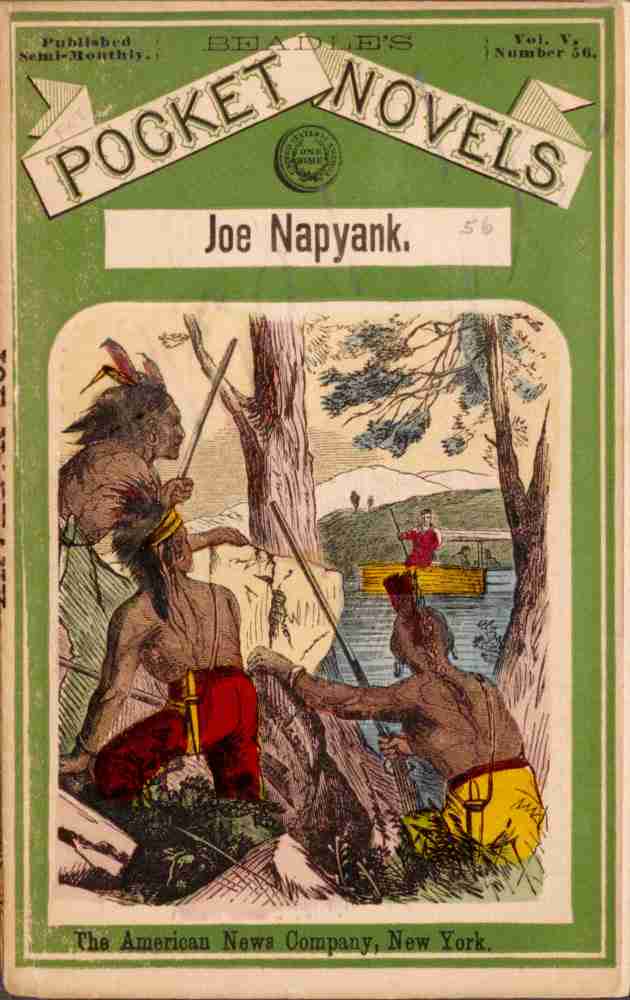
Joe had secured his knife before throwing the savage into the ravine, and with this single weapon he confronted his two foes. They were both about the same distance from him and he was in doubt whether to expect their united visit at the same moment, or whether they were going to attack him singly. The latter proved to be the case.
One of the Indians seemed to be a sort of chief, or, at least, superior in authority, to the other; for waving his hand for him to keep his distance, he advanced upon the white man, with the manifest resolve of disposing of him without aid from any one else.
The savage was a much more formidable foe than the other, and Joe Napyank, being greatly exhausted from his recent terrible struggle, he was in a poor condition to receive him. Nevertheless there was no avoidance, and he showed an undaunted front. The Shawanoe halted a moment, as if to decide upon the best methods of attack, and then with the same yell, as his predecessor gave, he sprang forward.
He had passed over half the intervening space, when he gave utterance to another outcry, not of exultation, but of agony, and throwing up his arms, fell dead!
The hunter had caught the report of a rifle, and saw a red spot appear on the forehead of the Indian, so that he understood instantly that he had been shot. The remaining aborigine, having seen all, displayed his common sense by turning on his heel, and fleeing at the top of his speed.
But whence had come this shot so opportunely? What friend had he in the Dark and Bloody Ground? How came he to be here at the critical moment?
Joe looked inquiringly around, and for the space of a few moments, his question remained unanswered. But while still wondering, who should step forth to view but Stoddard Smith?
“Just in time, it seems!” he exclaimed cheerily as he came forward and grasped his hand.
“I never was so glad to see a man in my life. How came you to be here at this time?”
“Looking for you, and what made you leave me?”
A few words explained all.
“It was Providence that brought me here,” added Young Smith. “I think he is smiling on our efforts to obtain Ruth.”
“She isn’t far away. We’ll travel together after this.”
“Hope so. You at least have found it rather dangerous to be alone. But are there no other Indians in the neighborhood?”
“Yes; and it’s time we left these parts. I’ve an idea, as I said, that Ruth and Teddy ain’t far away; so let’s tramp.”
And once more, our two friends set about accomplishing the direct object of their expedition.
CHAPTER XI.
TEDDY O’DONNELL AND RUTH McGOWAN—IRISH SHREWDNESS—A PUGILISTIC TRIUMPH—THE INDIAN FIGHT—LIBERATION.
It was one of those singularly fortunate occurrences that rarely happen more than once in a lifetime, that made Teddy the Irishman a prisoner in the hands of a body of Indians, possessing some claims—although it must be confessed rather slight—to chivalry. The identical chief of the party had once been made a prisoner by Teddy and a celebrated scout, and on that occasion was treated as a lawful prisoner of war, and formally released.
The leader being a genuine Indian never forgot the kindness. He was not one of the original party that captured the Irishman upon the flat-boat, but when he was brought ashore he recognized him at once. Teddy with all his shrewdness, contended that every Indian looked precisely as did all other Indians, and he therefore failed to suspect his identity.
The party, as has been already hinted, divided about a dozen, among whom was the chief just referred to, taking charge of the two captives and starting on a direct line for the Indian towns in the valley of the Piqua.
To the surprise of both they were allowed to walk side by side and no restraint was placed upon their conversation. No burdens or indignities were imposed upon each, and the chief seemed to graduate the progress of the party to the disposition and strength of the girl.
“Why do they not kill us!” asked Ruth, after Teddy had related the particulars of his capture, and the situation in which he had left his friends upon the island.
“Injins doesn’t always do things in that shtyle. It’s meself that has been a presn’r among ’em afore this, and they didn’t kill me but once. That time I broke me neck, but it was speedily set and mended agin.”
“Will they not slay me?”
“I hardly think so. How would ye like one of these copperskins for a husband?”
The look of detestation and horror which answered this, made the Irishman regret his attempt at a joke.
“Please don’t worry about this matter. It’s the habit of these same gintlemen to ax for a wife afore they take her. But the way that chief views yourself and me, he has taken a strong notion to one of us. P’rhaps he has a bootiful daughter and mither at hum, and he is admirin’ me as a future husband for one of ’em.”
The genial, good-natured air of the Irishman had its effect upon Ruth, who for the time may be said to have forgotten her captivity.
“Why, Teddy, would you like one of those dusky beauties for a life partner?”
“I couldn’t tell very well till I tried, as the man said when he was recommended to die by drowning; but one of ’em might do till I got tired of——. Begorrah! but Miss Ruth, does ye obsarve how that chap keeps his eye upon me? If I’m not as greatly mistook than I ever was in my life, I’ve met him afore.”
Teddy tried to recall the features. The more he looked at him the more certain was he that the two had encountered previously. But he was unable to place him in his memory; and the Indian, observing that he was subject to remark and scrutiny, turned his face away, and henceforth remained out of view as much as possible.
“Oh!” said Ruth, relapsing into her former despondency, “Are we ever to see our friends again?”
“Of course we are although we may be subjected to slight delay in the same. I expect to meet them considerable soon.”
“But how—how shall we do it?”
“Can’t exactly tell yet, but we’ll all larn in due season. They’d get tired of keeping us perhaps after awhile and give us lave to walk away.”
“Do they ever do such things?”
“I can’t say they do,” laughed Teddy, who hardly expected the earnestness manifested in the question. “But as my ould friend Patrick Henry observes, there is no way of judging by the future but by the past, and looking to the past, I axes what has been the conduct of the haythen Injins for the last ten years to give me hope of keeping me for any considerable time in their clutches. I’ve been there before and never staid.”
“But, how has it been with me?”
“Yes, being with me makes the same rule apply to yer own government, so be aisy and don’t worry and fret yourself which there is no good to come from it.”
But Ruth McGowan found it hard work to extract relief from the ingenious sophistries of her companion. Look at it as she might, everything was gloomy and cheerless. Her cherished friends left behind her, instead of being able to come to her rescue, most probably were unable to provide for their own safety. It was therefore vain to look for assistance from that direction.
Perhaps her father and mother were prisoners at that moment—perhaps murdered. And her lover Stoddard Smith—where was he? Free, a captive, or dead? If either of the former, were not his thoughts turned to her, and was he wondering at her situation? Should they ever meet again on earth—or were they now separated forever in this world!
The thought was saddening, and the distressed girl covered her face and wept. Teddy observing her sorrow remained silent awhile, but he was too cheerful himself to allow any unnecessary grief around him.
“If it was meself I wouldn’t shed a tear to plase ’em,” he said. “Some of the haythen are just cruel enough to be pleased to see it, although it doesn’t sthrike me that the chief is one of the number. He seems to be more tender-hearted than the others.”
“But how can I help it when I think of my friends?”
“I s’pose it ain’t aisy, but then don’t think of ’em. Just think of the situation we bees in this minute, and then larf.”
“Ah! it’s hard work to see anything to laugh at—oh!”
At this juncture, Teddy caught his toe in a root and stumbled to the ground. His fall was so ridiculously grotesque, that several of the stoical bronzed faces were relaxed, and Ruth could not forbear a smile herself. Not one of them suspected it was a piece of strategy, got up for the especial benefit of the female captive herself. Teddy took his discomfiture good-humoredly.
“You are not injured, I hope,” said Ruth; “you must pardon me, but I could not keep from laughing, you seemed so much taken by surprise.”
“I’d much rather see you laugh than cry; it’s more pleasant to all concerned. But did you see the unmannerly dogs grin at me? That chap seemed to enjoy it as much as yourself.”
Teddy was going sideways, looking toward the savages as he spoke, when he again stumbled so awkwardly as to bring a grin into the face of every savage in the company.
“What yes laughing at?” he demanded in either pretended or real fury. “Have ye no more manners than to laugh at a fellow that stubs his toe? Yer no christians but haythens, all of yes.”
“Poor man!” said one of them in much sympathy, “much hurt pale face—sorry—much hurt?”
“Don’t get too far wid your tongue or, or ye’ll run agin the fist of Mr. Teddy O’Donnell, who understands the noble art.”
“Poor man—much hurt—sorry——”
A terrific whack took the tantalizing Indian directly in the mouth and he toppled over backward like a ten pin. As he went to the ground, the spectators all manifested their enjoyment of the scene. The Indian was stunned and bewildered for a moment, and then, as he rose up with his mouth bleeding, his flashing eyes and wrathful demeanor showed that he was fully bent on avenging the mortal insult. Drawing his knife, he was about to spring upon him, when the chief advanced and disarmed him of his knife and tomahawk, seeing which Teddy voluntarily resigned his, and the two confronted each other with the arms only that nature had given them.
It is possible that in that moment, that the dusky pugilist was sensible that he stood at a disadvantage but there was no retreat for him, and he therefore advanced to the attack.
Teddy “squared” in the most approved style, and danced around on his feet as if anxious for the contest to begin. Pausing a moment, the Indian made an awkward plunging blow, and received another shock in the mouth that laid him as flat as before.
Nothing daunted, he sprang to his feet and made at his antagonist more resolutely than ever. Teddy now toyed awhile in order to give the savage more confidence, and then getting him fairly at his mercy, he dealt him a more tremendous blow than before—one that completely “knocked him out of time,” and ended the contest triumphantly in favor of the Irishman.
Upon rising to his feet, the Indian slunk among his comrades, who did not hesitate to jeer at him unmercifully, and to admire the conqueror in a proportionate degree.
This incident would be scarcely worthy of narration, were it not that it had an important bearing on the fate of the two captives themselves. Brave men always admire skill and bravery. This is especially true of an uncivilized people, who sometimes look upon a hero with a feeling of the strongest admiration.
It cannot be pretended that Teddy O’Donnell excited any such emotion as this, but he did produce a sentiment, that under Heaven, eventually proved the salvation of himself and Ruth McGowan. The leader, who entertained none but the kindest feelings toward him, was still doubtful whether it would do to allow him to go free, even with the explanation he might make to his brother followers. But now when he had witnessed his vanquishing of one of his best warriors he felt no hesitation in claiming the greatest favor for him.
In fact he was fully resolved that the man should be liberated but that the girl should be retained!
The chief now advanced straight to the Irishman and addressed him.
“Glad see you—me Wahlangson.”
“Mighty glad to see you,” responded Teddy, grasping his hand, and identifying him the moment he heard his name pronounced.
“Brave man,” added the chief admiringly. “Like much.”
Teddy understood Indian ways well enough to understand what all this was tending to. He felt that his case was safe and he did not hesitate to manifest a little of his joviality.
“Would yes like a thrial? If ye does, jist say the word, and I’ll do my best to accommodate yes.”
The Indian did not understand the precise meaning of this, at any rate he concluded to take no offence at it.
“Fight for Wahlangson?”
“That depends on circumstances, as the cobbler—”
An exclamation from one of the warriors arrested their attention. The chief turned his head, and his immobile countenance for once betrayed signs of emotion. The whole party manifested excitement, and it was not long before Teddy understood that a hostile party of Indians had appeared, and a conflict was inevitable.
“Big fight—big fight!” said the chief. “Kill big fight—white man fight for Wahlangson?”
“Aye! that he will,” replied the chivalrous Irishman, going into the trouble for the reason that he loved it, and because he believed it was policy to do so.
“Take her away,” said he, pointing to Ruth.
“Yes—you take.”
Teddy grasped her hand and led her some distance in the wood.
“Now do you stay there till the fight is done wid. It won’t be long, and I’ll soon be wid yes.”
“God protect you.”
Teddy hurried back, arriving just as the conflict began. Instead of fighting behind trees, as is the general custom of Indians, they “charged” on and the fight became hand-to-hand. This was just the thing for Teddy, who laid about him in the same ecstatic manner that he did before being captured on the flat-boat. While thus engaged he saw his old friend Wahlangson upon the ground, and hard pressed by two huge redskins. Springing forward he sent one turning flip flap, which so relieved the chief that he regained the advantage he had lost, and soon stood on the same footing with his warriors.
The contest was short, sharp and decisive. Ten minutes after it was made the attacking party fled in confusion, leaving two dead and several badly wounded.
If Wahlangson had experienced a deep admiration for the reckless Irishman, he was now literally overflowing with it. Going up to him, he took his hand, and undoubtedly, with great agitation, said,
“Much like—heap like—big like—heap like—B-I-G like!”
“Begorrah the same to yes. I intertain the most unbounded riverence to yer honor, as the boy said to the snapping turtle.”
“Want go home?”
“Well, yes, yer honor, I should rather like to do the same, bein’ as the ould woman will be out of praties, if I don’t help dig her some.”
“Go—go—Wahlangson willing.”
“Ye bees now—ye ain’t lying I hopes.”
“Go—no me follow—trail no touch—Wahlangson say so—no Shawanoe follow.”
“I axes only that condition—that none of yees attempt to foller me. Does ye agree to that?”
After considerable explanation, and by the help of pantomime, Teddy made the chief understand his wishes. The latter gave his promise, and gaily kissing him good-bye went off whistling St. Patrick’s Day in the morning.
Some considerable distance away he came up with Ruth, and gallantly offered her his arm. It need not be said she gladly took it, and the two speedily left the ground.
When the chief discovered that Teddy had taken away his cherished captive, he was somewhat chagrined, as this was more than he counted upon. But he did not follow. He was too much of a true Indian to molest one who had served him so well.
CHAPTER XII.
THE END.
Napyank the hunter and Stoddard Smith stood consulting together.
“We must now hunt the trail,” said the former; “and to do that we’ve got to go some way back into the wood.”
The two set out, and the greater part of the day was consumed in traveling. Toward the middle of the afternoon they struck a trail, which, after following for a mile or so, they became convinced was in seeking, as there did not appear the least evidence of either Teddy or Ruth forming one of the company. Finally when darkness closed around them, they were still at a loss, and decided to encamp until morning.
“Here seems to be as good a spot as any,” said the hunter, halting by the side of a small brook.
“Sh! there is some one ahead of us,” returned young Smith, pointing up stream, where a trembling light could be discerned through the trees.
“Let us see who they might be.”
The two stole cautiously forward. When a few yards away, they gained a glimpse of the party and heard some speaking.
“As I was about to observe when yees interrupted me, we’re now at no great distance from the river, and we’ll reach there in due time, that is if we travel. I s’pose you’ve no ’bjection to seeing your parents jist now.”
“Indeed I can hardly content myself Teddy in remaining here until morning.”
“Yees wouldn’t be particularly angry if yees should meet that young man they calls Smith, I suppose?”
“Certainly not.”
“Arrah! Miss Ruth: there is a great wild beast behind yees.”
Ruth sprang to her feet, and glanced back, and instead of encountering the angry front of some wild animal, she saw—Stoddard Smith and Joe Napyank before her.
* * * * * * *
The next day as McGowan was beginning to grow desponding and hopeless, and had made up his mind to cast the raft loose at nightfall, and risk the attempt to reach the settlement, Joe Napyank and his three companions made their appearance. The wonderful skill of the matchless hunter had led them directly to the spot.
The sacred joy of father and mother, and the restoration of their daughter, of whose deliverance at one time there could scarcely seem the least grounds of hope—was too sacred—too holy for pen like ours to attempt to depict.
The raft was strengthened by the addition of much more material, so that it easily buoyed the entire company; and when it was fairly dark, it came forth from its concealment, and the fugitives committed themselves once more to the treacherous Ohio.
There were yet dangers and perils to be encountered, and it was not until the afternoon of the ensuing day, when the unsightly cabins of the settlement appeared, that the little party breathed freely, and felt that they were at last—safe.
The surviving Smiths became identified with this portion of the West, and there are found there their descendants at this day. Joe Napyank fell during Wayne’s celebrated campaign against the western Indians. Teddy O’Donnell lived a bachelor, and, as a matter of course, died at a ripe old age. The grandchildren of Stoddard Smith were those who stood by his bedside during his last moments.
THE END.
Frank Starr’s American Novels.
MAMMOTH OCTAVO, ILLUMINATED COVERS, 10 CTS. EACH!
Frank Starr’s American Novels are so alive with spirit, interest, and the power that springs from unconscious strength in authorship, that they have become so popular as to lead in their sales all others in the market—a success which will be greatly heightened by future issues, which will embrace novels of incomparable merit.
- 138—Kid Kerley, the Trapper; or, Nattie of the Woods. By Dr. J. H. Robinson.
- 139—The Fighting Trapper; or, Kit Carson to the Rescue.
- 140—Thayendanegea, the Terrible; or, The War Eagle the Mohawks. By Ned Buntline.
- 141—The Black Horse of the Prairies; or, Days of Peril. By James L. Bowen.
- 142—The Texan Spy; or, The Prairie Guide. By Newton M. Curtis.
- 143—The Gulf Pirate; or, The Freebooters of the Mississippi. By Lieut.-Col. Hazeltine.
- 144—One-Eyed Sim; or, The Forest Home. By James L. Bowen.
- 145—Old Rube, the Hunter; or, The Crow Captive. By Capt. Hamilton Holmes.
- 146—Doblado, the Outlaw; or, The Oronoco Chief. By J. Thomas Warren.
- 147—The Red Warrior; or, Stella Delorme’s Comanche Lover. By Ned Buntline.
- 148—The Son of the Sea; or, The Cutter’s Cruise. By Roger Starbuck.
- 149—The Texan Herdsman; or, The Hermit of the Colorado Hills. By W. H. Bushnell.
- 150—Stung Serpent, the Last Chief of the Natchez. By Captain Hamilton Holmes.
- 151—Scouting Dave; or, The Winnebago Renegade. By James L. Bowen.
- 152—The Arkansas Regulators; or, How Ned Studley Won His Wife. By Edward Willett.
- 153—The Slaver Captain; or, Scuttled at Sea. By Roger Starbuck.
- 154—The Secret Shot; or, The Rivals of Misty Mount. By Herrick Johnstone.
- 155—Mike, the Guide; or, Lost upon the Plains. By James L. Bowen.
- 156—Waving Plume; or, The Free Trappers’ Pass. By William R. Eyster, M. A.
- 157—Border Ben; or, The Fatal Treasure. By James L. Bowen.
- 158—The Black Hunter; or, The Cave Secret. By Burton Saxe.
- 159—The Young Ranger; or, The Frontier Scouts. By James L. Bowen.
- 160—Tom Wiley, the North-west Scout. By I. M. Nichols.
- 161—Loyal Heart, the Pale-face Hunter; or, The Trappers of Arkansas. By Gustave Aimard.
- 162—Old Nick Whiffles; or, The Trapper of the North-west. By Dr. J. H. Robinson.
- 163—The Gold Guide; or, Steel Arm, the Regulator. By Francis Johnson.
- 164—The Death Track; or, The Outlaws of the Mountain. By the author of “The Gold Guide.”
- 165—The White Wizard; or, The Great Prophet of the Seminoles. By Ned Buntline.
- 166—Hirl, the Hunchback; or, The Swordmaker of the Santee. By Dr. J. H. Robinson.
- 167—Tiger-Slayer; or, Eagle Head to the Rescue. By Gustave Aimard.
- 168—Alapaha, the Squaw; or, The Renegades of the Border. By Francis Johnson.
- 169—The Border Bandits; or, The Horse Thief’s Trail. By Francis Johnson.
- 170—Assowaum, the Avenger; or, The Doom of the Destroyers. By Francis Johnson.
- 171—Saul Sabberday, the Idiot Spy; or, Luliona, the Seminole. By Ned Buntline.
- 172—Prairie-Flower; or, The Baffled Chief. By Gustave Aimard.
- 173—Mountain Max; or, Nick Whiffles on the Border. By Dr. J. H. Robinson.
- 174—The Silent Rifleman. A Tale of the Texan Trail. By Henry W. Herbert.
- 175—Long-armed Sampson; or, The Scout of the Silver Pond. By Newton M. Curtis.
- 176—Red Ralph, the Ranger; or, The Brother’s Revenge. By Ned Buntline.
- 177—The Giant Trailer; or, The Lost Scalp. By Francis Johnson.
- 178—The Doomed Guide; or, The Hunter’s Trail. By Francis Johnson.
- 179—The Ranger’s Rifle; or, The Wolf of the War-path. By Francis Johnson.
- 180—War-Ax; or, The Trapper’s Revenge. By Francis Johnson.
- 181—Redpath, the Avenger; or, The Fair Huntress of the Trapping-grounds. By Dr. J. H. Robinson.
- 182—The Blue Brotherhood; or, The Young Patroon’s Inheritance. By Newton M. Curtis.
- 183—The Smuggler; or, The Skipper’s Crime. By Ned Buntline.
- 184—The Trail-Hunter; or, Red Cedar, the Prairie Outlaw. By Gustave Aimard.
- 185—The Pirates of the Prairies; or, The Bandit at Bay. By Gustave Aimard.
- 186—The Trapper’s Daughter; or, The Outlaw’s Fate. By Gustave Aimard.
- 187—Old Tiger, the Patriot; or, The Heroine of the Mohawk. By Newton M. Curtis.
- 188—The Sea Bandit; or, The Queen of the Isle. By Ned Buntline.
- 189—The Bush Ranger; or, The Half-breed Brigade. By Francis Johnson.
- 190—The Outlaw-Hunter; or, Red John, the Bush Ranger. By Francis Johnson.
- 191—Golden Feather, the Buccaneer’s Daughter. By Arthur M. Granger.
- 192—California Joe; or, The Angel of the Wilderness. By Lieut.-Col. Hazeltine.
- 193—Bob Brant, Patriot Spy. By Edward Willett.
- 194—The Border Spy. By Lieut.-Col. Hazeltine.
- 195—Old Hal Williams; or, The Spy of Atlanta. By J. Thomas Warren.
- 196—The Bushwhacker’s Daughter. By Edward Willett.
- 197—Sergeant Slasher. By Herrick Johnstone.
- 198—Old Guess Markham. By J. Thomas Warren.
- 199—Crazy Dan. By Edward Willett.
- 200—Old Ben Manx. By J. Thomas Warren.
- 201—Old Bill Woodworth. By Edward Willett.
Frank Starr’s American Novels are always kept in print, and all back numbers can usually be supplied by news agents; but where any given number cannot be found on the news stands, it will be sent to any address by mail, prepaid, on receipt of price—TEN CENTS, six months (13 Nos.) $1.25; one year, (26 Nos.) $2.50. Address FRANK STARR & CO., Publishers, 41 Platt Street, New York.
THE STAR WEEKLY!
The Saturday Journal!
THE BEST SERIALS, BEST STORIES, BEST MATTER,
By the Best Living American Writers!
Leads all the Popular Weeklies in the maintained interest and entertaining character of each issue; in the wide-awake and fresh spirit that pervades all its departments; in the captivating variety of its contributions; in the decided influence which it exerts on every reader, old or young—characteristics which have won for it the enviable title of
THE FAVORITE HOME AND FIRESIDE WEEKLY!
presenting more elements of interest, entertainment and useful knowledge than any other weekly in America can boast of: and its unparalleled success and widespread popularity are solely due to its merits as a family journal, as a reader’s companion, as a personal friend. It embraces:
Brilliant Serials by Brilliant Writers,
Splendid Stories by Enchanting Story-tellers,
Sparkling Essays by Incomparable Essayists,
Irresistible Humor by Noted Humorists,
Notes of Travel, Adventure and Experience,
Unique Answers to Correspondents,
Sunshine Papers, Topics of the Time,
Poetry, Items of Current Interest, etc., etc.
Each issue is, literally, a happy thought, a welcome guest, an Argosy of Literary Novelties, which, once introduced to a reader’s notice, becomes an accepted favorite.
The New York Saturday Journal is beautifully printed from clear, open, easily-read type, on fine white paper, and gives, with each leading serial, a beautiful illustration—features which have gained for it the title of Fairest of all the weeklies.
It is furnished at the following rates, viz.: $3.00 per year; $1.50 for six months; $1 for four months; two copies for one year, or one copy for two years, $5.
Specimen copy forwarded on application.
BEADLE AND ADAMS, Publishers,
98 William Street, New York.
THE ILLUMINATED DIME
POCKET NOVELS!
PUBLISHED SEMI-MONTHLY.
Comprising the best works only of the most popular living writers in the field of American Romance. Each issue a complete novel, with illuminated cover, rivaling in effect the popular chromo, yet sold at the standard price, TEN CENTS.
NOW READY, AND IN PRESS.
- No. 1—Hawkeye Harry, the Young Trapper Ranger. By Oll Coomes.
- No. 2—Dead Shot; or, The White Vulture. By Albert W. Aiken.
- No. 3—The Boy Miners; or, The Enchanted Island. By Edward S. Ellis.
- No. 4—Blue Dick; or, The Yellow Chief’s Vengeance. By Capt. Mayne Reid.
- No. 5—Nat Wolfe; or, The Gold-Hunters. By Mrs. M. V. Victor.
- No. 6—The White Tracker; or, The Panther of the Plains. By Edward S. Ellis.
- No. 7—The Outlaw’s Wife; or, The Valley Ranche. By Mrs. Ann S. Stephens.
- No. 8—The Tall Trapper; or, The Flower of the Blackfeet. By Albert W. Aiken.
- No. 9—Lightning Jo, the Terror of the Santa Fe Trail. By Capt. Adams.
- No. 10—The Island Pirate. A Tale of the Mississippi. By Captain Mayne Reid.
- No. 11—The Boy Ranger; or, The Heiress of the Golden Horn. By Oll Coomes.
- No. 12—Bess, the Trapper. A Tale of the Far South-west. By Edward S. Ellis.
- No. 13—The French Spy; or, The Fall of Montreal. By W. J. Hamilton.
- No. 14—Long Shot; or, The Dwarf Guide. By Capt. Comstock.
- No. 15—The Gunmaker of the Border. By James L. Bowen.
- No. 16—Red Hand; or, The Channel Scourge. By A. G. Piper.
- No. 17—Ben, the Trapper; or, The Mountain Demon. By Maj. Lewis W. Carson.
- No. 18—Wild Raven, the Ranger; or, The Missing Guide. By Oll Coomes.
- No. 19—The Specter Chief; or, The Indian’s Revenge. By Seelin Robins.
- No. 20—The B’ar-Killer; or, The Long Trail. By Capt. Comstock.
- No. 21—Wild Nat; or, The Cedar Swamp Brigade. By Wm. R. Eyster.
- No. 22—Indian Jo, the Guide. By Lewis W. Carson.
- No. 23—Old Kent, the Ranger. By Edward S. Ellis.
- No. 24—The One-Eyed Trapper. By Capt. Comstock.
- No. 25—Godbold, the Spy. A Tale of Arnold’s Treason. By N. C. Iron.
- No. 26—The Black Ship. By John S. Warner.
- No. 27—Single Eye, the Scourge. By Warren St. John.
- No. 28—Indian Jim. A Tale of the Minnesota Massacre. By Edward S. Ellis.
- No. 29—The Scout. By Warren St. John.
- No. 30—Eagle Eye. By W. J. Hamilton.
- No. 31—The Mystic Canoe. A Romance of a Hundred Years Ago. By Edward S. Ellis.
- No. 32—The Golden Harpoon; or, Lost Among the Floes. By Roger Starbuck.
- No. 33—The Scalp King. By Lieut. Ned Hunter.
- No. 34—Old Lute, the Indian-fighter; or, The Den in the Hills. By E. W. Archer.
- No. 35—Rainbolt, the Ranger; or, The Ærial Demon of the Mountain. By Oll Coomes.
- No. 36—The Boy Pioneer. By Edward S. Ellis.
- No. 37—Carson, the Guide; or, the Perils of the Frontier. By Lieut. J. H. Randolph.
- No. 38—The Heart Eater; or, The Prophet of the Hollow Hill. By Harry Hazard.
- No. 39—Wetzel, the Scout; or, The Captive of the Wilderness. By Boynton Belknap, M. D.
- No. 40—The Huge Hunter; or, The Steam Man of the Prairies. By Edward S. Ellis.
- No. 41—Wild Nat, the Trapper. By Paul Prescott.
- No. 42—Lynx-cap; or, The Sioux Track. By Paul Bibbs.
- No. 43—The White Outlaw; or, The Bandit Brigand. By Harry Hazard.
- No. 44—The Dog Trailer. By Frederick Dewey.
- No. 45—The Elk King. By Capt. Chas. Howard.
- No. 46—Adrian, the Pilot. By Col. Prentiss Ingraham.
- No. 47—The Man-hunter. By Maro O. Rolfe.
- No. 48—The Phantom Tracker. By Frederick Dewey.
- No. 49—Moccasin Bill. By Paul Bibbs.
- No. 50—The Wolf Queen. By Captain Charles Howard.
- No. 51—Tom Hawk, the Trailer. By Lewis Jay Swift.
- No. 52—The Mad Chief. By Captain Chas. Howard. Ready.
- No. 53—The Black Wolf. By Edwin E. Ewing. Ready.
- No. 54—Arkansas Jack. By Harry Hazard. Ready.
- No. 55—Blackbeard. By Paul Bibbs. Ready.
- No. 56—The River Rifles. By Billex Muller. Ready Aug. 15th.
- No. 57—Hunter Ham. By J. Edgar Iliff. Ready Aug. 29th.
☞ Beadle’s Dime Pocket Novels are always in print and for sale by all newsdealers, or will be sent, post-paid, to any address: single numbers, ten cents; six months (13 Nos.) $1.25; one year (26 Nos.) $2.50. Address,
BEADLE AND ADAMS, Publishers, 98 William Street, New York.
Transcriber’s Notes
- Silently corrected a few typos.
- Retained publication information from the printed edition: this eBook is public-domain in the country of publication.
- In the text versions only, text in italics is delimited by _underscores_.
- Created a Table of Contents based on the chapter headings.