
The Project Gutenberg eBook of John de Lancaster: a novel; vol. I.
Title: John de Lancaster: a novel; vol. I.
Author: Richard Cumberland
Release date: September 27, 2022 [eBook #69055]
Most recently updated: October 19, 2024
Language: English
Original publication: United Kingdom: Lackington, Allen, and Co, 1809
Credits: Sonya Schermann, Chuck Greif and the Online Distributed Proofreading Team at https://www.pgdp.net (This file was produced from images generously made available by The Internet Archive)
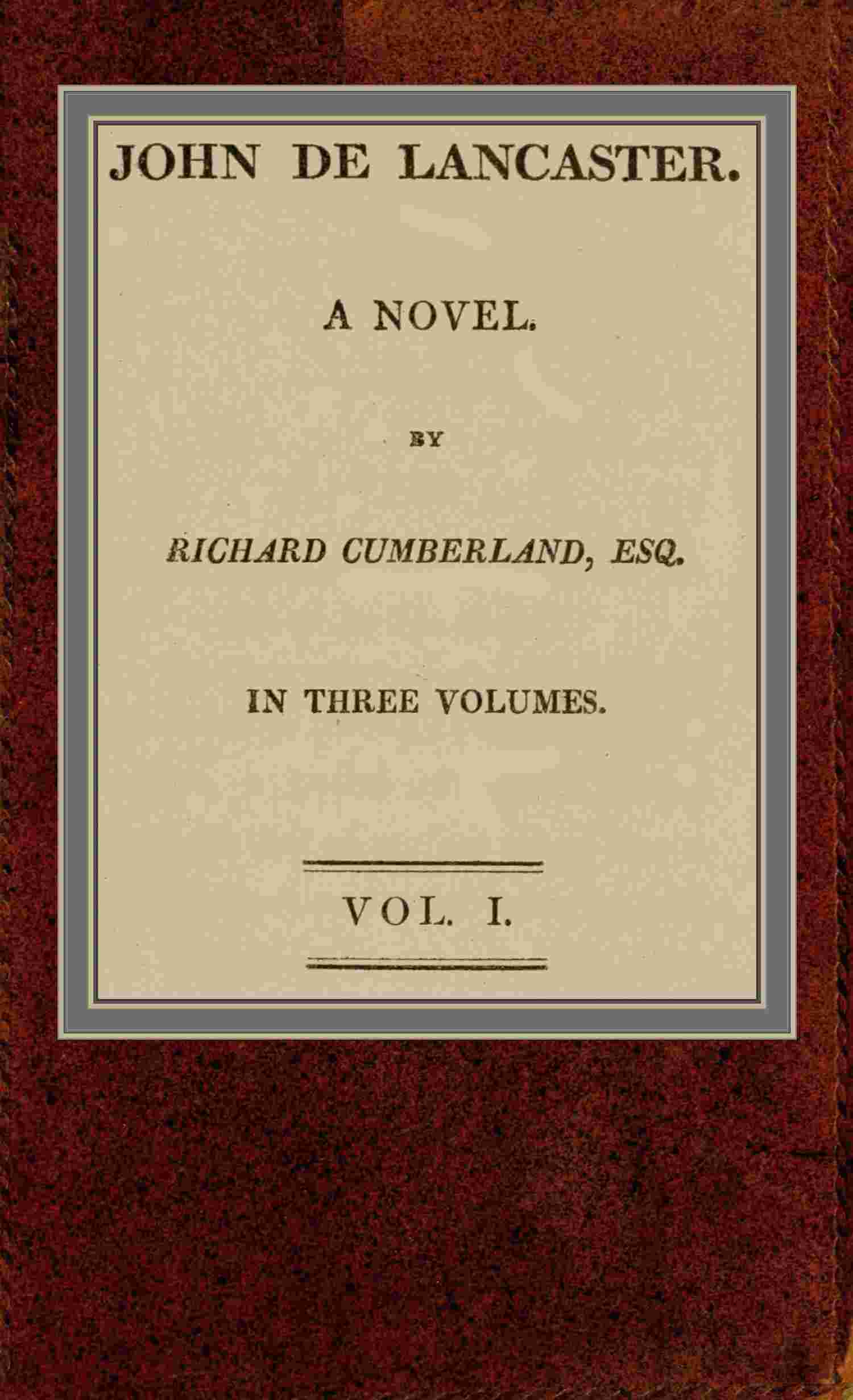
JOHN DE LANCASTER.
VOLUME I.
| Contents. JOHN DE LANCASTER. BOOK THE FIRST. CHAPTER I., II., III., IV., V., VI., VII., VIII., IX. BOOK THE SECOND. I., II., III., IV., V., VI., VII. BOOK THE THIRD. I., II., III., IV., V., VI., VII. Some typographical errors have been corrected; a list follows the text. (etext transcriber's note) |
JOHN DE LANCASTER.
A NOVEL.
BY
RICHARD CUMBERLAND, ESQ.
IN THREE VOLUMES.
VOL. I.
LONDON:
PRINTED FOR LACKINGTON, ALLEN, AND CO.
TEMPLE OF THE MUSES,
FINSBURY-SQUARE.
———
1809.
Harding and Wright, Printers, St. John’s Square.
JOHN DE LANCASTER.
BOOK THE FIRST.
CHAPTER I.
The Reader is made acquainted with the Family of De Lancaster.
On the first of March 1751, Robert De Lancaster, a native of North Wales, and grandfather of my hero, had assembled his friends and neighbours to celebrate, according to custom, the anniversary of their tutelary saint.
I enter at once upon my story without any introduction, having already announced this novel in my Memoirs, and I flatter myself, if it is perused with that candour, to which fair dealing has some claim, it will serve to entertain the major part of its readers, disappoint not many and corrupt not one.
Robert de Lancaster was a gentleman of great respectability, and Kray-castle, the venerable seat of his family through many generations, lost nothing of its long-established fame for hospitality on this occasion: the gentry were feasted, and the poor were not forgotten.
The family of this worthy antient Briton consisted of an only son Philip, married to an heiress of the house of Morgan, and a maiden daughter, named Cecilia. He was himself a widower. Mrs. Philip De Lancaster was at this time in that state, which gave speedy hopes of an heir to the very ancient family, into which she had married: in the festivities of the day she had taken little share, and in the superintendence of her father-in-law’s household absolutely none: that province she had found in much more able hands, and never sought to interfere with the administration of it: in short she had no ambition for authority, and very great objection to any thing, that might require exertion, or occasion trouble.
Cecilia De Lancaster from the death of her mother, through a period of more than ten years, had patiently and without repining suffered her youth to pass away, amply repayed by the love and approbation of her father, whilst she devoted herself to all those duties, which had devolved upon her, when Kray Castle lost its mistress. Her brother Philip had quite as little disposition to trouble as his lady, so that all things were under the unenvied government of Cecilia; and every guest, that resorted to the house, every domestic, that belonged to it, bore witness to the excellence of her administration.
A character like hers, though located amidst the recesses of Merionethshire, could not be totally divested of attraction; for she had high pretensions on the score of fortune, and a pedigree, that only stopped where the world began: these might have been enough to satisfy any reasonable man, though some perhaps would have rated them the higher for the loveliness of her person, the excellence of her understanding and the virtues of her mind.
Amongst the many suitors, who in various periods of her celibacy had been induced to propose themselves to her, none had been so persevering in his addresses as Sir Owen ap Owen, baronet, a gentleman by no means of yesterday, and possessed of a very fair and ample landed property, upon which there were no other encumbrances save only the barren rocks and unproductive mountains, over which it stretched. He was indeed not very eminent as a scholar; for although Sir Owen had without doubt been taught to read, he had almost entirely discontinued the practice of it: and indeed, considering the nature of Sir Owen’s more immediate pursuits, reading might very well be dispensed with, as it could only tend to interrupt his evening nap, and not improve him in the art of hallooing to his hounds, or pushing round the tankard to a tawdry toast: he however administered justice to his neighbours, and settled differences in a summary way after a fashion of his own, by reference not to any books of law, but to the beer barrels in his cellar; by which his decisions as a magistrate became extremely popular, and men quarrelled first, that they might get drunk afterwards, and patch up the peace in their cups, which they had broken when they were sober. By these means Sir Owen got a good name in the county, and supported a considerable interest, which he never failed to employ, as his fathers had done before him, in opposing and railing at the minister of the day, whoever that obnoxious animal might chance to be.
This distinguished personage was now in the fifth year of his suitorship, and verging towards the fiftieth of his age, whilst the inexorable Cecilia had already endured a siege half as long as that of Troy, without betraying any symptoms, that might indicate a surrender. In fact Sir Owen seemed now to content himself with a yearly summons, like the Moors before Ceuta, as a compliment to his perseverance, and to keep up appearances and pretensions.
It was now Saint David’s day, when he never failed to be a visitor to the castle, and he had brushed out the lining of his coach, and put himself in his best array, to do honour to the festival, at which he knew Cecilia would preside. His person was not eminently graceful, for he was a round, red-faced gentleman, neither tall of stature, nor light of limb; but his apparel bore the faded marks of ancient splendor, and his huntsman had bestowed uncommon pains in frizzing out a huge white perriwig, which he had powdered with no sparing hand. Sir Owen was at no time apt to be an idle looker-on whilst the bottle was in circulation, and on the present occasion he had charged himself more than usually high to encounter an opposition, which he had reason to expect would be more than usually stubborn; for though due consideration had been paid to his rank, and he had been placed at table close beside the lady, who presided at it, fortune had not favoured him with any striking opportunities for displaying his address, or advancing himself in her good graces. On the contrary he had been rather unlucky in his assiduities, and in his eagerness to dispute the ladle had overset the soup, with sundry other little misadventures, incidental to an awkward operator and an unsteady hand.
It is perfectly well understood, that the worthy baronet had pledged himself to his privy counsellor the huntsman for vigorous measures; confessing to him, whilst assisting at his toilette, with the candour natural to his character, that he was ashamed of hanging so long upon a cold scent, and protesting, with a due degree of spirit, that he would that very day either bring the trail to an entapis, or give up the chace, and draw off; for which manly resolution he had all proper credit given him by the partaker of his secrets, and the companion of his sports.
When the gentlemen had sate a reasonable time after the ladies had retired, it was the custom of the house to adjourn to the drawing room, where Cecilia administered the ceremonials of the tea-table. It was here Sir Owen meditated to plant himself once more by her side, and bring his fortune to a crisis; trusting that wine, which had fortified him with courage, would not fail to inspire him with eloquence. High in hope, and eager to acquit himself of his promise to his confidante at home, upon entering the room he pushed his course directly for the tea-table, where the cluster of candles and the dazzling gleams reflected from the polished apparatus, there displayed in glittering splendor, so confounded his optics, that without discovering the person of Mrs. Philip De Lancaster, or computing distances so as to bring up in time, he came foul of the tea-table, and discharged a part of the wreck with a horrible crash into the lap of the aforesaid lady, whilst his head came to the floor amidst the fragments of broken cups and sawcers with an impunity, which no common head would probably have had to boast of in the like circumstance. Dreadful was the consternation of the company, most alarmingly critical were the screams and convulsive throes of the unfortunate lady, whose lap was ill prepared to receive any such accession to the burden, which it was already doomed to carry. The consequences in short were so immediate, and their symptoms so decisive, that had not Mr. Llewellyn been in attendance, and happily not quite so tipsy as to be incapacitated from affording his assistance, the world might have lost the pleasure of reading these adventures, and I the fame of recording them.
A couch being provided, and the lady laid at her length upon it, she was carried up to her chamber, whilst the castle echoed with her piercing screams.
It would be treating this serious misadventure much too lightly, were I only to remark that the love-scene in projectu was of necessity adjourned by Cecilia’s leaving the company, and attending upon her sister-in-law, whom a whole bevy of females under the conduct of the sage Llewellyn followed up the stairs. We may well suppose, where one so able was present to direct, and so many were assembled, ready either to obey, or sagaciously to look on and edify, that every thing needful for a lady in her critical situation was provided and administered. Every visitor, whose recollection served to remind him that after such a discomfiture the speediest retreat was the best compliment he could pay to the master of the house, called for their horses and their carriages to the great disappointment of their servants, who had not yet paid all the honours to Saint David, that were by customary right Saint David’s due.
Sir Owen ap Owen, who had already taken some little time to recover his legs, found himself still at a loss to recall his recollection. At length, after contemplating the chaos he had created—By the Lord, friend De Lancaster, he exclaimed, I have made a terrible wreck of your crockery; but you should warn your housemaids not to dry rub your floors, for they are as slippery as glass, and let a man tread ever so carefully, a false step may throw him off his balance, and then who can answer for the mischief he may do? I heard a terrible screaming, but I hope, my good neighbour, nobody is hurt, and if your fair daughter, the divine Cecilia, (so I always call her) is inconsolable about her china, and if London can’t repair the loss, the East Indies shall, though I go all the way to fetch it home for her myself; for though I know well enough I have had a glass too much, and am but as you may call me a kind of bear in a ball-room, yet I know what a gentleman ought to do, when he has done mischief; and on the word of a true ancient Briton you may believe me, that if I had undesignedly set fire to your house, I am no such Hanoverian rat as to run away by the light of it: that is not my principle.
Your principle, my good friend, replied De Lancaster, nobody doubts, and if your accident shall be productive of no other mischief than what has happened to Cecilia’s tea-cups, Cecilia thinks no more of them than I do. The screams you heard did not proceed from her—
No, no, cried Sir Owen, her sweet pipe never uttered such a shrill veiw-hollah; so if she is safe from hurt and harm, all is well. ’Twas an accident, as you say, and there’s an end of it.
A servant now announced to the baronet, that his coach was at the door. De Lancaster entered into no farther explanations, and his awkward guest surrendered himself to the guidance of a coachman luckily not quite so tipsey as his master.
CHAPTER II.
Conversation in a Library.
When the wheels of Sir Owen’s coach had ceased from rattling over the flinty pavement of the castle court, Robert De Lancaster glanced his eyes round the room, and in a corner of it discovered his son Philip, unnoticed of him before. Neither the cataract and confusion, that had ensued upon Sir Owen’s tumble, nor the screams of a lady, in whose safety he might be presumed to have some interest, had provoked this disciple of Harpocrates to violate his taciturnity, or to stir from his seat. At the same instant Colonel Wilson, a friend of the family, entered, and brought tidings from the runners in the service of Mr. Llewellyn, that things above stairs were going on as well as could be expected.
Then with your leave, Colonel, said the lord of the castle, we will adjourn to my library, and there await the event. Upon the word Philip started from his corner, ran to the door and held it open for his father. A silent bow was interchanged at passing; the library was near at hand: the chairs were set ready, the candles lighted and the three gentlemen arranged themselves round the fire in their customary seats.
I think, said De Lancaster, addressing himself to the colonel, amongst all the extravagancies I have been betrayed into, there is none that sits so light upon my conscience, as the passion I have had for collecting books.
They certainly are a source of pleasure, said the colonel, to the readers of them.
They cause great trouble to the writers, Philip answered in an under voice, as if talking to himself.
Colonel Wilson was a disabled officer, having lost a leg in the service, and had now retired upon a sinecure government of twenty shillings per day to a small patrimonial estate in the near neighbourhood of Kray Castle: he was a few years younger than Robert De Lancaster, who had now kept his sixtieth birthday. Wilson had two sons; the elder was in the army, and the younger at the head of Westminster school: he was a man of strict probity, good understanding and an excellent heart. These were qualities, which De Lancaster knew how to appreciate as well as any man, and though his studies and pursuits had been widely different from those of the Colonel, yet he courted his company, and lived in perfect harmony with him as his friend and neighbour. Wilson on his part was not blind to the eccentricities of De Lancaster, but as they never disagreed except upon points, that did not interest the passions, their disputes were carried on without any mixture of acrimony, and only served to keep the conversation amicably alive.
Wilson had lived in the world; De Lancaster in study and retirement: the latter would sometimes contend against assumptions, which to the former appeared to be little less than self-evident; in the mean time De Lancaster would oftentimes undertake to demonstrate paradoxes, that to Wilson’s unsophisticated understanding seemed perfectly inexplicable: these he was in the habit neither to admit, nor pertinaciously to contest: if he had done the first, there would have been a speedy end to the discussion; if he had pursued the latter course, there would have been no end at all, for De Lancaster was not often in the humour to recede from his positions.
Philip De Lancaster on the contrary believed all things, and examined none: he was a man of great faith and few words; by no means wanting in curiosity, but extremely averse from enquiry and trouble. Being an only son and heir to the wealthy house of De Lancaster, it was thought adviseable by the fathers on each side, who were the contracting parties, that he should take to wife Matilda, only child of old Morgan of Glen-Morgan, and presumptive heiress to his fortune and estate. Philip, who had shewn no ardour as a lover, was by no means remarkably uxorious as a husband; and Matilda did not molest him with her fondness or attentions: They lived in the same house as appurtenances to the family at Kray Castle, (for such from time immemorial had been the custom of the De Lancasters) and they lived without quarrelling; for they were very little together; their passions were never roused by contradiction, or enflamed by jealousy; the husband had no attachments, and the wife, who was said to have been thwarted in her first love, laid herself out for no future admirers.
These few preliminary remarks may probably account for the placidity, with which Philip now sate down in the library between his father and the colonel to wait the issue of an event, in which if he did not manifest a very lively interest, the reason very probably was, because he did not feel it.
Philip, (if his sage remark is in the recollection of the reader) had risqued a truism, when he modestly suggested that it was a troublesome task to write a book. Philip did not speak this from his own experience; therefore it is, that I call his truism a risque, for it was not always that his father gave his passport to assertions of that character; but the learned gentleman’s thoughts were just then employed not upon the trouble, that we take when we bring our works into the world, but the trouble, which we give, when we ourselves are brought into it, and upon this topic he began to descant, as follows.
The unlucky accident, by which my blundering neighbour has precipitated Mrs. De Lancaster into labour-pains, must in all probability tend to aggravate and enhance those sorrows, in which by the condition of her sex she is destined to bring forth; and indeed, independent of that accident, I should not wonder if the pains she suffers, and the screams she utters, were more than ordinarily acute and piercing, planted as she now is, by adoption into my family, in the very stream and current from the fountain head of the primæval curse—
Whereabouts are we now, said the colonel within himself?
—Nevertheless, under the pressure of these apprehensions, I console myself with the reflection, that if the general observation, that what we produce with difficulty we are thereby influenced to preserve with diligence, be true in all other cases, it will be also true in that of child-bearing. If so, we may expect that the storgee, or natural affection of my daughter-in-law towards her infant will be proportionally greater than that of mothers, who shall have had easier times.
I see no grounds for that conclusion, replied the colonel.
Surely, sir, resumed De Lancaster, you must have remarked, that in all our operations, whether mental or manual, we are naturally most attached to those on which most pains and labour have been expended. Slight performances and slight opinions may be easily given up, but where great deliberation has been bestowed, we are not soon persuaded to admit that our time has been misspent and our talents misapplied.
Certainly, replied Wilson, there are some points, upon which we ought not to waver in our opinions, but there are many others, which it is not worth our while to be too pertinacious in defending. In my profession we must not quarrel with men for their caprices, so long as they are not mischievously or impiously eccentric. It is not often we can find a mess-room in the same way of thinking, except upon the question of another bottle.
In your profession, my good friend, resumed De Lancaster, (for which I have all possible respect) the pliability you describe may be perfectly in character, and much to be commended; for where differences are to be adjusted by arguments, swords should not be admitted into the conference. In my system of life I see no reason why I should be bound to think with the majority; nay, I confess to you I am very ill inclined to subscribe to popular opinions, unless upon strict investigation.
Are they always worth it? said the colonel.
I should think not, echoed Philip.
Pardon me, exclaimed De Lancaster! So many things are assumed without being examined, and so many disbelieved without being disproved, that I am not hasty to assent or dissent in compliment to the multitude; and on this account perhaps I am considered as a man affecting singularity: I hope I am not to be found guilty of that idle affectation, only because I would not be a dealer in opinions, which I have not weighed before I deliver them out. Above all things I would not traffic in conjectures, but carefully avoid imposing upon others or myself by confident anticipation, when nothing can be affirmed with certainty in this mortal state of chance and change, that is not grounded on conviction; for instance, in the case of the lady above stairs, whose situation keeps our hopes and fears upon the balance, our presumption is, that Mrs. De Lancaster shall be delivered of a child, either male or female, and in all respects like other children—
I confess, said Wilson, that is my presumption, and I should be most outrageously astonished, should it happen otherwise.
I don’t think it likely, murmured Philip.
No, no, no, replied De Lancaster; but we need not be reminded how many præternatural and prodigious births have occurred and been recorded in the annals of mankind. Whether the natives of the town of Stroud near Rochester are to this day under the ban of Thomas a Becket I am not informed; but when, in contempt of that holy person, they wantonly cut off the tail of his mule as he rode through their street, you have it from authority that every child thenceforward born to an inhabitant of Stroud was punished by the appendage of an incommodious and enormous tail, exactly corresponding with that, which had been amputated from the archbishop’s mule.
Here a whistle from the colonel struck the auditory nerves of Philip, who, gently laying his hand upon his stump, gravely reminded him that Becket was a saint—
De Lancaster proceeded—- What then shall we say of the famous Martin Luther, who being ordained to act so conspicuous a part in opposition to the papal power, came into the world fully equipped for controversy; his mother being delivered of her infant, (wonderful to relate) habited in all points as a theologian, and (which I conceive must have sensibly incommoded her) wearing a square cap on his head, according to academic costuma. This, Colonel Wilson, may perhaps appear to you, as no doubt it did to the midwife and all present at his birth, as a very extraordinary and præternatural circumstance.
It does indeed appear so, said the colonel. I know you don’t invent the fable; I should like to know your authority for it.
My authority, replied De Lancaster, in this case is the same as in that of Becket’s mule; Martinus Delrius is my authority for both; and when we find this gravely set forth by a writer of such high dignity and credit, himself a doctor of theology, and public professor of the Holy Scriptures in the university of Salamanca, who is bold enough to question it?
I am not bold enough to believe it, said Wilson.
CHAPTER III.
An Accession to the ancient Family of De Lancaster.
When the good man of the house perceived that the Salamanca doctor and his anecdotes only moved the ridicule of his friend Wilson, and even staggered the credulity of his son Philip, he pursued the subject no further, but wearied with the exertions and agitations of the day leaned back in his easy chair, and fell asleep. The parties, that were still awake, seemed mutually disposed to enjoy their meditations in silence, till upon the Castle clock’s striking eleven, Philip appositely remarked that it wanted but an hour to twelve—
And then, said Wilson, the first of March will have become the second of March, so that if your boy don’t make haste into the world, saint David’s day will be over, and he will not have the privilege of being born with a leek in his bonnet, and Martin Luther will keep the field of wonders to himself.
The story is very extraordinary, said Philip; but do you think it is true?
Do I think it is true, replied Wilson, that this gentleman, (pointing to a picture over the chimney) whom I take to be Icarus, came into the world, as the painter has described him, with his wings at full stretch? If you can give credit to the one, you may believe the other.
I think the safest way is to believe neither, Philip observed; but the gentleman you point at is not what you suppose: I believe he is some King: It is a family piece, and my father can explain it to you.
That I will do directly, cried the father, who had waked just in time to hear what his son had been saying. The personage you enquire about is not Icarus, but King Bladud of unfortunate memory, and the incident being historically connected with the records of my family, I have had the picture cleaned and repaired, and conspicuously hung, as you see, over the chimney piece of my library. He with the wings is, as I told you, King Bladud: He has miscarried in his experiment, and fallen to the ground from the topmost pinnacle of the Temple of Apollo. The venerable old man in the sacerdotal habit is the priest of Apollo, and the Philosopher in the saffron-coloured mantle is my ancestor, the ingenious contriver of the unlucky pinions. From him it is I date the privilege of attaching wings to my more ancient bearing of the Harp, as you see it displayed on the banners in the hall, and in sundry other parts of the castle, with the appropriate motto underwritten—Dum cœlum peto, cantum edo.
Thank you, my good sir, said the colonel: I am perfectly satisfied. For my own part I am contented to exhibit three cockle-shells on the handles of my spoons, but where I picked them up, and how I came by them, I know no more than the man in the moon, nor care.
At this instant Cecilia entered the room, and, running up to her father, joyfully announced the welcome entrance of our hero on this mortal stage in the character of a lovely boy, adding in the usual phrase that the mother was quite as well as could be expected.
I rejoice to hear it; I rejoice to hear it, exclaimed the grandfather. But, my dear Cecilia, are you quite certain that it is a boy?
Dear sir, replied Cecilia, you wont suppose the people about my sister can be deceived as to that.
Why no, said De Lancaster, upon better recollection I presume they cannot.
Cecilia directed a congratulatory look to her brother, and nodding to him, as she left the room, said, I give you joy, Philip, I give you joy with all my heart. Philip received it with many thanks, and entertained it with much composure.
Reach me the family bible, son, said De Lancaster, and looked at his watch, observing that it wanted half an hour of midnight. He thereupon entered the day and hour of his grandson’s birth in the recording leaf of the aforesaid holy book; observing, that he would postpone engrossing the event into his pedigree roll till his attorney could attend for that purpose—I confess, added he, it is more properly the office of my bard David Williams, but as he, poor man, is blind, I shall wink at his excusing himself from that branch of his duty.
I don’t see how you can well do less, said the colonel.
He will be christened John, continued the old gentleman, not attending to the colonel’s remark: the links in the chain of my genealogy have long been distinguished by the alternate names of John, Robert and Philip, and the brightest of the three has fallen to his turn. The Johns have been the heroes of the family: That was my father’s name; he was a gentleman of the most punctilious honour, but he was killed in a duel with a foreign officer, who happened to tread upon the train of my mother’s gown in a ball-room. The Philips universally, without the exception of my worthy son here present, have been lovers of their ease, and my great-grandfather was very generally distinguished by the style and title of Robert the Philologist: by manuscripts, which are now in my possession, it appears, that he had been at considerable pains and study in writing comments and annotations for a new and splendid edition of the Incredibilia of Palæphatus: This he did not live to complete, but he is said more than once to have declared, that he would convince the world, that Palæphatus told many more truths than he himself was aware of.
Perhaps Palæphatus atoned for it, said the colonel, by telling many untruths, that he was aware of;—but is it not time to go to bed?
CHAPTER IV.
Our Hero pays his first Visit to his Grandfather. The congratulatory Lay of the Minstrel.
The next morning Robert de Lancaster rose with the sun. From the window of his chamber he cast his eyes over that grand and beautiful expanse of country, which the proud and lofty site of his castle overpeered. It was the first sun, that had risen on his new-born hope, and the splendour, which that glorious luminary diffused over the animating scenery under his survey, was to a mind like his peculiarly auspicious and impressive: his bosom glowed with pious gratitude to the Supreme Dispenser of those blessings—It is too much, all-bounteous Being, he exclaimed, too much for sinful man! I am not worthy of such goodness.
He summoned his servant, and being informed that the night had passed well with Mrs. De Lancaster, he desired the child might be brought to him: his wish was speedily obeyed. He stood for some time intently gazing on the countenance of his grandchild, and at length pronounced it to be a perfect model of infantine beauty, open and ingenuous, every thing in short that his warmest wishes could have pictured.
I perceive, cried he, and can decypher the hand-writing of nature in the expressive lineaments of this lovely babe: if God, who gave him life, shall in his mercy give him length of days, he will be an honour to his name and an ornament to his country.
He is a sweet pretty puppet, said the nurse.
Pooh! cried the prophet, I am not speaking of what he is, I am telling what he will be. I prognosticate that he will be brave, benevolent, and virtuous—
And handsome and tall and well-shaped, re-echoed the loquacious dame; only look what fine straight limbs he has, pretty fellow!
Take yourself away with him! cried De Lancaster in displeasure. You have interrupted me with your chatter, and the continuity of those thoughts, which spontaneously presented themselves, is no more to be resumed.
The nurse departed, dancing the child in her arms, and prattling to it in her way, unconscious of the offence she had committed, whilst De Lancaster, pacing up and down his room, in vain attempted to find that place in the book of fate, from which her untimely gabble had caused him to break off—It is lost, said he to himself; I can only discern bright gleams of virtuous happiness, but not unclouded, not without those darkening shadows, that denounce misfortune.—Heaven forbid my father’s fate should be this infant’s portion with my father’s name!
He ceased; sate down, and, whilst the tear hung on his cheek, silently put up an unpremeditated prayer.
It was his custom every morning after he had dressed himself for the day to be attended by his bard David Williams, and it was now the hour for the old man to present himself with his harp at the door of his patron’s chamber: whilst he was in it, all approach was interdicted; the mind of De Lancaster seemed in a peculiar manner to sympathize with the melody of the harp: he had not only a national predilection for that instrument in common with his countrymen of the principality, but professed an hereditary attachment to it as a true De Lancaster, whose ancestors had worn it on their shields from the days of King Bardus. He had now heard the signal, that announced the morning visit of his minstrel, but a doubt struck him whether he could admit him to perform without hazarding an infringement upon his own order for general silence throughout the castle, as recommended by the sage Llewellyn: whilst pausing upon this dilemma it luckily occurred to his recollection, that there was a piano as well as a forte upon his favourite instrument, and furthermore, that the apartment of his daughter-in-law was at the greatest possible distance from his own; balancing these considerations in his mind, the good man became satisfied upon the point in doubt so far, that David was allowed to enter, and perform his morning serenade under suitable restrictions.
There was a stool, on which Williams always sate during his performances, and an easy chair, in which the patron reposed himself, and indulged his silent meditations. By signals audibly given, on the arms of the aforesaid chair the blind musician was directed to modulate the character and spirit of his movements, so as to correspond and accord with the movements of the hearer’s mind. It was a communication without language, perfectly well understood by the performer, who no sooner heard the signal for soft music than he began a prelude so exquisitely tender, that the strings only whispered under his fingers, till at length being filled with the inspiration of his muse, he broke forth extemporaneously into the following strains—
“That greets our new-born hope with light!
“Give me to feel thy cheering ray,
“Tho’ these dark orbs are wrapt in night.
“These hands to wake the tuneful string,
“The muse her influence hath bestow’d,
“And taught her sightless bard to sing.
“Melodious solace of the blind!
“Airs, that may heal a mother’s pain,
“And sooth a father’s anxious mind!
“Let no rude string disturb its rest;
“And lo! instinctively it creeps
“To nestle at its parent breast.
“Shall never view its lovely face;
“I ne’er must see that star arise,
“The day-spring of an ancient race.
“This infant to thy nursing care,
“And for the virtuous grandsire’s sake
“Oh! hear the humble minstrel’s pray’r!
“Of Lancaster’s time-honour’d name,
“When coming ages shall have past,
“May rank amongst the first in fame!”
Thou hast sung well, David Williams, said the patron, as soon as the harp had ceased, and I command thee to accept, and wear upon thy finger, this antique beryl, upon which is engraved a head of the poet Homer, thy prototype in melody not less than in misfortune. Thy muse, old man, hath not been unpropitious: go thy way therefore, and cherish thy spirit with the best flask of metheglin, that my cellars afford. I know it is thy favourite Helicon, which at once gives nerves to thy fingers, and nourishment to thy fancy. Get thee hence, blind bard, and be merry!
Old David devoutly drew the ring on his finger, and with a profound obeisance replied—I thank you and I bless you, my munificent patron. I will drink prosperity to the illustrious house of De Lancaster and the new-born heir thereof. It has stood from the time when the old world was deluged, may it stand till the time when the new one shall be dissolved!
With these words David took his leave and departed, whilst De Lancaster, glowing with that pure sensation of refined delight, which music can convey to its admirers, and blest in having now recruited his pedigree with a new descendant from the loins of Noah, sallied forth for the breakfast room, displaying on his stately person a new suit, after an old fashion, of flaming full-trimmed scarlet, ornamented with enormous gold-worked buttons, plentifully dispersed; a prodigious flowing perriwig of natural hair sable as the raven’s plume, with rolled silk stockings and high-topped square-toed shoes, which, resounding upon every step of the oaken stairs as he descended, gave loud and early notice of his approach to the personages assembled to receive him.
Cecilia, Philip and Colonel Wilson in turn presented themselves, and received his cordial embrace, for in his heart nature had implanted all the warm affections of father and of friend, and in courtesy of manners he was a sample of the chivalric ages; Llewellyn therefore was by no means overlooked; his services were both highly praised, and liberally repaid. Lawyer Davis also attended, being summoned for the purpose of the enrolment. So many were the messages of enquiry from the neighbours round the castle, that almost every servant and retainer belonging to his houshold made an errand to present themselves and pay homage to their good old master. Had pen, ink and paper been called for, there would have been three domestics to have brought them in: in the mean while it may be presumed that the more than usually profound respect, with which they accompanied their devoirs, was in some degree owing to the awe they were impressed with by the splendor, in which they saw him now arrayed; and certain it is, if they needed any pardon for this excess of reverence towards a mortal like themselves, the stately person and commanding countenance of Robert De Lancaster were exactly such, as in their predicament might serve for an apology: his stature was of the tallest, but well-proportioned and erect; his frame athletic, but without a trace of clumsiness or vulgarity; his voice, his action, his address were all of that character, which seemed peculiarly adapted to impose respect. Colonel Wilson, who had got secret intimation of this brilliant sortie, which his friend was about to make, had brushed up his epaulets, and turned out in full uniform for the occasion.
Not so Sir Owen ap Owen, baronet, of Penruth Abbey, who, having been told of the event as he had just turned his hounds into cover, instantly galloped off to Kray Castle; and being now ushered into the room in his hunting jacket and boots, exhibited a figure, which both in dress and address was as perfect a contrast to that we have been describing, as reality could present, or imagination feign.
Cecilia took an early opportunity of saying she was upon duty and withdrew: the rest of the company fell off one and one, and Sir Owen found himself left with Mr. De Lancaster.
What ensued will be related in the following chapter.
CHAPTER V.
An importunate Visitor interrupts the Business of the Morning.
It must be obvious to the well-bred reader, that this visit of Sir Owen to the worthy owner of Kray Castle, though not exactly in form, was nevertheless not out of place, considering what had passed in the antecedent day. We may literally say that it was made upon the spur of the occasion, and this we hope will be an apology for our introducing the baronet in boots. Without doubt he was conscious that something more was due from him than a simple enquiry could acquit him of, but the happy turn things had taken, since his head came to the floor and our hero into the world, relieved him in great part from his embarrassment: the politeness of De Lancaster put him entirely at his ease, when turning to Sir Owen, he said—I think, my good neighbour, as I am indebted to you on my boy’s account for his early introduction into life, there is nothing wanting to complete the favour but that you should take some charge of him, now he is with us, and stand godfather at the christening.
To this the baronet made answer, that he should be ready to obey the call, and was greatly flattered by it, adding with a significant smile, that it was not his fault, if he had not by this time had the honour of standing in a nearer relation to a grandson of Mr. De Lancaster than that of godfather; to which the other as readily replied—Neither was it his fault.
This was so fair an opening, that Sir Owen could not miss it, and upon this hint he spake. His speech, though not remarkable for its eloquence, was extremely easy to be understood: he professed a very sincere esteem and high respect for the amiable Cecilia: he would make a very handsome settlement upon her, and add two horses to complete his set, so that she should command her coach and six; he would new set the family jewels, furnish the best apartments afresh, and build her a conservatory: he would leave off smoking, take to tea in an afternoon, and learn quadrille: he would move the dog-kennel to a greater distance from his house, that the hounds might not wake her in a morning: he would stand candidate for the county at the next election, and as soon as he had taken his seat in parliament, and overturned the present ministry, he did not doubt of being made a lord. He said he was well aware of the lady’s high pretensions on the score of pedigree, but he flattered himself he should have something to say on that head, when he had looked into matters, and refreshed his memory; this he knew for a fact—that old Robin ap Rees, his minstrel, had records to prove that his ancestors, the Ap Owens, were not drowned in the general deluge, but saved themselves with their goats on the tops of their mountains in Merionethshire; and this should be made appear to the satisfaction of Cecilia as clear as the sun at noon-day: he added in conclusion, that as a mark of his respect for the name of De Lancaster, his second son should bear it jointly with his own, coupled with another ap.
These proposals being submitted, he wished to know if there was any thing more, that could be required of him for the satisfaction and content of the lady he aspired to. To this Robert De Lancaster gravely answered, that certainly there was nothing wanting to complete his wishes but her consent.
Why that is what I have always intimated to her, cried the baronet, that she had nothing to do but to say yes, and I was ready to strike hands upon the word and clinch the bargain. When a thing can so easily be set to rights, it is rather surprising to me, that she can hesitate about it.
Upon De Lancaster’s dropping a hint as to the seriousness of an engagement for life, and that two opinions must coincide upon that measure, Sir Owen very appositely observed, that it was mere loss of time to spin out a business year after year, that could be finished in a single minute.
I grant you, my good friend, said De Lancaster, that Cecilia could do more towards settling this affair in the space of one minute than you and I could do in a twelvemonth, for she is absolutely her own mistress; therefore with your leave we will turn it over to her, and when I have next the honour to see you, I will engage you shall have an answer from her own lips: let me only request you to receive that answer as decisive, be it what it may; and for your own as well as for her repose stir the question no more.
So let it be! replied Sir Owen, and fit it is that so it should be; for, take notice, I am getting on all this while, and she is not standing still in life, so that for the sake of posterity we had best lose no more time about it. If it is to be, the sooner it is done the better; if it is not, why there must be an end of it; I must turn my horse’s head, as they say, another way; and that puts me in mind that I have left the hounds in cover, and, if they find, I shall be quite and clean thrown out.
Nothing in this life more likely, replied old Robert archly, and with this answer, which cut two ways at once, the baronet, who just then thought of nothing but his hounds, bustled out of the room, muttering to himself—Huntsman will wonder what, the plague, has become of me.
CHAPTER VI.
Some Men are more fond of telling long Stories than others are of listening to them.
When this inauspicious conference was over, and the subject matter left, in the diplomatic phrase, ad referendum, Robert de Lancaster, who was anxious to dispatch the more interesting business of the day, rang the bell for his servant, and by him was informed that all parties were in readiness to attend him to the audit-room, where, amongst other family treasures, the record of his pedigree was kept in a vaulted casemate so fortified, as to bid defiance both to force and fire.
Accompanied by Cecilia, Philip, Wilson and Lawyer Davis, followed by the nurse carrying the infant, and Williams, in his bardal habit, led by a venerable domestic out of livery, he proceeded to the spot, and with his own hands liberated the incarcerated roll. It was a splendid record, and when spread out at full length exhibited several figures gaudily emblazoned. Colonel Wilson, who had no great respect at heart, but much gravity of countenance, whilst these ceremonials were in operation, addressing himself to the master of the show, said—It is well, my good friend, that you have stage room enough to display this fine spectacle in perfection without putting any of your ancestors to inconvenience—Then passing along till he came to the upper end of the roll, where Japheth, son of Noah, conspicuously kept his post, and pointing to a figure on the step next below him, he gravely asked who that majestic personage might be in kingly robes, wearing a crown on his head, and carrying a sceptre in his hand: Robert De Lancaster as gravely replied, that it was Samothes, the first sovereign monarch of this island, from him called Samothea.—Wilson bowed, and obtruded no more questions.
Whilst the ceremony of enrolment was in process—I record this infant, said the grandfather, by the name of John, although he hath not yet received the sacred rite of baptism, forasmuch as the pronomina of John, Robert and Philip have been successively adopted by my family from the very earliest time of the Christian æra to the present—Write him down therefore by the name of John.
This being done in proper form by Lawyer Davis, and date annexed, blind Williams gave a crowning twang upon his harp (for I omitted to premise that he brought it with him) and in a loud and solemn tone chanted forth—Floreat!—when our hero (unwillingly I record it to his shame) set up such a dismal and most dolorous howl, as startled all the hearers, but most of all his grandfather, who, struck with horror, cried out to the nurse—Take him away, take him instantly away! Why would you let him roar at this unlucky moment?—Bless your honour, said the prating gossip, ’tis a sign of strength—A sign! repeated the sage; how should you know of what it is a sign? Away with him at once! I would it had not happened.
As the cavalcade now marched away in solemn silence, Colonel Wilson, halting on his wooden leg, whispered to Lawyer Davis, who was in the rear—This is ridiculous enough, friend Davis, we must fairly confess; but the harmless foibles of good and worthy men should not expose them to our contempt.
Amongst the many oddities (for I am loth to call them absurdities) that marked the character of Robert de Lancaster, his pride of pedigree was one of the most prominent and most open to ridicule. That his friend Colonel Wilson saw it in this light there is no doubt; yet although he was quite intolerant enough towards many of Robert’s eccentricities upon speculative points, in this favourite folly he left him undisturbed, perceiving, as we may suppose, that it was a prejudice not to be attacked but at the risque of his friendship. This topic therefore had never come into discussion, and even the history of the picture, lately brought out of obscurity, was, as we have before observed, new to the incurious colonel. He had seen the pedigree unrolled for the first time, but of its contents he knew no more than what his single question about King Samothes had drawn from De Lancaster in the way of explanation.
If Wilson acquiesced in this foible of his friend, none else amongst the numbers, that were in habits of acquaintance with the family, were likely to start any question as to the antiquity of it; they were so cordially welcomed, and so hospitably entertained at Kray Castle, that it would have been hard indeed upon their host, if they could have swallowed nothing at his table but the dinner, that he put upon it. Add to this, that the good old man was a patient listener to other people’s anecdotes, though a deliberate narrator of his own. For all those dealers in the marvellous, who are proverbially said to shoot a long bow, he had a great deal of companionable fellow-feeling, and as he did not hold the commonly received opinions of the world in very high respect, he had boldly put together and amassed a curious and elaborate collection, somewhat after the manner of Coryat, of what he styled his Confutations of vulgar Errors. These have come under the inspection of some people since his death, and though it must be owned that they are not to be read without some few grains of allowance, yet there is a sufficiency of novelty to make them entertaining, and good sense enough interspersed to render them in a certain degree respectable.
He there paradoxically asserts, (and I must believe it was his serious opinion, for he was fond of repeating it amongst his intimates) that the human understanding had been extremely narrowed and contracted, since the art of printing had been discovered and carried into practice, for that tradition was the mother of memory, and book-reading the murderer. For modern history he had a sovereign contempt; he said it was a mass of voluntary misrepresentations, and that no man could be trusted to write the annals of his own time; strenuously contending, that it was from the dark ages only we could strike out light to illuminate mankind. In the early writers of the history of his own country he was profoundly versed, and could adduce a host of authorities to prove that Dominicus Marius Niger and Berosus were clearly warranted in their affirmations that the island of Great Britain was as well and as fully stocked with inhabitants long before the days of Noah, as any other country upon the face of the globe.
Upon all these topics Wilson had not much to say: he knew his friend was in the habit of disputing points, which others took for granted, and taking many for granted, which by others were disputed; he was therefore well contented to let him talk his fill so long as he was only talking for fame, resolved on his own part to take no more for truth than he saw fit; and, being always able to prove what he himself asserted, what he heard asserted without proof he did not hold himself always bound to believe.
He now perceived the time was come, when it would be no longer in his power to parry the propensity so discoverable in his friend on this occasion to treat him with a discussion on the antiquity of his family: he was prepared to meet it, nay, he was just now disposed even to invite it by some leading questions respecting the family bards, and the authenticity of the facts by them recorded.
This was every thing that De Lancaster could wish for: it was at once a salvo for his vanity, and a challenge to his veracity. Assuming thereupon a more than ordinary degree of solemnity, he said—It is not to the bards alone that I am indebted for all I know of those, who have borne my name before I was in the world, though much is due to their correct and faithful records of the times they lived in. By my own perseverance in keeping hold of the clue, which, by the help of Joannes Bodinus, Franciscus Tarapha, Wolfangus Lazius, and other equally illustrious authorities, hath led me to the fountain head of my genealogy, I have at this moment the consolation to reflect, that when that most incomparable personage Samothes, (first son of Japhet, who was third son of Noah) was monarch, patriarch and legislator of this my native island, I had an ancestor then living in it, who shared the blessings of his government, was also nearly allied to him, and stood so high in his favour and confidence, as to be appointed president and chief teacher of theology in that celebrated college of philosophers called Samothei, which both Aristotle and Secion affirm to have been established in the days of this good king, and so called in honour of his name: but not this school only, the whole island took its name after this excellent king, and was for a course of years, till the arrival of Albion, called Samothea, as both the learned Bale and Doctor Caius concur in affirming—but perhaps to you, Colonel Wilson, these anecdotes may be uninteresting; and, if so, I will pass them over.
By no means, my good friend, replied the colonel, for be assured that all these family facts, which you have collected, and Moses in his history seems to have overlooked, are to me perfectly new and extremely entertaining.
Sir, resumed the narrator, Samothes was succeeded by his son Magus, from whom the Persian Magi derive—(Wilson arched his eye-brows, as men are apt to do on certain occasions)—and Sarron succeeded Magus, from whom were derived a sect of philosophers amongst the Celtes, called Sarronides. In the reign of Druis, continued De Lancaster, or, as Seneca writes it, Dryus, (which I take to be a corruption) my ancestors transplanted themselves, together with the philosophers, named after their sovereign Druids, into the isle of Anglesea, which, as Humphry Lloyd truly observes, was their chief place of abode, or, more properly speaking, their pontifical headquarters. Bardus, the son of Druis, succeeded to his father, and in his reign so famous was my then existing ancestor for his performances on the harp, that we have ever since borne that instrument by royal grant of this king as our family coat of arms and crest. Now, let it be observed, added he, that many families have coats of arms and crests, and can’t tell how they came by them.
That is true, said the colonel, and one of those am I; but I beg pardon for interrupting you: I pray you to proceed.
After a period of three hundred and ten years, the Celtes being subdued by Albion the giant, and this island subjected to his dominion, he changed its name of Samothea to that of Albion. This same Albion the giant was, as every body knows, the fourth son of Neptune—
I am proud to hear it, cried the colonel, but I protest to you it is the first I ever heard of him, or any of his family: I can now account for our superiority in naval affairs; and I most heartily hope that the trident, which this son of Neptune inherited from his father, shall never in any time to come be wrested from his posterity of this island.
I hope not, replied De Lancaster; but I proceed with my narrative—Upon the landing of Brute with his Trojans, (which was not above three thousand years ago) I find it asserted by Master Henry Lyte of Lytescarie, that this island was no better than a rude and barren wilderness, ferarum altrix, a nursery for wild beasts, as he slightingly denominates it; but I must take leave to tell that learned antiquary, that his history, which he proudly styles The Light of Britain, might more properly be called The Libel upon Britain; for I will neither give credit to his lions, which he presumes to say overran the island, nor implicitly acquiesce in his monstrous white bulls, with shagged manes and hairy foreheads, forasmuch as I find no mention of them in our King Edward the First’s letters to Pope Boniface, wherein this very point of the landing of Brute in Albion is very learnedly discussed. As for his lions, I treat that fable with contempt, for, besides that King Edward does not mention them, I will never believe there could have been one in the whole island, else how came King Madan, the grandson of this very Brute, to be killed and devoured by wolves in a hunting match, when it has been notorious from all time, that the wolf will fly from the hunter, that has anointed himself with lion’s tallow? Will any man suppose that the royal sportsman could have failed taking that obvious precaution, had there been but a single ounce of the fat of that animal in the whole kingdom?
Nobody will suppose it, said Wilson, and I am satisfied there were no lions for the reason you assign: I must beg leave to doubt also if there was any authority for his enormous white bulls, provided you are quite sure that King Edward does not hint at them in his correspondence with the Pope: but have we not lost sight of your ancestors amongst these lions and the bulls?
Not so, replied De Lancaster, for upon the partition, which Brute made of the kingdom between his three sons Locrine, Camber and Albanact, my family is found in the Cambrian district upon the very spot, where Kray Castle now stands; which will warrant me in saying without vanity that few land-holders in the island can boast a longer tenure in their possessions, this being not above sixty-six years after the taking of Troy, and eleven hundred thirty and two years before the Christian æra.
That is quite sufficient, said the colonel: few post-diluvian families can produce a better title.