
"No, no; I shall have to tell you, if you can't tell me."
The child suddenly turned her head. It was time, she evidently thought, for all this fun with a stranger to come to an end. He was a very nice gentleman, and looked very kind, and said a great many things she could not understand, and made her say things too. But reality was best, after all; a heart's love is not transferred in a moment, no matter who may have the best right to it; and there stood John, looking pale and grave, in the shadow of the apple-trees, listening in silence to all that was going on.
"I'm John's Lily!" she said, and slipping her hand out of Colonel Maxwell's, she sprang back to her old friend and began in an eager whisper, "John, John, pick me up and give me a ride round the garden. Quick, John dear! When we come back they'll all be gone and we'll have dinner."
John bent towards the little girl, colouring scarlet, while Mrs. Randal hastened to explain and apologise.
"The village people got into the way of calling her John's Lily, sir, because those two always thought such a lot of each other. They are such playfellows—and the dear child don't quite understand yet, so I hope you'll please to excuse——"
But there was no need of any excusing. Instead of carrying Lily off round the garden as she wished, John led her back among the lilies, and put the little hand he held into Colonel Maxwell's once more.
"Look here, Lily," he said, "this is your father, your own father, as lost you that time I picked you up, when you was a little girl of three. Now you're going away with him to your own home, and you've got to be a good girl and show him as mother and me hasn't spoilt you. Look up now and call him father. Say 'Dear father.'"
Lily stared at John in silent astonishment. But she had learnt by this time to know his face on the very rare occasions when he meant to be obeyed. So she lifted her wondering blue eyes to that other face, strange but so kind, and said in a low, half-unwilling voice, "Dear father!"
"My dear little girl," Colonel Maxwell said under his breath, as he stooped to kiss her.
Then he grasped John's hand and shook it heartily.
But Lily, over-wrought by these surprises, rushed away from them both, flung herself into Mrs. Randal's arms, and burst into a violent fit of sobbing and crying. John's mother, comforting and scolding by turns, took her away into the cottage and closed the door.
So John's Lily passed from his care into that of her rightful guardian. There was of course a great deal to tell Colonel Maxwell that he had not heard yet; the adventure of the fair, when those who had originally carried off the child made such a bold attempt to possess themselves of her again; the reappearance of Dick, as he was called, only last February, and his trying to entice her away from the village till John frightened him successfully away. There was a great deal to talk over, a great deal of surprise to be expressed at the failure of the police to trace the child, which could scarcely have been possible except in this very lonely country village so far from railways and the outer world. Sir Henry Smith was inclined to think John a stupid fellow for not having exerted himself to give notice to the police; but Colonel Maxwell understood John's unwillingness better than his friend, remembering that the child herself could tell nothing about her home, and that John could not possibly have known into what hands he might be surrendering her.
Colonel Maxwell had a great deal of talk with John and his mother that Sunday evening, when he walked over to Markwood again, this time alone, and took his little girl to church with him. He had something to give thanks for now, something to make him glad. Most of the village knew by this time that Sir Henry's friend was Lily's father, and he was stared at by many curious eyes. After the service he took Lily back to Mrs. Randal and asked her to keep her for one more night; the next day he would drive over and fetch her to Carsham, where Lady Smith was ready with a kind welcome for the little stray bird so happily caught again.
John walked nearly to Carsham House with Colonel Maxwell that evening, and came back alone in the sweet summer dusk. When he got home his mother was not in the kitchen; he listened at the foot of the stairs, then called very gently, "Mother, are you there?" for fear of waking Lily. His mother did not seem to hear him, but he could hear her moving about upstairs. Presently, however, she came down, and he could see that she had been crying. For a few minutes they sat in their two chairs, silent; then John said suddenly, "Don't take on so, mother. Is the child asleep?"
"Fast asleep now, dear lamb," said Mrs. Randal. "But it was a long time before she went off, she was that excited, and no wonder. I had to sit by her and sing hymns with my old cracked voice. Dear, dear, she'll have no one to sing her to sleep to-morrow night, I guess."
Mrs. Randal ended with a sob, and dried her eyes again.
"Her father thinks no end of her," said John after a pause.
"Yes, and he does seem like a nice man. But it's a mother's care as she'll miss, that poor little one. He'll have a good nurse for her, I dare say, but that won't be the same thing. I've been just a bit more than an old nurse to Lily. And she'll miss you, John. Her father and her little brothers may be ever so fond, there's not one among 'em all as will be the slave you've been. I almost told Colonel Maxwell as much."
"It couldn't have gone on always, and it's just as well it's happened now," said John, rather doggedly. "If you ask me, I expect we shall miss her more than she'll miss us. At that age they soon forget. But you and me—we shall have a precious dull life of it now, mother."
Mrs. Randal rocked herself gently backwards and forwards.
"Yes, my lad, yes," she said. "It would ha' been better for you, after all, if you'd never seen Lily in your life."
"No, that it wouldn't."
"Yes, yes," his mother persisted. "If it hadn't been for her, poor child, you might have been married to Polly Alfrick long before now, and had a home and a family of your own like other young men of your age. Why, John, my dear, you're nigh on eight-and-twenty."
"I told Lily to-day as I was getting old," said John, with a grim smile. "But don't you worry about me. I wouldn't have had it different."
There was another long silence. Mrs. Randal sighed once or twice. At last she said, "And what did you and the Colonel talk about?"
"Oh, a lot of things," said John. "He has some notions about me; there's scarce anything he wouldn't do for me. To begin with, there's a thousand pounds reward for finding the child, which belongs to me, he says, though I don't see how. It appears to me as he found her himself. Well, and over and above that, he'll start me in a farm or a blacksmith's business in Canada, and pay our passages out, yours and mine. Or he'll put me in the way of a superior sort of trade in London, where I can go in for all sorts of ornamental iron-work and make a lot of money. In short, he'll do all as lies in his power to help John Randal on in life and make him rich and happy. Do you understand, mother? A thousand pound cheque to begin with—that means a balance at the bank—and anything you please to follow after. But even with a thousand pound, this here old place won't be big enough to hold you and me—will it, mother?"
Mrs. Randal took off her spectacles, as people sometimes do when they want to see more clearly. She rubbed her eyes and looked at John. But she could make out so little that she put her spectacles on again. The brilliant prospects which he had been spreading before her seemed to have no effect on John's countenance; his eyes were no brighter than usual; his dark face looked tired and pale; his long legs were stretched out wearily. Presently, as his mother said nothing, he glanced at her with a faint smile.
"Well, what do you say, mother? How will you like being rich? Do you vote for Canada or London?"
"My lad, it's selfish of me—I am behaving queerly, to be sure! Here's your fortune made all of a stroke, and me no more thankful than this. Well, John, there's no doubt you'll do well wherever you go, whether it be London or beyond the seas, and I'm sure Colonel Maxwell's very kind. Only there's one thing to be said. I'm too old to move, my dear, that's certain. You must let the forge—Jim Nash is sure to take it—and your old mother must stay in the old cottage to welcome you back again. I wouldn't stand in your way, and it's real thoughtful of Colonel Maxwell to say he'll pay my passage too, but I'd be frightened out of my life to go in a boat even, much more a big ship on the sea—and as for London, the smuts and the noise would shorten my life by ten year. So you just do the best for yourself, John, without thought of me."
John listened very quietly.
"And you'd stay here all alone by yourself, would you?" he said.
"Yes, my dear. I couldn't leave the old home, so don't worry about your mother. I should be lost among strangers. With a young man like you it's a different thing. I expect Colonel Maxwell thinks you're thrown away at Markwood, and he's not far wrong."
"But supposing I chose to stop at Markwood—there'd still be the thousand pound. What should we do with that, mother—build a new house?"
"I don't know," hesitated Mrs. Randal. "The old one's good enough for me. But of course you'd get married, John."
"There's nobody I want to marry—you know that."
"Well, you might in time—and she'd be sorry, maybe—she might come round——"
"Do you think I'm likely to ask her again?" he said, his face hardening.
"She don't deserve it, to be sure," murmured Mrs. Randal. "Well, thinking over what's best for you, I do believe Canada's best. You've had a lot of trouble, and losing this dear child ain't the least of it, and in a fresh country you'd make new friends and start over again."
"Forget it all and start fresh. That's what you're thinking, is it?" said John.
"Well, my boy—seems as if it might be the best for you."
"I'll tell you then," he said. "You've heard Colonel Maxwell's offers, but you haven't heard my answers to them."
"Why, you've got to think them over."
"No. He said so, but I said there was no need for that. What's the good of considering and beating about the bush when one's mind's made up already?"
"What was the good of taking me in so, then?"
"I had a mind to see what you'd say."
"Well, but what did you say? That's what I want to know!"
"Look here, mother, you may think I'm wrong. Colonel Maxwell went on for half-an-hour or more, offering me all these fine things. I refused every one of 'em."
"You did, John? The money and all?"
"The money first and foremost. I've no right to the money, and if I had, would you and me like to be paid for sheltering that child, who's been the brightness and the blessing of our lives for four years? 'No, thank you, sir,' I says to him. 'My mother's looked on your little girl as her own, and she loves her as her own, and she'd never speak to me again if I pocketed a shilling of your money. Besides, your getting back the child was no doings of mine or hers. It belongs more to Sir Henry Smith, your friend, as brought you here to-day.' He laughed at that. Then I thanked him all the same, and I told him I wanted no change in no shape or way, and I'd no taste for emigrating, nor had you, and I wouldn't live in London on no account, nor ask you to do so, and my cottage and my old trade, which was my father's and grandfather's before me, was all I wanted in this world. Whether he thought me a mean-spirited chap, I don't know—all I know is, I want help from no man, and from him less than anybody. So, mother, there's the end, and Lily leaves you and me pretty much as she found us."
Mrs. Randal was half thankful, half disappointed. Good and gentle and refined as she was, she had not quite John's grand contempt for money and for getting on in the world. One need hardly say that she had not a covetous or an ambitious thought for herself, or that she spoke the exact truth in saying that she wished to end her days in the old cottage where all her married life had been spent. But it is possible to care not at all about worldly advantages for one's self, and yet to value them highly for those one loves; and Mrs. Randal, while John was talking of Colonel Maxwell's offers, had felt both glad and proud that her son was no longer to live a hidden life in this quiet village of Markwood. With a large sum of money to start him, with his own good capacity and steadiness and industry to carry him on, John would indeed have had a chance of raising himself and his family to a very superior position. And the world outside Markwood—so his mother thought—must be so much the better for knowing John. However, it was not to be; and Mrs. Randal, who never fretted over useless fancies, told herself that John knew best and that he had decided rightly. She understood him; she was all the prouder of him in her heart, really, because he chose to live his life independent of another man's money or help, and to work on in his own quiet way. Remembering, as she often did, the pure love and kindness in his face when he first brought in the lost baby, on that stormy summer evening four years ago, she could not help understanding that those four years of Lily's bright presence would lose half their sweetness as a happy memory, if all his unselfish tenderness was to be paid for.
Of course there was a great deal of talk in the village, among both young and old, about the departure of John's Lily, about her new-found father, and about the fine London house which was supposed to be her home. Markwood had not often such a subject for gossip. The worst of it was, that much of this gossip had to be made up on the spot, for very little information was to be dragged out of the only people who really knew anything—John, Mrs. Randal, and the Vicar. Mrs. Alfrick was particularly vexed at having missed seeing Colonel Maxwell; now that Mary was gone, she seldom got through her work on Sunday in time to go to church. She wrote off the news to Mary, however, and observed that John looked more glum and disagreeable than ever, and that his mother would tell one nothing. She also expressed deep offence that Lily had not been sent up to say good-bye to her and the children, when she was sure she had always treated that foundling child kinder than anybody, long before a living creature could have guessed that her father was a grand gentleman.
Lily was gone; her flower namesakes faded in the hot summer sun; the creamy rose-leaves dropped on the narrow paved walk under the cottage wall, where she used to gather them up so carefully. John went about his work as usual, but he neglected the garden a little—it was too silent, too sad—and he never looked out of his forge when the children were coming from school. His mother, always quiet, grew a little quieter, and watched him sometimes with eyes to which the tears sprang too readily. They seemed to think only of each other, and did not talk much of the past; one might almost have fancied that those homely walls had no history, that dead loves had never lived at all, that both Mary and Lily were forgotten.
CHAPTER XIII
GIVEN BACK
"The time draws near the birth of CHRIST:
The moon is hid; the night is still;
The Christmas bells from hill to hill
Answer each other in the mist."
—TENNYSON.
A hard winter followed that beautiful summer, and Christmas Eve, when it came, was one of the coldest days that Markwood could remember. This is saying a good deal, for the cold of those valleys can be something which higher and drier regions do not know. The frost-fog that lingers there on a level with the river has the power of piercing to the marrow of one's bones; it is colder than the bitterest wind that ever blew.
Mary Alfrick thought she had never been so cold in her life as on that Christmas Eve, when she came home for her first holiday after fifteen months of steady work at the Orphanage. She had had a long cross-country journey. Her father met her with his trap at the station; he seemed glad to see her in his rough way, and the welcome, careless as it was, made Mary feel that she had been right in coming. She had not been very willing to come; there was not much love at home for her; the associations of Markwood could only be painful; and yet sometimes she knew that her heart fairly ached with longing to see the place again from which she had banished herself so resolutely.
It was not so foggy on the high ground near the station, though the ground was as hard as iron, and the red sky foretold sharper frost still. Lower down, through Fiddler's Wood, they seemed truly to drive into the Arctic regions. A slight covering of snow lay on the road, enough to make driving bad and slippery; but the rime frost itself, the congealed white fog, which hung on everything, clothing every twig and bush in a thick coat of snowy crystals, had almost a more wintry effect than actual snow. Among the trees the mist hovered; it lay like a cold white sea in the valley, catching their breath as they descended into it and drove through the village, where in the advancing dusk nobody was to be seen, except a few boys sliding on the side of the road. Farmer Alfrick shouted at them angrily, and growled a good deal about broken legs.
They did not pass the blacksmith's shop, which was further on towards the church, and they could not see along the street through the fog. It was a little better when they turned into their own lane and climbed the short hill to the farm. Here Mary's welcome was cordial enough; her stepmother was pleased at her coming—"somebody to speak to at Christmas-time," as she said—and the children, especially Lizzie, were glad to see her. Mrs. Alfrick had honoured her guest by lighting a fire in the parlour, and here she and Mary sat in the evening after supper, when the children had been sent to bed and the father was smoking his pipe in the kitchen, which he found the warmest room of the two.
Before sitting down with her stepmother, Mary went to the house door and looked out. It was quite light, for a moon was shining above the fog. Invisible herself through white misty clouds, she yet filled them with her light, so that the mist itself seemed to shine. It was intensely cold, freezing hard. The church bells in the valley were ringing a Christmas peal—"Peace on earth, goodwill to men"—but their sweet and joyous voice only filled Mary with a deeper sadness. She almost wished now that she had not come. It was bad to be reminded of happy Christmas Days gone by. She closed the door and went quietly back into the parlour, where Mrs. Alfrick was poking the fire, and began unpacking some presents she had brought for the children.
"Well, Polly, I always did say you had a good heart," said Mrs. Alfrick. "My word, they will be pleased! There, sit down; you look perished. Your father said you were improved in looks, but for my part I don't see it. You're ever so thin, and to my mind you look years older than when you went away. I expect you've been harder worked than at home. I wish you could have settled your mind to have stayed—there was nothing to drive you away as I could ever see. You and John was a pair of idiots to make such a fuss about nothing, and now you see that child's gone, so you wouldn't have had much longer to wait."
Alfrick and his wife were both right about Mary. She looked thinner and older, though in fact her work had been easy. But in other ways she was improved; better dressed, gentler in manner and voice; an extremely nice, refined-looking girl, who did not now, with a wider knowledge of the world, think it necessary to hide her natural goodness under a rough, hard manner, or to "speak her mind," whether reasonable or not, on every occasion. Mary quite saw that she had herself, by her own obstinate temper, destroyed John's happiness and her own. Many a time she had said to herself, "I might have forgiven him when he asked me. I needn't have broke it all off like that." But regret seemed useless. John had his pride too, plenty of it; and even if they met again, a reconciliation hardly seemed possible; neither of them, now, could easily ask for it.
"Well—that's over, so don't let us talk about it," said Mary. "How's Mrs. Randal, though?"
Mrs. Alfrick pulled a long face and shook her head. "Didn't your father tell you? She's alive, and that's about all."
Mary started. "Mrs. Randal—dying! You don't mean it, mother!"
"I do. It's the bronchitis. She never was over strong. She caught cold the beginning of this severe weather, you know, and for the last week she's been as ill as ill can be. John's so grumpy, I haven't liked to go there much myself, but I saw Ellen Nash this morning, and she'd seen the doctor coming out, and he said it was very serious."
"Did he say there was no hope?"
"Well, I can't repeat his words, but that's how I understood her. She said this here frosty fog was killing her, spite of all John could do."
"Who is nursing her?" said Mary.
"Why, John. He don't seem to care about the neighbours coming in. Mrs. Nash says she'd do anything, 'cause Mrs. Randal was always good to her; but there, she's a weak sort of creature, not much use in a sick-room."
Mary did not say much. Mrs. Alfrick went on talking, and she sat listening like somebody in a dream. Perhaps half-an-hour passed in this way. She gazed at the fire, but saw Mrs. Randal's pale kind face, and remembered that June day long ago when John was out in the thunderstorm, and his mother had said words that sounded so sweet, telling the girl Polly that if trouble was to come she would sooner have her there than any one else. Then the storm had passed away, and in the golden evening John had come in with the little lost child in his arms.
"GOD forgive me!" thought Mary. "Even then I was a bit jealous of that child. I tried to do my duty by her, so I did, but that's not much after all."
Presently one of the children upstairs began to cry, and Mrs. Alfrick went up to it, leaving Mary alone in the parlour. After a few minutes she went out again into the passage and opened the front door. All was the same there—cold, still, misty and shining. Mary turned back into the house, remembering that she had left her warm shawl in the parlour. She threw it round her head and shoulders, slipped gently out once more, down the path, through the garden gate, into the quiet lane. Less than five minutes, even in this thick mist which obscured the way, would bring her to John's door.
Markwood is an old-fashioned place, and goes to bed early. Even the bells were silent now, and though it was Christmas Eve the houses were shut up; no lights glimmered through the fog when Mary turned the corner into the village and hurried along the street. Almost sooner than she expected she was close to the blacksmith's forge: her hand was on the old gate once more, she was lifting the familiar latch. But before going further she stood still and looked at the cottage; a red light rose and fell in the kitchen window where the blind was not drawn down, and the window above shone with a steadier light; that was Mrs. Randal's room. Mary stood at the gate trembling, partly with cold, partly with the fear of being too late, most of all with extreme nervousness at meeting John again. She had never known she was so weak, and felt surprised at herself, but at that moment she nearly turned round and ran back to the farm.
The house seemed to be quite silent. Mary collected herself, told herself this was no time for shyness, that her old friend wanted her help, whatever John might think or say. She went with light steps along the yard and looked in at the window. The kitchen was empty, only the old tabby cat lay asleep before the fire. Mary did not knock, but gently tried the latch of the door; it opened easily, she stepped quickly in and shut it again, so that the cold mist might not follow her. Then she stood in the middle of the room listening.
If John was awake, his quick ears would certainly have heard some one come in; if he had fallen asleep from fatigue, poor fellow—well, she could wait a minute or two and then go softly up to his mother's room. She had hardly time to think this before she heard a sound upstairs; a chair moved; slow, careful footsteps crossed the floor, and now were coming down. Mary suddenly felt suffocated by her shawl, and threw it off; there she stood in the ruddy firelight, in the middle of the room, with flushed cheeks and shining eyes, a strange vision indeed to John, who came down cautiously without a light to see what unexpected visitor Christmas Eve Lad brought him.
For a moment they looked at each other in silence, and then Mary, seeing that she must break the ice, came towards him and held out her hand.
"You'll forgive me, John?" she said, in a very low, tremulous voice, "and let me nurse your mother."
John's answer was not made in words. A few minutes later, when he had a little recovered from his first bewildered joy, he told Mary that his mother was better that evening, wonderfully better. Her cough had been less troublesome all day; she had been far less feverish, and now, not long ago, she had dropped off into a beautiful sleep.
"I thought them bells would keep her awake," said John; "but no, she lay there and listened as if it was sweet music, and went to sleep as happy as a child, with a smile on her face. I believe she knew you was coming."
"I think the bells made me want to come," said Mary. "They always sound so like old times, don't they? Let me go up and see her."
"You must be as quiet as ever you can. Oh, Mary, I've got more than I deserve. I thought maybe I should never see you again."
"Well—I told you once I'd wait all my life," said Mary; "but to-night I found I couldn't wait any longer."
After an hour's refreshing sleep, Mrs. Randal woke to see the faces of her two children bending over her. Just then the bells broke out once more, so loud and joyous that they almost shook the old cottage roof with their swinging.
"I'm better," said Mrs. Randal. "Polly dear, is that you? A happy Christmas!"
CHAPTER XIV
SEVEN YEARS AFTER
"So, Lily, from those July hours,
No wonder we should call her."
—E. B. BROWNING.
Once more a summer day. The children, not long out of school, were loitering in the warm shadows of the village street, for the sun was still high in dazzling, cloudless blue, and there was no air stirring, not even enough to flutter the topmost leaves of the great trees that stood round about Markwood. The roses and the jessamine were out on the blacksmith's cottage, and its old yellow front looked just the same, opening on the little green yard. Beyond was the row of stately white lilies in full flower, and beyond them again the red rosebushes and the clusters of pinks. The house door stood open, but all was still, except for the sound of clanking iron that came from the forge. There the blacksmith of Markwood worked as usual, and was never in want of work, for his name, still more than those of his father and grandfather, was known all round the country as that of a clever and conscientious workman.
He was alone in the forge that afternoon, for the usual group of horses, which often came from miles away, had tramped off down the street, and though John in the prime of life was a more sociable man than in his younger days, he did not care now any more than then to have his workshop made a gossiping place for the village. Still, at thirty-five, he was the leader of all the best young fellows about in their cricket and other games, but still he was a man with few intimate friends—his home and his trade were enough for him.
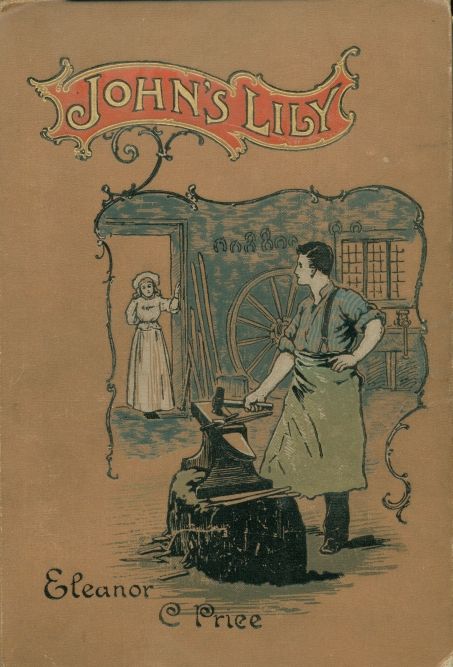
He was finishing some work that afternoon, whistling a tune as his hammer clanked on the anvil, looking very black and very hot, with his shirt sleeves rolled up above his elbows, when the light from the door was suddenly darkened. John looked up, pushing back his hair from his forehead, and then stood upright, balancing his hammer and staring with bewildered eyes. In the doorway stood a tall young girl, dressed in white, with a shady hat, under which her fair hair fell in curling ripples to her shoulders. She was slender and pale, but though she did not look strong, the smile that shone in her blue eyes spoke of perfect happiness. She looked as if her life was all made of summer days, and better than this, the sweetness of her expression seemed to show that she loved making others happy. As she stood looking at John, the pale cheeks flushed a little, and she almost laughed at his wondering astonishment, but she said nothing.
"Why—Lily!" said John, under his breath, and then he too coloured suddenly, as if ashamed of himself. "I beg your pardon—I never thought of seeing you like that—a grown-up young lady."
"I'm not grown-up—I'm only fourteen," said Lily, and she stepped inside the forge and held out her hand. "Oh, John—I'm so glad to see you again. You're just the same—and how is mother?"
"She's very well, thank you," John replied; but he looked at his own black hand and shook his head and laughed. "No, that won't do," he said. "But it is your own self, and—I hope your father's well."
"Yes, thank you, John. We have come to Sir Henry Smith's for a few days, you know, and I did so want to see if you had forgotten me, and I asked Lady Smith if I might come here all alone, and she sent me in a pony-cart—it's waiting in the village. Did you think I was never coming back any more? I believe you had half forgotten me."
"No, no," said John hastily. "I couldn't ever forget you. But don't you see, you've grown up; you ain't the little child any more, and standing there with your back to the light, 'twas no wonder I was a bit puzzled. And it's a long time, to be sure——"
"So it is—but I've written to you always, haven't I, John? And you know how my father took us abroad very soon, so that we haven't been much in England since I left you. As for you, John, you are not altered in the very least. Just exactly the same."
"Ain't I? I've got some grey hairs, Miss Lily. Well, I have much to be thankful for," said John. "I've got a good wife and a dear little child. Now please to go to Mary in the house, and I'll clean myself and be with you in a minute. You'll take a cup of tea with us, for old sake's sake?"
"Please. I should like it very much," said Lily.
Mary was looking out of her kitchen door. She had heard John talking to some one in the forge, and had seen the light little figure in the doorway, and guessed very well who it was, though she had not seen Lily since the terrible day of Carsham Fair, when the child was the innocent cause of the greatest sorrow of her life. But she bore no malice for that now; she was far too happy as a woman to find it worth while remembering the troubles of a girl, and she could not have been married more than six years to John without catching something of his wide, generous, simple way of looking at life. It was with the kindest smile, therefore, that she came forward to welcome Colonel Maxwell's daughter.
"Oh, Mary, what a naughty little girl I was!" said the child, putting up her face to be kissed. "And you were always kind to me. But there never were people like John and mother. Tell me again, before he comes in, about his bringing me home that day."
"I'll tell you everything you like," said Mary, smiling. "But won't you come into the garden first and see the flowers. You used to like them—and mother's there—and you know there's another Lily."
"Yes; but why did you call her so?"
"It was John's wish. I expect he couldn't do without a Lily."
The old apple-trees seemed more bent, more mossy; their shade seemed deeper on the green garden paths; and there, her grandmother's faltering steps left far behind, a little child came running—a little shy child—and buried her face in her mother's gown. The girl, her namesake, looked down at this small creature wonderingly. This was the first strange element in her old home; a child who had more right there than she. The garden that used to be her own, with all its fruit and flowers, where she was queen, and the first of her subjects used to carry her throned on his shoulder—her garden now belonged to this fat, rosy creature of five years old, whose life had been troubled with no adventures, no wild changes of losing and finding, who had a little brown face and dark eyes like John's, and hair of that brown fairness which means to become dark by-and-by. This was Lily—John's Lily now;—but the child of fourteen, with all her sweet fancies and romantic recollections, shook her head and thought that this baby's name did not rightly belong to her. A dear little loving child, but not one of the flowers that rule the garden. She would be John's little maid, her father's pet and darling, but never a princess that ruled him with a look or touch, never the real "John's Lily."
But Mrs. Randal, looking eagerly over her spectacles, rather lame with rheumatism, came hobbling hastily along the path by the strawberry-bed, and her welcome was loving enough to make Lily Maxwell feel that there was one heart here, at least, where she still had the warmest corner. And then John came, with clean hands and face and in his Sunday coat. He was a little shy with this young lady, who was somehow so very different from the child who had been taken away from him seven years before. Just a shadow of her old wistfulness came into Lily's blue eyes as he turned away from her after a few words and caught up his own little girl to his shoulder, and whispering, "Lily like a ride?" rushed off with her round the long old path, the nice green slope round the strawberry-bed, so familiar to another child long ago.
But it was all peaceful and happy. There could not, indeed, be a happier village home than this where Lily came to visit her old friends. She stayed to tea with them in the quaint old kitchen, and lingered there, talking and telling them long stories about her life and that of her brothers, till the shadows were growing long, and the evening sweet and cool. Then she left them, promising to come again soon.
And little Lily Randal, John's own little girl, proudly showed her father what the pretty young lady had fastened round her neck: a gold chain with a small locket engraved with the letter L, just like one she wore herself, except that the hair in it was not dark, but pale gold like her own.
"She always was a sweet child, and she is still," said Mrs. Randal. "They haven't spoilt her. She told me the four years with us was the happiest of her life. I hope not. I hope there's many blessings in store for her."
"She was always something like an angel," said John thoughtfully. "When I looked up and see her standing in the door, all in white like that, I remembered when she come to me in the railway carriage. There was always the same look in her eyes."
And Mary smiled and said, "Ah! she'll always be John's Lily."
THE END.
LONDON AND WESTMINSTER:
WELLS GARDNER, DARTON AND CO.