
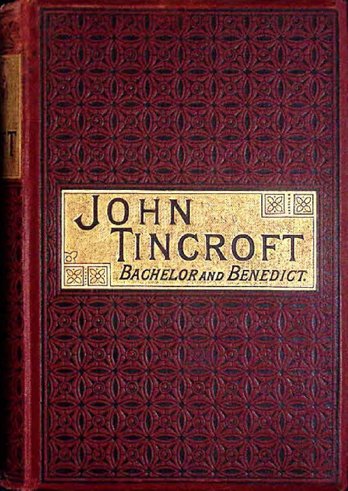
The Project Gutenberg eBook of John Tincroft, bachelor and benedict
Title: John Tincroft, bachelor and benedict
or, Without intending it
Author: George E. Sargent
Release date: March 18, 2024 [eBook #73193]
Language: English
Original publication: London: The Religious Tract Society, 1891
Transcriber's note: Unusual and inconsistent spelling is as printed.
JOHN TINCROFT
BACHELOR AND BENEDICT
OR
WITHOUT INTENDING IT
BY
GEORGE E. SARGENT
AUTHOR OF
"THE STORY OF A CITY ARAB," "THE STORY OF A POCKET BIBLE,"
ETC., ETC.
LONDON
THE RELIGIOUS TRACT SOCIETY
56 PATERNOSTER ROW, 65 ST. PAUL'S CHURCHYARD
AND 164 PICCADILLY
MORRISON AND GIBB, PRINTERS, EDINBURGH.
CONTENTS.
CHAP.
VI. JOHN TINCROFT'S RESOLUTION
XIV. JOHN TINCROFT'S BOLD STROKE
XVI. JOHN TINCROFT STILL UNDER A CLOUD
XIX. WHAT HAPPENED AT LOW BEECH FARM
XX. HOW TOM GRIGSON SPED IN HIS WOOING
XXI. JOHN TINCROFT AT HOME; AND THE SKELETON THERE
XXVIII. THE LAST OF THE HOLLY ARBOUR
XXIX. "BLESSED ARE THE PEACEMAKERS"
JOHN TINCROFT.
CHAPTER I.
AT LIBERTY HALL.
SO many years ago that those who are old now were young then, and so few years ago that deeds then transacted are fresh in the memory of many who are living now, John Tincroft, an undergraduate of Oxford, was invited to spend the long vacation with a college friend.
And the invitation came very opportunely, John thought.
For one reason, he had no home of his own. His parents had been long dead, and a distant relative—a London merchant—who had charge of his orphanhood, was not particularly, certainly not passionately, fond of him. This gentleman took care to explain, however, to all whom it might concern, that he had always done his duty towards the lad. But, as regards this duty, whatever else it might include, it possibly had not occurred to Mr. Rackstraw that the providing a happy home should have formed a component part of it.
In the next place, John Tincroft was comparatively poor, and he was becoming poorer. His patrimony, a small one at first, had been woefully diminished by his three years' term-keeping, and still more so by carrying on a Chancery suit; that is, by paying his lawyer to carry it on for him. He was not in debt, however, which was something in his favour—or perhaps in his disfavour with college tradesmen.
But he was much nearer the bottom of his purse than he cared to be, when the offer of a three months' residence in a hospitable home was placed before him. He had only one or two more terms to keep, and he wisely thought that he could not employ this last long vacation better than in reading with young Grigson (if he would be read with) as was proposed. So the invitation was accepted.
In another year, Tincroft would be far-away from England. He was going to India in the Civil Service. This much his guardian, who had no sons of his own to step into the appointment, had done for him, without much cost or trouble to himself.
"It will be the making of you, if you mind what you are about John," said Mr. Rackstraw; "and as to that plaguey Chancery suit and the Tincroft estate, it isn't worth your while staying in England to be the winner—or the loser, which is the more likely of the two."
He did not add audibly, "And I shall be well rid of you into the bargain," though probably, he thought it within himself.
John Tincroft had already commenced making preparations in a small way for his expatriation, as well as for his future duties; that is, he had plunged head foremost into certain Oriental histories, under a misty idea that they would be useful to him when he got to Calcutta.
John Tincroft, though an Oxford "gownsman," was a shy and awkward youth, of about two or three and twenty. He had never had the advantage of society—ladies' society, of course, is meant; and this deprivation had been hurtful, for it had made almost a misanthrope of him. In this respect, however, he had been the victim of circumstances.
His mother he had never known: he had no sister nor aunt nor fair cousin to initiate him into the mysteries of easy intercourse with his species. His school breeding, and, after that, his college training, together with his guardian's want of sympathy, had had the further effect of monasticising his young life. And this effect, which had grown into a habit, had been intensified by his narrow circumstances. Everybody knew that John Tincroft was under the cloud of straitened means, and who does not know, or cannot understand, how this evil reputation (according to worldly maxims) inexorably closes one door after another against those who lie under it?
Tincroft, at any rate, had felt it keenly, and it had increased his natural shyness.
The isolation of which we have spoken had favoured him in one respect, however: it had made a hard student of him, which, perhaps, he might not otherwise have been. For, to tell the truth, John Tincroft was not over-bright, though, under the circumstances, which otherwise were in his disfavour, he had thus far, and almost to the end, passed through his college course creditably.
More than this, he had happened to be of some use to Tom Grigson, the hospitalities of whose home he was about to experience. How the young freshman in his first term managed to get into trouble with the authorities of the university, and how the older and remarkably quiet fellow-collegian was accidentally, but fortunately, able to help him out of it; how the two thereafter formed a kind of friendly acquaintance; how Tincroft aided Grigson in his attempts at scaling some of the lower heights of Parnassus; how, in return, the younger occasionally enticed the elder to the Minor dissipations of a boating trip to Nuneham, a scamper to Woodstock on hired hacks, a stroll to Wytham strawberry gardens—(are they there still, I wonder?)—or a cricket match on Bullingdon Green, must be left to another pen or another time.
Once, I grieve to say, the volatile Tom induced the sober John to a surreptitious badger-draw in Bagley Wood, where they had "capital sport," as Tom averred; and on another occasion—but this is a secret—the two started off, under shelter of a winter evening, to the neighbouring town of Abingdon to witness the débût of a young actress at a temporary theatre there, the severe morality of Oxford forbidding stage-plays within the precincts of the sacred university town; and once, only once, the recluse was entrapped by his tempter into the revelries of a wine-party—once was enough, for, as the due punishment of his sin, poor Tincroft had a splitting headache which lasted him three days. All this, in more minute detail, must remain untold.
To compensate for these occasional outbreaks, it is only fair to say that the influence of the steadier gownsman was often exerted in keeping his more mercurial friend from mischief, and in prompting him to a decent attention to his studies. An assurance of this fact from Tom Grigson himself had been the procuring cause of invitation to Grigson Manor House, which was presided over by the head of the family—Tom's elder brother.
Portmanteaus, trunks, boxes, and carpet bags were heaped on the roof of the Tally-ho. There was a huge mountain of them, for some dozen or two gownsman were "going down" that day on this particular coach, and dozens more would follow on the morrow, and more morrows after that. And so with all other coaches going out of the university city on those days and every succeeding day till the old colleges were empty.
From the Angel, up the High Street, by Carfax, along the New Road, over the Botley bridges, on and on the coach rattled merrily, with John Tincroft and Tom Grigson among its passengers. It was early morning when they started from Oxford; evening was drawing on when they were safely deposited with their luggage at the town on the old coach road nearest to their destination. There the dog-cart from the Manor House received them, and in another hour they were safely landed, had performed their ablutions, changed their dusty travelling attire, and were doing justice to the late dinner specially prepared for their benefit.
The shy, awkward gownsman had no reason to complain of his reception. His host was a bluff, good-natured bachelor, older than his brother Tom by a dozen years or more. He prided himself on being a country gentleman of the good old school, without any nonsense about him (which, however, sometimes implies a good deal of that commodity); and the hearty welcome he gave to the invited guest was none the less agreeable, perhaps, for being rough and homely as well as sincere.
"You'll have to take us as we are," said Mr. Richard Grigson: "all I can say is that this is Liberty Hall."
And so it was Liberty Hall. It was a pleasant change for John Tincroft, who, as we have said, had never known what it was to have a comfortable home of his own. The Manor House was a large, rambling old place, something between a mansion and a farmhouse, with plenty of rooms in it, well furnished with old-fashioned furniture. There was one room with a cheerful aspect, overlooking a pretty flower garden, and bookcases lining its walls: it was the library of the old house. Tincroft sat there from day to day—one hour with Tom Grigson reading, and as many hours as he pleased by himself, studying for his vocation in the East, till he almost forgot that he was "under a cloud."
Richard Grigson was a good specimen of his class, and a good match for his house. He was half farmer, half idler. He was rich, so he had no need to work; was strong in constitution and active in habits, so he was a sportsman. He shot in shooting season, hunted in hunting season, and thought it a waste of time to read much beyond the daily and weekly papers and a sporting magazine. Add to this, Richard Grigson was reckoned a fair sort of landlord by his numerous tenants—small farmers mostly—so long as they paid their rents with tolerable punctuality. We shall, however, know more about him by-and-by.
As to Tom Grigson, the collegian, he would very well have liked to be as idle and active as his brother; but the fates were against him, as he would have said. He was a younger brother, with only a younger brother's portion—a very small one; and needs must that he would have to work for his living, in some respectable and gentlemanly way, of course, but still to work. So he had consented to go to college, to learn how to do it, or how not to do it, as the case might be.
To tell the truth, Tom was not much more studiously inclined than his elder brother. At any rate, he did not see the fun of poring over books in vacation time, when he could be on horseback half the day, and lounging the other half of it to his heart's content. Very soon, therefore, John Tincroft had the library to himself, and worked away with his Oriental studies.
"This will never do, Tincroft," said his host to him one day, two or three weeks after his arrival; "you are positively wearing yourself to skin and bone with your books and all the rest of it."
"Am I?" said John, glancing nervously at his nether extremities, and feeling his arm above the elbow. "No, I don't think I am, though," he added, in so serious a tone that his friend laughed.
"I didn't mean to alarm you, old fellow; and now I look at you again, you have some muscle left, though none too much. But come, you must follow Tom's example—the idle scamp—and lay aside your books for a while. They'll wait for you; they won't run away from you, I'll warrant."
"But I shall have to run away from them soon," returned John, gravely.
"So much the better, for anything I can see to the contrary. A jolly time you will have of it when you get out to India; tiger-hunting, elephant-riding, and all that sort of thing. Do you know, I half envy you!"
"You forget fever and sunstroke and snakes, and all that sort of thing," retorted the guest. "And even the tigers you speak of—supposing such a thing as a tiger-hunt for me, which isn't likely—but even they have claws and teeth."
"I must give up India, then," said Grigson. "But seriously, friend, your shutting yourself up in this room all day—" they were in the library—"when you might be enjoying yourself out and about, is good neither for body nor mind."
"I must work, you know, Mr. Grigson," returned John.
"No doubt: so must we all, I suppose. But that doesn't mean that we are never to do anything else. 'All work and no play,' you know, 'makes Jack a—' I beg your pardon, though; I didn't mean that you are 'a dull boy,' though you are Jack. But come, you must shut up for once. We are going to drive over to the Mumbles. I have some business to do with Elliston; and Tom wants to introduce you to the ladies there—Jane and Kitty. By the way, if you could get hold of one of them, Tincroft, you might burn your books and stop in England. And why shouldn't you?"
"I shall never marry. I have no vocation that way. If I were independent, I might; but what's the use of talking? No, thank you, Grigson, I would rather be excused the Mumbles."
"You must do something of the sort, or where is the use of having a holiday? By the way, next week, Tuesday, we have our summer picnic; all the tenants that like to come, and their families; wives, daughters, sons, lovers, and all the rest of that sort of thing. You'll join us there, at any rate?"
"What do you mean? I mean, what do you do? Where do you go?" John Tincroft asked dreamily.
"Oh, as to the going, we shan't have to go far. They come to us. We have tables, forms, and chairs out on the lawn; and there's eating and drinking, you may make sure of that; and after that—but you'll see enough of it before it is over. And you must put your books away for that day, at any rate."
"Are your tenants a very noisy set?" asked quiet John.
"Oh, they are not as still as mice, and they don't roar quite so loud as lions. They are a decent set altogether; and with two Oxford men to keep them in order, we shall do. It will be something to amuse you, I dare say."
"I am afraid not," said John, wearily; "but I suppose I must do what you bid me."
"Of course you must," said Richard Grigson.
CHAPTER II.
THE LOVERS' WALK.
LEAVING Tincroft for the present to the hospitalities of the Manor House, we introduce two other actors in our domestic drama. The time is evening; the place, an old-fashioned garden; the date, a year or thereabouts before that of our previous chapter, for necessity is laid upon us to take a retrograde step or two before fairly starting off in our history.
There was a shaded walk in the garden just referred to, which, from time immemorial, had been known as "the lovers' walk." True to this designation, the grass-path was, on the evening of a summer's day, trodden by two lovers, who paced up and down it side by side.
"I don't like this going away from you, Sarah dear, any better than you like it yourself," he said, in a tone half-sorrowful, half-remonstrative.
"What occasion is there for your going away then, Walter?"
She was a fair-haired, blue-eyed girl of eighteen, who asked this question. Her eyes were filled with tears as she looked up into her lover's face. It was hard to withstand such a pleading look—so Walter doubtless felt.
"You know the reason why, Sarah," he replied, tremulously; "I have told you, over and over again, that father says there are too many of us at home, eating up all the profits of his small farm, and that one of us boys ought to be getting on at something else, and earning a living for himself."
"I know all that, Walter; but there is no occasion for you to be the one. You are the oldest, and ought to be at home. And we going to be married, too; and that will have to be put off—with such a home as you know I have got! Oh, Walter, Walter, it does not seem as if you loved me much!" Saying this, the now weeping girl threw herself on a rustic seat and sobbed sadly.
What could the lover do but seat himself close by her side and speak soothing words, comforting words, encouraging words, very gently, very lovingly?
But she would not hear him.
"I know why it is; you want to be rid of me now you know that there's nothing to be got by me—that father has no money, and can't pay back what your father lent him, and it's all an excuse your going away to make more room for the rest. Why couldn't George go if somebody must—or Alfred, or James?"
"Sarah, you don't mean what you say—you can't mean what you say."
The words were spoken very gravely, we may be sure, yet not sternly. Walter Wilson was a commonplace man enough—a rough farmerly young man, without much education; but he was tender-hearted and true-hearted, and his love for his cousin was strong. For they were cousins, these two, as well as lovers—the children of two brothers.
Matthew Wilson (Walter's father) and Mark Wilson (Sarah's father) were both farmers in a small way, but they were widely different in character, different also in regard to their home surroundings. Matthew, for instance, had a large family; Mark had but one child, the Sarah of our narrative.
Matthew was hard-working and sober; Mark was idle and dissipated. In spite of his large family, Matthew had prospered, while Mark—who, by the way, had the better farm of the two—had managed to go down in the world, sinking lower and lower, as time went on, into debt and despondency. So it came to pass that, in one particular strait, and with promises of stricter attention to business in future, Mark had been saved from absolute or immediate ruin by the generosity and confidence of his brother, who placed nearly the whole of his hard-earned savings in Mark's hands—and lost them.
Matthew had a hearty affection for his brother, but he liked money too; and it was not in human nature—at least, it was not in his nature to be indifferent to the loss of the four or five hundred pounds which he had lent to Mark when the certainty came home to him that they were lost. In his first paroxysm of vexation, he vowed that, brother or no brother, Mark Wilson should smart for his treachery; and, though he soon cooled down in these thoughts of vengeance, he declared that neither he nor his family should hold any further intercourse with the man who had stripped him of almost every ready-money pound he could call his own.
This, however, was easier said than done. Matthew's eldest son, Walter, was not only in love with, but had been sometime affianced to, his (Walter's) pretty cousin, Mark's daughter, and that with the mutual consent and liking of the parents on either side. And Walter, at any rate, had no thought of visiting the sins of the father upon the innocent girl, and—himself. He even clung with the greater fondness to poor Sarah, who could not be held accountable for her father's misconduct and consequent misfortunes.
Matthew himself acknowledged this; but inwardly determined, if possible, to sever the only remaining link between his unlucky brother and himself; and probably thinking, not unwisely, that such a connection would be a drag to Walter in after-life, he insisted that his own altered circumstances made it necessary that his eldest son should leave home. He did this trusting to the probable chances that absence would, in some way or other, effect the separation which he had no power to compass by absolute authority. But he had a fair reason also for this determination. Walter, of all his sons, was the most fitted to push his way in the world. And, added to this, an old school-fellow and friend had made overtures to him to join him in a distant part of the north country, where he himself was established as a land surveyor.
These explanations given, we return to the two disconsolate lovers.
They were again pacing the shady walk, sorrowful enough; but Sarah's complaining mood had disappeared for the time, and she was listening to the hopeful pleadings of her lover. What lover is not hopeful? Can love be without hope?
"It won't be long, darling. Two years will soon pass away, and then I am to have a share in Ralph's business. We shall be sure to get on, for Ralph is a capital fellow, and so clever; and I—well, I can work, you know; and with you, Sarah, to brighten up my prospects, I'll work like a slave, and think nothing of it."
"Dear Walter!"
"The worst of it is, I shall be so far-away that it won't be possible for us to see each other till the two years are gone; but you won't forget me, love?"
"Forget you? Oh, Walter!"
"I know you won't: you are such a darling, you know, to remember. And then, when the two years are past and gone—"
"It is a long time to look forward to, Walter," sighed the young lady. "I shall be quite an old woman by that time."
"An old woman of twenty! What shall I be then? But we won't make a trouble of that: only say that you'll try to keep up a good heart. Courage, my pet, and all will turn out well in the end. And as to this move, I don't know that it isn't the best thing that could have happened. Farming isn't much without plenty of money to carry it on; and if a fellow like me hasn't got money, his knowing how to work on a farm doesn't help him much. He is nothing better than a day-labourer. So, Sarah dear, give me a kiss, and say 'tis all right."
And so the lovers parted that evening.
The next morning, Walter was travelling far-away—every mile widening the distance between him and all that his heart held dear.
Walter Wilson was not a hero exactly; but he had some good stuff in him, for all that. He was, at any rate, sturdy, honest, persevering, and affectionate. All that is necessary to say for him in this chapter, however, is that he reached his destination in due course, joined his friend Ralph, and entered with a good deal of energy on his new line of life. Here, for the present, we leave him.
Poor Sarah, his cousin and affianced wife, had a more trying ordeal to pass through. Her home was not a happy one. Her father was now as often in liquor as sober, and, in whichever state, he was dissatisfied and quarrelsome.
Her mother had never been very managing as a farmer's wife, and what qualifications she once possessed, had long since been abandoned. The cloud that hung over her household was so dark and threatening that she could see no light breaking through it, and she had become hopeless. Worse than this, the habit which had ruined the husband in health and circumstances was insensibly gaining ground upon the wife. She drank secretly, and was for days together incapable of conducting her family affairs. Then, waking up to a sense of her degradation, she made feeble and unsuccessful efforts to "set things to rights."
This was bad enough for the daughter, who had neither strength of body nor mental capacity to cope with surrounding difficulties; and who, now that Walter was gone, had no one to encourage or comfort her. For she was at feud with Walter's family.
Her uncle Matthew looked coldly upon her. Her aunt treated her as if she were a puppet or a doll—so she said—when they met, which was not very often, but it sometimes could not be avoided; for Mrs. Matthew now and then looked in to see how Mr. and Mrs. Mark were getting on, and to report at home what she saw and heard. And these reports served only to widen the breach between the two brothers and their households.
As to her cousins, George, Alfred, and James, they plainly made it to be understood that they considered their brother Walter a fool for tying himself up to "a helpless bit of goods" like Sarah, though she was his cousin and theirs. And they were naturally enough bitter against their uncle Mark for having made off with so much of their father's cash.
All this was hard upon Sarah. Of course, if she had been made of the stuff of which heroines are supposed to be formed, she would have risen above all discouragements. But she was not a heroine. She was merely a farmer's daughter, poorly educated, but fond, and, we must add, feeble also, with no particularly vivid apprehension of the sterner duties of life, and with no very strong principle to help her on in a course of self-denial and self-sacrifice, should this be needed. She knew, however, or thought, that she loved Walter, and she had full faith in his fidelity.
One of Sarah's greatest trials was in the unkindness of her cousin Elizabeth, Walter's sister. With only a year difference in their ages, the two girls had been very close and intimate companions from childhood; and till within a year or two of the date of our history, their friendship had been unbroken. And it was Elizabeth who had been, first of all, the secret prompter of the engagement between the cousins, and then the private go-between of the two lovers until that engagement was ratified by the higher powers. Now, however, all old associations were severed; and Elizabeth, as Sarah well knew, had employed all her skill, though unsuccessfully as yet, to induce her brother Walter to break off the match which she prophesied would be an unhappy one.
Thus completely alienated from her former friends, and more sinned against than sinning, with an unhappy home, and more required of her in domestic duties than she had power to accomplish, poor Sarah Wilson would have given way to utter hopelessness but for the bright vision of Walter and the happy home—in nubibus; where we must leave her, while we take up the former thread of our drama.
CHAPTER III.
THE PICNIC.
AS bright a day as could be desired opened upon Richard Grigson's picnic. Determined that for one day at least his recluse guest should be drawn out of his shell, the hospitable master of the Manor House declared himself unequal to the task of making preparation for his visitors without John Tincroft's help. So the morning was occupied in setting out tables, forms, and chairs on the lawn, in daintily dressing up bowers, and, finally, in drawing up a programme for the evening's entertainment.
"Are you much of a cricketer, Tincroft?" demanded the squire.
"I detest the game," said John, heartily, remembering a stunning blow he had received from a cricket-ball on Bullingdon Green.
"That's capital. Then, while Tom and I are at it with the young fellows, you will have to take care of the ladies."
"Worse and worse!" exclaimed the guest, in sore dismay. "Your brother knows I am not a ladies' man."
"The more's the pity," said the remorseless squire; "and the more reason why you should begin to be."
"But, my dear friend—"
"There's nothing to be afraid of, Tincroft," put in Tom, who rather enjoyed the perplexity of his college friend. "There will be only a score or two of old women and a few pretty girls. And if you don't succeed in amusing them, they will amuse you, and themselves too, I daresay."
"If they can't do that, they will fare badly, I am afraid," said John, disconsolately, wishing himself for the time safe back in his Oxford rooms.
"We shall have the parson here to help you out," continued Mr. Grigson.
"And to keep you out of mischief," added Tom, laughing.
With a heavy heart John Tincroft at length took refuge in the library, anathematising all picnics in general, and this one in particular; by the time the dinner-bell sounded, he was deep in his Oriental studies.
It was an early dinner; but before it was well over, the invited guests began to arrive, and were spreading themselves over the lawn in detached groups, or were wandering in the gardens, that day thrown open to them. An hour later, they were clustering round the tables. An hour later still, the wickets were pitched in an adjoining meadow to which the host and his brother and the young tenant-farmers had adjourned; while the fair sex, with a sprinkling of the older men, were devising other means of employing the next two or three hours of the evening.
Among these, in company with Mr. Rubric, the grey-headed clergyman of the parish, John Tincroft walked about uneasily. Under the protection of the reverend gentleman, however, he managed not only to keep down his natural shyness, and to conceal his awkwardness, but to make mental notes of the, to him, strange society into which he found himself thrown.
Especially his attention was drawn towards a remarkably pretty young woman (so he thought her), who, seated at one of the tables a little apart from the rest, was pouring out tea—for the tea-things had not yet been removed—for an elderly couple, the only other remaining occupants of the half-dozen or more seats at that particular table. The young person was rather smartly dressed; and under her bonnet, which was redundant of pink satin bows, shone out, as John believed, the brightest pair of blue eyes it had ever been his fate to encounter. Perhaps it was the previous exercise in the open air, or it might have been the exertion of tea-making and tea-drinking, or it might even have been the consciousness of having attracted the attention of the gentleman from Oxford; but, from whatever cause, a bewitching blush overspread her cheek, and mantling there, took refuge under the fair, glossy hair which hung low down so as half to conceal an alabaster neck in delicious curls, for so John apostrophised both neck and curls in his foolish thoughts.
It is not to be supposed that the Oxonian had more than a hasty glance, for this first time, of the rustic beauty. His natural shyness indeed would have cut still shorter even this brief observation, if the clergyman by his side had not halted at the table to make two or three commonplace remarks to the elderly pair, who seemed not particularly gracious in their replies.
Accordingly he, still accompanied by his friend from Oxford, passed on to another group some distance off; at another table. Here the pair were more pleasantly received, and an invitation was given to them to take seats which, as in the other instance, had been vacated. The invitation was accepted.
"There's a cup of tea or two left in the bottom of the pot," said an oldish lady who had officiated; "and there's clean cups and saucers, and there's lots of cake."
"The boys were in such a hurry to get away to the cricketing," added a farmerly man at her elbow, "that they forgot what they came here for, I think."
While these and other compliments were passing, and after being introduced to the hearty speakers, John Tincroft noticed that this group consisted also of three individuals—apparently, as in the former instance, father, mother, and daughter. Singularly enough, also, there was considerable resemblance between the two men at either table. They were both elderly, grizzled, and weather-worn. Their countenances were alike in form and feature, though remarkably different in expression; and even the tones of their voices were similar. The females, however, of this table presented a striking contrast to those of the other: the mother, if she were the mother, being stout and red-checked, whereas the elderly woman in the other instance was thin and pallid; while the daughter, if she were the daughter, was coarse and hard-featured, with hands which might, as John opined, have been accustomed to grasping the stilts of a plough, or wielding a flail upon occasion.
"And your eldest son Walter—you hear from him sometimes, I suppose, Mr. Wilson? I hope he is getting on in his new profession," said the clergyman, when one or two other topics of conversation had been exhausted.
"Oh, bravely, sir. Ralph Burgess and Walter yoke together uncommon. Their business is brisk, and Ralph says as how Walter takes to it like anything."
"He has not been home to see you since he left, a year ago or more, I think?"
"No, he hasn't," said the farmer; "he is a longish way off, you see, sir."
"True."
"And a good thing too," said Mrs. Wilson, sharply.
"Indeed, my good friend; now I should have thought you would have been glad for him to have been nearer you, so that you might—"
"Better away," said the mother, interrupting her pastor.
"Dear me!" he ejaculated, quietly.
"You see, sir," interposed the husband, "we should be glad enough to see Walter; but there's others, leastways there's another, would be glad enough too. And that's what we don't want."
"And don't mean, if we can help it," added the young woman, who had not hitherto spoken; and the natural hue of her cheeks glowed with a deeper, darker colour.
"Ah! I understand," said the clergyman, rather reprovingly, or so it seemed to John. "You mean that you wish to break off his connection with his cousin," he looked towards the other table as he spoke; "but is this quite right, Mrs. Wilson? Do you think it is, friend Matthew?"
"Walter shan't marry Sarah if we can hinder him, right or wrong," exclaimed the young woman, fiercely.
"Fie, fie, Miss Elizabeth!" the meek clergyman interposed.
"I am not wanted here, I think," said the shy Oxford man to himself, when he had heard enough to understand that a family matter was in danger of being discussed. Accordingly, he slipped away from the table, and wandered without his guide to another part of the lawn.
By this time the tables on the lawn were for the most part deserted, and the greater number of the tea-drinkers had strolled into the cricketing meadow—the old farmers to criticise the play of the juniors, and to compare the puny strokes and new-fangled bowling of modern Toms, Dicks, and Bills, with those of former cricketers in the good old times when they themselves also knew how to handle a bat. The young maidens went to watch and admire their lovers and brothers as they increased the score of runs.
The lawn was not altogether left desolate, however, and Tincroft noticed that the first trio of whom we have spoken still lingered at the table where he and the rector had left them. I do not know whether or not his curiosity was quickened by the evident reference he had just heard to the pretty girl at that board, or whether it arose from the strange and unaccustomed sensation his accidental glance had awakened in his breast; but certain it is that before he had been alone many minutes, he was steering his course towards the group. Not a straight course either; but by repeated tacks, and as though he were unaware of his own intention, he presently arrived within eyeshot of the pretty flaxen curls, the alabaster neck, and the bright eyes of the fair object of his admiration—yet not near enough to attract special attention.
If he had not been shy and awkward, nothing of course would have been easier than to have gone boldly up to the table and, under cover of being the friend and guest of the squire, making acquaintance with the elderly couple; and thus have gazed his fill at the beauty by their side. This feat was too daring to be attempted, however; and it answered his purpose quite as well, probably, to gaze at the fair Dulcinea at a safer distance.
The tea-drinking was over at that table as elsewhere; and now John Tincroft was sorely troubled to see that the pretty girl was crying. That is, he judged as much, for a handkerchief was repeatedly used as though to wipe away the tears which he was too far-off to discern. He was not too far, however, to hear angry tones from the farmer, either seconded or answered by shrill objurgations on the part of his wife, and apparently directed towards the weeping girl.
"I wish I knew what to do," muttered John to himself; "but there, what have I to do with it? What's come over me, I wonder?"
Leaving this question unanswered, John walked slowly away; but either unable to resist the fascination which had "come over" him, or moved by a chivalric desire to protect the damsel, if need were, he presently retraced his steps, venturing nearer this time, though partially concealed from view under the foliage of an old chestnut tree, at the foot of which was a rustic seat.
"I have a right to be here," quoth John, inwardly; "and if people choose to talk loud enough in other people's grounds to be overheard, it is no fault of mine."
If Mr. John had cared (which he did not) to hear the dispute, he was baulked, for the conversation had by this time subsided. He saw plainly enough, though, that the girl was in some kind of distress, and he partly guessed the reason when he observed that her father's face was flushed, and that he was, with unsteady hand, pouring out into a tea-cup some transparent fluid from a flask he had drawn from his pocket. He had evidently had recourse to this before, and was again raising the cup to his lips when a voice from some distance caused him to hold his hand and look round.
Tincroft looked too in the direction of the voice, and saw his friend the clergyman, with Farmer Wilson and his wife within a dozen yards of the table. It was Wilson who had spoken. He spoke again when he came nearer.
"So you are at it again, Mark," said he, angrily, and looking the other in the face. "If you must be getting drunk," he added, snatching the cup out of the drinker's hand, and dashing out its contents on to the greensward, "you might at least have the decency to do it at home, and not come here making a show of yourself, and disgracing your kith and kin."
"And so I've been telling him, and so has Sarah," cried Mrs. Mark; "but he wouldn't heed us—you know you wouldn't, Mark," said she, deprecatingly.
By this time the unhappy man, whom our readers will before now have recognised, was on his feet, and giving vent to ebullitions of rage against his wife, his daughter, his brother, and all and sundry besides. And it was plain to Tincroft that the poor miserable man had made such bad use of his time and his gin-flask since tea as to be unsteady alike on his legs and in his speech.
The quarrel might have heightened to a disturbance had not the peace-making clergyman interfered, by replying to the thickly-spoken demand of Mark to his brother—"What business is it of yours what I do or don't do, Matthew? What right have you to come prying about like a sneak, as you are?"
"Gently, gently, friend," said the rector; "and you, Mr. Matthew, don't answer your brother, for 'grievous words stir up strife,' you know, and 'a brother offended is harder to be won than a strong city.' It was I, Mr. Mark, who persuaded your brother and sister to come and speak to you and Mrs. Mark here. I told them that it would not look well if it were known that you were all at this pleasant holiday party, and should go away without having passed a word with each other. I am sorry now that I interfered."
"Oh, never mind, sir, never mind," said the sober brother; "Mark knows that I know that there's nothing new in this. As good a fellow as ever lived, sir, till he took to drinking; and now—there, the least said the soonest mended."
And saying this, Matthew Wilson took his wife by the arm and walked slowly away, leaving Mr. Rubric to make what impression he might upon the unhappy brother.
Meanwhile, as John Tincroft had seen from under the chestnut tree, the pretty daughter of Mark had vanished from the scene; and coincidently with this, all his interest in it was over. He noticed only that his friend the clergyman sat down by Mark's side, and seemed to be giving him a quiet lecture, which was listened to, or rather received, in stolid silence; and that afterwards, Mark and his wife retreated through the gate of the Manor House grounds into the high road, so that he saw them no more at that time.
Then, seeing that the rector was walking towards the cricket-field, he followed, and joined company, arriving at the ground just as his college friend Tom Grigson was bowled out, after an innings of an hour, and having made forty runs for his score.