
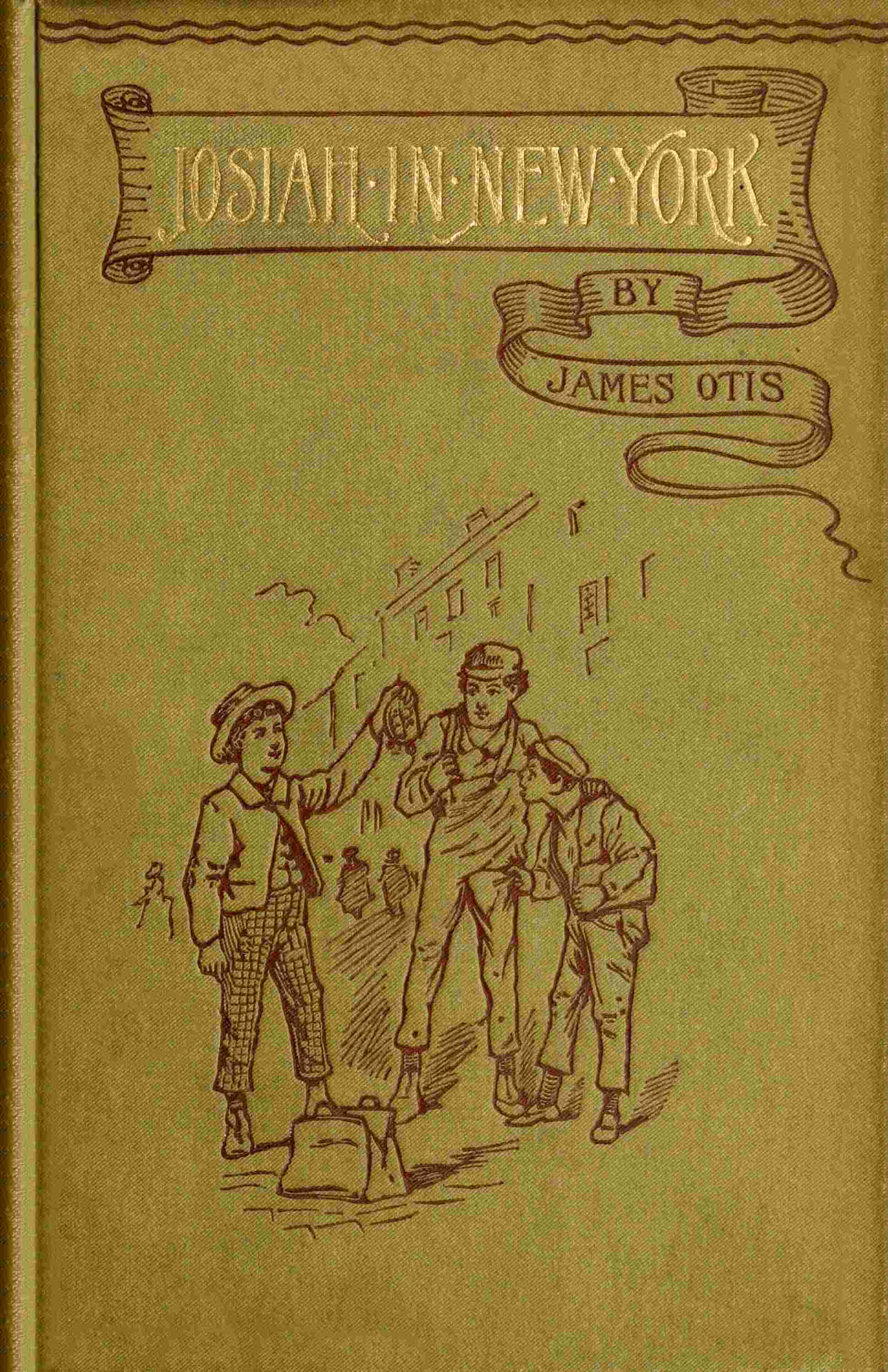
JOSIAH IN NEW YORK;
OR,
A COUPON FROM THE FRESH AIR FUND.
CHAPTER I.
THE SHINDLE FARM.
On this particular day an almanac would not have been needed to prove to the visitor at the Shindle Farm that winter was near at hand.
The wide-spreading trees leading from the road to the low-studded house, which made up in breadth what it lacked in height, had already put on their autumnal dress of crimson, gold, and brown, embroidered here and there with green left over from the last summer’s wardrobe. The enormous barn was crowded to overflowing with fruits of the harvest. Mows were heaped high with sweet-scented hay, and the corn-bins filled almost to bursting. The granaries seemed to groan under their heavy burdens, and the sleek cattle, noting the lack of grass in the pastures, looked into the building now and then with an air of satisfaction because of the ample supply of food housed for their especial benefit.
The broad fields, so lately beautified with waving grass, golden grain, and nodding plumes of vegetables, were waiting for the mantle of snow with which they were to be covered until spring should come again.
The yellow pumpkins, dotting the brown earth like nuggets of gold, were all that remained uncared for among the varied fruits of Farmer Shindle’s industry.
The barn-yard fowls were fat, and looked so contented that it seemed certain they could have no forebodings of the Thanksgiving soon to come, while the sheep were comparing their new wool coats as if proud of the perfect-fitting garments.
In the roomy kitchen, whose well-scrubbed floor contrasted vividly with the bright brick hearth, were festoons of apples threaded on strings, like a Christmas-tree’s pop-corn ornaments, and hung on convenient pegs by the thrifty housewife, who bent solicitously over the huge porcelain kettle wherein pumpkin rind was being converted into imitation citron.
Everything about the farm, animate or inanimate, appeared to be aware of winter’s approach; and none so plainly gave evidence of this fact as did the heir of the Shindle estate, Master Josiah.
He was concluding his share of the harvest labors by tying together large bunches of herbs which were to be hung in the broad-beamed attic to serve, at no distant day, either as pleasing condiments for the table, or distasteful tea for Josiah when his stomach should rebel against too heavy a burden.
He well knew the uses to which these herbs would be put, and treated them correspondingly.
The sage and summer savory were fastened together with tender care, and a far-away look of happy anticipation came into his eyes as he thought of the Thanksgiving turkey; while the pennyroyal and thoroughwort were bound up roughly and tightly, as if he wished to avenge himself in advance on the disagreeable mixtures these herbs would form for his especial benefit.
This was to be the last of his duties on the farm for several days; and the most careless observer could have told, from his movements as well as the expression on his face, that some very decided change was near at hand.
Every few moments he ran to his room where a well-worn but serviceable leather valise stood half-packed with a miscellaneous assortment of wearing apparel and trinkets, and, after a hasty survey of the odd collection, returned to his work, each time consulting with his mother as to the possibility of a storm in the near future.
Three months previous Mr. Shindle had received as boarders from New York, five beneficiaries of the Fresh Air Fund in the persons of the Bartlett twins, their brother Tom, and Bob and little Jimmy Green.
These visitors, three of whom were too young to get into very much mischief, had spent a week at the farm; six whole days of pleasure unalloyed, save at certain intervals, and when they returned to their homes it was with the distinct understanding that Josiah should pay them a visit as soon after the harvesting was ended as might be convenient.
Master Shindle’s parents had been parties to this agreement; and from the time he bade farewell to Bob and Tom at the railroad station, probably not a single day passed without his speaking of the promised visit.
He had never seen anything larger in the way of a town than Berry’s Corner, where he lived, and which comprised not more than twenty buildings, including one store, a blacksmith’s shop, and the post-office.
Josiah’s anticipations were probably more keen than if no obstacles had arisen which threatened to prevent the long-promised visit.
A week previous Farmer Shindle discovered that there was a possibility of his being unable to go to the city at the time set by his son, because of business which called him in another direction; and for several days it seemed as if Josiah would be obliged to defer the journey.
The first arrangement was that his father should accompany him to New York, and come after him at the expiration of a week; for neither Mr. nor Mrs. Shindle believed their son could, with safety, travel so far alone.
As a matter of course the boy’s disappointment was great; and, after several long and grave consultations, it was decided that if a letter could be received from either Master Bartlett or Master Green, announcing a willingness to meet him at the station in Jersey City, he should be allowed to go unattended.
Josiah himself carried the letter addressed to “Thomas Bartlett, Baker’s Court, New York, N.Y.,” to the post-office; and during the next three days the government employee at Berry’s Corner had a very vivid idea of the responsibility of his position, for the Shindle heir visited the office at least twice in every twenty-four hours, intimating more than once that the important missive might have been sent in the wrong direction, or mislaid at that point.
Undoubtedly the postmaster felt relieved when it was possible for him to deliver the reply directed to Farmer Shindle in not particularly graceful penmanship; and Josiah was in a fever of excitement until he learned the contents.
Tom and Bob promised to be at the railroad station on the Jersey-City side of the river, awaiting the arrival of the train which would leave Berry’s Corner at eleven o’clock Monday forenoon; and they assured the farmer and his wife, more forcibly than elegantly, that there was not the slightest danger in allowing Master Shindle to travel alone, because of the watchful care they would have over him at the terminus of the journey.
Finally the day came, as all days will, whether they be for good or evil, which had been set for Josiah’s departure.
At eight o’clock in the morning he had scrubbed his freckled face twice in such a vigorous manner as threatened to rub off the skin, while his tow-colored hair was combed into a painful state of exactness.
Josiah was forced to complete the labor of caring for the herbs, which should have been performed on the Saturday previous; and after the last bunch had been carried into the attic he was at liberty once more to inspect his baggage with a view of again assuring himself that everything was in its proper place.
“The first thing I do after meeting Tom and Bob will be to sell them woodchuck skins,” he said to his mother, as he came from his chamber arrayed in a new suit of clothes, and staggering under the weight of the huge valise. “Towser has bit one pretty bad, an’ father says nobody will be crazy enough to buy them; but Bob told me there were lots of stores in New York where nothin’ but fur was kept, an’ of course they’ll want woodchucks.”
“Don’t count too strongly on getting much money from that source, Josiah,” his mother said mildly. “You have got three dollars, and that ought to be enough to spend in one week.”
“So it will if I don’t have to pay too big a price for the presents I want to get you and father.”
“Don’t bother about us, my son, but enjoy yourself, and we will be just as glad to see you empty-handed when Saturday comes, as if you brought half the things in the city. Give me your hand-kerchief so I can tie the money in one corner. Father’s going to pay for the railroad-ticket, and you won’t have any use for it until you get to New York.”
Josiah had no intention of carrying his wealth in the manner proposed, for if Tom and Bob should see it in such a receptacle they would call him “green.”
He had provided himself with the proper outfit at the expense of no small amount of time, and several of his most cherished treasures, by trading with one of the neighbor’s boys for an old calf-skin wallet many sizes too large for himself or his money. There were two holes in it; but by the judicious use of glue and a piece of one of the woodchuck skins, he had repaired the damages until, in his eyes at least, the ancient pocket-book was as good as new.
There were many pennies in Josiah’s hoard; and after these had been placed in the well-worn calf-skin, and the whole stowed snugly in the inside pocket of his coat, a stranger might have fancied he was slightly deformed; but this, according to the young traveler’s ideas, was rather a pleasing addition, since, if the true nature of the protuberance was discovered, he would be looked upon as a capitalist.
For at least the tenth time Mrs. Shindle laid down rules governing his conduct during the six days he was to be absent from the farm.
“Don’t run around in the grass and get your feet wet, unless you change your stockings at once; and be sure to do exactly as Mrs. Bartlett tells you. Don’t wade in the brooks; and you must not wear Tom’s mother’s life out bringing home all sorts of wild animals, as you do here. It is very well to have woodchucks, crows, and foxes in the country; but in the city, where there is so much less room to move around, it will be terribly unhandy.”
Josiah promised faithfully to heed these injunctions; and after giving his boots one more coating of tallow, locking the unwieldy valise, and drawing his coat over the huge pocket-book, he was ready to start for the station.
As a matter of course, it was necessary to bid adieu to the pet calf, who was so well acquainted with the entire family that he did not hesitate about entering the house whenever the doors were left open; and, strange as it may seem, the animal exhibited no signs of grief at his master’s departure.
He butted his head against Josiah’s stomach, intimating that he was ready for another pail of milk; but the boy did not think it advisable to run the risk of soiling his clothes; therefore, kissing the demonstrative calf directly between the eyes, he clambered into the wagon, which was drawn up in front of the kitchen door.
Then he leaned down from the lofty perch to kiss his mother, as she once more repeated the well-meant advice; and, by an earnest application of the whip, the fat horses were started down the lane, while Towser ran on ahead, barking and wagging his short tail, ignorant of the fact that his master was about to undertake so long and seemingly dangerous a journey.
When the farm-house was shut out from view as the wagon turned into the highway, a very large and uncomfortable lump came into Josiah’s throat; and, despite the past three months’ anticipations, he began to feel sorry such a visit had ever been contemplated.
Of course he wanted to see New York, and meet Tom and Bob, as well as the twins and Jimmy; but this leaving his mother was by no means pleasant, and it is probable he would have turned back then and there, if he could have done so without absolutely saying he was homesick, even before the farm was lost to view.
Every yard of distance traversed caused the lump in the traveler’s throat to grow larger, and he was forced to shut his teeth tightly to prevent a veritable sob from escaping.
He realized now more fully than ever before what a good friend a fellow’s mother is.
He was ashamed to let his father know the state of his feelings, and on arriving at the station remained suspiciously silent.
The tears were too near his eyelids to permit of speech without giving them an opportunity to flow, and he paid no attention to his best clothes as he took Towser in his arms and kissed him again and again.
Every thump of the dog’s tail against his side seemed like a reproach because he was willing to go away even for so short a time; and when, with many a puff and hiss, the steaming engine brought the long train of cars to a standstill, the traveler could not even bid his father adieu.
“Be a good boy, Josiah; don’t get into mischief; and I’ll come for you bright and early Saturday.”
Without replying, Josiah went quickly into the cars lest his tears should be seen; and seating himself at the window he watched Towser, who ran back and forth on the platform in the greatest anxiety because his young master had disappeared from view.
This was not calculated to dispel the sorrow in the boy’s heart; and when the train moved away, Towser following to the very borders of the settlement, Josiah could control his feelings no longer.
Leaning his head on the window-frame, he gave full sway to grief; and when the tears had ceased flowing sufficiently for him to look out once more, there was no familiar object in sight.
Berry’s Corner was far away; and as he thought of this fact there might have been another shower of tears if the newsboy had not thrown into the seat a package of candy with, perhaps, the well-meant advice:—
“Better buy that, bub! Only ten cents, an’ a prize in every lot! It’ll kinder keep your mind off the calves you’re leavin’ behind.”
This last remark may have been intended as a joke; but Josiah’s heart was too sore to admit of his taking it as such, and he answered indignantly:—
“If you ever owned a calf as good as mine, you’d be sorry to leave him.”
“Full-blooded Jersey, I suppose? Eighty to a hundred quarts of milk when you fill the pail with water?” the boy said with a chuckle of satisfaction, and then added impatiently, “Come, pay me for that candy! I can’t stand here all day!”
Josiah was dimly conscious of the fact that he had not agreed to make the purchase; but the boy’s tone was so peremptory that the huge pocket-book was drawn forth with no slight difficulty, much to the amusement of the candy vendor.
After this financial transaction was completed, and Josiah had opened the package only to find the cheapest of brass pins as a prize, the first attack of homesickness began to pass away.
He was angry because of having been cheated; and this fact, together with the panorama which could be seen from the window, so diverted his attention that, for the time being, he forgot both the calf and Towser.