
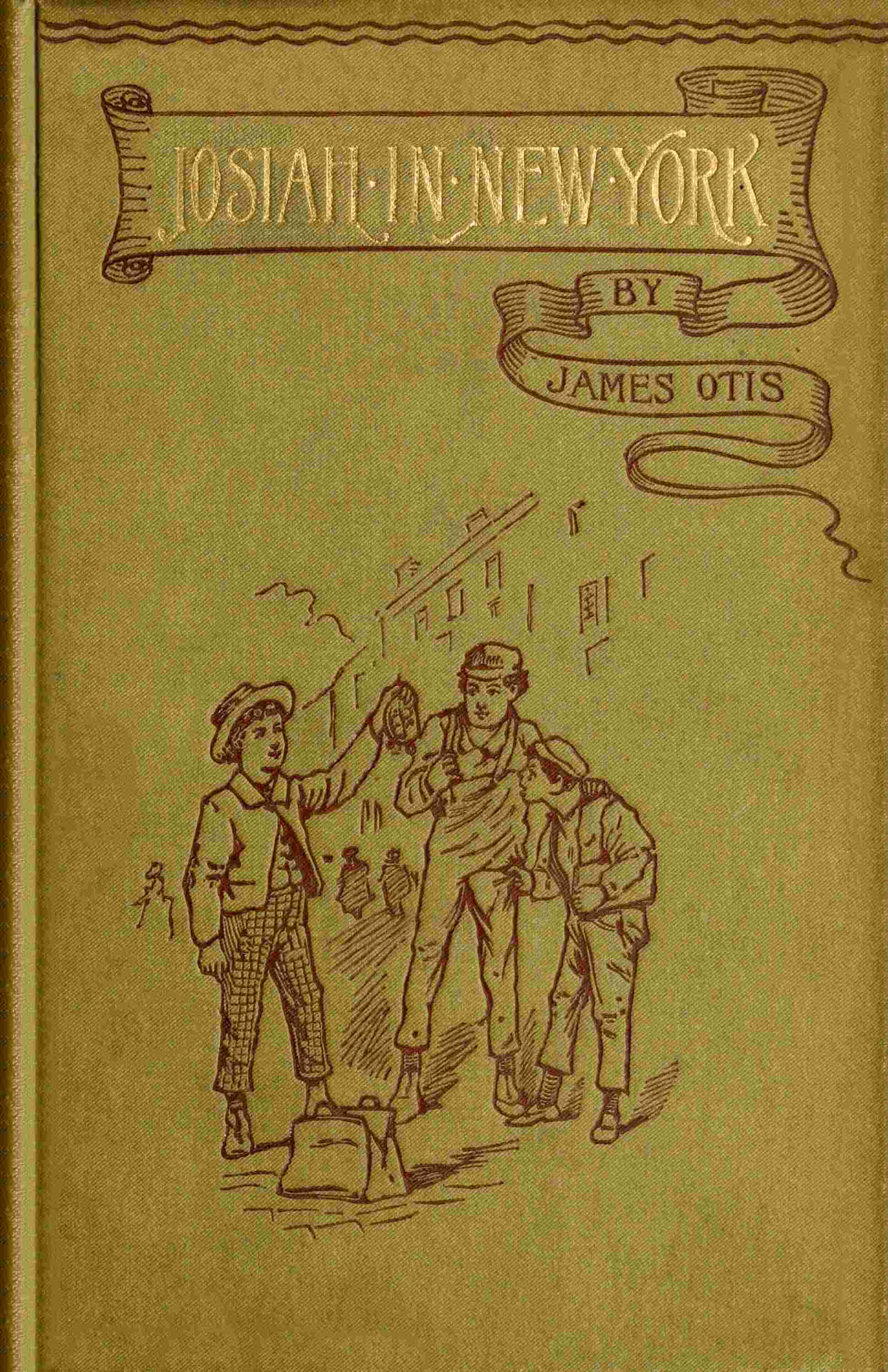
CHAPTER V.
A MEAN TRICK.
Master Shindle took no heed of the flight of time as he gazed around, finding something to entertain or surprise in every animate or inanimate object within his range of vision.
That which caused him the greatest astonishment, was the newsboys as they crossed the street regardless of the horses which appeared at every second on the point of trampling upon them; and when there were no longer any of these young merchants to amuse him, he turned his attention to the shop windows, where he was soon deeply interested in a collection of fire-arms.
He had long wanted to own a revolver, and it seemed to him as if now was the opportunity to purchase one, provided he received as much as he thought he had every reason to expect from the woodchuck skins; therefore it was with the air of an intended purchaser, rather than an idler, that he scanned the cards, on which was written the price affixed to each weapon.
He was still engrossed in this pleasing occupation, when Sadie’s acquaintance, Sim Jones, approached, and halted suddenly on seeing him.
“There’s that duffer Sadie Mitchell had in tow! I wonder what he’s doin’ here?” Master Jones muttered to himself, and then looked around carefully, with a view of ascertaining whether Josiah had any friends in the immediate vicinity.
There was no one near who seemed to take an interest in the country boy, and Sim concluded it was a convenient season in which to settle his debt with Sadie for not having given him more information regarding her new acquaintance.
Therefore, stepping quickly to Josiah’s side, and assuming such a look as he thought would impress the stranger with an idea of his friendliness, Sim asked:—
“Say, have you found Tom Bartlett yet?”
“No; Sadie’s up-stairs now lookin’ for him. Some feller told her Tom an’ Bob were here.”
Sim gave one quick glance in at the hall, and then said hurriedly:—
“When I saw you on West Broadway I forgot to ask Sadie if you’d been over to the Mayor’s office, so I hustled right ’round to find you, ’cause you see girls don’t pay so much ’tention to sich things as they oughter.”
“What things?” Josiah asked in astonishment.
“What things!” Sim repeated as if in surprise. “Do you mean to tell me you didn’t know you oughter go to the Mayor’s office as soon as you got inter town?”
“Of course I didn’t. What does he want with me?”
“A mighty sight, you’ll find out! I kinder thought Sadie Mitchell wouldn’t know enough to tell you, so I went ’round to the City Hall an’ asked the folks if they’d seen a feller from Berry’s Corner. They said ‘no,’ an’ that the Mayor was pretty nigh wild ’cause you didn’t come to him the minute you struck town.”
“What does he want me for?”
“Why ’cordin’ to the law he has to give every feller from the country a dollar’n a half jest as soon as they get here, an’ if you don’t skin over there mighty quick it’ll be too late.”
“Tom an’ Bob didn’t say anything about it when they was up to my house.”
“I s’pose they thought you knowed, or else was countin’ on takin’ you there as soon as you got in; but of course it couldn’t be done when they didn’t meet you. How would it do to run over with me? It won’t take more’n a minute, an’ you’ll get back before Sadie Mitchell comes down.”
Josiah hesitated an instant, and then decided there would be no harm in accompanying this very friendly-disposed boy, more particularly since he seemed certain they would be back in time to meet the match-girl, therefore he replied:—
“All right; go ahead, only we mustn’t keep Sadie waitin’, ’cause it won’t do for me to lose her before I find Tom an’ Bob.”
“Oh, I’ll look out for that part of it. Of course we sha’n’t miss her; an’ if we should, I could find the fellers for you quicker’n she can. It kinder makes a boy look green to be taggin’ a girl ’round the city, an’ I’m certain Tom Bartlett wouldn’t like it if he found out what you’re doin’.”
“It’s a good deal better’n not knowin’ where to go, ’cause if it hadn’t been for her I’d had a pretty hard time last night, ’less I’d found Baker’s Court.”
While they were talking, and paying no heed to the fact that Master Jones was making sundry mysterious gestures to acquaintances whom they passed, Josiah had followed the guide from Chatham Street to Center, and not less than half a dozen disreputable looking boys were watching his every movement with the keenest anticipations of pleasure.
On arriving at what Master Shindle thought was an enormous building, because it was many sizes larger than his father’s barn, Sim halted, and, pointing to the long flight of stairs leading from the street, said:—
“Go straight up there ’till you get to the top. Then open the door, an’ tell the Mayor you’ve come for the dollar an’ a half.”
Josiah obeyed without hesitation, but on reaching the first landing his suspicions were aroused.
Never having visited a City Hall before, his ideas regarding one were rather vague; but he fancied the Mayor would be found in a different kind of a place, and, despite his ignorance, the many business signs in the hall-way soon convinced him he was not in a municipal building.
He hesitated, turned, and was on the point of asking for further particulars from the obliging Sim, when he heard a roar of laughter from the foot of the stairs.
“If the Mayor gives money to folks from the country, I reckon Tom an’ Bob would have told me last summer,” he said to himself. “That feller is makin’ a fool of me.”
Then he descended to the sidewalk, and stood looking about him in perplexity.
He had paid no particular attention to the route taken when he left Chatham Street, and not many seconds elapsed before the very unpleasant fact that he was lost presented itself.
During several moments Josiah stood silent and motionless, trying to combat the fear which came upon him with the knowledge that he was separated from his friends, and had no definite idea of where they might be found.
The throng of pedestrians, each intent only on his own business or pleasure, bewildered the boy, and the rattle and rumble of vehicles served to increase his helplessness.
Surrounded though he was by human beings, never before had he felt so truly alone.
Involuntarily his mind went back to the time when he lost his way in the woods at Berry’s Corner; but there even the birds seemed friendly, and sang and twittered about him as if to share his grief, while here no one paid the slightest attention to his sorrow, save the group of boys on the opposite side of the street, who were making merry at his expense.
Now, even more than when he caught the last glimpse of Towser’s short tail at the railroad station, he wished he had never been tempted to leave the farm.
For the second time tears came very near his eyelids; but the sight of his tormentors across the street served to hold them in check, for he did not intend to allow those boys to know of the sorrow in his heart.
It was the feeling of resentment, that others should have taken advantage of his helplessness, which aided him in controlling his feelings, and he said resolutely as he walked toward Printing House Square:—
“They know I’m green as grass; but they sha’n’t see me cry.”
Then turning toward the shop windows on the left in the hope of seeing one which looked familiar and thus give him some idea of his whereabouts, he pushed resolutely on until accosted by a second stranger.
“Are you the Shindle feller Tom an’ Bob are lookin’ for?” the boy asked.
Josiah’s short experience in the city had taught him to be suspicious, and he replied quite sharply:—
“Well, what if I am? Are you another feller what wants to send me to the Mayor’s office?”
While speaking he glanced toward the opposite side of the street, and there saw his enemies running at full speed as if the coming of this last boy had alarmed them.
“I ain’t tryin’ to play any tricks,” the stranger replied in a friendly tone. “Tom an’ Bob are huntin’ for you, an’ I offered to help. Sadie Mitchell told ’em what was done last night, an’ when they come out of the office they’re hired to clean every mornin’, you wasn’t anywhere to be found. They’re pretty nigh wild to know what’s happened to you.”
“Why didn’t they meet me at the station?” Josiah asked suspiciously.
“They both went there, an’ staid more’n an hour after your train got in. I happen to know, ’cause I was with ’em.”
“Mighty funny,” Josiah said half to himself. “I hung ’round the place two hours, an’ didn’t see hide nor hair of either one.”
“It must be you didn’t get into the right station, ’cause we watched so’s you couldn’t get past, no matter which door you came through.”
“Why, I went right out into the street after I got tired standin’ on the platform.”
The stranger was silent an instant as he tried to reconcile this story with his own knowledge of the facts, and then the truth suddenly dawned upon him.
“It must have been that you didn’t strike the station at all, but stood in the train-sheds till you went to Jersey City, instead of comin’ ’cross the ferry.”
“That’s jest what I did.”
“Then the thing is plain enough. You see, folks ain’t allowed on platforms where the cars stop, an’ so we had to wait near the ferry-slip. If you’d followed the other passengers it would have been all right.”
“Then Tom an’ Bob really was there?”
“Of course, an’ we couldn’t figger out why you didn’t come, ’less somethin’ happened so’s you had to stay at home a day longer than was ’greed on. Now, if you’ll go with me, it won’t take more’n half a minute to find the other fellers.”
This boy spoke in a very friendly tone, and appeared to be thoroughly conversant with the matter; but at the same time it was possible he might be one of the party who had been having so much sport at the country visitor’s expense.
Josiah feared the joke would be continued; but the thought came into his mind that his condition could hardly be made worse, and he replied promptly:—
“See here, I’ve jest come from Berry’s Corner, an’ never was in the city before, so don’t play tricks on me ’cause I’m green.”
“You needn’t be afraid. I’ve heard what your folks did for Tom’s crowd; an’ if that gang over there try any funny business, I’ll thump the head offer every one before night.”
“I ain’t sure as it’s best to do that,” Josiah replied hastily, “though I should like to get even with the feller what told me ’bout the Mayor.”
“I’ll give you a chance before long,” the stranger said generously. “Come with me: my name’s Bill Foss, an’ when we’ve found Tom an’ Bob we’ll clean out that gang. They’re puttin’ on too many airs ’round here.”
The boy turned as he spoke, and Josiah followed him, but feeling a trifle uncertain whether it would be advisable for his friends to punish the enemy very severely, because his visit was not yet ended, and he might some day find himself in a more unpleasant predicament.
“I’m a friend of Tom’s,” the guide said, as he slackened his pace to admit of Josiah’s walking by his side. “I guess Sim Jones an’ the crowd what played the trick on you know too much to fool ’round where I am.”
Master Foss spoke so confidently that all Josiah’s fears fled; and when they arrived at the building where Sadie left him, he had perfect faith in Bill’s integrity.
“Tom’s gone over to Chatham Square lookin’ for this feller, an’ Bob’s down to the elevated station, so you’d better stand right here till they get back,” a friend of Billy’s, who had been left on guard, said, as he hurried away to attend to his own business now his mission was accomplished.
In order that the time might pass pleasantly to the stranger in the city, Bill explained how he once punished a portion of that same crowd who had just played the practical joke, and while he was in the midst of the story Messrs. Bartlett and Green arrived.
Josiah had no reason to complain of the warmth of their greeting.
Each seemed to think it necessary to shake him vigorously by the hand, scrutinizing his face closely meanwhile, as if to make sure this was the same boy who had been met at Berry’s Corner.
Then Josiah related his experience of the past twenty-four hours; and when he had concluded, Tom gave an explanation similar to the one made by Bill, regarding their failure to meet him as agreed upon.
Josiah could not fail to be satisfied that his friends had kept their promise to the letter, and that it was his ignorance rather than their neglect which prevented a meeting at the proper time and the proper place.
“Where’s Sadie?” he asked, suddenly remembering that she should have been with the party.
“Up on the Bowery somewhere,” Tom explained. “It’s time for her to ’tend to business, an’ she ’lowed she’d better leave, ’cause we wouldn’t want a girl hangin’ ’round.”
“But we would;” and Master Shindle spoke very decidedly. “She’s been mighty good to me, an’ I want to tell her I won’t forget it.”
“You’ll have plenty of chance to do that. Just now we’ve got to go right up to the house an’ straighten things out. When you didn’t come yesterday, mother thought you wouldn’t be here at all, an’ we must tell her how it happened.”
“Besides, you don’t want to lug that valise ’round town,” Bob added, “’cause we’re goin’ to put you through this city in great shape, an’ can’t be bothered with a lot of baggage.”
Although the boys appeared so eager to go home, it was fully ten minutes before Josiah could answer all the questions asked by them.
They wanted to know how the calf had thriven since their visit to the farm, inquired particularly concerning Towser, and were eager to learn what would be the prospect for a good crop of turtles next spring.
When Master Shindle had satisfied their curiosity regarding every animal on the farm, Tom asked with mild solicitude after Mr. and Mrs. Shindle.
The visitor was also called upon to tell how many days he had spent weeding carrots, if the harvest had been plentiful, and whether woodchucks allowed themselves to be killed as readily as Josiah had intimated during the previous summer.
Then he in turn learned all that could be told in a brief way regarding the twins and Jimmy, and the benefit resulting from their visit to Berry’s Corner.
“It seems like as if they’d kept right on growin’ fat jest thinkin’ of the farm,” Tom said. “Bob an’ me promised they should go out agin before the cold weather came, but business was dull, an’ we couldn’t scrape up cash enough to pay the fares. We’re comin’ next summer, though. How many woodchucks did you kill?”
“Four; an’ thousands of ’em showed up after you fellers went away, but me an’ Towser didn’t have time to get many. It was awful hard work to tan the skins. Say, where do you s’pose I could sell ’em? I kinder ’lowed to buy mother an’ father a present with what I got for the fur, an’ spent so much last night I don’t know but it’ll take all I’ve got to see me through. It’s dreadful expensive goin’ ’round the city, ain’t it?”
“I reckon you can sell ’em at the fur stores on Broadway,” Tom replied. “The folks there buy all kind of sich things, an’ we’ll see ’em to-morrow. I s’pose you count on gettin’ a pretty good price?”
“I’d be willin’ to take a dollar apiece, if they couldn’t pay any more; but these are awful big skins. It seems as if the lot oughter fetch five dollars anyhow.”
Neither of the young gentlemen from Baker’s Court was very well informed as to the value of fur; and since they had never seen a woodchuck, no idea of the market-price could be formed.
However, both were positive such pelts would sell readily, and with this assurance Josiah was content.