
The Project Gutenberg eBook of Journal of Residence in the New Hebrides, S.W. Pacific Ocean
Title: Journal of Residence in the New Hebrides, S.W. Pacific Ocean
Author: C. Bice
A. Brittain
Release date: October 9, 2018 [eBook #58060]
Most recently updated: January 24, 2021
Language: English
Credits: Produced by Chuck Greif and the Online Distributed
Proofreading Team at http://www.pgdp.net (This file was
produced from scans of public domain works at The National
Library of Australia.)
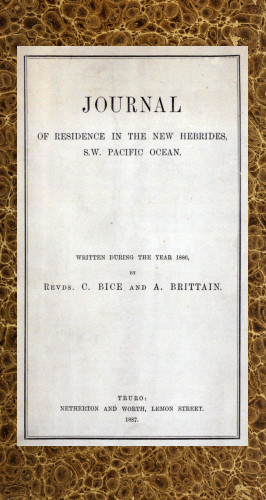
JOURNAL
OF RESIDENCE IN THE NEW HEBRIDES,
S.W. PACIFIC OCEAN.
WRITTEN DURING THE YEAR 1886,
BY
Revds. C. BICE AND A. BRITTAIN.
TRURO:
NETHERTON AND WORTH, LEMON STREET.
1887.
PREFACE.
I have been induced to publish the following Journals at the request of some friends who have perused them, and think they will prove interesting to others. The Journal of the Rev. A. Brittain arrived too late for insertion in the ‘Island Voyage’ for this year, and I have been requested by the Rev. William Selwyn, the Secretary of the Melanesian Mission, to print it with my own. I do this with the greater pleasure, because his report will not only supply me with a good excuse for rushing into print, but will furnish others with a more full and complete account of the work of the Melanesian Mission in the New Hebrides.
The three islands herein spoken of are the Northernmost of the above-mentioned group—the New Hebrides—and form the Southern boundary of the Melanesian Mission work in the islands of the South-west Pacific Ocean.
Araga (or Pentecost) and Maewo (or Aurora) are long and mountainous islands running almost North and South, about forty miles each in length, and separated by a narrow channel three miles wide. Opa (or Leper’s Island) runs at right angles to these, a broad, massive, grand looking country, resembling in appearance a huge whale, the hump of which rises to a height of over 4000 feet.
Araga and Opa are thickly populated, but Maewo has a scattered and sparse population. Opa is about sixteen miles from Araga, but a channel of only five miles in width separates it from Maewo.
The languages and dispositions of these neighbouring lands are much more varied and dissimilar than would naturally be inferred from their close propinquity. And the majority of the people, too, seem to prefer an inland situation, all which serve to make the work of the Missionary the more arduous and difficult. On these islands every outward prospect is pleasing, and the inhabitants themselves not so far gone in vileness as to be incapable of improvement, as I hope the following pages will show. The work of the Melanesian Mission has been established in these islands a good many years now, with more or less success, and schools are in active operation as follows:—
At Araga—Wonor, on the Southern face of the island, and Lamoru and Qatvenua on the North.
At Maewo—Tanrig, Tasmouri, Tasmate, Mandurvat, Naruru, and Uta. All these stations are on the North of the island.
At Opa—Tavolavola, Lobaha, Walurigi, the most flourishing of which is that first mentioned.
With these few preliminary remarks and explanations I leave the following simple pages to tell their own story.
CHARLES BICE.
N.B.—The vowels in the Melanesian languages are pronounced as in Italian: a = ah, e = a, i = e.
The letter written n̈ = ng in singer; d = nd, b = mb.
J O U R N A L.
1886.
Friday, 9th July.—The weather seaward looked very threatening as we stood on the Pier at the Settlement in readiness to embark. All the Melanesians, boys and girls, to the number of about 50 had already gone off to the ship which lay tossing and tumbling at her anchorage as if anxious to be let free. A considerable number of Norfolk Island friends were on the Pier, in addition to most of the Members of the Mission, to bid us Farewell and wish us God speed. Many thoughtful little mementos, too, found their way into our hands from our warm-hearted and well wishing friends. The process of shaking hands took some time in execution, but one could not but feel the absence of many who were unavoidably absent on the occasion. My own little ones were the last to bid me good-bye, and poor little Walter (my youngest son) was very tearful. Shortly after, we were all in the boat, and “let go” was called out. The landing was very smooth, and we got out with very little difficulty. Besides the Captain, Mr. Turnbull and myself were the only passengers. It was close upon 5 o’clock p.m. when we got on board, and some of the passengers had already begun to feel the motion of the ocean. After things were put into some order and the shore boat dismissed with Captain Bates and the Norfolk Island crew, the command to “heave away” was given, and then I saw for the first time the steam winch at work. Before many minutes the anchor was in its place in the bows of the ship, and the long process of raising the anchor in old days, performed by manual labour, reduced to a minimum. We slipped quietly down the leeside of the island, and had ample time to get into some amount of order and readiness for a very dirty, rough night. Opposite the Mission, the boys ashore had lit a large bonfire, and we could hear their shouts, borne seaward by the raging gale. As night closed in the sky became very dark and lowering, and we knew full well what we were to expect. We had dinner while still under the lee of the island, but before the meal was finished, we were knocking about in the heavy head gale. Of course any where but at Norfolk Island, where there is no certain shelter, it would be approaching madness to put to sea with such a crowd of people in a small ship on a night like this, but here there is no help for it. Perhaps had we not got away as we did, we might have been detained another week, from the uncertainty of wind changes and the insecurity of the anchorages. All night it blew very heavily, with a nasty head sea. Of course, the wind being very strong and dead ahead, we made little or no progress, and were in fact hove to. Most of the passengers spent a very unpleasant night, and the poor little children, of whom we had four on board, suffered like the others. The poor boys in the schoolroom had a disagreeable time, owing to the large amount of cargo on board, in addition to their own luggage. The Southern Cross, however, is a magnificent sea boat, although slightly lively, and being at sea was, to me at least, the worst of the evils we experienced that first night. Mr. Turnbull is a good sailor, and he and I were alone in the saloon. Poor old Manekalea I invited also to sleep there, on account of his blindness, and I asked Silas Kema to sleep there and look after him. Poor fellow, his sight seems quite gone, but he is wonderfully patient and resigned. I think now he begins to feel that there is no hope of his ever seeing again, and he begins to try and help himself and get about alone a great deal more than before. The loss of so young, active, and intelligent a Teacher must be much felt in the district of Ysabel, formerly under his charge.
Saturday, 10th.—The wind had abated little, if any, this morning, and the vessel was making little or no headway. It rained a good deal throughout the day, and that allayed both wind and sea by evening. Very few of the boys appeared on deck, and I myself was quite hors de combat. Mr. Turnbull kindly offered to read prayers in English for me in the Evening, and I managed the Mota with a few who were able to attend. These first days on board ship are very trying, one feels quite out of it altogether, and the sea legs are somewhat long in returning when one has been ashore for any length of time. Towards evening the weather moderated a little, but there was very little life about the ship. These unhappy days when one is the victim of mal de mer leave a very unsatisfactory impression behind them, and if any recollection is left, it is always painful. I was not actually seasick myself, but I felt uncomfortable enough for a time, and did not care for ship’s fare.
Sunday, 11th.—The weather more moderate. I conducted Morning Prayer both in English and Mota, and generally our passengers were getting over their indisposition. It was not a very profitable day however to me, for I could not settle to anything: our Service hours on Sunday, at sea, are English Mattins at 9 o’clock a.m. and Evensong at 7 p.m. Mota 11 a.m. and 7.30 p.m. Our daily hours for meals are 8 a.m. breakfast, 12 noon lunch, 5 p.m. dinner. On Sunday this is slightly changed, and we dine at 1, and tea at 5 p.m. At anchor, too, the English Morning Service is postponed to 10 a.m., and all the sailors are enabled to attend. Usually only one watch can be present while the vessel is at sea. This year we have a crew composed entirely of Englishmen. We have generally had previously a strong admixture of foreigners. The steward, indeed, is a German, but he has been with us so many voyages, speaks and reads English so well, that one quite forgets his nationality. The crew are a very nice, quiet, well-behaved set of men, and all look so respectable. I believe the Captain has many applications for billets on board the Southern Cross, she being a popular vessel now-a-days, besides, a trip in her is a paying affair, for I am told that sometimes the men realize from £10 to £30 and £40 by the sale of curios alone. The great collector on board now is John Brown the boatswain, and he has accumulated quite a museum, which he meditates taking to England for sale next year. Brown is an old Island Trader, and knows all the specialities of the trade and what will captivate the native taste. Penny whistles and half-penny looking glasses, I believe, are the line this trip. There is very keen competition too on board when the curio fields are reached, chiefly at Santa Cruz and some of the Solomon Islands. Sunday passed away somewhat profitlessly, and evening once more closed over a day past and gone. I did not give the sailors a Sermon, but reserved my efforts for the Melanesians, many of whom were able to attend. I naturally chose the subject of the Gospel as the basis of my remarks, viz: the recovery of the lost sheep and the piece of money, which I applied to the condition of the heathen to whom we were going, and our duty as seekers of those who were still wandering upon the mountains and upon every high hill, with none caring for them or seeking them out. We had some singing after the service, and the termination of the day at least was pleasant, and I hope profitable. One’s thoughts naturally wandered away back to Norfolk Island, and one thought of the quiet peaceful Sunday evenings there, and the love of those we had left. The vessel was much more at her ease this evening, and we could undress and rest in bed with more comfort.
It was a great pleasure to me from this time forward, to see the boys dropping into the cabin one by one to say their prayers, unbidden but none the less welcome.
Monday, 12th July.—This morning the wind has moderated very considerably, and the sea is going down. The vessel moving along much more gently and easily, sometimes towards our destination. Life on board is almost utterly devoid of interest or excitement. There is little or nothing stirring, and out of our element we feel restless and not fit for much. We begin now however, to fall into ship-shape ways, and things begin to look a little straighter than they did. The boys are divided into sets of cooks, and have to take their turn in order to cook and keep the schoolroom clean. The Melanesians have three meals a day, and they are supposed to look after their own food, the cook giving directions as to what he wants doing. After the misery and prostration of mal de mer have passed off, the boys get very lively, and do not easily again succumb.
In the evening we had music. Brown the boatswain has a most ingenious instrument called, I think, the “Cabinetto,” which plays almost any tune; a piece of perforated paper is turned over a sort of key-board, like a mouth organ, by means of a handle, and the closed notes are kept silent, while the open ones speak according to the length of the perforation. Its tone is somewhat harsh, but the music is very correct, and there is plenty of it. Brown bought this instrument, which cost him some £15 or £16, for the special amusement of his young Melanesian friends. The girls never seem to tire of turning the handle, and the more it is turned the better the owner seems pleased. Forward there is a very good concertina, exceptionally well played by one of the sailors, a banjo played by another, and a tin plate beaten by a third makes a very fair tambourine. Altogether, the hour between 5 and 6 p.m. is very lively with strains of music and other enlivenments. The boys most thoroughly enjoy the music, and are very attentive and enthusiastic listeners, breaking in with a good chorus when they happen to know any of the pieces played. At 7 p.m. English Prayers, a shortened form of Evensong with a hymn, and afterwards full Evensong in Mota with a good deal of singing. We have many nice voices on board this time, and the singing is exceptionally good. Owing to the crowded state of the schoolroom, service is held in the saloon, which is inconveniently small for the large number who attend. The girls who hitherto have been prevented from attending, by reason of sea-sickness, this evening put in a very fairly large appearance. Most Melanesian ladies are bad sailors, and some never get over the inconveniences of the uncongenial sea element.
Tuesday, 13th July.—The weather this morning was somewhat finer, but still a good deal unsettled. We have failed as yet to get hold of the S.E. Trades, but are living in hopes that a favourable breeze will soon waft us onward to our destination. The great excitement this morning was the smoke of a steamer, which at first we wildly imagined must be the vessel expected from Sydney to meet us at Norfolk Island, giving us chase. However, wiser heads, by the direction of the ship’s head and the course of the smoke, made it out to be the Rockton or some steamer from Fiji towards New Caledonia. Whatever ship it may have been, the excitement all ended in smoke. Beyond this, we have had nothing stirring all day. The moon at night dispersed the clouds, and the concertina forward enlivened the monotony of the evening. And so has passed another day, leaving little record of any work done.
Wednesday, 14th July.—We were to-day somewhere in the neighbourhood of Walpole Island, a flat, uninhabited island lying by itself in mid ocean, on which myriads of sea birds have their dwelling, and lay their eggs and hatch their young. The weather was somewhat hazy, so we got no sight of the sun although the Captain was anxious to do so, not having been able to see that orb either to-day or yesterday. The ‘dead reckoning’ alone showed him our probable whereabouts, but he was not able to get any definite position laid down. Shoals of fish were seen about the ship to-day, and the boys perched on the bowsprit end succeeded in cleverly catching two fine skipjacks, one of which we had cooked for dinner, and which was pronounced as very good eating. No bait is required for these fish, a line, rod, and hook to which a piece of red rag is attached, are requisite, and the motion of the vessel makes the tempting object skip along the surface of the water, to which the fish rises and swallows hook and all. They are large fish, and peculiarly strong, especially with their tails. At times they breach out of the water to a great height, the motive power being seated in their tails. One of the boys unadvisedly took hold of one of those caught to-day too near the tail, and the fish lashing out struck him on the forefinger, and at first I fancied had sprained it, for the whole hand swelled, and he was in considerable pain for some time. This evening it was very quiet and pleasant, and the moon added to the pleasantness of the occasion. It is wonderful to mark how the days lengthen as we go further North, and how the weather grows warmer. Soon we shall dispense with waistcoats, and bye and bye coats will likewise go, except at meals and at prayers. We saw nothing of Walpole Island, and the Captain got no sight of the sun again to-day.
Thursday, 15th July.—This morning we were well up with Anaiteum, the first of the New Hebrides group, and belonging to the Presbyterians who have been established there a great number of years. Soon after Tanna appeared in view, and later on in the day Eromango. We could not see the volcano at Tanna, so that we cannot speak of its activity or otherwise. We passed close under Eromango, and for some time the water was quite smooth. We had a most beautiful wind all day, the real S.E. Trades, and we were enabled to make good progress towards our first place of call. Everyone on board seems to have sprung into life with the sight of land, and no doubt many see in the islands we are passing the anticipation of their own homes. Most of our passengers are from the New Hebrides and Banks’ groups, of which these three islands are the commencement. It was most beautiful all day and the evening especially enjoyable; the Captain wisely remarked that if it were always so fine, there would be too many sailors, or at least persons who would want to go to sea. Melanesian islands are disappointing as viewed at a distance from the sea, for they are like any other place, but the great beauty of them is seen on nearer inspection and ashore. These three islands and the Loyalty group are not so thickly wooded as some farther North.
Friday, July 16th.—Strong S.E. Trades, and we moved along rapidly all day, doing over two hundred miles. We found ourselves in the evening running through the passage between Ambrym and Pentecost at the South end of which we expected to find Mr. Brittain, who had been left there when the ship went back to Norfolk Island. We stood quite close into the place, but receiving no manner of response from the shore we began to suspect that after all the bird had flown. The vessel stood off and on all the night, and it certainly was more comfortable than usually is the case under the like circumstances. The vessel rode very quietly all night, and on
Saturday, July 17th.—We were early off our place of call, and seeing no signs ashore the boat was lowered and I took the steer oar in a furious wind and a heavy sea. The approach to and departure from this place were as nasty as could be, and I was not sorry to be on board all right again. Mr. Brittain had left some time before, and our visit was futile except that we brought off his things. The people were quiet and well behaved, and Tom (the teacher) was in great form. Tom, having been educated in Sydney, speaks remarkably good English and is evidently held in respect by his people. Their dress and appearance are very like their neighbours of Ambrym, and the women wear the flaxen petticoat also like the Ambrymese. Their language, too, I believe, is akin, the distance separating the two islands not being more than five or six miles. Tom is building a very nice school, and there seems a large population. A big, chiefly looking man was sitting on the beach as we were coming away, and Tom told me that he was the chief of the place. I had brought nothing with me from the ship, and the boys had nothing, so the best I could do for the great man was to give him a tin of sardines which I got out of one of Mr. Brittain’s boxes. I dare say he would have preferred tobacco, but he seemed as satisfied as natives usually appear to be, for they are not generally very demonstrative or profuse in their thanks. The tide was falling fast so we had to beat a hasty retreat and got off with some considerable difficulty.
Poor Tom must find life at home somewhat of a change to the ‘easy life’ he enjoyed in Sydney. I believe he was very much scandalized when he first got home at the outrageously indecent dress of his countrymen. He himself still dons the Sydney costume, but minus boots. Poor boy! I dare say he dreamed in Sydney of the reforms he would endeavour to effect when he got home, but the stern difficulties in the way he now begins to realize. Oh! Missionary work seems easy enough when viewed from an arm chair at a distance of many thousand miles, the difficulties only become apparent when the man is brought into close connection with his work, and has to grapple in a stubborn, persistant hand to hand fight with the Evil one. Poor Tom! I suppose he will try a little at first to stem the tide, and failing in that, will drift along with the stream. To a poor youth like that the difficulties of his position must seem stupendous and insurmountable. Nothing but the grace of God is sufficient for such. I dare say ere now his bright vistas and day dreams are being only too rudely dispelled, for he will have to find out like all other Missionaries that Christians are not made by machinery, or believers made such in a day; it is a long and weary process, but labour is not in vain in the Lord. Once more on board, the boat was hauled up, and on we started for the North end of the island where now we hoped to find Mr. Brittain. We saw a Labour vessel at anchor along the coast, and got to our own anchorage about 4 p.m. Mr. Brittain came off in his boat very sick, and with some difficulty got on board. He has been ill three weeks and was very anxious for the return of the vessel. During the evening he brightened up a good deal and I dare say felt much better for the society of his white brethren. He gave a very sad account of the state of things ashore, great sickness and considerable mortality. We had a very quiet night at anchor, and determined to stay here till Monday. We had some boys to land, and the boats were going forth and back all the evening. The clatter alongside was fearful owing to the large number of canoes that put off to the ship and every occupant speaking at the same time. They used to be a very noisy crowd, but have much improved of late years. It was a most glorious night at anchor and not excessively hot. We consider that we have done very well to be here so soon with the bad start from Norfolk Island. How the boys and girls did enjoy the fruits of their own islands again, especially green cocoanuts and soft sugar cane! And how pleasing was it too, as well as entertaining, as the shades of evening closed in, to watch the coy and shy flirtations of the young married couples on board; one or two were quite oldfashioned at the process, but Charles and Monica especially were somewhat more bashful. The young bridegrooms were most attentive to their respective spouses on the voyage but necessarily lived apart. The boys and men all live together in the schoolroom, and the girls and married women aft. There are as yet no married people’s apartments, we shall look for those when we get a bigger ship.
Sunday, 18th July.—Quiet and peaceful day at Araga. The natives regarded the observance of Sunday so strictly that they troubled us very little with their noisy chatter, indeed very few canoes came off at all to the ship, and we were able to have an uninterrupted day of rest. Our services began at 10 a.m. with English Prayers. We chanted the Venite, read the Te Deum, and sang the Jubilate besides singing the Glorias in the Psalms, and two hymns. We had therefore full Mattins with a short address to which the men paid very good attention. I tried to make the discourse as easy and lively as possible, and interspersed a few anecdotes among my remarks, which I think, being appropriate, were appreciated. The service lasted just three quarters of an hour so that the men were not wearied. It was not a very hot day, but beautifully bright and glorious. Shorewards it looked most lovely, the bright sunshine lighting up the vegetation with a silver sheen, everything seeming to catch the infection from the King of Day, who rejoiced as a giant to run his course. On board a gentle breeze cooled the air, and under the awning and down below alike it was bearably comfortable and refreshing.
At 11 o’clock we had service in Mota, at which we had the attendance of all the Melanesians of both sexes in the ship, and a very hearty, cheering service it was. I reserved my address to them for the evening and before noon our religious duties for the morning were over. We dined at 1 o’clock and in the afternoon Mr. Turnbull and myself went ashore. This was his first experience in these islands and he was duly impressed with the natural beauty everywhere apparent, and the good nature of the people. It was nearly high water when we went in over the reef, and the clearness of the sea, the beauty of the coral bed, the dear little blue and vari-coloured fish which flitted about produced their due effect on him. The white beach, too, with its background of most luxuriant green rising from the base and clothing in marvellous profusion the tops of the hills greatly delighted him. The climb up the hill somewhat dispelled the fancy, but one could well imagine oneself in some semi-fairy land so strangely beautiful as it all looked. We were in a very liquid state when we reached the school about three quarters of a mile up the hill, and green cocoanuts were very acceptable. Here we found in the midst of all the loveliness a poor little child dying amid squalor and destitution. The poor young mother was sitting over it and crying her heart out. Her son had been buried the day before and there seemed not a particle of hope for the elder sister. I said what I could to comfort the mother, but it was too late to do anything for the child. The father with a third child was walking up and down disconsolately outside. The sight had its effect on me, for the father bears the honoured name of my great friend Bishop Key of Kaffraria, the mother bears my wife’s name, and the little dying one the name of my own daughter, the boy too who died the day before was called “Bailey” a cognomen revered by all Augustinians as the name of its late Warden.
Poor things! May God give them all the comfort of His grace, the only balm for a troubled and afflicted soul.
We walked about the village for a time and everything being utterly new and strange to Mr. Turnbull he was very much charmed. We visited old Sarawia who was once, and I dare say now is, the chief man in the place. He still looks much the same as ever but professed himself to be failing in health, and suffering from a sort of paralysis in his left leg. It does not seem however as if he intended to die just yet for he has lately taken two or three additional wives. We also saw the great wind and rain maker, but he said he had given up the trade now, and came to school regularly. Formerly he used to derive a good income from it I believe.
The houses and gamals (men’s quarters) here are most squalid and wretched, but the people seem content, and don’t trouble themselves much about their habitations, but what they shall eat or drink is a prominent consideration in all their minds. Their great treasures here are pigs and mats, and a man’s wealth and standing is measured by his possession in these. After proceeding through various grades if a man can kill one hundred pigs at a feast he is looked upon as a man of importance and his name is handed down to posterity as a great man, and I believe by that means his fare is prepaid to the realms of the Blest. The reverse I believe obtains with those who possess no treasures and kill no pigs. Everyone therefore in the interval between his advent into this world and his departure from it, endeavours to slaughter according to custom one pig or more, or the consequences will be terrible if not here at least hereafter.
This is a cheap way at all events of purchasing blessedness and no wonder they are eager with the small price for it. A fighting man formerly was looked upon as having more claim to their Walhalla than a man who refused or who had failed to take blood. This title certainly of late years has not been so eagerly coveted, and so far it is, thankworthy, but “when the wicked man turneth away from his wickedness and doeth that which is lawful and right he shall save his soul alive,” this last clause as yet is omitted from their programme.
On our way back I could not refrain from paying another visit to the dying child. There still sat the faithful mother, and there still lay her pretty child, life was not yet extinct, and she had turned since I saw her before. I determined when I got off to the ship to try and get some medicine as a sort of dernier resort. I doubt if medicine will ever more do any good. We got off to the ship before 5 p.m., and at that hour had tea, bread and sardines, and cake which the cook had concocted. The “Cabinetto” was going most of the evening, Brown having thoughtfully brought some sacred sheets for Sundays. At 7 p.m. we had Evensong in English and afterwards in Mota with an address on the Gospel, “Be ye therefore merciful,” “not only were we to ask mercy for ourselves I said, but we too must extend it to others, and we should find plenty of opportunity of doing so, in the places to which we were going. If we only felt for a moment the mercy of God towards us as revealed in Christ Jesus, we must be merciful to our fellows, and we must show them the same mercy we had experienced and known in our Saviour’s dealings with our own souls.”
We had great singing afterwards, which they always enjoy. It was most resplendent on deck afterwards, and one was thankful for the quiet and refreshment throughout of the day of rest.
Monday, 19th July.—Mr. Brittain well enough this morning to go ashore to collect his things and make arrangements with his teachers. It is his intention if health permits to stay ashore in Mr. Palmer’s district at Mota and the Banks’ Islands, but in his present condition such a step would scarcely be wise. However, time will tell. While he was ashore Mr. Huggett, the mate, always ready to lend a helping hand, and myself put the teacher’s things together, and when he came off Mr. Brittain had nothing to do but give them out according as they had been deserved. Meanwhile there were crowds of people round about the ship, and much trading was carried on by the boys and girls on board. They use here canoes with outriggers, and the larger ones are very clumsy, unwieldy monsters. The Captain hates the sight of them alongside for they rub the paint off the ship, and sometimes even damage the copper. In the Solomon Islands they have no outriggers, and the natives are much more expert in the management of their canoes, both large and small.
Here at Araga they have a very large number of canoes, but they are very bad.
We weighed anchor at noon and stood across to Opa and were at anchor at Tavolavola by about 3.30 p.m.; a very nice breeze took us across, and on arrival there we made preparations for going ashore at once. I found matters satisfactory ashore, and the school in full swing, the young teachers all neatly and nicely dressed.
They were glad to have Charles back again and the women walked off with his pretty wife, dressed in all her bit of best. She had done a good deal of weeping between the ship and shore, evidently being very reluctant to leave her friends on board. Her eyes therefore were slightly tear bedyed, and her cheeks also, before she got ashore. The school looked cared for, and I was pleased to see a very nice new house built for me. The people were very glad to have me back and received me in their usually cordial fashion. An English Trader had built a house, and had resided some months near the village, but had lately taken his departure, why I know not, but I believe there was not trade enough.
There are a number of white men now trading all over the island, the mystery is how they can make it pay. Monica was very tearful again when I bid her good-bye, poor girl I dare say she will have a hard struggle at first among her own country women, but I trust she may have strength given her to resist the wiles of the Evil one and his agents among them. She is a pretty, flighty girl, but much improved of late, and became a great favourite on board. She has a most estimable husband and I hope she will make him a good helpmeet.
We passed a very pleasant night at the snug anchorage and all the boys came off to the ship next morning.
Tuesday, 20th July.—We weighed anchor and dropped down to Lobaha, about four miles along the coast to the Westward. Here we found Herbert Arudale well. He came off to the ship with his wife Mary who was not well. They seem to live much happier now, and both were beaming over with smiles. He gives but a poor account of his work, which is much in statu quo. The fact is his field is very limited if he must confine himself to his own people, and it never suggests itself to a Melanesian to go farther a-field. The mountain must come to Mahomet, for Mahomet never dreams of going to the mountain. However, now with Didi and his wife, a most exemplary pair, and seemingly very devoted, they ought to make a fresh start. Baitagaro I saw ashore and he seems to have improved, but it must be heart breaking work to labour on year after year, and get little or no attention to what you say, no appreciation of the message you bring, and no interest taken in all you endeavour to do. However, it is what the Man of Sorrows passed through, and it is what His true followers have to experience also.
Here we almost filled the ship with fruit, especially a kind ardently longed for by the Norfolk Islanders, which they call the Vee apple, but which the Opa people term “Uhi.” Some very sweet oranges too were offered for sale, and the ship looked like a fruit market.
We hoisted our anchor before noon and stood across to Maewo where we anchored in the evening. No one being down on the beach, I started off Arthur Huqe and Duwu to Tanrig to tell the people to come down in the morning.
The village is three or four miles from the watering place and except the ship is there, the Tanrigese seldom come down to this beach, the sea being nearer on the other side of the island. Mr. Turnbull and I with some of the boys went in and had a most delicious bath, after so many days privation all the nicer. The river we found very full and the rush very great, but the water was most beautifully cool and refreshing. This now is the chief and best watering place in the islands, and the water itself is most excellent. Late in the evening a boy arrived who had rowed a long distance in his canoe, and he gave us the news, which was good on the whole. He told me again the tragic story enacted at N̈adui, a village not far from the watering place. One Vulatewa was a reputed disease-maker, and he resided there. Lately there had been a great mortality at Maewo, and especially among the still heathen people of Tanrowo, a coastal district bordering on N̈adui. The great man, Melkalano’s son died and his brother and many others, and Vulatewa insisted that he had made the sickness, and would kill many more except he were propitiated. However, propitiation by the gift of pigs or money was not in Melkalano’s line, and collecting his followers he made a raid on poor Vulatewa and killed him and two others, cutting them into small pieces, and leaving them as they were killed.
They then drove out the other inhabitants, or rather fear had already lent them wings for flight, and destroyed the village. The poor people left everything they possessed behind, and took refuge in all directions among their friends. The people at the next village, where there was a flourishing school, took fright also, and cleared out of their homes leaving a fine handsome school-house and a new church almost finished. The boy added that as soon as Vulatewa was dead the sickness was stayed. We did no watering this evening as the tide did not suit. After a very quiet night at anchor on
Wednesday, 21st July.—We started watering ship. This is a busy process and keeps everyone on board well employed. Two large canvas tanks are fitted into each boat, and fastened underneath the thwarts. Into these the water is poured from buckets until both are full, a suction pump and hose on board empties these canvas tanks into iron receptacles under the floor of the schoolroom, and one boatload fills about a tank and a half. Seven or eight loads of water therefore finished the watering to-day. When everything was finished, the boys and girls went ashore to wash their clothes and bathe, and this day here is always looked forward to. The people came down from Tanrig in the morning, and I was busy packing up my things. After lunch I went ashore and started away the bearers with my belongings. How they managed to carry all the heavy boxes and a big harmonium up the hill and on for three or four miles, I don’t know, but they did it, and did not think much of it. I went on board again, and thanks to the Captain’s kindness, I got the loan of one of the ship’s boats, my own having been stolen by a labour ship last year. After an early dinner, escorted by Arthur, &c., I left for Tanrig. It was just getting dusk when I arrived, and I had no time to put anything straight. We had Evensong, and after that I prepared for bed. The mosquitos were somewhat numerous, but it was too late to get out my net, and so I put up with their music, and soon was oblivious of their singing or teasing. It seems quite natural to be here again, and as is usual the place has not changed at all. The boys however, have built me a beautiful new house, and I shall live in great comfort. I miss several faces too from the congregation, whom death has removed.
Thursday, 22nd July.—I left the Southern Cross last night expecting to get away early this morning, which I suppose she did. However I am so far away from the sea, that I have no means of knowing what she did. Naturally too, I was very busy this first day ashore. The first business after Morning Prayer, was to start off Samuel and the Tasmouri contingent who had spent the night here. They had a good many things to receive, but they got away in time to reach home before night. There were numbers of other things to be done also, such as putting the new window in the Church, unpacking the harmonium, making a platform for it, &c. The old mode of life seems to come back wonderfully naturally to me. Breakfast of rice, with sugar and cocoanut milk, and afterwards a cup of delicious Norfolk Island coffee, for which delicacy I am indebted to my kind friends Mr. and Mrs. Fletcher Nobbs. My midday meal is a bit of biscuit or roasted yam, and I reserve myself for the great meal of the day in the evening, not sumptuous but amply sufficient, fried rasher of bacon, fried taro pancake, and most excellent potatoes, for which I am indebted to Mr. Alfred Nobbs at Norfolk Island. After this I have a cup of milkless tea, which I brew in that charming teapot sent me from China by Dr. Codrington. They say ‘enough is as good as a feast,’ and I suppose this is why I am perfectly satisfied with this rough meal. After dinner I have nothing again till next morning.
Friday, 23rd July.—A most superb morning, and the place looks very charming early in the day and in the evening, at midday there is a strong glare and it is almost too dazzling. The church looks most picturesque and pretty, nestling in a perfect forest of bright coloured shrubs, among which are many European representatives, e.g. the Poinsettia, the Geranium, Marvel of Peru, and others imported from Norfolk Island. Arthur certainly has expended great pains and taste in the plantation, and it amply rewards him. Outside the stone fence is an orange grove, the dark green of which stands out in bold relief against the bright colours within. The church is still in a good state of preservation and will last for some time yet. It is getting inconveniently small however, and will soon want enlarging. It bears evident signs of being made good use of, and they tell me the congregation morning and evening is never short of 50 or 60. In a very short time I hope this will be a purely Christian village, and that not only in name, but in deed and in truth. I see considerable change here since I left in the number of the new houses, and the care of the town, for such it now has a right to be called. Before long the Church will be the centre of a number of private residences, and the people begin to build better houses. Arthur has constructed his like mine with high walls caned all round, and made it very comfortable.
Except the ground floor my house is quite as nice as a one roomed boarded house. The school and church are almost contiguous, and both are strong, substantial buildings. There are at present 80 names of scholars on the books, and these are regular attendants. I hope before I leave, please God, to see that number augmented. At present we are strong in teachers, with the two Arthurs, Patrick, Harry, Duwu, Tilegi, Kate and Agnes. This morning after service, a shortened form of Mattins with a hymn, we had school, and I hope progress has been made. I was pleased to hear the teachers questioning their classes on the subject about which they had been reading. The perseverance of the old men in puzzling out the dreary sheets is perfectly astonishing, but they will not be denied. They have, however, learnt much by heart, e.g. Lord’s Prayer, Creed, Te Deum, &c. The women are quite as persevering, if not more so, and I don’t like to damp their ardour by forbidding them to try and learn to read. The first class of girls are far away ahead of the boys, and know a very great deal. These same girls used to sing very nicely, but they have got into the most disagreeable drawl, and so far from following a leader, they take the bit between their teeth, and sing as fancy dictates. This I shall try and remedy before I leave again. We have now a harmonium for our services, thanks to the very great kindness of my friend and benefactress in England, Miss Mount, who is far more beneficent than I at all deserve. The two Arthurs play very fairly well, but Arthur Huqe is organist at present. After school I had visitors from Golvanua, a populous district some ten or twelve miles from here. They are very peculiar people and very wild, I am sorry to say I have only been there once, and that only a flying visit. I told them I was coming again soon, and they seemed pleased. I gave the head man some tobacco, and he said when I came to their place he would give me food and take care of me. Our people here are rather terrified of them, and the distance is so great that very few have ever been there. There were two nice little boys with them, and I asked them if they were not tired, but they scouted the idea.
I was so busy all day that I did not get away from home, and things begin to be a bit more ship-shape. I begin to feel very comfortable in my new house, but I dare say if my friends saw me, they would fancy it was far from comfort. However, I have a continual feast in a contented mind. In the evening, instead of school, we had singing, into which I endeavoured to infuse some life and harmony, and partially succeeded, but not to my taste quite yet. Then in the evening I held a teacher’s class, and we had much profitable conversation.
Saturday, 24th July.—This is observed by us as a whole holiday, and after Morning Prayer nothing is required of the school till the evening service. Arthur Aruduliwar decided to have his house thatched to-day, and a large party assembled to help him. Here they do everything by means of ‘Bees,’ (working parties). ‘Bees’ dig the gardens, plant the crops, dig the food, build the houses. The women do the cooking, and the owner of the house makes the feast, this is all he has to do, he is not supposed himself to do any work. Next week they are going to thatch a gamal, more stupendous work, and a great many people are going to be engaged, and there is to be much feasting, and I believe a dance. Marvellous harmony prevails in this community at present, and I never hear a harsh expression, nor witness a passionate action. They are the merriest, happiest, most contented people I ever saw, and I think the best natured. A party from Tasmouri appeared during the morning, and Thomas Aruloli among them. I asked him to stay the night, but he replied that it was his Sunday at Tasmate to-morrow, and he would not like to miss. I was pleased at this, for it showed the boy’s conscientiousness with respect to his self-imposed duty. I gave him his goods, and he and the others started again soon after for home. These natives don’t seem to know what fatigue is, and this double journey, which I should be sorry to undertake, they make nothing of it. After a frugal lunch the boys and I went to Ruos, where we bathed and washed our clothes. The river is certainly a boon and a blessing, and a good bathe has a most invigorating effect on one. In the evening the teachers came in and sat a long time with me, and we had much suitable conversation. While they were sitting here, a sound, which I had heard all day and couldn’t find the reason of, kept going on continually, and I asked Arthur what it was. He told me it was a bamboo placed high up on a top branch of a banyan tree in front of my house, in which notches were cut below each joint, and when the wind blew strong it sounded in the bamboo with the same effect that would be produced by so many persons blowing at once into the several orifices. This seemed to me very ingenious, but Arthur Huqe tells me they have the same practice at Opa. They say when the wind blows strong the sound is heard a great distance off, and I can quite imagine it.
We heard this evening the reports of two big guns in the direction of the watering place, so it is conjectured that a vessel is at anchor there. However it was too late to go and see.
Sunday, 25th July.—First Sunday ashore at Maewo, and a very quiet and pleasant day it has been. I think too, it has been one of the most gloriously brilliant days I have ever seen. The morning was beautiful, the midday marvellously resplendent, and the evening indescribably lovely. The place did look so beautiful too. I told the people they ought never to cease praising God for so beautiful a heritage as He had given them. They have not a want or a care, but I fear they fail to appreciate the beauty, according to the truth of the old adage which speaks of familiarity breeding contempt. We had Sunday school very early, for two reasons more especially, (1) because it is cooler in the morning, (2) because we are not plagued with blowflies which appear in untold numbers wherever there is any congregation of people.
After a short interval devoted to breakfast, we had Mattins, and after this a short service and an address for the teachers. We had a very few strangers present to-day, but all our own people turned up. We did away with the great midday feast to-day for the first time for many years, but some of the women cooked a large quantity of food which was distributed to the boys in the usual way. This food business had become too laborious, and too much the chief part of the day, so that I fancied a relaxation for a time would be beneficial.
Patrick went to Mandurvat to take service there, but I stayed at Tanrig. At six different stations, school and service have been held and the day duly observed.
Evensong was a pleasant service here, and the church looked very nice lit up with the new lamps. The strains of the harmonium too, gave an additional pathos and homeliness to the occasion. I gave an address on the Gospel for 5th Sunday after Trinity, which I think was understood and appreciated. We had much singing afterwards and the public part of the day ended with the Blessing. May that blessing ever rest upon us here and elsewhere, and may we always endeavour to do all to God’s glory.
Monday, 26th July.—I reckoned without my host last night when I rashly permitted Agnes and Kate to cook for me this week at their own request. They made a tremendous fuss about it, but the rice came to table uncooked, and in such a small quantity that my breakfast was spoilt and the coffee was anything but good. However they did their best and I dare say to-morrow they will do all right. They were both wonderfully good, and not only washed up for me but gave my premises a good sweep as well. Poor Agnes, she is hideously lame, but she pretends to the liveliness of a kitten. The fence around the school is rather high and I watched her endeavours to get over with her lameness and her petticoats. She managed better than I expected, but I stood by in readiness to lend her a helping hand in case she fell. She comes back fully impressed with a sense of her importance and dignity after so many years absence, and her friends made a great deal of her. To-day she is off with the other women on some excursion or other, and is fully convinced that she is as active as any of them. Before long no doubt she will fancy herself useful and engaging enough to be the life partner of Tilegi, and to be the faithful companion of his joys and sorrows. She is an intelligent girl, and her long training at Norfolk Island ought to make her useful here. She is perfectly charmed with her home, and she sees very plainly the beneficial results produced by Christianity. When she left, she herself was among the few baptized, now she comes back to the bosom of a Christian community with a good church and school, daily Morning and Evening Prayers, and perfect harmony and good will among all men. She will miss little at home now of what she has grown accustomed to at Norfolk Island, and it must be a pleasant realization to her. The girls, too, with whom she will have daily association are all Christians, and she will be spared the shock and repulsion of heathen women’s talk and actions. Her father has died in the interval, a truly godly man in his life, and a believer at the time of his death.
There is no face I miss here more than that of James, a true and faithful friend to me, and I firmly believe, too, of our Lord and Saviour Jesus Christ. Arthur tells me his death was perfectly peaceful and happy, and he desired at the last to depart and be with Christ which was far better. His two children followed him, and the three lie side by side in the quiet and rest of the grave. A reputed mother, but one who is really an aunt, Amina, takes charge of Agnes until Tilegi or some one else claims her as a bride, for in spite of her deformity I suppose she will not eschew marriage herself, or be allowed to remain in single blessedness by her friends, for here young ladies are not over plentiful, and to judge by the appearance of some already married there is no accounting for taste among the men of the place. Elizabeth, the wife of James, has found solace in another partner, but she spoke of her former husband with a due amount of grief and tears, and said to me, pointing in the direction of his grave, “He lies asleep over there.”
Yet there are here those who are ‘widows indeed,’ and good old Dorcas is one such. This old lady well deserves her name, for she is full of alms deeds, and kindness to all, and I firmly believe is a true follower of Jesus Christ. She lives alone with a little grandchild in her own hut and trains up dutifully the child in the way she should go. Very seldom is old Dorcas away from her seat in church, and she exercises a benign and gentle influence over her own sex in the village. Anna, another good old widow, has died in my absence, and the loss of such is much felt. Among the younger women there is a perfect colony of children, and this is most thankworthy as being a proof that infanticide has been quite stamped out, and formerly it seemed to be a sort of religious duty here. Children were looked upon as being uncanny as well as a nuisance, and if the mother did not kill her offspring herself, she found plenty of aiders and abettors in the old midwives who attended her. The father seemed utterly impotent to prevent the evil. Now the fathers have turned head nurses and are abundantly proud of their children.
This morning after Prayers and school I walked down to the river side at Rarava, whither almost the entire population had preceded me, and where I lit upon a busy scene. It was a most resplendent day, but the overhanging branches of the wide spreading foliage lent a charm and grateful shade to the occasion. The men were engaged in digging the ‘taro’ roots, from their irrigated beds, and the women busy washing and preparing them for culinary purposes. The ladies here, present no exception to a proverbial excess in the use of the ‘unruly member’ as the especially noticeable characteristic of the gentler sex in more favoured parts of the world, and a Babel-like clatter of tongues formed a striking accompaniment to the quietness and order of the work in hand. The taro beds of course are mud, pure and simple, and the taro when dug is a very dirty vegetable, it is covered over besides with long tenacious feelers for roots, and these are picked off with the fingers in the most skilled and practised manner much after the fashion of plucking and preparing a bird for table. When the cleaning and plucking process is perfected, the long stalks are collected to a head and tied up in convenient bundles with one of their own parts in the most ingenious and knowing manner. Two bundles are then arranged on one long pole, and carried by one bearer on the shoulder, one bundle before and another behind their backs. The weight is considerable, but here the burden is borne by the men, the women carry the broad leaves and other concomitants of native cookery. Beyond the cackle there was very much merriment which all seemed in accord with the dancing sparkling waters of the clear flowing river. The prospect around was most beautiful and although not extensive the landscape was most bewitching, and the eye was never tired with seeing.
These natives have great natural taste, which is displayed to a far greater degree in the arrangement and beautifying of their yam and taro gardens here, than in any other island I have seen.
The broad, handsome evergreen taro leaf spreads its verdure right and left, and all around, amid the friendship of the gay-leaved croton, the majestic dracæna, and the vari-coloured hibiscus, while here and there, to vary the prospect, the graceful cocoanut lends the beauty and elegance of its chastely spreading branches; all this beauty is thrown into relief by a back ground of the most marvellously beautiful bush, which shuts it in as with a natural fence, and leaves the only wish and feeling with the observer just to get for a moment a peep of what lies beyond. Breaks here and there however, in the background, revealed distant hills clad to their very summits with a richness and profusion of vegetation such as always abounds in these lovely islands where ‘every prospect pleases.’ I could select so many subjects for pictures here as almost to finish up all my dry plates, my only hope is that I may meet with some measure of success when by and bye I try my hand at photography. A header into the cool waters and a swim up and down stream was very refreshing. The boys enlivened the scene by their merriment and gambolling in the water, and altogether it was an occasion of much delight, and not the less so to me when I considered that all these people, almost without exception, had passed before through the healing waters of Holy Baptism. As possessing so much of the element, it is perhaps only natural that these people should love the water, and bathe a great deal more than their appearance would give one reason to suspect. The boys, and more especially, I think, the girls, are very fond of the water, and never seem tired of bathing when near the river-side. ‘Tanrig’ is distant about two miles from the river, and this distance, although inconvenient for many reasons, is very convenient for others, and especially because of the mosquitos which abound in the neighbourhood. Here some times they are bad enough, but by the water-side they are, I believe, unbearable. I know I find them troublesome enough there by day, and I don’t care to experience the worry and misery of them by night. They are called here ‘namu,’ and are said to be particularly troublesome at a certain period in the growth and maturity of the yam.
Any one who has not lived in a tropical country can have very little conception of the discomfort and worry of these little maddening tormentors. Yet there are others whose attacks produce more serious consequences, and an illustration was afforded this evening. “Kate Tevano” (Arthur’s wife) was coming across to my house, and when almost at my door she gave a scream of terror and retired at once back again. I rushed out to learn the cause, and found she had been bitten by a centipede in the toe. The blood was just oozing out, and there were the distinct marks of his two fangs. In about ten minutes she was in great agony, and in the course of the evening her foot swelled and the pain was most terrible, and she couldn’t bear anything near it. Poor child, I left her in floods of bitter tears before going to bed, and she expected to be in pain all night long. The natives have some antidote for it, and the women were applying that all the evening. I confess that I did not know myself what to do, except to bathe it with hot water. There was a great hunt for the venomous little reptile, but of course he had made himself scarce. How he got on her foot, and why he bit her, no one knows, but there are multitudes of the creatures here, and perhaps the mystery is that people are not more often bitten. They have scorpions too here whose bite is very venomous, but one doesn’t often hear of their biting. There is a very large ant here called the ‘gandee’ to which I have a great aversion, and its bite is very sharp. Snakes here are not venomous, but the people have an instinctive dread of them, but they do not trouble us much. There is a hideous creature which lives in the thatch of the houses, an ugly toad-like lizard, with large red prominent eyes, which has such a tenacity of grasp with its feet that it sometimes even sticks so tight to the person it attacks as to take away the very skin in its grasp. Indeed, to me there are many strange and uncanny creatures in these islands to which I give as wide a berth as possible. Even in putting on your clothes you may find that a scorpion or centipede have taken up their quarters, in your hat you may find another monster, while most likely your shoes will be the tenement of some hideous reptile. Use and experience cannot rid one of a shudder when one thinks what may be, and yet if one is always anticipating these evils one’s very life becomes a burden.
Tuesday, 27th July.—I visited poor Kate this morning as soon as I got up, and found her still in considerable pain and her foot a good deal swollen. She had slept but little during the night, and was still very tearful. However, her friends assured her that the poisonous effects would soon pass away, and it proved true, for I saw her walking, or rather limping about during the course of the forenoon. I was anxious to see a centipede this morning, and by and bye a man came bringing one which he held tightly by head and tail. It was a pretty creature and not so black as some I have seen, the legs indeed were of an orange yellow colour. It tried very hard to riggle away, but the ruthless boys soon put an end to its existence. How many legs it actually has I did not stop to count, but I saw its nasty fangs and preferred keeping a respectable distance from them.
A nasty lizard such as I have before mentioned was shortly after discovered in the thatch of my house just over my head, and captured after an exciting hunt. One creeps when these creatures are brought so near one, and is thankful for daily protection from them.
To-day has been the occasion of an important event here, viz: the thatching of a gamal (men’s quarters). This, indeed, is one of the greatest events known here, and there has been much feasting and festivity. The men do the thatching, and neighbours and strangers from a distance come to assist. There must have been quite a hundred men at work to-day, and it was the part and duty of the women to prepare food for them, and judging by the quantity spread out to-night they must have been kept pretty busy at work.
The house was a large one, and it took most of the day to finish it. The roof when complete was most neat, and a perfect protection from heat and wet for many years to come. The thatch is made from the frond of the sago palm and very durable. Cocoanut fronds are sometimes used, but they do not make so neat a roof nor nearly so lasting.
These native houses, although seemingly such poor structures, take some time and skill in building, and are very fair habitations when finished. They are rather low according to our ideas of comfort, but the natives grow accustomed to a crouching posture within doors, and they say the low roof does not catch the wind so easily, nor is the interior so cold. This is a consideration for people with no clothing, and I know myself from experience how cool it sometimes is here. Indeed, this very year I have never passed a night without being covered with a blanket, and even then I have not quite kept the cold away. A native, however, generally sleeps near a fire, and the interior of their houses are very snug. After the work was done this evening there was a great brew of kava, a drink made from the root of the kava plant, but here called “Malowo,” and highly intoxicating. There is much ceremony in connection with the drinking of this beverage, which as far as I have seen, if taken in fair moderation, produces strong inebriation, but is not an excitant, nor does it leave any ill effects when once the narcotic effects pass off. Any one who drinks is supposed to do so fasting, in order, I believe, that the draught may have the more effect. One or two cups are enough to produce intoxication, but of course men will make beasts of themselves in the drinking of kava, as well as of any other strong drink. Here it is prepared from the green root, and grated up with a rough, round coral stone, then squeezed into cups made of the half of a cocoanut shell, strained and mixed with water, after which it is ready for imbibation. To look at it is like soap suds, and to the taste it is like what I should suppose that compound resembled, with an additional admixture of rhubarb and magnesia, with a suspicion of strong senna or black draught. Indeed I think it is about the nastiest potion conceivable, and no wonder the drinker takes an unconscionably long time in swallowing the compound, and when finished would almost rather he had never drunk it. I was very glad to see most of our own people at school and prayers, but I believe some have reserved the ‘nightcap’ till nearer bed-time. When the drowsiness is over I believe a craving for food results, and then the appetite is appeased even if it be in the middle of the night. Certainly, however, a man is never quarrelsome over his cups, but a drowsiness and torpor creep over the most quarrelsome and irrepressive after the draught. The mode of preparation similar to that practised here obtains in all the Northern New Hebrides, as far as I know, but at Mota and the Banks’ Islands generally, and in Fiji it is prepared by a process of mastication, and is not nearly so intoxicating in its effects. At Santa Cruz and in the Solomon Islands the use of the kava is unknown, but instead they chew the betel nut.
I had the old men for school to-night, and very interesting it was, old blind Sulu (Daniel) was among the number and paid the greatest attention, assenting in a marked fashion when anything especially pleased him. Poor fellow, he finds wonderful comfort in his religion, and is a most regular attendant at all services and at school. He gets about wonderfully in spite of his blindness, and does wonderful things for a man so totally blind. His patience and cheerfulness under his affliction are marvellous, and he seems to live in hopeful anticipation of the time when he shall see his Lord and Master face to face, Whom now he sees with the inward eyes of his spirit. He is the only blind man here, and I have never seen but one dumb man in these islands.
Wednesday, 28th July.—Our people had a great dance last night after school which they kept up with great spirit and vigour until an early hour this morning. The occasion was the thatching of the new gamal, and a great many took part, and never once intermitted their vigour from the start to the finish. The dance is called a “Sagoro,” but the chief part of it consists of singing with a clapping of hands and peculiar dancing in time. It is no easy work, and when I went to see them about the middle of the performance the perspiration was running down their bodies. Some of the songs are very pretty, but the movement of the dance is not particularly graceful or elegant. The women stand in a ring outside, and what is called “weluwelu.” This ‘weluing’ consists in keeping the feet close together and moving the knees from right to left besides joining in the chorus. Their shrill voices sound quite weird along with the deep tones of the males, but by no means discordant. Native songs have mostly an air sung by one voice, and a chorus joined in by all, and these Maewoese are noted for their songs. I did not attempt to go to sleep before the performance was over, and the consequence was a slight dilatoriness this morning, which as might be expected, was not only manifest in my case. However, after morning duties here I started with Arthur Huqe and Patrick for Mandurvat, passing through the pretty snug little village of Naruru on the way. Here we found a man by name ‘Tamaragai’ sitting with his pretty wife and child in the neat enclosure in front of his house. All the other denizens of the village according to the invariable custom which prevails here, had scattered to the four winds. After the dew is off the bushes here there is a general exodus from all the villages, and at noon it is useless to look for any one at home, for all are abroad. They are very industrious people and find perpetual occupation in their gardens or elsewhere from morning till evening. They say if they stay at home they do nothing but sleep, and a native has not many resources for occupying his time indoors. They have a great dread of the dew, for they say it engenders elephantiasis. Cases of this unpleasant disease are very prevalent here, and it looks very odd to see men and women with great swollen legs and feet and monster hands and arms. However, those afflicted with it do not seem to suffer so much pain as discomfort.
We reached our destination after a somewhat weary walk on account of the dampness of the roads after the heavy rain in the night. I found a nice new school, and the teachers awaiting my arrival. The population is small, but the people are well-intentioned and anxious for instruction as exhibited by their having built the school entirely themselves. The leading spirit there and his wife came to-day and asked for Baptism, and desired that they should at once be put under instruction for that sacred Rite. This was cheering, and I hope the example thus set will be largely followed. Food according to native custom had been prepared, and green cocoanuts, and we spent some considerable time with the kind hearted people. They have only an inferior teacher, but he is very zealous to do his best according to the amount of wisdom and knowledge he possesses. They have some sort of daily service and school, but it must of necessity be very elementary.
It is etiquette here for the host or someone appointed by him to see you off the premises, and this afternoon we were escorted some distance from the village by most of the male population, and when at what was looked upon as a respectable distance they stepped to one side, a sign that that was the last we should have of their society, and calling my name the host said, “Iya, go sage,” which is perhaps equal to “There, you go up,” to which I was supposed to respond calling his name, “Io, go toga,” “All right, you stop.” We then started for home. Arriving at Na Ruru the major part of the population were awaiting us, and Anthony the teacher with them, fear has driven him and his little flock to take refuge here, the third exodus they have made from their homes, and it is hoped that at last they will be safe from the ruthless incursions of the heathen bushmen. Poor fellow, he had begun to build a substantial new church, which was left with the other houses in their precipitate flight, but nothing daunted he has begun a third time to collect materials for another building. Had they continued however where they were, I doubt if they would have been molested. The only excuse for so doing would have been that they were friends of the villagers attacked by the bushmen. We sat for some time in conversation with the friendly people until the sinking sun warned us to be up and moving homewards. After prayers and singing, which we always have by an unvariable custom instead of school on Wednesday evenings, I received a request from some heathen strangers, twenty in number, that they might dance before me. I assented, and now at a late hour they are still at it, and going ahead with such vigour that I do not like to stop them. This dance is a piece of policy, for I am supposed to give them a handsome gratuity at the end, and the request to-night has been for tobacco. I am supposed also to be very liberal on these occasions, and certainly they have earned their wages. Their dance is very like that of the Tanrig people, but of course the songs are somewhat different, and to my taste not so pleasing. It is certainly curious that people living really in such close proximity should speak a dialect so utterly different that I can scarcely understand a word they say. I always assent to their dancing for it brings them here in large numbers, and for no ulterior purposes, and I like in every way to cultivate all friendly feeling between ourselves and our neighbours. Their powers of endurance are wonderful, there were many small boys among the dancers to-night, and the hands of my watch pointed to nearly 2 o’clock a.m. before they finished, and previously they must have walked some twelve or fifteen miles over very rugged country. It must be considered too that these dances are performed without any intermission, and carried through with great vigour to the very end. I believe they had contemplated going on till morning, but that would be too terrible. Now as I write this they are gone, and the place is as quiet as if I were alone the sole inhabitant. I am now quite ready for bed and have really been so for hours, but the din and noise would render sleep an impossibility. God grant that in time these heathen songs may be changed for Christian hymns.
Thursday, 29th July.—My house has been thronged all day with heathen visitors, and I have tried to say something about our blessed religion. I hope they were duly impressed. They certainly gave me a warm invitation to visit them which I shall not be backward to accept, and moreover they promised to pick me out two or three boys to go to Norfolk Island. One man was most anxious to visit Norfolk Island, and I promised him that if he were so minded when the ship came back his wish should be gratified. I dare say I was quite safe in my promise, for no doubt he will cry off at the last. However, I hope I may get the boys. Everything was a matter of astonishment to these poor people, who have rarely if ever seen a white man, and a trumpet and pop gun which I gave a small boy produced the most unbounded delight. I wish my good friend Archdeacon Stock and Miss Kreeft had been here to see what unfeigned joy their kind gifts produced. A prettily dressed doll I brought with me, and which came too, I think, from Wellington, has been the seven day wonder during my visit. Yesterday one of the boys threw it down by accident, and the frail waxwork fell to pieces. There has been more lament over that lifeless toy than over half a dozen ordinary female human beings. Agnes, however, this morning disgorged a beautiful doll of her own, which she got from a Christmas tree, carefully wrapped in ample folds of calico, and the Bushmen I think will never lose the impression the revelation of its beauty produced upon them.