
CHAPTER VI
ACTOR CEREMONIALS
The Kabuki actor has long maintained a high regard for the dignity of his calling, and carefully preserves the old ceremonials in connection with elevation in rank, memorial plays in honour of an ancestor, introductions of young actors, succession to the headship of an actor family, and the observances of the anniversaries of actors past and gone.
These are stage events which serve to deepen the personal interest the playgoer takes in the actors, and are links that bind the player to the past, and express his hope in the future.
Kojo, or the announcement ceremony, is the one seen most frequently. The curtain is drawn aside, and there is seen a double line of actors prostrating themselves in the attitude of humility before the audience, their faces resting upon their outstretched hands.
Behind them plain gold screens are arranged, they kneel on a long scarlet rug, and are dressed in the stiff skirts and shoulder-straps that formed the actor’s attire of ceremony in the old days. A little apart is the announcer, generally an elderly man who has been long in the service of the actors, a sort of chief of staff of personal attendants. He calls out in a peculiar voice, asking every one in the audience to pay attention. Then the chief actor raises his head, and addressing the audience with the utmost courtesy draws attention to the young man who has changed his name and is at the threshold of his career, expressing the hope that the audience will pardon his mistakes, and take an interest in his future progress. The father of the actor whose rank is thus raised may also speak a few words in his son’s behalf, and the chief object of interest then raises his face modestly, and asks the patronage of the audience.
At other times, the kojo is for an actor well on in years, who declares that he has given his stage name to a son or pupil, and that owing to his age and infirmities he is not able to take an active part, and desires to enter upon a period of semi-retirement.
Something of the close relation between father and son in Kabuki was shown in a kojo given at the Imperial Theatre in connection with the succession to a new name by the son of Onoe Baiko, the chief actor of this theatre. Baiko’s son, who is being carefully trained in the art of the onnagata, became Eizaburo, the seventh, denoting a certain state of progress in the attainment of the Onoe stage standards. The kojo on this occasion was performed with more than customary dignity, seven stars of the Onoe family, including Onoe Kikugoro, the sixth, attending, and each saying a few words of congratulation, strewing flowers, as it were, in the pathway of the young actor.
Similar to the solicitude of a mother in her care and consideration given the début of a daughter into society was that of Baiko for the son who is to follow in his footsteps and inherit the traditions of his art.
As is the custom upon the occasion of a change of name and consequent advancement in rank, a play was given in which Eizaburo took an important rôle, and although he was very young and immature, still in his teens, he had the responsibility of acting in a character, given to perfection by his father, that of Yuki-hime, or the Snow-Princess, the beautiful young heroine who is made a prisoner in Kinkaku-ji, the Golden Pavilion of Kyoto. She is at last bound with ropes and tied to a cherry tree.
Then the doll-stage, from which the play was taken, asserted itself. Eizaburo became a marionette, and was moved by two doll-handlers, who were none other than his father and another member of the Onoe family. Yuki-hime, true to the doll-actors, went through a complicated pantomime to the accompaniment of minstrel and samisen player, descriptive postures that revealed her determination to escape. Drawing the outline of a rat in the fallen petals about her feet by means of her big toe, the real rodents appear by magic, or rather on the ends of pliant black rods held by two property men on each side of her; using their teeth upon the rope, Yuki-hime is soon free.
Onoe Matsusuke, the veteran member of this family, was the announcer, following the custom of the Doll-theatre; the young actor, Morita Kanya, the thirteenth, became rhythm marker, stamping his feet to emphasise the changing beats, while Onoe Baiko and Onoe Kozo were the doll-handlers, who stood behind the erstwhile marionette and moved it according to the requirements of the play.
Dressed in the black costumes of the doll-stage the handlers came to the front of the stage before the piece began, lifted the face flaps of their black hoods and introduced themselves to the audience in their new disguise, then assumed again the black obscurity, and the strange but highly fascinating movements of Yuki-hime began.
It is only the really great, whether among actors or members of other professions, those who have reached the height of their careers, who can descend to such personal effacement as this. Perhaps it is only possible in the East, where there still lingers some instinct for the great truth that mankind has from time to time recognised—that personality is less important than art.
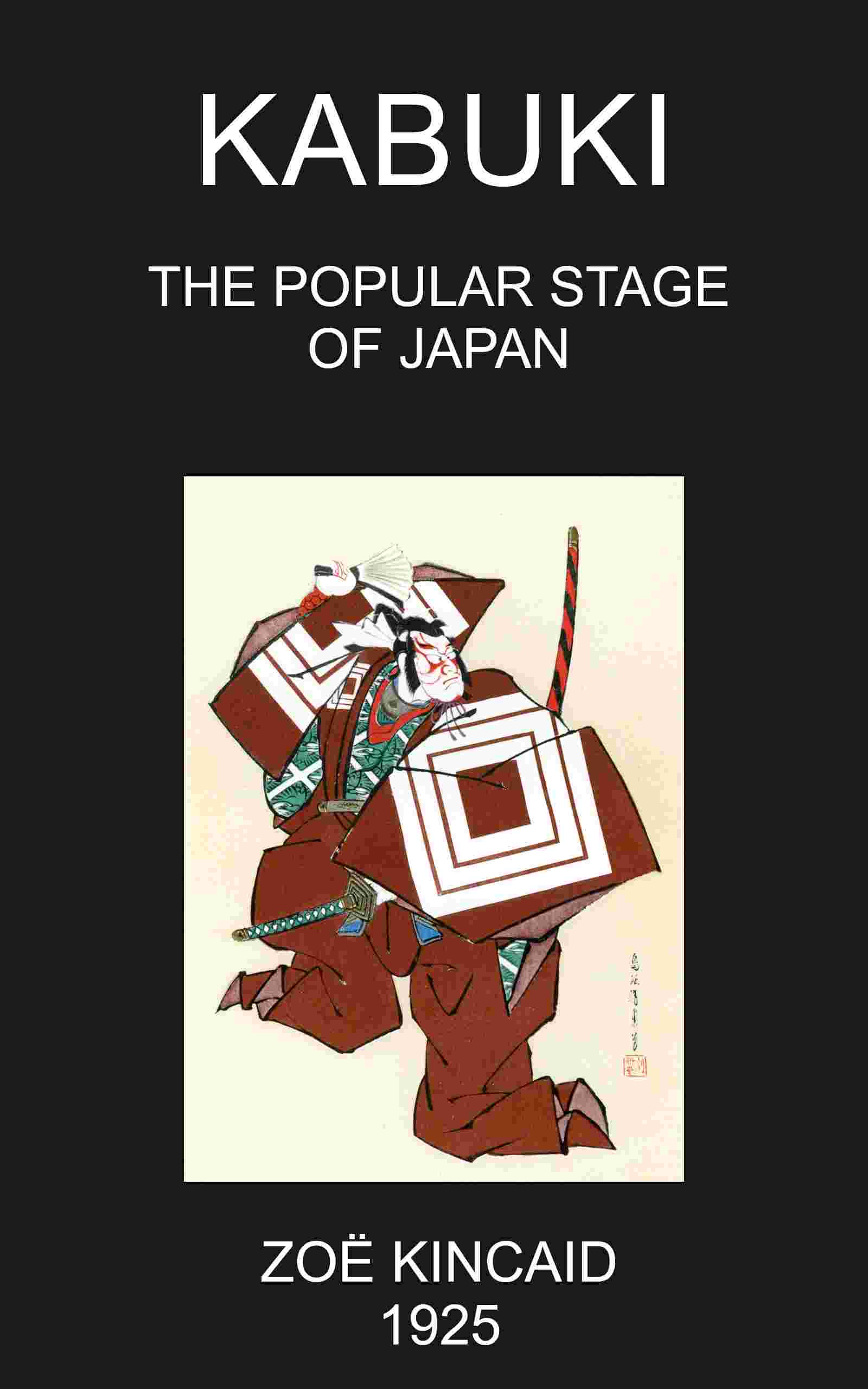
The fifteenth anniversary of the death of Ichikawa Danjuro, the ninth, was celebrated in a fitting manner by the Tokyo stage, and the kojo, or salutation to the audience, was given at the chief theatres, the Imperial and the Kabuki-za. Thirty players, for the most part those associated with Danjuro during his lifetime, and also his two daughters, made up two long lines of bowing actors, recalling the ceremonies of Yedo Kabuki. All were in the terra-cotta kimono bearing the famous crest formed by three squares, worn by the first Ichikawa in the Genroku period, and used by his descendants and pupils ever since.
In the kojo given at the Imperial, Matsumoto Koshiro, the most talented pupil of the late Danjuro, acted as master of ceremony. There was one very small figure among the actors, Danjuro’s grand-daughter, bowing before the footlights between her father, Ichikawa Shinsaburo, and her uncle, Ichikawa Sansho. The appearance of this last descendant of the chief actor-house of Kabuki caused the audience to grow enthusiastic in their applause.
An actor’s improvisation at the Kabuki-za to honour the memory of Danjuro was also given. The stage showed the front of a Yedo theatre with a tea-house at one side and a sign announcing the Danjuro anniversary. Nine of the most popular onnagata of the Kabuki-za and Ichimura-za entered as maids of the tea-house and stood waiting for the appearance of otokodate, or chivalrous commoners. These popular characters were taken by fourteen of Tokyo’s best actors, and they came in slowly by the two hanamichi and stood facing each other, talking across the audience, displaying by their voice and manner some characteristic which had endeared them to playgoers in past performances. With the onnagata they made a brave array of actor talent.
Into their midst came the veteran onnagata, Nakamura Utayemon, chief of the Tokyo actors. He made his entrance as the mistress of the tea-house, and addressed the audience on Danjuro and his work for Kabuki.
The Ichikawa crest was conspicuous in the decorations of the theatre within and without, and high over the entrance of the Kabuki-za, where the yagura, or drum tower of the Yedo theatre was accustomed to appear, there shone forth at night a huge Ichikawa crest in electric globes, somehow linking the modern actor of Japan with the fraternity in the West.
Less elaborate is the announcement of a minor actor’s promotion to a grade or so above the rank and file, made during the progress of a play, which is done in various graceful ways.
Two women in the establishment of a daimyo, rivals in the play, enter by the hanamichi with their attendants, and the procession proceeds to the gate of a temple. All enter with the exception of the rivals, and one maid.
For a moment the current of the play is turned aside, and in the gay-patterned costumes of their rôles, the two leading characters kneel down on the stage with the maid between them, each taking turn in explaining how the young man in the female disguise has been a pupil of a stage favourite who has recently died, of his association with him, and that as he has now progressed in his work they crave the patronage of the audience. The maid then returns thanks for the favour of the audience, and all three rising to their feet they take up the lines of the play as though there had been no interpolation,—the maid being admonished to join the others within the temple, as she may be needed.
When the adopted son of Danjuro, the ninth, was fired with ambition to become an actor, since he was a member of so distinguished an actor-house, no teacher seemed ready to volunteer. His father had been a banker, and he was thus not born in the purple. Nakamura Ganjiro of Osaka generously consented to assist him. For years he studied hard and at last made a first bow in a Tokyo theatre. His introduction planned by Ganjiro only serves to show the esteem in which the great Danjuro was held, and that for his sake Ganjiro was willing to assist a member of his family.
The scene selected for the introduction was that of the pine-shaded highway, the Tokaido, Mount Fuji in the background. By way of the hanamichi came a retinue of retainers in bright scarlet, with thin over-garments of white. The son-in-law of the illustrious Danjuro appeared as a splendid daimyo riding on a horse, a white-haired servitor leading the way.
On reaching the stage the rider dismounted, and kneeling in the centre of two long rows of the retainers who bowed low over their outstretched hands, the sponsor, Ganjiro, spoke of Ichikawa Danjuro and expressed the wish that Sansho, his son-in-law, would become a good actor. Sansho, responding, declared that he would do all he could to improve.
No sooner were his words spoken than a white satin curtain descended, having for design a large carp attempting to jump up a waterfall, symbol of the difficulties Sansho must overcome before reaching the heights of the profession.
Sainyu, one of Osaka’s fine old actors, came to say farewell to Tokyo but a short time before his death. The ceremony of retirement was most appropriate. The stage was prepared for a comic dance, and while various performers were attracting the attention of the audience, a large box, such as is used to contain a toy or doll, was carried in and remained to one side while the merriment proceeded. Finally, when curiosity with regard to the box had increased considerably, property men lifted the mysterious object and placed it in the front of the stage, removed the side nearest the audience, and within was disclosed the venerable actor as a marionette. In the many-coloured garments of Sambasso, the humoresque figure of the Nō stage, and manifestation of an ancient Shinto deity, whose semi-religious dance was performed at dawn with the opening of the theatre, he was brought forth limp and lifeless.
Stage attendants attached imaginary wires to his arms and head, and he performed this characteristic dance after the fashion of the dolls. Finally, real wires were attached to his costume and he rose into the air, still making marionette motions with his arms and legs, and disappeared into the regions above stage,—a feat for an actor over seventy years of age.
His love for the ceremonial also causes the actor to cherish the memory of the real persons whose lives have formed the material for drama. When the play of Sakura Sogoro is to be performed, the actors repair to Sogoro’s village, not far away from Tokyo, where stands a shrine sacred to the martyred village head who presented a direct appeal to the Shogun to lessen the heavy burden of taxes imposed upon the farmers, and in consequence forfeited his life. There the actors address his spirit, and during the run of the play a temporary shrine is erected within the theatre before which daily offerings of fruit, vegetables, and wine are made.
In the same manner, whenever Chushingura is performed in Tokyo, the actors who are to take part assemble at Sengaku-ji, the little Buddhist temple where are buried the Forty-seven Ronin, before whose tombs clouds of incense rise unceasingly. Nor do the Osaka actors forget to keep green the deeds of Michizane, the patron saint of Japanese literature, who departed from Osaka on his sad exile, and whose tragic fate inspired Takeda Izumo to write the Village School, and other loyalty scenes, in his famous doll-drama. Whenever a portion of this play is given the actors pay their respects before the spirit that has been deified in one of Osaka’s most popular shrines.
So long as there are actors who delight in changing their names and giving new ones to their sons, and to whom ceremony has a recognised place in the theatre, the fine old Kabuki regime will not soon pass away.