
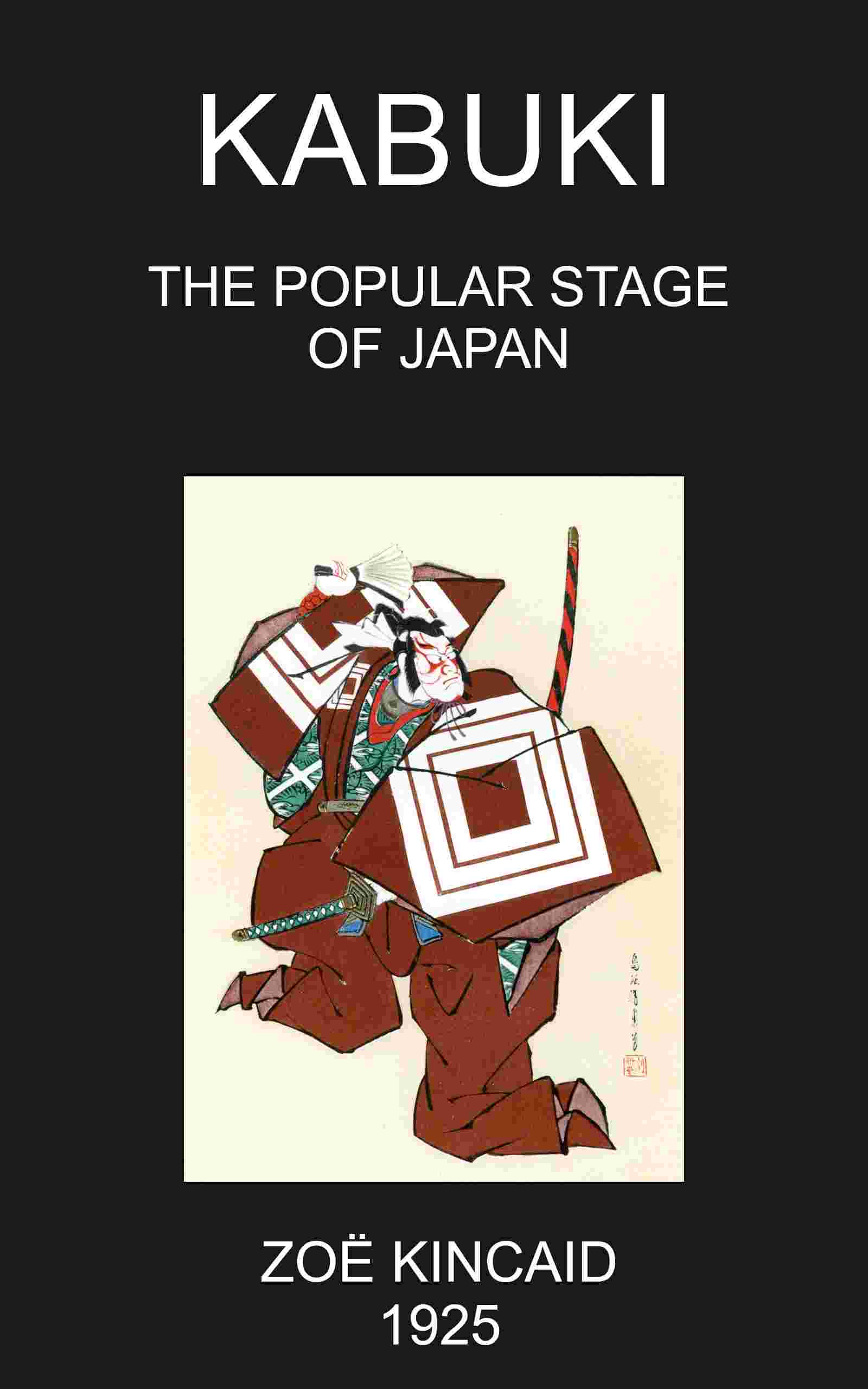
YAKUSHA
CHAPTER XI
DANJURO AND TOJURO
The first two Kabuki actors endowed with creativeness of a high order were Sakata Tojuro, of Kyoto, and Ichikawa Danjuro, of Yedo, exponents of contrasting theatre principles—the real and unreal.
They were epoch-making actors, and the manner in which they moulded the plastic theatre material of their generation is visible at the present day in the two schools they founded, that still flourish side by side in Kabuki.
Sakata Tojuro reflected the taste and elegance of his Kyoto environment. He was romantic and natural in his acting. He left no successor, but there have always been actors faithful to his styles The present Nakamura Ganjiro, of Osaka, in taking Tojuro for model and in inheriting his mantle, has appeared to be the very incarnation of this old actor.
Ichikawa Danjuro, of Yedo, established the school of aragoto, or rough acting—made out of the cloth of exaggeration, the grotesque, picturesque, unnatural, unreal. He was followed by eight members of his family, who carried on his traditions. Many of the Ichikawa actors were men of genius, who not only handed on their theatre inheritance but added new features. No other actor line has had such a powerful influence upon Kabuki as the nine members of this family.
These players appeared in what is called the Genroku age—the sixteen years from 1688 to 1703. But it also includes the years preceding and following, altogether a space of thirty years—a period of growth and expansion. It has been named the Japanese renaissance, and sometimes called the golden age of Japanese civilisation, and was a period of high achievement in literature and in art. Chikamatsu Monzaemon, Japan’s first dramatist, flourished in this period, and Ihara Saikaku wrote his criticisms of the actors.
Tojuro’s ancestors lived in the northern province of Echigo, and his father owned a Kyoto theatre. He is said to have been born in 1645, and died in 1709, and was the most representative actor of Osaka and Kyoto for the whole of the Genroku period. Tojuro was the star of the Miyako-Mandayu-za, of Kyoto, for many years. Chikamatsu Monzaemon wrote plays for him, before he turned his entire attention to composing pieces for the marionettes. Kaneko Kichizaemon, another playwright of the time, was closely associated with Tojuro, and has left many impressions of him in his book Jijinshu—or Collection of the Year’s Dust—little stories about actors, chiefly Tojuro. “All these stories came to my insignificant ears,” he writes, “therefore I call this book a collection of the year’s dust.”
Tojuro was a power in the transformation of Kabuki out of the chaotic state that followed the abolition of the Wakashu. He believed that art was long and time fleeting; he displayed broadmindedness toward his contemporaries, and did not criticise them. He was noble and refined in appearance, we are told, and had received a far better education than was the lot of most actors of his day. He had literary ability, and collaborated with his playwright friends in the composition of his plays, and wrote several dramas himself. Kaneko Kichizaburo writes that Tojuro learned to play the Nō drum from a Nō musician, so that he must have been familiar with the aristocratic stage, and the dignity and ceremonials of the Nō actors. His personal character was high, and he frowned upon the immorality of the actors, which was something that could hardly be avoided in such a loose and luxurious age. No record is left to tell of his wife and children. He had a sister whose son he adopted, but the son went to Yedo to live, and did not become an actor. His younger brother inherited his great name, yet only succeeded in imitating Tojuro, so that his talents stopped with himself and were not transmitted, as in the case of the Ichikawas of Yedo.
Many anecdotes have been handed down relating to Tojuro’s extravagance. He received a large salary, but was not at all frugal, and was accustomed to say to those who remonstrated with him about his wastefulness that in order to be a great actor it was necessary to be generous-minded and reckless. He never wore a dress that had been washed; his room was lighted by candles, not by the oil wick which was general in those days. Moreover, he did not subsist on rice and vegetables, the diet of most families, then as now, but lived like a daimyo, partaking of fish and fowl. Every day he drank a cup of the rarest tea, while he warmed his sake with costly charcoal, all in the lordly manner of a feudal magnate.
When actors repaired to his house for rehearsal, he received them seated on a beautiful silk cushion, with a gorgeous lacquered tobacco-box in front of him, and served his guests a sumptuous repast.
Once, when he played in Osaka, he ordered drinking water from Kyoto to be brought to him in casks, and his rice was selected grain by grain. When he was asked the reason for this extravagance, he replied that if his rice were not properly selected the grains might be mixed with grit and his teeth be ruined; and that if he drank Osaka water he might become ill, and in consequence be obliged to absent himself from the stage, to the great loss of his manager. It is suspected that Tojuro loved advertisement more than Kyoto water, and knew how to make himself talked about by the people of his day.
He was at his best when portraying tradespeople, and was more at ease in plebeian than in aristocratic rôles. His successful plays were those dealing with everyday life rather than historical pieces, which were the delight of Ichikawa Danjuro. Tojuro’s specialty was acting in plays dealing with the gay quarters, which pleased the people of the Genroku age immensely.
How he regarded the art of the actor may be judged from an extract taken from Kaneko Kichizaburo’s Sidelights on Tojuro: “When a poor man desires money he may be able to obtain it by stealing, or he may find it in the road, but with regard to acting nothing can be stolen. An actor who is ignorant of the fundamental principles is one who is destined never to excel.”
Kaneko tells another story to illustrate Tojuro’s attitude towards the art of acting. A certain actor who had a son 12 years of age wanted him to learn the art, but did not think it necessary for him to bother how to write or to know anything about figures. Tojuro hearing of this said:
“The art of an actor is like a beggar’s bag and must contain everything, whether it is important or not. If there is anything not wanted for immediate use keep it for a future occasion. An actor should even learn how to pick pockets.”
At one time, returning with Kaneko from the theatre, he stopped suddenly on the bridge they were crossing and stood motionless, looking down into the water, deep in meditation over some problem of acting. The playwright asked him if he had dropped something, but he did not answer. After a pause he said: “Well I have learned a great lesson!”
On another occasion he stopped at a tofu-ya, or white-bean-curd shop, went straight in and watched how it was manufactured, and after thoroughly acquainting himself with the process, thanked the proprietor of the place and went away. Such information might be worth while to know, since he could use it on the stage some day, and therefore he put it into his beggar’s bag.
That Tojuro valued the art of the real upon the stage may be judged from the many stories that have been handed down about him, but that he was aware that the real might be carried too far is shown from the Jijinshu: “Tojuro had to play the part of a beggar, but did not wish to wear tattered and soiled garments. He thought the audience came in order to be amused, and that if things were too realistic it would make a bad impression upon them.”
On the other hand, the care he exercised with regard to naturalness on the stage is shown from another of Kaneko’s little stories. A gatekeeper suddenly aroused from sleep was to yawn and ask: “Who is it?” Tojuro objected to the manner of the actor playing the gatekeeper, and made him repeat it many times before he considered it satisfactory in giving the audience the correct impression of one suddenly awakened in the dead of night.
Tojuro’s claim to fame began with his acting of Izaemon, the lover of Yugiri. Yugiri was a courtesan of the gay quarter of Shimbara, in Kyoto, and afterwards lived in a famous house called the Ogiya in Shimmachi, Osaka. It was first written in one act. Chikamatsu Monzaemon took the love story of Izaemon and Yugiri, and wrote a masterpiece, Keisei Awa no Naruto. It is the favourite play of Nakamura Ganjiro, of Osaka, to-day. Tojuro acted Izaemon in this piece on the eighteen occasions it was performed during Genroku, and it never failed to attract a large audience.
Thus Tojuro was the founder of the natural school, which, if there had been no other influences to hinder its supremacy, would have developed in a similar way to the realistic stage of the West.
There were, however; other theatre materials for the asking, and the members of the Ichikawa family made use of these with lavish hand, causing the talents of the actors to flow in channels quite removed from Tojuro’s realistic art.
The first of the nine Ichikawas was born in 1660, and died in 1704. His father was a samurai in the province of Kii, named Horikoshi. When the daimyo he served was defeated in battle, Danjuro’s father became a ronin and lived in retirement in the district. Afterwards he removed to a village in the province of Shimosa, where he became a farmer. He went to Yedo in 1644, and called himself after the village he had left. He was a man of strong character, skilled in writing, an adept at figures. It was very natural, possessed of such accomplishments, that he should become popular among his neighbours in Yedo, and he was chosen to represent the landlords of his locality.
He was good at business and made a fortune for himself. There were in Yedo in those rough-and-ready times men called otokodate, or chivalrous men of the people, who did not fear the blustering two-sworded samurai, who too often attempted to intimidate the peaceful citizens. Danjuro’s father associated himself with these brave spirits, who were always ready to defend the helpless and to protect the interests of the middle and lower classes. Such was the father of the first Ichikawa Danjuro, the representative Yedo yakusha of the Genroku period.
The exact date of the first Danjuro’s advent into the world is in question, some accounts say 1660, others 1648, but as the inaccuracy of dates in Japanese records is so frequent, it is not a matter to be greatly concerned about. His father’s friend acted as godfather and called the child Ebiso,—a name which has persisted in the family, and is given to the members when they are very young. The boy’s dwelling was in the vicinity of the Nakamura-za and Ichimura-za, that drew him irresistibly, just as the Tokyo urchin of to-day steals off to see the moving pictures whenever he has sufficient to pay the entrance fee. He must have made up his mind at an early age that he wanted to become an actor, for he appeared for the first time at the Nakamura-za, when he was 14 years of age. He took the stage name of Ichikawa Danjuro, and acted the rôle of Kintoki, the fabulously strong baby-hero of a Japanese fairy tale,—a red-faced, muscular baby, generally depicted with an axe over his shoulder. The new actor was an immediate success.
Danjuro was responsible for a new mode of acting that astonished and delighted Yedo people,—the aragoto, or rough style. The Doll-theatre was the source of his inspiration. There were minstrels who recited the military exploits of Kimpira, a Hercules who slew demons and beasts. The minstrel, desiring to appeal to the fighting spirit of the Yedo people, beat his rhythms with a long iron rod, and sometimes wielded this weapon so wonderfully that he broke off the heads of the performing dolls or smashed the scenery in his exploitation of valour.
The people had begun to grow tired of plays dealing with the effeminate and luxurious life of the gay quarters; they wearied of sentimentality, and welcomed performances that were more manly and possessed a militaristic appeal. Danjuro, the first, seized the opportunity to please the citizens of Yedo, originated the exaggerated artificial style now inseparably linked with the Danjuro line, their famous eighteen plays, or Juhachiban, being treasures of Kabuki that are woven out of the pure fabric of fancy, and so unreal that those steeped in realism can find but little to admire in them. Yet they represent the talent of this long actor line; they have been altered, improved, added to in the way of treatment, costume, and acting by successive members of the family, unadulterated theatre material, full of taste and style, but as yet unknown to the unseeing eyes of the West.
Like Tojuro, the first Danjuro was not only an actor, but also of a literary turn of mind, and took an active part in the composition of his plays.
As he wished for a son to succeed him he repaired to Narita, not far from modern Tokyo, where stood then, as to-day, the famous Buddhist temple sacred to Fudo, the God of Fire. Here he worshipped, praying to Fudo for a son. The petition was granted, for a son was born who inherited his father’s characteristics to a remarkable degree. Danjuro had a play written concerning Fudo, by way of returning thanks, and selected a business name by which his successors are always known—Naritaya, after the temple in the village of Narita. Horikoshi remained the family name, that of his samurai ancestors; Naritaya was the name given off the stage by his fellow-actors and familiar friends and tradespeople; while Ichikawa Danjuro was his stage name. He also possessed a nom de plume with which he signed his short verse, for he was a poet in addition to his other qualifications.
Descriptions of Danjuro say that he was strong, his arms brawny, his shoulders broad, and that he stood erect. Warrior rôles were his specialty, and when imitating heroic deeds of the Doll-theatre he played with such a display of force, and his gestures were so remarkable, that when he trod the stage the reverberations were so violent that the stock-in-trade of such porcelain shops as happened to be in close proximity to the theatre were threatened with destruction! However, Danjuro could, when occasion demanded, use naturalistic methods, for the critics of his day praise him when he acted the rôle of a blind shampooer, and mention his gestures as being “so natural”!
In an old book there is a description of his stage methods. He was asked to attend a social function in the mansion of a certain nobleman, and requested to give some aragoto piece. He took down the upper part of his kimono and performed as Kagekiyo—the hero of several Nō dramas—and his actions were so spirited that he broke all the shoji, or white paper screens. The guests were anxious to know what the host would think of the entertainer’s destructive methods, but, contrary to their expectations, the daimyo was pleased and presented him with a costly gift. Danjuro is said to have made the comment after his strenuous acting that if an actor was afraid in the presence of a daimyo he could not play aragoto.
The contrast between the styles of Tojuro and Danjuro was very great, but both truly reflected the tastes of their audiences. The three theatre towns had then, as they have at present, special characteristics.
Kyoto was quiet and easygoing; Yedo military and intense, the centre for the samurai from the provinces who continually came and went. The inhabitants of Osaka and Kyoto, who were mild and gentle in disposition, went wild over Tojuro’s artistic acting, taking pleasure in the effeminate, sentimental heroes and heroines of the gay quarters, and they rather looked with disdain upon the exaggerated, artificial, and altogether extraordinary acting of Danjuro.
Danjuro was bold, eccentric, rough, and heroic; Tojuro elegant, sensuous, and luxurious, reflecting the spirit of the Kyoto and Osaka people, who were pleased to see his plays of everyday life, and faithful depiction of human nature. Tojuro was eloquent, and sometimes his speeches were so long as to tire his audience; Danjuro was so quick-spoken that sometimes he could not be understood. The theatre materials out of which Danjuro and Tojuro cut their patterns—the real and unreal—continued to coexist after the Genroku period. The one did not swallow up the other; but both maintained their place and use,—sometimes mixed, with strange results, sometimes found without adulteration.
Perhaps the most famous of Danjuro’s plays is Kanjincho, a popularised version of Ataka, a Nō drama. “Kanjincho” means a Buddhist scroll upon which are written the names of subscribers to a fund to restore or rebuild a temple. Without asking leave, Danjuro appropriated this Nō play. A member of the house of Kineya, the musicians of Kabuki, suiting the music to the plot, there was evolved the most perfect music-posture play of the Japanese theatre. Danjuro, the first, played it in 1702. The theatre was crowded, and the piece continued for 150 days. It was called Oshiai Junidan, meaning to crowd or push together. And after the lapse of more than 200 years this Kabuki masterpiece still holds audiences in a spell, and never fails to arouse the greatest enthusiasm. It was performed before the Prince of Wales on his visit to Japan in April 1922.
Danjuro played another piece, Soga no Goro, at the Ichimura-za, which became the inspiration of every actor in later times. When he acted Goro, the hero of the Soga play dealing with the revenge of the Soga brothers upon the slayer of their father, he wore a kimono embroidered in a design of lightning, and three rice measures, or three boxes of graduated size fitting into each other. After this he took three rice measures as his crest, and this was to become one of the most famous actor-symbols on the Japanese stage.
Danjuro journeyed to Kyoto and Osaka, and astonished the audiences in these cities by his originality and activity, the country people flocking in from the outlying districts. In Osaka he was so well received that a popular song sang his praises. He studied short poems while in Kyoto, and his teacher gave him a nom de plume, the custom of an actor taking a poetry-name originating with him.
An account is given in Kabuki Koto Hajime, or Beginnings of Kabuki, of Danjuro’s meeting with Tojuro. Danjuro went to the theatre to see Tojuro act, but found that he was absent on account of illness. Danjuro greatly regretted that he was unable to see Tojuro on the stage. But on the following day a messenger came from Tojuro inviting him to dinner at a restaurant.
When Danjuro reached the place, Tojuro failed to make an appearance, and after he had waited for a long time and was beginning to grow impatient he saw his host in ordinary dress arranging flowers in another room without as much as casting a glance in the direction of his guest, as unconcerned as though quite unaware of his presence. This made Danjuro angry, and he was just on the point of retiring when a messenger from Tojuro apologised for the delay and said he would join him immediately. He had changed his clothing, wearing his very best, and received his guest in the most dignified manner.
Danjuro was so much impressed by his appearance that he said there was no necessity to see him act, and left for Yedo the next day. The gossip of the time said that Tojuro planned to overawe his Yedo rival, and had determined that no Yedo actor should carry away laurels from Kyoto during his lifetime, so that if this report be true the long-established rivalry between the theatres of Yedo and those of Osaka and Kyoto had already begun at this time.
Danjuro’s stage career ended suddenly at the age of 45. His death is one of the most tragic events in the history of the Japanese theatre. He was murdered in his dressing-room by a fellow-actor in 1704. Some accounts say that the murderer’s name was Sugiyama Hanroku. Ihara Seiseiin, who has closely inspected the suspected actor’s record for the year in which Danjuro was murdered, says he was unable to find the name of Sugiyama Hanroku, but discovered one Ikushima Hanroku, who was recorded as an actor of considerable ability, being ranked as first of the middle class. Accounts with regard to the motive prompting the deed are conflicting. Some say jealousy; others that this actor had a son who was a deshi, or follower, of Danjuro, and had changed his name to Ichikawa; again that Hanroku was a man of evil character, and Danjuro gave him some sound advice which he did not heed, and that this made Danjuro indifferent to the son. Yet most accounts agree that the cause of the tragedy was Danjuro’s changed attitude towards the son.
The result of this crime was that the proprietors of the theatres were summoned to the magistrate’s office, and an order was issued that continuous plays could not be given, and only those of one act were allowed, the audience to be changed at the end of each act.
Hanroku made good his escape from Danjuro’s dressing-room, but was taken to prison on that day, and died there before his sentence could be carried out. Danjuro’s widow cut her hair short, and lived a life of retirement in Meguro, now a suburb of Tokyo.
Danjuro, the first, was fortunate in leaving behind him the successor who had been given to him in answer to the prayer made to Fudo, the God of Fire, at the Narita Temple, for this son was to become one of the most famous actors of the Danjuro line.
(Three rice measures).
(Derived from toy resembling three monkeys).
(Peony).