
CHAPTER XII
YAKUSHA OF GENROKU
During the Genroku period that produced so many men of distinction in art, literature, and the drama, the audiences of the three towns had a brilliant array of actor talent from which to choose, and the achievements of the contemporaries of Sakata Tojuro and Ichikawa Danjuro resulted in a keen appreciation of the actor’s creativeness. The common people were to become familiar with a high order of acting, since the emphasis, whether rightly or wrongly, as judged by Occidental standards, was always on the actor, the playwright being of secondary importance.
Three stars were to be seen during Genroku on the stages of Kyoto, Osaka, and Yedo. They were Yamashita Kyoyemon; Takeshima Kyozaemon, the son of that Takeshima who had been the head of a company of women players in Kyoto; and the second Arashi Sanyemon, son of the actor of the same name, who previous to this had gained great success in Yedo, and then removed to Osaka, where he owned a theatre.
Yamashita Kyoyemon, who died in 1717, was the son of a Kyoto artist. He was at first a Nō actor, but gave up this profession to follow the fortunes of Kabuki. Sakata Tojuro regarded him as a rival, and Kyoyemon often acted with Tojuro at the Miyako-Mandayu-za in Kyoto. Once a rumour was circulated that he was dead, which proving untrue the people flocked to his banner, and he was more popular than ever before.
The historians of Kabuki agree that he was a man of fine bearing and gentle disposition, and that while he did not quite equal Tojuro’s grand manner he was in no way an actor of little talent. It was Kyoyemon who appeared in the first stage version of Chushingura, the tragedy of the Forty-seven Ronin, who avenged the death of their lord and then committed harakiri in Yedo. Afterwards the tale inspired Takeda Izumo, who wrote a drama for the marionettes that is undoubtedly one of the masterpieces of the Japanese theatre to-day.
It is said of Kyoyemon that even a rustic from the provinces, who had never seen him before, and knew nothing concerning him, could not fail to be impressed by his presence, and to understand without being informed that he was the leading actor.
He had his little frailties, however, for he was too fond of applause, and so eager for the praise of the audience that he pandered to the tastes of the lower classes, and was given to making vulgar asides. This was entirely unlike Tojuro, who had a high moral character. Like Tojuro, however, he held the mirror up to nature, and the side-lights upon his stage methods that have been handed down reveal the fact that he excelled as a samurai, particularly as a ronin, or free-lance, who roamed the country in quest of adventure, and wearing the costume of a traveller.
One of Kyoyemon’s brothers became a celebrated priest, and his daughter married Sawamura Chojuro, a leading actor of a later period. His wife’s sister married an onnagata, the first Yoshisawa Ayame, and their son Matataro inherited Kyoyemon’s name, becoming Yamashita Kyoyemon, the second—hence his family occupied a prominent position in the actor fraternity.
The second actor of importance at this time was Takeshima Kyozaemon, son of Yamato Dansuke, of O-Kuni Kabuki fame. Although he played often in Kyoto, he made Osaka his headquarters, and at last went to Yedo, where he played with Ikushima Shingoro, the unfortunate actor exiled because of a love affair with a lady-in-waiting of the Shogun’s Court. For three years he played at the Ichimura-za and Morita-za, and then took up his residence in Kyoto, where his son was the proprietor of a theatre. He was particularly partial to samurai rôles and knew how to handle a sword. His son was also a good actor, and succeeded to his name.
The third famous actor of Tojuro’s time was Arashi Sanyemon, the second. He was younger than Tojuro and Kyoyemon, and died early. The first Arashi was his father, but the boy was evidently regarded as an ugly duckling, for his father did not consider that he possessed sufficient talent for a stage career, and he was apprenticed to a candle dealer, the business requiring him to travel from one place to another. When the elder Arashi was taken ill, the son was called to Osaka to take up the parental profession, and so had the difficult task of trying to live up to his father’s reputation. At first the audience laughed at him, but as he had the same face and voice as his father, he soon attracted attention and came to be regarded as one of the leading actors. Indeed, he was considered in some respects superior to his father, especially in the art of love-making; he was genuine and unaffected, and possessed a well-shaped nose and fine eyes.
The foregoing actors were tateyaku. The most noted actor to take katakiyaku, or the villain rôle, of this period was Kataoka Nizaemon, who died in 1715. At first he was a samisen player of Osaka, and during his early years was associated with the management of Osaka theatres, beginning a stage career in middle life, yet reached high rank and was regarded as a genius. He was tall and well-proportioned, and had a fierce look in his eyes which gave him a decided advantage in the villain rôle. He could also play the hero well, but received great praise for his old men characters, a specialty that seems to have remained in the possession of this actor line, for the modern representative, Kataoka Nizaemon, of the Kabuki-za, Tokyo, never pleases his audiences better than when playing as oyajigata, or old men.
Nizaemon was samurai-like in his bearing. He is on record as saying that actors should be familiar with popular poems, know Buddhism and Shintoism, and be well informed on a variety of subjects so as to draw upon such knowledge in their work on the stage. No doubt Nizaemon practised what he preached, for he played many rôles in his time. His real son, who was a theatre owner, succeeded as Nizaemon, the second, but died soon after, and the Kataoka generations were continued by a younger sister of the first Nizaemon, who had married an actor. It was her son who succeeded to the hereditary name of Kataoka Nizaemon, the third,—a stage name that has continued down to the present. Kataoka Nizaemon and Ichikawa Danjuro are the only two actor families that have come down from Genroku in unbroken succession to modern times.
The first Danjuro’s greatest contemporary in Yedo was Nakamura Hichisaburo, who died in 1708. He was Danjuro’s equal in many respects, and shared the honours of Yedo Kabuki with him. But Hichisaburo left no family to carry on his traditions, and in consequence obtains a less important position in the history of Kabuki than Danjuro, the first, who founded a line of actors that have been uppermost on the stage for more than two hundred years, and were regarded as the feudal lords of the theatre before whom all others of the fraternity bowed in respect and admiration.
Nakamura Hichisaburo was exactly the opposite to Ichikawa Danjuro in his stage methods. He belonged to Sakata Tojuro’s real school, and was quiet and restrained on the boards. Danjuro was bold and exaggerated, Hichisaburo effeminate and mild. They represented the two currents of the popular mind during Genroku. Danjuro was not altogether welcome in Kyoto and Osaka, Tojuro’s stronghold, where his style was not wholly appreciated, although he was acknowledged to be a great actor. Hichisaburo, on the contrary, met with great success on the stages of these towns.
He was a handsome man, and the criticism of the time acknowledged his dignity of manner. Unlike Danjuro, he did not startle with the strength of his militaristic actions, which caused him in some quarters to be regarded as slow. But this was according to Yedo critics, who had grown accustomed to Danjuro’s striking efforts. In Kyoto, it was contended that Hichisaburo was not good as a fighter, but one critic declared that he was like patent medicine, good for everything.
Hichisaburo’s manner on the stage was similar to Tojuro’s, yet the stars of Kyoto appeared to tower above him. As a lover he was very popular, and delighted in mixing Yedo slang with his stage lines, and knew how to reach his audiences. It is said of him that he was good in pathetic rôles and “could bring tears to the eyes of a demon”. Moreover, he was a good dancer, which was probably due to the fact that he was entirely familiar with the Nō stage. Some years younger than Danjuro, he married the daughter of the second Nakamura Kansaburo, and probably took the name of Nakamura from this family.
Like most of the actors of this early period he wrote his own plays, the most successful of which was Asamagatake, or Mount Asama. Although Hichisaburo was a Yedo actor, he spent much of his time in Kyoto and Osaka.
The most prominent actor who imitated Hichisaburo was Ikushima Shingoro. Hichisaburo was taken ill on the stage while playing Juro, one of the brothers in the Soga revenge, his favourite rôle.
After Danjuro and Hichisaburo, the most distinguished actor of this time was Nakamura Denkuro, who died in 1716. He was of more aristocratic theatre lineage than the two prominent Yedo actors above, for he was no less a personage than the grandson of Saruwaka Kansaburo. The first Kansaburo had three sons: the first was the child of a concubine and did not inherit; the second son, who accompanied Kansaburo to Kyoto and danced before the Emperor, succeeded as second of the line, taking the name Akashi, which he was given at the time of this performance in Kyoto. He left his name to his younger brother, who became the third head of the family.
The son by the concubine was blessed with two sons, and one of them was no other than Nakamura Denkuro, who exercised considerable influence upon Yedo Kabuki, establishing traditions that have been handed down to modern times. Denkuro’s father, perhaps because of his illegitimacy, never appeared as an actor, but was engaged as an accountant of the Nakamura-za all his life. Nevertheless, it was his son who inherited the theatre genius that might have been expected to appear in the first Kansaburo’s legitimate offspring.
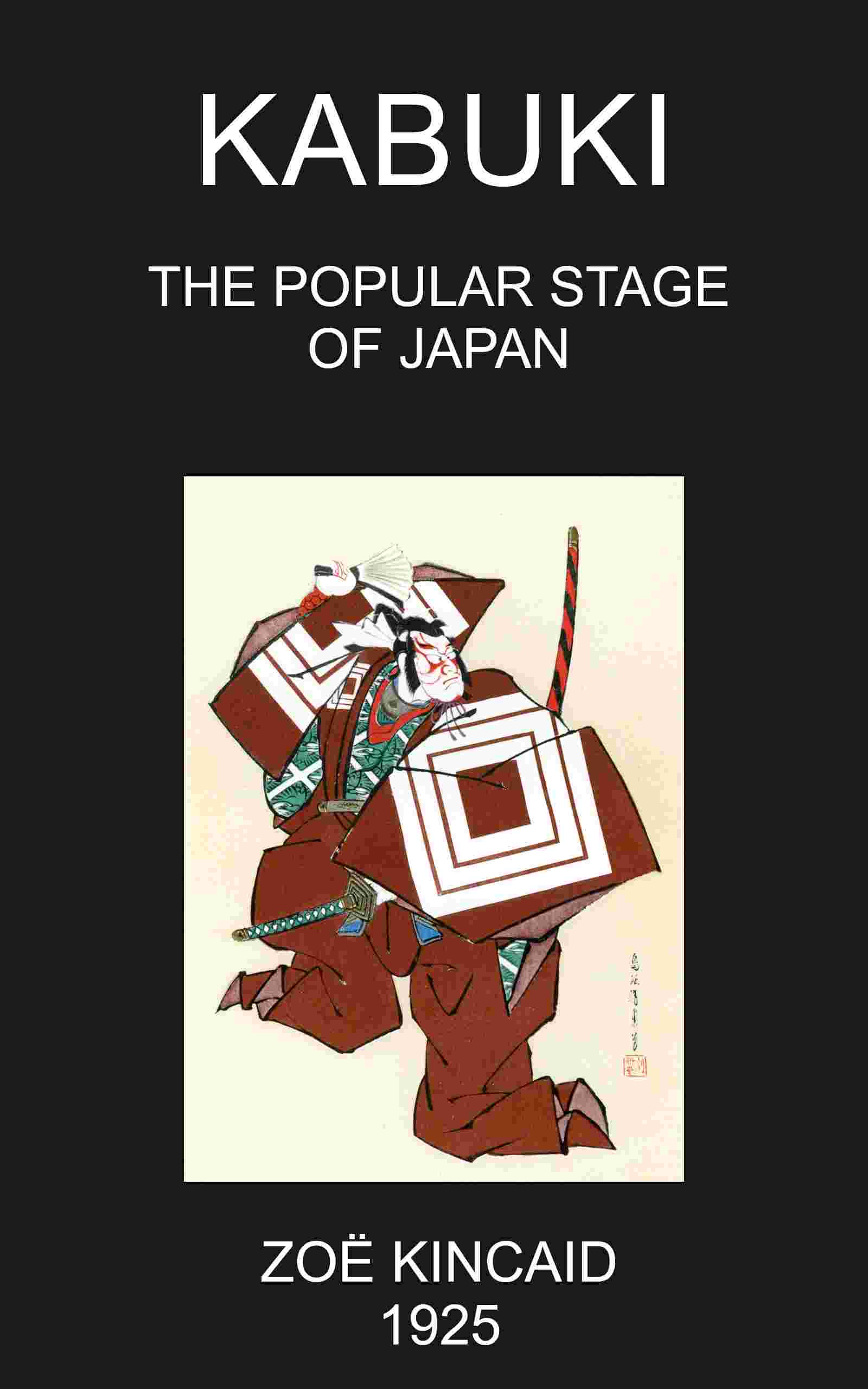
The rôle of Asahina, an historical character, at the Nakamura-za made Nakamura Denkuro famous, and the manner in which he painted his face with broad red lines and the style, colour, and design of his costume have served as a model for all succeeding actors who have essayed this popular rôle. Asahina was a bold warrior of the time when Yoritomo ruled by the sword in Kamakura. Denkuro used Asahina’s crest to decorate his stage costume, a crane in a circle, and it has always been preserved, Asahina not being considered by audiences or actors as the real thing unless faithful to all the details of Denkuro’s grotesque creation.
And it is by these traditions that the modern Tokyo actors link this old past with the bustling, strenuous modern days, for a veteran of the Kabuki-za in Tokyo succeeded to this illustrious stage name a few years ago, and to celebrate the auspicious occasion appeared in all the startling array of colours, unearthly red make-up, and exaggerated gestures and postures of his Yedo predecessor.
On account of chronic illness Denkuro was obliged to withdraw from the stage at the height of his career, and could only return to say a few words on the introduction ceremony of the second Hichisaburo, who was a child-actor when he took the name Nakamura Hichisaburo had made so famous. Denkuro had been closely associated with the first Hichisaburo, hence his interest in his youthful successor.
Another tateyaku who acted with Danjuro, and was regarded as equal to Nakamura Denkuro, was Miyasaki Denkichi. He was put in prison with other actors in connection with a scandal in a nunnery. The abbess of the institution was a favourite at the Shogun’s Court, and in consequence of her high position, and because the entrance of the despised playfolks within her female fold was regarded as a laxity of moral practice that deserved high punishment, she was sentenced to death and the actors were imprisoned. Miyasaki Denkichi played on the stages of the three towns, but died in obscurity, very likely as a result of his irregular life.
Among the deshi, or followers, of Danjuro, the first and most noted was Ichikawa Danshiro. An actor bearing the name died in 1922, a veteran member of the Kabuki-za company in Tokyo.
In the middle of his career this first Danshiro shaved his head and became a Buddhist priest, retiring to a provincial temple. As Yedo Kabuki of those days was lacking in good actors, messengers were frequently sent to his distant temple asking him to return to the stage, but he repeatedly refused. At last he consented upon the condition that at the end of the performances he was to return to his holy profession.
He acted the rôle of Mongaku Shonin, the samurai who made love to the heroic Kesa Gozen, or the Lady Kesa. Wishing to get rid of her husband, the samurai planned to kill him in his sleep. Kesa Gozen gave Mongaku a sign by which he would know the right head to cut off—the hair was to be freshly washed. But to his horror the assassin found that he had killed the Lady Kesa herself, who had thus sacrificed her life to preserve her honour and by her act had saved the life of her husband. In penitence for this deed, Kesa Gozen’s lover became a priest, and the interest of the Yedo playgoers in Danshiro’s return to the stage in this priestly rôle may well be imagined. True to his word, this follower of Danjuro returned to his temple and died there in 1717.
As to the celebrated villains who played with the above actors, the two stars were Yamanaka Heikuro and Nakajima Hiroyemon.
Senior to Tojuro and Danjuro, Yamanaka Heikuro died at the age of 83, and played with both the first and second Danjuro. He adopted a son, who did not live to succeed him. Many stories are told of the impressiveness of this stage villain, and how even the actors playing with him sometimes became frightened at his appearance. He was of large physique and a man of forceful character, so that he was eminently fitted to play the diabolical katakiyaku whose fierceness and violence caused the Yedo audience of those days to feel thrills of horror.
Great stage changes took place during the second part of the Genroku period, and the rapidly developing Doll-theatre began to influence Kabuki and its actors. The public tired of the sentimentality introduced by Tojuro, and expressed a taste for the loyalty and sacrifice plays such as were in vogue in the Doll-theatre, that had begun to capture the public imagination.
The actor genius of the latter part of the Genroku period was undoubtedly Sawamura Chojuro, who was born in 1680 and died in 1734. He was the son of an Osaka merchant. His elder brother was also an actor of repute, and a younger brother an expert drum performer. Although he played with Tojuro, he did not confine himself to this school exclusively, but was influenced by the different styles of the Genroku stage. He assimilated and harmonised the characteristics of the celebrities who had preceded him, and so did much towards the establishment of the rules of acting that pertain to modern Kabuki. He made himself popular in samurai plays, in those of everyday life that reflected the manners and customs of his time, and he was equally at home in historical pieces that required the exploitation of the unreal, while he excelled also in dancing. His son, called Chosaburo, became the second Chojuro.
A follower who took the name of Sawamura Chojuro, the third, was destined to found a strong actor family that is flourishing in Tokyo to-day, half a dozen members of this name now being prominent. He was known on the stage as Sawamura Sojuro, a name to reckon with in Japanese stage history. The present Sawamura Sojuro of the Imperial Theatre, Tokyo, with his four actor sons, and a nephew, Sawamura Chojuro, make a formidable family array of players, there being no fear for some time to come that this line will suffer extinction.
When Yedo Kabuki lost its two Genroku stars, Danjuro and Hichisaburo, there was a vacancy that no one else could fill, and the Yedo people must have felt a lack of interest when witnessing the performances of those who tried to take their places. There were in reality only two actors in Yedo at this time who upheld the past glory of the stage. One was Ikushima Shingoro, and the other Nakajima Kanzaemon.
Ikushima Shingoro, one of the most tragic figures among these old actors, was born in Osaka, and came to Yedo during his years of stage apprenticeship. He acted almost exclusively at the Yamamura-za. He was 44 years of age when his love affair with a lady of the Shogun’s Court caused him to be banished from Yedo, and for twenty years he lived in his place of exile, never returning to the scene of his stage triumphs. A modern play has been made concerning this unfortunate actor, who, according to the gossip of the time, was more sought after by the venturesome Court lady than disposed to seek her himself.
And just as Saruwaka Kansaburo’s performances before the Emperor and Shogun had been an honour to the whole actor profession, so this Ikushima scandal was to remain a blot on the actor’s escutcheon for many years to come. The whole trouble was caused not so much by Ikushima, or the owner of his theatre, Yamamura Chodayu, as by the romantic Lady Yenoshima herself. Although the secret of the friendship of the actor and lady was kept for many years, the audacious Yenoshima put the fat in the fire. As representative of the Shogun’s mother she was sent with other Court ladies to pray at Zojo-ji, a Buddhist temple of Yedo that remains one of the striking features of modern Tokyo. The party reached the temple early in the morning, and there presented but a few of the many gifts they had brought with them, reserving the best to be distributed at the theatre as favours. Hastening over their devotions, the party made haste to the Yamamura-za.
All was excitement within the theatre, where seats had been reserved for a hundred persons. The proprietor, Yamamura Chodayu, and the leading actors headed by Shingoro, clad in ceremonial kimono, came out to meet the distinguished party, and a feast was given. It is said that Yenoshima and her friends grew slightly hilarious, and a sake bottle was pushed over, with the result that the contents fell upon the head of a samurai in the audience below, who became angry, and in spite of apologies left the theatre. Yenoshima’s behaviour that day at the Yamamura-za soon became known, and it was not long after that the whole disgraceful affair came to the ears of the officials of the Shogun’s Government, with the result that Yenoshima was exiled to a small island off the coast in a distant part of the country.
She was then 33 years of age. Her sentence was lightened afterwards owing to the clemency of the Shogun’s mother, and she was transferred to the province of Shinano, where she was put in charge of the local daimyo. In those days, however, as it was the custom to punish not only the guilty, but to inflict it likewise upon the immediate members of the family, Yenoshima’s brother was condemned to death, and a younger brother exiled. After this the iron hand of the shogunate rested heavier than ever upon the theatre folks, for the Yamamura-za was not only deprived of its licence, but the building was demolished, all property confiscated, and this theatre ceased to exist. The proprietor as well as the actors, Ikushima Shingoro and Nakamura Seigoro, and even the onnagata, Iwai Hanshiro, were all exiled.
The first Matsumoto Koshiro appeared at this time, and as the seventh Matsumoto Koshiro, of the Imperial Theatre, is one of the leading actors of present-day Japan, it is interesting to know something of the founder of this line. He came to Yedo from Shimosa province, and was at first an onnagata, but later changed to tateyaku. He belonged to Danjuro’s aragoto, or rough-acting school, inherited from the brave balladry of early Yedo Joruri, and is even said to have rivalled Danjuro in the art of the unreal. In middle age he shaved his head as a sign of retirement from active life. His adopted son succeeded to his name and stage inheritance, but later on he became by adoption Ichikawa Danjuro, the fourth, the Matsumoto Koshiros afterwards being closely associated with the Ichikawa family, the present Matsumoto Koshiro having been the deshi, or pupil, of Ichikawa Danjuro, the ninth.
In Kyoto, an actor who showed much originality and played in both Osaka and Kyoto at the time the above actors were active in Yedo, was Shibazaki Rinzaemon, who was quick to recognise the art of the doll-actors. His specialty consisted in imitating them. He was well fitted in personal appearance, character, and voice to be a leading actor. He began his stage study in Osaka, where the dolls were beginning to rival the real actors, and it is easy to see how the movements of the puppets, their airs and graces, postures and gestures, as created by the nyngyo-tsukai, or doll-handlers, who were artists in every respect, introduced the Kabuki actors to a whole new world of expression, of style and taste, which they were eager to command.
A star common to the stages of Kyoto and Osaka when Shibazaki Rinzaemon flourished was Kosogawa Juyemon. He had been a samurai in daimyo service, and became an actor from choice. As revealing the sentiment of the time, it is recorded that one of his relatives came to the theatre to kill him because the ex-samurai had the insolence to act under his own name. This the relative considered a piece of great effrontery, and but for the pacification of the theatre people would have carried out his intention. Shibazaki Rinzaemon was good, as might have been expected, in samurai rôles. He lived to a ripe old age, and when he became too infirm to appear as a fighting man, contented himself with old men’s rôles. Before his death he lost his sight, but still his usefulness upon the stage did not cease, for he was accommodating enough to act blind characters.
(Ivy leaf).
(Stork).