
PLAYS
CHAPTER XXV
KABUKI PLAY FORMS
I
The four characteristic play forms of Kabuki may be classified as follows: sewamono, plays of everyday life; jidaimono, historical drama; shosagoto, music-posture drama; and aragoto, highly imaginary improvisations. Closely allied with these forms is odori, the descriptive dance, which forms the very foundation of the actor’s art, as it is known and practised in Japan.
Sewamono are plays in which human nature holds sway, the playwright selecting for his material the joys and sorrows of the people around him. Those composed for the Doll-theatre partake of the nature of balladry, the marionettes moving to music, song, and recitative, while those written for Kabuki are more akin to the drama of the West.
Jidaimono, historical drama, are pieces that have heroes and heroines taken from the pages of history for central characters.
But since the playwright was forbidden by the authorities to represent the real events of history, his only recourse was to take famous personages and set them in the midst of a wholly imaginary and irrelevant plot. As he was unable to confine himself to truth, he allowed his imagination to run riot in the painting of characters and scenes as far removed from the realities of life as possible.
Shosagoto, also called furigoto, the music-posture drama, provide the most characteristic Kabuki pieces. Largely influenced by the Nō, the shosagoto combine all the Kabuki arts—plot, music, scenery, acting, movement, and colour, and represent the most sincere collaboration of the Kabuki specialists.
Even more detached from life than the jidaimono is the fourth variety of Kabuki play, the aragoto (lit., rough acting). Originated by the first Ichikawa Danjuro, these pieces cannot be classified as drama, for they scarcely possess any form, and are the result of improvisation on the part of the different members of the Ichikawa family, who added or altered, improved or patched up, producing the traditional eighteen pieces of this house.
The essence of aragoto is exaggeration, and this applies to every detail, gesture, posture, movement, costume, and acting. The flimsy material that serves to unite all these strange ingredients is generally an abstraction, and the expressions and words used are largely symbolic. The entire emphasis is placed on the art of acting, and the playwright is left a long distance behind.
Modern stage-writers have made signal departures from these time-honoured forms, and melodrama, as well as translations and adaptations of Western plays, are now frequent. In the weaving of their patterns, however, the modern playwrights appear to wish to throw overboard as much lumber of the past as possible, but without great success. Out of the fusion of East and West that is going on upon the Japanese stage at present, much of interest is to be expected in the future.
On account of the long hours through which the performances extended, it was necessary to spread a veritable theatrical feast to sustain the interest of the audience and keep its attention from wandering. The programmes were so planned as to include all types of Kabuki pieces, and this holds equally true of the entertainments afforded by the modern stage.
In the old days the arrangement of the programme was fixed and unchangeable, and although at present changes are made now and then, the sequence of the pieces remains practically the same.
Ichibamme, or the first piece, is a selection of three acts from a jidaimono, or historical drama. Then comes the naka-maku, or middle curtain. This is a short shosagoto, but occasionally a one-act aragoto offering is presented. Sometimes two short pieces are given, and nowadays this is the position assigned to any attempt by a new writer.
Next comes the nibamme, or second piece. This is a sewamono, or play depicting the life of the people. For conclusion there is a gay dance in which the young actors are generally to be seen. This is called the hane-maku, or end curtain.
Although the Kabuki play forms fall into these four categories, actors, playwriters, dancing masters, musicians, and others responsible for the productions never allowed themselves to follow rigidly the special forms that had been evolved. These stage workers were like a painter who dips his brush into the colours on his palette as they are needed. Similarly the Kabuki experts combined the real with the unreal; introduced dance, pantomime, and, music, even feats of acrobats as they saw fit, and worked freely, unconscious of limitation.
II
Chikamatsu Monzaemon was one of the first dramatists to discover the value of human nature as material for his plays, and his contemporaries and successors also sought inspiration in the domestic life about them, producing the type of drama called sewamono, or plays of the people.
That “All the world loves a lover” is as true of Chikamatsu’s Izaemon as of Shakespeare’s Romeo. Originally acted by Sakata Tojuro of Kyoto in the Genroku age, Izaemon is one of the oldest rôles on the Japanese stage, and never loses its freshness. Animated, sentimental, full of the eternal dreams and joys of youth, Izaemon makes his appearance on the hanamichi eager to see his love Yugiri, an inmate of a house called Ogiya in Shimmachi, the gay quarter of Osaka. Here at a tea-house where he is well known he buys a wide straw hat that hides his face, it being the custom at the time for frequenters of the quarters to go about with their faces hidden. Izaemon selects one that has a red cord on the top, so that Yugiri shall know him. Yugiri, the centre of a courtesan train, makes a brilliant show upon the hanamichi, and within her domain Izaemon is seen as a petted, gilded youth, accustomed to the luxury of the day, as became the son of a prosperous business-house in Kyoto, the Fujiya.
Then is seen the abode of Izaemon’s business-like mother, who, left a widow, has carried on the house in a capable manner. She sorrowfully disinherits Izaemon because of his prodigality as Yugiri’s lover.
Izaemon alone, on a snowy day, in a room of his home looking out on the garden, dreams of Yugiri; asking himself what she is doing at that moment, regretting he cannot go to Osaka since his mother has declared he must find a livelihood for himself. Anxious, yet happy in his dreams, his mother appears, and presents him with a poor kimono made of paper, that his father was obliged to wear when working hard to lay the foundation of the family fortune. This is given the youth as a symbol that he must leave the house on account of his extravagance and likewise must build up his own career. Poor and unsuccessful, tired with wandering about, Izaemon returns to see Yugiri as he has heard that she is ill. A deep straw basket-shaped hat covers his face, his kimono is weather-stained and patched, a forlorn figure, as he stands at the door of the Ogiya. Servants of the place take him for a beggar, and attempt to drive him away, but the proprietor recognises his former wealthy patron, and warmly invites him within.
Izaemon next learns that although Yugiri has been ill she has recovered, that a samurai, Hiraoka of Awa, is interested in her, and that the son born to Yugiri and himself has been adopted by Hiraoka.
Believing Yugiri faithless to him, and overcome by jealousy, he enters her room and awaits her coming, pretending to be asleep. When she succeeds in arousing him he feigns coldness and indifference, but finally he can no longer suppress his true feelings, and they give expression to the sufferings they have both undergone during the separation. It is one of the best love idylls of the Japanese stage.
The conversation between the youthful lovers is interrupted by the abrupt entrance of a stranger dressed as a samurai, wearing a sword. Taking off the cloth wrapped about the head, the newcomer reveals the coiffure of a woman, adorned with beautiful combs and hair-pins. It is O-Yuki, the wife of Hiraoka, who, disguised as a man, has sought an interview with her rival. She has come to ask Yugiri to relinquish all claim to the child, wishing to adopt him as heir of the Hiraoka family.
There is a pathetic scene when Yugiri journeys to the home of the samurai that she may see her son for the last time, and Izaemon, in order to obtain one glimpse of the boy, goes disguised as a kago, or palanquin bearer.
The path of true love never did run smooth. Yugiri becomes ill. The plight of Yugiri and Izaemon appears hopeless. O-Yuki, overcome with pity, sends money to ransom Yugiri from the Ogiya, and at the same time Izaemon’s mother, softened by her son’s sufferings, sends a still larger amount to buy Yugiri’s freedom. Her child is also restored to her, and with her loved ones she goes forth to freedom, all to be happily united with Izaemon’s mother in Kyoto.
In one of the best sewamono, Nozaki-mura, or The Village of Nozaki, by Chikamatsu Hanji, is seen the eternal triangle composed of Hisamatsu, O-Some, and O-Mitsu.
Hisamatsu, employed in the establishment of a well-to-do pawnbroker of Osaka, fell in love with the daughter of the house, O-Some. They were apparently made for each other, and the parents of O-Some would have gladly given their consent to the marriage, had not the villain of the play, an elderly, dissipated clerk of the pawnshop, cast covetous eyes on his master’s daughter, and, jealous of the growing friendliness between Hisamatsu and O-Some, spread scandal about them.
There is another obstacle, however, for Hisamatsu has already been betrothed to O-Mitsu. He has been selected by O-Mitsu’s father, according to the prerogative of parents in Japan to choose life companions for their children. O-Mitsu lives with the old man in the country, anxiously awaiting the day when she will become the bride of Hisamatsu, they having been brought up like sister and brother.
One of the best scenes in this long domestic tragedy is the meeting of the three youthful characters. There is something so genuinely homely and human about O-Mitsu, as she is seen busying herself in preparation for her marriage to Hisamatsu, all unaware that her future husband has already given his heart elsewhere. The drab interior of a humble farmhouse seems to have been transformed, and to reflect something of the girl’s radiance as she poses to the rhythm of the samisen, the minstrel on his rostrum to the right of the stage explaining her movements.
Those long acquainted with the play know that O-Mitsu will cut slices from daikon, the long, white, radish-like vegetable, in readiness for the wedding feast, but how she does it is watched with fascination. Every one, too, knows that she will make her toilet before the round metal mirror, full of bashful happiness at the thought of her approaching marriage.
Even while O-Mitsu is deep in thoughts of herself as a bride, her rival, O-Some, of whom she has never even dreamed, appears on the hanamichi in the midst of the audience. She is the very acme of good taste and style, the daughter of an Osaka family that does not lack in this world’s goods. She is clad in a resplendent purple kimono. O-Mitsu can never hope to compete with this beautiful creature, who comes knocking at the cottage entrance.
Looking within her mirror O-Mitsu sees the reflection of the visitor, a vision of beauty, in contrast to her own rustic simplicity, and the flame of jealousy begins to bum. In her confusion she pays no attention to O-Some, overturns her mirror, and chops up the daikon recklessly into small pieces.
Still hostile to the visitor, who remains waiting for admittance, O-Mitsu is joined by Hisamatsu and the father, who are not yet aware of a stranger’s presence, although O-Mitsu puts her head out of the door in anything but a hospitable manner, making exclamations of scorn and anger expressive of her hostile state of mind as she pushes her rival away, closes the latticed door, and to make sure that it is secured against O-Some’s invasion, places against it a bundle of dried twigs gathered for fuel.
Very human, too, is the application of moxa, a burning medicine, to the legs of the old farmer, who writhes with pain at each fresh ministration by his daughter. Hisamatsu, taking part in this operation by massaging the old man’s shoulders, is surprised to find O-Some at the entrance and motions her to go away. He has not yet had time to break the news of his relations to the Osaka maiden, and is at a loss what to do. O-Mitsu also continues to show her displeasure, but the unwelcome visitor cannot be driven away. The farmer, at last viewing the newcomer, realises the situation, and drags the unwilling O-Mitsu out of the room, leaving the lovers together.
After a sorrowful love scene between Hisamatsu and O-Some, O-Mitsu returns, but they are astonished to find that she has cut off her hair and wears the garb of a nun. She has decided that Hisamatsu and O-Some belong to each other, and so sacrifices herself that they may have no regrets on her account. O-Some is full of gratitude, and Hisamatsu is overcome by her sacrifice. O-Some’s mother next appears to take her daughter home.
The stage then revolves showing the side of the cottage, a stream of water, a boat landing, and a boatman waiting for his passengers to the left, while on the right two palanquin men are ready to take Hisamatsu away.
Quickly the hanamichi is spread with a blue and white cotton cloth to represent water. Mother and daughter prepare to embark in the boat. The shoji, or white paper windows of the cottage, are pushed aside, and O-Mitsu gazes out sadly.
To the rippling, merry rhythms of the samisen, and a spring song in praise of the plum blossom sung in a rollicking way by the palanquin bearers, they take their departure; Hisamatsu carried in a palanquin on one hanamichi looking across the heads of the audience at O-Some, and again with regret at O-Mitsu; O-Some and her mother borne over the cotton waves spread out along the main hanamichi, the boatman working so hard at the task of plying the oar that he has to take off his coat to cool himself, the blue and white robed property men really doing all the pushing and pulling of the craft so that it moves smoothly through the audience. O-Mitsu and the old father stand together outside the cottage, lonely figures, bearing the brunt of the sorrow of farewell; the whole theatre becomes a stage, and each and every person in the audience feels his or her connection with the play and with the actors.
Hisamatsu and O-Some were not destined to enjoy life. Believing that they could never clear themselves of the aspersions cast upon their characters by the slanders of the evil clerk, they seek a happier world where their spirits may be united. In the gloomy storehouse, erected as a mark of congratulation when O-Some was born, the bodies of the lovers are found together.
III
For the exploitation of the unreal we must turn to the jidaimono. The audiences of Old Japan did not bother their heads if the plot of a play was so complex that they really could not remember where it began and how it ended, to judge from Kokusenya Kassen, or the Battle of Kokusenya, a jidaimono by Chikamatsu Monzaemon that enjoyed unbounded popularity when first produced in 1710, and continues to hold its own, proving its lasting qualities.
Like Tennyson’s Brook, the complicated characters in this piece come and go, and the play goes on for ever; in consequence, modern audiences must witness it piecemeal, since it is only the doll-actors that are able to give the play in its entirety, and even they must be active from morning until late afternoon if they are to act all the scenes in this queer old Chikamatsu drama.
Fashioned out of the cloth of exaggeration, Chikamatsu’s hero, Watonai, has no kinship with human beings; his fierce countenance showing broad red and black markings, the bushy hair, the outer costume of purple covered over with a design of twisted rope in white, the inner garment of scarlet studded with brass buttons, the huge curved sword—Watonai might as well belong to the theatre of the moon, since he has nothing in common with ordinary mortals.
Watonai’s father was a faithful minister of a deposed Ming Emperor, who took refuge in Japan, and married a woman of Kyushu. Their son, fired with enthusiasm to go to his father’s country in an attempt to restore the Ming dynasty, reaches the castle of Kanki, a Chinese general married to Watonai’s half-sister, who had been left behind when her father was obliged to flee to Japan.
Arrived at the Lion Castle, Watonai allows his Japanese mother to enter as a hostage, and his Chinese sister, Kinsho, whom he has never seen, declares she will try to win her husband to Watonai’s cause. If he is favourable, she will pour white face powder into the stream beneath her window, and should the answer be in the negative, a quantity of rouge will dye the water. But the general does not favour his unknown brother-in-law from Japan, and Kinsho stabs herself in the breast, her blood dyeing the rivulet that flows into the Hoang-ho.
Watonai, standing on a stone bridge, watches for a sign from his sister, understands the answer is unfavourable (a property man dexterously turning over a flap in the blue stage river to show the necessary red colour). Amid much stage agony Watonai’s mother and sister die, and Kanki consents to aid the hero.
When the bridge on which Watonai stands, gazing anxiously into the river searching for a sign from his sister, is slowly forced up from below the stage, the hero is seen shading his face with a wide straw hat, and holding a flaming torch,—the audience little realises the amount of preparation that has been necessary for this impressive entrance.
Nor can the trouble the actor takes to make up according to the Ichikawa traditions be fully realised, unless a close inspection of this remarkable personage is made behind the stage.
The actor who takes the rôle of Watonai must transform his everyday countenance into a theatrical mask, that might be an apparition from the planet Saturn. The face is first painted dead white, and on this ground he draws red lines with a writing brush. Beginning with the bridge of his nose, two lines curve out over his forehead suggesting a lobster’s claws, the sweeping lines on cheeks and about the mouth forming spaces of white that are shaped like peony petals. Touches of black about the eyes and mouth are made to make them large and aggressive. Then the terrifying wig is put in place—large, bristling, the hair standing on end, signifying the daring courage of a character half Chinese and half Japanese with intent to conquer China.
After seeing Chikamatsu’s Watonai, it is realised that Japanese actors take even more pains to be unreal than Occidental actors endeavour to be lifelike.
Kinkaku-ji, or the Golden Pavilion, built by the Shogun Yoshimitsu in the fourteenth century, still stands for the public admiration in Kyoto, an historical sight in the old capital. This forms the setting for a popular scene in a fantastic doll-theatre play that is one of the best examples of jidaimono.
In this long complicated drama by Nakamura Ake and Asada Icho, the chief character is the villain, Matsunaga Daizen, who has usurped the Shogun’s power, and taken up his residence at the Golden Pavilion, where he leads a dissolute life. A beautiful young woman, Yuki-hime, daughter of a famous painter, is confined in Kinkaku-ji, this mansion of romance being reproduced in a realistic manner by the scenic craftsmen of Kabuki.
Tokichi, a loyal retainer of the Shogun, enters upon the scene, and his battle of wits with Daizen over a game of go, the Japanese chess, is a familiar and favourite scene with playgoers. Outplayed by Tokichi, Daizen in his anger overturns the go table and throws a lacquered counter-box into a well in the garden, ordering Tokichi to pick it out without wetting his hand.
Not to be outdone, Tokichi immediately overcomes the difficulty by placing a hollow bamboo pole to the waterfall that forms part of the painted scenery of the background, and the water in the well rising he lifts out the counter-box with his fan, and places it on the upturned table which he holds outstretched in one hand, his postures signifying triumph over the tyrant.
Yuki-hime, left alone with Daizen, is commanded to paint a picture of a dragon, which she declares she cannot do without having seen one. Very conveniently a silver dragon jumps up the painted waterfall aided by the indefatigable property men, and Daizen holds out his flashing sword that she may catch the reflection of the dragon.
But she sees much more, for the blade is that once owned by her father, and she knows that Daizen is her father’s enemy. Without more ado Yuki-hime’s arms are bound about with rope and she is tied to a cherry tree. She struggles to free herself, but as this is all in vain, she calls magic to her aid. Rats rush to the rescue and gnaw the rope, setting Yuki-hime free from Daizen’s clutches.
Tokichi once more enters, searching for the Shogun’s mother, who has remained immured in the Golden Pavilion and invisible. He climbs a tree to reach the upper story, and, rolling up a curtain, the hostage is seen sitting calmly within. It is an unusual and picturesque scene worthy of the jidaimono tenets.
After entering into the doings of all these queer stage-folk, it is a pleasure to find that Daizen, like most theatrical villains, is finally defeated by Tokichi’s superior strategy.
IV
In contrast to the realistic plays with their snow-storms and earthquakes, fighting bouts and harakiri scenes, there are the shosagoto, or music-posture dramas. Dr. Yuzo Tsubouchi once characterised these pieces as phantasmagoria. To the stage workers in the Occident, groping their way to find a new method to unite the independent arts of the theatre, this Kabuki form would come as a delightful surprise.
The shosagoto consists of a slight plot, simple dialogue, descriptive dances, symbolic movement, descriptions sung by a chorus,—welded together by the rhythm of drum, flute, and samisen. For the shosagoto the three different styles of stage music are used, Nagauta, Tokiwazu, and Kiyomoto, that originated in Yedo and are as typical of Yedo Kabuki as the Joruri, or balladry of the Doll-theatre, is of Osaka.
Both as to plot and music, the shosagoto owe their inspiration to the older music-drama of the Nō, and the best pieces are adaptations of Nō plays. A partiality for the weird is pronounced in shosagoto. No doubt the fantastic characters of the Nō had much to do with the cultivation of this taste in the people, and the craftsmen of Kabuki have become master-hands in the staging of such plays.
Kanjincho, a scroll on which are written the names of those contributing to a fund for the erection or repair of a temple, is an acknowledged Kabuki masterpiece.
The play had its origin, far back in the past, in the classical Nō drama, but for 200 years has been produced on the popular stage. Preserving much of the Nō tradition as well as Buddhist atmosphere, it gives an impression of dignity, but even more of unity of plot and treatment, of speech and chorus, of posture and costume, centring in the motive of loyalty of man to master.
The setting represents the Nō convention—a wide-spreading pine tree painted on the background, bamboo decorated walls to right and left. Singers and samisen players of the Nagauta orchestra are clad in the terra-cotta ceremonial kimono of the Ichikawa actor family, to whom the piece belongs by inheritance. Below the red dais of the Nagauta, the Nō drum beaters sit on stools, the flute player and round-drum performer kneeling at the sides. The movement, straight forward to the climax and dénouement, is built upon the ever-complex and conflicting rhythms of drum and flute. The colour and design of the costumes lend a larger beauty to the harmony of their postures, gestures, and dances.
Benkei, a warrior priest, is the principal personage in the play, and he holds the centre of the stage for an hour. As the drama opens, the drums begin to beat, and voice and flute are added. Togashi, the keeper of the mountain barrier, makes his appearance from the left, where the black, green, and red curtain is held on high to let him enter, according to the Nō tradition. He makes an impressive entrance, accompanied by a page bearing a sword, and advances to the front of the stage, where he announces that he has heard there is trouble between Yoritomo, the lord of Kamakura, and military dictator of the country, and his brother Yoshitsune, and that the latter, with his attendants, has started from Mutsu in the disguise of a yamabushi, or mountain priest. He has received orders to prevent them from passing the barrier.
Yoshitsune presently appears on the hanamichi, a wide hat and a staff in his hand, with a Buddhist box upon his back to carry the sacred sutras, or other religious writings.
When the yamabushi with Yoshitsune are standing in a line in the midst of the audience, Benkei comes last, a striking figure in his brocaded skirt and black upper robe adorned with gold characters related to the doctrines of the yamabushi. He carries a rosary with vermilion tassels. He is the hero of many adventures, and has sworn faithfulness to his young lord, Yoshitsune.
Togashi, on guard, bars the way. Benkei declares that they are on a mission to collect funds to rebuild the temple of the great Buddha at Nara, but the ever-watchful Togashi announces that if the yamabushi are upon such a mission, they must have a subscription list, and he will listen while Benkei reads it.
Benkei must pass this test. Slowly he takes out of his box the Kanjincho, a scroll containing the names of donors to the temple fund, and pretends to read the contents. Togashi doubts him as he unwinds the scroll, and creeps up quietly to have a look. Benkei snatches it away and Togashi starts back. The dramatic value of the situation is greatly intensified by the exaggerated costumes of the two principal figures, whose postures bring storms of applause from the audience.
Then comes one of the most interesting moments of Kanjincho, the questions and answers. Togashi says that he does not doubt that they are genuine yamabushi, but still he would like to ask Benkei some questions, and he puts the warrior-priest through a cross-examination; why he dresses in such a warlike costume when his life is devoted to Buddha, why he wears a sword, being a priest of Buddha. Benkei has a quick answer for all the questions that Togashi hurls at him, and at length the party are permitted to proceed on their way, the keeper of the pass admiring Benkei’s faithfulness to his master.
Benkei leaves by the hanamichi, the yamabushi follow, and Yoshitsune is left behind on the stage. One of Togashi’s men whispers in his ear. He thinks he has discovered Yoshitsune among the yamabushi. To throw him off the scent Togashi calls them back. The little company is proceeding quickly along the hanamichi when the abrupt order causes them to halt in dramatic attitude. To allay all suspicion, Benkei takes an unpardonable liberty and strikes Yoshitsune with his staff. After Togashi and his men have retired, Benkei seeks Yoshitsune’s forgiveness for his rash act, and weeps because of his offence, but Yoshitsune signifies his approval of Benkei’s strategy, which has saved their lives. The delighted retainer jumps back, bows his head to the stage, and then expresses in a dance the emotions he has gone through. Yoshitsune and the yamabushi pass out by way of the audience path to the beating of drums and light ripples of the samisen.
Left all alone, the faithful Benkei takes up once more the yamabushi box, slips it on his back, and starts by way of the hanamichi. The curtain is drawn, the attendant holding back one end as Benkei pauses before making his wonderful exit. He takes three jumps on one foot and then leaps forward, whirling his staff in air, and repeating this, clears the hanamichi in three great bounds, giving expression to his triumphant mood and the strength of his loyalty to his master, amid the thunder of big drums, the shrilling of the flute, and the steady metallic clapping of the hyoshigi, that announce the end of the piece.
V
For the same reason that the music of shibai, depending as it does on unfamiliar groupings of sound and intricate and ever-changing rhythms, does not appeal immediately to Occidental ears, so the aragoto plays of Kabuki are equally incomprehensible. They are largely the improvisations of actors, have little plot, and sometimes are quite meaningless. Unliterary they are to a degree. But their whole value lies in the remarkable stage treatment they display, how it is done apparently being of much greater importance than what it is about. These strange plays do not appeal to the intellect, nor are they planned to stir the emotions. They are not intended to be anything in particular, simply the unconscious theatre instinct at work creating a feast of colour and movement to spread before the eyes.
The eighteen pieces of the Danjuro family are for the most part aragoto, in which acting and posture are the chief features. Sukeroku is among the best of these quaint Ichikawa pieces. The scene is the outside of a house in the gay quarters, the entire front vermilion-coloured and barred, the usual show place for the inmates according to the old custom. Several gorgeous processions pass over the hanamichi to the stage, and then comes the villain, a venerable white-haired old gentleman, in bronze brocade, the very person the hero, Sukeroku, seeks.
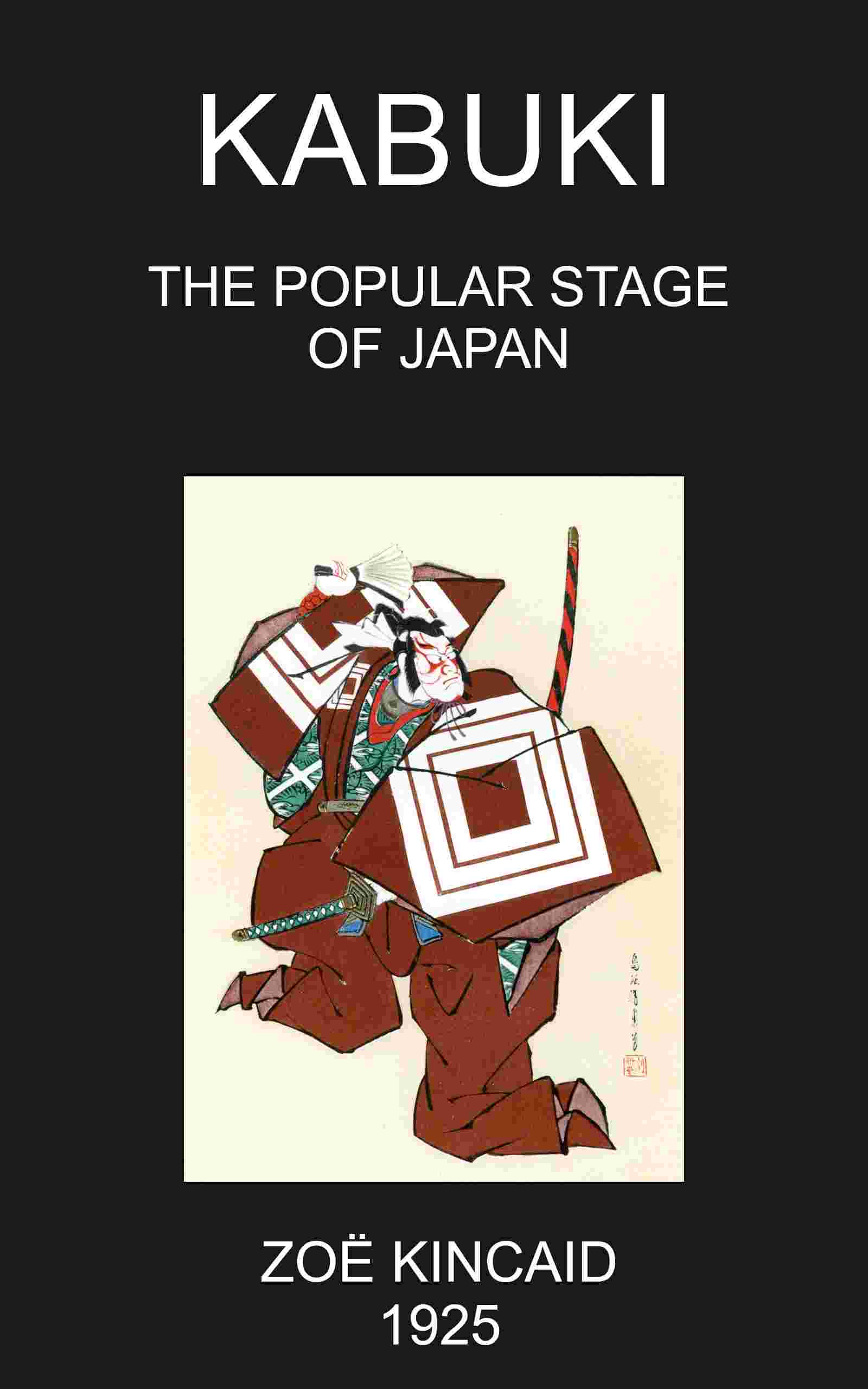
Sukeroku makes an unusual entrance, running in through the audience, his head bowed low and covered from sight by a half-shut oiled-paper umbrella. He makes a striking theatrical figure, for he wears a black kimono lined with pale blue and edged with scarlet, while his belt, or obi, is of green brocade bearing for design in gold the familiar three-rice-measure crest of the first Danjuro. A red neckcloth sets off the white mask-like face with the broad red outlines about the eyes, true to the make-up traditions of the Ichikawa house. A purple band is tied around his head and falls in folds at one side.
In his postures on the hanamichi with his black and white umbrella, Sukeroku every second assumes a new pose, that causes him to appear like a piece of statuary in a bewildering number of aspects, as he shadows forth the meaning of the character he represents,—the bravery and fighting spirit of an otokodate, or man of the people, always ready to defend the weak. He also suggests that Sukeroku is in reality Goro, one of the Soga brothers, and that he is disguised as Sukeroku, and is searching for a lost sword.
Thus the actors who created the character in the time of the fifth Danjuro knew what they were about, for the Soga brothers, otokodate, chivalrous commoners and searchers after swords, were prime favourites with Yedo audiences, and they were combined for greater effect in the character of Sukeroku.
Seeking for a quarrel in the pleasure quarters, brave Sukeroku is no respecter of persons, for his only aim is to make men draw their swords that he may find the one of his quest.
His taunting of the stately old villain in the attempt to arouse his ire, and the intimidation of a samurai whom he causes to throw down his swords and then crawl on all fours between his outstretched legs, are full of humour.
As a last attempt to make the venerable miscreant show his sword Sukeroku, championed by Agimaki, the gorgeous belle of the quarter, suddenly jumps forth from his hiding-place behind Agimaki’s ample robes, and assaults the brocade-clad dignitary, who involuntarily draws his blade. At sight of it Sukeroku immediately recognises that it is the precious weapon of his search.
Later he kills the villain and takes the sword, when a new danger threatens him as the men of the enemy are about to surround him. He looks about to find a place of concealment, and as a last resort jumps into a big water tank used on the occasion of a fire. Throwing aside a pyramid of small tubs, that are used as ornaments across the top of the same, he knocks the bottom out of one and placing it over his head allows it to float on the surface of the water.
The searching party look everywhere to find him. They even climb to the roof of the house, but Sukeroku and his stolen sword are safe under the water.
When he emerges real water splashes all over the stage and comes as a surprise in a play so entirely artificial and unreal. Perhaps on that very account it has the intended effect, for the audience is quite startled by the audacity and bravery of this highly imaginary hero.
Kagekiyo, a legendary character, the hero of several Nō dramas, is the central figure in an aragoto piece in the possession of the Ichikawa family. It represents the actors’ impress upon theatre material, nebulous, without the concentration that comes from a literary mind. Yet to lovers of the unreal it is full of attraction.
Certainly very little of the world of reality clings about the material or movement of this one-act species of drama which has for motive the valour and strength of Kagekiyo, a general of the Heike clan, whose cause has been defeated and who is confined in a cavern.
His appearance is dramatic in the extreme, when the guards allow him to gaze forth from a square opening in the bars of his prison-cave. His face is heavily lined with broad red lines, his fierce and threatening top-knot of hair that stands straight on end is accentuated by peculiar side wings of lacquered wood suggesting strands of hair that form a frame for the ferocious countenance. His costume of glittering gold brocade, with vivid touches of green and red, is in keeping with the strange visage of the dauntless warrior.
That he may taste all the bitterness of defeat, his wife and daughter are led in bound with rope, and he is brought forth to speak with them, his arms tied behind him in the most approved manner of the modern serial moving picture.
When everything seems against the outlandish hero, he is freed from his fetters and allowed to sit on a huge boulder in the centre of the stage, where he postures as he relates the misfortunes of his clan and declares his loyalty—an active figure whose every gesture is all the more conspicuous because of the groupings of the immovable personages on either side.
Kagekiyo shows some traces of human emotion, and is overcome at the treatment meted out to his wife and daughter, yet still keeps a stout heart, even when his son is placed within the gloomy cavern.
He scorns the Genji generals who gaze on his captivity, by refusing their offerings of food, kicking it unceremoniously away, and bellows in the extravagant style that is so typical of aragoto. At length his outraged feeling getting the best of him he lifts up the great stone on which he has been sitting and uses it as a missile to throw at the Genji followers, who, driven hither and thither, are finally routed. Kagekiyo, fighting to a finish, reaches a climax of grotesqueness as he poses in triumphant attitude brandishing a large beam of wood which has been his weapon of defence.
VI
Odori is closely allied to the Kabuki arts, and forms an essential part of a great variety of pieces. Since without it no theatre programme would be considered complete, odori becomes one of the most important Kabuki forms.
Tamura Nariyoshi, a theatre manager with a long experience of Kabuki behind him, a genius of the Meiji period, who died a few years ago, once said that the mere movement of the limbs was not dancing. Should a dancer wish to suggest that he was looking at Mount Fuji, gazing at the sea, or watching a shadow, the three ideas must be expressed in different ways. Dancing, like acting, he said, should have a meaning, and the performer must keep steadfastly to the central idea, otherwise interest would be lost.
This is the clue to the understanding of odori. The least gesture made by the dancer has significance, and nothing is left to chance. The training in dancing the yakusha undergoes gives him control over all parts of his body. He uses his head and shoulders equally with the eyes and face; the arms, hands, and fingers are all expressive, while the waist and feet play no small part in the presentation of the idea of the dance. Pantomime is first cousin to odori, and rhythm and song next of kin.
Of the many material objects the Kabuki dancers have chosen as media of expression, the chief is the fan. For a thousand years this has been a symbol of the dance, and its technique has come about through the desire of centuries of dancers to convey emotion through the movements of the dance.
What magic this fragile object is able to create is clearly visible when some dancer of long training who has acquired a mastery of movement, opens and shuts his fan, causing flowers to bloom, and rain to fall; or waving it outstretched, butterflies flutter and a boat tosses on the waves. He closes it and traces the outline of a mountain and points to the stars; or opens it sweepingly in imitation of the frolic of the wind.
What a world of romance the fan discloses, suggesting shyness, affection, disapproval, consent! How the widespread silver fan beckons to some enchanted moonlit garden; upraised, reveals a triumphant mood; or the dancer, with a stamp of feet and swift motion of the body and fan thrown about from hand to hand, describes some merry festival under the falling petals of the cherry trees.
In connection with odori there is an important Kabuki expert, the furitsuke-shi (lit., movement-to-make master), who is largely responsible for the charm of the descriptive dance, but who has received scant recognition for his work. The furitsuke-shi has trained the actors, assisted in the production of the music-posture dramas and innumerable short dances, and when given an opportunity to create has left behind him pieces that are still the stock-in-trade of the actors.
Since the early Kabuki performances largely consisted of dances, the players were accustomed to manage according to their own ideas and tastes. With the rapid development of Kabuki a dance specialist was necessary.
Pantomime as an element of dancing had long been old on the Nō stage, but it came afresh to Kabuki from the Doll-theatre, where the movements of the marionettes were so remarkable in the sphere of the dance that the actors were obliged to imitate them. Gradually there came into existence experts who devoted their time and talents to the teaching of this art to the actors.
The furitsuke-shi was an obscure profession, but nevertheless very important for the stage. The sakusha furnished the libretto for the odori, or shosagoto, while the furitsuke-shi planned the movements, studied the relation of the dancers to each other, calculated the picturesque groups, and produced the ensemble so characteristic of these Kabuki forms.
The furitsuke-shi were the repository of the complicated dancing technique of their day, yet they were quite subordinate to the actors, and when they wished to carry out an idea they were obliged to consult their superiors, and in consequence worked under great difficulties. Apartments were assigned to the stage dignitaries as became their rank in the shibai world, but such was the position of the humble dancing-master that he generally fraternised with the men who furnished the incidental music for the plays, and who were considered far beneath the regular musicians performing out in front, the Nagauta, Tokiwazu, and Gidayu performers. The furitsuke-shi were regarded as merely hangers-on behind the stage.
It often happened, however, that these men became actors. The fourth Nakamura Utayemon was the son of a furitsuke-shi. A modern instance of this is Matsumoto Koshiro, the seventh, the most versatile actor of the Tokyo stage, who was adopted when a child to become the head of the Fujima school of dancing, but later was taken under the patronage of the ninth Danjuro Ichikawa, and is the master’s most brilliant follower.
On the other hand, actors who were good in dancing but failures on the stage, often followed this profession. Bando Mitsugoro, one of the best dancers of the Tokyo stage to-day, has practically given up acting, appearing only in dancing pieces. He gives his time largely to the instruction of young actors.
At present the Fujima house of dancing is the most flourishing in Tokyo. The founder of this family was a Nō Kyogen actor called Kambei, who hailed from a village named Fujima. He migrated to Yedo and taught dancing, and was succeeded by his son. The third Kambei, however, was one of the most original exponents of this school, and how he came to inherit the headship of the family forms an interesting story.
He was employed as a boy of all work in the fish market, that stronghold of independent Yedo citizens, and was sent by his employer to escort his little daughter to and from her dancing lessons. Having to wait in the entrance of the house, the boy soon came to take a vivid interest in the proceedings, and by dint of peeping within he learned the dances much quicker than the legitimate pupils. The second Kambei recognised the lad’s ability, and not only took him under his wing, but eventually married him to his daughter, and made over to him the Fujima school.
Kambei, the third, died under strange circumstances. It was found out that he had carried on a love affair with the mistress of a daimyo who was one of his patronesses. The lord is supposed to have had him secretly dispatched, and then sent his body home with the explanation that he had suddenly expired. It was thought by his wife and pupils that he had been poisoned, but the mystery was never solved.
His wife carried on the teaching but, being a woman, she had no relation with the theatre. Among the third Kambei’s pupils was Nishikawa Senzo, who became a star of the Nishikawa school.
After the third Kambei’s time the Fujima house had two branches founded by his pupils; one was called Fujima Kangoro, and the other Fujima Kanyemon. As the Kangoro line has always had a woman at its head, it has not been employed by the theatre. That carried on by Kanyemon is now the first school of Tokyo, with Hanayanagi second. Nishikawa maintains its prestige in Nagoya; Kyoto possesses the Katayama school, while the leading schools of Osaka are the Umemoto and Yamamura.
(Metal cross).
(Alphabetical character repeated).