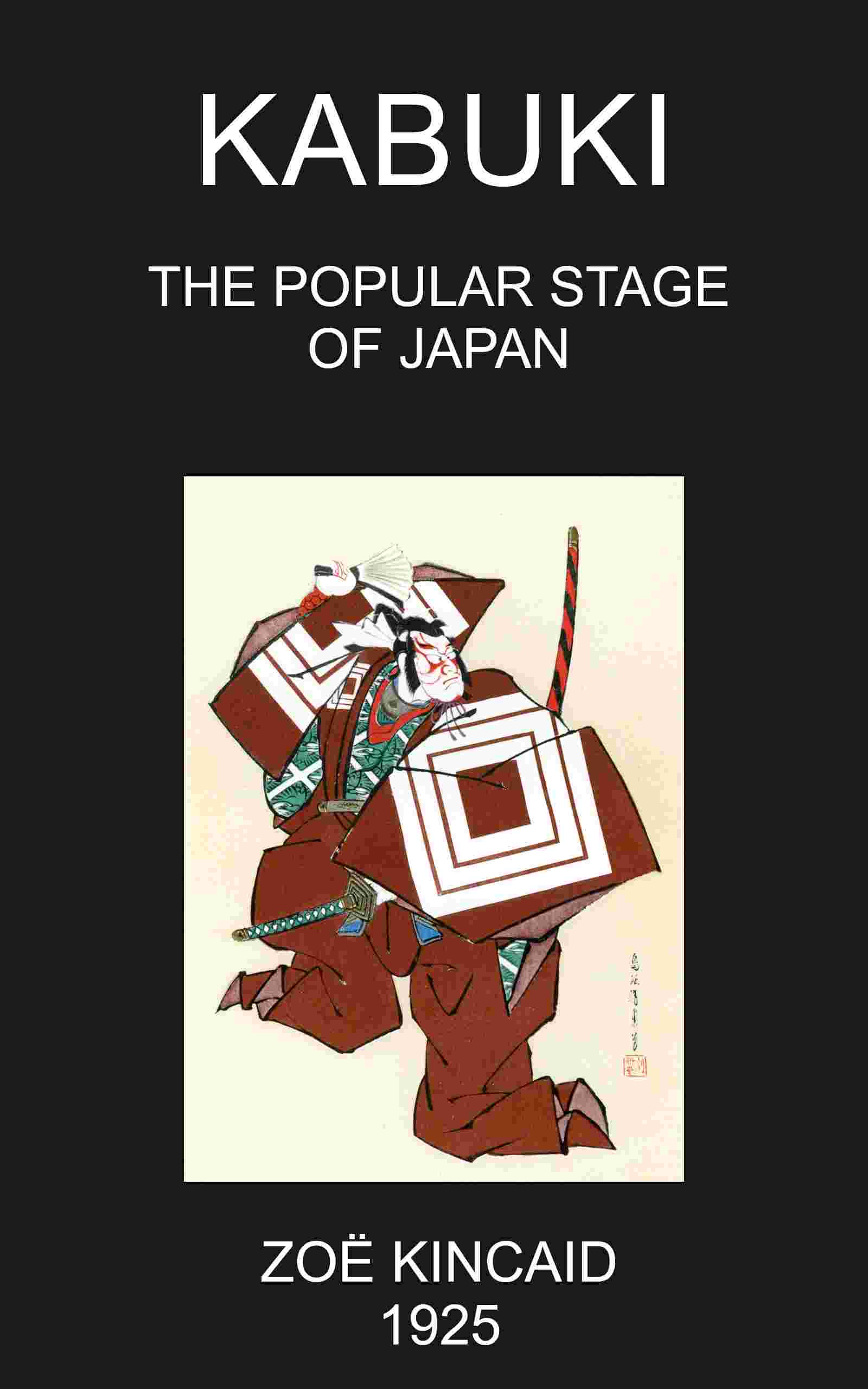
| FACE PAGE |
| The character of Kamakura Gongoro, a warrior of Old Japan,
as presented in Shibaraku! (lit., Wait-a-Moment). A famous actor
improvisation, or aragoto play, one of the hereditary eighteen pieces
of the Ichikawa Danjuro family. (From a painting on silk by Torii
Kiyotada, the present head of the Torii School) |
|
| Frontispiece, in colour |
| Onoe Kikugoro as a brave samurai woman mounted on a white velvet stage
steed |
22 |
| Nakamura Matagoro, the leading boy-actor of the Tokyo stage in the rôle
of a girl-pilgrim, O-Tsuru |
36 |
| Announcing Ceremony. Kojo, or announcement ceremony, in which the
central figure is Ichikawa Danjuro. The modest actor whose name is to
be changed or rank raised bows low, hiding his face from view. (Colour
print by Hasegawa Kampei, the fourteenth, and Torii Kiyosada, father of
Kiyotada) |
40 |
| The last of the Ichikawa family, the granddaughter of Ichikawa Danjuro,
the ninth |
42 |
| Theatre Treasures exhibited. At the Nakamura-za, founded by Saruwaka
Kansaburo, the gifts given to him by the Shogun were considered as
treasures of the theatre and exhibited on certain anniversaries with
much respect, the actor holding the gold sai, or battle signal, and
covering his mouth with a piece of paper lest his breath soil it.
(Colour print by Hasegawa Kampei, the fourteenth, and Torii Kiyosada,
father of Kiyotada) |
69 |
| Ichimura Uzaemon, the thirteenth, as Yasuna in a posture dance
descriptive of a man who has become demented because of the loss of his
wife |
82 |
| Onoe Matsusuke as Komori Yasu, or Bat Yasu, so called because of the
birth-mark on his cheek which resembles a bat. A bold, bad man of Yedo |
99 |
| Matsumoto Koshiro, of the Imperial Theatre, in the character of
Townsend Harris, the first American Minister to Japan. A photograph of
the intrepid Kentucky Colonel is on the actor’s dressing-table |
111 |
| Nakamura Utayemon, leading actor of the Tokyo stage, in the rôle of
Yayegaki-hime, the young princess in the play Nijushiko, or Twenty-four
Filial Persons |
132 |
| Three onnagata of Asia: in the centre Mei Ran-fan of the Peking
stage, to the left Nakamura Utayemon, the leading onnagata of Japan,
and on the right Nakamura Fukusuke, the son of Utayemon and one of the
most fascinating impersonators of women in Tokyo |
136 |
| Nakamura Jakuyemon of Osaka, an onnagata who imitates the acting of the
marionettes |
140 |
| Yoshida Bungoro, a doll-handler of the Bunraku-za of Osaka, who has
devoted his life to the management of female marionettes |
144 |
| A scene from Chushingura, as played by the marionettes in the
Bunraku-za of Osaka |
148 |
| O-Sato, heroine of a ballad-drama of the Doll-theatre. Reproduced from
an oil painting by an Osaka artist and shown in a Tokyo art exhibition.
The doll-handlers are grouped behind like shadows |
150 |
| Yakusha making a round of New Year calls. In the foreground a member
of the Ichikawa family, with two pupils and his servants, following
behind an onnagata similarly attended. The kites in the picture show
the favourite pastime of children during the New Year holidays. (Colour
print by Hasegawa Kampei, the fourteenth, and Torii Kiyosada, father of
Kiyotada) |
154 |
| Matsumoto Koshiro in the rôle of an otokodate, or chivalrous commoner,
ready to defend the oppressed lower classes from the blustering
two-sworded samurai |
160 |
| Nakamura Kichiyemon as Kumagae, a warrior of Old Japan |
166 |
| To mark the opening of the theatre season when actors, playwrights,
and musicians were engaged, there was a gathering called Seeing-
for-the-First-Time. (Colour print by Torii Kiyonaga) |
175 |
| Advertising the Play. During the performances two men garbed in long
trailing feminine attire, their heads covered with cotton towels,
attracted the passers-by by their verbal advertisement. One imitated
the lines of the actors, and the other handed out wooden tickets.
(Colour print by Hasegawa Kampei, the fourteenth, and Torii Kiyosada,
father of Kiyotada) |
177 |
| Face Lights for the Actors. When the theatre became dark it was
necessary to illumine the actor’s face with candle-light. Here property
men are holding out candles on the ends of pliant rods that the face of
the dancer may be seen, and candles form the footlights. The performer
is the serpent princess in the disguise of a beautiful dancer in the
piece Dojo-ji. (Colour print by Hasegawa Kampei, the fourteenth, and
Torii Kiyosada, father of Kiyotada) |
181 |
| Ceremony of welcoming an actor. It represents the onnagata, Segawa
Kikunojo, returning to the Nakamura-za in Yedo after an absence of two
years in Osaka. (From colour print by Utagawa Toyokuni) |
182 |
| Nakamura Ganjiro of Osaka as a melancholy lover in a play of the
people |
186 |
| Nakamura Fukusuke of Tokyo in an onnagata rôle |
215 |
| A Kaomise, or face-showing ceremony at the Nakamura-za in 1772. By this
time the roof of the stage had disappeared and only its symbol remained
over the front of the stage, which now approached the long narrow style
in vogue in the Doll-theatre. (Colour print by Utagawa Toyoharu) |
217 |
| Interior of the Nakamura-za in 1798 when Ichikawa Danjuro, the sixth,
was promoted to the head of the theatre. By this time the roof of
the stage had become a decoration overhead. (Colour print by Utagawa
Toyokuni) |
218 |
| The largest Nō theatre in Japan, that of Onishi Ryotaro in Osaka, a
modern structure combining architectural features representing the
different periods of Nō theatre development |
220 |
| Kataoka Nizaemon, the eleventh, as Yuranosuke, the leader of the
Forty-seven Ronin, in the play Chushingura |
228 |
| Nakamura Ganjiro of Osaka in his favourite rôle, that of Izaemon, the
lover of Chikamatsu Monzaemon’s drama, and played for two centuries by
the Kabuki actors |
256 |
| Matsumoto Koshiro, the seventh, as Watonai, the grotesque hero of
Chikamatsu Monzaemon’s drama, Kokusenya Kassen, or the Battle of
Kokusenya. The inner garment is bright red studded with brass, the
lower purple with a design of twisted white rope |
262 |
| Matsumoto Koshiro, the seventh, as Benkei, the warrior-priest in
Kanjincho. He performed in this rôle when the Prince of Wales visited
the Imperial Theatre |
264 |
| Sawamura Sojuro, the seventh, of the Imperial Theatre, as Togashi, the
keeper of the barrier, in Kanjincho, Kabuki’s music-drama masterpiece |
266 |
| Morita Kanya, the thirteenth, son of the aggressive theatre manager of
Meiji, as Yoshitsune, the young hero of the music-drama, Kanjincho |
268 |
| Onoe Baiko as the Wistaria Maiden, in a descriptive dance |
272 |
| Onoe Kikugoro, the sixth, as the transformation of a maid into a white
fox, in a descriptive dance, Kagami Shishi, or the Mirror-Lion |
274 |
| Nakamura Ganjiro of Osaka as Genzo, the village schoolmaster in
Terakoya, or The Village School, by Takeda Izumo |
278 |
| Ichikawa Chusha as Matsuomaru in Terakoya (The Village School), who
sacrifices the life of his son that the Michizane heir may survive |
280 |
| Jitsukawa Enjaku of Osaka as Gonta in the sacrifice play, Sembonzakura,
by Takeda Izumo |
282 |
| Ichikawa Sadanji as Sadakura, the highwayman, in the play
Chushingura |
284 |
| The Harakiri scene from Chushingura |
286 |
| Scene from Yotsuya Kaidan, or The Ghost of Yotsuya, by Namboku Tsuruya.
Onoe Baiko is seen as the disfigured O-Iwa, and Onoe Matsusuke the kind
old masseur who holds up the mirror that she may learn the truth |
294 |
| Banzuiin Chobei, a man of the people, rôle by Matsumoto Koshiro |
300 |
| Nakamura Kichiyemon as Sakura Sogoro, the Village Head who sacrificed
his life for the good of the people |
302 |
| Nakamura Fukusuke of Osaka as a belle of the gay quarters. Letters are
made as long as possible to produce the better effect |
304 |
| Onoe Baiko as the demon woman in Ibaraki, escaping with her severed arm |
306 |
| Matsumoto Koshiro and Onoe Baiko in Seikinoto, the music-drama piece,
in which Baiko appeared as the spirit of the cherry tree |
316 |
| Ritsu-Ko Mori, the leading actress of the Tokyo stage |
347 |
| The Imperial Theatre of Tokyo, completed in 1911. The building
withstood the earthquake shocks of the great disaster of 1923, but the
interior was destroyed by fire. It has now been entirely restored. The
Imperial is becoming an international theatre centre, and has welcomed
actors, musicians, and dancers from England, America, Russia, Italy,
and China |
368 |
| Onoe Baiko, leading actor of the Imperial Theatre in an onnagata rôle |
370 |
| (1) The new Kabuki-za. (2) Entrance Hall of the new Kabuki-za. The new
Kabuki-za, with a seating capacity of 4000, which was opened on January
6, 1925. Under construction at the time of the earthquake disaster,
September 1, 1923, the concrete structure remained intact. Japanese
architectural features have been used throughout the Kabuki-za, and,
rising out of the ruins of the city, it is one of the most imposing
buildings in Tokyo |
374 |