
CHAPTER XXVII
KABUKI RÔLES
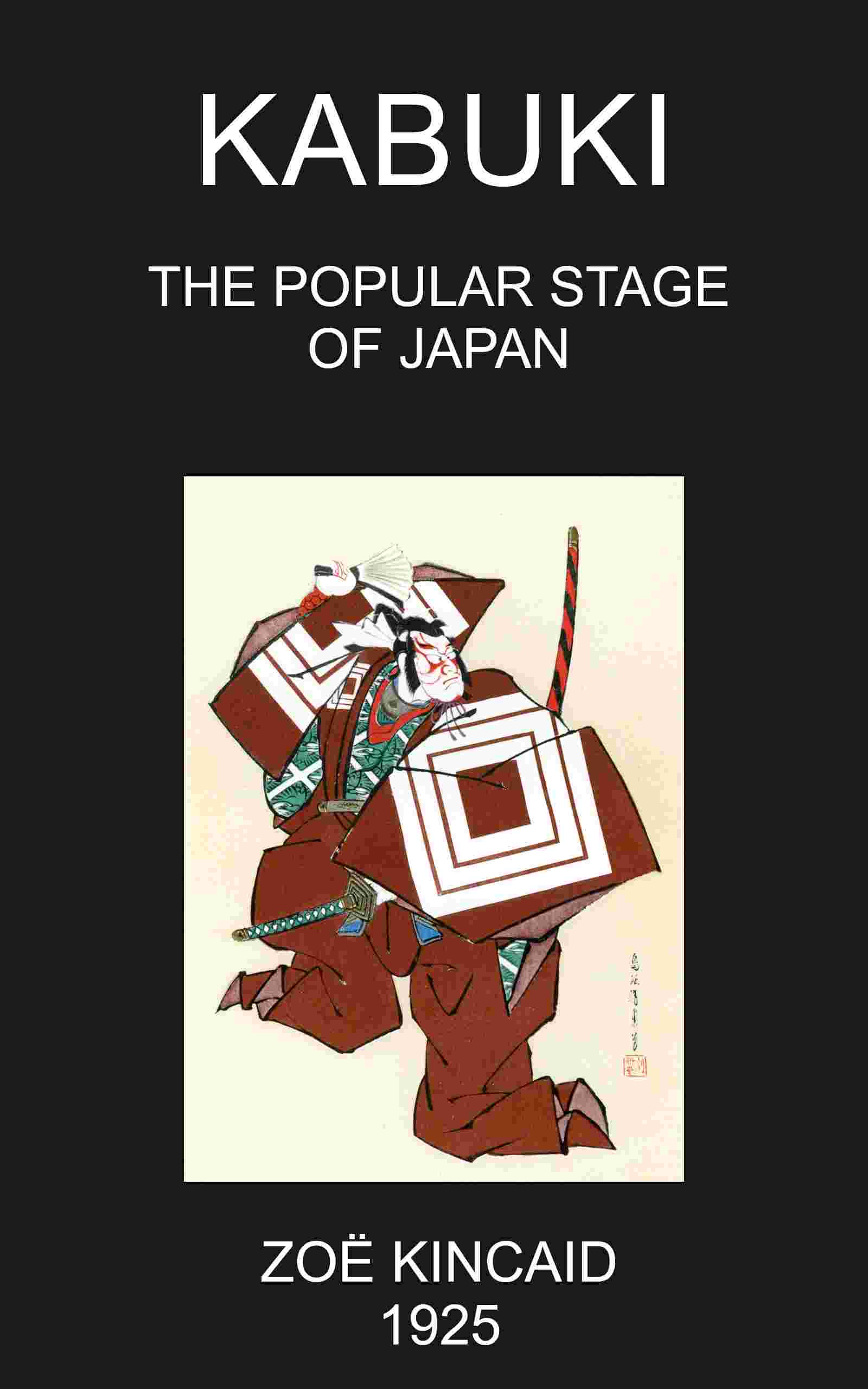
They make a strange passing show, like personages from dreamland, the people of Kabuki: a daimyo on a hawking expedition, strolling puppet showmen, monkey performers, blind minstrels, pilgrims and priests, samurai and farmer, swordsmith and robber. Creations of playwright and actor, these warriors and lovers, villains and ghosts form vivid and abiding memories in the minds of the Japanese people.
In the consuming passion for loyalty and self-sacrifice, character was often subordinate, and the heroes and heroines of the plays went to absurd lengths to justify the overwhelming theme. The ethics taught by these rôles differ in many respects from the familiar figures of the Western stage, yet at the same time the depths of human nature are sounded, the same tragedies and comedies that make the whole world kin; the eternal clash of evil and good. In addition, there are the rôles fashioned out of the pure fabric of fancy, showing an unquenchable thirst for beauty, and love for the striking and the strange, grotesque and supernatural, creatures called forth from enchanted gardens of the imagination.
A strict adherence to rôles was brought about in the early stages of Kabuki’s development, and this system persisted. There were first the tateyaku, or hero rôles, characters always championing the right; the katakiyaku, or villain specialty, a necessary rôle where the upright and ignoble were thrown into contrast; oyajigata, or old men’s rôles, and kawashagata, the characters of elderly females. The comedian was called dokegata, while onnagata was the name given to men who played women’s rôles, and koyaku were children.
As the plays became more complex these rôles underwent modifications. Of villains there was a rogues’ gallery,—an interesting study in itself. Deep-dyed personages, irredeemably wicked, were created, the worst of the worst; bad men in gorgeous costumes were sometimes half good, and there were villains with a hint of pathos in their natures, while the smooth individual who could smile and smile and be a villain still was among this company. The favourite character of this description was one outwardly bad, a disguise to cloak the good within, a person merely pretending to be among the evildoers but all the time assisting the righteous cause.
Many different types of heroes were born, from those of honest peasantry to the samurai and aristocrat. Venerable old men were as popular as callow youths. A popular rôle was a karo, or chief retainer, in the service of a feudal lord, and a mediator who tried to bring peace and harmony between warring factions was a rôle that pleased the people. Brave fighting men who could hold off an overwhelming number of attackers thrilled the audience; young daimyo, elegant, effeminate, robed in rich brocades; otokodate or chivalrous commoners, ready to unsheathe their swords in the protection of the brow-beaten lower classes; lovers torn between the affections and stern duty, and strong unrelenting characters forsaking wives and children to wander about the land in search of an enemy that the ends of justice might be attained,—such were the rôles played to the delight of their audiences by the yakusha, or rôle men.
In the sphere of the onnagata there are an endless number of good women and true, from the consort of a Shogun to the fair ladies of the nobility and wives of ordinary citizens. Beautiful, youthful princesses wearing flowing kimono of scarlet, purple, or pink adorned with gold, and crowned with silver head-dresses, are a fascinating creation of the onnagata. The three favourite rôles of this description are Toki-hime, who forsakes her father for her husband; Yayegaki-hime, who takes a treasured helmet from her father and restores it to its rightful owner, her lover; and Yuki-hime, who, bound by a tyrant to a cherry tree, calls rats to her aid that gnaw the ropes and set her free,—all youthful maidens of high degree.
Middle and old age are not despised in Kabuki, and the matron, white-haired grandmother, and middle-aged women have a recognised place. They are sometimes the chief characters in a play, for in Asia it is just as natural to be old as young—a stage in the journey of life that all must reach.
Admiration for the actors who create such contrasting types of women grows the greater the more we become familiar with these fascinating females; bad, slangy, naughty girls; voluble, gossipy wives of the tradespeople; brave, heroic women of the samurai class; not to overlook the faithful nurse, innocent maidens, the bad stepmothers, and maidservants, honest and faithful.
Rôles the actors enjoy playing, characters that are household names, such is the combination which has established Kabuki on such a firm foundation that it has weathered the storm of the conflicting influences that have broken about its strong citadel.
Tomomori, of forlorn hope, the last of his clan, his white and silver armour bespattered with blood, makes a final stand before plunging into the waves. He climbs to the top of a rock, and picking up a huge anchor lifts it high above his head; then casts it into the sea, the rope attached to his body drawing him relentlessly, until he falls over backward to his fate, as realistic a death-agony as could be found on any stage.
Kezori Kuyemon, a sea rover, in a drama by Chikamatsu Monzaemon, talking Nagasaki dialect, a swaggering freebooter the actor loves to paint. And Kezori’s junk that fills the entire stage, the crew, a rough-and-ready lot, looking for trouble. The vessel begins to turn as though a real pirate craft, and not one resting upon a painted ocean with a painted sky for background. Kezori stands on the prow, his hair, brown and bushy, bleached by exposure to sun and wind, his beard shaggy and unkempt, his seafaring costume having for design a diabolical devil-fish.
For contrast, Heiyemon, a servant to one of the Forty-seven Ronin, who undergoes a struggle between filial duty and faithfulness to the loyal retainers. Heavy-hearted he leaves home, saying farewell to father, wife, and child, knowing that he may never see them again. He stops to rest in the shade of the big pine trees that line the great highway, the Tokaido, and to eat the simple boiled rice his wife has prepared for him. Home-sickness overtakes him, and he cannot touch the food. Doves fly down from the trees above, and they make him think all the more of home. He must see his father once more, and apologise to him for his neglect; he must show his heart, and tell of his secret intention to join the band. But when he starts, remembrance of the cause he has espoused pulls him back. Wavering between the two desires, he sees the mother dove has fallen to the ground dead, and the young ones hover about her as though bereft. Casting all scruples to the winds, he runs homeward, only to find that his father was aware of his undisclosed plan, and the better to aid him has committed suicide that he may be free to devote himself to the great cause.
Kochiyama, a crafty priest of low rank, visits the mansion of a daimyo, and passes himself off as a prince of royal blood at the head of a great temple. He makes a striking figure in his white inner garment and thin scarlet outer robe, and is treated with every mark of respect. Knowing of a scandal within the household, he seeks to profit. He tells the lord he will lose all his possessions should the affair be made known. The maids spread a fine feast in front of him, but he waves it aside, saying that he would prefer a drink of the tea brewed from the golden globe flower. Acting on the hint, the steward of the household brings him the required hush money. On his departure he coolly confesses the game he has played, and laughs insolently at the enraged servants of the daimyo. On the hanamichi he meets with a confederate and counts the booty.
Seven hundred years ago the Soga brothers, Goro and Juro, revenged themselves upon Kudo, the slayer of their father, and since that time, like the story of how Horatius kept the bridge in the brave days of old, the tale has been sung and acted, there being hundreds of Kabuki plays with Goro and Juro as characters; their story inspired the playwrights of the Doll-theatre and formed the theme of several Nō dramas. The mother desires the eldest son to do the fatal deed, hoping to save the two younger. They are all anxious to take part in the killing of the man who treacherously put their father to death when they were children. Goro pleads that Juro be allowed to accompany him, and the mother reluctantly consents. The blind brother who has become a priest is denied, and so takes his own life.
They wear straw raincoats and rough straw sandals and the wide hat of the farmer; they start off to the foot of Mount Fuji, where Kudo has gone on a hunting expedition. Goro’s costume is black with a gay design of butterflies, white plovers on the wing adorning that of Juro. They creep into the hunting-lodge where Kudo is sleeping, and accomplish their end. Soon the youths are surrounded, put up a brave fight, but forfeit their lives.
Few plays reflect the national characteristics more than the Soga Brothers’ Revenge,—the impersonal emotions of Goro, Juro, and the mother; the deeply implanted desire for revenge in Old Japan for wrong done; the allegiance to the dead rather than the living. The Soga brothers did not think at all of leaving their mother; they were consumed with loyalty to the spirit of their departed father.
Stammering Matabei—how many fine actors have essayed this rôle created by Chikamatsu Monzaemon! In history he was the founder of colour prints in Japan, but in this play he is an artist who desires his master to recognise his ability by giving him the great name of Tosa. His teacher, however, is not willing to acknowledge his genius. Tongue-tied, he cannot reveal his mind to the master, and his voluble wife, who makes up for his loss of speech, only complicates matters. Suddenly, a number of farmers run through the audience armed with hoes and other agricultural implements announcing that there is a tiger in the neighbourhood. Matabei stutters that there are no tigers in Japan, and that it must be the creation of some artist come to life. Scarcely are the words uttered than a tawny tiger emerges from a bamboo thicket and wags its head. A younger and more favourite pupil takes a brush and draws an outline of a tiger in the air, and in this is sufficient magic to drive the ferocious animal away.
Then Matabei and his wife out of disappointment plan to die together, and the artist decides to paint a farewell picture. He chooses a square stone water-basin, and gazes into the water to catch the reflection of his face, for he wishes to draw his own portrait. He selects the side away from the audience and begins to work when, on the opposite side, facing the audience, appears the picture he is drawing. His art is so wonderful that the picture has penetrated the stone, and when the teacher sees the miracle he relents and allows Matabei to take the coveted name.
How a common robber may become so picturesque that all his faults are forgiven is to be seen in the rôle of Ishikawa Goemon. He had a Chinese father and a Japanese mother, and in punishment for his highway robberies he was finally boiled in oil. Goemon took up his quarters in the second story of the great red gate of Nanzen-ji, a Kyoto temple, and made his depredations by night. In a huge black velvet costume, a loose outer garment of gold brocade, and the conventional wig of a villain, hair that stands on end like a chestnut bur, Goemon emerges from his place of concealment to the gallery above the entrance gate and surveys the scene, smoking his pipe peacefully. Then the man searching for him appears out of the nether region of the stage, catches the reflection of the robber’s face on the surface of the water in a bronze temple-urn, and exclaims that so long as there is sand on the seashore there will be robbers in the world.
Bad characters transformed into heroes—these rôles appealed to Kabuki audiences. Such was Gonta, a vagabond, a braggart, and a bully, and yet he proves to have a heart of gold. He was ready to bluff a samurai out of his money, swagger boldly, yet shows tenderness for his child, and does not hesitate to sacrifice both wife and offspring when he responds to the clarion call of loyalty.
An uncompromising villain is Kosai, the octogenarian keeper of a house of ill-repute, a revelation of selfishness and indifference to the suffering and anguish caused by his slave traffic. A red tam-o’-shanter worn by ancients in Japan covers his head, beneath which is the aged, seared, hardened face. His kimono is of large brown and yellow checks, over which is thrown an upper garment of dark green, and he leans on a tall red-lacquered staff,—a harsh and fantastic figure. His is a personality so deeply sunk in crime that even those actors who specialise in katakiyaku, or villain’s rôles, scarcely ever act such a despicable character. It seems a thankless task to play such a monster, and yet the very strength of his wickedness is sufficient to stir up lethargic citizens who allow such persons as Kosai to flourish like green bay-trees. He meets his just deserts, but hanging seems too good for him.
Fortitude in the face of suffering and death gives the Kabuki actor the opportunity to perform some of his best rôles. Such a Spartan rôle is that of Sato Masakiyo; poisoned by his enemies and with but a short time to live, he is seen with his beautiful young daughter-in-law seated in an ornate red pleasure-craft on Lake Biwa. A small boat comes near with a messenger from the enemy to see if the poison has taken effect, and he is surprised at the hero’s complacency. Next a gift of armour is presented, but Sato strikes his sword against the chest, and the would-be assassin concealed within turns a somersault over the side of the vessel. A temple bell booms out, a sailor’s song is heard in the distance, and the ship points out over the audience. Sato, who has shown admirable control in the face of physical suffering, reels to the prow, and there calmly surveys the scene, remarking that it is a fine day, while the stage-blood which oozes from the corner of his mouth falls down upon his white neckcloth.
In the Kabuki actor’s large repertoire of weird rôles there are few to equal the frightful monster, Tsuchigumo, or The Earth Spider, a popular version of a Nō drama. This creature weaves its spell round a warrior who suffers from some mysterious illness. The spider visits him in the disguise of a priest and throws the web that enmeshes him. It is like day fireworks, made of thousands of strands of compressed paper, that when released fly forth like a fine-spun web, spraying far out over the footlights and above the heads of the people. Again, the spider is tracked to its den and comes forth to fight, shooting the fragile strands of its web into the boxes of the pit. Old and young reach out eagerly for the filmy stuff that wanders gossamer-like from stageland, and the intimate relation between the audience and the players is fully established.
Out from the phantasmagoria of the shosagoto stands Seikinoto. In this, Seikibei, a grotesque character, is seen enjoying himself alone on the stage, imbibing from a large red sake cup, when there is let down from the realm of the stage hands above a piece of grey carved wood to represent clouds in which are prominences the audience is led to believe are stars. Shining down into his broad sake cup the stars foretell that should he cut down the ancient cherry tree in the centre of the stage, he will be able to realise his ambition.
He seizes an axe almost as large as himself and proceeds to fell the tree. But he is stopped by an apparition, the spirit of the cherry tree. She is seen at first, faint and weird, within the bole of the tree, but comes forth and dances with Seikibei, property men causing sudden transformations in their costumes. She is in a cherry-coloured kimono, her hair long, and face pale. Seikibei wears a queer black costume bordered with large black and white checks, his hair all tumbled. In a picturesque posture dance they attack each other, he armed with his exaggerated axe, she defending herself with a branch of the cherry, the spirit coming out victorious in the strange encounter.
Three female entertainers in the mansion of a great lord are an entertainment in themselves. Like creatures of some other world they make their appearance through the stage, forced up from the depths of stagedom by a special contrivance to form a motionless group like a piece of statuary. Clad in similar costumes, one carries a bamboo rake, another is armed with a garden broom, while a third has a basket. They are in frolicsome mood as they attend to the garden and pick twigs of scarlet maple. To add to their enjoyment they make a fire with the maple leaves and warm some sake, which is supposed to have additional virtues if so prepared, according to a Chinese poem.
A mere sip of the beverage sends these fanciful females into different states of intoxication, and there is such a fantastic scene that it could not by the wildest flight of imagination be made into an argument against the cup that cheers; one laughs, the other scolds, and the third weeps. The samisen and the minstrel support now one and then the other, causing a din and clatter that is so well calculated as to be less confusing than it seems in the mere description.
One is in reality a spy, and slips away thinking her companions are still under the magic of the sake warmed by the burning maple leaves. The other two come quickly to themselves since they are also secret-service damsels on the look-out for spies, and so it turns out that the intoxicated trio were only feigning drunkenness after all. When three well-matched actors take these rôles, there is an interesting display of onnagata skill.
Three onnagata rôles in Kagami-yama (lit., Mirror Mountain) provide sharp contrasts in the types of women. Iwafuji is a wicked maid in the household of a feudal lord, while ranking below her is O-Noe, all that is gentle and good. Jealous of the virtues and accomplishments of O-Noe, the evil Iwafuji intrigues, and her plot succeeds so well that the good maid is disgraced beyond all hope of redress. There is no way in which O-Noe can clear herself, and she takes her life.
O-Hatsu, servant to O-Noe, true-hearted and valorous, heedless of the consequences, meets Iwafuji in the garden and fights to a finish, the bad Iwafuji dying to the satisfaction of the audience, while the young lord of the mansion appears to approve O-Hatsu’s action, and promotes her to the position in the household her mistress enjoyed.
Among the heroines of the common people there is O-Fune, the daughter of a ferryman named Tombei, in the village of Yaguchi. A fugitive samurai takes shelter in their cottage with his lady-love, whom he passes off as his sister. As a price has been put on the guest’s head, Tombei, an old villain, wishes to obtain the money. O-Fune manages to spirit the hero away. It is a rôle of many emotions. In love with the guest, made love to by her father’s assistant, jealous of the fine lady, she is wounded by her father who has attempted to kill the fugitive,—and summoning all her strength she beats the drum in the tower, gathering the people together that the samurai may have the opportunity to escape to a place of safety.
Should any one ask a ferryman on the Sumida River in Tokyo to tell an old story of that muddy commercial stream, he would no doubt relate the tale of Takao, and how she was ransomed from the courtesan life by a daimyo who paid her weight in gold, and how when she attempted to escape from his pleasure-boat on the river, as she loved another, the enraged lord cut off her head.
And that character taken from the pages of a fairy-tale, O-Ryu, the spirit of the willow tree! She lives in a rustic cottage in the heart of the forest, with her husband Heitaro and little son. When she hears the woodsmen chopping down the old willow near by, she knows that her earthly life is over. As the stroke of the axe resounds, O-Ryu is transformed from a modest wife to a greenish ghost. There is a great whirl of willow leaves about her, and in the fitful glare of uncanny green light she says farewell to her child and disappears among the trees, becoming fainter and fainter until she is lost in the distance.
Some actors are better fitted to act rough Yedo girls, or women of the lower classes, but it is the ambition of the best onnagata to portray noble women. Such a rôle is Kesa Gozen, or the Lady Kesa, the unfortunate but heroic noblewoman. Held up as an example of chastity and devotion, Kesa Gozen should take her place among the good women of the world’s stage.
A samurai falls in love with her, and to protect her honour and save her husband, she becomes privy to a dreadful plot against him that she knows will never be carried out. At night the samurai approaches the bedroom, gropes about, and finds the wet hair that he has been told is that of the husband. Tragic indeed is the youth’s awakening when, on the steps leading to a temple close by, he uncovers the head he has taken, and sees by the light of the moon that it is the face of the woman he loves.