
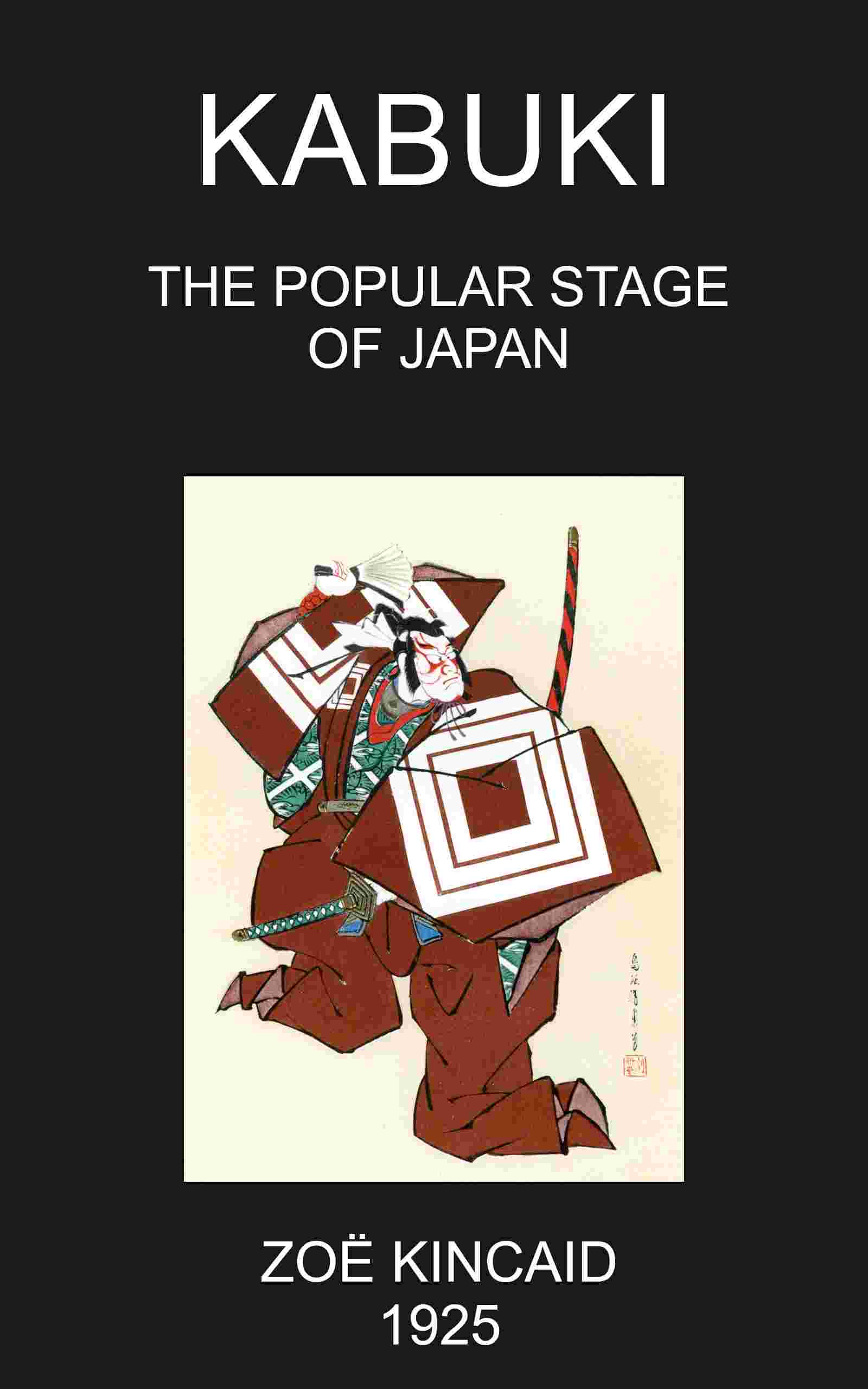
KABUKI
CHAPTER I
KABUKI
Solid attention from the close-set heads of the playgoers kneeling on their cushions in the boxes of the pit to the crowded galleries on three sides, and enthusiasm displayed in the tachimi, or standing-to-see place near the ceiling, where patient people remain on their feet for long hours—the keenest critics as well as the warmest supporters of the actors—such is the scene witnessed daily in the theatre of Japan.
The Occidental cannot long withstand the mass psychology of this audience; that is, if he makes an attempt to share its point of view and appreciate the excellent things provided upon the stage. He feels its subtle unity, its amazing cohesiveness; he is carried away by an unseen stream, engrossed, engulfed, and wakes up with a start to find himself an entity again; or else, detaching himself from the atmosphere in which he has been immersed, wonders at this overflowing expression of Japanese life.
Statesmen, publicists, and editors of the Occident wax eloquent about Japan and her problems, but here is something they quite ignore and leave out of consideration, this manifestation of the pure spirit of the people with minds relaxed enjoying the theatre art that pleased their ancestors.
Seekers after mystery will not find it here, for there is nothing that is inscrutable. Merely the people laughing or crying as the play proceeds, spontaneous in their approval of the triumph of right over wrong, absorbed in the clash of evil and good,—the same theatre material that has served to amuse and attract mankind for the last two thousand years.
Just the people, displaying depths of human nature, undisturbed by the questions that vex the politicians, the propagandists, the militarists, and other dread phantoms that cast their dark shadows over a sunny, smiling world.
The creative spirit belongs to no one land or people, and its expression becomes the treasure of all. Kabuki, the popular stage of Japan, is the result of three hundred years of intensive cultivation. Its genius and successful achievements belong to a common sum total, and are a contribution to the world’s theatre. Its actors are members of the same fraternity as those of the West, and claim kinship with them.
Nothing in the entire realm of Japanese life reveals the characteristics of the people so unerringly as Kabuki. It is a store-house of history, and has exercised a moral force upon the whole people. The crowded audiences in the big theatres of Tokyo, Osaka, Kobe, Kyoto, Yokohama, and the countless minor places of amusement, testify to the enjoyment and relaxation afforded by the performances. There are the achievements of the actors, who may easily be recognised as men of the first ability; the frequent attempts of new stage writers, that are worthy of consideration as evidence of Japan’s modern tendencies; the living traditions of the old masterpieces to witness, and the many interesting ceremonies of the theatre. Kabuki represents a whole world of creativeness both past and present, a sphere of theatre activity that remains a terra incognita to the Occident.
There is something poignant in the endeavours of generations of Kabuki players who obeyed the voice within them, asking no acknowledgement, expecting no return, doing their duty as they knew it without the least idea of the vague western hemisphere—completely unknown to their brothers in other lands.
For more than three hundred years these actors have lived and had their being in their own narrow spheres. True to the best theatre instinct within them, they bequeathed their accumulated treasures of style and taste, the purest and most varied of theatre material, to their successors, the modern actors, who, so far as the West is concerned, remain obscure, unvalued, and unappreciated, even as did their ancestors when Japan was isolated and had no relations with outside countries. Yet their art was good, and will one day gain recognition. They have carried on their traditions unswervingly; they are the custodians of all that pertains to the theatre of the present, and the future looms large with possibilities.
There are three separate and distinct theatres in Japan: the Nō, or classic drama, with its masked figures, perfected five hundred years ago; Ningyo-shibai, or the Doll-theatre, where marionettes interpret complicated ballad-dramas; and Kabuki, the popular theatre, in which male players reign supreme. These are the Japanese theatre arts, interwoven into the very fabric of society, the amusements of the people that reflect their psychology, tastes, and aspirations.
The Nō became crystallised into an art at the time of the Shogun Yoshimitsu (1368–1398). Long before Yoshimitsu held sway, the country had been brimful of song, dance, poetry, minstrelsy, and the three theatres of modern Japan may be said to have inherited the accumulated tendencies of a thousand years.
Deeply rooted in the people was the love of theatrical entertainments which were held in connection with the festivals of shrines and temples. From these performances developed companies of players who formed hereditary actor families, the members of which were regarded as belonging to the common people.
When Yoshimitsu saw a performance at a Kyoto temple that pleased him he gave his patronage to the players, and at one bound they were elevated to a new position. It was at this time that the Nō was brought to a state of perfection, and the support and encouragement given by so highly placed a personage resulted in the monopoly of this theatre by the aristocracy, to be reserved henceforward for their own use and entertainment.
During the long Tokugawa regime, the Nō continued under the protection of the Shogun, and was patronised by the various daimyo. When the shogunate fell, the Nō almost went out of existence, but slowly regained its prestige, and within recent years it has attained unprecedented popularity. It is regarded as a means of culture, and is claimed by increasing numbers of intellectuals. Yet it still retains its aloofness from the common theatre, which it continues to disdain as cheap, vulgar, and sensational. In spite of the fact that it has come to a standstill and lives on the past, its influence is very great.
As an expression of the human spirit by means of inanimate figures, the Doll-theatre of Japan is unique. It is a surprise to find this jewel of art in Osaka, the city of smoke-stacks—an art that has been alive in Japan for more than three hundred years, but is at present practically confined to one small theatre, the Bunraku-za.
Other countries have their doll-theatres in more or less flourishing conditions, but few have reached such a state of completeness as that of Japan. For here is a rare combination—inanimate figures instead of actors of flesh and blood; doll-men trained from childhood to acquire the technique to manage the cold and lifeless forms through which flows the creative genius of the handlers; minstrels and musicians who have devoted their lives to the interpretation of the plays; and the best brains of the dramatist employed in order that the dolls may be triumphant and their use fully justified.
Kabuki, the popular stage, was but the assertion of the people to the right of their own form of entertainment, since the Nō had become the exclusive amusement of the higher classes. All the materials for a theatre of the people were abundantly at hand, and it only needed the impetus to start it flowing in the right direction.
Ningyo-shibai, or the Doll-theatre, and Kabuki rose at the same time, both popular theatre arts. Kabuki was destined to be profoundly influenced by the marionettes, and the music of the Doll-theatre owed its inspiration directly to the Nō.
While Japan’s theatre genius has not developed in the same direction as the intellectual drama of the Occident, her actors are the product of severe discipline. Kabuki is one of the most professional stages of the world. The actors are trained from childhood, and keep their place in the ranks until their steps are tottering. There is no opening for the amateur to gain admittance to this well-regulated world with its set standards.
And of the countless plays, but few are known to the West. There are the dramas rich in human nature, as romantic and sentimental as the West could desire, with a realism that rivals that of the Occident. On the other hand, there is a remarkable excursion into the realm of the unreal, and grotesque characters cut out of the cloth of exaggeration form the characteristics of the many quaint plays that have been handed down to posterity by the nine stars of the Ichikawa family, the actor-line that has contributed more than any other to the development of the Japanese theatre. There are, also, the shosagoto, or music-posture pieces, ethereal, graceful, fairylike creations, and associated with these a whole sphere of descriptive dancing.
To attempt to justify the existence of Kabuki by seeking to explain it in the light of the Occidental theatre means to digress, for comparisons are idle until the whole story of the Japanese stage is made known. No doubt when Kabuki becomes more familiar to the West much of a critical nature will be written as to where the two approach or diverge.
The aim of this book is to lay the essential facts of Kabuki before Occidental readers. For it is believed that the way to judge such an institution is to find out first what it signifies to those who have brought it into existence. After which may be considered the value it holds for the West. When an attempt is made to explain Kabuki in Western terms confusion begins. It becomes a much simpler matter if left to explain itself.
In the Nō the actor and playwright were subservient to interpretation, and art was greater than personality; in the Doll-theatre, playwrights, minstrels, doll-handlers—all worked so enthusiastically that they forgot themselves and were absorbed in the marionette,—a truly unselfish theatre co-operation. Much of Kabuki, however, has been of an ephemeral nature. The actors improvised as they saw fit. It was their world and the playwrights were their servants. The whole art of Kabuki evolved by these players of Japan is unconscious, and should be of the greatest interest to lovers of the theatre in all lands, for the reason that the relation of a people to their theatre, the different use of dramatic materials, the development of characteristic customs and conventions reveal by way of comparison and contrast the virtues or defects of the systems that exist elsewhere.