
WeRead Powered by ReaderPub
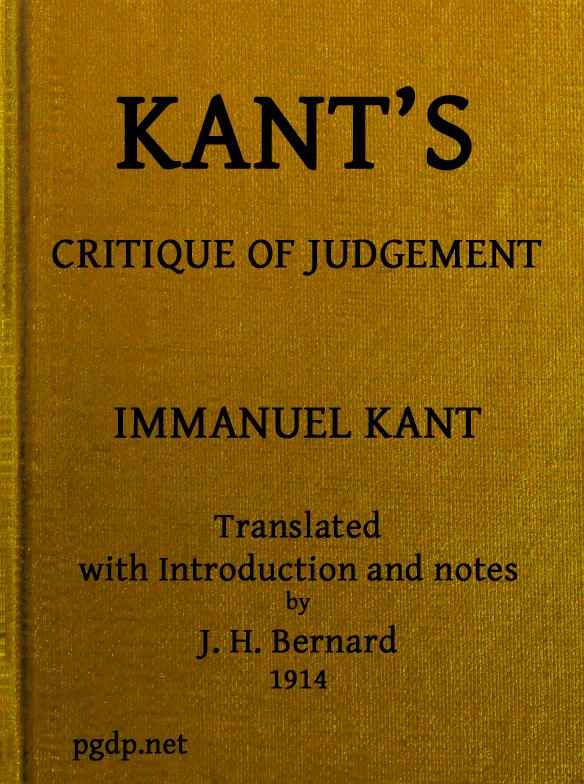
Kant's Critique of Judgement cover

Kant's Critique of Judgement

Chapter 41: Transcriber’s Notes
Open in WeRead

Explore more books like this:

About This Book

A philosopher investigates the faculty of judgment, arguing that reflective judgment mediates between understanding and reason and unites the theoretical and practical domains. He analyzes aesthetic judgment by distinguishing disinterested pleasure, free and dependent beauty, the sublime, genius, and the role of a shared sensus communis in claiming universal communicability. He then examines teleological judgment, treating organisms as seemingly purposive and proposing a regulative principle for interpreting natural purposiveness without positing literal final causes. Throughout the work conceptual analysis and examples are combined to show how judgment grounds aesthetic experience and supports a systematic unity between nature and moral thought.

Transcriber’s Notes

Punctuation, hyphenation, and spelling were made consistent when a predominant preference was found in this book; otherwise they were not changed.

Simple typographical errors were corrected.

Ambiguous hyphens at the ends of lines were retained.

Text has three occcurrences of “casuality”, which have been retained, but which may be misprints for “causality”.

These are transliterations of the Greek text for use on devices that cannot display such text:

Page xvii: kosmos.

Page xxii: kalo.

Page xxiv: sôphrosynê.

Page xxxiii: nous.

Page 397: kat’ alêtheian (or) kat’ anthrôpon.

Footnote 79 (originally on page 195): ha gar auta lypêrôs horômen, toutôn tas eikonas tas malista êkribômenas chairomen theôrountes hoion thêriôn te morphas tôn atimotatôn kai nekrôn.