
The Project Gutenberg eBook of Kate Mulhall
Title: Kate Mulhall
A romance of the Oregon Trail
Author: Ezra Meeker
Illustrator: Rudolf A. Kausch
Oscar W. Lyons
Margaret Landers Sanford
Release date: February 25, 2026 [eBook #78040]
Language: English
Original publication: New York: Ezra Meeker, 1926
Other information and formats: www.gutenberg.org/ebooks/78040
Credits: Al Haines
Signature of President Coolidge
from the White House,
March 25, 1926.
PRESIDENT AND OLD PIONEER
Calvin Coolidge and Ezra Meeker, two stalwart Americans—the President a New Englander, and Mr. Meeker a native of Ohio, though for nearly all his adult life a resident of the Pacific Northwest. Mr. Meeker was a youth past fourteen when the late John C. Coolidge, father of the President, was born. Photograph taken on the White House grounds, near the Executive Offices, in October 1924, just after Mr. Meeker had flown in an aeroplane from Washington State to the City of Washington: and the old gentleman took advantage of the opportunity to say to the President—as he had to President Theodore Roosevelt near the same spot on November 29, 1907—that the memory of the Pioneers should be preserved, and the route of the Oregon Trail suitably and permanently marked.
EZRA MEEKER
Born December 29, 1830. Only survivor (1926) among the adults who passed over the Oregon Trail in their own outfits at the height of the migration of 1852. Founder and President of the Oregon Trail Memorial Association, Inc.
KATE MULHALL
A Romance of the
OREGON TRAIL
By
EZRA MEEKER
Author of: Ox-Team Days, Pioneer Reminiscences,
The Busy Life of 85 Years, Pioneer Stories for
Children, Story of the Lost Trail to Oregon
Drawings by Margaret Landers Sanford, Rudolf A. Kauach
and Oscar W. Lyons
Map of the Oregon Trail, and photographs
Published by
EZRA MEEKER
18 OLD SLIP, NEW YORK CITY
THIS VOLUME IS INSCRIBED AS A TRIBUTE OF DEVOTION TO
THE MEMORIES OF
PHOEBE BAKER MEEKER
MY MOTHER
ELIZA SUMNER MEEKER
MY WIFE
WHO CROSSED THE OREGON TRAIL AS A YOUNG MOTHER IN 1852,
AND WAS AFTERWARD THE COMPANION OF MANY YEARS OF MY LIFE
THE HEROINES OF THE PLAINS
AND 20,000 PIONEERS
MEN, WOMEN AND CHILDREN—BURIED IN UNMARKED GRAVES,
ALONG THAT GREAT HIGHWAY OF HISTORY TO THE FAR NORTHWEST
Copyrighted 1926
By EZRA MEEKER
All rights reserved
CONTENTS
FOREWORD: Ezra Meeker, the Author
By Robert Bruce.
Early Life in Missouri; A Farewell Party; Kate's Suitors
Off for Oregon; Crossing the Missouri; Encountering the Buffalo; Troubles with the Indians
Trials of the Long Trail; Dangerous River Crossings; the Death of Catherine; West of the Rockies; Separation of the Party; New Homes in the Oregon Country
A Massacre and a War; Kate Mulhall, Deputy Sheriff; A Race for a Wife; The Wedding and Charvaree; A Delayed and Adventurous Honeymoon on Puget Sound
An Encounter with Pirates, and a Fortunate Deliverance; Ben Found; His prompt start for Missouri and unexpected arrival; a Son born to the Peltons
The Wedding of Ben and Linda; A second Overland Trip; Massacre of nearly all the Company; Binding up the Wounds; The Trip resumed; Survivors reach the Oregon Country
Linda's hope never realized; Death of David Mulhall; Craig's promise remembered; Lessons from a Trail-marking Outfit; Decision to make the trip
The Start for the Rockies; Re-discovery of the Old Trail; Recollections of Burnt River; All signs of Ben's grave obliterated; A granite Monument erected near the Lone Pine and wagon tire at the grave of Catherine Mulhall: Closing Scenes
The Missionary's Story—The Lewis and Clark Expedition; Outline History of the Oregon Missions; Jason Lee's great sermon; Massacre of Marcus and Narcissa Whitman; Destruction of the Mission, &c
LIST OF ILLUSTRATIONS
President and Old Pioneer ...... Frontispiece
Ezra Meeker, the author ...... Frontispiece
Condensed map of the Oregon Trail and National Road
Farewell Party at the Mulhall Homestead in Missouri
A near catastrophe in crossing the Missouri
Typical emigrant outfit on the Oregon Trail
Under the Yoke for the first time
A Corral at an overnight stop on the Trail through the Indian Country
Monument along the Clover Creek Highway, near Tacoma, Washington
The honeymoon party on Puget Sound
Tracks on the Oregon Trail made nearly a century ago
Dr. John McLoughlin welcoming Mrs. Whitman and Mrs. Spalding to Fort Vancouver
Arrival of the Sager orphans at the Whitman Mission
——————
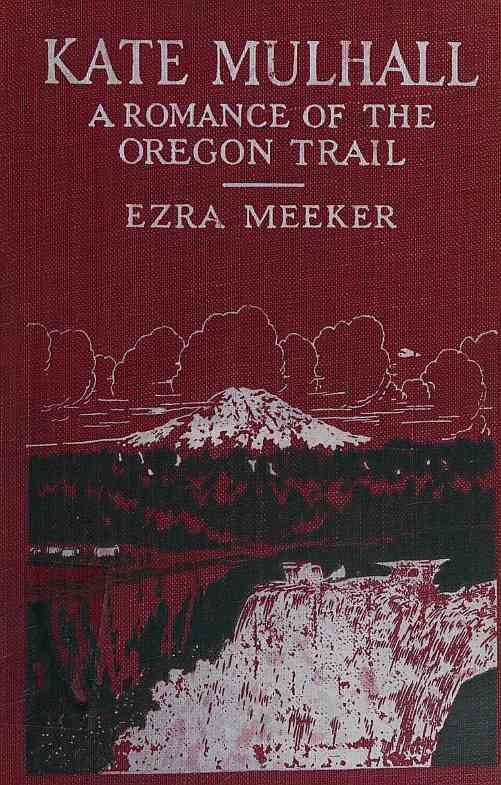
The front cover design combines a distant view of the majestic mountain of the Pacific Northwest with a pictorial representation of one of the great falls on the western slope of the Rocky Mountains—both landmarks enshrined in the memories of the few surviving Pioneers over the Oregon Trail.
FOREWORD
EZRA MEEKER, THE AUTHOR
A LIFE SPAN OF MORE THAN NINETY-FIVE YEARS FROM THE
ADMINISTRATION OF ANDREW JACKSON TO THE
PRESIDENCY OF CALVIN COOLIDGE
By ROBERT BRUCE
Ezra Meeker was born December 29, 1830, about ten miles east of Hamilton, Butler County, Ohio, while Andrew Jackson was President of the United States, John C. Calhoun, Vice President, and Martin Van Buren, Secretary of State. There had been only six Presidents—Washington, John Adams, Jefferson, Madison, Monroe and John Quincy Adams; and the last three were still living. Considerable numbers could remember listening to the Declaration of Independence at Philadelphia or elsewhere; a trifle less than half a century had elapsed since the decisive victory at Yorktown, and survivors among men who served in the armies of the Revolution were younger than the average of Civil War veterans in 1926.
Although we are accustomed to think, read and speak of the Oregon Trail as "old," the route to which that name has since been given did not come into existence until several years after Mr. Meeker was born. So the shadow thrown upon the screen of time by the living figure of this remarkable man is longer than we may say figuratively is cast by the highway itself; and while the latter has been gradually passing into the background of history and romance, he is still carrying forward with singleness of purpose and unabated energy what will probably be left to posterity as the most important work of his whole busy life.
Prior to 1830, neither the people east of the Mississippi nor the Government at Washington had adequate conceptions of the geographical, political or future commercial importance of the Pacific Northwest; and the wonderful developments there in the last seven decades have grown out of the overland migration of the 40s and 50s, or at least owe much to it, historically and practically.
A most appropriate symbol of the "Course of Empire" from the valleys of the Mississippi and Missouri to the Columbia River and Puget Sound country would be a miniature wagon—sometimes idealized as a "prairie schooner"—carrying many thousands of home seekers into what now comprises all of Oregon, Washington and Idaho, with contiguous parts of Wyoming and Montana. Except for that great human movement, of which the author of this Romance is the only survivor among the men who went over the Trail with their own outfits in 1852, that region would have continued primarily a fur-hunting territory for many years later than was actually the case, and then in all probability have become a part of the British Dominions in America.
As a youth, Ezra Meeker saw recruits somewhat older than himself leave for the Mexican War; he was intensely interested in reports about the far-away and then almost legendary Oregon Country before there was any established travel to it, and heard echoes of the discovery of gold in California—though he was not, as frequently stated, a "Forty-Niner." Accounts of opening the Panama Railroad in 1855, with its considerable effect upon the subsequent emigration to the Pacific Coast, and of the Crimean War, reached the family cabin built with his own hands in "Old" Oregon. Mr. Meeker is now the only one left from the adults residing in Washington Territory when it was created in 1853.
For more than fifty years he was a farmer and hop grower in the Puget Sound region, meanwhile spending four winters introducing hops from Washington and Oregon in the European market; and was also at one time a prospector and miner in the Yukon. Within the span of his life the population of the United States has increased from less than Thirteen Millions, then living mostly along the Atlantic seaboard, to about a Hundred and Fifteen Millions occupying the whole country to the western ocean. So far as we have been able to ascertain, Mr. Meeker is the only person who ever undertook an important work of fiction in his 95th year; and this has been done to revive and preserve the experiences and memories of his youth, in connection with the efforts of two decades to mark the Trail and honor the Pioneers.
PREFACE
Having thrice crossed the Oregon Trail by ox-team, first during the year 1852 accompanied by a courageous young wife, the second and third times during the years 1906-10, erecting monuments to mark the Trail and perpetuate the memory of the pioneers who traversed it, again in an automobile in 1915, and finally over 1,300 miles of it in an aeroplane in October, 1924, presumably none will question that the author can write from his own experiences.
One hundred and seventy-one granite monuments have already been erected on or near-by the general route of the Oregon Trail, along which twenty thousand died. An effort is now being made to portray the scenes and experiences of these pioneers in moving pictures with fidelity to historical accuracy, that present and future generations may know what happened in the winning of the great Farther West.
The names of the actors in this romance are fictitious; but the characters are as the writer knew them. The incidents are based on occurrences in real pioneer life, many of which the author saw, some of which he experienced, and all he knows to be in accordance with the truth.
[Signature of Ezra Meeker]
New York City, January 1926.
Condensed map of the National Road and Oregon Trail, the first transcontinental route, which did more than
any other to "bind the nation together in a common brotherhood, and thus perpetuate and preserve the Union."
The journeys described in this volume were made over these two great lines of travel.
CHAPTER I
EARLY LIFE IN MISSOURI; A FAREWELL PARTY;
KATE'S SUITORS
Kate Mulhall was just twenty when her father crossed the Missouri River and the Great Plains on their way to the "Oregon Country." Prior to the day of their departure for that far-away region of mystery and romance, she had never been outside the restricted neighborhood where she was born—in La Fayette County, Missouri, whose every third inhabitant was a slave; had never seen a railroad, and until a short time before, not even a cook-stove. All of her life had been in a real pioneer environment; but she grew up strong, hearty and self-reliant upon the plain and wholesome food, the pure air and active outdoor life of what was then the frontier.
She was of the brunette type, with dark hair and lustrous eyes that fairly sparkled with the delight of being interested in the fields and flowers, grand old woods full of wild life, birds, animals and everything about the home or farm. Of more than the average height, her movement was lithe and free; her form an excellent subject for an artist's brush. Outdoor life appealed to her nature, and she took a joyful satisfaction in all of its activities.
Kate was an expert horsewoman and a crack shot with the rifle, often picking a wild turkey off the lower limb of a forest tree at one or two hundred yards. In addition to that splendid game bird, timorous water-fowl were abundant on the rivers and in ponds; deer, grouse and pheasants in the wood and brakes; rabbits and squirrels almost everywhere; and the "razor-back" hog, wild and ferocious, roamed the forests and dense thickets of Missouri in those pioneer days. Many a litter of pigs, sprung from domesticated ancestors, lived by digging out edible roots under the surface, or hunted beneath the heavy fall of autumnal leaves for the more nutritious acorns, beechnuts and walnuts.
The constant search for food developed an independent life which soon relapsed into the state of nature; so wild hogs became, like the deer and turkey, common property for the hunter's rifle. From these various kinds of game Kate kept the Mulhall family table well supplied with substantial and seasonable food. Missouri also harbored among its inhabitants not a few wild men, contact with whom sometimes involved taking desperate chances.
David Mulhall, Kate's father, was a typical non-slaveholding farmer of that period in Missouri—honest but not "progressive" in the present general understanding of that word. He was intensely prejudiced against the negroes, but bitterly opposed to the institution of slavery. Because of these well-known views, he was regarded with suspicion by a majority of his slaveholding neighbors; and, in fact, looked down upon as belonging to the "poor white trash" of the South who worked with their hands.
Many others like him migrated from Missouri because of their hatred of slavery, though usually carrying with them a prejudice against the black man. Others left that region for "free territory" because of the bitter class prejudice existing between those who owned negroes and those who did not; and the latter particularly to save their children from the necessity of competing with slave labor.
Mulhall was by nature and training an easy-going person, who believed in "letting well enough alone"; and was, therefore, averse to going out upon a world of uncertainties, or taking unnecessary chances for bettering his condition. He was born before the advent of railroads in the United States, when oxen supplied the principal means of transportation, and "hog and hominy" comprised the basic food supply for a majority of the people.
The sickle cut his grain, which was thrashed by the flail; and the wind separated it from the chaff. Boiled wheat frequently took the place of white bread, as it was a long distance to a mill and usually a tiresome wait for the "turn" to have the grist ground; hominy was often substituted for johnny-cake or corn pone when the meal was all gone. It is difficult for a generation accustomed to an abundance of every kind of food, including luxuries, to realize how the American farmer lived in the early part of the nineteenth century.
A rather large one-room cabin was the home of the Mulhalls—with a loft overhead, the fireplace in one end and the bedroom, curtained off for the parents, in the other. Kate's room was in the loft with the younger children—all girls—reached only by a ladder fastened to the wall; the patter of rain on the roof often lulled the youngsters to sleep, whether they willed it or not.
Kate was not one of those who constantly chafe for things they cannot have and lament over their fate. She was too healthy in mind and body to give way to discontent—was satisfied with her lot, and proud of the class to which she belonged. Nor would she willingly exchange places with anyone who lived in idleness and comparative affluence upon the involuntary labor of fellow mortals of a different color.
Fine qualities of head and heart combined with an exceptionally attractive personality to make her very popular with the young men of marriageable age and inclinations in all the country around. Nor were all of her admirers of her own circle; at least one belonged to those prone to consider themselves superior to white families who owned no servants. But at the time this story begins, Kate had no serious intention of taking any step that would abridge her personal freedom; there was plenty of time for that.
But whenever there were any "doings" in the neighborhood—dances, spelling bees, sociables or camp-meetings—she was sure to be on hand, and never lacked for an escort home. Sometimes it would be Ben Hardy, at other times James Price or one of the Shaeffer boys. She had never gone anywhere with Isaac Pelton, although she always treated him in a friendly way at such places, and actually admired him more than any of the other young men of her acquaintance.
He was a fine looking young man, sensible and well-behaved; but when the thought that he belonged to the slave-holding class—most of whom either sneered at her kind of people, or acted patronizingly towards them—came vividly into her mind she said to herself, in effect, "Banish the thought! Never will I come to terms of intimacy with one of those would-be aristocrats, however nice he may be personally."
Isaac was really a victim of circumstances. Born of a slaveholding family, he had a good education and bore himself like a gentleman, never assuming any airs of superiority over his neighbors, whatever their station in life. As a matter of fact, he deplored the conditions that separated him from those with whom he felt he had more in common than with his own people. There were many like him in those days.
Standing six feet in his stockings, he was erect in bearing and rather slender in frame, though no weakling when it came to physical prowess; "of stature tall and slender frame, but firmly knit" would apply to Isaac Pelton. His hair was brown and his eyes grey, indicating mental alertness; a slightly prominent chin and firm-set lips stamped him as one not easily swayed from his course.
At a neighborhood gathering just prior to the beginning of this story, Isaac noticed that Kate had no escort; so, availing himself of a favorable opportunity, he approached her and in a very gentlemanly way offered to see her home. It was the first time Pelton had ever done anything of the kind; Kate seemed embarrassed for a moment, and blushed perceptibly.
If only her feelings were to guide her actions, she would have cheerfully accepted the offer, for she really liked Isaac and admired his many good qualities; but again that class barrier arose in her mind, and she courteously declined. He knew it would be useless to try to press his suit further just then; so retired, defeated for the moment but not discouraged.
Pelton had been studying Kate for quite a while, and as time went on, the more interested he became; her sterling qualities appeared to greater advantage every time he had an opportunity to observe her. He felt that she was the one woman he could love and cherish throughout his life; and no matter how great the obstacles in his path, he would win her.
Notwithstanding the rebuff, he felt sure that she had no personal objection to him, but was actuated by what she deemed a principle. Were he not the owner of human chattels, he believed his advances would have been more favorably received; that barrier must somehow or other be removed before he could hope to be successful. He was right, but that was a wakeful night for Kate. The more she thought about it the worse she felt; she regretted wounding Pelton's feelings, but it would have strained her principles to have accepted his offer.
As she lay awake pondering over recent events, Kate began to realize that Pelton was more to her than she had imagined; and remembered the many small courtesies extended by him when they met at the frequent neighborhood gatherings. Both were fond of flowers, and she now recalled the many new bouquets slipped into her hand with a list of their names and classifications. She remembered, too, that unlike so many of the neighborhood boys Isaac always had something sensible to say, and was an attentive listener; that at times he seemed reserved, almost timid, in her presence.
An almost forgotten incident of two or three years before now came vividly to her mind; how when the matter came to his attention, Pelton hunted up and soundly thrashed a ruffian who had used insulting language to her. These and other incidents helped to banish sleep. As her mind was absorbed with thoughts relating to Isaac, in a dreamy sort of way Kate began to realize for the first time in her life that a strange feeling of more than friendship, admiration or simply respect possessed her. She loved Pelton in spite of herself.
Then the hateful words "slave" and "slaveholder" stole into her mind to break the reverie, causing her to again exclaim half aloud to herself, "Banish the thought!" The present generation can scarcely realize the virulence and intensity of the feeling generally held by the slaveholding class against anyone who condemned that system. Kate was well aware of this, and naturally inferred that Pelton was imbued with the same sentiments.
Her attitude was due to some definite facts within her personal observation or knowledge, of which a single instance will suffice here. One James Smith, of Pike County, had recently published in a local paper the following advertisement: "For Sale: six yoke of oxen; two nigger wenches; four buck niggers; three nigger boys, one barrel pickled cabbage and various other articles of merchandise," stating as his reason for selling, "I'm g'wine to Californy." This gave assurance that the sale was genuine and conveyed the intimation that bargains in slaves might be picked up there.
After Kate had recovered somewhat from the excitement incident to refusing Pelton's offer to accompany her home, the mother reminded her that Isaac did work with his own hands and was shunned by many of his class because of it. "But, mother," she replied, "you know I have no thought of marrying anyway!" Nevertheless she could not help being vexed for allowing herself to be influenced by such a prejudice.
Kate had known Pelton, or rather of him, almost her whole life, having often seen him at the meeting-house and upon other public occasions. She was conscious of some admiration for him; but had no thought of betraying her secret by act or manner, although she may unconsciously have done so. One thing Kate was sure of—she never would place herself in a position for others to look patronizingly upon her; nor would she ever become the wife of a man who held slaves. Perhaps Kate had never thought about this as a rule of life; it was an expression of her nature.
According to common gossip in the neighborhood, she had two or three suitors, but there was nothing to warrant such an assumption. James Price had been known to spend a Sunday evening or two at the Mulhall cabin, and Ben Hardy had twice gone home with Kate from singing school. Coming to Kate's ears, this gossip annoyed her. "Couldn't a body be civil without being talked about?" she asked herself. Then her mother would say, "Well, what's the difference? Some people do get married, you know, and there's no harm in talking about it. Father and I were married once upon a time, and it didn't hurt us even if people did talk."
Kate couldn't fathom what was running in her mother's mind, for she had said time and again that she was not going to marry and leave home. But when alone, she was troubled by the thought that she did feel just a little jealous when she heard that Isaac Pelton had gone home with Linda Shaeffer two Sundays ago, and that James Price had also paid attentions to her.
"Fudge," she said to herself, "what's the matter with me?" and pinched her arm until it hurt for having such a thought. She should really be glad of it, for Linda was her friend. But, in spite of her effort to banish it, the idea would come back when thinking of Pelton as Linda's beau.
James Price was of a good family, but several years older than either of the girls; in fact, as thought in those days, bordering on bachelordom. He was of good address, but not ambitious to make his mark in the world, aside from mingling with the petty politicians of the county; and might have passed for one of them. Price called twice at the Mulhall cabin and stayed unusually late; there was nothing to indicate that he had come to "see" Kate, but the sharp eyes of the mother easily detected the object of his visit, and later she told Kate so.
The Hardys lived on a rented farm not far from the Mulhalls and they had been neighbors for several years. Kate and Ben attended school together, had pulled on the long grapevine in the tug-of-war on the same team or on opposite sides; had been to candy pullings in the sugar making season, and twice were the last "spelled down" as captains of the two opposing camps of spellers. But that they were old enough to marry seemingly never occurred to either of them.
Ben was the opposite of Kate in complexion, figure and general appearance. While Kate was very dark, Ben was fair—almost pale—with deep blue eyes; Kate's eyes were almost coal black and her face was full, while Ben's was spare. Ben stuttered just a little, but enough to be noticed and occasionally to amuse those with whom he was not well acquainted. Ira Hardy, Ben's father, was not thrifty in worldly matters. Some would say he was shiftless or indolent; whatever the cause, the elder Hardy suffered by the imputation, and his son Ben with him.
One day Kate came home from a visit to her Uncle Tim's with the news that he was going to Oregon. Her cousin Jacob had written of mountains miles high where you could see snow all summer, and yet it would be warm in the valley; and the grass remained green all winter. Potatoes were selling there for three dollars a bushel, eggs sixty cents a dozen and butter for seventy-five cents a pound; daisies bloomed in December and apple trees would bear in three years from the graft. Jacob also wrote that there were no wild turkeys or bees in all that region; if his father could bring a swarm of honey bees he would be able to sell them for a thousand dollars spot cash. He added a statement about there being no slavery in Oregon.
What most impressed father Mulhall was the report of no slavery there, and that the grass remained green all winter. They all knew that what Jake wrote would be found true; but he had neglected to describe the difficulties of a trip to Oregon—the danger, fatigue, intolerable dust, alkali water and a thousand other things which would not fit into such a fine picture.
"I tell you, Catherine, if you will agree to it and Kate will go along, I've a notion to go to Oregon this very next year." "But what will you do with the farm?" the good wife inquired by way of response. "What's the use of a farm if we can't make any money on it? Sam Kemper sold nearly a full steam-boat load of hogs for a hundred dollars, and just went off leaving his farm to be sold for taxes." "I'm in favor of going, and that's all I have to say," was Kate's comment as she climbed the ladder to the loft.
That night again Kate was wakeful; try as best she could to sleep, her eyes would remain open. Gradually the vision of Oregon faded from her mind, but that jealous thought of Linda would not down. Nevertheless, what was Isaac Pelton to her? Didn't she scorn the very thought; and hadn't she erected a lasting barrier between them?
It soon became known that Squire Mulhall was going to Oregon the next spring, and an unexpected buyer came for the farm; it went at a low price, but that was better than leaving it to be eaten up with taxes. Preparations now began in earnest for the great journey.
Kate wanted the mare Nell to ride, and when she thought about the side-saddle, remarked to her mother, "I'm going to have a saddle I can ride with comfort and safety, and they may say what they please. You and the children must have Dick and Ned and a carriage like Sam McCoy's," Kate continued; "they'll take you through all right."
Squire Mulhall was a quiet man, of few words and meant whatever he said. He did not hesitate to condemn slavery, though not from the housetop; but would not conceal his real sentiments, thereby incurring the displeasure of his neighboring slaveholders without forfeiting their respect. Some other subjects, one of which was the use of whisky—upon which he held positive opinions—developed real enemies; he said as little as possible about them, and went the even tenor of his way.
That was before the time of temperance societies or of saloons as known in later days, when the school-master, or even the parson, would take a "wee drop"—sometimes more. Whisky, obtainable in almost all retail stores at twenty-five cents or less a gallon, was usually in evidence at social gatherings and often in the harvest fields.
"Catherine"—-the Squire speaking to his wife—"I've a notion to invite in the neighbors before we go, and include all. Maybe some won't come, but I want them to know I bear no ill will to any of them; what do you say?"
"Such a crowd—you wouldn't know what to do with them," was Catherine's cautious response.
Kate suggested, "Send them to the barn and let them dance on the thrashing floor."
"That's the thing," continued Mulhall, "the women folks put off their extra duds in the cabin, and the men go to the barn—plenty of room there."
"Anything to please you and Kate; I'll do the best I can, but you're undertaking a big job," Catherine said.
And so plans were laid for a farewell party during the months before the start was to be made for Oregon.
"Let me see," asked the Squire, "how will we go about inviting 'em; post up notices, would you say?"
"You wouldn't want that man Tracer, who treated you so last year and said so many mean things, would you?" inquired Kate.
"Why not? It didn't hurt me a bit; it did him. Let 'em all come and wipe the slate clean," Mulhall responded.
"It would be better to write the invitations and send them around," Kate said.
"Well, well, have your way," answered the Squire, "but I'd like to invite everybody."
"How'd you expect to light the barn? Candles would blow out or run down so fast they wouldn't last long," Catherine asked without receiving an answer.
Next morning Kate went over to see Ben Hardy—called "Bennie" by everybody—to ask his help in making ready for the party. Although just past nineteen, Ben hardly looked like a grown-up. As a boy he had been a regular "towhead," and his hair hadn't darkened much yet which, with a light complexion, made him look very young for his age. Kate and Ben had always been good schoolmate friends, and she thought no more of asking a favor of him than she would of a younger brother old enough to help her.
"I golly, you bet I'll help you," Ben said; and at once the two began the planning.
Squire Mulhall's barn was large, with a capacious thrashing floor between the two mows, one for grain and the other for hay. A wide door on either side opened the way for a team to drive in one way and out the other.
"I've got it," Ben exclaimed after talking about how to light the barn; "we'll take two or three barrels, knock out the ends, fill them with dirt and stick torches in the dirt. You just leave it to me, Kate, and I'll make that barn floor so light you can see to read. Besides," he added, "it's full moon that night."
Any reader who may have had the experience of cutting down a "coon tree" by the light of a hickory bark torch will readily understand the origin of Ben's idea. Coons were plentiful in the Missouri bottom lands; a story is told that during the Civil War some people were compelled to adopt a diet of elm bark fried in coon grease as a substitute for bread and butter.
Meanwhile Squire Mulhall was busy cleaning up things about the barn, fixing a long table where the women folks could put their knickknacks, and bought a half dozen tin cups, which he said would be enough to go around with the "gourds" they had. These were to be placed by the cider barrel that would stand just outside the barn where all could help themselves.
Mulhall rode over to see if Pelton would let Andrew come and play for the dancers, and Jennie help Catherine in the house; and added, "Of course they can bring Margie along." Pelton had already received an invitation from Kate, and wondered if it was written in her own hand; it was real neat and Ben Hardy had delivered it. Pelton didn't dream of being jealous of Ben, thinking of him as a mere boy, not realizing there was but a year's difference in age between Ben and Kate.
"Why, yes," Pelton said, "you can call on me to help in any way I can; and I will bring over a barrel of cider."
Mulhall said he had already provided for a barrel, but Pelton thought one wouldn't be enough and said he would bring another. One of the neighbors provided a bushel of hickory nuts; another some walnuts, and the like. Still another, not to be outdone, brought a good supply of leaf tobacco he had raised, and a great number of cob pipes; many women smoked in that day.[1]
Mother Hardy said it would never do to leave Catherine all the work of providing for so large a crowd, and the other women thought the same; so word came to her not to bother about the table at the barn, for they would bring their own dishes and enough of everything all the people could eat. The fact was, when the word passed around that Squire Mulhall was going to give a farewell party, with everybody invited, class prejudice broke down. Or at least it was suspended; apparently everyone was pleased, and ready to join to make it a great success.
A few days before the party, a man rode up to the door of the Mulhall cabin.
"Won't you come in?" was the Squire's greeting. Without seeming to notice the invitation, the stranger asked, "Is this Squire Mulhall?"
"Yes, won't you come in?" was the renewed invitation.
"I jest come to tell ye," the stranger continued, "I live down in Jackson Township where that feller last year came and talked so mean about ye. We believed him and talked about as mean as he did; but it was all a lie. So we got together yesterday and signed this paper to let you know afore you go to Oregon that we now know it was all a lie, and don't want you to hold anything against us. If ye will let us, we want to bring up a nice fat critter and barbecue it for your friends; ye needn't turn yer hand over to pay a cent, and we will bring a lot of things to go with it."
The man's manner was proof of his sincerity. After the Squire had assured him that he and his friends would be welcome without bringing anything, but that they might bring whatever they wanted to, the stranger rode off without going into the cabin.
Hearing what had been said, Kate came near, threw her arms around her father's neck and kissed him for teaching her by this example to be kind to one's enemies. She kissed him again and again, while her tears wetted his cheek as well as her own, saying "I shall never forget it"; and she never did.
At last the day of the party arrived and with it, true to promise, a large delegation of men and women from Jackson Township, with two wagon-loads of lumber and the "critter"—a fine fat beef—in another wagon to be barbecued. In an incredibly short time the lumber was unloaded and a dozen willing hands were laying a floor just outside the barn for dancing, while some were erecting tables and others digging a pit for the barbecue.
This is no overdrawn picture; the pioneers were accustomed to do for themselves, and not stand by to be waited on. Thereby hangs a big story of pioneer life, full of self-reliance and independence, the simple life that developed manhood and joy in the household and on the farm.
For the time being, Ben's usual occupation was gone; the older men fairly drove him away, and told him to be ready to take part in the dance. The women in the cabin did the same for Kate, who then started up the ladder to dress for the great occasion.
Andrew and Stinson's colored man Sam often spent happy hours singing and playing together; and Sam was asked to come along with his banjo. When the music began every elderly dame remembered her younger days; soon the cabin was full of dancers as in the long ago, and the songs were of the kind that bring rapturous joy. Nothing moves the emotions more than the pathetic melody in the old folklore songs of the negro race; in this case the souls of the two experts were in the music.
FAREWELL PARTY AT THE MULHALL HOMESTEAD IN MISSOURI, BEFORE LEAVING FOR THE OREGON
COUNTRY, AS DESCRIBED ON THE OPPOSITE PAGE.
The visitors from Jackson Township had also brought fiddlers; dancing was going on in the barn and on the improvised floor near-by, as well as in the cabin. For hours the tables were full of happy partakers of the barbecue and the abundant viands with which they were loaded.
Ben and Kate had planned to have their first dance of the evening together; so when James Price asked her for it, she told him that he should have the next. Ben was on hand for the engagement, and from that moment Price was jealous of him; as the evening wore on Ben and Kate again danced together, and then Price was sure he had a rival. Finally Pelton offered and was accepted; to Kate's own surprise she was dancing with a slaveholder, but justified herself by Squire Mulhall's lesson of forgiveness, though somehow there was more to it than she could explain to herself.
Probably disturbed by the noise and unusual light, the cock crowed at midnight, but nobody paid any attention to it. At near daybreak the elderly folk began to leave; but the younger ones said they wouldn't go home till morning, and didn't. By daylight the hay mow was full of sleeping men, Andrew and Sam were on their way home nodding, and the Jackson Township folks were loading their wagons; the big event passed into history, but the memory of it remained for many years.
During the night word came to the cabin that some of the men were acting in an unseemly manner. Catherine said to herself she'd bet the grocer had slipped some whisky into the barrel of cider he sent; in fact, was sure of it, as what she had tasted seemed unusually strong. Going out to the barn and biding her time, she threw her apron over it and opened the faucet; the barrel was soon empty, and what had been left soaked the ground.
Kate and her father were the last to leave the barn. A bright shining sun spread over the scene; the symphony of song birds so dear to Kate's ears had nearly ceased, and the dew on the grass was fast disappearing, though some of it still glistened in the bright sunshine. Nell, the favorite mare, whinnied to remind the Squire that she missed the usual early breakfast; Brindle and Star, though quietly and contentedly chewing their cuds, looked wistfully at Kate for her deft hands to relieve their full udders of milk.
After attending to the wants of Nell and Ned, the Squire hurried to the cabin where Catherine, who had returned some time before from the night's activities, lay in peaceful slumber. Kate soon finished her task, and as usual took the milk to the cabin. The cock of the yard had ceased to crow, and silence reigned over the scene so recently one of boisterous joviality.
Throwing herself upon the bed without undressing, face resting upon her arm, Kate's mind was full of visions as well as of serious thoughts, particularly of the night just ended. The memory of Pelton's breath upon her cheek as they participated in the dance became uppermost in her thoughts; in spite of herself, tears mingling joy, despair and contrition came involuntarily and wet the pillow.
After what seemed to be hours in this mood, Kate fell into a troubled sleep which lasted until long after midday, when she was awakened by the gentle touch of her mother's hand accompanied by words of affection. "Don't you think you had better have a bite? It's long after dinner hour; father is up and it would be nice to eat together."
Catherine had arisen a little after the usual hour, and given the children their breakfast, followed by permission for them to visit the children of a neighbor for the day, that the sleepers in the cabin might not be disturbed. Mulhall arose with a slight headache, which he couldn't account for, unless it was drinking a little too much "cider"; Catherine kept her own counsel, but of course knew what was the matter with the Squire's head.
Other influences were at work upon Mulhall; the excitement incident to the warm greetings of his neighbors, and the general expression of genuine regret that the community was about to lose so valuable a member, had their natural reaction. The Squire's thoughts also turned to the stern responsibilities confronting him, and how he was qualified to meet them. Had he fully informed himself as to the obstacles to be encountered; was he personally fitted to safely make the long trip and not endanger the lives of his family?
In a word, Mulhall awoke in a mood of anxiety, dissatisfied with himself and in fact with a stroke of the blues, so often fatal to true happiness. The dinner passed moodily; the Squire had nothing to say, and Kate very little. Strive as best she might, Catherine could not arouse the usual cheerfulness, and gave up in despair.
We think of discontent as synonymous with pessimism, unhappiness, misery and many other ills of life; on the other hand it leads to enterprise, boldness and progress. Had the pioneers been content with their lot, they would never have crossed the Missouri River; there might have been no long western trails, and the Oregon Country would probably not have been secured to the American Government. Civilization itself rests upon the spirit of adventurous discontent; so when Squire Mulhall arose from the table in that frame of mind, he simply followed in the footsteps of many others, realizing, however, that he had not taken care to acquaint himself definitely with what lay ahead of them on the proposed trip.
One day Pelton rode up in front of the cabin, hitched his horse and came to the door. Kate, not knowing who was there, went to answer the call.
"Is the Squire at home?" inquired the visitor.
"Yes, he is at the barn," was her reply, as she invited him in while the little sister ran to call father. Pelton disarmed all embarrassment by at once making inquiries about Oregon; and Kate could hardly do otherwise than to take a seat beside him to answer his questions—and more too—about Oregon and the proposed trip.
Bess returned to say that, "Father will be in as soon as he puts the team away." Neither Kate nor Pelton showed any signs of impatience at being left alone; she enjoyed talking about Oregon as much as he liked to hear her, and so they forgot everything except the topic of the great trip.
Stamping his feet repeatedly to shake off the mud and partially clean his boots, father Mulhall's presence was announced; and at once in true pioneer spirit, he asked Isaac to have his horse put up and stay to supper. Preparations for a frugal repast were well under way when Pelton arrived; but it would never do, the mother said, to sit a neighbor caller to such a picked-up meal. So while the two men went to the barn to care for the horses, Kate and her mother took counsel together.
Only a few days before she had picked off a young turkey with her father's rifle; but the mother said the "leavings would at best make a mussed-up meal." Just at dusk Kate went off to the barn for a chicken; she had no trouble securing a desirable fowl and quickly returned to the house. They had plenty of "sassafras" bark for tea, and a small portion of last spring's run of maple sugar.
One of the neighbors had found a bee tree and brought over a dish of honey that the mother had saved for special occasions. Thirty years before, Daniel Boone discovered bee trees lower down the river; but the dry plain and lack of timber had served as a barrier to invasions farther west extending, as we have seen by Jake's letter, to the Oregon Country—and as we later know, to the whole of the Pacific coast.
The children had an early supper and were out of the way, leaving only the four people to partake of the meal and join in the conversation, most of which was naturally about the proposed journey. During the evening it developed that Pelton knew more about the Oregon Country than the Mulhalls; so Kate couldn't help but surmise that his early inquiry about Oregon thinly veiled the real object of his visit.
She was puzzled to know how anyone of spirit could come back after the rebuff she had administered to him; but could not help acknowledging to herself that she had really enjoyed the visit, and wondered if she had in any way revealed her inmost feelings. Long before bedtime she climbed the ladder to the loft determined not to "make a fool of myself"; but as before, she couldn't go to sleep until long after their visitor had left.
As Pelton rode home from the Mulhalls, he berated himself for not carrying out the design that prompted the visit, and let Kate know that he intended to free his slaves; then his pride would again rise up to justify hesitation. Would Kate assume that this resolution was either a subterfuge, or simply to win her hand? Could she respect a man who would sacrifice a principle, as Kate would assume that all slaveholders believed that slavery was right? No, he must convince her by deed to prove the sincerity of his purpose, not by words of promise actuated by the motive to gain favor in her sight.
Then came the question, could he free all of them? Margie was a minor and if "free" could, under the laws of Missouri, be taken before the County Court and bound out to servile employment until of legal age; this was virtual slavery, and it would unquestionably be done upon motion by some one of the slaveholding class who might make application to the court to enforce the law. The secret "Blue Lodges"—night riders in fact—law or no law, in conjunction with other organizations of similar aim, virtually ruled the State. When Pelton arrived home and in accordance with life-long custom called Andrew, in a fit of absent-mindedness he told him to take care of "Kate" instead of naming his saddle horse, "med."
"Massa, what's you mean?" asked the servant.
"Oh, I mean Ned, of course," was Pelton's reply.
Andrew chuckled to himself and told Jennie he'd bet Massa had been off to see Kate Mulhall, bringing a response that she hoped he might "ketch her." Pelton was vexed at himself, but now recalling the slip of the tongue, awoke to the consciousness of how completely the one name had taken possession of his mind. He did not know that another was awake in the Mulhall cabin loft revolving his own name in her mind.
The spark of hope to win Kate's hand was almost extinguished; yet he felt sure that only the slavery question prevented the successful prosecution of his suit. Pelton thought he knew, and actually did know, her real feeling toward him, while Kate imagined that she might have given some manifestation during Pelton's visit—a possible unguarded word, a tone of the voice that spoke louder than words, or an expression of the eye that revealed her secret. All these haunted her wakeful hours, and followed into the dreams of restless slumber.
Who can fathom the essence of pure love, that flows from the heart like the fragrance of the flowers of the field, that knows no bounds, breaks all barriers; and, if disappointed, leaves a sting in memory through life? Such was Isaac's love of Kate. He had known her independent character and unselfish devotion to her father, and last though not least, her altruistic actions on many occasions. He was but two years older than Kate, and in health her equal; why should he not claim her and establish a happy home? Then that monster slavery would arise to dispel his dreams.
Pelton had inherited a part of his father's estate, including two slaves, Andrew and his wife Jennie. Both were older than he; in fact, Jennie looked after his clothes when he was a boy, and he thought almost as much of her as of his own mother. Pelton maintained his own household and "Mamma" Jennie took scrupulous care of it.
She had a five-year-old girl that Isaac thought the cutest little thing he had ever seen—fat, chubby and always in good humor; and of course Jennie thought there never was another such a cute girl as her Margie. Sometimes a cloud came over her face as she thought what might happen if "Massa" died, or got in debt and couldn't pay; but as yet little Margie had no forebodings, and her mother was careful not to open any way for such thoughts.
Pelton had long contemplated setting free all three of them; but if he did, what could Andrew do for himself? He might apportion enough land to make a home for them; but a black man was forbidden by law to own land, and in fact had no protection for property of any kind. At one time he had seriously thought of going to Oregon himself, taking Andrew and Jennie with him to set them free there; but word came that the pioneers had passed a law[2] forbidding negroes living in Oregon under penalty of the whipping post, if they did not leave after due warning. Kate, in entire ignorance of Pelton's troubles and intentions, looked upon him as one of the class she could never treat with forbearance.
Up to this time Isaac had kept his own counsel as to his plans; to let them be known would serve no good purpose and bring upon him a storm of obloquy and reproach from other slaveholders for endangering their property rights. Within his recollection, the like had been done only once in the neighborhood, when Squire Young manumitted eleven slaves, and finally moved away to escape continual insult because of his act. Pelton knew, or thought he knew, that Kate's impulsive action was because of her intense hatred of slavery and aversion to slaveholders; but anticipated the taunt that he had freed his negroes as the price of winning a wife.
He had made the fateful visit in an undecided frame of mind—just drifting, though intending if the opportunity occurred to make a clean breast of his whole plan. But soon after Kate left the room, he started for home while she lay sleepless on her bed in the loft. Here we leave them, each with a troubled mind, to take up another thread of the story.
[1] The author remembers lighting his mother's pipe with a coal of fire nearly ninety years ago, before matches had come into general use.
[2] This law, passed by the Provisional Government in 1843, was never enforced and soon repealed; but it served to illustrate the intense prejudice against the black man by pioneer settlers who nevertheless voted resolutely against making Oregon a slave State.