
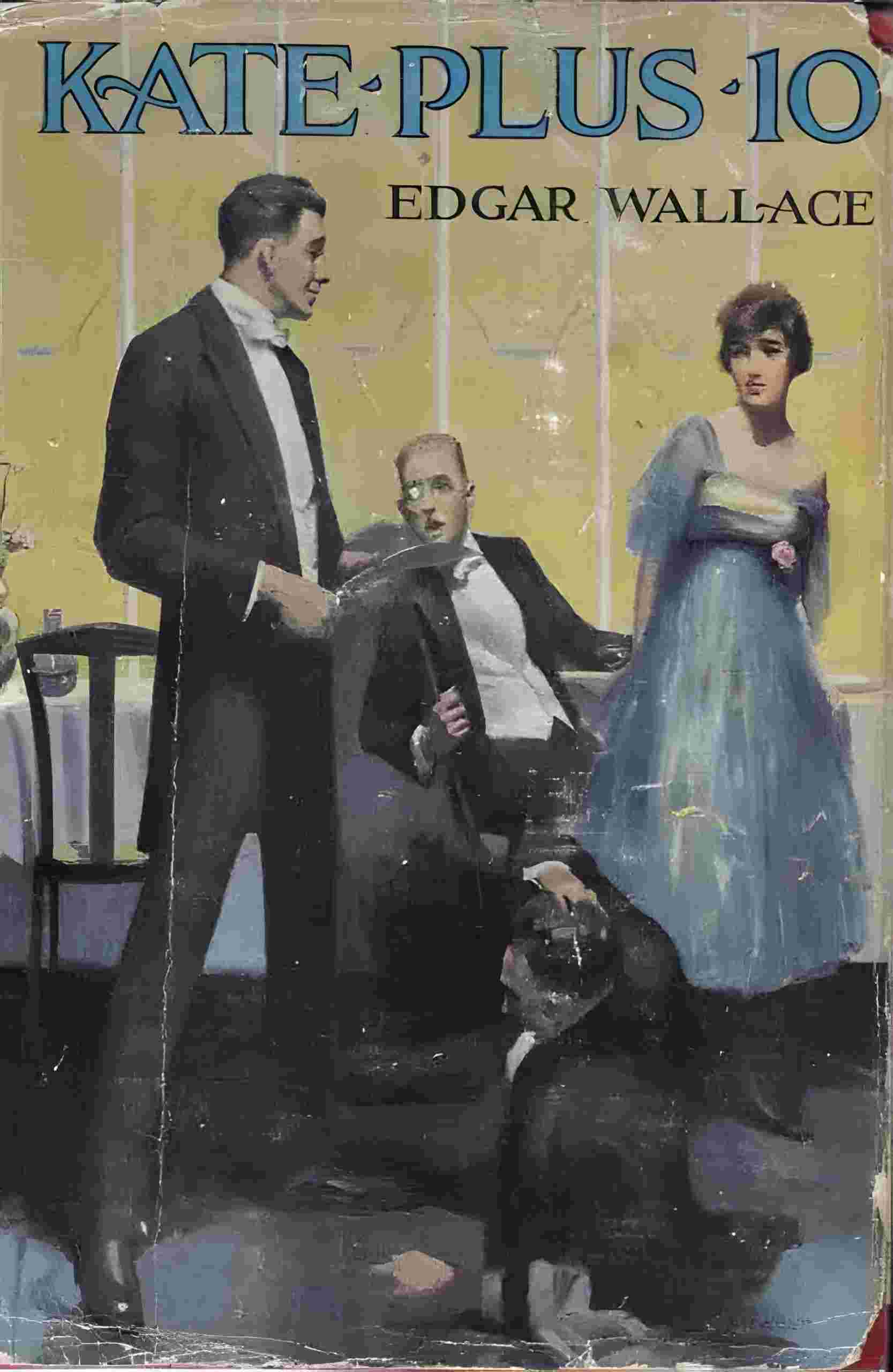
The Project Gutenberg eBook of Kate plus 10
Title: Kate plus 10
Author: Edgar Wallace
Illustrator: Charles H. Towne
Release date: June 2, 2025 [eBook #76212]
Language: English
Original publication: Boston: Small, Maynard & Company, 1917
Credits: an anonymous Project Gutenberg volunteer
KATE PLUS 10
BY
EDGAR WALLACE
Author of
“The Clue of the Twisted Candle,” etc.
WITH A FRONTISPIECE BY
Charles H. Towne
BOSTON
SMALL, MAYNARD & COMPANY
PUBLISHERS
[COPYRIGHT]
Copyright, 1917
By SMALL, MAYNARD & COMPANY
(INCORPORATED)
CONTENTS
I. Eighty-three pearls on a string
II. Mike said nothing—there was nothing to say
III. Other eyes watched Michael
IV. “The ideal Criminal is a strategist”
VII. The Princess Bacheffski—beautifully dressed
VIII. An artist makes an exhibition of himself
IX. The shareholders and an interruption
X. Sir Ralph lost a princess and found a policeman
XI. Lady Moya was curiously unlike herself
XII. A motor car was met by a special train
XIII. The chronology of a great theft
XIV. The remarkable train that did strange tricks
XV. As Sir Ralph said, “Business is Business”
XVI. On the unmorality of professional thieves
XVII. The independent strategy of Señor Gregori
XVIII. The colonel was a gentlemen at the last
XIX. Michael developed a fondness for the criminal classes
KATE PLUS 10
CHAPTER I.
EIGHTY-THREE PEARLS ON A STRING
The Earl of Flanborough pressed a bell push by the side of his study table and, after an interval of exactly three seconds, pressed it again, though the footman’s lobby could not have been far short of fifty yards from the library and the serving man was never born who could sprint that distance in three seconds.
Yet, in such awe was his lordship held that morning by his man-servants, his maid-servants and everything within his gates, that Sibble, the first footman, made the distance in five.
“Why the dickens don’t you answer my bell when I ring?” snapped the Earl and glared at his red-faced servant.
Sibble did not reply, knowing by experience that, even as silence was insolence, speech could be nothing less than impertinence.
Lord Flanborough was slightly over middle age, thin, bald and dyspeptic. His face was mean and insignificant and if you looked for any resemblance to the somewhat pleasant faces of the Feltons and Flanboroughs of past generations which stared mildly or fiercely, or (as in the case of the first Baron Felton and Flanborough, a poet and contemporary of Lovelace) with gentle melancholy from their massive frames in the long hall, you looked in vain. For George Percy Allington Felton, Earl of Flanborough, Baron Felton and Baron Sedgely of Waybrook, was only remotely related to the illustrious line of Feltons and had inherited the title and the heavily mortgaged estates of his great-uncle by sheer bad luck. This was the uncharitable view of truer Feltons who stood, however, more remotely in the line of succession.
Lord Flanborough had been Mr. George Felton of Felton, Heinrich and Somes, a firm which controlled extensive mining properties in various parts of the world, and the one bright spot in his succession to the peerage lay in the fact that he brought some two millions sterling to the task of freeing the estates of their encumbrances.
He was a shrewd man and an unpleasant man, but he had never been so objectionably unpleasant until he assumed the style and title of Flanborough and never so completely and impossibly unpleasant in the period of his lordship as he had been that morning.
“Now, what did I want you for?” asked Lord Flanborough in vexation. “I rang for something—if you had only answered at once instead of dawdling about, I should—ah, yes—tell Lady Moya that I wish to see her.”
Sibble made his escape thankfully.
Lord Flanborough pulled at his weedy moustache and looked at the virgin sheet of paper before him. Then he took up his pen and wrote:
“Lost or Stolen: Valuable pearl chain consisting of eighty-three graduated pearls. Any person giving information which will lead to their recovery will receive a reward of two hundred pounds.”
He paused; scratched out “two hundred pounds” and substituted “one hundred pounds.” This did not satisfy him and he altered the sum to “fifty pounds.” He sat considering even this modest figure and eventually struck out that amount and wrote, “will be suitably rewarded.”
He heard the door click and looked up.
“Ah—Moya. I am just tinkering away at an advertisement,” he said with a smile.
The Lady Moya Felton was twenty-two and pretty. She re-collected in her admirable person many of the traditional family graces which had so malignantly avoided her parent. Well-shaped and of a gracious carriage, though no more than medium in height, the face with its delicacy of moulding was wholly Felton. If the stubborn chin, the firm mouth and the china-blue eyes had come from the dead and gone Sedgelys, the hair of bronze gold was peculiarly Feltonesque.
When she spoke, however, the carping critic might complain that her voice lacked the rich quality upon which the family prided itself, for the Feltons were orators in those days when a parliamentary speech read like something out of a book. Moya’s voice was a trifle hard and without body; it was also just a little unsympathetic. Lord Flanborough boasted with good cause that his daughter was a “practical little woman” and at least one man beside her father could testify to this quality.
“Dear, don’t you think it is a little absurd—advertising?” asked the girl.
She seated herself at the other side of the desk and, reaching out her hand, opened a silver box and helped herself to one of her father’s cigarettes.
“Why absurd, darling?” asked Lord Flanborough testily; “lost property has been found before now, by means of advertising. I remember years ago when I was in the city, there was a fellow named Goldberg—”
“Please forget all about the city for a moment,” she smiled, lighting her cigarette, “and review all the circumstances. Firstly, I had the pearls when I was at Lady Machinstones’ house. I danced with quiet, respectable people—Sir Ralph Sapson, Sir George Felixburn, Lord Fethington, Major Aitkens, and that awfully nice boy of Machinstones. They didn’t steal them. I had the pearls when I left, because I saw them as I was fastening my fur cloak. I had them in the car because I touched them just before we reached the house. I don’t remember taking them off—but then I was dead tired and hardly remember going to bed. Obviously, Martin is the thief. She is the only person who has access to my room; she helped me undress; it is as plain as a pikestaff.”
Lord Flanborough tapped his large teeth with his penholder, a practice of his which annoyed his daughter beyond words, though at the moment she deemed it expedient to overlook the fault. The loss had frightened her, for the pearls were worth three thousand pounds and she was one of those people whose standard of values had a currency basis.
“I have asked Scotland Yard to send their very best man,” said Lord Flanborough importantly. “Where is Martin?”
“Locked in her room—I have told Fellows to sit outside her door,” said the girl, and then, interestedly, “When will the detective arrive?”
Lord Flanborough picked up an open telegraph form from the table.
“ ‘Sending Inspector Pretherston’—by Jove!”
He blinked across the desk at his daughter.
“Pretherston,” she repeated thoughtfully; “isn’t it strange?”
“Pretherston—hum,” said her father and looked at her again.
If he expected to see any confusion, any heightening of color, even so much as a faltering of glance, he was relieved, for she met his gaze steadfastly, save that there was a far-away look in her eyes and a certain speculative narrowing of lids.
The romance was five years old, and if she cherished the memory of it, it was the charity which she might show to a favored piece in her china cupboard; it was something to be taken out and dusted at intervals. Michael Pretherston was a bad match from every point of view, though his invalid cousin was a peer of the realm and Michael would one day be Pretherston of Pretherston. He was hideously poor, he was casual, he had no respect for wealth, he held the most outrageous views on the church, society and the state; he was, in fact, something as nearly approaching an anarchist as Lord Flanborough ever expected or feared to meet.
His wooing had been brief but tempestuous. The girl had been overwhelmed and had given her promise. Recovering her reason in the morning and realizing (as she said) that love was not “everything,” she had written him a letter of fourteen pages in which she had categorically set forth the essential conditions to their union. These called for the abandonment of all his principles, the re-establishment of all his shattered beliefs and an estimate of the cost of placing Pretherston Court in a state of repair suitable for the reception of the Lady Moya Pretherston (née Felton).
To her fourteen pages, he had returned a thirty-two page letter which was at once an affront and a justification for anarchy. It was not a love-letter; rather was it something between a pamphlet by Henry George and a treatise by Jean Jacques Rousseau, interspersed with passionate appeals to her womanhood and offensive references to her “huckster-souled” father.
“He was always a wild sort of chap,” said Lord Flanborough, shaking his head darkly. “I understood that he had gone abroad.”
“I suppose there are other Pretherstons,” said the girl; “still it is strange, isn’t it?”
“Do you ever feel… ?” began her father awkwardly.
She smiled and laid down her cigarette on the crystal ash-tray.
“He was wholly impossible,” she agreed.
There came a gentle tap at the door and a girl entered.
She was dressed neatly in black, and her prettiness was of a different type to that of her employer (for Lady Moya indulged in the luxury of a secretary). It was a beautiful face with a hint of tragedy in the down-turned lips and, it seemed, a history of wild sorrow in her big grey eyes. Yet of sorrow she knew nothing, and such tragedy as she had met had left her unmoved. Her abundant hair was of a rich brown; the hand that clasped a note-book to her bosom was small and artistic. She was an inch taller than Lady Moya, but because she did not show the same erectness of carriage she seemed shorter.
“Father, you asked me to let you have Miss Tenby this morning,” said Lady Moya with a nod for the girl. “I don’t know whether you will still want her?”
“I am so sorry this dreadful thing has happened, Lord Flanborough,” said the girl in a low voice; “it must be terrible to feel that there is a thief in the house.”
Lord Flanborough smiled good-humoredly.
“We shall recover the pearls, I am certain,” he said; “don’t let it worry you, Miss Tenby—I hope you are comfortable?”
“Very, Lord Flanborough,” said the girl gratefully.
“And the work is not too hard, eh?”
The girl smiled slightly.
“It is nothing—I feel awfully ashamed of myself sometimes. I have been with you a month and have hardly earned my salt.”
“That’s all right,” replied his lordship with great condescension; “you have already been of the greatest assistance to me and we shall find you plenty of other work. I was glad to see you in church on Sunday. The vicar tells me that you are a regular attendant.”
The girl inclined her head, but said nothing. For a while she waited and then at a word of polite dismissal, she left the library.
“Deuced nice girl, that,” said his lordship approvingly.
“She works well and quickly, and she can read French beautifully—I was very fortunate,” said Moya carelessly. “What were we talking about when she came in? Oh, yes—Michael Pretherston. I wonder now—”
The door opened and a footman announced,
“Inspector Pretherston, m’lord.”
“Inspector Michael Pretherston, you silly ass,” corrected the annoyed young man in the doorway.
It was Michael, then!
A little older, a little better-looking, a little more decisive—but Michael, as impetuous and irresponsible as ever.
“He spoilt my entrance, Moya,” he laughed, as he came with rapid strides toward the girl; “how are you after all these years—as pretty as ever, confound you. Ah, Lord Flanborough, you’re wearing well—I read your speech in the House of Lords on the Shipping Bill—a fine speech; did you make it up yourself?”
Moya laughed softly and saved what might have been a most embarrassing situation—for his lordship was framing a dignified protest against the suggestion that he had shared the honours of authorship.
“You are not changed, Michael,” she said, looking at him with undisguised, but none the less, detached admiration; “but what on earth are you doing in the police force?”
“Extraordinary,” murmured Lord Flanborough, and added humorously, “and an anarchist, too.”
“It is a long story,” said Michael. “I really received my promotion in the Special Branch—the Foreign Office Branch—and was transferred to the C.I.D. after we caught the Callam crowd, the Continental confidence tricksters. It is disgraceful that I should be an inspector, isn’t it? But merit tells!” He chuckled again, then of a sudden grew serious. “I’m forgetting I’ve a job to do—what’s the trouble?”
Lord Flanborough explained the object of his urgent call, and a look of disappointment appeared upon Michael Pretherston’s face.
“A miserable little larceny,” he said reproachfully. “I thought at least Moya had been kidnapped. Now, tell me all that happened on the night you lost the pearls.”
Step by step the girl related her movements and the periods at which she had evidence that the pearls were still with her.
“And then you reached your bedroom,” said Michael, “and what happened there? First of all, you took your fur wrap off.”
“Yes,” nodded the girl.
“Were you in a cheerful frame of mind or were you rather cross?”
“Does that matter?” she asked in surprise.
“Everything matters to the patient and systematic officer of the law. Temperamental clues are as interesting and material as any other.”
“Well, if the truth were told,” she confessed, “I was rather cross and very tired.”
“Did you take your cloak off, or did your woman?”
“I took it off myself,” she said after a pause, “and hung it up.”
He asked her a few more questions.
“Now, we will see the sorrowful Martin,” he said, “and let me tell you this, Moya, that if this girl is innocent she has grounds for action against you for false imprisonment.”
“What do you mean?” demanded Lord Flanborough with asperity. “I have a perfect right to detain anybody I think is guilty of theft.”
“You have no more right to lock a woman in a room,” said the other calmly, “than I have to stand you on your head. But that is beside the point. Lead me to the prisoner.”
The prisoner was very pale and very tearful; a middle-aged woman who felt her position acutely and between sobs and wails made an incoherent protest of her innocence.
“I suppose you have searched everywhere?” asked Michael, turning to the girl.
“Everywhere,” she replied emphatically. “I have had every box and every corner of the room examined.”
“Suppose the string of the pearls broke, would they all fall off?”
“No, they would still remain on, because each pearl was secured. Father gave them to me as a birthday present and he was very particular on that point.”
“I would like to bet,” said Michael suddenly, “that those pearls are not out of this room. Show me your wardrobe.”
The girl’s wardrobe occupied the whole of one wall of her dressing-room, and the tearful Martin opened the rosewood doors for his inspection.
“This is your fur cloak, I presume? Did you examine this after the loss?”
“Examine the cloak,” said Lady Moya in surprise, “of course not. What has the cloak to do with the loss? There are no pockets in it.”
“But if I know anything about the fur cloaks that are fashionable this season,” said Michael, wisely, “I should say that there is a possibility that this luxurious garment had a great deal to do with the loss. In fact, my dear Moya,” he said, “your mysterious loss has been duplicated and triplicated this year. In two cases the police were called in, and in the other case the owner had the intelligence to find her lost trinket without assistance.”
He lifted the cloak down very carefully and opened it to show the silk lining and there, caught in one of the long flat hooks, dangled the pearls. The girl uttered an exclamation of delight and slipped them from its fastening.
“Wonderful, isn’t it?” said Michael dryly. “That is what has happened, not three times but half-a-dozen times since these flat hooks have been introduced. You take the cloak off in a bad temper, the hook catches the chain, breaks it, you bundle the cloak in your wardrobe and there you have the beginning of a great jewel mystery.”
“I can’t tell you how delighted I am,” said the girl. “Michael, you’re wonderful!”
Michael did not reply. He turned to the frightened waiting-woman with a kindly smile.
“I am so sorry you have been worried about this, Mrs. Martin,” he said, “but when people lose very valuable property they are also inclined to lose their very valuable heads. I am sure Lady Moya is sorry and will make you due compensation for any inconvenience you have been put to.”
The girl stared at him resentfully.
“Of course, I am awfully sorry, Martin,” she said, coldly.
“Oh, my lady,” said the woman eagerly, “I am only too pleased that you have recovered your chain. The worry of it has made me quite ill.”
“You can have a week’s holiday,” said Lord Flanborough, magnificently. “I will get you a free railway ticket to Seahampton,” he added.
“So you see, Mrs. Martin,” said Michael with that bland air of his which scarcely veiled the sarcasm so irritating to his lordship, “your generous employers will leave no stone unturned to minister to your comfort, regardless of expense. And when you are at Seahampton, Mrs. Martin, (I trust you will not lose the return half of your free ticket) you will be allowed to walk up and down the promenade on equal terms with the aristocracy and breathe the ozone which, ordinarily, is created for your betters. You may sit on the free seats and watch the pageant of life step past you and, reflecting upon the generosity of your betters, you may appreciate the good fortune which brought you into hourly contact with the aristocracy of England. And on Sundays, Mrs. Martin, you may go to church where quite a number of the seats are also free and may even share a hymn-book with a Gracious Person who is so vastly above you in social standing that he will never recognize you again, and there, I trust, you will pray with a new fervence that the deliberations of the House of Lords may receive divine inspiration.”
“Oh, indeed I will, sir,” said Mrs. Martin almost stunned by his eloquence.
He left the woman, overwhelmed, and returned with a very ruffled Lord Flanborough and an indignant Moya to the library.
“What utter nonsense you talk, Michael,” said the girl angrily. “I don’t think it was kind of you to attempt to set my servants against me.”
“Beastly bad taste,” said Lord Flanborough, “and really, Pretherston, you came here as an officer of the law and not as an old acquaintance and I think that you exceed your duties, if you don’t mind my saying so.”
“Old acquaintances,” said Michael, picking up his hat and his coat from a chair where he had put them before the interview, “are especially made to be forgotten, a peculiarity of which one is reminded in that Bacchanalian anthem which is sung at all public dinners where sobriety is bad form. I was merely endeavouring to inculcate into the mind of your slave a few moral principles, beneficial to you, and to society.”
“Don’t tell me that,” growled Lord Flanborough, “as though I didn’t recognize your sarcasm.”
“Children and the lower orders never recognize sarcasm,” said Michael with a broad smile.
He held out his hand and somewhat reluctantly his lordship extended his own flabby paw.
“Before I go,” he said, “I suppose I had better take a full account of this case. You haven’t a secretary or anybody to whom you can dictate the circumstances? You see I have to make a report to my cold-blooded superiors.”
Moya had reached the stage where whatever remains there was in her friendship with Michael Pretherston had not only died but had been cremated in the fires of her smothered anger and she was as anxious to see the end of this interview as was her father.
“Perhaps you will ring for Miss Tenby,” she said after a pause.
Her father pressed the bell and the waiting Sibble answered it.
“Send Miss Tenby,” said his lordship.
“And I do hope, Michael,” said the girl severely, “that when Miss Tenby is here you will not make such extravagant comments as you did before Martin.”
“Miss Tenby,” interposed Lord Flanborough, “will not welcome such talk. She is a young girl with—er—”
“I know, I know,” said Michael solemnly, “she is genteel. She does forty words a minute on the typewriter and goes to church, filling in her odd moments with needlework and accompanying you on the piano.”
“It must be a wonderful thing to be a detective,” said Moya, sarcastically; “as a matter of fact Miss Tenby is one of the fastest typists in the world.”
Michael swung round on her with an odd look on his face.
“Fastest typists in the world,” he repeated with all the humor gone out of his tone; “does she sing?”
It was the girl’s turn to be astonished.
“Yes, she does, and very beautifully.”
“Does she prefer Italian opera?” he asked.
At this, the girl laughed aloud.
“Somebody has been telling you all about her and you are trying to be mysterious,” she accused.
Further conversation was cut short by the arrival of the girl, who walked in, closed the door and came straight to the desk. She stopped dead at sight of Michael. Moya saw the meeting, saw the girl stiffen and her sorrowful eyes fixed upon the detective’s face.
“Why, Kate!” said Michael Pretherston softly. “Well, well, well! and to think that we meet again under such noble auspices.”
Miss Tenby said nothing.
“And what is the great game?” asked Michael, banteringly. “What beautiful impulse brought you to this sheltered home and how is the Colonel and friend Gregori and all those dear boys? By-the-way, the Colonel must be out by now, Kate. What did he get, three years?”
Still Miss Tenby made no reply.
“What is the meaning of this?” demanded Lord Flanborough, feeling that the moment had arrived to assert himself. “Do you know this lady?”
“Do I know her,” said Michael, ecstatically; “why, I am one of her greatest admirers, aren’t I, Kate?”
The girl’s sad face softened to a smile which showed the regular lines of her white teeth. She spoke and her voice was gentle and appealing.
“It is perfectly true, Lord Flanborough,” she said quietly, “Mr. Pretherston knows me. He also knows that my uncle, Colonel Westhanger, has been mixed up in a very serious scandal which brought him within the reach of the law. It is perfectly true that when I was a little girl I was known as Kate. It is just as true that I am trying now to live down my association with law-breakers and am trying to rehabilitate myself in the world.”
“H’m,” murmured Lord Flanborough, a little taken back, “very creditable.”
Moya turned to Michael indignantly.
“I suppose that you think you are rendering a great service to the world in trying to drag this poor girl down to the gutter, in exposing her to her employers and in obtaining her dismissal from honest employment.”
“I do,” said Michael shamelessly.
“I think it is a barbarous thing to do!” said Moya angrily.
She had not yet decided in her own mind as to what steps she would take in face of this revelation. In view of her own character, it is possible that “Miss Tenby” would have a very short shift at her hands. But for the moment the opportunity for the display of benevolence and Christian charity was not to be passed over. She saw the girl’s appealing eyes and clasped hands and, for a moment, she felt a sincere thrill of pity for a brave sister struggling to escape the octopus tentacles of law and crime; for a moment she felt a genuinely unselfish desire to help another.
If she expected Inspector the Hon. Michael Pretherston—for such was his incongruous title—to wilt under her reproaches, she was disappointed. Michael had not taken his eyes from the secretary, nor had the twinkle in those eyes abated. He nodded to “Miss Tenby.”
“Kate,” he said, “you are really a wonder, and to think that you have never yet come into the clutches of the law until now.”
“Until now,” said the girl quickly, raising her voice.
He nodded.
“The Prevention of Crimes Act,” murmured Michael. “I can take you,”—he emphasized the “can”—“on a charge of obtaining employment with forged letters of recommendation, also with being a Suspected Person.”
The girl dropped her attitude of humility, threw back her head and laughed, showing her even white teeth.
“Oh, you Mike!” she railed him. “Oh, you busy fellow!”
Her amusement did not last long for instantly her face was set again and the grey eyes blazed with rage.
“One of these days you will be too clever,” she said bitterly. “I have seen better men than you and cleverer men than you go out, Michael Pretherston. You and your Prevention of Crimes Act! You can’t put that bluff over me. The Act does not come into operation until you have a conviction against my name, and that you will never get, you brute!”
“Kate, Kate!” murmured Michael. “There’s a lady present.”
She nodded.
“I guess I’ll get my kit together,” she said; “it hasn’t been exactly a holiday trip.”
“My sympathies are entirely with you,” said Michael; “it must have been awfully dull after the gay orgies of Crime Street.”
“There is one thing I have always wanted to know,” said the girl, pinching her lip thoughtfully.
She walked to the desk, and Lord Flanborough was too much taken back to arrest her progress. Without a word she opened the silver box on the table and took out a cigarette.
“I have always wanted to know what kind of dope this dear old gentleman smoked.”
She looked at the cigarette critically and with an exclamation of disgust threw it back on the desk.
“Gold Flavours!” she said scornfully; “can you beat it, Mike? And he has a hundred thousand a year!”
“You must make allowances for the decadence of the governing classes,” said the soothing Michael.
He turned and nodded farewell to the girl and with Miss Tenby’s arm in his he passed out of the room, and Lord Flanborough and his daughter looked at one another in speechless amazement.
CHAPTER II.
MIKE SAID NOTHING—THERE WAS NOTHING
TO SAY
“You might do worse than lunch with me,” said Michael Pretherston.
He stood outside Felton House with the girl whose belongings in one small Gladstone bag had been deposited on the curb, pending the arrival of a taxi-cab.
“Why should I lunch with you?” she asked insolently. “I thought you were going to pinch me.”
“Your vulgarity is appalling!” said Michael, shaking his head in reproof. “I cannot pinch you in the vulgar sense. I have no desire to perform that operation in the corporeal sense. You had better compromise and lunch with me.”
The girl hesitated.
“Think of my reputation,” she said.
“Thoughts of your reputation keep me awake at night,” answered Michael lightly and called a taxi.
They found a little restaurant in Soho and in an underground cellar where the bad ventilation was compensated for by a blaze of light, they ate their simple meal.
“Now, Kate, I want to ask you what your little game is,” said Michael; “and I need the information because I know it isn’t a little game.”
“I was scared sick over those pearls,” said the girl, ignoring the question. “It would have been horrible bad luck to have been taken for a job I had nothing to do with and such a paltry job, too!”
“You owe me something,” said Michael.
“I owe you more than I can ever repay you,” said the girl significantly.
“I suppose one of these days,” suggested the detective after an interval of thought, “you will instruct some of your hired pals, Gregori or the Colonel or little Stockmar, to inflict on me a painful injury.”
“You!” said the girl scornfully. “If there were not men like you in the police we should have been destroyed years ago! You are a sort of an insurance scheme and it pays us to keep you alive and well. Why, Crime Street would go into mourning the day you were buried.”
“You are not trying to be rude to me, are you?” he asked.
She looked at him slyly from under her long lashes and her eyes were dancing with fun.
“Why do you think I went to Lord Flanborough?” she asked.
He shook his head.
“I’m blessed if I know,” he confessed. “Of course, I knew it was you the moment I heard of the rapid typewriting and the Italian songs. Now listen: I am not trying to speak to you for your good.…”
“Don’t!” she said laconically.
“But I have often wondered why a well-educated girl and a nice girl, as far as I know to the contrary, should prefer the life of a crook to.…”
“To earning £2 or £3 a week and working all day to earn it,” she finished for him; “to living my life in one little room on a top floor in Bloomsbury, waiting my turn every morning for my bath. To being made love to by the assistant manager and sacrificing my immortal soul for a half-a-crown dinner and a bottle of red wine! It is funny, isn’t it! I have had the experience for professional purposes and I don’t like it a bit, Mike.”
She looked at him straight in the eyes. She had dropped her air of flippancy, her slang; the voice that spoke was not to be distinguished from that of any other gentlewoman.
“You see, a woman is differently circumstanced to a man. She wants nice things and her attitude toward life, and indeed the whole of her conduct, depends entirely upon the degree of niceness she requires. Men don’t do things for women for nothing. They lend to their men friends all the money in the world and are grateful if they get it back. They expect nothing more than their money and are surprised when they get it. But if I were a typist in a city office and I borrowed £2 from the assistant manager or from the chief bookkeeper or a fiver from one of the partners, why, Mike, I should be booked for supper on Wednesday. Men want more from women than a quid pro quo; they want two quid pro quo. In return for the £2 I borrowed, I should pay interest well outside the range of the multiplication table. Suppose a man lent you £2 and asked you in exchange, not only to repay the money, but to renounce all your dearest principles for the sake of the loan; if he asked you to betray your friends, where you had been loyal to them, and lie, where you had been truthful; break your word where you had been faithful, be a thief where you had been honest? Would you surrender every reticence, every honourable instinct, every precious faith?”
Mike said nothing. For there was nothing to say. He paid the bill and escorted the girl to a cab.
“I am not going to be sorry for you,” he said; “you are having The Life. One of these days I shall come along and take you; but I shall hate it. Hop in, Kate!”
Kate literally hopped into the waiting taxi, waved her hand in farewell and was gone.
Michael Pretherston stood for fully five minutes on the edge of the pavement, meditating upon what the girl had said. She had struck a responsive note in his soul, for she spoke no more than was the truth, as he knew.
He went, a little sadly, back to headquarters, remembering en route that he had forgotten to write the report. Should he go back to the Yard and compose it from memory or should he return to the unsympathetic atmosphere of Felton House? He decided upon the latter and surprised Lord Flanborough in the act of taking an afternoon nap. Michael was full of apologies and was so unusually respectful that his lordship forgot to be annoyed.
“Moya’s out,” he explained.
“I will endeavour to bear up,” replied Michael, seating himself at his lordship’s desk and preparing to take a note of the circumstances which had led to his lordship’s call for assistance. He finished the report, blotted and folded it and placed the document in his pocket.
“I only want to ask you one or two questions and they concern Kate—or Miss Tenby, as you call her. I’m afraid I gave you a shock this morning.”
“It was certainly a surprise,” admitted Lord Flanborough cautiously; “who is this Kate? We have made a very careful search of the house but nothing is missing so far as we can tell.”
Michael laughed.
“You needn’t worry about that. Kate is not a pilferer. Her real name is Katharine Westhanger; they call her Kate and she is the Colonel’s niece. Her age is eighteen or nineteen, and from a child she has been brought up to regard the world as her oyster. Her mother was a wholesome parson’s daughter, her father was a rascal who was kicked out of the army in ’89 for an offence against the Law of Property. Her maternal grandfather was General Sir Shaun Masserfield, the greatest strategist the British army has ever held—Kate inherits his genius but has not learnt his code. Her father died when she was a child and her uncle, who is a greater scoundrel than her father was—the family on the Westhanger side has a criminal history which goes back at intervals for two hundred years—completed her education. Kate has been brought up to be a thief, but a big thief. She is, I believe, the brains of the biggest criminal organisation in the world. Every member of the gang has been taken, but no evidence has ever been offered against Kate. She plans the big swindles and each one is bigger than the last—but never once have we traced the offence to her door.”
“Why is it that the police—?” began Lord Flanborough.
“The police, my dear Flanborough,” said Michael wearily, “are human beings who have to deal with human beings. They are not angels, nor thought readers, nor are they clairvoyant. The laws of this country are so framed that the criminal has six chances to every one possessed by his enemy. We know Kate was concerned in that big bank smashing exploit which took two million crowns from the treasury of the Bank of Holland. It was Kate who organised the raid upon the London jewellers in June of last year. Kate is the mother of Crime Street. You don’t know that thoroughfare, but one of these days I’ll introduce you to it, if you are curious—but I warn you that if you expect to steep your soul in sordidness, you will be disappointed—it is the most respectable street in London. Her ingenuity is remarkable, her patience beyond praise, and that is partly why I have come back: I want to know why she was here and what she was doing?”
“As I say…” began Lord Flanborough again.
“For Heaven’s sake,” interrupted Michael, “don’t tell me that you haven’t missed things! I tell you Kate would not touch a pin in your house. In the first place she is a well-off woman. Why in Heaven’s name should she bother her head about your belongings? I don’t suppose, if she had the full run of your house, she could find £100 worth of realisable property! No, that is not why Kate came to you. How long has she been here?”
“Nearly a month,” said Lord Flanborough, a little annoyed that the result of his own private investigations had so utterly failed to impress a representative of Scotland Yard.
“What work has she been doing?”
“Ordinary secretarial work for Moya. She came with excellent letters of recommendation.”
“You can forget those,” interrupted Michael testily; “the gentleman who wrote them lives at No. 9, Crime Street and his name is Millet.”
“She was a wonderful typist,” began his lordship, who was seeking about in his own mind for some excuse which would explain why he had been deceived.
“That I also know. She is, as you say, one of the fastest typists in the world. In fact, no aspect of her education has been neglected. She speaks five languages and read French fluently when she was nine. What work has she done for you?”
Lord Flanborough considered for a while.
“She has copied a few letters and reports.”
“What kind of reports?”
“Reports from our South African companies. You see, Michael, I still retain the direction of most of my old interests.”
“Were they very important—the reports, I mean?”
“Yes and no,” replied Lord Flanborough slowly; “they were merely records of output, cost of production and projected shipments.”
“On what other work was she employed?”
“Let me think,” said Lord Flanborough.
“I am letting you!” replied Michael tartly. “You used to have a very private code-book if I remember rightly.”
“That is true,” said Lord Flanborough, “but of course, she did not see that.”
“Where did you keep it?”
“In my desk,” said Lord Flanborough.
“Is it possible that she could have seen it?”
“It is possible, but wholly impossible that she could have copied it.”
“For how long a time together was she left alone?”
“Five minutes was the longest period she was left in the library alone,” said his lordship after consideration.
Michael fingered his chin.
“Did you ever come into the library and find her in a semi-fainting condition?” he asked.
Lord Flanborough looked at him with open-mouthed amazement.
“Did she tell you?”
Michael shook his head.
“No, she has told me nothing. I gather from your question that there was such an occurrence?”
“It is remarkable that you should ask the question,” said his lordship. “I did come in one morning to find the poor girl—er, the wretched girl, in a semi-fainting condition.”
“And you went out and got her a glass of water and sent for your housekeeper, I suppose,” said Michael, his lip curling.
“Yes, I did,” admitted his lordship.
“Which means, in plain language,” smiled Michael, “that you surprised her in the act of examining some of your private documents and that whilst you were getting the water and calling assistance, she was replacing whatever she was looking at where she had found it. Did she on any other occasion draw your attention, on your entering the room, to some peculiar circumstance, such as one of the pictures not hanging straight or a broken vase?”
Again Lord Flanborough looked astounded.
“Yes, once she pointed to the china cupboard and asked me who cracked the glass. As a matter of fact, the glass was not cracked at all,” he explained.
“But you went over and examined it?”
“Naturally,” said his lordship.
“That was exactly the same trick,” said Michael; “whilst you were making your inspection she was able to replace any documents she had been examining and close the drawer—if they were in a drawer. Now, I wonder what her game is?”
“You don’t suggest,” began his lordship in alarm, “that she is scheming to rob me?”
“I hope not,” said Michael gravely; “from the idea of your being robbed, the imagination reels.”
“I wish you wouldn’t be so sarcastic. I am afraid you have never quite forgiven Moya—”
“I bless Moya every time I think of her,” said Michael quickly; “she rendered me the greatest service that one human being can render to another, when she refused me. I hope to do better than Moya. As Moya’s father, you utter a pained protest. I know, I know,” said Michael, and he waved his hand cheerfully from the door.
CHAPTER III.
OTHER EYES WATCHED MICHAEL
Michael Pretherston was back at the Yard in time to catch his chief before he departed for the day.
Commissioner T.B. Smith, to whose recommendation this young scion of the aristocracy owed his promotion, was not helpful.
“If we took Kate on any charge it would not prevent the swindle going forward,” he said; “you may be sure she has mobilized all her resources and her little army is ready to the last button of the last gaiter. There is supposed to be a fellow watching her all the time, but he seems to have missed her rather cleverly. Anyway, I don’t think there is much to be gained from shadowing her, because she knows she is under observation and acts accordingly. But I have a word of advice to you, my young Hibernian friend, and that is to keep a sharp eye on your own precious life. Kate is afraid of you.”
“She didn’t give me that impression this afternoon,” said Michael sadly.
“Kate is a bluff; you mustn’t take any notice of what she says. You accept a friend’s advice and go very carefully to work. I am not so sure that you didn’t behave indiscreetly this afternoon.”
“That is impossible!” said Michael stoutly, and T.B. Smith laughed.
“The thing to have done was not to have recognized her and to have kept her under observation, pursuing your enquiries in the usual way.”
“If you can suggest any method by which I could have prevented her from recognizing me and recognizing the fact that I recognized her I will admit that I was wrong,” and T.B. Smith agreed.
“You may be right,” he said; “anyway, look after yourself.”
Michael promptly forgot his chief’s advice and spent his evening making a solitary reconnaissance of Crime Street. Crime Street does not appear upon any plan of London, but if you will look at any large survey of the Hampstead district, you will find in a somewhat irregular tangle of buildings within a stone’s throw of the Heath, a curious oval which is conspicuous on the plan, not only by its own symmetry but by the graceful lines of the thoroughfares which radiate therefrom.
This is Amberscombe Gardens. The centre of the oval is occupied by four houses, Numbers Two, Four, Six and Eight; the northern side of the gardens by five houses, Numbers One, Three, Five, Seven and Nine.
Into Amberscombe Gardens from the north run three roads, the first of which (opening into the oval between Numbers One and Three) being called The Approach; the second, dividing Numbers Five and Seven, called Bethburn Avenue; the third between Numbers Seven and Nine, Coleburn Avenue. On the south side of the oval the arrangement of the streets is very similar. Originally, the central space had been occupied by nine houses but these had been pulled down by the proprietors of the remaining four and a private garden, common to all four houses, had been laid out by the owners of these properties. So that on the southern side of the central oval, there were no buildings, but a wall bisected at regular intervals by plain garden doors which form such a common feature of London suburban residences.
In reality, the roadway to the north and south of the plot is all Amberscombe Gardens, but the oval which curves round to the north was, at the period this story covers, known to the police as “Crime Street,” and in this description the nine houses on both sides of the northern curve were involved.
Number One, the most modest of all the buildings, was in the occupation of Dr. Philip Garon, an American practitioner who made frequent visits across the Atlantic and invariably returned to deposit a very handsome surplus in the local branch of the London and Western Counties Bank. Dr. Garon was successful as a result of the sublime assurance of all ocean-going passengers, that the notice, conspicuously displayed in the smoking-room warning passengers not to play cards with strangers, did not apply to them.
Number Three, a pretty house smothered in clematis in the proper season of the year, with its white window sashes and its sober red front, was the town house of Mr. Cunningham, who, apparently, had no initial and no Christian name. He was known to his intimate friends as Mush, the derivation of which is a little obscure. Mr. Cunningham described himself as independent, which meant no more than that he was independent of the ordinary necessities of making an honest living. In a sense, he was by far the best known of the Colony, for Mush had served two terms of penal servitude, one in an English and one in a French prison. He had the reputation of being able to cut holes in steel safes with a greater rapidity than any other gentleman in his profession, and it is said, probably with truth, that he had improved upon the oxy-hydrogen jet and had introduced a new element which shortened the work by half.
The tenant of Number Five was a gentleman, benign of countenance and very good to the poor. He was called the Bishop by friends and foes alike. His real name was Brown and he had been concerned in more bank swindles than any of the other colonists, though he had only one conviction to his discredit and that a comparative flea-bite of nine months’ hard labour.
The owner of Number Seven was described as “Mr. Colling Jacques, Civil Engineer,” in the local directories. The official police “Who’s Who” noted that he was a wonderful pistol shot, and recorded, in parenthesis, that on the occasion of his arrest in connection with the smashing of the Bank of Holland, no weapon was found upon him. It was also added that there was no conviction against him in England, though he, too, had seen the inside of a French prison.
Number Nine was pointed out to sightseers, with a certain amount of local pride by the guide, as the home of Millet the forger, who had received on one occasion a fifteen years’ sentence, but had been released after serving two years, an act of grace on the part of the authorities which earned for him a certain unpopularity with his peers and was held to be not unconnected with the subsequent arrest of a few of his former associates, the suggestion being that Mr. Millet had turned King’s evidence.
At Number Two, on the “oval” side of the street, lived H. Mulberry, a respectable and methodical man, who went to his little office in Chancery Lane every morning of his life by the 9:15 and returned to his home at exactly 5:30 P.M. year in and year out. Mulberry was a begging letter writer on a magnificent scale. He had a wonderful literary style which seldom failed to extract the necessary emolument which he sought.
Number Four, a much larger house, indeed the second largest in Crime Street, was the habitat of “Señor Gregori, a teacher of languages.” Unfortunately for him, he had in the course of his thrilling career taught other things than the liquid tongue of Spain. For example, he had taught the Bank of Chili that their “unforgeable” notes which, it was boasted, defied photographic reproduction could be turned out by the tens of thousands and that the six tints in which a gold bond was printed offered no insuperable difficulty to a clever craftsman with an artist’s eye and a sense of colour.
In Number Eight lived the two brothers Thomas and Francis Stockmar of Austrian extraction, who were described as political refugees but were undoubtedly criminals of a peculiarly dangerous type. The Stockmars were dour, white-faced men with short bristling hair and were certainly the least presentable of all the colonists.
Number Six has been left to the last, for this was the most important house in Crime Street. It was a story higher than any other, built squarely, with no attempt at beauty. It is said that the third floor consisted of one room and that from its many windows it was possible to command, not only all the approaches to the northern side of the gardens, but those to the south; it has even been suggested that it was so planned, that, in case of necessity, the house could be converted into a fortress, from the third floor of which a last desperate stand might be made. This then was Number Six, the abiding place of Colonel Westhanger and his brilliant niece.
Michael Pretherston was no stranger to Crime Street. He had made many visits to this locality, and it had been at his initiative that the roadway of Amberscombe Gardens had been dug up one fine morning by a gang of road-breakers and there had been revealed that remarkable subterranean passage which connected the one side of the street with the other. The passageway led from the summer house in the gardens of the oval to a stable in Number Three.
The Colonists, however, swore stoutly that they knew nothing whatever of the existence of this passage and that it must have existed years before they came to the street. The civil engineer, Colling Jacques, pointed out to the district surveyor that the very character of the passage suggested that this was some storm water drain which had been laid down and forgotten by the contractor. Or else it had been laid down in error and the contractor had been either too lazy or too rushed to break it up. There were many other explanations, none of which was wholly acceptable.
Michael, swinging his stick, passed that portion of the road in which the passage had run and wondered with a reminiscent smile where the new tunnel was, for that there was a new one, he did not doubt.
Night was falling, and Dr. Philip Garon’s dining-room windows blazed with light. Mr. Mulberry’s, on the right, was more modestly illuminated. Mr. Cunningham’s house was in darkness, as also was “The Bishop’s.” There were lights in the bedroom at Number Seven but Number Six was black as also was Number Eight.
He saw Millet standing at his garden gate, smoking, and crossed the road toward him, realizing that the keen-eyed gentleman had already observed his presence. Millet, a florid man with a genial, almost fulsome, manner met him with a friendly nod.
“Good evening, Mr. Pretherston,” he said. “I hope you are not looking for trouble.”
Michael leant on the top bar of the gate and shook his head.
“I shouldn’t come here for trouble,” he said; “this is the most law-abiding spot in London.”
Mr. Millet sighed and murmured something about misfortunes which overtake mankind and added a pious expression of his desire to forget the past and to end his days in that security and peace which sin denies its votaries.
“Very pretty,” said Michael blandly, “and how are all our good neighbours? I was thinking of taking a house here myself. By-the-way,” he added innocently, “I suppose you don’t know any that are to be let?”
Mr. Millet shook his head.
“I am all alone here,” he said, “if you were really serious about wishing to live in this neighbourhood, I should be honoured to act as your host, Mr. Pretherston.”
“And how is Kate?” demanded Michael, ignoring the invitation.
“Kate?” asked the puzzled Mr. Millet; “oh, you mean, Miss Westhanger. I haven’t seen her for several days—I think it was last Tuesday afternoon I saw her last.”
“Yes, at 2:30 in the afternoon,” mocked Michael, “she was wearing a blue dress with white spots and a green hat with an ostrich feather. You remember her distinctly because she dropped her bag and you crossed to pick it up. You needn’t start the alibi factory working, Millet; I have nothing against Kate for the moment.”
Mr. Millet laughed softly.
“You will have your joke,” he said.
“I will,” said Michael with grim emphasis, “but it is going to be a long time developing. I haven’t seen the Stockmars lately either.”
“I never see them at all,” Mr. Millet hastened to state. “I have very little in common with foreigners. Whatever there is against me, Mr. Pretherston, I am a patriot through and through. I am proud to be English and I don’t take kindly to foreign gentlemen and never will.”
“Your patriotism does you credit, Millet,” said the detective dryly as he prepared to move on. “I wish you would be patriotic enough to give me a tip as to what game is on,” he lowered his voice. “You know all that is happening here and you might do yourself a little bit of good.”
“If I knew anything,” said the other earnestly, “I would tell you in a moment, Mr. Pretherston, but here I am, out of the world, so to speak. Nobody ever consults me and I am glad they don’t. I want to be left alone to forget the past—”
“Cut all that Little Eva stuff out, Uncle Tom,” said Michael coarsely.
Other eyes had watched Michael, from behind blinds, through unsuspected peep-holes, a dozen pairs of eyes had followed him as he took his slow promenade along Crime Street.
Colonel Westhanger, a tall, grey man, stood in that big room on the third floor of his house, his hands folded behind him, his chin upon his breast, following every movement of the detective. Gregori, handsome and lithe, stood at his elbow, shading the glow of his cigarette in the palm of his hand.
“Colonel mio,” he said softly, “I would give much for an opportunity of meeting that gentleman in a nice dark passage, in one of those old Harrison Ainsworth houses which were providentially built over a river.”
“You will have your wish one of these days,” said the Colonel gruffly; “I don’t like that fellow. He is not one of the ordinary run of policemen. They are bad enough, but this fellow knows too much.”
He nibbled his white moustache, shook his head and turned away from the window as Michael took his farewell of the forger.
“Watch him on the other side,” he said, “and send one of the boys out to follow him.”
He descended the thickly carpeted stairs to the first floor, which was the living suite. The drawing-room in which he turned was a beautifully furnished apartment, and the girl who had been sitting at the piano, her nimble hands running over the keys, looked up as he entered.
CHAPTER IV.
“THE IDEAL CRIMINAL IS A STRATEGIST”
“Where did he go?” she asked.
“He went to Millet,” said the Colonel, throwing himself down to a divan and biting off the end of a fresh cigar. “I wonder what the dickens he wants?” he mused.
Kate Westhanger made a little grimace.
“You can never tell whether a policeman finds his duty a pleasure or his pleasure a duty,” she said. “I suppose he is just renewing acquaintance with Crime Street.”
“Don’t use that phrase,” snapped her uncle.
“I shall use whatever phrase I wish,” she said calmly. “You are getting nervous. Why?”
“I’m not nervous,” he protested loudly; “I am getting old I suppose, and the job is such a big one. It is almost too big for me and if I occupied the position I had a few years ago, Kate, I would drop it. After all, we have made a good deal of money and we might as well all of us live to enjoy it.”
She was back at the piano again and was playing with the soft pedal down.
“Can’t you find anything more cheerful than the ‘Death of Asa’?” growled her relative.
“It is nerves, of course; I am awfully sorry.”
She got up and closed the piano with a bang which made him jump.
“I don’t know what to do about Mike,” she mused.
“Gregori has a solution,” said the Colonel.
“To cut his throat, I suppose,” said the girl coolly. “Gregori is so elemental and so horrific! I can’t imagine that he ever has cut a throat in his life, but I suppose he feels that it is in keeping with his sunny southern nature to talk like that. No, Colonel mio,” she mimicked, “we have stopped short of murder so far and I think we will remain on the safe side. My theory coincides with Mike’s. I was reading an article of his in a Socialistic paper the other day and it was all about the Right to Live. I don’t believe in killing people. I believe in bleeding those who have grown apoplectic with their money and I don’t even know whether I believe in that.”
“What do you mean?” the Colonel looked up at her under his shaggy brows.
She shrugged her shoulders.
“I mean,” she said slowly, “I never know whether my views are my own views or whether they are just your views which I reflect like a mirror. You see, dear,” she said, “I am very young but I have a logical mind and my logical mind tells me that no girl can have any very definite views at nineteen, not of her own, I mean. Perhaps when I am twenty-five I shall look upon you as a terrible person, and all this,” she spread her hands out, “as something to think of with a shudder.”
“In the meantime,” said her uncle practically, “you are Miss Ali Baba, chief strategist of our little army and a very exigent young lady—by-the-way, Gregori is kicking.”
She looked at him with a contemptuous little twist of her lips.
“There is a great centre forward lost in Gregori,” she said. “What has moved that dago’s feet?”
“Hush, hush, my child,” cautioned her uncle, “our admirable friend is upstairs and, anyway, it doesn’t do to speak disrespectfully of one’s criminal associates. There is a certain punctilio in our profession which you may have noticed.”
“How queer it sounds!” she said, leaning forward and clasping her knee. “Do you know, uncle, I cannot think straight. Ever since I was so high,” she stretched her hand out before her, “I have never known a desire to secure anything I wanted, save by taking it from somebody else. At the school in Lausanne I seemed to be amongst the queerest people and, honestly, although you had warned me, I thought they were all mad. All their fathers made money in business, which seems to be a slow method of stealing which is allowed by the law. Think of the horrible monotony of working steadily day after day without any holidays, with no excitement, no adventures, save the artificial thrill of a theatre and the adventures that meet you on your way home.”
“I didn’t even know there were those kind of adventures,” said the Colonel, fingering his trim moustache and enjoying with closed eyes the fragrance of his cigar.
“Oh, yes,” nodded the girl, “you meet all sorts of men who raise their hats and say, ‘Good-evening, Miss,’ or ‘Haven’t we met before?’ I don’t think they have ever said anything else,” she reflected thoughtfully,—“they all belong to the ‘Good-evening’ or the ‘Met you before’ school, and they all want to know if you are ‘going their way.’ ”
“What happens then?” asked the amused Colonel, carefully removing his cigar in order that he might laugh without detriment to the accumulating ash.
“I have only had one experience,” said Kate. “It was with a young man with a horribly weak chin. He had studied in both schools, for his ‘Good-evening’ was followed by a request for information upon my immediate plans and I let him walk with me. I expected something very dreadful but he talked mostly about his mother and the difficulties he had about getting a latch-key. He wanted to take my arm but I told him it wasn’t done and then he suggested that I should meet him on Sunday. By this time I had learnt all about his family, his mother and the girl he was prepared to sacrifice to retain a continuation of our intimacy. I also discovered his name was Ernest and that he was the cleverest man in his office.”
“He wanted to kiss you, I’ll be bound,” said the Colonel.
“I think he did,” admitted the girl, “but he didn’t say so. All he said was that he hoped it didn’t rain and asked if he might write to me. I told him he might, but, unfortunately, he forgot to ask me my address—” she broke off suddenly, “what is Gregori kicking about?”
“That Madrid affair didn’t go off as well as it might,” said the Colonel, avoiding her eye.
She nodded.
“I know; and Gregori blames me, I presume.”
“Gregori never blames you,” said the Colonel, “I think Gregori would knife anybody who said a word against you.”
“No,” she said, nodding her head, her eyes fixed on the opposite wall, “the Madrid affair went badly, in spite of the fact that there were forty-two sheets of manuscript in Spanish and English giving the most elaborate directions. It was a month’s work for me and it was all wasted and the greater part of a hundred thousand pesetas because Gregori’s trusted Señor Rahboulla thought he could improve upon my instructions and joined the train at Cordova in a light grey suit when I told him to wear the conventional black of the madrilleno and when I insisted upon his making his entrance to Madrid from Toledo. I knew that Cordova was watched by the French and Spanish police and I knew too that they would be looking for a stranger. Rahboulla advertised himself, was arrested and the chain, which I had carefully pieced together, was broken. By the time he had shaken off the police and arrived in Madrid the closing hour of the Prado had been advanced from six to five and the consequence is, that the Velasquez is still in the picture gallery and we are a hundred thousand pesetas the poorer.”