
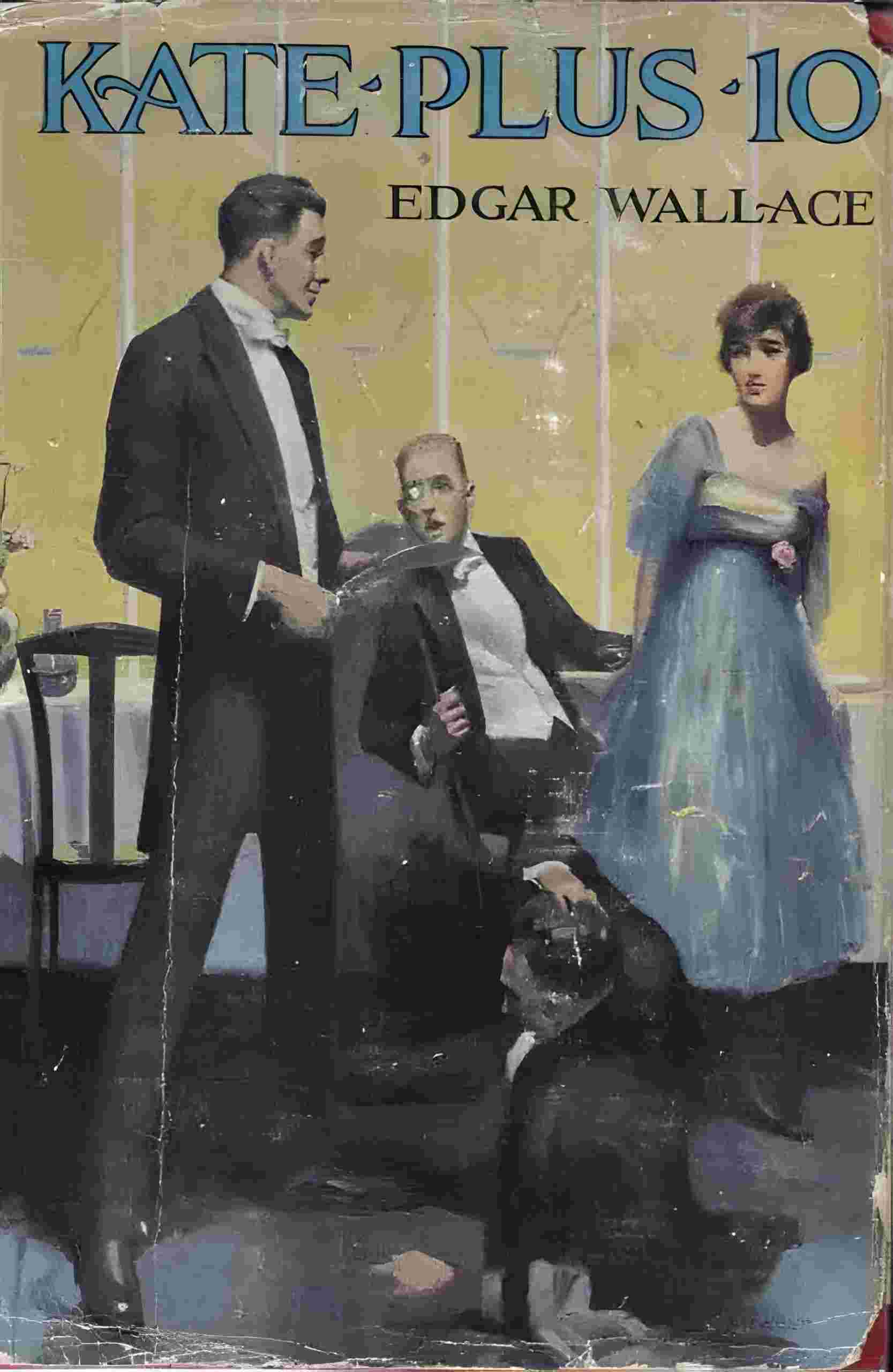
The Colonel shook his head.
“You are a wonderful girl and I will admit you are right. Heavens! the patience required to work out these details!”
“The ideal criminal is a strategist,” said the girl. “He foresees every move of the enemy and forestalls him. He makes a diversion at one point and his real attack at another. He prepares the way for retreat at the same time as he is preparing his advance. It took me six months to obtain all the information I wanted and it took six minutes for Rahboulla to upset our plans.”
She laughed.
“If things go wrong, you blame the general,” she said. “Three years ago, Gregori the Kicker introduced an Italian into one of our schemes—the business of the Nottingham Post Office. That went wrong, too.”
“There I admit you were right,” the Colonel hurried to say; “Tolmini made a mess of it.”[1]
“And tried to drag us all into it when he was caught,” said the girl; “he went to prison under the impression that I had led him into a trap—though the fool was told the mail bags were not to be touched until the night shift came on duty.”
“Why do you mention him now with such emphasis?” asked the Colonel curiously.
“Because he’s out of prison—and he’ll be kicking, too,” she replied, “just as Gregori kicks!”
“ ‘Let the dead past bury the dead,’ ” quoted the Colonel. “And how is the new scheme?”
“Much farther advanced than you think. There are still one or two roads to be made smooth, one or two outposts to be rushed, some barbed wire to be cut.”
“By Gad!” cried the Colonel admiringly. “You ought to have been a soldier, Kate.”
She leant back in the chair with her hands clasped behind her head and looked at him searchingly.
“You were once a gentleman, uncle,” she said in that direct way of hers and Colonel Westhanger flushed and frowned.
“Well, my dear uncle,” she expostulated, “you are not a gentleman by the ordinary code now are you?”
“I have certain instincts,” protested the Colonel gruffly; “hang it all, Kate, you don’t let a fellow down very lightly.”
“I suppose you are still something of a gentleman,” said the girl reflectively; “the mere fact that you are annoyed at the suggestion that you are not proves that. But what I mean to say is this: there was a time when you obeyed another code, when you thought stealing was a disgraceful thing and robbery under arms a crime. You must have associated with men on whose word you could rely and who would never commit a dishonest or a mean action—men who were prepared in battle to give their lives for you. And you must have commanded men who had the same views and have punished soldiers who stepped aside from the straight path and committed little crimes which, compared with yours, were as pin-heads to the dome of St. Paul’s.”
“I can’t see why you want to talk about the past,” said the Colonel irritably. He was still a fine figure of a man, grey-moustached, broad of shoulder, tall and straight of back and had about him that indefinable something which men who have commanded men never entirely lose.
“I am merely comparing you with me,” she said; “you have the advantage of having seen both sides. Tell me, which is the better?”
“Which do you think?” he demanded suspiciously.
She tossed her cigarette into the grate.
“I think this is the better,” she said frankly; “it is very pleasant and very exciting. And all the good people I have met have been very dull. I think that is because all good people are dull.”
“There are some good people,” said the Colonel virtuously, “who are very interesting.”
“Not because of their goodness,” rejoined the girl quickly; “if you meet a very popular good man it is because there is something about him which is not absolutely good. If you hear a man speak of a parson as a good fellow you will generally discover that he goes to the National Sporting Club and sees boxing or rides to hounds or does something which is quite unassociated with his professional duties or the exercise of his innocent qualities. But you have not answered me. Which is better?”
“If I had my life to live over again—” began the Colonel with a wry face.
“That’s silly,” said the girl calmly. “You won’t have your life to live over again, so why speculate upon the possibility? Anyway, if you could live your life over again, you could not possibly benefit by your present experience, because you would not remember it. You have lived two lives, which is the better?”
“You are in a queer mood, to-night,” said Colonel Westhanger, rising and stalking past her to the fire-place. “Have you got religion, or something?”
“Which is the better?” she asked again. “To be a free thief or to be in the dull bondage of honesty?”
“For your peace of mind the honest life is the better,” said the Colonel. “You have no sleepless nights, no agony of mind which you have to conceal with whatever skill you possess at every knock at the door, no fear of the police, no wondering what the next day is going to bring forth.”
“Really!” she looked up at him quizzically. “Do honest men never have any of those experiences? Do honest men get into debt, for example, and dread the coming of the collector? Does an honest man who is getting grey feel a little sickening sensation in his heart every time his employer looks at him thoughtfully?”
The Colonel turned round and snarled over his shoulder.
“As you seem to have all your answers ready-made, I don’t know why you trouble to ask me,” he snapped; “there are advantages and disadvantages on both sides of the picture.”
The girl was in a restless mood and presently she sprang up, walked to the window, opened the little square of shutter and looked out into the darkening street. Then she crossed to her little desk at one side of the fireplace. She sat down and wrote for a while, then, as suddenly, she dropped her pen and got up again.
“You are going to ask another question,” warned the Colonel.
“Only one,” she pleaded.
“Well, fire away,” he grumbled ungraciously.
“What would induce you to forsake your career and apply your undoubted talents, as the assize judge said to poor dear Mr. Mulberry, to better purpose?”
“Wealth,” said the Colonel promptly,—“enough stuff put aside to bring me in a nice little income. And here again, let me say, Kate, that you and I could well afford to knock off—”
She interrupted him.
“That is a purely material inducement,” she said. “What other—spiritual or ethical?”
“Oh, rot!” he snapped. “Why do you ask these fool questions?”
“Because I am wondering,” she said, “what influence could be brought to bear upon me. The opinion of my fellow creatures? No, I don’t care what they think. I know they are mostly fools and so why should they influence me? Wealth? No, if I were rich as Crœsus I should go on, for the sport of it. Punishment? No, I should use my spare time in correcting the faults in me which had resulted in my detection. I am afraid I am incorrigible, uncle, for there is something about this life which appeals to me no end—and now I am going to dress,” she said, making for the door.
“Going out?” asked the Colonel in surprise.
She nodded.
“But Gregori—”
“Gregori can wait,” said Kate, “and Gregori bores me. He is always trying to make love.”
“Is that remarkable?” suggested the Colonel archly.
“It is remarkably annoying,” said the girl. She flung open the door and stepped back. Gregori, politest of cavaliers, stood deferentially in the entrance and she surveyed him coolly.
“Were you listening?” she asked.
“Señorita!” he said, shocked.
She laughed and passed out. Gregori watched her as she mounted the stairs till she turned out of sight, then he closed the door and came across to the Colonel.
“Our little friend is hard on me,” he said with no hint of malice in his voice.
“She is a queer girl, Gregori,” replied the Colonel, shaking his head.
“She is a queer girl,” repeated Gregori; “queer indeed, yes.”
He stroked his little black moustache.
“She doesn’t like me.”
“Who does she like?” snapped the older man.
“You, I trust,” smiled the Spaniard.
The Colonel tossed his head despairingly.
“I hardly know,” he said. “What a reversal of positions!”
The Spaniard took the seat the girl had vacated.
“I know what you are thinking about,” he nodded; “a few years ago she was the obedient child absorbing our code—to-day she is the tyrannical mistress of the situation.”
He deftly unrolled and rolled a Spanish cigarette, licked its edges and fumbled for a match in his waistcoat pocket.
“She is all brain, our Kate,” he said admiringly, “but her heart—pouf!” he puffed out a cloud of smoke to emphasize the word.
“There is no end to her energy,” he went on; “sometimes I think she is dangerous and then when I come to consider all things it is impossible to say that she can be. After all, hers is only the plan. The responsibility for the bungling is with us—the plan is so perfect that you can hardly pick a hole in it. She works out to the last minute detail the chronology of a coup, she dresses it, rehearses it. She never fails. Yes, it was Rahboulla,” he agreed, “and I was wrong to kick. What was it she called me, a ‘centre forward’ and a ‘dago’,” he laughed softly.
“She is very young,” said the Colonel apologetically, “and a little impetuous of speech—she talks too much, I think.”
“A pretty woman can never talk too much,” said the gallant Gregori; “she can think too much and talk too little. A person who talks is like a lighted house with all the blinds up and the doors open, you know where you are. Now, Colonel mio, how far have we got with this new scheme?”
The Colonel brought a chair in one hand and a light table in the other to where the Spaniard sat, produced from his inside-pocket a bunch of memoranda and in a few minutes the men were deep in the discussion of the most remarkable, the most startling and the most daring enterprise that Crime Street had ever undertaken.
CHAPTER V.
A CHORUS GIRL AT SEBO’S
Sebo’s Club was crowded, for it was the dinner hour and Sebo’s is the most extensively patronized of the dining clubs. Here, all that was beautiful, all that was smart, all that was famous and brilliant in the world of society, letters and the drama met on common ground—the inherent and universal desire which humanity has for careless comfort. A Cabinet Minister and his party sat at the next table to that presided over by a great revue actress; the owner of a Derby winner sat back to back against a famous Radical satirist. The editor of a great London daily could look across his table and without shifting his eyes could count in his field of vision the pretty dancer from the Empiredrome, a royal physician, a peer of the realm and a ragtime singer.
The big dining hall blazed with lights, the little tables were crowded together so as to leave scarcely room for the waiters who, by some mysterious dispensation of Providence, seemed able to thread their ways through impossible spaces. The noisy coon band kept up its rhythmic pandemonium in one corner of the room, but did not drown the rippling laughter and the buzz of light-hearted talk.
In the little vestibule a young man, very tall and very thin, paced the tesselated floor with that evidence of resignation which tells so eloquently the story of the Unpunctual Guest. He was very fair and very pink. His countenance was vacant and the vacancy was by no means relieved when he screwed a gold-rimmed monocle into his right eye.
Presently the glass doors swung and a girl came hurriedly toward him, holding out her gloved hand.
“I am awfully sorry I am late, Reggie,” she said with easy familiarity.
“If you were an hour late or five hours late or a day late,” said the young man with gentle ecstasy, “I should be content to wait, Miss Flemming.”
She flashed a dazzling smile at him.
“I shouldn’t be horribly shocked if you called me Vera,” she said.
The young man went pinker than ever, coughed, stuttered, ran his gloved finger inside the high upstanding collar about his thin throat, dropped his eye-glass, retrieved it and did all this in the space of four seconds, thereby betraying his perturbation and his gratitude.
“You have a table, I suppose?” said the girl when she had returned from depositing her coat.
“Rather!” said the young man, and added after a second’s thought, “Rather!”
He fussily shepherded her through the mass of tables where his own attenuation enabled him to emulate the deeds of the agile serving man and brought her to a corner table which was smothered with rare flowers. Heads were turned, sharp eyes focussed the couple, some smiled, though for the girl the glances held nothing but admiration or cold-blooded appraisement, according to the sex of the observer.
“Reggie Boltover!” said one young man.
“Who is Reggie Boltover?” asked his companion.
“A human being loosely attached to a million,” was the laconic description.
The girl was radiant, the smile hardly left her face and the eyes which glanced shyly up to her tall companion were full of wonder and delight.
“So this is Sebo’s,” she said. “Isn’t it a dreadfully wicked place?”
Reggie Boltover’s face creased alarmingly—he, too, was smiling.
“My dear Miss—my dear Vera,” he said boldly, “should I bring you to a wicked place, now I ask you; should I bring you to a wicked place, should I?”
His conversational powers were not brilliant but his heart was pure. He was not really a wicked young man about town and his chief wickedness lay in his implicit belief that he was. He had met the girl one night by accident. A more daring friend of his, and nearer approaching Reggie’s own ideal of doggishness, had induced him (he protesting feebly) to call at a stage-door where he was meeting a charming friend to take her to supper. The charming friend in the generous large-hearted way of chorus girls had introduced her friend, Vera Flemming, a new-comer to the ranks of the chorus, and they had all supped together and Vera had been very charming to Mr. Reggie Boltover and he had asked her to go with him up the river and had serious thoughts, because of her evident refinement, of introducing her to his mother, which shows that Reggie had reached the most dangerous stage of infatuation. There was really nothing wrong about Reggie Boltover and nothing remarkably terrible about this strangely initiated friendship.
Chorus girls are merely shop-girls with a taste for caviare and peaches. They are no more sinful than their sisters in the same social strata and the only difference between them is that, whilst they are exposed to similar temptations, the chorus girl has a larger field to pick from and the candidates are much more presentable. A shop-girl accepts the hospitality of a tea-shop, the chorus-girl goes to the Ritz. Both have one consuming passion, a desire for good food, for which they do not have to pay.
Reggie Boltover, who, to do him justice, knew everybody, entertained the girl for half-an-hour by pointing out the various celebrities in the room and Vera Flemming was interested without being enthusiastically so.
“I would rather you talked about yourself,” she said, “you are ever so much more interesting than these people.”
“Oh, no,” said Reggie, with a little giggle; “oh, no!”
“You are, indeed, you are,” she said earnestly.
“Oh, come,” said Reggie; “oh, come! no! I am not interesting; oh, dear no!”
His life he admitted frankly was very ordinary. All that he did was to sign a few cheques, liquidate a few debts, see a few “fellows” about “things” and “there you are,” said Reggie.
“It must be wonderful to be in a position of power,” said the girl musingly. “Of course, I come from a very poor family. We only think in shillings where you think in thousands of pounds. And it is awfully hard to realize what it feels like to order people to do things instead of being ordered.”
Reggie Boltover, who had never ordered anybody to do anything in his life and would not have dared to dispute the judgment of the innumerable managers and directors whom his sainted father had appointed in his life-time, wondered himself what it felt like. He had often meditated, with a shudder, upon the necessity which might one day arise, for his taking the initiative in the conduct of his business. He dimly realized that, in time, all his managers and directors would die and he had dimly speculated upon the question as to who would replace them. He had a feeling that perhaps one might go to Whiteleys and order some new ones, but it had never occurred to him that at his autocratic word managers and people of that description could be made out of mud, or that an order affecting the business which he was supposed to control would be acted upon if he were to give that order.
“Well, you know,” he said, “I never really tell people to do anything. You see, I never see them except very occasionally. Of course, they make reports and all that sort of thing and I have a man who reads them so everything is all right and I just sign cheques and see a few fellows and there you are.”
Under the genial influence of her sympathetic interest he expanded a little and proved that he was not as wholly incompetent as he pretended to be. For instance, he knew that the iron works and ship-building yard which still bore his father’s name, and incidentally his own, made “a deuced lot of money” every year and that certain other properties made no money.
There was one property of which he spoke with great bitterness but only because his father, in his life-time, had also spoken of that matter with similar violence and asperity. Apparently, the one redeeming feature about Boltover’s Cement Works lay in the fact that it had no manager and therefore produced no reports. It was in fact a deserted shell of a building so infamously unprofitable that Boltover senior (now in Heaven) had directed almost with his last breath, if you believed Reggie, that his name should be erased from the official designation of the company.
“You see it was bad cement; you know how cement is made, don’t you?”
“I should love to,” said the girl, her eyes shining, “I have often wondered.”
“Well,” said Reggie looking round the table for something to illustrate the object lesson, “you dig in the river and you take out a lot of stuff and you chuck it in a cart and then you chuck it into a fire and you pull it out and do something to it and there you are! That’s cement. Only our cement wasn’t cement, if you understand. That is what made the beastly thing so awkward.”
“How wonderful!” said the girl. “I shall always remember that.”
“Of course, we’ve got our eyes open,” said Reggie now fairly launched upon the story of his life, “and one of these days we shall catch a mug.”
“Catch a—?” asked the girl, puzzled.
Reggie went very pink, but he was excited and grateful at this demonstration of the girl’s refinement.
“Forgive the vulgarity, Miss—Vera; I mean we shall find a purchaser. I once nearly sold the beastly thing for £10,000 and the day the deed was to be signed, they took the poor chap away to a lunatic asylum, poor old bird, not right in his head, you know. That is why he wanted to buy our cement works. Comic, isn’t it?
“D’you know,” said Mr. Boltover, suddenly, “when I came round to the stage door that night I never expected to meet you?”
She looked at him in innocent surprise.
“Didn’t you really?” she said incredulously as though the idea had occurred to her for the first time, and then, thoughtfully, “I suppose you didn’t.”
“I didn’t expect to meet you,” repeated Mr. Boltover, who, when he had got hold of one complete sentence, held tight to it until his groping mentality had reached out and securely grasped another. “No, I didn’t expect to meet you, but I’m awfully glad. I feel I owe that young lady more than I can ever repay.”
He said this with an unusual display of sentimentality.
“That young lady” was his companion’s chorus girl friend, who at that moment was retailing to her youthful companion at the far side of the room such details of Vera’s life as she had been able to secure in a seven-day acquaintance.
“Vera’s not in our show now, of course,” she said; “I don’t think she had ever been on the stage before. She’s an awfully fresh kid. Came late to rehearsals and all that sort of thing, but I like her immensely.”
She smiled and bowed to Vera who, at that moment, had caught her eye.
“She’s very pretty,” said her companion.
“Yes; isn’t she?” agreed the girl, her interest in her friend suddenly evaporating.
But there was one in that crowded dining-room whose every disengaged moment was employed in watching the girl and her companion. It involved his getting into the way of other waiters and called down upon his head execrations in Neapolitan, Sicilian and the choicest slang of the Montmartre. He was a man who had prayed for two years for such a moment as this, and his soul rejoiced in savage exaltation that so Heaven-sent an opportunity had come.
As the night wore on his plan took a definite shape. For the consequence he cared nothing. Here was his opportunity, here was his enemy. He seized a moment, slipped through the service door and passed down a flight of stone steps to the crowded kitchen filled at that moment with a babble of sound as the orders were repeated across the steaming brass pots and the blistering hot plates. He passed through the kitchen to the larder department, and found what he sought in the big cool vault where the butchers worked. It was a long thin knife. He waited until the butcher’s back was turned and slipped it up his sleeve, passed rapidly through the kitchen, ignoring the chef’s demand as to his business, and reached the warm, bright restaurant again.
He had no time to waste.
The butcher might at any moment detect the theft and the thief hauled into the service room to explain his conduct. He made his way across the room to where Mr. Reginald Boltover and his fair companion sat.
Reggie thought the man had a message, but Vera, looking up, saw the man’s evil face—and knew. She half twisted, half flung herself against Reginald Boltover as the waiter’s hand came up to strike. She saw the knife glitter for a space of a second and closed her eyes, then there was the sound of a struggle and she opened them in time to see the vengeful man flung backward to the floor and an immaculate Michael Pretherston standing over him examining the knife with some interest.
She met the inspector’s eye and smiled, though the smile was forced, for even as he bowed, she heard the mockery of his surprise.
“Why, Kate!” he murmured. “I’m always meeting you.”
CHAPTER VI.
KATE CAME TO THE FLAT
“At 9:40 on the night of the 15th instant I was present at Sebo’s Club. The room was full of diners and amongst them was Mr. Reginald Boltover and a girl giving the name of Miss Vera Flemming, who was in reality Kate Westhanger. At 9:52 an Italian named Emil Tolmini, employed as a waiter at Sebo’s Club, attempted to stab Kate Westhanger but was prevented and taken into custody. In the course of the struggle in which he was disarmed he sustained a slight scalp wound and permission was given for him to be taken to the kitchen to have the wound dressed. I regret to state that he succeeded in making his escape. He is a convict on license (record No. P.C.A./C.C.C. 85943). He is an old associate of the Crime Street gang and was obviously attempting to avenge himself upon the girl for some injury, real or imaginary, which he had suffered.
“I made no attempt to warn Mr. Boltover as to the character of his companion, but subsequently calling at his flat in Piccadilly on the pretence that I wished to get information about the attempted murder, I discovered that he had been introduced to the girl at a theatre where she was posing as a chorus girl. She had evidently laid a deep plan to meet him, for what reason it is not clear. He is a very wealthy man and it may be necessary at a later stage to warn him, but at present I have taken upon myself the responsibility of refraining from that act.”
Michael Pretherston ended off the report with his neat signature, folded it and inserted it into an official envelope which he addressed to his chief. By good fortune he met that brilliant man coming into Scotland House as Michael was going out.
“I think you did right,” said T.B., after he had heard the story; “I wonder what her game is? I have a good mind to detail a man to take the whole case up.”
“Let me do it,” said Michael, eagerly.
T.B. Smith pursed his lips.
“You are rather a big man for a job like that, Michael,” he said, “it may turn out to be nothing more than a common or garden chorus girl’s romance.”
“Kate isn’t the chorus girl type,” said Michael, “if it is big enough for her to be in it, it is quite big enough for me.”
The chief thought for a moment.
“Very well then,” he said at length, “you can take on the job. Do it by yourself if you possibly can, I haven’t any men to spare. But keep in touch with me. Blowing a whistle won’t be of any service to you if these people mean business and get after you.”
He hesitated again.
“Confound Kate!” he said. “I suppose you have circulated a description of the ice-cream merchant?”
All Latin criminals came under this generic description with T.B.
Michael nodded.
“Well, good luck,” said the chief, “but be careful!”
When the young man had gone T.B. beckoned to an officer who was passing.
“You’re the very man, Barr,” he said; “pick up Mr. Pretherston and don’t lose him—you may choose your own opposite number.”
The sergeant saluted and hurried out after his charge.
Michael went back to his rooms with a light heart. It was the kind of job that he liked better than any other. He had not told the chief all his suspicions. Kate’s game was a big one. High-flyer as she was, she was out for a height record—that he realised. There was some association between her month with Lord Flanborough and the careful cultivation of Reggie Boltover’s acquaintance. When he came to think of it she must have met Boltover while she was still with Flanborough. He had taken it for granted that the girl was a resident secretary but possibly he had arrived at this conclusion in error. So it proved next morning when he called Lord Flanborough’s house on the telephone and had a private conversation with the butler. The young lady, during the time she had been at Felton House, had left every afternoon at four o’clock.
A little talk with the stage manager at the theatre showed that the girl had never attended any of the morning rehearsals and had missed one of the matinées. Michael saw this part of the scheme plainly enough. Kate, through her spies, had discovered that Boltover had an acquaintance who had a friend at the theatre. She had come to the stage with no other object than making a friend of the girl who all unwittingly was the instrument by which she was to meet Reggie.
The detective knew that this was no chance acquaintance. He followed the manœuvres of Kate through all their devious paths. He took the opportunity in the afternoon to call upon Reggie at his office which was something between a board room and a boudoir.
Reggie’s theoretical interests were multifarious. He was the nominal head of a dozen different corporations which his industrious father had created for his profit. In practice he knew very little about any of them and nothing about some.
“I hope your lady was not alarmed,” said Michael, with spurious anxiety.
“Oh, no, the lady was not alarmed; oh, no,” said Reggie, shaking his head violently. “Oh, dear no. She was not alarmed. Of course, it would have been different if she had been alone, but being with me, naturally she—er she—er was not alone.”
“Naturally,” agreed Michael.
“No, she was not alarmed,” said Mr. Boltover, “in fact, she was very cool, remarkably cool. I have never seen anybody so cool.”
“I hope when you see her again,” said Michael, “you will tell her I asked.”
“Certainly,” said Mr. Boltover heartily; “certainly I shall tell her you asked.” And he added after a moment, “When I meet her again.”
“She seemed, if you will forgive the impertinence, so interested in everything,” encouraged Michael.
“You are quite right,” said Reggie eagerly, “you are perfectly right. That just describes her. She is interested in everything.”
“It is nice to meet people who are interested in one’s business,” Michael went on artlessly. “I never mind people being interested in my business, do you?”
“Oh, dear no,” replied Mr. Boltover in alarm, as though the very thought that anybody should be discouraged from an interest in his affairs, caused him acute mental unhappiness; “oh, dear no. Certainly not. Not at all.”
“Of course,” smiled Michael, “she could not very well understand all the complexities of your business, Mr. Boltover—it is such an enormous one.”
“Well,” hesitated the other, “I don’t know. I am not so sure. She is a very intelligent young lady. I was talking to her about my business when this dreadful affair happened and she was so calm that she just went on talking about it, don’t you know. My business, I mean. I thought it was a most remarkable instance of coolness. I was telling one of our directors to-day about it, and he thought it was a remarkable instance of coolness. Yes, even when I was taking her home she told me a lot about herself and—things. Her grandfather is a very wealthy man, a financier. I didn’t know that.”
Michael might have said that he too was unaware of the fact, but he knew just the moment when a tactless interpolation might dry up the fount of Mr. Boltover’s eloquence.
“Very intelligent lady indeed,” wandered Mr. Boltover, “oh, yes, I was talking about her grandfather—he is a very rich man. She thought that he might be able to take one of our properties off our hands. I was awfully surprised. Naturally, I did not think she had any money being in the chorus and all that—I hope I haven’t been indiscreet?” he asked anxiously. “You possibly did not know that she was on the stage.”
“Oh, yes, I did,” said Michael with a smile; “you have betrayed nothing, Mr. Boltover.”
“I am awfully glad,” replied the other, relieved; “what was I saying, about her grandfather, yes. I think I might sell him that property. I hate parting with properties—we have refused quite a number of good offers—sheer sentiment, don’t you know?”
“But perhaps this is not a paying property.”
“Oh, no, not at all,” said Mr. Boltover; “by no manner of means whatever. Still we don’t like parting with them. Of course, I talk a lot of rot about people wanting to buy the works and I always tell that great joke about a lunatic—ha, ha—but really it isn’t true. No, not really true, oh, no.”
Michael had never heard the great joke about the lunatic. What he was anxious to hear were details of Kate’s projected purchase but in this he was foiled. There was precious little of the business man about Mr. Reggie Boltover but one lesson he had learnt, and learnt thoroughly, and that was the art of silence. His revered father was wont to say, “If you never open your mouth, Reggie, nobody will know what an ass you are,” and in business, at any rate, Reggie most religiously lived up to this injunction.
What was the girl’s object?
Michael was puzzled. Strangely enough the obvious never occurred to him, or if it did he dismissed it without a second consideration. He did not look upon Kate as the type that would find any amusement, whatever the profit might be, in the inveigling of a young fool to the altar. Kate wanted the excitement, not the money. That was her history. He had first met her when he was in the Special Department and it had been over a little matter of a King’s messenger’s despatch bag which on a cross-channel journey had mysteriously disappeared, though it was practically handcuffed to the owner’s wrist, that he had first become acquainted with the girl. He was interested in her, but only mildly so, because, at the time, he arrived at a somewhat hasty judgment. It was later, when the strong-room of the “Muranic” was forced and twenty-five packets of diamonds vanished in mid-ocean and when he had been in charge of the investigations which had resulted in the imprisonment of Colonel Westhanger, that he had first formed a true estimate of the girl’s character—an estimate which he had had cause to modify, but never to change.
Michael lived in a big block of flats near Baker Street, where he maintained a somewhat elaborate establishment for an inspector of police. He had, however, a private income of his own which he had inherited from his maternal grandmother and as he was a man of simple tastes and very few extravagant needs, he was able to live very comfortably indeed. He reached his home a little before 8 o’clock and was astonished as he came through the lobby of the flat to meet Beston, his man-servant, clad in fine raiment and going forth.
“Hello, Beston, where are you off to?” he asked in surprise.
The man touched his hat cheerfully.
“I am going to the theatre, sir, and thank you very much for the tickets,” he said. “Cook went ten minutes ago and I stayed behind to tidy things up.”
“Oh, cook went ten minutes ago, did she?” said Michael. “That’s good. When did the tickets arrive?”
“About an hour ago, sir, by a district messenger. It was very kind of you to wire to us that you were sending them.”
Michael laughed softly.
“Your surprise at my consideration hurts me, Beston,” he said. “I always do things like that. By the way, did they spell your name correctly in the telegram?”
“I think so, sir,” said the man in surprise, fumbled in his pocket and produced the orange slip.
“I am sending you two tickets for the theatre to-night. May not be home until to-morrow. Pretherston.”
Thus read the wire, which had been handed in at the Strand Office.
Beston sensed some difficulty.
“I hope it’s all right, sir,” he asked anxiously.
“Quite all right,” replied Michael with a cheerful nod. “Don’t wait for me now, I shall not be in very long.”
He mounted the carpeted stairs, opened the door of his flat and closed it carefully behind him. He went straight to his study, pulled down the blinds and drew the thick curtains across the windows, then he turned on the light, took up the telephone and gave a Treasury number.
“Is that Sergeant Pears?” he asked. “Is there a telegram waiting at the Yard for me?”
“Yes, sir,” said the sergeant’s voice.
Michael winked at the wall.
“Do you mind opening and reading it?”
There was a little pause and then the sergeant repeated into the receiver:
“To Inspector Michael Pretherston, Scotland House. Come up by the earliest train. Am staying at Adelphi. T.B.”
“Handed in at Manchester, I suppose?”
“Yes, sir,” said the sergeant, “at three-fifteen.”
“Is the chief in Manchester?”
“Yes, sir; he went by the morning train.”
“Excellent,” said Michael, “thank you very much, sergeant.”
He hung up the receiver.
This was Kate’s work—the beautiful detail of it, the knowledge she possessed of T.B. Smith’s movement. She had probably sent a man up on the same train with the chief and had given him the telegram in advance, with exact instructions as to the minute it was to be handed in. Yes, it was Kate. Yet (he became uncomfortable at the thought) it was not like her to leave things to chance. How came she to miss him at the Yard? He returned to the telephone and again called up his assistant.
“What time did the telegram arrive?” he asked.
The sergeant’s voice was apologetic.
“I am very sorry, sir, I am afraid it arrived while you were here, this afternoon. It was given to a messenger to take in to you and in some extraordinary way the constable forgot it. I have reprimanded him.”
“That’s all right,” said Michael, relieved.
His relief, curiously founded, he might have found it difficult to explain. It was the relief which the matador feels when he sees the bull, which steps so proudly into the ring, will put up a good fight. It was the relief of the huntsman when a strong fox breaks from covert. He wanted Kate and that extraordinary organization, which he had set himself to conquer, to be at its best that his victory might be the more satisfactory.
He looked at his watch. It was five minutes past eight. He knew that his visitor would give the servants an hour and he must employ that hour profitably. He began to write rapidly on a pad of scribbling paper, tearing off the sheets as fast as he had filled them. He had been working for an hour when he heard a bell tinkle. Some one was at the front door. He switched out the light, walked into the passage (he had already removed his shoes) and listened. Whoever was coming had sent an agent in advance to discover whether the flat was empty. Again the bell rang. Michael made no sign. It rang a third and last time. The detective made his way stealthily to the window and slipped behind the curtains. He had left his study door open, so that he could hear every sound. He had ten minutes to wait before the faint click of the lock told him that the door had been opened. He knew that the visitor would come to the study last, and he proved to be right. Three minutes passed—as near as he could judge—before he caught the flash of a lamp which was directed cautiously to the curtained window. The light passed slowly along the floor until it reached the skirting, travelled round until it found the lower edge of the drawn curtain. Through the slit he had cut in the heavy velvet hangings Michael witnessed the search. Presently the light went out after focussing itself upon the electric switch. There was a click and the room was illuminated.
The girl who stood by the desk was soberly dressed and was apparently in no hurry. She pulled her gloves off slowly, whilst she allowed her eyes to rove over the littered table. Half a dozen sheets of writing attracted her attention and when her gloves were removed she picked the papers up, pulled the big writing chair to the table and sat down to read. She read the notes through carefully and once she smiled. When she had finished she put them down, leaned back in the chair and looked around the room, then,
“Come out, Mike,” she said.
Michael stepped forth without embarrassment.
“I was nearly deceived,” she said, “with your precious account of the happening at Sebo’s and then I realized that this could not have been written more than five minutes before. You forgot to blot the last sheet and the ink is still damp.”
She rubbed her fingers over to prove the fact.
“Why aren’t you in Manchester?” she asked.
The staggering question nearly took his breath away.
“Well, if you aren’t the real Kate!” he said admiringly.
“I’m in your chair I’m afraid,” she said.
“Not a bit.”
He dropped into a deep settee.
“Now tell me all the news. But before we go any farther,” he said with mock concern, “wouldn’t you like a chaperone?”
“Don’t worry,” she replied, “I have a chaperone.”
“Not in my flat I hope,” he said in a tone of alarm. “You, I can trust, Kate, but the idea of your low thieving friends being up against all my movable goods gives me a little pain.”
She fished in her bag and produced a little gold case. She opened it and took out a cigarette.
“You won’t have one, of course?”
“Not one of yours, Kate,” he said reproachfully. “No, I’ll have one of my own if you don’t mind.”
“I think you are very rude,” she said with a lift of her brows.
“It’s better to be rudely awake than politely asleep,” he said meaningly. “When one has to deal with clever criminals one has to take all sorts of precautions.”
She laughed and looked at him curiously.
“I wonder what made you a policeman?”
“Nature,” he said promptly.
She was puzzled.
“I don’t quite get your humor,” she said.
“Nature provides all things with some form of protection. It gives the oyster its shell and the tiger its stripes. It gives the squid his ink-sack and the shark his teeth. Nature always produces antidotes. When criminals are stupid they have stupid policemen to deal with them. When criminals are extraordinarily clever, Nature provides the police force with an officer of unusual intelligence. I came to the police in blind obedience to the laws of Nature.”
She laughed softly in his face.
“It’s so nice to be able to discuss things with a man of sensibility,” she said. “Of course, some of my friends are awfully clever and uncle is very philosophical, but then they all take a very one-sided view of things, and I think it’s so much better to hear the other side of every question. You can get two views on all subjects except crime,” she went on. “If you believe in Darwin’s theory you can meet hosts of clever people who bitterly oppose it. If you are a Christian Scientist you can meet hosts of Theosophists. Even if you are a firm believer in monogamy you can generally hire a Mormon to argue on the other side. It is only when we come down to crime that you meet the truly insular view, held by people who know nothing whatever about its finesse, or the genius necessary to break the laws without leaving a big hole to show where you went in and another to show where you came out. That is why I like you, Mike,” she said frankly.
“Any appreciation is very gratifying to me,” said Michael, “but that which is so enthusiastic that it leads my admirer to break into my flat to ravish my secret thoughts, is a little overwhelming.”
“I wanted to know what you were saying about me,” she said, “though I ought to have known that you would not leave things about for me to read—still,” she justified herself, “to do myself justice, I did not expect to find your confidential reports on your desk.”
There was a big safe in one corner of the room.
“I was going to open that.”
She nodded toward the strong-box.
“You saw me the other night,” she turned the conversation suddenly.
“At Sebo’s—yes,” he said, “I saw you.”
“What did you think?” she asked quietly.
“I thought you were with the loquacious Mr. Boltover for a special reason of your own,” he said slowly.
“He is an orator,—isn’t he?” she agreed,—“but he’s quite a nice boy, really. God didn’t give him brains and it’s not fair to make fun of a man’s deficiencies.”
“What did you want of Reggie?” asked Michael.
“I just wanted to know all about him,” she said, “that kind of people are always interesting to me.”
“What did you want of Reggie?” he asked again.
“How insistent you are!” she laughed.
She got up and began strolling about the room, taking down books from the big bookshelf and examining their titles.
“What catholic tastes you have, Mike—and Tennyson, too. How depraved!”
“You will find a Browning somewhere,” he said carelessly.
“That’s more encouraging,” she smiled. “It’s an awfully comfortable room. Quite like the room I thought you would have.”
She looked at a book plate on the cover of one volume.
“You were at Winchester, I see. So was uncle.”
“The poison and the antidote!”
“You are not fair with uncle. He’s a mental degenerate, too. Crime is a disease with him.”
“And with you?” said Michael quickly.
“It’s a hobby. It’s a tremendous excitement.”
She put the book down and turned to him.
“You don’t know what it’s like. To work things out and make them happen, to cover a couple of sheets of paper with writing and then see all sorts of things move in obedience to those instructions, to see thousands and tens of thousands of pounds change hands, to know that men are going long journeys, that special trains are being run, that telegraph wires are humming all over the Continent, that a dozen brilliant thief-catchers are working and worrying in a vain attempt to undo all that twenty or thirty lines of writing have done.”
“This will be used in evidence against you,” warned Michael flippantly.
The girl was not posing. Of that he was convinced. Her big grey eyes were brighter, her whole face was alight with the excitement of the thought, her voice had a new thrill. She was exalted, transfigured at the thought of the power which her shrewd brain gave to her.
“What did you want of Reggie?” he asked again.
The light faded out of her eyes and she was her normal self again.
“Oh, I wanted to pick his pocket,” she said mockingly; “or, no, I know something better—I wanted to marry him. He’s worth two millions.”
“I don’t think you will ever marry for money,” said Michael.
“What makes you say that?” she asked quickly.
He shrugged his shoulders.
“That is the estimate I have formed of you. I may be wrong.”
“I shall never marry,” she said with decision. “I’m not of the marrying kind. I hate men in some ways. I hate them so much, that it gives me a real joy to take away the one thing in the world that they really love. You know the Claude Duval tradition—I mean the idealized Claude Duval of tradition, not the sneak-thief valet of actuality—of robbing the rich and never robbing the poor—well, I rob men, and I never rob women.”
“In fact you rob the people who have the money,” said Michael. “That isn’t clever.”
“No, but it sounds awfully good. I’m thinking of including it in the great speech I shall deliver one of these days at the Old Bailey.”
“What did you want from Reggie?” he asked.
“You are almost monotonous,” she laughed. “Well, I wanted information.”
She turned and again he saw that bright light in her eye and that eager look in her face.
“I will tell you, Michael Pretherston,” she said, pointing a white finger toward him. “We will play fair. I am going to do a big thing. I am going to make the most wonderful steal that the world has ever known. That is why I found Reggie. That is why I made a martyr of myself and endured the boredom of Lord Flanborough’s society.”
She clapped her hands like a child.
“It’s a big thing, Michael, but it’s full of complications, wonderfully full of strategy, and I am going to do it all with your assistance.”
He jumped up and flung out his hand.
“Put it there, Kate,” he said.
“This is going to be the big thing for both of us and I am going to be the victor. If you win you have whatever you’re after. If I win, you have me,” she said with a little laugh.
He looked at her in silence.
“I can almost see you gripping my arm and pushing me into the steel pen,” she said. “I can see you sitting in court in a brown—no, a blue—overcoat, with your hat nicely balanced on your knees, looking up at me in the dock and wondering how I am going to take it.”
A cloud passed over his face.
“You’re a pessimistic little devil,” he growled. “No, I wasn’t thinking about that.”
“What were you thinking about?” she asked, her eyes wide open in surprise.
“I was thinking I’d marry you,” he said.
She looked at him in amusement.
“You’re mad, aren’t you?”
“Yes,” he said; “didn’t you know?”
“Marry you!” she said scornfully. “Great Heavens!”
“You might do worse,” he said with his cheerful smile.
“Can you name anything I could do that would be more hopelessly degrading than marry a policeman?”
“Yes,” he said, “you might be an old maid and keep cats. You take it for granted, of course,” he went on, “that I am letting you go now.”
“Naturally,” she replied, “I have given you something to live for.”
“You may be right,” he said quietly and opened the door for her.
They walked down the felt covered passage to the front door.
“I owe you something,” she said as they stood in the doorway. “The young man from the South nearly put an end to my promising career.”
“A little thing like that is hardly worth mentioning. Good night, Kate, are you sure it is safe for you to be out alone so late?”
She made a little face at him and went tripping down the stairs. She turned into the street, but had not gone two paces when a hand caught her arm.
“Excuse me,” said a voice.
By the light of a street lamp she recognized her captor as a detective sergeant from Scotland Yard.
Before she could protest a voice spoke from the darkness of the balcony above and it was the voice of Michael.
“All right, sergeant,” he said.
She shook herself free of the man and looked wrathfully up at the dim figure.
“I forgot you’d have your nurse handy, Michael,” she jeered.
“Good night, dear,” said the voice from the balcony and to her intense annoyance she felt an extraordinary sensation wholly new to her, but which with her quick woman’s wit she correctly diagnosed, as she hurried angrily along the street.
For Kate Westhanger had blushed for the first time in her life.
CHAPTER VII.
THE PRINCESS BACHEFFSKI—BEAUTIFULLY
DRESSED
Lord Flanborough gave a dinner party. He was a methodical man and invariably made his arrangements a long time in advance, and he was not unnaturally annoyed, when, at the eleventh hour, his daughter suggested a change in the plans.
“My dear Moya,” he said testily, “don’t be absurd. Surely after what has passed—after his extraordinary attitude—”
“Oh, daddy, what nonsense!” said the girl. “Michael is really a good sort and he will be amusing. I really cannot sit out a dinner with all those boring people, and if you don’t invite him, I shall have a headache.”
“But, my dear,” protested her father, “Sir Ralph will be quite entertainment enough, surely?”
“Sir Ralph is the biggest bore of all,” she said calmly. “Please let me have my way.”
So to his surprise and amusement Michael received an invitation to dinner, couched in such gracious terms that he formed the wholly incorrect impression that some other guest had failed Moya and that he was being called in to relieve her of the responsibility for thirteen people sitting at table.
It was even a more dreary dinner-party than Moya had imagined.
Sir Ralph Sapson was amusing in his own way, but his own way was not Moya’s way. He was a stout, handsome, young man on the right side of thirty, immensely wealthy and, according to her father, immensely capable. Though there had been no definite arrangement it was understood, mainly by Lord Flanborough, that Sir Ralph desired a closer association with the Flanborough family than his directorships gave him.
The remainder of the guests were even less entertaining than Sir Ralph. There were three other members of the peerage. Old Lord Katstock who was a political lord who had once occupied a position as under-secretary in some forgotten administration, the Marquis of Cheddar who was a sporting lord and had theories on the Bruce Low system of breeding, Lord Dumburton who was a soldier lord, very poor and very wicked, unless rumour lied, and an assortment of directors which included Mr. Reginald Boltover who recognized Michael with a guilty start and took no interest whatever in his dinner but waited with bated breath for Michael to reveal his guilty secret. There were two or three ladies who gave Michael the impression that they had been dipped in diamonds by their herculean maids, there was a thin, dowdily dressed lady with a hooked nose.
(“Has the Duchess borrowed anything, Moya?” said Michael under his breath.
“Not from me,” said the girl significantly, “but father is rather susceptible. She’s an awfully good sort really, but I do wish she wouldn’t take snuff.”)
Michael knew, or was known to, them all.
“It’s a rum idea of yours, going into the police, Pretherston,” said Sir Ralph with that air of patronage which he reserved for people poorer than himself.
“It’s just as rum an idea as your going into trade and keeping shops,” said Michael.
Sir Ralph smiled indulgently.
“We have to do something to make an honest living,” he said. “I suppose the reference to the shops is my association with the Colonial Retail Stores. That makes a hundred thousand a year, Pretherston.”
“Then you have a hundred thousand reasons for selling bad jam,” said Michael; “I’ve given up buying things at your shops.”
“That is a tragedy,” said Sir Ralph with heavy humor. “Try us again and we will endeavour to merit your patronage.”
“I have another bone to pick with you,” said Michael.
He did not like Sir Ralph Sapson.
“I came up the other day from Seahampton, the railway carriage was beastly, hadn’t been cleaned for a month, and the train was fifty minutes late. The London and Seahampton is another of your profitable ventures isn’t it?”
“I am told that I have an interest in it,” said Sir Ralph, with a smile at the girl, “but, really, my dear Pretherston, when you find a railway so badly conducted you ought to complain to the police.”
This amused him so much that he laughed without restraint and was, as a result, compelled to explain his joke to fourteen people who were anxious to share it.
Michael had to leave early.
“I should dearly love to stay and play bridge with you,” he said.
“Michael, you are a little horrid, aren’t you?” asked the girl.
“Horrid?” he asked, puzzled.
“You are so practical, you weren’t always like that.”
“And you weren’t always unpractical,” he laughed.
She had hoped—she did not know exactly what she had hoped, but the new Michael was so unlike the old that she could almost have cried with vexation. Gone was the old recklessness, the old extravagance (save in directions annoying to her guests) and the old adoration which shone in his eyes. There was an unpleasant feeling that he was laughing at her all the time and that did not add to her happiness.
“I don’t think you’re nice, anyway,” she said; “won’t you come more often to see us?”
“When you lose a pearl necklace, or find the hired lady surreptitiously carrying off your provisions, drop a line to Inspector Michael Pretherston, Room 26, Scotland House and I will be with you in a jiffy.”
“By which I understand you don’t want to see us at all,” she said petulantly; “I am sorry I asked you to-night.”
“I, for my part, am very glad,” he said.
Later, when Michael had left, Sir Ralph was to find her a very unamusing companion, though why she should be annoyed with her sometime suitor only a woman can understand. She did not love him. In some ways she rather disliked him, and possibly the underlying reason for her inviting him at all, was in order to confirm and seal her indifference. If Michael had been in the least way attentive, had shown the slightest desire to recover the lost ground and to resume the old romance, she would have found an intense satisfaction in checking him and would have gone to bed that night happy in the knowledge that she had permanently attached to her one for whom she had not the slightest tenderness.
This is the way of women who, when offered a dish, a dress, a colour, a material or a man, invariably say, “I would like to see something else.”
Her abstraction was so marked that Sir Ralph thought she was ill, which instantly produced that headache which it is every woman’s privilege to adopt at a moment’s notice.
“You ought to take care of Moya, Flanborough,” he said to his host at parting, “she’s not at all well.”
“I have noticed it,” said the dutiful parent who had noticed nothing of the kind and had inwardly remarked that Moya was sulking about something. “You have an extraordinary eye for things of that kind, Sir Ralph.”
“I understand human beings,” admitted Sir Ralph, “it has been my one engrossing study in life. It is almost a vice with me. When a man comes into my office I can generally sum up his character, his business and his capabilities before he has opened his mouth.”
“It’s a great gift,” said Lord Flanborough solemnly.
Sir Ralph Sapson was in a particularly cheerful mood that night. In the brief interview which he had had with his future father-in-law he had not only secured a tacit agreement of his right to be admitted to the family and an expression of Lord Flanborough’s approval, but he had clinched a very excellent business arrangement which had been hanging fire for twelve months—an arrangement which may be briefly summarized:
Lord Flanborough was the chairman of the Austral-African Steamship Company which carried merchandise and passengers between Cape Town and Plymouth. Sir Ralph was the chairman of the London and Seahampton Railway and was also chairman and a large shareholder in the Seahampton Dock Improvement Company. The docks had improved much more rapidly than had the trade which could justify their existence and the deal which was really a side-line to the more romantic business of a matrimonial alliance, was that the ships of the A-A line should shamelessly abandon Plymouth and Liverpool and should have their headquarters at Seahampton, an arrangement which offered advantages on both sides, since Lord Flanborough was not without interest in the Seahampton docks.
The night was chilly, a full moon rode serenely in the skies; there was a touch of frost in the air and more than a suspicion of frost on the sidewalk. Sir Ralph Sapson’s car was waiting, but he ordered the chauffeur to drive home, saying that he would prefer to walk. Sir Ralph lived in Park Lane so that he had nearly a mile to cover, but he was in that mood which made light of so unusual an exercise. He reached the door of his imposing residence and his hand was on the bell when he heard his name called. He had noticed as he walked up to his door that a little distance along the road was a big motor car, its head lamps gleaming and a chauffeur busy tinkering with the engine.
“I am afraid you don’t know me,” said a sweet voice.
Sir Ralph raised his hat.
The girl who stood on the sidewalk was obviously a lady. She was as obviously beautifully dressed, and Sir Ralph who had an appraising eye valued the ermine cloak she wore at something not far short of a thousand pounds. A single broad collar of diamonds about her slender throat was all the jewellery she wore.
“I am afraid I don’t,” he said.
“I only met you once,” said the girl timidly, “in Paris. You were introduced to me in the foyer of—”
“Oh, yes, at the Opera, of course,” said Sir Ralph who, amongst other things, was a patron of the Arts.
She nodded and seemed pleased that he had remembered her, a compliment which Sir Ralph did not fail to observe.
“My car has broken down,” she said, “and I was wondering if I could beg your hospitality. It is so horribly shivery here.”
She drew her cloak tighter around her.
“With all the pleasure in life,” said Sir Ralph heartily, “but I have only a bachelor’s establishment, you know,” he laughed.
He rang the bell and the door was opened instantly.
“Put some lights in the drawing room,” he said to the servant. “Is there a fire there?”
“Yes, Sir Ralph,” said the man.
“Can I get you some coffee or a little wine?”
She had pulled a big chair up before the blaze and was resting her little white slippers upon the silver fender. Her shapely hands were outspread to the fire and Sir Ralph noted that on her fingers there was no sign of the plain gold circle of bondage.
“You will think it awfully rude in me, but I cannot recall your name,” he said, when the servant had gone.
“I don’t suppose you do, my name is rather a barbarous one,” she laughed. “I am the Princess Bacheffski.”
“Why, of course!” said Sir Ralph heartily, “I remember distinctly now.”
To do him justice, Russian princesses are not unusual phenomena in Paris and he had a very bad memory for foreign names.
“I suppose I am being very unconventional,” she said with a little grimace, and for the first time he noticed that she spoke with the slightest accent, “but needs must when the devil drives, and I had either to sit in that cold car or grasp the good fortune which fate threw in my way. And you, Sir Ralph, are looking just the same as when I saw you last. You are one of the big business men in London, aren’t you?”
“I have a few interests,” admitted Sir Ralph modestly.
They talked of Paris which Sir Ralph knew, and of Russia through which he had travelled on one occasion, and of London, and then the coffee came and a few minutes later, her chauffeur, to tell her that the repairs had been effected.
“Before I go I want to ask you one favour, Sir Ralph,” she said.
She was a little embarrassed and nervously twisted a ring on her finger. Sir Ralph saw this and wondered.
“You have only to ask anything, Princess, and it is granted,” he said gallantly.
She hesitated a moment and bit her lip in thought.
“I am going to take you into my confidence, and I know as a man of honour” (Sir Ralph bowed) “you will not betray me. I am in London, but I am not supposed to be in London.”
She looked at him anxiously as she made this confession.
“I understand,” said Sir Ralph, which was not true.
“You have probably noticed—you were so quick at seeing those things—that I am not wearing my wedding ring. Well,” she hesitated, “Dimitri and I have quarrelled, and I do not want him to find me. I haven’t been to the Embassy or to call on any of my old friends.”
“You may be sure,” said Sir Ralph, “that your secret is safe. I may say,” he added, “that this is not the first time I have been entrusted with a confidence as delicate.”
“I know I can trust you,” she said, warmly gripping his hand. “I am staying in a little furnished flat which I have taken in Half Moon Street. I have a duenna with me for the sake of the proprieties—Dimitri is so funny about those things—so if a busy man can spare the time, I am always in between four and five—”
“It will give me the greatest happiness to renew the acquaintance,” said Sir Ralph and raised her hand to his lips.
Sir Ralph retired to rest that night more pleased with himself than ever.