
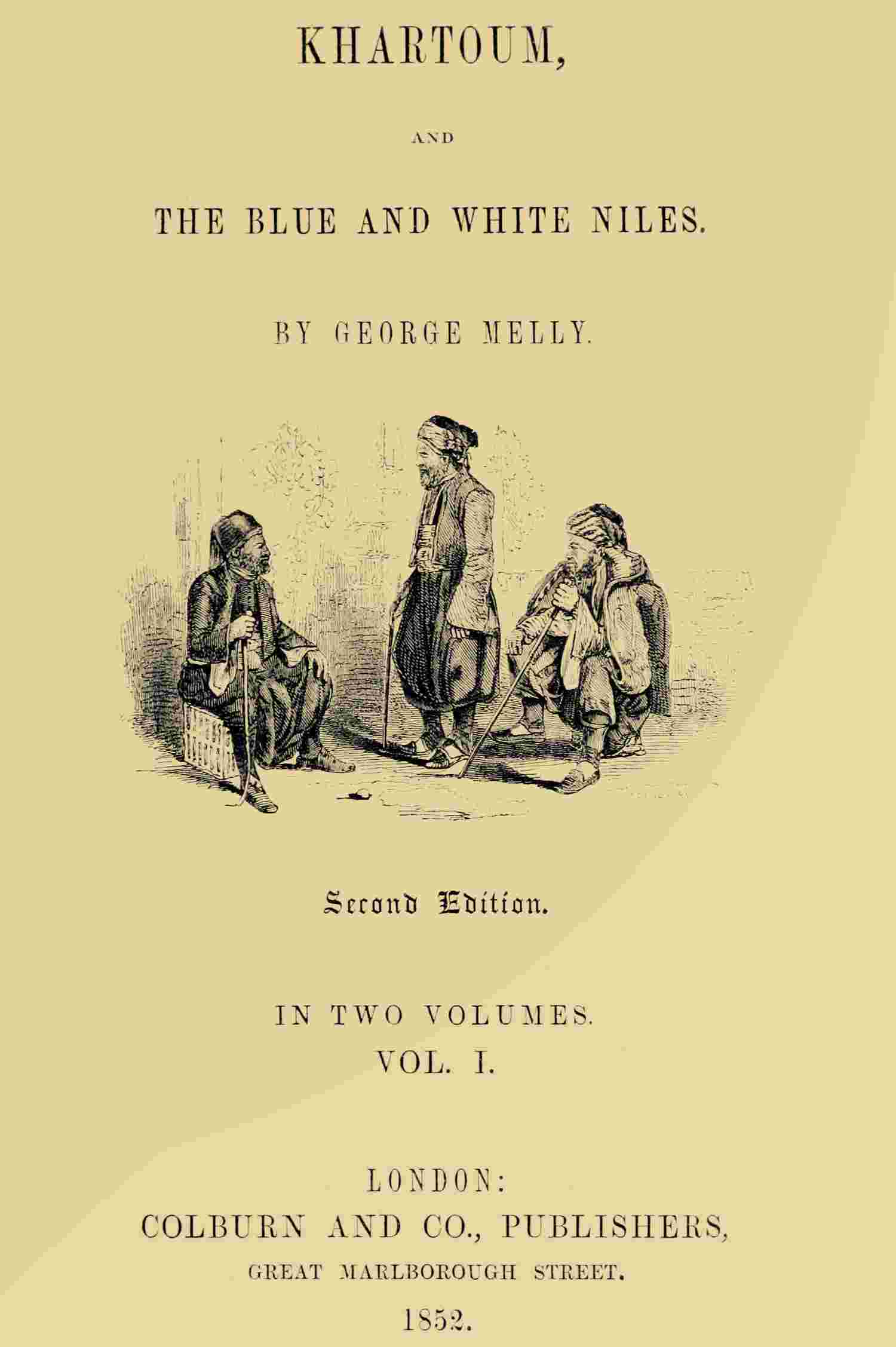
KHARTOUM,
AND
THE BLUE AND WHITE NILES.
VOL. I.
KHARTOUM,
AND
THE BLUE AND WHITE NILES.
BY GEORGE MELLY.
Second Edition.
IN TWO
VOLUMES.
VOL. I.
LONDON:
COLBURN AND CO., PUBLISHERS,
GREAT MARLBOROUGH STREET.
1852.
LONDON:
Printed by Schulze and Co., 13, Poland
Street.
LIST OF ILLUSTRATIONS.
| VOL. I. | |
| KHARTOUM AND THE NILES | Frontispiece. |
| DRAGOMEN | Vignette. |
| MAP OF NUBIA | To face page 237 |
| VOL. II. | |
| IPSAMBOUL | Frontispiece. |
| THE AUTHOR | Vignette. |
PREFACE.
The Work now presented to the public, is nothing more than a transcript from a Journal kept by the Author during a tour in Egypt and Nubia, (undertaken in company with other members of his family) only a few months ago. The peculiarity of the relations of Egypt and the Porte at the present moment, affords the Author the best excuse he can put forward for appearing in print, and he hopes that observations so recently made over a very interesting portion of the dominions of the Pasha of Egypt, by a perfectly disinterested spectator, may be though not unworthy the attention of the reader.
It is only here necessary to add, that we succeeded in penetrating Nubia as far as Khartoum, the place of junction of the Blue and White Niles, where few travellers had preceded us, and to which town no ladies had ever penetrated before.
LONDON,
OCTOBER 5, 1851.
CONTENTS
OF
THE FIRST
VOLUME.
| CHAPTER I. | |
| The Adriatic — Alexandria — The Grand Square — Pompey’s Pillar — English invaders — Egyptian Cemetery — Cleopatra’s Needles — Stroll through the streets — The Great Canal — The first pipe | 1 |
| CHAPTER II. | |
| Up the Canal — Arab boats — Shoal of swimmers — Beautiful mirage — Egyptian tillage — Atfeh — The lock — The Nile | 19 |
| CHAPTER III. | |
| Cairo — Description of the inhabitants — Treatment of women — Adventure of an Arab boy — Encounter with a native lady — Courtship and marriage in the East — Taking home the bride | 36 |
| CHAPTER IV. | |
| The water-carriers of Cairo — An Egyptian bath — The bazaars — Turkish gallantry — Shopping in the East — The slave market — The Court of the Cadis — Turkish justice | 51 |
| CHAPTER V. | |
| The Citadel of Cairo — Mosque of Mehemet Ali — Moslem Carnival — The College of Dervishes — Curious religious ceremony — Presentation to the Viceroy — The Nepaulese Ambassador — Visit of the ladies to Ibrahim Pasha’s hareem | 70 |
| CHAPTER VI. | |
| Disgrace and flight of Artim Bey — Visit to Achmed Bey — Palace of an Egyptian noble — Arabian horses — Tombs of the Caliphs — The gardens of Shoobra — The imprisoned lady — Grotto of the Virgin Mary — Heliopolis — Boulac — Ishmael Bey — The boats | 87 |
| CHAPTER VII. | |
| Departure from Cairo — Ascending the Nile — Invasion of rats — Our dragoman and retinue — The Pyramids — Nile etiquette — An evening on shore — The Tombs of Beni Hassan — The first crocodile — Shock of an earthquake | 106 |
| CHAPTER VIII. | |
| Ossioot — The city gate — The mountain of tombs — Visit to Ismail Pasha — Encounter with a Latin monk — Ekekian Bey — Story of a cat — Arrival at Keneh — Visit to Hassan Said — The dancing girls — Departure from Keneh | 127 |
| CHAPTER IX. | |
| The Plain of Thebes | 151 |
| CHAPTER X. | |
| Karnac and Luxor | 165 |
| CHAPTER XI. | |
| Esneh — Dancing girls — Mehemet Ali — Summary justice — The mountain of the Chain — Angling in the Nile — A battle with the natives | 183 |
| CHAPTER XII. | |
| Assouan — The treaty with the Reis — The quarries — The Persian invasion — Caravan of slaves — Hunting for jackalls — Daireh’s love story | 177 |
| CHAPTER XIII. | |
| Philæ | 208 |
| CHAPTER XIV. | |
| The first Cataract of the Nile | 227 |
| CHAPTER XV. | |
| Korosko — Shooting excursion — Crocodiles — Ipsamboul — Colossal statue | 231 |
| CHAPTER XVI. | |
| Retrospect | 255 |
| CHAPTER XVII. | |
| Itinerary for the Desert | 282 |
| Appendix | 285 |
KHARTOUM,
AND
THE BLUE AND WHITE NILES.
CHAPTER I.
The Adriatic — Alexandria — The Grand Square — Pompey’s Pillar — English invaders — Egyptian Cemetery — Cleopatra’s Needles — Stroll through the streets — The Great Canal — The first pipe.
After a pleasant journey through Lombardy, and a very agreeable stay at the city of gondolas and palaces, we arrived at Trieste on the 25th of September, 1850, on our way to Egypt. Our party consisted of my father and mother, my brother and sister, and myself. We had all travelled much, and were thus pretty well accustomed to the small annoyances, which those who leave comfortable homes in England to visit other lands, must expect to encounter. But it should be borne in mind that two of our number were ladies, which may show that the journey we contemplated was neither too fatiguing nor too difficult; many may therefore follow in our steps, and enjoy, as we did, a tour full of new and interesting scenes.
We hoped, before returning, to be able to penetrate far into the depths of Nubia; departing from the beaten track of Nile travellers, to reach the 14th degree of north latitude, and add our names to those of the few English who have gazed on the junction of the White and Blue Niles. Some of us might have had wild wishes relative to the undiscovered source of that mighty river: while others might have looked with some degree of apprehension to the task of making a road where none existed, and traversing a country hitherto explored only by men. We all agreed, however, to go as far as it appeared safe and easy; meanwhile to bind ourselves to nothing, but to be ruled entirely by circumstances; which, in fact, are the real guide-books of travellers—more especially in an unknown country.
The morning of the 27th of September, far as the year had advanced, was a most charming one; for summer, like other visiters, lingers long on the beautiful shores of the Mediterranean—never leaving the southern, and but for a few brief months the northern coast of that blue lake.
In the middle of the harbour of Trieste, gay with Austrian frigates, and Neapolitan corvettes, lay the ‘Europa,’ a large steamer, which was to start for Alexandria at half-past eight. Before that hour we were all on board; soon afterwards we bade adieu to Europe, and doubling the Pirano point, stood down the Adriatic, skirting its rocky shores that were backed by the distant blue hills of Illyria. Up to this moment we had scarcely been able to look round us, so crowded were the decks with shore-people, bidding adieu to Indian passengers, and Alexandria merchants; but when delivered from these intruders, we found ourselves in a large and commodious vessel, about the size of the boats plying between Liverpool and Glasgow. Some thirty persons were walking the deck, a few smoking cigars, and others lighting long chibouques, as if, on weighing anchor to quit Europe, we were already in the East. We might have thought that this was indeed the case; for the thick awning could not protect us from the intense heat of the sun; and the Gulf of Venice, unruffled by a single wave, looked more like a mirror than a sea.
As soon as we were well off, I observed a young Englishman, in a spirit characteristic of our country, attack the captain about the passage—as to whether it was likely to be rough or pleasant, with many similar unanswerable questions as though the weather could be insured for the next five days in the most changeable of waters. The captain—and when does that authority not pretend to know the future movements of the winds and waves?—averred that it would be a dead calm to Corfu, and thence a “nasty bit.” That the dead calm might to a landsman be a stiff breeze, I well knew; but the prospect of the “nasty bit” was really serious, and remained a bug-bear to all concerned till the end of the voyage. Like many such things, however, it proved more imaginary than real; and we arrived at Alexandria after a beautiful passage of five days, no one on board having any cause for disagreeable impressions.
Alexandria is flat, as is indeed all Egypt, up to the mountains which form the Valley of the Nile. We were nearly at the end of our voyage before we discerned any trace of the famous shores of Egypt; and then we saw only the summit of Pompey’s Pillar, rising up, like some witness from the past, to notify their antiquity and fame. Almost at the same moment, we distinguished the masts of the Pasha’s fleet, and about half an hour afterwards we could see the sand hills of Alexandria. At length, we reached the port, entering through a channel between two rocks, not two hundred yards apart, which constitute the natural defence of one of the strongest harbours in the Mediterranean.
The instant we dropped anchor, the steamer was surrounded by boats, some bringing off friends, and others sanitary officers; while many twenty-four or thirty oared boats, full of sailors of the Pasha’s fleet, dressed in white, kept continually passing and repassing, spite of the burning sun, with all the animation of a regatta. In a few moments our deck was covered. We had several ladies on board, who had come to rejoin their husbands: they had deserted them and fled to Trieste on the approach of the cholera—notwithstanding their conjugal vow as to sickness and health. Their neglected spouses had hastened to receive them, and were much affected at the reunion, sobbing like so many children. Whether this, however, was in token of gladness, or in lamentation for the loss of the liberty enjoyed during their bereavement, it were hard to say. I observed that the gentlemen kissed one another, and was surprised to find, on inquiry, that no relationship existed between them, but that they were merely acquaintances. The ladies, though it is their peculiar privilege in our own happy land, were not complimented with these marks of affection; so completely is the order of things reversed in this country!
Accompanied by a friend, who had kindly taken rooms for us at the principal hotel, we made our way to the shore, where a carriage and some donkeys, the animals most in fashion here, were pressed into service, and we proceeded towards the great square, the chosen quarter of the Franks. In the afternoon Mr.—— acted as our cicerone to the lions of Alexandria.
This, the first Eastern town to Europeans, and last of their country to the Arabs—is of considerable extent. The houses are all flat-roofed, and being chiefly white, look peculiarly glaring under the burning sun of Egypt. The principal European square is a very gay place; and there the traveller may take a last look at the mantillas, polkas, silks, crapes, large-pattern trowsers, and black hats, which adorn the English and French visitors and merchants, as they walk up and down on the shaded side, parading themselves in the latest imported fashions. Each Consul has his national flag flying from a high flagstaff, surrounded by a circular staircase, from the top of which he can command a view of the flat-roofed houses; the harbour sparkling with the flags of all nations, and the beautiful blue sea beyond. English people, averse as they are to public scrutiny, would, if exposed to it, consider these points of view extremely disagreeable, they afford the means of discovering all that is going on in neighbouring houses which they overlook.
In our way round the town we were obliged to resort once more to the donkeys, and, to say the truth, they made no bad steeds. They are a different race from those of England. The Egyptian donkey is always pulling away at his bit, and is anxious to be off as fast as possible. He never lies down, goes well, and scarcely ever seems spent. Instead of a saddle, his equipment is a cushion of carpets, strapped over his sleek and well-kept hide affording a comfortable seat.
The first of the Alexandrian antiquities that we visited was Pompey’s Pillar, which, though it bears the name of the renowned General, was raised by Diocletian. We could not but approach it with feelings of veneration, as a tribute paid in a remote age to genuine heroism, and majestic misfortune; but were disappointed to find that it was simply a column of red granite, of great height, placed on the top of a hill. We here, for the first time, noticed the disgraceful practice which has grown up among travellers in the East, of defacing the temples and other monuments of antiquity, by printing, smoking and carving their names on stones which, apart from historical associations, Time has rendered venerable. Pompey’s pillar has not escaped this irruption of the Huns and Vandals; it is emblazoned in letters, two or three feet in length, with the names of its barbarian invaders. I am sorry to add, that they are British, as were most of those which we met with subsequently. After expressing our disgust at the bad taste of such people, and their effrontery in so parading it, we left the spot, wondering how so noble a monument could have been subjected to such an outrage.
The hill on which this pillar stands, overlooks the burial-ground of Alexandria, which, like all cemeteries in the East, is outside the town. We learnt, on inquiry, that it is the custom to inter only one body in every grave; and we were much struck with the curious appearance the cemetery presented, each grave being marked by a little dome of plaster, instead of a tombstone; being thus covered over as a protection from the attacks of the numerous dogs that here prowl about at night. They are also often surmounted by an aloe, the emblem of Eternity.
We rode homeward by Cleopatra’s Needles,—two fine obelisks of red granite; one of them now lies prostrate, but the other, seventy feet in height, may yet stand for ages. The fallen column is the property of the English government, to whom it was presented by the Pasha; but a disgraceful parsimony has hitherto prevented its removal.[1] Though erected in honour of Ramesis III., an early King of Egypt, it is the name of the wondrous Queen, that serpent of old Nile, that lends interest to the spot, and we lingered to recal her strange, eventful history, not without a feeling of sadness at the change which, since that epoch, has come over her once mighty realm.
The streets of Alexandria are made of mud, battened down, which renders them very dusty; and it is difficult, as there are no pavements, and many people in the streets, to move along rapidly. Indeed, the crowds in the Eastern towns excite great surprise in travellers; and it was not till I went into the houses of some of the inhabitants, that I was able to account for them. In England there are always, except in the leading thoroughfares, more persons in the houses than out of them; but in Egypt, during the afternoon especially, the entire population is from home, except a few women employed in domestic duties. The children are playing in the streets; the industrious are buying and selling in the bazaars; and the idle, if poor, are lolling against the street walls, or, if rich, smoking pipes and drinking coffee in the coffee-shops. Here and there a carriage, full of gaily-dressed Frank ladies, preceded by an out-runner, dashes by, in the avenue cleared for it by the Nubian’s thick-lashed whip. Here a troop of soldiers, dressed in white, march past, to the beat of a drum, which sounds as if it were broken; and with the accompaniment of a fife, like a penny whistle, played grievously out of tune; while in another quarter janissaries, in their hideous costume, and armed with cracked pistols, hustle the people out of their way, as they walk up and down. Every place is full of people, all trying who can do the least, and kill time in the easiest manner; though occasionally, at rare intervals, some young English clerk may be seen bustling along, with his head full of business, quite indifferent to the scene around. He is a new-comer, animated by our national activity, and it will take some months to make him walk, and smoke, and loiter like one thoroughly acclimated.
In the way back to our quarters, we passed the Mahmoudieh Canal, which connects Alexandria with the Nile. This is one of the vast works of Mehemet Ali, and the one, perhaps, in which he most signally displayed his indifference to human suffering, and recklessness of human life. It is said that 30,000 men were carried off by hunger and disease in the prosecution of this gigantic undertaking—a fact which almost makes one forget its great utility.
Here we saw many boats, but though they appeared sufficiently commodious, they were generally very large, and we determined to wait till we reached Cairo to select there the kind which we required, to ascend the first cataract.
The thermometer being at 103°, the heat was very oppressive; we were therefore anxious to get away as soon as possible, leaving the remainder of the Alexandrian lions till our return. Accordingly, we made interest with the Overland Transit Administration, who kindly entered into an arrangement for providing a steamer to convey us up to Cairo.
Before we started, I was initiated into the art of smoking. We went to call on a merchant, who received us in a room furnished all round with divans—low sofas piled with cushions; and on our entrance, three servants at once presented us with our first pipe of Latakia. I found it more agreeable than I had expected, though—perhaps on the principle that practice makes perfect—not so pleasant as many I smoked subsequently. After this, little coffee-cups, holding about two spoonsfull, came on. The cups were mounted in silver filagree; the coffee made thick, and was extremely fragrant. I have never tasted any equal to what is made in Egypt, though I am convinced it might be had, if we took as much trouble to prepare it. The Orientals only roast the coffee when it is actually wanted, and then put it, ground rather coarse, in boiling-water in a little pot, containing just the quantity wanted. The moment it rises, it is ready, and must be instantly drunk.
The custom of smoking, and coffee-drinking, is universal here, even amongst the poorest Arabs, and you often see a peasant, arrayed in rags, smoking out of a chibouque, the mouth-piece of which is worth at least two or three pounds. It is often an hereditary pipe, handed down as an heir-loom.
CHAPTER II.
Up the Canal — Arab boats — Shoal of swimmers — Beautiful mirage — Egyptian tillage — Atfeh — The lock — The Nile.
The wind was blowing strongly from the south on the day we left Alexandria. Thus we were at once to be exposed to all the hardships of Eastern travelling, beginning the day with the sirocco, followed by the worst night we ever had in Egypt. At an early hour we quitted our hotel, and leaving our baggage to come on in an omnibus, proceeded in cars past Pompey’s Pillar to the canal, where we discovered the small steamer which was to convey us to Cairo. We at once proceeded on board, and found more than a dozen other passengers assembled, including several Jewesses, and the Indian officers and their ladies who had accompanied us from Trieste. A few minutes afterwards we heard with surprise, and with some degree of pleasure, the familiar direction to “go a-head.” Soon our ears caught the corresponding cries of “stop her,” “ease her,” we therefore made no doubt that the engineer was an Englishman; but, on inquiry, he proved to be a black slave, whose whole stock of English was summed up in these words. An Arab, anything but prepossessing in appearance, was stationed in the prow, and kept up an interchange of abuse, fortunately in his native tongue, with all the trading boats, which seemed to make it their aim to offer us every interruption; and certainly it was not their fault that they were unsuccessful.
We saw some pretty villas, though, for the most part, the passage on the canal was in the highest degree monotonous. Its tedium was relieved, however, from time to time by our watching the troops of children, of all ages, who sprang into the water as our boat approached, and followed us for some distance, gamboling alongside like a swarm of porpoises. Indeed, water seems almost the natural element of the Egyptian; and it was most amusing, when the wind fell, to see the crews of sailing vessels jump into the stream, headed by a man with a rope in his mouth, and swim ashore, where they towed away till, turning some sweep, the white lateen sail again caught the breeze, when they all returned on board. They swim well, but not in the European manner, for they use only one hand at a time, which, though more expeditious, is much more fatiguing.
When about ten miles from Alexandria, we came on a rare, and, to strangers, most novel spectacle. It was the Egyptian mirage; and the illusion was so perfect, that for some time, I could not be persuaded that what I saw with such distinctness was not real. The vast plain of sand, stretching far into the distance, assumed the appearance of a boundless lake, smooth and serene as glass; the trees bordering the Desert, became capes and headlands, washed by the tranquil waters, and the white towers of the Suez telegraph, far in the background, were transformed into a fleet of ships. The scene held us spell-bound, and it was with a strong feeling of disappointment that we saw it vanish.
I have already mentioned that a sirocco was blowing; and though we had a thick awning overhead, the heat was intense, rendering the steamer a floating furnace. At last, we were fairly driven from the deck, and took refuge in a small, close cabin, where, with every contrivance our ingenuity could suggest, we were unable to obtain a breath of air. In this situation, it was a relief to learn that we were approaching Atfeh, the point at which we should quit the canal, and be launched on the waters of the Nile.
Atfeh is a large village, composed of miserable mud huts, about six feet high, surrounded by pigeon-houses; for everybody seems to keep pigeons. We landed for a short time, and walked through the place, which we found inhabited by the lower class of Arabs, and dreadfully infested by dogs. What particularly struck us, was the ugliness, if I may be allowed so harsh a word, of the Arab women; yet we found, as we proceeded further, that it could be even more striking—in the lowest depth, a lower still. The children suggested the idea of a plague of locusts, they were so numerous; and, as if clothing was considered a superfluity in such a climate, were all perfectly naked. And here I may remark, that in the villages we visited, we found the inhabitants were all either very young, or elderly; there were no persons of middle age; and it can scarcely be conceived what a strange hiatus the absence of this link created.
Returning on board, our steamer entered the lock, and as the water poured in, gradually rose to the required level, when the flood-gates were opened, and we floated on the Nile.
This was only an arm of the river, here scarcely broader than the Thames at Putney, and muddier than ever was Thames at Blackfriars. Yet how can I describe the feelings it awoke in us? or how eager and earnest was our first glance at its waters?
From the earliest antiquity, the Nile has been everything to Egypt, and, though no longer held in such high veneration, it is still her nurse and mother. But for the Nile, her soil would be barren; her rich valleys, a desert; her interior inaccessible. It is the Nile that fertilizes her fields and pastures; the Nile that opens a highway to her remotest villages.
It was, no doubt, for these reasons, that their great river was associated by the ancient Egyptians with everything they held sacred. On its waters they performed their solemn pilgrimages; celebrated their festivals and triumphs; and when life was extinct, the bodies of the dead were ferried over to their final resting-place. No wonder that they regarded it with superstitious reverence—that they loved it as a benefactor and worshipped it as a god.
Of course, till this moment, we held as an article of faith that the Nile annually overflowed its banks, and inundated the whole country; we found, however, that this was a vulgar error, as the river was now at its highest elevation, yet remained within bounds. Indeed, the natural level of the country is almost everywhere nearly two feet above the reach of the water, and where this is not the case, artificial banks have been raised, which effectually confine the river, while sluices supply the means of irrigation. We saw this attained by other means as we proceeded,—the water being drawn up in earthenware jars, secured round large wheels, turned by oxen or camels; and each jar, as it came up full, was emptied into a large trough, which poured its contents in moderate quantities over a portion of soil. This machine is called a sakiea. Another plan is to place a pole between two mud pillars, with a weight at one end, and a goat-skin bucket attached by a rope to the other. A man pulls the rope down till the bucket is filled with water, when the weight brings it up again, and he overturns it into little dykes, which, emptying themselves into sluices, are gradually discharged on the land. Four men are required day and night to work one of these shadoofs, and two or three are generally seen asleep, or smoking, while another is hard at work. There is a similar contrivance every forty or fifty yards, and thus the country is profusely watered.
We had gone but a short distance, when we came in view of a most charming scene, and in the midst rose the little village of Foua, composed of only a few mud huts, which, however, in this spot looked exceedingly picturesque. A beautiful Egyptian sunset shed its glories around, gleaming like gold on the tall palm trees, while the minarets of the mosque, white as snow, stood strongly out on the dark blue sky. Flocks of pigeons careered to and fro overhead, or alighted on the glaring pigeon-house; and before us flowed the Nile, in her calmest mood, giving a look of completeness and repose to the picture. It came opportunely to compensate us for our hitherto monotonous passage, and our eyes were unwilling to withdraw from it, for we now began to find that the sketches of Roberts were not altogether imaginative, and that we could recognise some of the places pourtrayed by his pencil.
This little oasis was succeeded by a flat, uninteresting country, overgrown with reeds, and by extensive marshes, which abounded with various species of birds; I noticed, among others, plovers, pigeons, gray crows, variegated king-fishers, and huge hawks. Soon afterwards we discovered two beautiful gazelles, which stood looking at our little vessel for a moment, as if lost in amazement, and then flew with the swiftness of light across the plain. Nothing could exceed the grace and nimbleness of their movements, and we watched their progress with the greatest interest. They are, I learnt, seldom found so low down the river, though met with in great numbers up the country.
We were much amused by seeing a herd of buffaloes swimming for one of the numerous islands. They were in charge of several men, who sat on the hindmost of the drove, controlling the movements of the rest. It was, however, no easy task to keep them in order, and the men had frequently to jump from one buffalo to another, at the imminent risk of a ducking, to reach some unruly beast which would not be restrained by moral influence. I was surprised to see that these animals swam almost entirely under water, only their heads being visible; yet they are always drawn with the whole back above the surface. Such are the tricks of artists!
It was now time to think of how we were to pass the night, and, with our limited accommodations, this became a very grave question. The Jewesses had taken possession of the ladies’ cabin, and with their inherent predilection for garlic, and other national peculiarities, possession on their part was tantamount to an exclusion of the English ladies. After a consultation, however, it was determined to dispatch an embassy to the fair Hebrews, to see if it were possible to effect some arrangement as to windows, so as to secure a circulation of air; but, of course, the mission proved abortive. We were now in a dilemma, and it required all our ingenuity and gallantry to suggest a means of relief. At length, it was resolved that the Jewesses should be left undisturbed, and that the whole of the representatives of Christendom, numbering some twenty persons, should pack in the gentlemen’s cabin—a little close place, which gave an admirable idea of the black-hole of Calcutta.
Now Greek met Greek, and English good-humour and good-nature came out in the most favourable colours. Here lay a captain of the Indian army, a most agreeable fellow; but, in our restricted space, about a foot too long, being of the unconscionable stature of six feet two. His head rested on a sofa, and his feet on the table, in a very comfortable-looking slant. In another corner, a Scotch lieutenant arranged some cushions for his bride, whose wedding trip was by the Overland Mail; and good care he seemed to take of her, though he took much more of himself. My party disposed themselves as they best could. For my own part, I made a good pillow of a carpet-bag, and went off to sleep with as little delay as possible.
Morning found us very early on deck, in a tolerably dirty condition, from the steam and soot which had poured through the open windows, and with very narrow resources for amending the same. Indeed, a resolution seemed to have been tacitly adopted, that henceforth every one was to eschew razors, and moustachios and beards were to be allowed to develop themselves in the wildest luxuriance.
On looking round, we found the country much improved, and could well imagine it a land of perpetual plenty. The richly-cultivated plain, scarcely two feet above the level of the river, was a perfect garden of wheat, sugar-canes, beans, and lentils. Hundreds of men were baling water with shadoofs, which discharged themselves over the fields, while milk-white oxen, worthy successors of Pharaoh’s fat kine, walked round and round in little sheds, turning the creaking sakiea. It was indeed a scene such as only Egypt could furnish.
After breakfast, we came in sight of the Pyramids, which loomed out of the horizon like huge mountains. They were still an immense way off, and we were able to form some notion of their real height, when, though standing on a plain of sand, they assumed at a distance such gigantic proportions. From the moment they became visible, we could talk of nothing else; and every one looked with impatience for the time when he should stand at the foot of these Alps of art, and be able to inspect them closely. Even the Jewesses were in raptures,—perhaps they went back in their minds to that dark period when “the officers of the children of Israel, which Pharaoh’s taskmasters had set over them, were beaten, and demanded, wherefore have you not fulfilled your task in making brick as heretofore?”
Early in the afternoon, we reached Boulac, the Wapping of Cairo, having accomplished the passage from Alexandria in about thirty hours. We landed amidst the greatest hubbub imaginable—as if all the population had turned out to receive us. With some difficulty we made our way through the crowd,—which had assembled to witness the arrival of the boat, and conducted our ladies to a perfect London omnibus that we found standing in readiness. We then saw our luggage hoisted on camels, which bore our enormous packages, some weighing a thousand pounds, with the greatest ease; but we were afterwards less astonished at this, when we beheld a porter walk nimbly up a flight of stairs with a box weighing three hundred weight, supported solely on his back, by a cord round his forehead.
All being ready, we joined the ladies in the omnibus, which was dragged off by four miserable Arab horses; and we soon found ourselves in comfortable quarters at the Hôtel de l’Europe.
CHAPTER III.
Cairo — Description of the inhabitants — Treatment of women — Adventure of an Arab boy — Encounter with a native lady — Courtship and marriage in the East — Taking home the bride.
Alexandria had enabled us to form a conception of what we should see at Cairo; but, in some respects, we found Cairo essentially different. What first struck me, was the variety of race and caste distinctly marked in the inhabitants, and the consequent diversity of costume, producing an effect highly picturesque. Three-fourths of the population are Arabs, and these are divided into two classes—rich and poor, or traders and working-men. The latter are fine, well-made fellows, and being generally about six feet high, with noble foreheads, and dark eyes, would present an imposing appearance, were it not marred by a bad expression of countenance. They have been denounced as excessively dirty, but I must confess, that, on a pretty close view, I saw nothing to create such an impression. Nor did I observe among them so many cases of blindness and ophthalmia as I had been led to expect—though these diseases certainly are more prevalent here than in Europe. In other points, however, I found the labouring class in a much better position—healthier and better fed, than the poor in our large towns; and I have seen more squalor and wretchedness in the back streets of Liverpool than among the very dregs of the people of Egypt.
The dress of the poorer sort of Arabs is generally a blouse of brown cloth, or blue calico, sometimes it consists solely of a piece of cloth thrown with something of a classic grace over the whole person; and a tarboosh, or Greek cap, which, wrapped round with a roll of white calico—a fashion much discouraged by the Pasha, as injurious to health—becomes a turban. Their wives wear a long robe, also of blue calico, a square of the same material thrown over the head; and a strip of white or black cotton, secured across the nose by a brass clasp, covering the whole face, except the eyes—the only attraction they have to display. None but the very poorest and—since the dreadful truth must be told!—the very plainest, have their faces uncovered in the streets; hence it is fair to presume that these are the ugliest of their sex. Indeed, though it may seem inexcusable to speak of the Arab women with so little gallantry, I believe that they might all show their faces without exciting the least sensation. Their complexions are very bad; and, when married, they are tattooed over the chin, and their eyes, though fine, are insufficient to light up features utterly vacant. They seem to be regarded with consideration by their husbands, and are treated with great politeness by the Arab donkey-boys, and others of the male sex, with whom they come in contact in the streets.
The next class are the shop-keepers and native merchants, who dress much better, wearing wide Turkish trousers, of white cotton or cloth, richly braided; a jacket of the same colour, covered with braid; satin waistcoat, and red pointed shoes. Their favourite colours are black, blue, and chocolate, though many adopt a mixture of all. In this class, besides the richer Arabs, must be included Greeks, Armenians, Copts, and Jews. The Jews are marked by a slight difference in their costume, having the trousers much longer, and wearing heavy turbans, made of muslin and gold thread. Some of their dresses are very handsome, and all are exceedingly expensive—the price of a common suit of cloth, including gaiters, which, in wet or dirty weather, entirely cover the stockings, being about eight pounds. Of course, it is easy to increase this to thirty or fifty pounds, and even the last-named sum does not include the magnificent turban and belt, and richly-ornamented sword. In this superb attire, the rich citizen presents himself in public, riding a donkey—a steed which may be thought very ill-adapted to such an equipment, though here it does not present the sorry appearance that might be supposed.
The wives of these bourgeois are costly articles, and their apparel often amounts to a little fortune. A large, very full dress, slightly fastened at the waist, and commonly made of shot silk, ranging over such bright tints as red, yellow, orange, blue, and lilac, falls over wide silk trousers, fitting on yellow boots, like demi-Wellingtons, which are thrust into thick-soled clogs of the same colour. Over all this, from head to heel, comes a sort of capacious cloak, of black silk; and a rich lace veil completely covers the face and neck. Such a heap of clothes naturally forms itself into a bundle; and it is no exaggeration to say that one of these ladies, when in proper walking costume, takes the street to herself, filling up the passage from wall to wall.
The highest class of native inhabitants embraces the Beys and Pashas, or nobility. These personages dress something in the European manner, with frock coats buttoned up the front, decorated with a star or crescent of diamonds, which, by their degrees of splendour, denote the rank or office of the wearer. Their wives are never seen in public, and a glimpse of them can only be caught by great alertness, when they are taken out, with an ostentatious cracking of whips, in a large close carriage, emblazoned with gold or silver, and so jealously guarded and curtained that even the air can scarcely reach them.
The vehicle is drawn by four horses, driven at full speed, and preceded by a Nubian outrunner, whose long whip secures it a clear passage. The adroit observer may then distinguish, through the half-screened windows, certain piles of silk and muslin, and a few pairs of eyes; this is all that appears of the lights of the harem.
The Nubian outrunners exercise their vocation in a very merciless way; however, with equal surprise and pleasure, I saw one thwarted in his vindictive purposes, in a manner that I cannot but record. An Arab boy, with the mischievous propensities of his age, had scrambled up behind the carriage of Ali Bey, a son of Ibrahim Pasha’s, when proceeding through one of the streets of Cairo; but being perceived by the Nubian, sprang down again, and made off. This, however, did not satisfy the outrunner, who instantly dashed after him, his face distorted with rage, leaving no doubt that he intended to inflict a most severe chastisement. The poor little urchin ran for his life; at least one blow of the Nubian’s whip, wielded by such a muscular arm, must certainly have crippled him. So desperate were his efforts to escape, now darting up the street, and then wheeling round and round, that the chase became quite exciting, causing every one to stop and look on, though only one dared to interpose. Just as the boy was sinking from exhaustion, a Turkish lady drew him towards her, and threw her robe over him. Oriental chivalry forbade the Nubian to advance; after a few moments’ hesitation, he turned sullenly away, and the boy was set at liberty. Thus, the ministering gentleness of woman everywhere makes itself apparent, and her influence is felt and acknowledged.
Egyptian ladies of rank, as I have already remarked, are seldom seen in the street; but soon after the adventure here described, it was my good fortune to encounter another. I was alone in a narrow street, on my way to the Consulate, when I saw a heap of female attire coming towards me, taking up, as usual, the whole passage. My dismay may be conceived, as I looked around in vain for some recess, where I might instal my poor proportions till the pile had passed by. I was on the verge of despair, when the lady, possibly in endeavouring to squeeze herself into a smaller space, put her foot on her veil, which instantly brought it down, disclosing a face of the most perfect beauty, a brilliant complexion, and dazzling eyes, at this moment lit up by a smile. As she picked up her veil, I caught a glimpse, through her half-open domino, of a red silk dress, tied with a blue sash, white satin trowsers, and red boots. She was evidently of high rank, and if so, could only have got out alone in some clandestine manner.
The cruel seclusion in which the sex are kept by the Turks and Egyptians, commences with infancy, and is preserved till death. This makes an Eastern courtship and marriage as matter-of-fact an affair as can well be imagined. As women are never seen by any of the opposite sex but their husbands—not even by their cousins or brothers, except in the streets, when it would be a gross breach of decorum to address them—a gentleman who wishes for a spouse, having no opportunity of choosing for himself, is obliged to communicate the circumstance to his mother, and this worthy matron, who in all probability has previously well considered the subject, soon indicates one whom she considers suitable. The candidate for matrimony then requires a list of the lady’s good qualities and attractions, which, of course, are in every case of the most unexceptionable kind; and when he has made up his mind, he waits on the lady’s father, and makes his proposals. These are to pay down a certain sum, varying from £1000 to £20,000, not as a settlement on the wife, but as compensation to the father, wives being always purchased here. A part, however, of this money is laid by as a provision for the wife, in case of her being divorced; and, as the husband would then have to refund this, it serves to strengthen the bonds of matrimony in a surprising manner. All being arranged, the father, suitor, and friends repair—without the lady—to a mosque, where they celebrate the marriage, which is little more than a simple question and answer. The question is put to the father by the bridegroom, who asks, “Will you give me your daughter to be my slave?” The reply is equally to the point, “My daughter is your slave.”
Some days now elapse, when the bridegroom, accompanied by his friends, proceeds to the house of his father-in-law, and brings away the bride, who is placed, completely veiled, in a palanquin, which is covered by a canopy, borne by the bridesmaids, who are under the direction of the bridegroom’s mother. The palanquin is preceded by a grand procession, composed of the bridegroom and his friends, a company of soldiers, and two or three camels, carrying young children; and the whole are marshalled forward by a band of music. In this way they traverse the town, and at length reach the bridegroom’s residence, where the bride is conducted by him, with great ceremony, to the apartments prepared for her. He then offers her some magnificent presents, which she receives in silence; and his mother and the other matrons, who are standing round, politely recommend him to go and pray. On his return from the mosque, he repairs to the apartment where he left his bride, and finds her alone.
He has not seen her face, or heard her speak, and a thousand anticipations of her beauty flash across his mind. What if these should disappointed? if her charms should be only imaginary, and her loveliness an invention of his mother’s? With eager steps he approaches her, and throwing off her veil, for the first time beholds his bride!
As I was not present at this interesting moment, it cannot be expected that I should be able to state what the gentleman said. As a conscientious traveller, I feel myself obliged to have recourse to that extremely original phrase—the scene may be more easily imagined than described.
CHAPTER IV.
The water-carriers of Cairo — An Egyptian bath — The bazaars — Turkish gallantry — Shopping in the East — The slave market — The Court of the Cadis — Turkish justice.
The water-carriers of Cairo, who rejoice in the not very flattering appellation of beasties, form a large section of the population, there being one attached to every house. An abundance of water, everywhere so desirable, is here an absolute necessary, and, at the same time, is made the means of the most luxuriant enjoyment. Who has not heard of the cool fountains of the East, and of the value which is set upon them by Oriental nations? Those of Cairo, with the ever-flowing Nile, furnish a lavish supply of the precious element, which is carried in the goat-skin buckets of the beasties to every house, and poured in floods into the baths.
The baths are a feature in Eastern life, with which every European is impatient to be acquainted, and I had been but a short time in Cairo, ere I made my way to one—not, I must confess, without some dread of the severe handling of the attendants for which I had been warned to prepare. On entering, I found myself in a large octagonal room, encircled by a raised divan, several feet wide, and covered with matting. Here I resigned myself to a valet, who, after fulfilling the duties of his office, conducted me into a narrow passage of white marble, having a stream of tepid water, about an inch deep, running through it, leading to a small room, where the water, now quite warm, covered my feet, and ran over a marble slab on which I sat, enveloping me in vapour. I was then taken along another marble passage, where the water was warmer, into a second room, where it was still hotter, and so, through another passage and another room, in which the temperature gradually increased, to a large marble chamber, where the water was very hot, forming a complete vapour bath. This prepared me for the Arcanum, a room about nine feet square, as hot as a furnace, where the water, at scalding heat, was continually running over the floor, which sloped downwards, and was very slippery. There I was rubbed with a horsehair glove, then plunged into a bath of the hissing water, about five feet deep, and, being dragged out, was well soaped and scrubbed, drenched with cold water, turned on my back, and treated in the most violent manner. This process was followed by a second immersion, when I was again pulled out, and shaved—a difficult operation in a dark room, filled with steam; but which was happily accomplished, and all traces of it effaced by a third and final plunge in the bath which completed the course.
I had yet to undergo the severe operation of shampooing, for which I was led back through the various passages, with the graduated scale of water-heat, to the octagonal room, where beds had been laid out, and every other preparation made. Reclining on one of the beds, I gave myself up to the Philistines, and was shampooed till I seemed almost at the last gasp, when, to my great relief, I learnt that all was over. Coffee and pipes were then brought, and, under their soothing influence, I began slowly but steadily to recover. Two shillings was the charge for this luxury, which was certainly most agreeable in its effects, but must be very enervating if used frequently.
The bazaars of Cairo constitute one of the attractions of the city. A rather wide street, to the left of the Hôtel de l’Europe, leads to the European bazaar, which is, in fact, nothing but a succession of small and miserable shops, where every English luxury is sold, and, considering the distance they have travelled, at not very exorbitant prices. This is succeeded by a new street, the haunt of usurers and money-changers, conspicuous among whom stand the sons of Judah; who may be seen, with not a few Arab millionnaires, sitting at their well-worn desks, with a large Milner’s safe open behind them, their features impressed with that peculiar look of cunning, and sharpness, which stamps the Shylock. Hence you immediately emerge on a more crowded thoroughfare, and here, at last, a Babel of contending voices, and a scene of bustle, baffling description, announce the native Arab bazaar.
The street, nowhere more than ten feet wide, is thronged in every part, and the purchasers bargaining at the shops, are unceremoniously jostled by donkeys, which are continually passing, laden with flour, sand, and water, giving the idea of a Lilliputian market, while every now and then they are pushed aside by a cart, drawn by a buffalo, and loaded with sumptuous furniture, plate, or china, which the Pasha is removing, under an escort of soldiers, from one palace to another. On one occasion I was much surprised at the indifference with which the guards saw a piece of gilding chipped off a magnificent looking-glass as the cart moved clumsily by, crashing against a massive archway.
The whole of the people are in the street, as the shops, which are more like little cages, can hold only the proprietor, who sits on a floor, four feet from the ground, from which he can put his hand on all his commodities, ranged in a small chamber behind. These consist chiefly of the produce and manufactures of the country, such as pipe mouth-pieces, and tobacco, corn, fruit, and every species of grain, Arab cotton fabrics, and abundance of hardware and shoes. A savoury odour calls your attention to a shop, where a quantity of little pieces of meat, pinned through by a wire, are roasting at innumerable charcoal fires. They are just a mouthful, and such a mouthful! the toughest beefsteak ever cooked being tender to these kabobs. Yet the people eat them, with the coarse bread bought at a neighbouring floor, with wonderful relish; washing all down with water, which they buy for the tenth of a penny of the water-carrier, who walks past calling out “moira! moira!” After this plain breakfast, they adjourn to the coffee-shop, and regale themselves with the never-forgotten pipe, and a cup of pure and fragrant Mocha, undefiled by chicory, and pleasant in taste as in smell.
As the stranger advances, a different scene meets his eye. He has escaped from the throng, and only two or three rich natives, mounted on gorgeously-housed donkeys, are in the street, or a few Turkish ladies, closely veiled, each attended by two of the watchful ogres of the hareem. The richly-carpeted shops are enclosed in front by a divan, and an old Turk or wealthy Arab sits in the midst, smoking a handsome silver or gold narghileh, and complacently looking round on his wares, which consist of Parisian jewellery, splendidly-mounted pipes, mouth-pieces of lemon-amber, worth almost their weight in gold, rich silks from China, muslins from India, swords from Damascus, and costly hilts from Constantinople. A chain runs across the street in some places, and it becomes necessary to dismount from the donkey and walk. Strangers attract little attention, and I walked about here alone without exciting any observation; but when accompanied by an English lady, she became the centre of all eyes, and I have no doubt the old Turks were much shocked at such a public exhibition of an unveiled lady, though I overheard them likening her to a beautiful full moon, and making other flattering remarks on her charms.
But though not stared at, the moment I accosted any of the merchants, they replied to me in the kindest manner, and I was invited to sit on the divan, and smoke the best pipe, whilst gold filigree coffee-cups were dispatched for the thickest coffee, which made its appearance in the most complimentary quantities. My hosts did not talk much, and were very laconic in their replies to my questions as to the state of the nation. They inquired after our ladies, but had I made any such inquiry of them, they would have deemed it an unpardonable liberty. They were, however, very communicative about their children, and, from what I could learn, they all had a beautiful daughter at home. I went sometimes with the dragoman, and sometimes alone, when, indeed, I was best received, though I could only converse by signs, and this amused them much. But I soon picked up a few words, particularly “taib,” good, which I told an old Turk was the only word wanted there, as all was “taib.” He immediately set to work unlocking case after case for my amusement, displaying, among other precious things, some very rare slippers, which I was afterwards assured were worn by ladies in bed. They were one mass of pearls, and cost about £40 a pair. I was shown handkerchiefs of the Parisian open work, in every stitch of which was a pearl, rendering the article entirely useless; and mouth-pieces of amber were produced, varying in price from £100 to £150, the value being thus raised by diamonds, mounted in the gold rings between the joints.
I was never tired of this old man, and I saw him very often. He always addressed me as the “Cavaghi,” a word which I had at first half suspected to mean “dog of a Christian,” but was subsequently persuaded, meant “Illustrious Stranger.” He never seemed to expect me to buy anything—which indeed I never did, being content to see this done by others. A lady, very richly dressed, came to him one day, and negotiated for a pair of pearl slippers. She began by talking of all sorts of things, and then offered about one third of the price named. The Turk turned to me, and a long smoke ensued, when he came down a fourth, and she came up, after another interval, to within about six pounds of his last offer, and then she went off with the slippers, having stood the best part of an hour. While the negociation was in progress, I offered her my seat; but she did not seem to have the least idea of what I meant, and stared at me with her beautiful but expressionless eyes, as if she thought me extremely restless.
Lower down are numerous streets, composing the Greek bazaar and the guild of the shoemakers’. In the former are the Manchester goods; the latter is a sort of museum of red and yellow leather shoes.
One of the first of the public places in Cairo that I visited, was the slave-market. It is a small square, the four sides of which form a sort of barrack, or lodging-house, for the accommodation of the female slaves. The males are exposed without, and I found here some eight or ten little boys, from six to twelve years old, lolling about as they pleased. They were a jet black, with very glossy faces, and thick hair, matted with grease. They had a stolid look, and seemed very drowsy, but appeared to be well-fed and contented. From them I turned to the female slaves, and was introduced to one who was a beauty in her way, though of the negro style, having large lips and a reduced nose, but remarkably fine eyes, which, however, a tinge of dark blue round the lids sadly disfigured. I put several questions to her, for the purpose of ascertaining how far she was reconciled to her condition, and was surprised to find, from her replies, that she did not consider captivity irksome, preferring Cairo to her own country, and having a sanguine expectation that she should obtain a good master. One of her hopes for the future was, that she would be able to procure a good supply of grease, to use in the adornment of her hair, which was dressed in little plaits, having a very peculiar look, but was not at all dirty. Her ambition being so humble, I could not refrain from gratifying it on the spot, and won the life-long gratitude of herself and three other young slaves, by giving them sufficient money to command the largest supply of grease they had ever possessed. The price of these girls, I was informed, was about thirty pounds each, but some younger ones were rated at forty pounds. The boys ranged from five pounds to ten pounds. One point in this melancholy exhibition I remarked with pleasure, not the less because it was unexpected; and that was, the good understanding that seemed to subsist between the slaves and their masters, and the care with which the poor creatures were treated.
Our next ramble was to the Court of the Cadis, which, from its notorious corruption, should be called the court of injustice. Here the scales of justice are turned, not by the merits of the cause, but by the weight of the bribe; and witnesses as well a judge must be purchased. The judgment-hall includes three distinct tribunals, each of which has its separate Cadi, and its own particular jurisdiction. The Cadis are all appointed by the Sultan, at Constantinople, and pay a high price for their offices, which invest them, in return, with the power of dispensing justice to the highest bidder, and of practising the most audacious acts of oppression.
The Court of the third Cadi, who tries the least important causes, was a large open gallery, having a divan at one end, on which the reverend functionary was seated, while a group of lawyers and scribes sat in a semicircle before him. In this space two miserable Arabs, who had had a quarrel, were arraigning each other with great acrimony, and witnesses were called on both sides, who flatly contradicted each other in every point—a common occurrence here, where a witness may be obtained to swear anything for twopence halfpenny. Such petty causes are usually decided in a summary manner, and the party who has the least money, not only loses his cause, but is severely bastinadoed into the bargain.
In a large room above, we saw the second Cadi, a fine old man, with a long white beard, which gave him a very venerable appearance. None but great civil causes are tried by this court, which consists only of the Cadi, and his clerk. We were passing on, when the Cadi invited us to stay, and on our complying, ordered us coffee. Being accompanied by an interpreter, we were able to converse with him, which we did for about twenty minutes, and found him a strange compound of good sense, shrewdness, and simplicity. He was very inquisitive about English jurisprudence, and would hardly believe that corporal punishment was not administered in our courts of justice, or that there was frequently a long interval between the commission and the expiation of an offence. In the East, a man commits a theft, and is tried, convicted, and punished within the half-hour.
Leaving this hospitable magistrate, we proceeded to another room, where we found the first Cadi, who is the supreme judge of the vice-royalty, and tries only very difficult causes. He was magnificently dressed, in red and gold, and was sitting alone, in great state, on a divan of rich silk, where he smoked his long pipe in perfect ease. He seems to have duties corresponding with our Lord Chancellor’s, is perfectly independent of the Pasha, and subject only to the Sultan, from whom he derives power, when the ends of justice require it, to summon the Pasha and all his officers into his court, and call them to account. But I have already intimated that no one well supplied with money need have any misgiving about this great functionary. I must record one curious instance of this. Mr. P——, the agent of a well-known house, had a bill on a native, which he wished to recover, but it was necessary, as a first step, to prove that the bill belonged to him, and, of course, it bore the name of the firm. The difficulty seemed insurmountable, but a native lawyer suggested a resource; and a shilling being invested in witnesses, it was proved in court that Mr. P—— was the son of the firm; on which the money was ordered to be paid.