
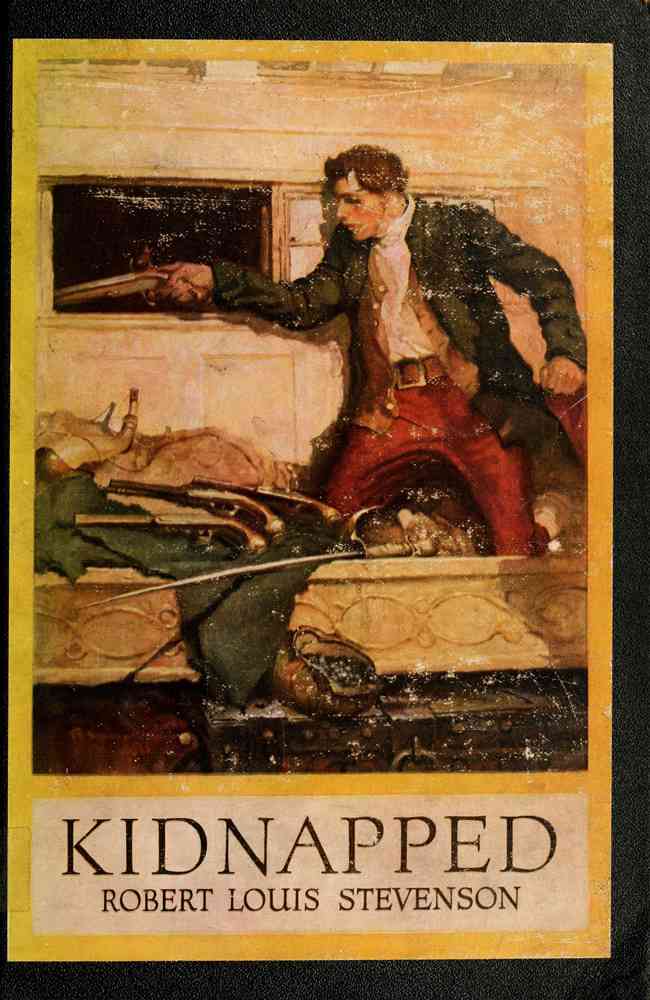
CHAPTER XXI
THE FLIGHT IN THE HEATHER: THE HEUGH OF CORRYNAKIEGH
arly as day comes in the beginning of July, it was still dark when we reached our destination, a cleft in the head of a great mountain, with a water running through the midst, and upon the one hand a shallow cave in a rock. Birches grew there in a thin, pretty wood, which a little farther on was changed into a wood of pines. The burn was full of trout; the wood of cushat-doves; on the open side of the mountain beyond, whaups would be always whistling, and cuckoos were plentiful. From the mouth of the cleft we looked down upon a part of Mamore, and on the sea-loch that divides that country from Appin; and this from so great a height as made it my continual wonder and pleasure to sit and behold them.
The name of the cleft was the Heugh of Corrynakiegh; and although from its height and being so near upon the sea, it was often beset with clouds, yet it was on the whole a pleasant place, and the five days we lived in it went happily.
We slept in the cave, making our bed of heather bushes which we cut for that purpose, and covering ourselves with Alan’s great-coat. There was a low concealed place, in a turning of the glen, where we were so bold as to make fire: so that we could warm ourselves when the clouds set in, and cook hot porridge, and grill the little trouts that we caught with our hands under the stones and overhanging banks of the burn. This was indeed our chief pleasure and business; and not only to save our meal against worse times, but with a rivalry that much amused us, we spent a great part of our days at the water-side, stripped to the waist and groping about or (as they say) guddling for these fish. The largest we got might have been a quarter of a pound; but they were of good flesh and flavour, and when broiled upon the coals, lacked only a little salt to be delicious.
In any by-time Alan must teach me to use my sword, for my ignorance had much distressed him; and I think besides, as I had sometimes the upper-hand of him in the fishing, he was not sorry to turn to an exercise where he had so much the upper-hand of me. He made it somewhat more of a pain than need have been, for he stormed at me all through the lessons in a very violent manner of scolding, and would push me so close that I made sure he must run me through the body. I was often tempted to turn tail, but held my ground for all that, and got some profit of my lessons; if it was but to stand on guard with an assured countenance, which is often all that is required. So, though I could never in the least please my master, I was not altogether displeased with myself.
In the meanwhile, you are not to suppose that we neglected our chief business, which was to get away.
“It will be many a long day,” Alan said to me on our first morning, “before the red-coats think upon seeking Corrynakiegh; so now we must get word sent to James, and he must find the siller for us.”
“And how shall we send that word?” says I. “We are here in a desert place, which yet we dare not leave; and unless ye get the fowls of the air to be your messengers, I see not what we shall be able to do.”
“Ay?” said Alan. “Ye’re a man of small contrivance, David.”
Thereupon he fell in a muse, looking in the embers of the fire; and presently, getting a piece of wood, he fashioned it in a cross, the four ends of which he blackened on the coals. Then he looked at me a little shyly.
“Could ye lend me my button?” says he. “It seems a strange thing to ask a gift again, but I own I am laith to cut another.”
I gave him the button; whereupon he strung it on a strip of his great-coat which he had used to bind the cross; and tying in a little sprig of birch and another of fir, he looked upon his work with satisfaction.
“Now,” said he, “there is a little clachan” (what is called a hamlet in the English) “not very far from Corrynakiegh, and it has the name of Koalisnacoan. There there are living many friends of mine whom I could trust with my life, and some that I am no just so sure of. Ye see, David, there will be money set upon our heads; James himsel’ is to set money on them; and as for the Campbells, they would never spare siller where there was a Stewart to be hurt. If it was otherwise, I would go down to Koalisnacoan whatever, and trust my life into these people’s hands as lightly as I would trust another with my glove.”
“But being so?” said I.
“Being so,” said he, “I would as lief they didnae see me. There’s bad folk everywhere, and what’s far worse, weak ones. So when it comes dark again, I will steal down into that clachan, and set this that I have been making in the window of a good friend of mine, John Breck Maccoll, a bouman[26] of Appin’s.”
[26] A bouman is a tenant who takes stock from the landlord and shares with him the increase.
“With all my heart,” says I; “and if he finds it, what is he to think?”
“Well,” says Alan, “I wish he was a man of more penetration, for by my troth I am afraid he will make little enough of it! But this is what I have in my mind. This cross is something in the nature of the crosstarrie, or fiery cross, which is the signal of gathering in our clans; yet he will know well enough the clan is not to rise, for there it is standing in his window, and no word with it. So he will say to himsel’, The clan is not to rise, but there is something. Then he will see my button, and that was Duncan Stewart’s. And then he will say to himsel’, The son of Duncan is in the heather and has need of me.”
“Well,” said I, “it may be. But even supposing so, there is a good deal of heather between here and the Forth.”
“And that is a very true word,” says Alan. “But then John Breck will see the sprig of birch and the sprig of pine; and he will say to himsel’ (if he is a man of any penetration at all, which I misdoubt), Alan will be lying in a wood which is both of pines and birches. Then he will think to himsel’, That is not so very rife hereabout; and then he will come and give us a look up in Corrynakiegh. And if he does not, David, the devil may fly away with him, for what I care; for he will no be worth the salt to his porridge.”
“Eh, man,” said I, drolling with him a little, “you’re very ingenious! But would it not be simpler for you to write him a few words in black and white?”
“And that is an excellent observe, Mr. Balfour of Shaws,” says Alan, drolling with me; “and it would certainly be much simpler for me to write to him, but it would be a sore job for John Breck to read it. He would have to go to the school for two-three years; and it’s possible we might be wearied waiting on him.”
So that night Alan carried down his fiery cross and set it in the bouman’s window. He was troubled when he came back; for the dogs had barked and the folk run out from their houses; and he thought he had heard a clatter of arms and seen a red-coat come to one of the doors. On all accounts we lay the next day in the borders of the wood and kept a close look-out, so that if it was John Breck that came we might be ready to guide him, and if it was the red-coats we should have time to get away.
About noon a man was to be spied, straggling up the open side of the mountain in the sun, and looking round him as he came, from under his hand. No sooner had Alan seen him than he whistled; the man turned and came a little towards us: then Alan would give another “peep!” and the man would come still nearer; and so by the sound of whistling, he was guided to the spot where we lay.
He was a ragged, wild, bearded man, about forty, grossly disfigured with the small pox, and looked both dull and savage. Although his English was very bad and broken, yet Alan (according to his very handsome use, whenever I was by) would suffer him to speak no Gaelic. Perhaps the strange language made him appear more backward than he really was; but I thought he had little good-will to serve us, and what he had was the child of terror.
Alan would have had him carry a message to James; but the bouman would hear of no message. “She was forget it,” he said in his screaming voice; and would either have a letter or wash his hands of us.
I thought Alan would be gravelled at that, for we lacked the means of writing in that desert.
But he was a man of more resources than I knew; searched the wood until he found the quill of a cushat-dove, which he shaped into a pen; made himself a kind of ink with gunpowder from his horn and water from the running stream; and tearing a corner from his French military commission (which he carried in his pocket, like a talisman to keep him from the gallows), he sat down and wrote as follows:
“DEAR KINSMAN,—Please send the money by the bearer to the place he kens of.
“Your affectionate cousin,
“A. S.”
This he intrusted to the bouman, who promised to make what manner of speed he best could, and carried it off with him down the hill.
He was three full days gone, but about five in the evening of the third, we heard a whistling in the wood, which Alan answered; and presently the bouman came up the water-side, looking for us, right and left. He seemed less sulky than before, and indeed he was no doubt well pleased to have got to the end of such a dangerous commission.
He gave us the news of the country; that it was alive with red-coats; that arms were being found, and poor folk brought in trouble daily; and that James and some of his servants were already clapped in prison at Fort William, under strong suspicion of complicity. It seemed it was noised on all sides that Alan Breck had fired the shot; and there was a bill issued for both him and me, with one hundred pounds reward.
This was all as bad as could be; and the little note the bouman had carried us from Mrs. Stewart was of a miserable sadness. In it she besought Alan not to let himself be captured, assuring him, if he fell in the hands of the troops, both he and James were no better than dead men. The money she had sent was all that she could beg or borrow, and she prayed heaven we could be doing with it. Lastly, she said, she enclosed us one of the bills in which we were described.
This we looked upon with great curiosity and not a little fear, partly as a man may look in a mirror, partly as he might look into the barrel of an enemy’s gun to judge if it be truly aimed. Alan was advertised as “a small, pock-marked, active man of thirty-five or thereby, dressed in a feathered hat, a French side-coat of blue with silver buttons, and lace a great deal tarnished, a red waistcoat and breeches of black, shag;” and I as “a tall strong lad of about eighteen, wearing an old blue coat, very ragged, an old Highland bonnet, a long homespun waistcoat, blue breeches; his legs bare, low-country shoes, wanting the toes; speaks like a Lowlander, and has no beard.”
Alan was well enough pleased to see his finery so fully remembered and set down; only when he came to the word tarnish, he looked upon his lace like one a little mortified. As for myself, I thought I cut a miserable figure in the bill; and yet was well enough pleased too, for since I had changed these rags, the description had ceased to be a danger and become a source of safety.
“Alan,” said I, “you should change your clothes.”
“Na, troth!” said Alan, “I have nae others. A fine sight I would be, if I went back to France in a bonnet!”
This put a second reflection in my mind: that if I were to separate from Alan and his tell-tale clothes I should be safe against arrest, and might go openly about my business. Nor was this all; for suppose I was arrested when I was alone, there was little against me; but suppose I was taken in company with the reputed murderer, my case would begin to be grave. For generosity’s sake I dare not speak my mind upon this head; but I thought of it none the less.
I thought of it all the more, too, when the bouman brought out a green purse with four guineas in gold, and the best part of another in small change. True, it was more than I had. But then Alan, with less than five guineas, had to get as far as France; I, with my less than two, not beyond Queensferry; so that taking things in their proportion, Alan’s society was not only a peril to my life, but a burden on my purse.
But there was no thought of the sort in the honest head of my companion. He believed he was serving, helping, and protecting me. And what could I do but hold my peace, and chafe, and take my chance of it?
“It’s little enough,” said Alan, putting the purse in his pocket, “but it’ll do my business. And now, John Breck, if ye will hand me over my button, this gentleman and me will be for taking the road.”
But the bouman, after feeling about in a hairy purse that hung in front of him in the Highland manner (though he wore otherwise the Lowland habit, with sea-trousers), began to roll his eyes strangely, and at last said, “Her nainsel will loss it,” meaning he thought he had lost it.
“What!” cried Alan, “you will lose my button, that was my father’s before me? Now I will tell you what is in my mind, John Breck: it is in my mind this is the worst day’s work that ever ye did since ye was born.”
And as Alan spoke, he set his hands on his knees and looked at the bouman with a smiling mouth, and that dancing light in his eyes that meant mischief to his enemies.
Perhaps the bouman was honest enough; perhaps he had meant to cheat and then, finding himself alone with two of us in a desert place, cast back to honesty as being safer; at least, and all at once, he seemed to find that button and handed it to Alan.
“Well, and it is a good thing for the honour of the Maccolls,” said Alan, and then to me, “Here is my button back again, and I thank you for parting with it, which is of a piece with all your friendships to me.” Then he took the warmest parting of the bouman. “For,” says he, “ye have done very well by me, and set your neck at a venture, and I will always give you the name of a good man.”
Lastly, the bouman took himself off by one way; and Alan and I (getting our chattels together) struck into another to resume our flight.
CHAPTER XXII
THE FLIGHT IN THE HEATHER: THE MOOR
ome seven hours’ incessant, hard travelling brought us early in the morning to the end of a range of mountains. In front of us there lay a piece of low, broken, desert land, which we must now cross. The sun was not long up, and shone straight in our eyes; a little, thin mist went up from the face of the moorland like a smoke; so that (as Alan said) there might have been twenty squadron of dragoons there and we none the wiser.
We sat down, therefore, in a howe of the hill-side till the mist should have risen, and made ourselves a dish of drammach, and held a council of war.
“David,” said Alan, “this is the kittle bit. Shall we lie here till it comes night, or shall we risk it, and stave on ahead?”
“Well,” said I, “I am tired indeed, but I could walk as far again, if that was all.”
“Ay, but it isnae,” said Alan, “nor yet the half. This is how we stand: Appin’s fair death to us. To the south it’s all Campbells, and no to be thought of. To the north; well, there’s no muckle to be gained by going north; neither for you, that wants to get to Queensferry, nor yet for me, that wants to get to France. Well, then, we’ll can strike east.”
“East be it!” says I, quite cheerily; but I was thinking in to myself: “O, man, if you would only take one point of the compass and let me take any other, it would be the best for both of us.”
“Well, then, east, ye see, we have the muirs,” said Alan. “Once there, David, it’s mere pitch-and-toss. Out on yon bald, naked, flat place, where can a body turn to? Let the red-coats come over a hill, they can spy you miles away; and the sorrow’s in their horses’ heels, they would soon ride you down. It’s no good place, David; and I’m free to say, it’s worse by daylight than by dark.”
“Alan,” said I, “hear my way of it. Appin’s death for us; we have none too much money, nor yet meal; the longer they seek, the nearer they may guess where we are; it’s all a risk; and I give my word to go ahead until we drop.”
Alan was delighted. “There are whiles,” said he, “when ye are altogether too canny and Whiggish to be company for a gentleman like me; but there come other whiles when ye show yoursel’ a mettle spark; and it’s then, David, that I love ye like a brother.”
The mist rose and died away, and showed us that country lying as waste as the sea; only the moorfowl and the pewees crying upon it, and far over to the east, a herd of deer, moving like dots. Much of it was red with heather; much of the rest broken up with bogs and hags and peaty pools; some had been burnt black in a heath fire; and in another place there was quite a forest of dead firs, standing like skeletons. A wearier-looking desert man never saw; but at least it was clear of troops, which was our point.
We went down accordingly into the waste, and began to make our toilsome and devious travel towards the eastern verge. There were the tops of mountains all round (you are to remember) from whence we might be spied at any moment; so it behoved us to keep in the hollow parts of the moor, and when these turned aside from our direction to move upon its naked face with infinite care. Sometimes, for half an hour together, we must crawl from one heather bush to another, as hunters do when they are hard upon the deer. It was a clear day again, with a blazing sun; the water in the brandy bottle was soon gone; and altogether, if I had guessed what it would be to crawl half the time upon my belly and to walk much of the rest stooping nearly to the knees, I should certainly have held back from such a killing enterprise.
Toiling and resting and toiling again, we wore away the morning; and about noon lay down in a thick bush of heather to sleep. Alan took the first watch; and it seemed to me I had scarce closed my eyes before I was shaken up to take the second. We had no clock to go by; and Alan stuck a sprig of heath in the ground to serve instead; so that as soon as the shadow of the bush should fall so far to the east, I might know to rouse him. But I was by this time so weary that I could have slept twelve hours at a stretch; I had the taste of sleep in my throat; my joints slept even when my mind was waking; the hot smell of the heather, and the drone of the wild bees, were like possets to me; and every now and again I would give a jump and find I had been dozing.
The last time I woke I seemed to come back from farther away, and thought the sun had taken a great start in the heavens. I looked at the sprig of heath, and at that I could have cried aloud: for I saw I had betrayed my trust. My head was nearly turned with fear and shame; and at what I saw, when I looked out around me on the moor, my heart was like dying in my body. For sure enough, a body of horse-soldiers had come down during my sleep, and were drawing near to us from the south-east, spread out in the shape of a fan and riding their horses to and fro in the deep parts of the heather.
When I waked Alan, he glanced first at the soldiers, then at the mark and the position of the sun, and knitted his brows with a sudden, quick look, both ugly and anxious, which was all the reproach I had of him.
“What are we to do now?” I asked.
“We’ll have to play at being hares,” said he. “Do ye see yon mountain?” pointing to one on the north-eastern sky.
“Ay,” said I.
“Well, then,” says he, “let us strike for that. Its name is Ben Alder. it is a wild, desert mountain full of hills and hollows, and if we can win to it before the morn, we may do yet.”
“But, Alan,” cried I, “that will take us across the very coming of the soldiers!”
“I ken that fine,” said he; “but if we are driven back on Appin, we are two dead men. So now, David man, be brisk!”
With that he began to run forward on his hands and knees with an incredible quickness, as though it were his natural way of going. All the time, too, he kept winding in and out in the lower parts of the moorland where we were the best concealed. Some of these had been burned or at least scathed with fire; and there rose in our faces (which were close to the ground) a blinding, choking dust as fine as smoke. The water was long out; and this posture of running on the hands and knees brings an overmastering weakness and weariness, so that the joints ache and the wrists faint under your weight.
Now and then, indeed, where was a big bush of heather, we lay awhile, and panted, and putting aside the leaves, looked back at the dragoons. They had not spied us, for they held straight on; a half-troop, I think, covering about two miles of ground, and beating it mighty thoroughly as they went. I had awakened just in time; a little later, and we must have fled in front of them, instead of escaping on one side. Even as it was, the least misfortune might betray us; and now and again, when a grouse rose out of the heather with a clap of wings, we lay as still as the dead and were afraid to breathe.
The aching and faintness of my body, the labouring of my heart, the soreness of my hands, and the smarting of my throat and eyes in the continual smoke of dust and ashes, had soon grown to be so unbearable that I would gladly have given up. Nothing but the fear of Alan lent me enough of a false kind of courage to continue. As for himself (and you are to bear in mind that he was cumbered with a great-coat) he had first turned crimson, but as time went on the redness began to be mingled with patches of white; his breath cried and whistled as it came; and his voice, when he whispered his observations in my ear during our halts, sounded like nothing human. Yet he seemed in no way dashed in spirits, nor did he at all abate in his activity, so that I was driven to marvel at the man’s endurance.
At length, in the first gloaming of the night, we heard a trumpet sound, and looking back from among the heather, saw the troop beginning to collect. A little after, they had built a fire and camped for the night, about the middle of the waste.
At this I begged and besought that we might lie down and sleep.
“There shall be no sleep the night!” said Alan. “From now on, these weary dragoons of yours will keep the crown of the muirland, and none will get out of Appin but winged fowls. We got through in the nick of time, and shall we jeopard what we’ve gained? Na, na, when the day comes, it shall find you and me in a fast place on Ben Alder.”
“Alan,” I said, “it’s not the want of will: it’s the strength that I want. If I could, I would; but as sure as I’m alive I cannot.”
“Very well, then,” said Alan. “I’ll carry ye.”
I looked to see if he were jesting; but no, the little man was in dead earnest; and the sight of so much resolution shamed me.
“Lead away!” said I. “I’ll follow.”
He gave me one look as much as to say, “Well done, David!” and off he set again at his top speed.
It grew cooler and even a little darker (but not much) with the coming of the night. The sky was cloudless; it was still early in July, and pretty far north; in the darkest part of that night, you would have needed pretty good eyes to read, but for all that, I have often seen it darker in a winter mid-day. Heavy dew fell and drenched the moor like rain; and this refreshed me for a while. When we stopped to breathe, and I had time to see all about me, the clearness and sweetness of the night, the shapes of the hills like things asleep, and the fire dwindling away behind us, like a bright spot in the midst of the moor, anger would come upon me in a clap that I must still drag myself in agony and eat the dust like a worm.
By what I have read in books, I think few that have held a pen were ever really wearied, or they would write of it more strongly. I had no care of my life, neither past nor future, and I scarce remembered there was such a lad as David Balfour. I did not think of myself, but just of each fresh step which I was sure would be my last, with despair—and of Alan, who was the cause of it, with hatred. Alan was in the right trade as a soldier; this is the officer’s part to make men continue to do things, they know not wherefore, and when, if the choice was offered, they would lie down where they were and be killed. And I dare say I would have made a good enough private; for in these last hours it never occurred to me that I had any choice but just to obey as long as I was able, and die obeying.
Day began to come in, after years, I thought; and by that time we were past the greatest danger, and could walk upon our feet like men, instead of crawling like brutes. But, dear heart have mercy! what a pair we must have made, going double like old grandfathers, stumbling like babes, and as white as dead folk. Never a word passed between us; each set his mouth and kept his eyes in front of him, and lifted up his foot and set it down again, like people lifting weights at a country play;[27] all the while, with the moorfowl crying “peep!” in the heather, and the light coming slowly clearer in the east.
[27] Village fair.
I say Alan did as I did. Not that ever I looked at him, for I had enough ado to keep my feet; but because it is plain he must have been as stupid with weariness as myself, and looked as little where we were going, or we should not have walked into an ambush like blind men.
It fell in this way. We were going down a heathery brae, Alan leading and I following a pace or two behind, like a fiddler and his wife; when upon a sudden the heather gave a rustle, three or four ragged men leaped out, and the next moment we were lying on our backs, each with a dirk at his throat.
I don’t think I cared; the pain of this rough handling was quite swallowed up by the pains of which I was already full; and I was too glad to have stopped walking to mind about a dirk. I lay looking up in the face of the man that held me; and I mind his face was black with the sun, and his eyes very light, but I was not afraid of him. I heard Alan and another whispering in the Gaelic; and what they said was all one to me.
Then the dirks were put up, our weapons were taken away, and we were set face to face, sitting in the heather.
“They are Cluny’s men,” said Alan. “We couldnae have fallen better. We’re just to bide here with these, which are his out-sentries, till they can get word to the chief of my arrival.”
Now Cluny Macpherson, the chief of the clan Vourich, had been one of the leaders of the great rebellion six years before; there was a price on his life; and I had supposed him long ago in France, with the rest of the heads of that desperate party. Even tired as I was, the surprise of what I heard half wakened me.
“What,” I cried, “is Cluny still here?”
“Ay, is he so!” said Alan. “Still in his own country and kept by his own clan. King George can do no more.”
I think I would have asked farther, but Alan gave me the put-off. “I am rather wearied,” he said, “and I would like fine to get a sleep.” And without more words, he rolled on his face in a deep heather bush, and seemed to sleep at once.
There was no such thing possible for me. You have heard grasshoppers whirring in the grass in the summer time? Well, I had no sooner closed my eyes, than my body, and above all my head, belly, and wrists, seemed to be filled with whirring grasshoppers; and I must open my eyes again at once, and tumble and toss, and sit up and lie down; and look at the sky which dazzled me, or at Cluny’s wild and dirty sentries, peering out over the top of the brae and chattering to each other in the Gaelic.
That was all the rest I had, until the messenger returned; when, as it appeared that Cluny would be glad to receive us, we must get once more upon our feet and set forward. Alan was in excellent good spirits, much refreshed by his sleep, very hungry, and looking pleasantly forward to a dram and a dish of hot collops, of which, it seems, the messenger had brought him word. For my part, it made me sick to hear of eating. I had been dead-heavy before, and now I felt a kind of dreadful lightness, which would not suffer me to walk. I drifted like a gossamer; the ground seemed to me a cloud, the hills a feather-weight, the air to have a current, like a running burn, which carried me to and fro. With all that, a sort of horror of despair sat on my mind, so that I could have wept at my own helplessness.
I saw Alan knitting his brows at me, and supposed it was in anger; and that gave me a pang of light-headed fear, like what a child may have. I remember, too, that I was smiling, and could not stop smiling, hard as I tried; for I thought it was out of place at such a time. But my good companion had nothing in his mind but kindness; and the next moment, two of the gillies had me by the arms, and I began to be carried forward with great swiftness (or so it appeared to me, although I dare say it was slowly enough in truth), through a labyrinth of dreary glens and hollows and into the heart of that dismal mountain of Ben Alder.
CHAPTER XXIII
CLUNY’S CAGE
e came at last to the foot of an exceeding steep wood, which scrambled up a craggy hillside, and was crowned by a naked precipice.
“It’s here,” said one of the guides, and we struck up hill.
The trees clung upon the slope, like sailors on the shrouds of a ship, and their trunks were like the rounds of a ladder, by which we mounted.
Quite at the top, and just before the rocky face of the cliff sprang above the foliage, we found that strange house which was known in the country as “Cluny’s Cage.” The trunks of several trees had been wattled across, the intervals strengthened with stakes, and the ground behind this barricade levelled up with earth to make the floor. A tree, which grew out from the hillside, was the living centre-beam of the roof. The walls were of wattle and covered with moss. The whole house had something of an egg shape; and it half hung, half stood in that steep, hillside thicket, like a wasp’s nest in a green hawthorn.
Within, it was large enough to shelter five or six persons with some comfort. A projection of the cliff had been cunningly employed to be the fireplace; and the smoke rising against the face of the rock, and being not dissimilar in colour, readily escaped notice from below.
This was but one of Cluny’s hiding-places; he had caves, besides, and underground chambers in several parts of his country; and following the reports of his scouts, he moved from one to another as the soldiers drew near or moved away. By this manner of living, and thanks to the affection of his clan, he had not only stayed all this time in safety, while so many others had fled or been taken and slain: but stayed four or five years longer, and only went to France at last by the express command of his master. There he soon died; and it is strange to reflect that he may have regretted his Cage upon Ben Alder.
When we came to the door he was seated by his rock chimney, watching a gillie about some cookery. He was mighty plainly habited, with a knitted nightcap drawn over his ears, and smoked a foul cutty pipe. For all that he had the manners of a king, and it was quite a sight to see him rise out of his place to welcome us.
“Well, Mr. Stewart, come awa’, sir!” said he, “and bring in your friend that as yet I dinna ken the name of.”
“And how is yourself, Cluny?” said Alan. “I hope ye do brawly, sir. And I am proud to see ye, and to present to ye my friend the Laird of Shaws, Mr. David Balfour.”
Alan never referred to my estate without a touch of a sneer, when we were alone; but with strangers, he rang the words out like a herald.
“Step in by, the both of ye, gentlemen,” says Cluny. “I make ye welcome to my house, which is a queer, rude place for certain, but one where I have entertained a royal personage, Mr. Stewart—ye doubtless ken the personage I have in my eye. We’ll take a dram for luck, and as soon as this handless man of mine has the collops ready, we’ll dine and take a hand at the cartes as gentlemen should. My life is a bit driegh,” says he, pouring out the brandy; “I see little company, and sit and twirl my thumbs, and mind upon a great day that is gone by, and weary for another great day that we all hope will be upon the road. And so here’s a toast to ye: The Restoration!”
Thereupon we all touched glasses and drank. I am sure I wished no ill to King George; and if he had been there himself in proper person, it’s like he would have done as I did. No sooner had I taken out the drain than I felt hugely better, and could look on and listen, still a little mistily perhaps, but no longer with the same groundless horror and distress of mind.
It was certainly a strange place, and we had a strange host. In his long hiding, Cluny had grown to have all manner of precise habits, like those of an old maid. He had a particular place, where no one else must sit; the Cage was arranged in a particular way, which none must disturb; cookery was one of his chief fancies, and even while he was greeting us in, he kept an eye to the collops.
It appears, he sometimes visited or received visits from his wife and one or two of his nearest friends, under the cover of night; but for the more part lived quite alone, and communicated only with his sentinels and the gillies that waited on him in the Cage. The first thing in the morning, one of them, who was a barber, came and shaved him, and gave him the news of the country, of which he was immoderately greedy. There was no end to his questions; he put them as earnestly as a child; and at some of the answers, laughed out of all bounds of reason, and would break out again laughing at the mere memory, hours after the barber was gone.
To be sure, there might have been a purpose in his questions; for though he was thus sequestered, and like the other landed gentlemen of Scotland, stripped by the late Act of Parliament of legal powers, he still exercised a patriarchal justice in his clan. Disputes were brought to him in his hiding-hole to be decided; and the men of his country, who would have snapped their fingers at the Court of Session, laid aside revenge and paid down money at the bare word of this forfeited and hunted outlaw. When he was angered, which was often enough, he gave his commands and breathed threats of punishment like any king; and his gillies trembled and crouched away from him like children before a hasty father. With each of them, as he entered, he ceremoniously shook hands, both parties touching their bonnets at the same time in a military manner. Altogether, I had a fair chance to see some of the inner workings of a Highland clan; and this with a proscribed, fugitive chief; his country conquered; the troops riding upon all sides in quest of him, sometimes within a mile of where he lay; and when the least of the ragged fellows whom he rated and threatened, could have made a fortune by betraying him.
On that first day, as soon as the collops were ready, Cluny gave them with his own hand a squeeze of a lemon (for he was well supplied with luxuries) and bade us draw in to our meal.
“They,” said he, meaning the collops, “are such as I gave his Royal Highness in this very house; bating the lemon juice, for at that time we were glad to get the meat and never fashed for kitchen.[28] Indeed, there were mair dragoons than lemons in my country in the year forty-six.”
[28] Condiment.
I do not know if the collops were truly very good, but my heart rose against the sight of them, and I could eat but little. All the while Cluny entertained us with stories of Prince Charlie’s stay in the Cage, giving us the very words of the speakers, and rising from his place to show us where they stood. By these, I gathered the Prince was a gracious, spirited boy, like the son of a race of polite kings, but not so wise as Solomon. I gathered, too, that while he was in the Cage, he was often drunk; so the fault that has since, by all accounts, made such a wreck of him, had even then begun to show itself.
We were no sooner done eating than Cluny brought out an old, thumbed, greasy pack of cards, such as you may find in a mean inn; and his eyes brightened in his face as he proposed that we should fall to playing.
Now this was one of the things I had been brought up to eschew like disgrace; it being held by my father neither the part of a Christian nor yet of a gentleman to set his own livelihood and fish for that of others, on the cast of painted pasteboard. To be sure, I might have pleaded my fatigue, which was excuse enough; but I thought it behoved that I should bear a testimony. I must have got very red in the face, but I spoke steadily, and told them I had no call to be a judge of others, but for my own part, it was a matter in which I had no clearness.
Cluny stopped mingling the cards. “What in deil’s name is this?” says he. “What kind of Whiggish, canting talk is this, for the house of Cluny Macpherson?”
“I will put my hand in the fire for Mr. Balfour,” says Alan. “He is an honest and a mettle gentleman, and I would have ye bear in mind who says it. I bear a king’s name,” says he, cocking his hat; “and I and any that I call friend are company for the best. But the gentleman is tired, and should sleep; if he has no mind to the cartes, it will never hinder you and me. And I’m fit and willing, sir, to play ye any game that ye can name.”
“Sir,” says Cluny, “in this poor house of mine I would have you to ken that any gentleman may follow his pleasure. If your friend would like to stand on his head, he is welcome. And if either he, or you, or any other man, is not preceesely satisfied, I will be proud to step outside with him.”
I had no will that these two friends should cut their throats for my sake.
“Sir,” said I, “I am very wearied, as Alan says; and what’s more, as you are a man that likely has sons of your own, I may tell you it was a promise to my father.”
“Say nae mair, say nae mair,” said Cluny, and pointed me to a bed of heather in a corner of the Cage. For all that he was displeased enough, looked at me askance, and grumbled when he looked. And indeed it must be owned that both my scruples and the words in which I declared them, smacked somewhat of the Covenanter, and were little in their place among wild Highland Jacobites.
What with the brandy and the venison, a strange heaviness had come over me; and I had scarce lain down upon the bed before I fell into a kind of trance, in which I continued almost the whole time of our stay in the Cage. Sometimes I was broad awake and understood what passed; sometimes I only heard voices, or men snoring, like the voice of a silly river; and the plaids upon the wall dwindled down and swelled out again, like firelight shadows on the roof. I must sometimes have spoken or cried out, for I remember I was now and then amazed at being answered; yet I was conscious of no particular nightmare, only of a general, black, abiding horror—a horror of the place I was in, and the bed I lay in, and the plaids on the wall, and the voices, and the fire, and myself.
The barber-gillie, who was a doctor too, was called in to prescribe for me; but as he spoke in the Gaelic, I understood not a word of his opinion, and was too sick even to ask for a translation. I knew well enough I was ill, and that was all I cared about.
I paid little heed while I lay in this poor pass. But Alan and Cluny were most of the time at the cards, and I am clear that Alan must have begun by winning; for I remember sitting up, and seeing them hard at it, and a great glittering pile of as much as sixty or a hundred guineas on the table. It looked strange enough, to see all this wealth in a nest upon a cliff-side, wattled about growing trees. And even then, I thought it seemed deep water for Alan to be riding, who had no better battle-horse than a green purse and a matter of five pounds.
The luck, it seems, changed on the second day. About noon I was wakened as usual for dinner, and as usual refused to eat, and was given a dram with some bitter infusion which the barber had prescribed. The sun was shining in at the open door of the Cage, and this dazzled and offended me. Cluny sat at the table, biting the pack of cards. Alan had stooped over the bed, and had his face close to my eyes; to which, troubled as they were with the fever, it seemed of the most shocking bigness.
He asked me for a loan of my money.
“What for?” said I.
“O, just for a loan,” said he.
“But why?” I repeated. “I don’t see.”
“Hut, David!” said Alan, “ye wouldnae grudge me a loan?”
I would, though, if I had had my senses! But all I thought of then was to get his face away, and I handed him my money.
On the morning of the third day, when we had been forty-eight hours in the Cage, I awoke with a great relief of spirits, very weak and weary indeed, but seeing things of the right size and with their honest, everyday appearance. I had a mind to eat, moreover, rose from bed of my own movement, and as soon as we had breakfasted, stepped to the entry of the Cage and sat down outside in the top of the wood. It was a grey day with a cool, mild air: and I sat in a dream all morning, only disturbed by the passing by of Cluny’s scouts and servants coming with provisions and reports; for as the coast was at that time clear, you might almost say he held court openly.
When I returned, he and Alan had laid the cards aside, and were questioning a gillie; and the chief turned about and spoke to me in the Gaelic.
“I have no Gaelic, sir,” said I.
Now since the card question, everything I said or did had the power of annoying Cluny. “Your name has more sense than yourself, then,” said he angrily, “for it’s good Gaelic. But the point is this. My scout reports all clear in the south, and the question is, have ye the strength to go?”
I saw cards on the table, but no gold; only a heap of little written papers, and these all on Cluny’s side. Alan, besides, had an odd look, like a man not very well content; and I began to have a strong misgiving.
“I do not know if I am as well as I should be,” said I, looking at Alan; “but the little money we have has a long way to carry us.”
Alan took his under-lip into his mouth, and looked upon the ground.
“David,” says he at last, “I’ve lost it; there’s the naked truth.”
“My money too?” said I.
“Your money too,” says Alan, with a groan. “Ye shouldnae have given it me. I’m daft when I get to the cartes.”
“Hoot-toot! hoot-toot!” said Cluny. “It was all daffing; it’s all nonsense. Of course you’ll have your money back again, and the double of it, if ye’ll make so free with me. It would be a singular thing for me to keep it. It’s not to be supposed that I would be any hindrance to gentlemen in your situation; that would be a singular thing!” cries he, and began to pull gold out of his pocket with a mighty red face.
Alan said nothing, only looked on the ground.
“Will you step to the door with me, sir?” said I.
Cluny said he would be very glad, and followed me readily enough, but he looked flustered and put out.
“And now, sir,” says I, “I must first acknowledge your generosity.”
“Nonsensical nonsense!” cries Cluny. “Where’s the generosity? This is just a most unfortunate affair; but what would ye have me do—boxed up in this bee-skep of a cage of mine—but just set my friends to the cartes, when I can get them? And if they lose, of course, it’s not to be supposed——” And here he came to a pause.
“Yes,” said I, “if they lose, you give them back their money; and if they win, they carry away yours in their pouches! I have said before that I grant your generosity; but to me, sir, it’s a very painful thing to be placed in this position.”
There was a little silence, in which Cluny seemed always as if he was about to speak, but said nothing. All the time he grew redder and redder in the face.
“I am a young man,” said I, “and I ask your advice. Advise me as you would your son. My friend fairly lost his money, after having fairly gained a far greater sum of yours; can I accept it back again? Would that be the right part for me to play? Whatever I do, you can see for yourself it must be hard upon a man of any pride.”
“It’s rather hard on me, too, Mr. Balfour,” said Cluny, “and ye give me very much the look of a man that has entrapped poor people to their hurt. I wouldnae have my friends come to any house of mine to accept affronts; no,” he cried, with a sudden heat of anger, “nor yet to give them!”
“And so you see, sir,” said I, “there is something to be said upon my side; and this gambling is a very poor employ for gentlefolks. But I am still waiting your opinion.”
I am sure if ever Cluny hated any man it was David Balfour. He looked me all over with a warlike eye, and I saw the challenge at his lips. But either my youth disarmed him, or perhaps his own sense of justice. Certainly it was a mortifying matter for all concerned, and not least Cluny; the more credit that he took it as he did.
“Mr. Balfour,” said he, “I think you are too nice and covenanting, but for all that you have the spirit of a very pretty gentleman. Upon my honest word, ye may take this money—it’s what I would tell my son—and here’s my hand along with it!”