
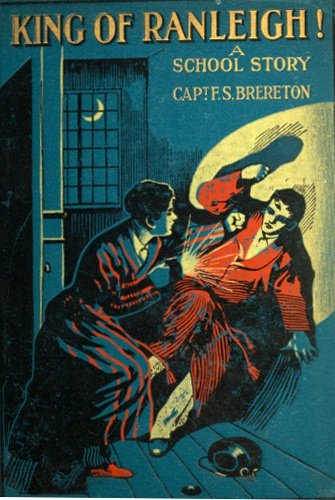
"HIS RAGE WAS ALMOST APPALLING."
"You little hounds!" he stuttered. "You did it. Don't tell me you didn't. I know you did. I'll set the police on you. You were trespassing. This is my property. I'll send Albert down to give you a hiding, and he'll be glad to do it. I'll—I'll——" His breath was gone by now, and he sat back gasping. But his anger did not subside, and Clive's prediction of coming evil was speedily realised.
"I shall send you off to school," said his mother. "You ought to have gone long ago. I really do consider your conduct to have been disgraceful."
"A piece of unmitigated mischief, and not of a harmless character," growled the Rector, who was given to choosing long words where possible. "Unmitigated mischief, Bert and Hugh. First you have the temerity to carry out something approaching a theft, a common and nefarious business. Then you implicate a respected neighbour in a catastrophe which might have terminated in his entire and total undoing. Bert, bend over."
Dear! Dear! It was a painful and humiliating week which followed. Young Rawlings up at the house giggled secretly at his father's discomfiture. But he threatened openly when he happened to come across Clive one morning. As for the three conspirators, they were not allowed to see one another, nor to communicate.
"You'll go on Wednesday," said the Rector. "I've written about you."
That was ominous. "We'll catch it hot," said Hugh. "I don't care. I'm jolly glad to be going. A chap ought to go to a big school, not stick always at home. There'll be a workshop. That'll be ripping."
"And cricket. That's better. Wish Clive were coming to the same school. Old Tom tells me he's led a dog's life these last few days."
Clive's existence had been wretched. He was glad, delighted in fact, when the day for departure arrived, and he took his place in the train for Ranleigh.
"That cad travelling too," he said, seeing Rawlings entering a distant carriage. "Glad he's going to some other place than Ranleigh."
He saluted his mother, waved to Old Tom, and sank back on his seat as the train started. If Bert and Hugh were glad to go to a public school, so also was Clive. He had longed to see life outside the village of Potters Camp with an intense longing. And here he was on his way. What would it be like? Was there bullying? Would he have to fag? and what sort of a place was Ranleigh?
CHAPTER III
OFF TO RANLEIGH
Going to school arouses a variety of emotions. In the case of Clive they were decidedly confused and jumbled, happiness, however, at the prospect before him predominating. For residence for a high-spirited lad at home, tied to a somewhat doting mother's apron-strings, is somewhat dull, and hardly conducive to good results, while the absence of a father had not improved matters. Indeed, it may be agreed without debate that the incident of that wonderful motor-car contrived by Clive and Hugh and the ingenious trap they had set for Rawlings had not been entirely mischievous. For here was Clive about to be launched on the schoolboy world, while Hugh and Bert, having listened to a long and verbose lecture from their father, hitherto their tutor at home, had entered a train and gone off likewise.
"What'll this Ranleigh be like?" Clive asked himself again and again. From taking an interest in passing scenery, he soon began to look forward to another stop with eagerness. For at each station there were boys. Some big, some small; some jolly and whistling, others glum and thoughtful. Not that glumness was the order of the whole day. For at one station Clive observed with some amusement one youngster under the escort of a fond father and mother. The lad had much ado to keep the tears back as the train departed, while his mother wept openly into a handkerchief of diminutive proportions. Within a minute, however, there came shouts of laughter from the next carriage into which this hopeful youngster had stepped, and peering in at the next station, Clive found the lad as merry as a cricket. He was beginning to wish that he could join them.
"I say," he began, somewhat lamely, "going to Ranleigh?"
A fat youth, with a greasy, pallid face, pushed his head out of the window and surveyed Clive as if he were an inferior beetle.
"Who on earth are you?" he asked, with some acerbity. "Who invited you to speak? that's what I want to know. Jolly cheek, I call it!"
Clive was taken aback rather considerably. This was not the sort of treatment to which he was accustomed. His gorge rose at it.
"Cheek yourself! Who are you, then?"
It seemed for a moment as if the fat youth would have an apoplectic seizure. His pallid face became suffused a dull purplish red. His neck swelled in fat folds over his collar. If looks could have killed, Clive would certainly have been slain on the spot. But the engine shrieked just then, while someone within the carriage seized the tails of the fat youth, who disappeared precipitately.
"Come in, Trendall," he heard a voice shout. "One would think you were a king, never to be spoken to. But who is he? My word, I got a glimpse of his phiz, and he looked as if he'd hammer you with pleasure."
Another mile on this almost endless journey and the train again panted into a station. Clive hung out of the window, and then became aware of the fact that two individuals were approaching his carriage, while from the one next door the youthful Trendall glared at him. Rawlings was one of those approaching. He descended with majestic step from his own compartment and hailed a porter.
"Hi! Portar!" he called. "Carry these things along heear. Someone's wanted to keep ordar."
Tall for his age, decidedly podgy, and with a cast of countenance which was not too attractive, Rawlings just lacked that brisk, clean appearance belonging to young men who go to our public schools. Despite expensive and well-fitting clothes, an immaculate tie and hat, and socks of most becoming pattern, the fellow did not look a gentleman. His air was pompous. His manner of addressing the porter ludicrous. He stepped up to Clive's compartment, nodded grandly to Trendall, and pulled the door open.
"He-e-ear, portar."
The magnificent one proffered a tip without looking at it, and Clive noticed that the man took it with alacrity.
"All fer me, sir?" he grinned.
"Of course! I'm not a pauper."
Rawlings waved him away magnificently, flopped on to a seat, taking the far corner, arranged his feet on the one opposite, and then began to take close scrutiny of our friend Clive. Meanwhile, another individual had entered the compartment. He was a tall, broad-shouldered, shambling youth, of decidedly foreign appearance, with clothes which spoke of a French provincial city. He stooped a little, was slow and ungainly in his movements, while his powerful shoulders were bent forward. But the face was striking and taking.
"Pardon," he said politely, lifting his hat as he entered. "This is for Ranleigh, is it not so?"
Rawlings regarded him stonily. "The cheek!" he muttered. "Is one to answer every bally foreigner? I'm not a portar!"
He thrust his hands deep into his pockets and glared at the intruder. For the new-comer was an intruder. Rawlings had made his way to this compartment with a view to discussing certain matters with Clive, and letting that young gentleman thoroughly understand who was the master. But that last movement was his undoing for the moment. The fingers deep in one pocket struck upon certain loose cash, and withdrawing the same, Rawlings was at once stricken with a terrible discovery. He had had certain silver coins there before, and twopence in coppers. Those he had intended to present to the porter. But they were still there, while two half-crowns were missing. In fact, in his lordliness he had presented the grinning fellow with five shillings! No wonder the man smirked and touched his hat. That had pleased Rawlings at the time. Now, as the train swung out of the station, he dashed to the window.
"Hi! Hi! Portar!" he bellowed. "Hi! You come back with those half-crowns. It was a mistake."
But the whistle drowned the sound of his voice, while the porter, half hidden behind a barrow, waved a farewell to him. Rawlings threw himself back in his seat with a growl of anger.
"You're going to Ranleigh, aren't you?" he demanded fiercely of Clive.
"Yes."
"Then just you look out for squalls. What dormitory are you in?"
"Don't know," came Clive's sullen answer. This Rawlings was considerably bigger, though little older, but still Clive was not going to be bullied. "How should I?" he demanded. "What's the place like?"
"You'll find out in time. And don't you try any traps there, youngster. See?"
Rawlings was determined to let there be no misunderstanding. He stretched across the carriage and took Clive by the ear.
"None of your caddish games at Ranleigh," he said, "or you'll get something worse than this, by a long way."
Clive beat him off with a well-directed blow on the arm. In fact, with such heat and violence that Rawlings, still enraged at the loss he had so stupidly made when tipping the porter, lost his temper, and it looked as if he would at once take in hand the chastisement of the lad who was such a near neighbour. But the third individual suddenly distracted his attention. Could Rawlings really believe his eyes! This new chap, whoever he might be, a froggy probably, had asked if the train went to Ranleigh, and therefore, obviously, was bound for that destination, and must be a new boy. He was actually stretching himself out across the carriage, with one boot resting against Rawlings's immaculate trousers, while—worse than all—he had a cigarette in his mouth and was setting a match to it. It wasn't the fact of smoking that horrified Rawlings. He had broken that rule himself, and been dreadfully ill, much to his chagrin. But Rawlings was getting up in the school. He was in the lower sixth, would probably be a prefect this term, and such an act was an outrage to his dignity.
"Well, I'm hanged!" he spluttered. "What on earth do you mean by that? Smoking! Here, stop it!"
But the one addressed merely viewed him mildly. His brows went up questioningly, while he stretched himself a little more at his ease, causing Rawlings to remove his immaculate trouser leg with swiftness.
"Do you hear?" he cried threateningly. "What's your name?"
"Richard Feofé."
"Hang the Richard! Feofé, then. Look here! Stop that smoking."
But Feofé still regarded Rawlings mildly, and taking a deep inspiration filled the carriage with smoke.
"You do not like it, then?" he asked. "Monsieur can then get into another carriage."
Rawlings went crimson with rage, and then pallid, while Clive began to enjoy the joke immensely, for long ago he had sized his near neighbour up, and knew him to be nothing more than a purse-proud bully. But for the disparity in their two weights and heights he would have long since openly defied the fellow. But it was better to see someone else do that. And here was a hulking, good-natured Frenchman doing it splendidly.
"Where do you come from? Who's your father?" demanded Rawlings roughly, as if to gain time in which to decide how to act.
Feofé was not to be hurried. He had never been to a school of any sort before, save the local one he attended in France. But he had met boys and youths in plenty. And always this quiet, shambling boy, with his broad shoulders and appearance of hidden power, had won respect without recourse to violence. He took another puff at his cigarette, a habit, by the way, rather more indulged in by boys in France, and regarded the resulting smoke with something approaching affection. His eyes twinkled. He shrugged his massive shoulders.
"Monsieur is somewhat curious," he said, using excellent English. "I am from Lyons. My father, he is a banker. My mother, ah, she is his wife, you understand. Then there is a sister. Susanne, Monsieur, younger by a year than I am. That is the sum of the family, but I will tell you all. There is a dog—yes, two—and a cat, and——"
Rawlings was purple. Beads of perspiration were breaking out on his forehead. Catching a sight of Clive's grinning face he ground his teeth with anger.
"Hang your family!" he shouted at Feofé. "Who wants to hear about Susan?"
Feofé shrugged his shoulders. "You were so very curious," he said. "But I will proceed. We live at Lyons, but sometimes we go to Paris. There I have an aunt and two uncles, Monsieur. Ah! Yes, I must tell you all. The aunt is Susanne also. A pretty name, Monsieur."
Rawlings was on the point of exploding. His dignity had long since gone to the winds. If he dared he would have seized this Feofé by the neck and shaken him. But the young fellow's broad shoulders and smiling, easy assurance warned him that that might be dangerous. But he must assert himself. He must show this Frenchman that he was a superior, and that that must be the light in which he must view him.
"Look here," he said at length, smothering his anger, "no more of your confounded cheek. Susanne's good enough for you, so just remember. You're going to Ranleigh, and it's just as well to tell you that I shall be a prefect. Know what that means?"
Even now he hoped to impress Feofé with his magnificence. But the lad merely raised his brows enquiringly, and shrugged his shoulders still lower against the upholstery of the carriage.
"A prefect. Someone in authority. Well?"
"And to be obeyed. Just chuck that smoking."
"But," began Susanne mildly—we call him Susanne at once, seeing that that name stuck to him forthwith—"but, by the way, what's your name?"
Imagine the impertinence of such a request! A new boy actually having the temerity to coolly ask the name of one who had been three years at the school. Rawlings gasped; he mopped his damp forehead.
"Rawlings," he growled.
"Then, Rawlings, you're a prefect, yes?"
"Not yet," came the somewhat confused answer. "But I shall be this term. It'd be a confounded shame if they passed me over."
"Quite so. A confounded shame. You would be a loss to the other prefects."
Susanne took another appreciative suck at the weed, while Rawlings went hot and cold. Satire went to the depths of his being. This Feofé was covering him with derision.
"Look here," he began threateningly, "it's about time you understood who you are and what I am."
"You're a prefect, yes?" answered Susanne, not the least distressed, his little eyes twinkling, "or will be, at Ranleigh. But you are not one here, in any case. Is it not so? Therefore, Rawlings, get into another carriage if you don't like smoke, and do let us be pleasant."
Never was a man more demoralised than Rawlings. He had made an entry into the carriage with the set purpose of bullying Clive, and of letting that young gentleman see who was to be the master. The commencement of the movement had cost him five precious shillings. That was sore enough. And then, naturally enough, he had addressed himself to this new boy—and had been worsted. It goaded him to madness to see Clive grinning still.
"Well done, Susanne!" called out that worthy, delighted at the turn events had taken. "Rawlings ain't a prefect yet, and in any case we're not at Ranleigh. I say, I'm a new boy too. He lives quite close to me."
He pointed a deprecating finger at Rawlings, and crossed to join Susanne. That young man welcomed him with open arms. The twinkle in his eye brightened, while he eyed Rawlings in a manner which made that individual squirm. In fact, never was the wind taken out of anyone's sails more completely. Susanne had reduced him to silence. Thenceforth Rawlings sat screwed into the corner, regarding the landscape with a face which showed the severest displeasure, while his lips muttered and twisted angrily.
"Wait till I get 'em to Ranleigh, that's all," he was promising himself. "The first thing I do is to kick this Darrell fellow. Then Feofé shall have a turn. I'll get my own back whatever happens."
Clive was no smoker. He was sensible enough to know that it would be harmful to him just as it would be to any other fellow, and for that reason refused the cigarette Susanne offered him. He wedged himself up close to his new chum, and commenced a long and intimate conversation. Meanwhile, other boys entered the train. Some in the next compartment, from which howls of laughter sounded, some in their own. Fellows nodded curtly to Rawlings. The fat Trendall came in at one station to have a chat with him, and found his chum curiously glum and silent. He couldn't understand him at all, nor fathom the movements of the two opposite. For Susanne and Clive regarded Trendall with the smallest interest. According to all the canons of school life they should have looked askance at a fellow who had been at the school a couple of years or so. In Clive's eyes Trendall should have appeared enormous. And, no doubt, had Clive been alone in this adventure, he would have been far less uppish. But Susanne was incorrigible. If he had never been to school before, he was at least not to be frightened by what was before him. To Clive, his easy, calm assurance was refreshing. To Trendall it was inexplicable. Finding conversation lagging he took himself off at the next station, his place being taken by two big fellows, who nodded cheerfully to the occupants of the compartment.
"Hullo, Rawlings!" called one, a very tall, slim young man, on whose upper lip there was a respectable growth of downy hair. "Not dead, then?"
"No," answered that individual sourly.
"New youngsters, eh?" was the second question as the tall fellow turned to Clive and Susanne.
"Yes," answered the former. Susanne took his hat off politely.
"Help!" called Harvey, for that was the name of the youth speaking, grinning at this quaint exhibition. However, he returned the compliment by lifting his own. "We don't do that sort of thing in England," he said, quite kindly. "I shouldn't if I were you. Fellows would start rotting. I say, can you play footer and cricket?"
Susanne's eyes sparkled. "I like them both tremendously. But play, ah, that is another question. In England fellows get a chance. In France you may say that games are only beginning."
"Book him for a trial next scratch footer," exclaimed Harvey, addressing his comrade. "Look here, you two, I'm Harvey. This is Bagshaw, secretary of our Games Committee, and of everything else that's useful. He's head bottlewasher to every institution at the school, and don't you forget it. I say, how do you call yourselves?"
How different was his manner from that of Rawlings. Feofé gave his at once, while Clive was not backward. The latter took an instant liking for Harvey. Of course, he must be a tremendous fellow at the school, top of all probably. Or was he a master? He looked almost old enough. Besides, he had a moustache, quite a decent affair. As to Bagshaw, he was a delicate-looking fellow of eighteen, perhaps, with a kindly, wizened face. A calm, studious man. The scholar of the school, no doubt, but not a games player. Nor was Clive far out in his reckoning. For Harvey was head scholar, a man head and shoulders above his comrades. Good at work, keen on books and such things, a decided master at debate, he was still a first-rate man at games, and perhaps shone still more as a leader. His clean-cut figure was the observed of all observers in School matches. His had been the fortune to listen to howls of appreciation when he had carried off the hundred yards, the quarter mile and the long jump at the School sports, while one and all, his football team or his cricket eleven watched his every move and gesture, loyal observers of all his wishes.
As to Bagshaw, he was almost as popular. No one expected him to play games. It was well known that he had a weak heart, and with that, of course, no fellow could play. But his Ranleighan Gazette was a masterpiece. His poems were enthralling; while, strangely enough, this delicate-looking fellow, a scholar also, could hold the boys spellbound. When taking "prep." Bagshaw was not one to be trifled with. There was no nonsense about this delicate, ascetic fellow. He was cool, calm and commanding, and to those who had the sense, a real help in difficulties.
"Ranleigh. All change!"
The lamps at the station were lighted now. Clive tumbled out on to a platform seething with boys of every age. Boys laden with footballs and bags. Boys clad in warm overcoats, and others nobly discarding the same for the walk up to the school. Caps were lifted in recognition of one of the masters. Clive found himself doing likewise and wondering whether all masters were the same. For this one, a fair giant, of ample proportions, smiled down upon them all. He gripped Harvey's hand with a vigour there was no denying, while still smiling round at the company. And then in twos and threes, and here and there in forlorn ones, for your new boy is not quick to discover chums, the contingent of Ranleigh boys took the road for the school. Through a portion of the village they went, leaving the Village Jubilee Memorial behind them. Up towards the common, all railed in, where sports and cricket matches are held, up past the butcher's shop, with its slaughter-house close handy, and so onward through the tree-clad lane, past the master's entrance, giving access to the Sanatorium also, past an even more important institution, the tuck-shop to wit, and so to the gates of the school. Above, a third way down the hill, myriad lights flashed from the building. Clive forged his way up the front drive with Susanne beside him, up the steep slope to the front doors, never entered except in the case of a few, save on arriving or departing on the first or last days of the term. And so into the wide space past the chapel entrance, between Middle and Second Form rooms. And there, swept continuously by a seething mass of boys, stood a short, bald-headed master, nodding here and there, smiling all the time, evidently delighted to welcome everyone.
"Darrell!"
Clive heard his name and stopped. The lynx-eyes of the bald-headed master had espied him.
"Sir," he gulped. He felt almost frightened. There were so many boys, and there was such an uproar.
"One South, Darrell," he heard. "How are you, boy? Glad you've come. Hop up the stairs there and you'll find One South dormitory. Your name's on one of the beds. Put your bag down on it, and then go to hall. You'll get tea there. Chapel'll be in ten minutes."
How did he know that this was Darrell? Clive found himself wondering that. And what about Susanne?
"Feofé," he heard, as he ascended. And then less distinctly, "One South," with the same instructions.
"I'm glad," he thought. "Susanne'll be with me. Wonder about that howling cad Rawlings. What a downfall! He'll not meddle with Susanne whatever happens. But he'll have his pound of flesh from me if the chance comes. Wish Harvey was to be in One South also."
He clambered up the steps and turned into a dormitory but dimly illuminated. But it was big and clean and airy, and bore an appearance of comfort, some thirty beds being covered with cosy-looking red coverlets.
Clive found his bed, deposited his bag, and then enquired his way to hall. Thick slices of bread and butter—known colloquially as "toke"—appeased a ravenous appetite. He had not even time to admire the huge proportions of the Hall, the many long tables, the names of boys long since departed who had won honours at the school, and the few pictures and portraits. A clanging bell summoned him he knew not where. He found himself processing with a number of others. Through that gallery they passed, with Middle and Second Forms on either side; then sharp to the left down a paved corridor, to a wide, arched entrance. They were in the chapel. Clive passed through the handsome raised seats of the choir, down the central aisle, and drifted aimlessly to one side.
"Here," someone whispered. "One South?"
"Yes."
"Then this'll do. Squat here."
The fellow made room for him. Clive squatted and listened. The organ was filling the whole beautiful chapel with the sweetest sound. Boys had ceased entering. He raised his eyes to the entrance through which he had come, just to be seen above the choir. "Be sure your sin will find you out," he read above the doorway. The bell ceased ringing, the notes of the organ were hushed, a low "Amen" came from the vestry. And then the choir processed to their seats. Harvey was amongst them, and Trendall, his fat cheeks shaking. There was a string of masters, of all ages almost, all appearances and all sizes, looking somewhat out of their element. And last of all came the Head. Not so very tall, not big, not imposing, there was yet something about him which called for another look. But the organ was pealing again, filling this magnificent building, with its high arched roof, to the depths of every crevice.
Clive cast his eyes aloft over the screen—in itself a thing of surpassing beauty—to the curtains about the organ loft, above which showed the foreheads and eyes of two of the school. And then the notes died away in a sob, which somehow seemed to have a welcome in it. The congregation kneeled. Then the voice of the Head broke the silence with the opening of the evening service, calm and dignified and musical. His eyes wandered round the assembled boys, not curiously, not with recognition in them, but with a welcome for all.
Ah! Clive shivered just a little. Of a sudden it had come to him that he was one of them, that he was a Ranleighan, that the school honour was his honour, its prowess his, its victories his to boast of. And then the singing of the choir thrilled him as he had never been thrilled before. He felt as do those old, loyal Ranleighans who visit their Old School after the lapse of years. The music, the lighting of the chapel, the very scent of the stone and bricks awake old memories, sweet memories and thrill them. So with Clive. He sang lustily with the rest, and then sank to his seat to listen to the lesson. There was Harvey at the lectern. Harvey the hero of the school, looking magnificent in his simple surplice. Harvey with head erect, his fair moustache curling, reading to them in a voice that showed no sign of trembling. How Clive would have shrunk from such a task! He shivered again at the thought of such a possibility.
Then came a hymn, the last prayers, and the thunder of the organ following. The choir filed away as they had come, the school remaining motionless till they heard the last "Amen" from the vestry. Then came movement. The boys were beginning to file out of the chapel and Clive prepared to follow. His eyes strayed this way and that, as he waited for his turn. All of a sudden he received something in the nature of a shock, something which set his heart thumping. For opposite him, waiting also to take their place in the procession of slippered boys, were two with familiar faces. Clive could have shouted their names. He almost did in his excitement and delight. For within a short dozen yards of him, as yet unconscious of his presence, were Hugh and Bert, his fellow conspirators, sent from their home as a direct result of that booby trap prepared for the unpopular Rawlings.
CHAPTER IV
SOME INTRODUCTIONS
"At last! Got you, you little demon! I'll teach you to laugh when a beggarly froggy gives me sauce. This'll help to make you remember manners, and is just a sample of what's to follow."
The amiable Rawlings, still smarting after his downfall in the train, had waylaid Clive Darrell. He pounced upon that youngster just as he issued from the chapel corridor, and with a heave and a jerk forced him through the narrow entrance into Middle School. A dim gas jet only served to show the immensity of the place, and its uncomfortable bareness. It was tenantless, save for the two who had now entered.
"No use your howling, my son," exclaimed the brutal Rawlings sneeringly, twisting Clive's arm till it was a wonder it did not break, and holding it so firmly behind his back that the lad could not move. "We'll commence with your lessons now, before school begins to-morrow."
He kneed the youngster unmercifully, shaking his whole body till it was a wonder his teeth were not jerked down his throat, and repeated the dose promptly. Clive shouted and kicked. His face was pale with pain, for his arm was terribly twisted. And yet he was powerless to get free. He wondered if he were going to faint. He certainly felt very giddy. Beads of perspiration were rolling down his forehead, and no doubt, in a little while, had the torture been continued, he would have actually fainted. But there came a sudden interruption. A stout, square figure lounged into the class-room, while a head appeared at the door behind. The figure belonged to Susanne.
"Pardon," he began, with that peculiar politeness for which, in the course of a few days, he became notorious, "but you are hurting Darrell."
Rawlings swung round on him, thereby nearly completing the fracturing of Clive's arm.
"You get off," he cried angrily. "You've nothing to do with this affair, and if there's any more of your sauce I'll serve you likewise. Hear that?"
Susanne seemed to be completely deaf. Not for one second did he forget his politeness. Indeed, it came to be said of Susanne, the good-natured, stolid Frenchman, that nothing ever put him out, and that even in the heat of footer he was always himself, the essence of politeness. But he could be deaf to threats. Moreover, such a thing as temper seemed to be foreign to him. He strolled up to Rawlings, took him by the nose and pinched that organ very thoroughly—pinched it, in fact, till Rawlings holloed. He let go his hold of Clive instantly, and clung to the injured organ, while his vengeful eyes flashed over the edge of his hands at Susanne. What precisely would have happened next it is impossible to state, for there came now a second interruption. Harvey's voice was heard. He had entered the class-room and was just behind the three.
"Serve you right," he said bluntly; "and look here, Rawlings, understand this from me: while I'm Head Scholar and Captain of the School this sort of thing's got to be put a stop to. I'll have no bullying, mind that. And have the goodness to remember that Darrell's a new boy. Now, youngster, cut. It's time you were upstairs in your dormitory. Same in your case, Feofé. Rawlings, you can come along to the scholars' room. I want a chat with you."
Clive clambered briskly to One South. True, he became a little muddled between the passages and the staircases, and found himself in the wrong dormitory. But a howl from a fellow hardly as big as himself sent him running like a rabbit.
"Here! Who's this kid?" he heard, while a youth with red hair sticking up abruptly from his forehead, as if he had received a severe fright when very young and had never recovered from it, stretched out and snatched at his collar. "What dormitory?" came the curt question.
"One South."
"Then out you go. We don't have One South kids fooling about in Two South, I can tell you. Clear off!"
Clive was actually staggered by the insolent arrogance of this youngster. He bolted, whereas, with all his wits about him, it is probable that there would have been at least a wordy warfare for some few minutes. And then he dived into his own abode, and made for his own particular bed. The dormitory was almost full now. That is to say, there was a boy to every bed save one. Clive sat down on the box placed between his bed and the next, and looked curiously round. There was silence in the place. There came to his ears merely the pattering of many restless heels upon the floor, while from the other three dormitories which went to make up the four in the south of the school buildings there came not so much as a sound.
Was Rawlings in the place? Thank goodness, no! Then Harvey? Of course, he'd gone off with the bully to the scholars' room. So there was still the chance that ill luck might put Rawlings in One South. Opposite, smiling at him, was Susanne, his peace of mind apparently unruffled by the scuffle in which he had so recently taken a part. As for the rest of the thirty odd fellows, they were large and small and medium, shock-headed, sunburned after their holidays, rather clean and well groomed for schoolboys, but then they were fresh from home, and as jolly looking as one could wish for. Compulsory silence, however, muzzled them for the moment. At the call of "speak" within ten minutes such a babel of voices arose that Clive was almost deafened. Susanne grinned now and crossed to speak to him.
"I say," he began, "who's that fellow I caught twisting your arm?"
"Rawlings; he lives near us at home. He's an out-and-out bounder."
"Ah! And a bully. He'll not try again when I'm near. But when he catches you alone, then there'll be trouble. I say, er——"
"Darrell."
"Then, Darrell, pity we're not next to one another here. Wonder if it could be managed?"
The suggestion was hardly made before a hand was placed on Susanne's shoulder.
"Look here, you're a new boy, aren't you?" asked a voice. "Well, I'm Sturton, you know, prefect of One South, and chaps aren't allowed to move over and speak to one another without getting leave. Now you know, eh?"
Susanne apologised in his best manner, while Clive inspected the one who had spoken. He hadn't seen him before, for the simple reason that Sturton was one of those who ascended to the organ loft at chapel time, and was there invisible. He had come up to the dormitory after "speak," and here he was, admonishing and advising Susanne as if he were another Harvey. Clive liked Sturton at once, liked his clean-cut figure and features, his bold brown eyes, his crisp and yet friendly way of talking.
"I say, please——" he began, and then became somewhat abashed.
"Eh? Fire away! You say——"
"I was wondering, sir, if——"
"Oh, come now, none of your 'sirs.' What is it?" asked Sturton, thinking that Clive was quite a decent little fellow, an acquisition to the dormitory.
"Well—er—oh, I don't know."
Sturton laughed outright. Susanne grinned. If Clive suffered from bashfulness, at least he didn't.
"He doesn't like to say it; but we're chums—isn't that the word?" he asked. "You see, I got into the same carriage with him. There was another chap there, and he'd come to make himself disagreeable to Darrell. So I—er, chipped in, eh?"
"Got it right—chipped in's the word," admitted Sturton, looking interested, while Clive nodded vigorously.
"Chipped in, and together Darrell and I made him look foolish. Darrell's wondering whether we could have our beds close together, then I needn't bother to ask leave."
"Why, of course! Bring your bag over. Change places with one of these fellows on either side. I dare say they won't mind."
The exchange was made promptly, and Clive found himself chatting away with his new friend. He was half undressed when that fair giant whom he had first seen at the station, and then again amongst the masters processing into chapel, entered the dormitory. He went from boy to boy, shaking hands heavily but with sincerity and friendship.
"Well, Darrell," he began, accosting our young friend, and speaking in so gentle and subdued a voice that Clive wondered if he had a bad cold, or if the voice really belonged to him, "been digging any more pits of late, eh? Or making motor-cars? Tell me all about them."
There was such genuine interest in this master that Clive told the tale, till Mr. Branson—for that was this master's name—wiped tears of enjoyment from his eyes. Also the same eyes sparkled when the boy spoke of his motor-car, and forgetting all else in the depths of his interest plunged into a description of levers and gears, of throttle and ignition apparatus, of lubrication and cooling. Was Branson—Old B., as fellows spoke of him usually—was he a fellow enthusiast?
"So you like engineering things, then, Darrell?" he said in his sing-song drawl, "and digging pits too? Well, so do I. Er—that is, I like the first. You'd like to join the carpenter's shop, eh? and the smith's shop? But no motor-cars. Ranleigh can't afford to have its boys rushing about the roads. And there are the police to be considered. Well, boy, I'm your dormitory master; I hope you'll like Ranleigh."
It was Susanne's turn next. Clive watched the slouching figure of the young fellow bend politely, and marvelled as he discussed his coming with Old B. as if he were his grown-up equal. But that was the peculiarity about Susanne. Perhaps he had mixed more with men than with boys. Certainly he had an old-fashioned manner about him, while his self-assurance was far in excess of that usually displayed by one of school age. Then came the turn of other new boys, while the place of the master was taken by Sturton armed with pencil and paper, and rattling silver in his pocket. There were silver coins to be paid for the support of the football club run by One and Four South, a request to which Clive assented readily enough, though it depleted his purse sadly.
It was striking half-past nine when at length all had turned in save Sturton and Massey, the other prefect. They sat on the edge of the table occupying the centre of the dormitory, on a line with the two rows of basins running down the middle. Snuggled down on his pillow Clive watched them debating in animated manner, and rose on his elbow as a pair of heavy feet came thundering into the dormitory. A young man dressed in a blue cotton jacket hurried from jet to jet of the gas pipes, and with the help of a notched stick extinguished all but one. He was gone in a moment, his thunder resounding from the other dormitories.
"Good night, Darrell," called Susanne.
"Good night, Susanne."
Darrell dropped asleep feeling happy and entirely peaceful. He liked Ranleigh so far, liked it immensely. If there was a great drawback to the place, if Rawlings did happen to be there, and to have shown the most unfriendly intentions, at least there were good fellows enough. Bert and Hugh, for example. What luck their being at the school! And Susanne too, and Sturton, and Harvey. Yes, Harvey held pride of place. He was Captain, lord of all he surveyed, immeasurably above the head of the humble Clive Darrell.
The violent ringing of a bell awakened Clive. He started up in bed to find daylight streaming in through the high-placed dormer windows. That same youth who had operated the gas taps on the previous night was thundering through the dormitory with his hobnailed boots, swinging a bell of generous proportions. Later, Clive gathered that he was known as a "beaky." He crossed to a door at the near end of the place and tapped heavily upon it. Then he disappeared as if in a perpetual hurry, and the ringing of the bell resounded from the other dormitories. Clive hopped out of bed, thereby arousing the inmate of the next bed. That young gentleman raised a very sleepy face from his pillow, hit rather snappishly at the hand which Clive had laid on his bed thereby to steady himself, and dropped back on his pillow.
"Hang you, waking me!" he grumbled, his eyes half shut, as if, too, there had been no such thing as a bellman. "It's always the same with new kids. Get funked when they hear a bell. Want to hop up at once. Here, you Darrell, call me when it's twenty past the hour. I give myself ten minutes the first morning, afterwards just five. Any decent fellow can wash and dress in that time."
Clive followed Sturton and a few of the others out of the dormitory, slippers on his feet and a towel about his waist.
"Swim, eh?" asked Sturton, giving him an encouraging nod.
"Rather!"
"You're the sort of chap we want then. Hullo! Masters still fugging. None of those old games, Masters," sang out Sturton, whose manner of addressing the one in question showed that he meant to be head of his dormitory whatever happened. "Here, out you come! Fugging may be allowed at home, but at Ranleigh, never!"
The unfortunate individual who lay next to Clive, and who had declared his intention of sparing a bare ten minutes on this, the first morning, for the purpose of ablution and dressing, was dragged out of bed without ceremony.
"Hop into your shoes and no skulking," said Sturton, standing over him. "I've had enough of your slackness, Masters. Every chap over twelve in this dormitory goes down for a dip every morning. The kids can, too, if they like. Same with those in Four South. I tell you One and Four are going to come out cock dormitory in footer this term if I can manage it."
Grumbling was of no use. Indeed, Masters showed no great inclination that way. Clive found him, after a while, when they had become more intimate, a merry, contented fellow, but dreadfully lazy.
"A regular slacker," Sturton declared on more than one occasion. "There's a cart-load of sisters at his home, and they molly-coddle the fellow. If he imagines an ache or a pain, even in his toe, he lies abed in the morning and is fed by one of the many sisters. But there's no bringing chaps up here on the spoon. No hand-rearing at Ranleigh if I know it. When a chap's ill, he can go to the sick-room. That's right enough. Or to the 'sanny' if he's really bad. Otherwise he's got to be fit—fit as a fiddle, Darrell."
Sturton was nothing if not open and straight-forward. Clive found in him something strangely akin to Harvey, the idol of the lower school, the man admired and envied by all the seniors. For Sturton was fresh and breezy in his ways. He addressed the juniors, not as if they were so many nuisances, or as individuals vastly beneath his notice—a manner much resorted to by Rawlings and the fat-faced Trendall—but as equals, cheerily; but always in a way that showed that he expected instant obedience.
His motto was perfection. He set an example of the strenuous life, and allowed no shirking where games were concerned. Nor was he backward where work came into account. His figure, dressed in an overcoat over his pyjamas, often with a towel about his curly head, was familiar to all in the dormitory who happened to open their sleepy eyes in the early morning. For Sturton was "swatting." He had some examination in view, and since the rules of Ranleigh forbade the burning of the candle at both ends, and indeed compelled the shutting down of all lights by ten o'clock at night, Sturton perforce had to burn the candle at one end only, and that the daylight one. Five o'clock found him poring over his books at the dormitory table.
And now he was ready to lead his juniors for the morning plunge. His conquering eyes viewed every bed in the place. Peremptorily he called to certain fellows. And then the procession set out for the bath, not sedately following Sturton, but in a rushing crowd, which went like an avalanche down the stairs, out of the wide passage between Middle and Second Schools, and then into the corridor about the quad. Clive peeped through the open windows, innocent of glass till the coming of December, when the school carpenter would put the frames into position. He saw a wide quad, smoothly asphalted, and rising by steps on the north side to a central doorway. Those open windows ran round it on three sides, and doubtless there were corridors within them. But he had little time for observation, for as part of that scampering throng he went pell-mell down the corridor, swung sharply to the left, and then along the east side of the quad. Up a short flight of steps, worn into deep hollows by the shoe-leather of many a Ranleighan, to the right abruptly, and so down a whitewashed passage with an abrupt turn at the far end, and then through a doorway into the dressing-room of the bath. A stretch of water lay between concreted walls.
"Cold as ice," shivered Masters, still begrudging the comfort of his bed. "Sturton's a demon for hardening fellows. All the same, a fellow feels frightfully fit when he's had a dip in the early morning. But a bed pulls; I could always do two hours longer any morning."
What fellow in his schooldays couldn't? A cosy bed pulls very hard on a cold, dark morning; but, with a peremptory Sturton about, there was no shirking. One and Four South boys mingled with others from West, a single, large dormitory, with those from North and East, and splashed into the bath. Sturton had his own ideas as to how the plunge should be taken.
"Can't stand a chap who walks in," he said. "Might just as well have three inches of water in a tub in one's room. A fellow ought to dive, and he can go in off the board if he wishes. For me, there's no place like the shallow end. You've got to be canny when you dive, for there's not three feet of water, and if you scrape the bottom, why, concrete on a naked chest acts like a rough file on soft wood. It draws blood every time. So you've got to remember that. Now, young Darrell, show Susanne the way. Follow me to the deep end. The first plunge'll freeze you to the marrow. The swim down will warm your blood. You'll come out again with your skin on fire, feeling as fresh as a daisy."
Off he went, cutting the water obliquely. Indeed, the dive was bound to be almost a flat one. Sturton did not appear again till he rose at the far end of the bath. Down he sank again, pushed off from the far wall under water and came up under Clive's nose, to that young gentleman's wonder and admiration. Then Clive attempted the same thing, flopped badly, stinging his hide severely. The ice-cold water sent a chill to his very marrow as he entered it. And then, as Sturton had said, his blood seemed to boil up as he took a first stroke. He was in a beautiful heat when at length he returned to the shallow end and clambered out to watch Susanne. That young man—known already to his dormitory by the name Clive had given him—looked somewhat doubtfully at the bath.
"Swim?" asked Sturton, who had not yet got his measure, and who with insular pride and prejudice was apt to look down upon a foreigner. "Eh?"
"Yes, but——"
"What? Funk the dive?"
"Yes," admitted Susanne frankly. "But I'll do it if it kills me."
He went souse into the water, sending a huge wave before him, and rising a moment later to rub his knees and elbows.
"Come to ground?" asked Sturton sympathetically. "Well, you won't to-morrow. Nothing like having one jar to teach you to be careful. Off you go. We'll all of us have to be nippy."
Clive had never before had much need to practise haste, for at home breakfast had not been an early function, while the school he attended was within easy distance. But at Ranleigh he soon learned what it was to be something of a speed merchant where dressing was concerned. He could scrub his skin dry after his morning bath in a mere jiffy. The rush back to One South dried all the parts he had missed in his hurry. To dive into his clothing was a process facilitated by many an artful dodge. Masters, in fact, was a promising instructor.
"Stick your things overnight so as you can hop into 'em all together," he advised. "Vest and shirt always as one, mind you, and tie still on the collar. Of course, any juggins knows the dodge of getting into pants and socks at one operation, while if you don't bother to undo your shoes, you can push your feet into 'em in a jiffy. Five minutes is my time for washing and dressing."
"Was," corrected Sturton, who happened to overhear this edifying conversation. "Was, Masters. I've been doubtful about the efficacy of the washing part. Chaps in One South have got to be known as fresh-water fellows, and a piece out of your short allowance won't help us. Besides, you're over twelve. Don't you let me catch you missing your dip in the morning."
Once dressed on that first morning Clive drifted down the stairs to Middle School. There was no particular reason why he should go there. But numbers of the school were entering the narrow doors, and he followed. Bert was just within, looking thinner than ever, his eyes still more dreamy. And Hugh was beside him, vivacious and very wide awake.
"I say, how ripping!" he exclaimed. "But wouldn't the Governor be riled if he knew what had happened? It was the last thing he wanted to do to send us to the same school. What about that beast Rawlings? Thought I saw him in chapel last evening."
"Impossible! The lordly Rawlings go to Ranleigh!" exclaimed Bert. "Nothing less than Eton'd suit him."
"All the same, he's here. I travelled a part of the way down with him," said Clive. "I say, I'll tell you all about him later. He's a beast, and no mistake. But I want to get hold of that fellow. Hi, Susanne," he called.
The Frenchman shambled awkwardly towards them. His provincial clothes were in marked contrast to those of the other fellows. Not that that fact seemed to distress him. Susanne cared not a rap for popular opinion. Half-way towards Clive a big fellow jostled against him while deep in conversation with another, and jarred by the contact turned angrily upon him. It was Rawlings, with the oily, fat Trendall beside him. At once the bully's face reddened. He looked threateningly at Susanne, while the Frenchman regarded him with something approaching amusement.
"Pardon," he began, for he deemed himself the cause of the collision.
"Hang your pardon! Look here, you Frenchman, there's just one thing you've got to understand. I'm a prefect, and——"
"You're a new kid," chimed in Trendall, looking distinctly unamiable. In fact, this greasy, fat fellow had thrown in his lot with Rawlings since the previous evening. There had always been some sort of attraction between them. But Rawlings was to be a prefect. To the self-seeking Trendall that was sufficient, a friendship with him promised many advantages, and here was an opportunity to cement that friendship.
"Precisely," said Rawlings, "and the sooner you get to know it the better. You'll do well to sheer clear of this Darrell."
There was surprise in his eyes as he saw Bert and Hugh. A sneer gathered on his face, and then a scowl of anger. For Hugh grinned a grin of recognition. He remembered the pit, and the manner in which it had captured the wrong individual.
"You're here too; then you'll catch it," growled Rawlings, moving on with Trendall.
"Pleasant," smiled Hugh, when he had gone.
"A gentleman, eh?" asked Susanne, with a lift of his dark eyebrows. "But——"
"My friends, Bert and Hugh Seymour," introduced Clive. "That Rawlings is an out-and-outer. With Trendall as his toady, and perhaps another crony, they can make life unbearable here for us. That is, for Bert and Hugh and I."
"And Susanne," said that worthy, smiling. "Remember that I have been dragged into this matter."
"Tell you," cried Bert suddenly, "we'll send the beast an ultimatum. Tell him we'll hammer him if he interferes with one or any of us."
That scheme had to be put aside for the moment, for there came a clamour at the door. There arose a shout of "Cave! Old B.," and an instant later that fair giant entered the form room, obviously having easily overheard the warning. Boys ranged themselves up into line, and there began Call Over, Clive's and other new boys' names being tacked on at the end.
"'Sum, 'sum, 'sum," the answers sounded, and then were punctuated by the ringing of the chapel bell. The door, shut a few moments before on those who were late, was swung open, and they processed to the chapel. After that there was breakfast in the Hall, and, later, form work began with a vengeance, Clive being placed in the Lower Third, while Bert attained to the Upper; Hugh ascended only as high as Upper Middle, while, to the surprise of all, Susanne romped into the Upper Fourth. It followed, therefore, that some time elapsed before the little quartette met again. But when they did, Clive drew up a letter, which, having received the signatures of all concerned, was duly posted to "Albert Rawlings, Ranleigh, Local."
"This is to inform you," it ran, "that we, the undersigned, have decided to lick you every time you touch one of our band. We refrain from giving you our private and confidential opinion of you. As gentlemen, we feel that we have no right unduly to hurt your feelings. And also, this opinion of ours must be very well known to you. Just sheer off and leave us alone is the sincere advice of
Clive Darrell,
Bert Seymour,
Hugh Seymour,
Richard Feofé (Susanne)."
CHAPTER V
AN ULTIMATUM
"What'll you do?" asked Trendall, breathing heavily as he leaned over Rawlings' shoulder in Lower Sixth Form room and perused the ultimatum which Clive and his chums had sent. "Lick 'em all straight off, eh? But, of course, you'd have to catch 'em singly. That Feofé cad is as strong as a horse, and though he can't fight as an Englishman can, he'd kick like a horse."
It seemed likely enough that the lordly Rawlings had considered that side of the question, or perhaps was even then considering it. For he turned a furrowed brow to his comrade.
"I'm going to lie low," he said. "One thing's certain, the first chance I get I turn the Darrells away from our place. Of course, you know, Trendall, that we own the whole show that Darrell's father had. He made a mess of things, and my father came in and bought. That's why he hates me so much. As to this letter, pooh! I'll get even with 'em all before I've done. Feofé doesn't frighten me, not a bit."
Certainly not. Yet Susanne had pulled the great Rawlings' nose, and that brilliant and magnificent bully had not retaliated. But he would, some day, when the moment was propitious. For the time being he left the little quartette alone, and Clive and his fellows were therefore at liberty to forget the feud; which they did promptly. In the meanwhile, Ranleigh had many things of interest to show them.
"Look here, Darrell kid," observed Masters one day, presuming on his two months' seniority of Clive, and on the fact that he had been two terms at the school, "I don't mind taking you along to show you the sights. Been to the tuck?"
"What's that? Oh, tuck-shop, I suppose?"
"Of course, booby! You don't suppose it's a sort of place where they do the washing! Well, suppose we go there and introduce you? Eh?"
Clive agreed readily enough. He was beginning to find that life at Ranleigh opened up a wider prospect for him. At home he and Hugh and Bert had been the best of chums, and no one had been admitted into their close friendship. But here the matter was different, and better. For the difference in forms separated the chums often enough. True, Bert and Hugh were in the same class-room as Clive, for it accommodated the two Middle and the two Third Forms. But at Ranleigh every hour saw a change in the class-rooms occupied by the various forms. Sometimes Clive was in Middle class-room, a little later he'd be in the Lower Fifth, and yet again in the "Stinks" room, a department that began soon to fascinate him, and which proved to be the one particular attraction to Susanne.
Circumstances, therefore, separated the chums often enough, for Bert and Hugh were in Four South Dormitory. Not that that prevented communication when in their respective dormitories, for the inventive Clive soon had a species of life-line manufactured, and this, when Sturton's attention was occupied elsewhere, could be tossed over the partition right on to Hugh's bed. Notes could thus be dragged backwards and forwards, and continuous communication kept up.
"But it can be improved, of course," said Clive, to which Hugh readily assented. "We'll make a telephone, nail the wires up the walls of the partition so that no one can see 'em, and then we can talk just as much as we want."
It never occurred to either of them that they might get all their chattering over in the daytime. But that is just the little point which people sometimes fail to comprehend. It was the novelty of clandestine conversation which attracted, and set these two inventors to work to construct a telephone from plans and descriptions given in a book they had managed to borrow.
In One South itself, Clive had Susanne always beside him, and very soon a firm friendship grew up between them. While on his other side lay Masters, the slug, as Sturton called him, a decent fellow, nevertheless, and now anxious to act as guide and faithful friend to our hero.
They passed along those endless corridors to the back doors, through which law compels the boys to emerge, and sauntered down between the Fives Courts. On the left lay the Gym, where Hugh had already been practising. Then beside the Tennis Courts, and away across the field which fronts the school. And who could wish for a better place? What father or mother or fond uncle or guardian could hope to find a healthier, better spot than Ranleigh? The world has heard of the school. It has made its mark in many a walk of life, so that there is no great need to describe it minutely or to mention its precise position. Suffice to say that it is situated in Surrey, that it projects three parts of the way up a sloping hill, which is bathed by the sun on every side. There is not a musty spot about it, not a corner nor a crevice in which injurious germs may hide. See it, then, a red-brick pile, clad with creeper, with its clock tower and its chimneys and pinnacles. Cast your eyes upon the surrounding country, and admit, as admit you must, that never was there a more ideal position. For the village is a mile away. The school stands beautifully isolated. Fresh breezes sweep direct from pine tree and heather across its roofs and into its windows. Add to these charms playing fields which vie with those of schools of greater antiquity, and you have a description of Ranleigh.
But we are forced to admit that Clive gave not a thought to it. He scudded across the field with Masters, dashed through the front gates and away down the road till they came to the tuck. It is a fascinating little shop, and here again we must admit that its contents appealed more strongly to Clive than did the surroundings.
"Never been in before, eh?" asked Masters slyly, well knowing the fact that Clive had not.
"Never; wish I had. Rippin', ain't it?"
"Not half bad," admitted Masters casually. "A chap can stuff himself full here for next to nothing. By the way——"
"Eh?" asked Clive, who was regarding a pile of apple tarts with close attention. "How much, please?" he asked the attendant.
"A penny each, sir."
"Cheap!" murmured Clive. "Oh, what where you saying, Masters?"
He was carefully inspecting the contents of his purse by then, and not looking particularly at Masters. It was not precisely what that young gentleman wanted. He coughed loudly. "Oh, never mind," he said lamely. "I—I didn't say anything."
It was such an obvious fib that Clive stared at him.
"Oh, did I?" then remarked Masters. "Oh, yes, I remember. But it doesn't matter."
He thrust his hands into his pockets, turned to the door, and beckoned to Clive. "Come on," he said, somewhat sadly. "Let's clear. I'll take you in some other time."
That was just the very thing that Clive could not agree to. He had been thick-headed before. But now he was beginning to grasp the situation. It was awfully nice of Masters, too, he thought, though, to be sure, he didn't see the smile on the face of the attendant.
"What's up?" he demanded. "You're never going to leave the tuck without eating something?"
"Must," came the answer.
"Why?"
"Oh, never mind." Masters shrugged his shoulders, and went from the cottage, Clive following. "Fact is," he admitted, once they were outside, "I've forgotten to bring money with me. It's a beastly nuisance."
"But it don't matter," cried Clive. "I'll lend you some."
"And then, of course," Masters hurriedly interjected, "it's a sort of custom here, you know, for new kids to—oh, never mind, let's clear."
"To what?" demanded Clive, beginning to fathom the mystery.
"Well, if you must know, it's a sort of custom at Ranleigh for new kids to stand treat the first time they enter the tuck. But it don't matter, as I said. Let's clear. I never borrow money."
The generous-minded Clive could see only one way out of the difficulty. Indeed, he was eager to show his hospitality. And so five minutes later found the two youngsters securely seated in the little room beyond the tuck, their feet over a gas fire, their teeth busily engaged with apple tarts, while steaming cups of cocoa stood beside them. By then, Masters' modesty had entirely departed. It had been a wrench, of course, to allow a new kid to treat him! But in for a penny in for a pound wasn't a bad motto.
"Tried those big chaps?" he asked, pointing to a box of squares of chocolate. "Ripping! They're only a penny, and there's different colours all the way through. Tony—met Tony yet? He's a fellow with red hair in Two South—well, Tony swears that there's regular pictures worked up in those squares, and that if you bite carefully you can see 'em. I don't believe it myself, but it's a joke trying."
Clive did know Tony. He was the red-headed fellow who had shouted at him and been so very pugnacious on the first night of the term when Clive had entered the wrong dormitory. As to the squares, well, it would be rather a joke to test this theory of Tony's.
"We'll test 'em, then," he said. "How many, eh?"
"Well, of course," said Masters guardedly, "a fellow could do it with one, I suppose. But he'd have to be clever. Two'd give a chap a better chance, while——"
"Sixpenn'o'th of those square things, please," demanded Clive, who was warming to Masters, and who happened to have received a useful present from a distant uncle that very morning. "You try first, Masters."
"And those brandy balls are just the things for prep.," remarked Masters, some little time later, as if it were an afterthought and he had not meant Clive to hear. "They're hot with peppermint, and you can smell 'em all over the class-room. It makes the chaps look round and long for some themselves, while the prefect who's in charge of the room gets raging. Come on, Darrell."
It was perhaps a fortunate thing that Clive's stock of sixpennies was becoming small, or he would have listened further to the blandishments of the crafty Masters. As it was, he purchased a liberal quantity of brandy balls, divided them with his friend, and then went off to other fields.
"Sundy tuck's there," Masters informed him as they skirted the common, where cricket matches are played. "Of course, the Head knows that there is one, and would give his ears to catch chaps there. My word, they would get a licking! But he can't succeed, and for a very good reason. You see, a chap can slip in without being seen, and if the Head or any other inquisitive master happens to come along and suspect, why, you can bolt from the back door, up the garden and over the wall at the end. I've done it. So have other chaps."
Before three weeks of his first term had passed Clive had a nodding acquaintance with all the surroundings of the school, and with most of the fellows. Moreover, he had witnessed the first great footer match of the season, and his youthful chest had swelled with pride because of the prowess of Harvey and other men. In fact, he was slowly and steadily imbibing that spirit of esprit de corps which helps a school along. He was beginning to understand that self-effacement is a good thing at times, and that the good of the school as a whole is what should be considered. Else, why did Harvey work so hard to train the team while still doing his best in school time? Why also did Sturton work so loyally to support him, and still rise at cock-crow every morning so as to prepare his own tasks?
But early frosts somewhat upset the plans of the Captain, and saw letters innumerable despatched to some three hundred homes, demanding that skates should be sent immediately.
"Another day's frost and we'll be able to go anywhere. They say the canal's good," said Hugh, who had been making diligent enquiries. "But my mark is the lake at Ditton."
"Private, isn't it?" asked Masters, who had joined the little band of friends, and who, in fact, was often with them.
"Yes. But what's it matter? The Delarths are away from home. They'd never want to keep good ice all to themselves. We'll take french leave."
"Or write and ask. Why not?" ventured Bert mildly.
"Why not?" repeated Susanne, with sparkling eyes. "It will make the fun better. Besides, it is rude, is it not, to trespass on private property?"
They scoffed at him promptly, and the very mention of rudeness put aside the intention to write.
"It'll be part of the lark to go without being invited," said Hugh. "I know the place already, for I've been skirmishing round to discover likely spots for nesting. In the spring I'll be there. And if this frost continues, I mean to try what it's like on the ice. So there, Susanne."
Two days later, after an intervening thaw of some five hours' duration, whereat the hopes and the faces of every member of the school, save the Captain and the footer team, fell dismally, the ice was reported to be bearing on neighbouring ponds, and particularly on that one down by the common in front of the butcher's shop. It had frozen very hard overnight, and the ground was as hard as a stone. After dinner, therefore, Bert and Hugh and Clive set out, Susanne being in their company also, with Masters following behind as soon as he could get away, an "impot" of some length having detained him. Indeed, the self-same Masters had made a valiant attempt to complete the task during dinner-hour in Hall. A pen of Clive's own invention had been brought into request. Thereon were fixed no fewer than three nibs, all of which would write at the same moment.
"You see, it's not one of those clumsy things one's heard of," said the lordly inventor when he produced this wonderful time-saving implement. "Anyone can tie three nibs on to one holder and try to write with 'em all. But the blots he makes, my word! One nib rests nicely, but has too much ink. A second is too short to reach the paper, while the third sticks the point through and tears a hole. This pen gets over all three difficulties. So long as you dip her carefully, she'll write, for all the nibs are carried on spring holders. It's a champion. I'm going to bring out a self-filling six-line automatic writer before I've ended. I'll sell 'em by the ton to chaps at school."
No doubt he might if he were fortunate, and if all "impots" were of the same character as that given to Masters. That worthy having incurred the displeasure of his form master had been very politely and in dulcet tones requested to deliver five hundred repetitions of the following statement. "There's a time and a place for everything."
"And all because he scented peppermint," declared Masters hotly, when he reported the matter to his cronies. "That chap Canning's a bounder. He's always finding fault somewhere."
"But," ventured Bert cynically, "perhaps he doesn't like peppermint."
"Doesn't like peppermint! Rot!" cried Masters. "Who doesn't?"
"Well, you do," grinned Susanne.
"And so does any decent fellow. But that's where it is. Canning isn't a decent fellow. He's always grousing. Masters, you're talking. Masters, you don't answer. Masters, you're a fool. Masters——"
"You're a glutton," grinned Hugh, enjoying the indignation of that individual, and receiving a buffet for his pains. "Well, he cobbed you sucking brandy balls, given you by Clive."
"And told me that they were beastly, that I was making a beast of myself to suck 'em in class time, and that there was a time and a place for everything. Then gave me an impot."
"Which has to be done."
"That's it, and there's skating this afternoon. I'm going."
It followed that Clive's inventive genius was called in to help, and that day at dinner, Masters, having gobbled up his meal, spent the rest of his time crouching over a book resting on his knee, on which was stretched the paper on which he was operating. And all would have been well, for he was making amazing progress with that patent pen, but for the fact that a sudden and unforeseen difficulty had arisen. The penny bottle of ink he had requisitioned had the most idiotically narrow neck.
"Asses!" he growled, showing the difficulty to Clive, who sat next him. "What makes 'em turn out bottles like that? How's a chap to get to work?"
Clive had many brilliant ideas constantly occurring to him.
"Shove it into a spoon," he urged. "A tablespoon. Empty the bottle in, and then you can dip easy. It'll prevent you dipping too deep. Get on with it."
Masters realised the brilliance of the suggestion, and at once put it into practice. He took the biggest spoon to be had, buttressed it around with bread-crumbs, and then emptied his ink from the bottle. That was famous.
"One gets along like a house on fire," he told Clive triumphantly. "And the writing's ripping. Old Canning'll remark on it. George! Darrell, you might sell him one of your pens. Look! There's fifty of the beastly lines written. Here we go again. 'There's a time and a place for everything.' So there is, my boy. Hall's the place for writing rotten impots, specially when there's skating."
Hall, no doubt, was an excellent place. But accidents will happen, and here with the most surprising result. For Masters, after much diligence, had actually managed to complete three hundred lines when his sleeve got anchored in the handle of the spoon filled with ink. It jerked over, and in one brief instant the writer of the "impot" had the contents of the spoon in his lap, while some of the inky mess flowed over the table, making an excellent black map on the cloth.