
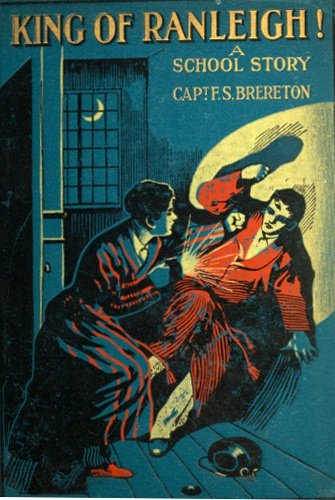
"'FORWARD!' ORDERED THE SERGEANT STERNLY. 'RUSH 'EM!'"
They started out into the chapel at a run. With a shout of triumph they threw themselves upon the four men within, bowled them over before they had recovered from their astonishment or could use their weapons, and soon had them tethered in the corners. It was exciting work while it lasted. Clive and Hugh tackled Peter, and were almost killed by the frantic struggles of that burly ruffian. It took them quite three minutes to recover their breath. Then they went to one of the corners, where poor Bert lay huddled on the same iron bedstead which he and Clive had noticed.
"Merely stunned, not otherwise hurt," said the Rector, who was bending over him. "It seems that he must have fallen from the floor above. I will cross-question those ruffians."
The three fellows whom Bert and his friends had decided must be swell mobsmen stood at the far end of the chapel surrounded by a crowd of exultant rustics, and now with hands firmly bound. A great noise came from their direction, and going towards them Clive heard first one and then another of the dishevelled rascals expostulating.
"What's the meaning of this violence and of this extraordinary assault?" the man whom Clive knew as Joe was demanding. "Answer at once, sergeant. Why are peaceful people thus attacked and set upon by ruffians with an officer of the law to lead them?"
That officer might have been a mile away. He stood, note-book and pencil in hand, and once more took the time by his watch.
"I have to warn you that anything you say will be used in evidence against you," he said coolly, having noted the time.
"Humbug! Evidence indeed! You'll require that, my man," came the heated answer.
"I charge you with being notorious burglars, with lying here ready to commit another offence. My witnesses, who overheard you discussing your plans, are Mister Clive Darrell and Mister Hugh Seymour."
Very pompously did the sergeant give the information. The man called Joe looked as if he would explode, so great was his indignation. But though the mention of our two young friends' names may have meant nothing to him, they seemed to attract the attention of another of the three who stood in the background till that moment almost unobserved. He started forward, looked closely at Clive and Hugh, and then, to the amazement of his comrades and all present, broke into a fit of uncontrollable laughter. He almost grovelled in his ecstasy. The Rector was really alarmed for the man's reason, while Bill Watson, the smith, stepped farther away and raised his iron bar in readiness for self-protection. It was Joe and the sergeant who first noticed the curious change which had come over Clive and his young friend. They were backing away. They looked horribly frightened. Clive had gone a fiery red, while Hugh was almost purple. They looked, in fact, as if they had seen the ghost said to haunt this ancient tower, and as if the sight had scared them out of their wits.
"I—I think we'd better be going," Clive managed to blurt out at last.
"Er—yes," agreed Hugh huskily.
"One moment, young gents," said the sergeant. "Why, if that chap ain't still laughin'. See here, my man, you just cut it short, or——"
He was interrupted by another gust. The burglar immediately in front of the one so vastly amused joined him in his merriment. Then Joe saw the fun, wherever it existed, and presently there were all three shaking with mirth, while their captors looked on sternly. And then the one who had set the fashion stepped to the front, torn and dishevelled after his encounter. Clive and Hugh backed away, and would have bolted, but at a glance from him stood rooted to the spot.
"Sergeant," said the man, "I'm Mr. Canning, a master at Ranleigh School. Ask those boys if they recognise me."
No need to ask. The faces of our two young friends supplied the answer. It was actually and decidedly Mr. Canning, the "Peach," as many called him, because of his blooming cheeks, the master so fond of giving "impots." Clive groaned aloud as he looked at him. Hugh wished the remaining roof of the chapel might fall in and bury him yards deep.
"Oh!" exclaimed the sergeant, looking glum of a sudden.
"And these are my friends. Mr. Oxon here, whom we call Joe, is the owner of Merton Tower. To proceed, there is a legend of buried treasure. He has lately come upon a clue hidden away in an ancient family manuscript. What more natural than that he should invite his friends to help him search for the missing valuables? What more natural than that the strictest secrecy should be employed? That these boys have discovered us is unfortunate. The fact that we have been taken for burglars is readily understood. It is a most excusable and humorous mistake. Allow me to assure you that we are the most harmless of individuals. As to the boy who fell into the chapel, he is merely stunned. We have been wondering how he managed to get into the tower. I suppose I should have recognised him. I didn't. As to the shots, we were merely amusing ourselves with a six-shooter. There. You have a full explanation."
Oh, the misery of it all! The stern looks of the Rector, the grins of the rustics, the smothered anger of the sergeant and constable. Never were Clive and Bert and Hugh more miserable than on the days which followed. People laughed aloud whenever they met them. At church half the congregation stared them out of face. While the thought that Mr. Canning had been one of their captures made all three turn almost yellow at the thought of the coming term at Ranleigh and the consequences of their late adventure. The worst of all undoubtedly was the fact that Masters managed to get wind of the business.
"How's burglars?" he asked, ungrammatically, immediately on encountering his old friends on their return to Ranleigh.
There was strife for the ten minutes which followed.
CHAPTER XIII
TRENDALL AND SOME OTHERS
After all, Masters had to have his joke, and knowing that inconsequential and extraordinary young gentleman as we do now, we can imagine that even the fierce ire of Hugh and of Bert and Clive had little terrors for him. He harped on that stale old joke of the burglars.
"How's burglars?" he fired off at the unfortunate heroes of that late adventure quite a dozen times within the first twenty-four hours of their return to Ranleigh, and was promptly hustled. Then, too, think of the bitterness of it all, the "Peach," the placid Mr. Canning, smiled at them and winked.
"Like his beastly cheek!" declared Clive indignantly, speaking in undertones to Bert and Hugh. "See the beggar smile and wink?"
"Grinned, the beast!" said Hugh, his lips pursed together. Hugh always did that when he was annoyed. He appeared to be endeavouring to muzzle himself, as if long experience of his temper warned him that an open mouth would result in some very bitter sayings. "Grinned, ugh!" he repeated.
"After all," began Bert, in those aggravatingly droning and dreamy tones of his, "you can't exactly blame the fellow, now can you?"
"Eh?" asked Hugh sharply. Here was an opportunity to be taken. A few more words from his respected brother would lead to a flare-up between them. Hugh rather wanted that. It would clear the air and get rid of some of his own irritability.
"Sticking up for the Canning beast, eh?" he demanded threateningly.
"No. Not quite, but—well, if you were in his shoes——"
"I'm not," snapped Hugh.
"But, if you were, you'd——"
"Wouldn't deign to wear 'em, ever," declared his brother haughtily.
"Oh, well, let's imagine someone else wearing them. He'd grin, wouldn't he? It was mighty funny, you know—er—for Canning."
"Oh, shut up!" shouted Hugh.
"Let's talk of something else," suggested Clive. "I say, the school's going to the dickens."
"Without Harvey, yes," assented Hugh, forgetting his irritation for the moment. "What'll we do? Who'll be captain of the school?"
They looked blankly at one another. To speak the truth, a bomb had fallen squarely into the middle of Ranleigh boys. Harvey, the head scholar and captain of the school, had left suddenly. He was not to have said good-bye for a couple of terms. But the Head had announced within a few hours of their return that Harvey had been called abroad suddenly to join his father in India. It was, without a shadow of doubt, a terrible blow.
"What'll we do?" asked Hugh blankly, appealing to the members of the Old Firm, now gathered about him. "The school'll go to the dogs."
"Not while the Old Firm's lively," said Masters.
"Try me as captain," suggested Susanne, with one of his quiet grins.
"Oh, do let's talk sense!" cried Clive pettishly. "It'd be ripping if Sturton got it. He's in the running, he's a scholar, and he's splendid at games. George! wouldn't he give some of the outside footer teams socks if he were captain."
But, till the point was cleared up, and the Upper Sixth had duly met together to discuss this momentous question and elect a captain, there was unusual despondency throughout the school. The Old Firm went about disconsolately that afternoon after their arrival.
"Nothing to do. Nowhere to go. Nothing decent," grumbled Hugh.
"Except impots," said Masters, with a scowl. "I've still some unfinished for that fellow Canning. A chap never gets clear of them at this school. I complained to the Governor."
"Ah. What happened?" asked Bert.
There was silence for a moment. Masters looked anything but pleased at the train of thought the question gave rise to.
"Let's do something pleasant," he said. "My Governor don't understand a fellow. To begin with, look at my allowance! A dog'd be disgusted. As for the impots, he laughed—laughed, I tell you."
Bert grinned. This question of impots was in the case of Masters quite an amusing affair. Besides, whenever the matter was mentioned Bert's mind always went back to the day when Clive's magic pen was brought into requisition, and when Masters had conducted his work so skilfully that he had contrived to ruin the tablecloth and drench himself in ink. But to grin at this point was dangerous. Bert straightened his features while Susanne changed the conversation.
"Hullo! Here's Trendall," he said. "He and Rawlings don't speak nowadays. I'm a bit sorry for that fellow."
"So am I," agreed Bert.
"Acted like an idiot. Might have belonged to the Old Firm if he'd behaved," remarked Hugh magnanimously.
"Let's invite him to feed," suggested Clive of a sudden.
"I say!" cried Masters, hearing the words. "You know—well, I don't mind, of course. In fact, glad to invite him. But Trendall's a fellow to eat; it'd be expensive."
"Hang expense! Hi, Trendall!" shouted Susanne, always the prince of good fellows.
The object of their regard was at that moment crossing the quad, looking forlorn and unhappy. The new term had begun badly for him, in fact. He was depressed like every other fellow at the thought of Ranleigh's loss. And then, slowly but surely, and in some few cases rapidly and with uncouth bluntness, he was being led to see that he was by no means a popular individual.
"Sit next one another in Hall?" he had asked Marsham, once quite a friend of his.
"Promised," came the surly answer.
"But there's another side. I'll sit there."
"Blandy's bagged it; you can't," Marsham told him sharply.
Thereat Trendall swallowed his annoyance and went elsewhere. But what a change it was to the commencement of the term before, when Clive had first made the acquaintance of Ranleigh! Then Rawlings and Trendall had grandly elected their table companions. No one had then been strong enough to refuse their invitation. Still, Trendall had not yet had his full lesson.
"I say, Wilkins," he began, accosting one of his own form fellows, "how'd it be if we went clubs with our grub this term? You know, I've had a bit of a turn up with Rawlings, and you and I have always been pals."
Wilkins was a thin, hook-nosed individual, with sandy hair already thinning at the temples, prominent cheek bones, a bent figure, and a pair of curious pink eyes which long ago had given him the soubriquet of the "Rabbit." He was one of those ill-developed youths who always appear anxious and hungry. But he had his good points, plenty of them, and was friendly with the majority.
"What say, Rabbit?" added Trendall, with all his old assurance.
"Thanks; not for me," came the chilling answer. "Try Parkin Tertius. He's new this term. He don't know too much about you."
"Look here!" ejaculated Trendall angrily. And then, recollecting the change in his circumstances, and deciding that he could not afford to be pugnacious, turned mildly upon Wilkins.
"Don't be funny, Rabbit," he said in tones almost of entreaty.
"Rabbit! Hang your cheek! I'm Wilkins to you, Trendall. Just see that you don't forget it."
His own particular friends would have smiled at Wilkins' fierceness. The Rabbit was the very last person to act in this manner. A little while ago he would never have dared speak to Trendall with such directness. Not that he was taking advantage now of the downfall of that young fellow. Wilkins was merely disgusted with him, just as were the majority of Ranleigh, and meant to let him know it. And after all, perhaps the Rabbit was doing Trendall a real service in thus dealing with him. For bluntness at school brings its lessons. It is never pleasant, perhaps, but it is more bearable there than in later life, when lessons are assimilated less easily.
Trendall turned sadly on his heel and went off dejectedly, his hands sunk deep in his pockets. At the corner of the corridor he came face to face with Rawlings, when the two passed one another without even nodding.
"Who funked after Guildford?" The gibe came floating down the corridor. "Who sat tight so as to let Susanne and his crowd get a whacking for you?" came with maddening distinctness.
Rawlings stopped abruptly. He felt almost impelled to return to Trendall's side as if to claim his support at such a moment. But Trendall was already moving rapidly away. With cheeks aflame and despair at his heart he raced from the corridor, leaving Rawlings to face the tormentors. Flushed to the roots of his hair, his hands in his jacket pockets, Rawlings strode majestically forward. He could see a bunch of small boys at the far end of the corridor, and made no doubt that they were the authors of those gibes.
"Come here, Jarvis," he commanded huskily, singling out a lad somewhat taller than the others. "What do you mean by shouting in the corridor?"
"Shan't!" was the answer flung at him. "You're not a prefect now, and I've as much right to shout in the corridor as you have."
Rawlings lifted his hand threateningly. Jarvis dived swiftly, twisted out of the grip of the bigger boy, kicked his legs from beneath him and then bolted.
"Who left Susanne's gang in the lurch?" came screaming down at Rawlings.
"Look out!" shouted Jarvis, hugely delighted at the success of his movements, and at seeing the bully sprawling. "Susanne's coming. Better hop, Rawlings. Susanne's promised to give you a hiding."
To return to Trendall, he dashed away from the corridor, hid his face in his class-room for a while, and then sauntered aimlessly across the quad, his chin sunk disconsolately on his chest, his hands once more buried deep in his pockets.
"Hi! Trendall!" he heard, and took no notice; doubtless it was those kids again.
"Little brutes," he growled. "All the same, we deserve it. Rawlings and I acted like low-down cowards. We left Susanne and his crowd to stand the whole trouble. We were found out, as I was sure would be the case. It'd have been better to have owned up. I would have done but for Rawlings. But there, we acted like hounds. Now they're making us pay for it."
"Hi! Trendall!" came floating once more across the quad. "Look sharp, there's a good fellow."
There was something kind about the voice. Trendall looked up and over at the far side. His cheeks flushed instantly, for there were Susanne and his friends beckoning to him. He hesitated. It was true that at the end of last term he had made amends to the Old Firm, and they had magnanimously shaken hands with him. But were they really inclined to be friendly? Had the intervening holiday swept away such good intentions?
"Well?" he asked doubtfully.
"Come over here," shouted Clive. "We want to speak to you."
"Rotten this about Harvey, eh?" began Susanne when at last Trendall had joined them, and was standing somewhat shamefacedly near the group. "Makes a chap feel like kicking the bucket. Let's have a feed, eh?"
"You know, over by the tuck-boxes," said Clive, nodding vigorously.
"Bert's got some ripping sardines," Masters informed the company. "And there's a whole loaf of new bread in my box. At least, it was new two days ago. Expect it'll be a bit hard now. But there's heaps of butter. I sneaked a whole heap from the kitchen. You see, our cook's a perfect ripper."
"This way," pointed Hugh, leading the party off to the huge room wherein tuck-boxes were stored. "We've fixed the whole business you know, Trendall. It's to be a sort of feast of peace. Something after the style of Red Indians smoking the pipe of peace. Susanne wanted it to be that really, using a pipe he's brought from home with him. But eating's better. Besides, there's a heap of stuff that must be tackled soon or it won't be fit for consumption. Here, take a pew."
Trendall was breathless. When one came to look at him now it appeared as if he had lost a good deal of his usual flabbiness. His cheeks seemed no longer fat and jowly. His whole aspect was more alert and pleasing. And now there was positively a smile on his lips, a glad smile, a smile almost of gratitude.
"Awfully decent of you chaps," he said.
"Rot! Try a sardine," cried Susanne, stripping the lid off and handing the tin. "Sorry there ain't forks, Trendall, but then, fingers first, eh? Hook one out with your penknife if you like. But it's easy enough to get hold of a tail. They are splendid like that. You just eat them like the Italians eat macaroni. Only look out. Sometimes the tail breaks away, and an oily sardine makes a beast of a mess on a fellow's breeches."
"Ripping!" ejaculated Trendall, swallowing his second sardine. "But, I say, I'm having more than my fair share."
"There's heaps more," declared Clive instantly. "We want you to have a real solid feed. Like those biscuits?"
"Look here, you fellows," said Trendall, and then paused, as if he had not the courage to continue.
The Old Firm became silent for the moment, Masters because he could hardly be expected to answer, seeing that his mouth was stuffed with bread liberally coated with butter and jam. They looked at their old enemy in a manner which showed their friendship. In fact, it was obvious to anyone who cared to look, and to Trendall certainly, that this was undoubtedly the Old Firm's method of showing their feelings.
"Ham, eh?" asked Susanne, breaking a somewhat trying silence, and offering their guest a huge slice hacked from a joint by means of Clive's penknife.
"Thanks. It's mighty kind of you chaps, but, really, I feel an awful brute to take your things and enjoy your hospitality. I——"
"Oh, that's all right," smiled Bert, looking straight at him. "Bygones are bygones, Trendall. We're burying the hatchet."
They were burying a good deal more to look at Hugh and Masters. The enormous masses of food those two healthy youngsters were causing to disappear threatened them with apoplexy.
"And, you know," said Susanne, "we're jolly glad to have you with us. The Old Firm don't like having enemies. This feast's to celebrate the loss of one of 'em, and to offer him friendship."
"Friendship! You—you don't mean——" began Trendall almost breathlessly, and then, remembering the painful experience he had already had, stopped abruptly. But Susanne's happy, open smile reassured him. Clive improved the occasion by offering their guest an enormous apple, while Masters bashed a hole in the lid of a tin of sweetened milk and held it out invitingly.
"You have first go," he said. "I daren't offer it to Hugh. He's such a thirsty beggar, and Clive's no better. Better have the first shot, Trendall. Then you're sure to get plenty."
But their guest declined the invitation with a shake of the head. For the moment his thoughts choked him. He gulped. Looking at him, Susanne felt sorry for their late enemy, for he was so obviously overcome by this cordial welcome.
"We understand all about it, don't you know, Trendall," he ventured, as if to save Trendall. "They're all bygones. We begin afresh here. You're one of us."
"You don't mean that you—want me to join you? That you would be glad to have me with you?" gulped Trendall, perspiration now on his forehead, the huge slice of ham on the lid of a tin box, serving as a plate, now neglected. "I—I——"
"That is, we'd like it, if you would," cried Bert, who had a knack of always saying the right thing at the right moment.
"You see," reflected Clive, "the Old Firm ain't a limited company. We've powers always to add to our numbers. We go on the principle of 'the more the merrier'—in reason, of course. Well, there's the invitation. Join the Board. Become one of the unlimited."
There were positively tears in Trendall's eyes. He pitched the tin lid to the floor and stood up. Clive could see that his knees were actually shaking. His face had gone a deadly pale colour. His breath came fast and deep and in jerks. Bert was terribly afraid lest he should faint and fall at the feet of those who were doing him this honour. Then a flush came to the sallow cheeks. Those who had known Trendall in the old days, the bad days when Rawlings dominated his thoughts and actions, would, had they seen him at this moment, have declared without hesitation that now they saw a vast improvement. The old sly, sneaking air was gone. This young fellow was no longer filled with arrogance. And when he smiled at Susanne and Clive and the others, genuine friendship looked out of his eyes, even if the latter were somewhat blurred by the mist which had risen so suddenly to cloud them.
"I'll join gladly," he said, with a catch in his voice. "If only you fellows knew how gladly! I've been a pig in the past."
"Hush!" interrupted Bert. "Bygones, you know, Trendall."
"Are bygones, and not to be remembered," cried Masters, having now got rid of the huge hunch of bread which had obstructed his vocal organs.
"Then let's shake hands again," said Trendall. "You can't tell how decent I think it of you fellows."
It was decent. When the Old Firm—that is to say, its first members—came later on to discuss the matter, they agreed that they had behaved nobly.
"Of course, we might have kept the enmity up for a long while," said Masters. "That'd have made Trendall sit up a trifle. But it's better to be friends. And think how useful."
"Useful. How's that?" asked Bert.
"Well, to commence with, Trendall's a slogging good chap at classics. If I'm in a hole ever——"
"You're always in one," laughed Bert, interrupting him.
"There's Trendall to help me," continued Masters, scowling at the interrupter.
"A nice way to look at a friendship!" jeered Susanne. "What next?"
"Well, you know," said Masters lamely, "I used to sit within sight of Trendall."
"That's why you warned us that he was such an eater," cried Clive. "He didn't do much this time, anyway."
"It wasn't that I meant. But Trendall's a lucky beggar," said Masters, his eyes opening at the thought of what he'd seen. "Talk about a spread at table! Why, his people sent him a whole turkey last term, a turkey ready cooked, with sausages. I just wanted that turkey. Wish my people'd think sometimes that turkey's good for fellows at Ranleigh."
Everyone, no doubt, have their own way of looking at the same matter. Masters at the moment viewed the addition of Trendall to the Old Firm from the point of view of what he personally would gain. Not that he was really serious. It may be said, in fact, that Masters was above such pettishness. Still, it was true enough that Trendall was first rate at classics, while Masters was an utter duffer. A little help now and again would certainly be an advantage. As for the turkey, well, it was known that Trendall had ripping hampers. Why shouldn't the Old Firm rejoice at their coming?
It may be imagined, too, that this sudden accession of Trendall to the ranks of Susanne and Clive and Company created quite a storm at Ranleigh. That very afternoon they were seen for the first time strolling arm in arm across the ground sloping down in front of the school. They were laughing and chatting as if there had never been such a thing as a disagreement between them. Then they turned into the tuck-shop, and casual visitors there saw and marvelled at Trendall treating fellows to apple tarts and cups of tea or coffee to whom, a couple of months before, they could imagine his administering something far less pleasant. That evening, in Hall, Rawlings saw the members of the Firm gaily signalling to one another, while, as if to make matters worse, there was Trendall seated comfortably between Hugh and Bert Seymour. Rawlings scowled behind his cup. He kicked savagely at the boy opposite when he remarked on this singular friendship which had arisen so unexpectedly. And then he found his attention caught by the entry of the members of the Upper Sixth. They came in in single file. There was Sturton, tall and cool and unconcerned. Stebbins, the fellow next behind him, a strong candidate for the captaincy, looked bored and sullen. Fellows liked him at Ranleigh; but not as they liked Sturton. Then came Bagshaw, "the oyster" as some called him, the poet, the leader writer, pale of face, stooping and delicate, but with flashing eye and jovial smile which were always captivating. You could knock poor Bagshaw down with the greatest ease. A fellow in Middle School could defeat him without the need to remove a coat. And yet Bagshaw was a power in the school, a force there was no denying. The most muscular boy had been known to tremble before him. It was said of Bagshaw that even Mr. Canning felt less assurance when "the oyster" was his opponent at the weekly meetings of the Debating Society.
Slowly, one by one, they filed to their places, while the heads of all at Ranleigh were turned to watch them. And then the figure of the Head suddenly appeared on the dais, with the master of the week beside him.
"Sturton is elected Captain of Ranleigh," he declared, and then disappeared with a discretion there was no denying.
"Hooray! Three cheers for Sturton!" bellowed one of his supporters.
The boys shouted till they were hoarse. Bert and Hugh and Trendall did their best to drown the shouts of those beside them. Susanne beat the table with a knife till the noise was deafening.
"Speech! Speech! Speech!" came thundering through the Hall; and—who would have thought it?—it was Bagshaw the delicate who possessed that enormously deep voice. Then Sturton popped up on the dais, and waited there for silence.
"You fellows," he began, his hands deep in his pockets, a habit at Ranleigh as elsewhere, "I'm awfully sorry about Harvey——"
Cheers. Counter cheers from opposite sides of the Hall. "For he's a jolly good fellow," started by Masters, and dropped with suddenness when that young gentleman found himself the only one chanting.
"He was a rattling good fellow"—more cheers. "One of the very best"—a perfect tornado—"and we all loved him. I say that he was one of the best captains this school has ever seen"—more cheers. "You'll do as well," was shouted from the far end of the Hall. "Hooray for Sturton!"
"I'll do my level best, be sure of that," went on Sturton. "I want to thank the Upper Sixth for choosing me, and you fellows for applauding their selection. I'm going to work hard. I'm going to make you fellows work hard too, I can tell you." "Shame!" from the end of the Hall. Laughter throughout. "Not me," from the irrepressible Masters.
"Yes, and Masters too," continued Sturton, at which there was another outburst of merriment. "We're all going to work hard. We're going to train steadily, and at the end of the term we're going to pull off that footer cup we've been so long after. You fellows, three cheers for Harvey!"
They gave them with a vigour there was no denying. Ranleighans shouted themselves hoarse in their exuberance. And then they filed out of the Hall where many busy tongues commenced wagging.
"Don't seem so bad after all," observed Clive. "This afternoon everything was at sixes and sevens, and a fellow could have sworn that we were in for a sickening term. Now it's A1. Sturton's Captain."
It was a fine thing for Ranleigh too. Harvey had been a fine fellow and a first-class leader. Sturton was to be as good. We shall see what he did with the material he had to handle, and how he made ready for the great day when Ranleigh was to fail or triumph.
CHAPTER XIV
THE STRENUOUS LIFE
Sturton was as good as his word when he said he meant to work and to make the rest of the school work with him.
"A regular nigger-driver," grumbled Masters, his face as long as a fiddle as he read the announcement on the board in the corridor close to the quad. "Listen to this. Here's a oner."
Very slowly, for he was not an expert at reading aloud, Masters gave the crowd about him the contents of the notice. There was no doubt about it either, bold though the innovation was. Sturton had put it down in big black letters which there was no mistaking.
"Notice!" it read. "In future, with a view to bringing those at Ranleigh to a condition of fitness, there will be compulsory exercise for all daily. The head prefect of each dormitory will present a list to the Captain at the end of each week, setting out against the name of each boy what exercise he has taken daily. It will be left to the honour of individual boys to make a truthful return. Exercise may take the form of football, fives, running, or gymnastics. At least an hour and a half must be spent at one of these. For football boys may join their own dormitory scratch games. For fives they may make up a four as formerly. In the Gym. they will be under the direction of the sergeant. On Saturdays there will be dormitory football, save when there is a school match. Once a week there will be a school run.
"E. Sturton."
There it was in cold letters.
"When do we breathe and sleep?" gasped Masters, when he had assimilated the whole of this momentous notice. "This means slavery."
"Rot!" ejaculated Bert, who happened to be near him. "It'll mean a deal less loafing, less guzzling at the tuck, or round where the tuck-boxes are kept, and a deal more fitness about the fellows."
"Hooray for Sturton! He means business."
It may be imagined that the innovation was discussed from every point of view. There were plenty of fellows at Ranleigh who eagerly welcomed the change.
"It's the best way of dealing with slackers without a doubt," said Bagshaw. "Wish I could take part in the thing myself. By the way, of course Sturton ought to put something about boys being excused who are ill, and so on."
A second notice was pinned beneath the first without delay, which made the position perfectly clear, while it showed that the Captain had no idea of altering his decision.
"Those in the 'sick-room' will be shown as so in dormitory lists," it ran. "Those permanently excused active exercise by doctor's orders will, if fit for the same, carry goal-posts, referee, or otherwise make themselves useful and interested in the games of their fellows. Absence from the school will be the only other excuse taken."
"And what if we kick and decline to be run about by this fellow Sturton?" asked Rawlings, who had now managed to chum up with one named Norman, head prefect of West Dormitory, a somewhat sulky, nerveless individual. It was a matter for wonder, in fact, how he had contrived to ascend to the post of head prefect of West. Certainly his own ambitions and efforts had not carried him to that exalted station. But he happened to be a brilliant mathematician, and by no means backward in other branches of his studies, and had therefore soon arrived at the Sixth Form. Force of custom rather than anything else had made a prefect of him. As a consequence, West, once noted for its brilliance in games, had not improved under his leadership. If Norman could have his own way he would have allowed matters to go on much as they were before Harvey took the lead. He had grumbled then at the added energy required. He positively growled when he had read Sturton's notice.
"What if we kick?" he repeated, for in Rawlings he found a ready and sympathetic listener. "What'll he do? Can't kick the whole lot of us, can he?"
"Then he'd have to grin and bear it," smiled Rawlings sardonically. "One would think we'd come to Ranleigh to be at Sturton's beck and call. Supposing a chap hates games; he's got to play 'em simply because of this idiot. What will you do? Cave in?"
The question was artfully put. Rawlings made Norman believe that he thought that such a course was only natural. In effect, he very strongly hinted that Norman had no alternative, that he was too weak, and that he was afraid of incurring Sturton's displeasure. And as may be imagined with a sulky individual like Norman, opposed to active exercise of any sort, sulkiness became swiftly stubbornness. From that instant Norman made up his mind to oppose the captain of the school to the utmost extent, in which decision he was secretly and actively encouraged and helped by Rawlings.
"Of course, I'll have to send in this bothering weekly return," said Norman, after a while, when the matter came up again for discussion. "But that doesn't say that I'm going to bother whether the fellows have actually been playing footer or fives or—what's the other, there's such a heap of 'em?"
"Gym. Wonder it isn't skittles."
"Well, I shan't bother, and you can let the fellows know that."
West soon gathered the meaning of their prefect. For the benefit of that dormitory, and to the credit of the majority of its members, it may be stated that few availed themselves of the dark hints thrown out by Rawlings. Sturton was a general favourite, and Ranleigh boys were wise enough to see that a certain amount of exercise was good for everyone, while it certainly helped to make them efficient in games and gave added chances in school matches. Esprit de corps was by no means dead in West, and much to Norman's annoyance a goodly proportion of the boys there followed Sturton's wishes to the very letter. A few did not. They banded themselves on the side of Norman and Rawlings. At the Saturday matches played between teams selected from individual dormitories the play of the boys of West was marked by slovenliness on the part of some, by desperate eagerness on the part of others. Even Sturton couldn't help noticing the matter.
"It's that fellow Norman, with Rawlings behind him," said Bagshaw, who was the Captain's right-hand man, just as he had been in the case of Harvey. Bagshaw was, indeed, a born organiser and leader. Had he been possessed of health and strength there was not the smallest doubt that he would have been Ranleigh's Captain. But none but an active leader is understood of schoolboys. Ranleigh liked and admired Bagshaw. Often enough he was feared. But he was never admired as were Harvey and Sturton.
"Pity, too," added Bagshaw. "Norman's a queer fellow, and wants understanding. He can be as nice as possible if properly handled, and as sulky as a bear if crossed. There's no doubt that he's made up his mind to break this scheme you've started."
"Then he must stand by the consequences. But I'd be sorry to have an upset. Look here, Bagshaw," said Sturton, "take an opportunity to speak to him. Persuade him in a friendly way, and not as if I wished it, to play the game and help the scheme. Everywhere else it has been swallowed. Fellows are as keen as mustard, and what is more, I'm sure they are happier. For there's always something to do now. It's too early to speak yet, but the Head says he thinks the boys look better. You have a chat with Norman."
No better envoy could have been selected. Bagshaw was a master of tact and discretion, and it followed, therefore, that he allowed several days to pass before accosting Norman, and even then it appeared to be a purely accidental meeting. Moreover, the result of his tactful discussion was, for the moment, excellent. Norman saw the error of his ways. A strong character such as Bagshaw's easily appealed to and swayed him. But there was Rawlings to reckon with, and that immaculate and scheming gentleman rapidly set himself to work to upset all the good Bagshaw had accomplished.
"So you're going to work in with Sturton?" he asked, with a sneering smile, when Norman had confided in him. "Congratulations!"
"What else can a fellow do? He asked me," answered Norman lamely, half apologetically, for Rawlings' sneers and gibes made him flinch.
"What else? Oh, nothing. Of course he asked you," said Rawlings meaningly.
"Eh? Why?"
"Well, he couldn't do anything else, could he? Sturton can't compel. This is a free country. Supposing you kicked? Why, we then come back to the very question you asked when this tomfoolery was first started. Supposing you kick? What can Sturton do?"
"Yes, I see; so we have. It's the same question over again," admitted Norman.
"Well, and what can he do?"
Norman was floored. Rawlings had the peculiar power of always making him feel as if he were a weakling and a fool, and as if others were getting the best of him. He only wished that Bagshaw had had that discussion with Rawlings, or when he was present. He felt angry with himself, and, of a sudden, angry with Rawlings for his asserted superiority.
"Look here! You always know best what to do. Or think you do," he stated bluntly. "What'd you do if you were in my place?"
"Not be led by the nose, that's one thing. Not allow the wind to blow me both ways. Not give in as soon as I found out that a fellow was afraid of me."
"Afraid of me! Sturton? Not he."
"Sturton, yes," said Rawlings, with another of those satirical smiles. "Else why did he send Bagshaw to interview you? He knows you're kicking. What can he do? He's floored. He's bound to send round and ask you to be a good boy and help him."
"But—but Bagshaw didn't say that," replied Norman desperately. "He pointed out that it was a pity that I should be the exception. He asked me to think of the school."
"School be hanged!" declared Rawlings. "It's Sturton, Bagshaw's asked you to think of. This is his pet scheme. Chaps have swallowed it because they couldn't help. You hate it. Then why be a mug and let him win you round with tales of the school and its honour, and so forth?"
All the good that Bagshaw had effected was destroyed in a few moments. Norman was, as we have said, one of those vacillating fellows whose opinions a breath will change. And here was Rawlings persuading him against his better feelings, and persuading him, too, without much difficulty. It may be said, indeed, that Rawlings had a perfect mastery in that direction. It was a pity that he did not use his powers to better purpose, while for the one he so easily twisted round his fingers, it may be said that it was a pity in his case that Sturton did not at once deal severely with him. For discipline and force are also persuasive powers. There are many youths and men also who, when left to their own devices, pursue a crooked line, their course marked by tempers, perverseness, and ill-feeling. But, if compelled by a strong hand, one they recognise as strong, run a course marked by its directness, and distinguished by eagerness for their task, enthusiasm for their leader, and the very best of tempers. Norman had it in him to behave like that. As a leader, even in a small way, he was worse almost than useless. Driven if need be, or led if he were wise, he could be a most excellent ally.
However, for the moment he had been persuaded into opposing Sturton's excellent scheme, and we must leave him and West Dormitory to their devices.
Discussion in the ranks of the Old Firm waxed furious when first Sturton posted his notice. But a few hours' contemplation, and some heated arguments, soon made converts of them. Even Masters grumblingly assented to the scheme.
"Awful nuisance, of course," he said. "But there's one thing."
"What's that?" demanded Bert.
"Exercise don't give time for impots. That beast Canning'll have to do without 'em."
But, strangely enough, Masters began to escape impots. Seeing the energy with which his friends threw themselves into the Captain's scheme, he had perforce to do likewise, and to his own astonishment he found the inclination to work in form time greater, the temptation to misbehave less, while he was distinctly less inattentive. But there was something more. He and Clive were deadly in earnest where football was concerned. They played respectively inside and outside right in the forward line, and but a few days from the beginning of the term had been lucky enough to attract Sturton's attention.
"George!" he remarked to Bagshaw, always his close attendant. "Didn't know those youngsters had it in them. At any rate, I didn't think Masters could be half as fast. He stuffs so much one would think it impossible. Look at 'em now. They've got the ball between them. Pretty!" he shouted. "Well done, Masters and Darrell."
You could have dug a pin in deep without Clive flinching. So greatly was he elated that he would easily have borne any suffering; while, as to the pain of a pin prick, that was nothing. It was part of the entrance rites of the Old Firm that a member must bear the thrust of a pin till it was buried to the head, and that without flinching.
"Worth watching, those two youngsters. Good fellows," said Bagshaw, who knew the inner history of every boy. "Might, one day, do for the team."
Sturton looked the two youngsters carefully up and down.
"Might," he agreed. "Two years hence, perhaps. They're real nippy forwards, and ain't selfish. Just look at Susanne!"
The latter attracted and held their attention for some while, for the Frenchman was a promising player. Slow, but strong, he played an excellent game at back, and had the weight and size for kicking.
"In a year he'd be big enough and know enough of the game," said Sturton. "Put him down, Bagshaw."
That day, in fact, saw the names of four of the Old Firm entered in Bagshaw's list of promising Ranleighans. For in the Gym they came across Hugh disporting himself on the horizontal bar, where he performed cleverly.
"Yes, sir. Make a good gymnast. Been trained badly or not at all," the sergeant told them. "But I'm watching him. This Mister Seymour'll be good to watch and bring along. Ranleigh could do with another of those challenge shields from Aldershot."
He nodded across to the wall of the Gym, whereon hung the shield won outright at the Aldershot public schools competition.
A month made an indisputable difference to Ranleighans. Steady, daily exercise told its tale without a doubt. The health of the school was decidedly better. True, the Head had at first been astounded and almost alarmed at the increased amount consumed at meal time. But then, the tuck was less often visited. Boys who in past times had lolled the afternoons away because there was nothing to do, now had no time to slack over their tuck-boxes and gorge. It was becoming almost bad form to gorge, though due allowance was, of course, made for the natural capacity of growing boys. And then, throughout the school there had arisen a friendly rivalry. The Head, with that discretion which marked him, came forward with a dormitory cup for runs, and this was to be won by the dormitory receiving the greater number of marks at the end of the term for the prowess of its individuals. Another dormitory cup was put up by a friend for football, and a third for gymnastics.
But the chief inducement of all, the aim and object of the whole school without exception, for even here Rawlings and Norman were in agreement, was the great annual football match with Parkland School, on this occasion to be played at Ranleigh.
"Harvey did his best to win, so did others before him," asserted Sturton, when six weeks of the term had gone and already a marked improvement in the playing of football had been apparent. "We'll do our utmost too, and choose our men carefully. I'm going to make a change this time."
"What's that?" demanded Bagshaw.
"Choose my men early, play them constantly, and fill up gaps and the places of those who go back in their play with reserves on my list. The most important thing is to get our team playing together, so as to know one another. Of course, we've a match against Ringham boys, and one or two others. But we've always beaten them in past years, and will do so again easily. So I mean to raise a team of masters and boys. Fortunately there are a number of the masters who play keenly, and they with selected boys will put up a game which will test the fellows we choose for the big match. How's that?"
The scheme, added to Sturton's other one, was, in fact, good, and, we must add, one practised at many schools. By carefully watching the dormitory games, and checking the playing of boys whose names had been recommended by their prefects, Sturton soon had a list of likely players. Two elevens were chosen from these, and a fine game played between them, when the Head himself helped in the selection of the final eleven. Then, once every week, and rather oftener as the great day approached, this eleven played a strenuous game against another composed of masters and boys, while Bagshaw coached them and refereed at one and the same moment. A looker on at that game could not have helped admit that one and all were in fine condition. After all, boys cannot take part in a weekly run, the length of which was gradually extended, in daily exercise of some energetic nature, in gymnastics and fives and what not, without becoming wonderfully fit. There was also the regular morning dip, which, though not compulsory, had now become a regular habit with the entire school. So popular was the notion indeed, that boys now descended by dormitories, times being arranged, and a limited period being given for the bathing.
Even West Dormitory had come up to scratch, while Norman, at first grudgingly, and now with generous openness, expressed his approval of Sturton's scheme, and applauded its success. But then, Bagshaw had had something to say to that. There had been a discussion between himself and Sturton and the Head, and as a result Rawlings had been promoted to another dormitory.
"On probation, you will please understand," said the Head, kindly but seriously, when informing that lordly gentleman. "Last term I had the painful task of degrading you. Now I am advised that it would be as well to give you another trial. You will go to East, where I hope you will remain next term as a prefect."
As it happened, there was a sterling fellow in charge of East, a tall, burly youth from Australia; one, too, in the habit of calling a spade a spade, and intensely loyal to his school.
"Just the fellow to sit on Rawlings if he wishes to belittle the new scheme," Bagshaw had advised. "At any rate, he's not likely to come under his influence. If the Head would move Rawlings there, on probation, and say nothing to Harper, in East, why, no one'll be the wiser, and Norman, left to himself, will see that he's been acting like a fool, and will come into line with the others."
The wise Bagshaw was of huge value to Sturton and to the school generally. The plan he proposed, and which the Head adopted, worked wonderfully. Norman regained his keenness of a sudden, while Rawlings found himself in strange quarters. He despised this big Australian Harper. But he took good care not to let him see that he did so, for Harper was not the one to put up with nonsense. Rawlings was even wise enough to keep his sneers and gibes to himself for a while, till he knew exactly what his senior's feelings were. And on the first occasion, when, imagining Harper to have cause for displeasure with Sturton, he ventured to disparage that fine fellow, and belittle his scheme, Harper turned upon him like a tiger.
"That's your sort, is it?" he asked grimly. "Don't you let me hear you say another word against Sturton or this scheme he's started. And look here, Rawlings. I noticed you skulking last dormitory run. You'll lead our fellows to-morrow, and I'll be with you."
Thereafter Rawlings kept very much to himself. He hated Harper, hated the exercise he was bound to take, and loathed Ranleigh. But, then, that was because he was too arrogant and selfish for his fellows. If he were disgusted, and if Harper's open contempt of him galled, there were plenty of others at Ranleigh who loved the place, who gloried in the improvement which Sturton had wrought, and who awaited the final test with eagerness and no little assurance.
"We'll lick those Parkland fellows hollow," declared Masters, as he lay in bed one evening.
"If we can," ejaculated Susanne, with caution.
"If we can!" cried Masters indignantly, sitting up promptly. "There's a thing to say! Why, even Sturton says we've a chance, and that's something."
It was a great deal, in fact. Sturton had taken pains to ascertain the fighting strength of Parkland. Against that he weighed the prowess of his own team. And, though unusually reserved in such matters, the admission had been dragged from him that Ranleigh had a chance. That chance the following Saturday was to see made absolutely certain or dashed aside. Ranleigh awaited the day with a curious mixture of fear and eagerness.
CHAPTER XV
STURTON'S POLICY IS VINDICATED
The great day at length arrived, the day on which Ranleigh was to rise to the giddy heights of success, or to fall once more beneath the hitherto superior attack of Parkland boys. A cold wintry sun peeped in at the dormer windows of the dormitories as the boys were rising, and set them cheering. They started the noise in West, actually in West Dormitory, where Norman, in place of scowling severely upon the delinquents, even encouraged them. The cheering was taken up in all the four South Dormitories, so loudly too, that the Head, still abed in his own house close adjacent, turned out in a violent hurry.
"What's that?" he demanded, appearing on the landing in dressing-gown and slippers, a somewhat dishevelled object it must be admitted, and one at the moment hardly likely to have awed the school had he come before them. "What's that, Jarvis?"
The latter was a youth employed about the house, at that moment on his knees and supposed to be scrubbing the hall floor. But Jarvis was not at work. He was listening intently, and just before the eager question was flung at him he actually raised his scrubbing brush, waved it violently overhead and gave vent to a cheer of his own.
"Stop that nonsense!" commanded the Head. "What's this stupid noise for?"
Jarvis, still brush in air, gaped at him in horror. Then he grinned. After all, those who knew the Head knew him to be a very human individual, with an overpowering love for Ranleigh and all that went to make the school a success. "Please, sir," he began, and then grinned again, while a thunderous burst of cheering came through the open hall windows and swelled past the ears of the waiting Head. "Please, sir, it's the day," grinned Jarvis. "You've forgotten, sir."
"Day! Of course it's day. It isn't night, stupid!"
"But the day, sir," came the answer.
The Head stamped impatiently. No one was more anxious that Ranleigh should win the coming match. But, for all that, he had other worries and anxieties, those common to all headmasters, and for the moment he had forgotten that this was the day of trial. Then he remembered and gasped.
"To be sure! To be sure, Jarvis! But this noise is most unseemly. I—er——"
He paused for a moment and then disappeared. "Leave 'em to it," he told himself, with a smile. "Boys will be boys. A little noise means encouragement. Let 'em continue."
Ranleigh boys did, with a vengeance. The fellows in North had taken the matter up long ago. Any other morning they would have still been abed, snuggled down till the very last moment, till they must rush to the indoor bath there to take their dip. Now they were up, with towels waving overhead, shouting to drown the cheers from South. As to East, the lusty Harper himself set an example, which all followed, even Rawlings, though somewhat feebly. And then, having had their dip, the School dressed with unwonted care and elaboration.
"Of course, you fellows will have to sport the School colours," said Masters to the few smaller boys near him in the dormitory, boys with whom his reputation was certainly enlarged since his addition to the ranks of the Old Firm. "You haven't got any, Tompkins. Then you'll jolly well have to find 'em. Sneak someone else's if you can."
"Can't," declared the youthful Tompkins, looking about him helplessly. "I've tried. Carter caught me in the act and swore he'd report me for prigging."
"Can't! There ain't no such word," said Masters severely, though he had used it often enough himself. "Ah! Bright idea! Look here, young un. I've two sets. I'll sell you one. Here we are. Dirt cheap! Two bob, money down."
That caused Tompkins to look askance at the great Masters. He had a very shrewd idea that, whatever the condition of the tie he was asked to purchase, he would certainly not be getting the best of the bargain. He was sure of it a few seconds later, when the article was produced. It was one which Masters had himself bought second, or more likely third or fourth hand, and it bore unmistakable evidence of hard and long wear. Tompkins turned his nose up.
"That!" he exclaimed. "Two bob! Not me!"
"Look here," said Masters. "None of your cheek, kid. It's a bargain; and you'll be jolly well kicked if you don't sport colours."
The end of the matter was that the seller deigned to take sixpence, the same to be paid by weekly instalments of one penny, Tompkins being by no means flush. Their dressing was hastily completed, when they rushed down for call-over and Chapel. Later, at breakfast, heads were turned from all directions to watch the various members of the team on whom the honour of Ranleigh was to depend. Those lucky gentlemen were eating stolidly and with satisfaction. It was clear that, whatever the ordeal before them, their appetites were not impaired. As for Sturton, he was positively boisterous.
"We'll put up a game, at any rate," he told Bagshaw across the scholars' table. "We'll give those Parkland fellows the game of their lives."
"And don't forget," cautioned his friend, "steady does it. Training is everything. If Parkland fellows are as fit as ours, why, then the tussle'll be all the harder. But if they're not, then we should come along well after half's called. That'll be the time to break up their defence and run through 'em. So keep our chaps in hand at first. Let 'em break out hard once the match is half finished."
There was anxiety even on the faces of the masters. And why not? They were every bit as keen as any of the boys. The Old Firm, usually so truculent and full of spirits, was quite subdued during morning school. The fate of the great day hung like a load upon their shoulders.
"What'd we do if we were beaten?" asked Clive desperately. "Ranleigh'd go clean to the dogs."
"Rot!" came Bert's characteristic answer. "We'd just grind away again, and beat 'em next time, certain. But Ranleigh's going to win. I've put my bat against Masters' tennis shoes, and must have 'em. You'll see. Sturton'll pull us through, and those tennis shoes fit me to a T."
Susanne, the friendly Susanne, actually nodded to Rawlings on this great day, while Trendall failed to scowl at him as had been his custom. As for Rawlings himself, he was in a fever. He wasn't such a cur that he didn't wish to see Ranleigh victorious. But, then, victory meant even greater popularity for Sturton, for Norman, and for Harper and other members of the school, and Rawlings was intensely jealous of anyone's popularity. He would have been king of Ranleigh could he have ordered it. He would have been the highest and the noblest, and then, what a life he would lead some of the fellows! Susanne, for instance—yes, he hadn't forgotten Susanne's behaviour, and how he had worsted him at their first meeting. Norman, too, for he hated Norman now that he no longer could control him, and Clive Darrell. He sneered as he thought of the latter, but the sneer became a frown. Rawlings was not quite sure what his own particular feelings were as regards our hero. In his heart of hearts he rather feared him. And the secret knowledge he had, knowledge unsuspected by Clive and his mother, but vaguely suspected and hinted at by their old gardener, gave him added cause for fear. Still, Clive had nothing to gain by this match against Parkland, and therefore Rawlings betook himself to the playing-field with as cheerful a face as he could assume, arm in arm with Soper, one of his own kidney, a slacker—one, in fact, of Ranleigh's bad bargains.
By two o'clock the field was crammed. Ranleigh boys wandered round and round the touch line, cheering madly now and again when they met a crowd of opponents. For Parkland was near at hand, and had sent every boy and master to watch the historic contest. There was a terrific burst of cheering when at length the Parkland eleven put in an appearance. Big, hefty fellows, they came down to the field in a group, and, arrived at the outskirts, Barlow, their Captain, a fine fellow, even when compared with Sturton, took the practice ball and punted it.
"My word!" groaned Masters, watching it soar. "He's a kicker! If they're all like him what chance do we stand?"
The question was answered within the minute. For having gone back and forth, the ball was finally kicked again toward the entrance to the field, for another group of players had suddenly put in an appearance. It was Sturton and his eleven. The Captain caught the punted ball in mid-air, stepped a couple of paces forward and sent it hurtling toward the sky. A terrific cheer greeted the performance and the arrival of the home team. Not that Ranleigh had stood still and silent when Barlow and the Parkland team came on to the field. They gave them a lusty and noisy greeting, while Parkland fellows, naturally enough, yelled at the top of their voices. Ranleigh fellows were sportsmen ever, and could afford such a welcome. Still, they had their own duties to perform, and they let Sturton and his team know well, and Parkland fellows also, that their undivided favour went in one direction.
And now the touch-line was black with figures. Already Barlow and his men were on the field, while Sturton was just entering the touch-line. Clive felt a little cold thrill run down his spine as he watched their Captain. Sturton, his head a little in the air, a cool smile on his handsome face, led the way direct towards Barlow, and shook that fine fellow's hand eagerly. Then followed Robson, a little shorter than Sturton, but nicely built, with particularly well-made legs and thighs. The back of his head supported his football colours, while issuing from beneath the cap was an abundance of fair hair. Robson also sported on his upper lip a line of similar-coloured fluff, much to Susanne's envy.
There was Norman close behind, Harper, the big Australian, and Purdey arm in arm, laughing heartily at some joke passing between them, Jenkins Primus immediately behind them and the remainder of the eleven. There was Bagshaw, too, dressed in a new suit of knicker-bockers, with a muffler round his neck, a flag in one hand and whistle in his pocket.
"Hooray for Ranleigh!" Masters started the shouting. The boys took it up all round the field with a vengeance, while the players arranged themselves.
"Parkland! Parkland for ever!" the enemy retorted with tremendous cheers, and then broke into the weirdest chant, something particular to Parkland.
"Hear 'em singing, or groaning, which is it?" said Masters, with huge disdain. "We'll make 'em sing, I can tell you fellows! Hullo, Tompkins, where's those colours?"
His grammar was not always too correct, but his meaning was at any rate evident. He pounced on Tompkins, tore his coat open and exposed his tie.
"A beastly red thing!" he shouted, seizing it and pulling at it till half the unfortunate Tompkins' shirt was dragged about his neck. "Here, what's the meaning of this? Treachery, eh?"
He eyed the delinquent fiercely. The wearing of this red tie was not only an insult to Ranleigh on such a day, but it was clear disobedience of orders. Had he not himself, the great Masters, commanded all the small boys of One South to don the School colours?
"Just you hop right off to the school, kid," he commanded severely. "If you ain't back here in double quick time with that tie, why—well, you'll see. Just fancy a Ranleigh fellow sporting a red tie on a day like this! Here, hook it, my beauty."
"But—but," expostulated the unhappy Tompkins—"but, Masters, I say——"
"Don't you say it then," declared that young gentleman fiercely. "Just hook it, quick."
"But it's no good going to the school," said Tompkins, determined to have a hearing. "You see——"
"I don't. Now, look here," began Masters, getting red in the face, for it began to look as if Tompkins would defy him, and already Bert was grinning that nasty satirical grin of his which angered other members of the Old Firm besides Masters. "I'm not going to stand your gas. You——"
"I tell you it's no good," cried his victim stubbornly. "What's the good of going to the school for a thing that isn't there?"
"Not there? Here, you're kidding."
"I'm not. Franklin's got the tie. He's wearing it now. He's got something to say to you."
Tompkins was beginning to regain confidence. Masters was as red as any beetroot. The mention of Franklin brought something unpleasant to his memory. If he could he would have closed this discussion promptly. But his victim meant him to have the whole story.
"You see, Masters," he said, "Franklin says he sold you the tie at the beginning of the term. You were to pay ninepence for it. You never did. Franklin says you gave him a fives ball, and that isn't anything like worth the tie. So he's taken it. He wanted one, you see. He's wearing it now. If you want me to have it you'd better ask him for it."
Masters growled. He recollected the transaction. "Why, that beast Franklin has got the tie and fives ball as well," he shouted.
"And says you owe him ninepence still," grinned Tompkins, while Bert and Clive and Hugh joined in the merriment.
"Owe him ninepence still!" their unfortunate comrade exclaimed, with every sign of righteous indignation.
"Yes, for hire," grinned Tompkins. "And, of course, our bargain's off. Franklin says he means to have his money, too, without waiting. He's bigger than you, Masters. I'd pay it if I were in your shoes."
Whereat the worthy Tompkins took himself off, secretly grinning, while the great Masters nursed his wrath and put up with the gibes and fun of his fellows. Not that he was ragged for long, for the two teams were now in position. Bagshaw brought the new match-ball and placed it in the middle of the circle marked in the very centre of the ground. Then he retired towards the touch-line, inspected his watch, pulled his whistle from his pocket, nodded to each Captain in turn, and then blew a shrill blast upon it.
They were off. Norman, playing centre-forward, kicked the ball across to Sturton, next on his left. The latter dribbled it neatly past a couple of the opponents and sent it on to Harper, on the outside left. The latter, seeing a crowd converging on him, kicked it right across to Bell, on the right of the field. But the enemy's half was down upon him in a moment. The ball hurtled back towards the Ranleigh goal, was headed by Jones Tertius, Ranleigh's half-back, so celebrated for his tactics, was jogged on a little by Harper, and was then taken in hand by Riseau, inside right, a quick and clever player. The watching crowds held their breath as the leather was rushed up toward the Parkland posts. Riseau passed neatly to his left, and well within the Parkland line Harper centred. But there the rush ended. A huge fellow, one of the enemy's backs, pounced upon the ball, lifted it a couple of yards high with a neat movement of his foot, and punted it over the heads of the players.
"Down on it, Parkland. Now's your chance!" bellowed the visitors, while Ranleigh fellows looked on in terror. The rush in the opposite direction was, in fact, swifter even than had been the previous one undertaken by Ranleigh fellows. Barlow shouted to his outside left. The man centred, and at once the Captain of the visiting team sent a shot at the goal which, but for Moon, would have succeeded. But Moon was a treasure. Ranleigh chaps shouted his name till they were hoarse. To this day, and for many a day to come, his prowess in goal will be remembered at the school. For Moon was a huge fellow, an ox in size and weight and muscular development. His arms were of the size of the average fellow's legs, and when he hit out his blows were terrific. See him then waiting for that shot between the posts of Ranleigh's goal. Not flurried, not at all, for Moon was an old hand. Watching eagerly and keenly, balanced on his toes, ready to spring to the rescue. And see what followed. Moon's right fist swung out, clad in its leather glove. Even Sturton could not have kicked the ball harder. Moon's terrific blow sent it soaring away over the heads of the players to the centre of the field, thus saving the goal for Ranleigh. Ah! They know at Ranleigh how to encourage a man, how to show their approval. The groan which went up from the lips of the visitors, their grumbles at their want of fortune, were drowned out of hearing by the shrill yells of Ranleigh boys, by their mad cheers and cries of delight. It was magnificent! Clive felt quite overcome. Masters declared that a testimonial must be given to Moon to mark this noble occasion, and would, in fact, have commenced a collection at once had not Susanne, knowing him somewhat thoroughly, declined to part with even a penny.
But the ball was being dealt with actively again. Ranleigh swept it well out of their own ground and sent it over the touch-line within easy distance of the enemy's goal. A moment later "Hands" was given against the home team, while the rush which followed the free kick carried the ball within the circle directly in front of Ranleigh goal. Then Moon pounced upon the leather, slipped, and fell in the mire. The greasy ball squeezed out of his hands as a pip shoots from an orange, there was frantic kicking for some few seconds, and then, to the bellows of the Parkland boys and groans of the Ranleigh fellows, it was kicked between the posts by Barlow.
Clive looked desperately at his fellows. "One to Parkland," he said. "They're awful hot. Think we'll be able to stop 'em?"
Susanne nodded his head cheerily. He was feeling just as anxious as the rest. But cheerfulness was half the battle with the Frenchman.
"You wait," he said, chewing a pencil. If he had been away from the school and its surroundings he would have had a cigarette between his lips. For the weed, he often asserted, consoled him wonderfully. "You wait till after half. Sturton'll give 'em socks then. Our chaps haven't started."
It was evident enough that Ranleigh had on this occasion been taken by surprise. The sudden rush of the enemy and the unfortunate slip of Moon had resulted in their undoing. But Sturton showed no signs of dismay as he led the men back into their own ground.
"Go steady," he whispered to them. "No rushing after this. Of course, push 'em for all you know, but keep well in hand. I'm going to stake everything on the last half of the game. By then they'll be cooked if they're not as fit as fiddles."
When at length Bagshaw's whistle went for half-time, and slices of lemon were brought out to the players, the score stood at three to one, Ranleigh having secured but a single goal.
"But you'll run up the score when we get going again," declared Bagshaw hopefully, as he chatted with the men during the interval. "I'll swear their chaps aren't as fit as we are. They've been going hammer and tongs all the while, and have only two more goals than we have. You chaps must push them hard. Make the running from the very commencement."
If Bagshaw was hopeful, others of Ranleigh School were not. There was now an air of depression about the fellows. The cheering of late had hardly been so loud or so enthusiastic. Clive wrapped his overcoat a little closer round him, for he felt positively chilly, while even Susanne looked less cheerful. As for Masters, it was a bitter day. He had hoped to be able to look down on Parkland fellows. If he were to be hoarse for a week after, it would have been fine to shout them down, to answer cheer for cheer. And now it looked as if they would do all the cheering. Also, to add to his depression, Franklin found him at half-time and became disgustingly insistent.