
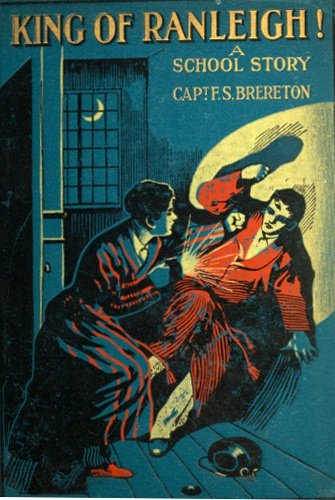
"You'll just jolly well pay up that ninepence or get kicked, young Masters," he said. "It's bad enough to have to lose a match like this, for I suppose that that's what's going to happen. I ain't going to lose money as well."
"But—but I swapped a fives ball," pleaded Masters feebly. "That's worth sixpence."
"Most are; yours wasn't. It went to pieces first game; it was a rotter," declared Franklin harshly. "None of your bunkum. That ninepence or a kicking."
It was no wonder that Masters welcomed the renewal of the game; though, to be sure, he was now silent. But in a little while he had almost regained his cheerfulness. For Sturton and his men were making the pace. Instead of playing on the defensive, they were carrying the war into the enemy's country. Within five minutes, in fact, they had scored a goal, whereat Ranleigh applauded vociferously.
"Just watch them closely, you fellows," Barlow cautioned his Parkland eleven, as they went back into their own ground for the kick off. "That was simply a rush. We got our first from them in the same way. Hold together and keep the ball always in their half."
"Well done," commented Sturton. "Don't let 'em rest. We're fit enough to keep at it hard till the whistle goes. So push 'em, boys."
How magnificently Moon used his fists! The shots which the Parkland team made at the home goal might easily have succeeded. But Moon made light of them. He always seemed to be in the right place and at the very right moment, while his ponderous blows sent the ball flying far from the goal. But if he had his work to do, so also had the keeper of the Parkland goal. Within ten minutes of the recommencement of play, Harper sent in a shot which struck one of the posts with a thud and scared the visitors. It brought a howl of delight and encouragement from the Ranleigh fellows.
"Pitch 'em in hard," Clive found himself shouting frantically. "Bravo, Sturton! Well done, Norman! Hooray for Ranleigh!"
But time went on swiftly. In spite of every effort, and in spite also of the almost obvious fact that Parkland men were hard pressed and none too fit, Sturton and his team had not yet equalled the score of the enemy. Ranleigh's score still stood at two, against three by Parkland, and time was terribly short.
"Play up, Ranleigh!" screamed the boys. "Stick to it, Parkland!" shouted the visitors. Sturton looked about him coolly, though there was anxiety in his eyes. He called to his men curtly. "Now, Ranleigh," he said. "Time's almost up. Let's do something."
They backed him up manfully. That brilliant little half who had nursed his forwards assiduously all through the game got the ball when all alone and dribbled it swiftly toward Parkland's goal. Ranleigh forwards were then well in advance, and a well-placed kick sent the leather neatly amongst them. Sturton passed with the rapidity of lightning to Harper, at the same time stepping aside to evade the frantic rush of one of the visitors' backs. Harper rushed the ball still closer to the goal, passed it to his nearest man, had it sent back within the instant and lost it. But that little half was there to support. He jogged the leather upward. A Parkland man got in a punt, sending the ball to a great height. There the wind caught it. Sturton, watching its flight, rushed in to meet its fall. A man charged him. He slid aside, and just in the nick of time headed the leather. A roar of cheering told him that he had been successful.
"A drawn game. Well, that's better than last time, when it was six to two," said Clive. "But it's rotten luck. Our chaps are heaps the better. Play up, you fellows!" he yelled, almost angrily.
And Ranleigh did play up. The eleven had seen Bagshaw consulting his watch with some anxiety and knew that there could now be but a couple of minutes left in which to finish the game. Parkland fellows knew it also, and were as keen to win as Ranleigh. Off went the ball again. Visitors and Ranleighan spectators of the game kept up a continuous roar, which might have been heard right down in the village. Scarves were waved aloft. Fellows tore up and down the field at the back of the spectators. Even masters were stirred out of their usual calm. But it seemed to no purpose. The ball oscillated round about the centre of the field for what seemed ages. Then the visiting team took it triumphantly along with them, and sent a long shot at Ranleigh goal which plumped straight for the centre.
"Done!" groaned Clive, hardly daring to look.
"Good old Moon!" shouted Susanne and Hugh together. "Moon's done for 'em. He's sent the ball back to our fellows."
It was an old trick of the Ranleigh goalkeeper. It may be doubted whether there are many goalkeepers who could put up a similar performance, for, as we have said, the Goliath in Ranleigh goal could strike with his fists harder almost than the average fellow could kick. In any case, he gave the ball a terrific buffet, sending it spinning back to the Ranleigh forwards. It was then that the fellows stood on their toes in their anxiety. Harper had the leather and muffed it. Sturton somehow managed to gain possession. It shot across to the far left a moment later, was rushed forward by the outside left, dribbled across to the inside man, and then sent flying between the Parkland posts. Perhaps ten seconds later, while yells of delight still filled the air, the whistle of the referee was heard blowing.
"Look here, Franklin," said Masters, meeting him some few minutes later. "Blow those colours. I don't care whether I owe you ninepence or nine bob. Come to the tuck for a blow-out. Ranleigh's won, my boy. A chap can't afford to quarrel about mere pennies on such a glorious occasion."
They chaired Sturton from the field. A pack of juniors endeavoured to do the same for Moon, but broke down under the ponderous burden. Even Parkland fellows cheered, for they were sportsmen.
"You played us a fine game and beat us handsomely," said Barlow, taking Sturton's proffered hand with a smile of friendship. "I hope you chaps will give us a return. My word, the improvement is an eye-opener!"
"And due to the new method," said the Head of Ranleigh that evening, when Sturton and the eleven took dinner with him. "This historic match is an answer to all critics. The School has much to thank our Captain for. The improvement in tone and fitness is wonderful."
Well, the day was done, the battle was fought and won, and Ranleigh was weary of triumph and happiness.
"Good night," whispered Susanne to Clive.
"Good night," came the answer. "Er—I say, Susanne."
"Eh?"
"There's one thing."
"Heaps," was the sleepy response.
"Yes, but I'm serious. I'm going to stick to footer till I get into the team. Hear that?"
"Mighty interesting," yawned Susanne. "Wake me up when you've got there, and, by the way, don't forget to speak when you are Captain."
Clive grew red with vexation. For he was serious, very serious indeed. In his own secret mind he registered that night a resolve to grow up as fine a fellow as Sturton, to fight his way into the football eleven, and—the biggest resolve of all—to even ascend to the glories of Captain of Ranleigh.
"I'll do it," he mumbled as he fell asleep.
CHAPTER XVI
A GREAT DISTURBANCE
Time waits for no one, and that statement was as true of Ranleigh boys as of any others. Clive Darrell, in a mere twinkling as it seemed, had become quite an old stager at the school. Since that momentous match when Sturton had led his eleven to victory, thereby stimulating Clive to declare the most ambitious of sentiments, two and a half years had slipped by, two and half years which had seen great changes at Ranleigh.
"But always the Old Firm hangs on and exists," reflected Bert, as he sat on the table in Upper Sixth and stared into the fire. "I remember the term when Harvey left."
"One of the best," interjected Susanne, now no longer a gawky, ill-dressed youth, given to smoking cigarettes on every occasion, but spick-and-span, as immaculate as Rawlings, very English in appearance, and looking quite twenty-one years of age, for the great Susanne sported a moustache, and could, had he wished it, as he often declared, have grown a beard even.
"Better than any of the masters, too," he had said. "Awful bore, don't you know, you fellows. A chap has to shave regularly now every day. That means getting up half an hour earlier——"
"Draw it mild," Hugh had cried. "Half an hour. That's enough for a dozen shaves."
Whereat Susanne had crushed his friend with a withering glance and an air of superiority which made Hugh blush.
"What do you know of shaving?" he had asked satirically, closely inspecting his friend's smooth chin. "Not much. You're a baby."
But the subject under discussion was the change which had come to Ranleigh. Harvey had swayed the destinies of the school. Then Sturton had come upon the scene with his new ideas of exercise for all every day. Clive remembered the success of that innovation. Then Lawton, an Upper Sixth fellow, had followed, and held the post for more than a year. Later Franklin had ascended to the giddy height to which Clive ventured to aim. As to the Old Firm, as Bert had said, it still clung tenaciously together.
"As big friends as ever," reflected Susanne. "That's something. Of course, there have been rows, eh?"
"Some. That one between Masters and Clive was a bad un. Remember it?"
Susanne did. It was back in a past age. It had taken place long ago. But in those days it had appeared excessively severe, and had threatened the break-up of the partnership. And the cause was really so very simple.
"All about a cricket ball," laughed Bert. "Masters had lost one."
"Yes, Masters always does lose something," agreed Susanne. "Of course, he discovered the exact article in Clive's locker."
"Of course! And claimed it."
"Refused all explanations. Almost went to the extreme of accusing Clive of theft. In the end said he must have put the ball there himself in mistake. They fought it out."
That was where the seriousness of the thing came in. And yet, looking back upon the event, there was little doubt that the tussle which had resulted cleared the air wonderfully. For Clive and Masters went at one another with their fists, and having struggled through half a dozen rounds were declared to have made a drawn battle of it. Of course they shook hands. In fact, within ten minutes of the finish of the contest they were chatting in the old amicable manner and demolishing a cake which had arrived at the school for one of them that very morning.
"And the funny thing about it all was that the cricket ball—the one Masters had lost—was discovered tucked away in a corner of his own locker, where, no doubt, he himself had placed it," laughed Susanne. "That's Masters all over. Flares out in an instant. Licks the dust afterwards when he knows he's wrong, and makes the most ample apologies. By the way, Bert, I wish that fellow Rawlings would take himself off. He spoils our happy family here. No one wants him, and precious few trust him. Besides, he's too old to be at the school any longer. He ought to have gone up to the 'Varsity long ago."
It may be said with truth and fairness that Susanne was by no means prejudiced. He didn't like Rawlings, and never had done so. More than that, Rawlings was decidedly unpopular, and had been so from the day when the ranks of the Old Firm had been recruited. Had he been different, more friendly and less underhanded, he would most certainly have been captain of the school. As it was the Sixth voted en masse against him, a fact which Rawlings did not fail to perceive. It made him furious. He hated his fellow prefects, detested the masters, and was stupidly and outrageously jealous of them all. And the presence of this unpopular fellow, older than any of the others in Upper Sixth, was a damper to their enjoyment. He was a damper elsewhere. In East he was head prefect, and a martinet. He seemed to air there all the high-handed manners he loved so much, and which were forbidden in his class-room. Why he remained on at the school was a problem which none could solve. But there he was, barred by the Sixth, detested by the juniors in his dormitory, and disliked by not a few of the masters.
Clive, too, had ascended to the Upper Sixth. It may be said, indeed, that his rise had been meteoric. Of a sudden he had taken most seriously to work, had developed an acuteness hitherto unsuspected, and much to the delight of Old B., who coached him, had rushed his way up the school till now he was the youngest fellow in his form. A prefect also, he was senior in his old dormitory, reigning where Sturton had once held sway.
Masters had managed to crawl to the Lower Sixth, and was noted in the school more for games than for lessons. His sturdy, genial figure attracted the admiring eye of many a junior as he tramped the corridor, and when we admit that he was still as much a boy as ever, we do no harm to his reputation. Trendall, now an excellent fellow, was with Susanne and Bert in the Upper Sixth, while Hugh, now Ranleigh's chief exponent of gymnastics, was in the Upper Fifth.
It seemed, in fact, that nothing more could be wanted by the Old Firm and their fellows at Ranleigh to complete their happiness, and that something approaching an earthquake would be needed to upset their equanimity. However, it is the unexpected which always happens, and one night Ranleigh was stirred to the very depths of its foundations.
"Darrell—I say, Darrell," whispered a tremulous voice somewhere near the hour of midnight, while a ghost-like figure bent over him. "Darrell, please, are you awake?"
Clive wasn't. He stirred uneasily at the touch of this junior's hand, for Parfit, the boy who had stolen across from his bed to wake him, was hardly eleven years of age. Naturally timid at the thought of disturbing so august a person as the head prefect of his dormitory, Parfit quaked as Clive rolled over on to his other side and snored. Then, as if forced on by desperation, the lad shook him with a heavy hand.
"Darrell, please," he called. "I—I——"
"Hullo!" Clive sat up, gaping and rubbing his eyes. "Bell gone! Eh? Then what the dickens——! Why, it's Parfit."
"Please, Darrell," said the youth, "I'm awfully sorry for waking you, but——"
"You'll need your sorrow, young un," came the none too friendly interruption, for Clive, like others, objected to be roused in the middle of the night without due reason. Not that he was hard with his juniors. Indeed, he was always jovial with them.
"Well, what is it?" he asked, hearing the boy's teeth chattering, and at once speaking to him kindly. "Been scared, eh? Been dreaming something that's disturbed you? Well, cut along, young un, you'll be all right."
But Parfit had no intention of cutting. "It's not dreaming, Darrell," he said eagerly. "It's fire."
"Fire!"
"Yes, I—I think. I'm next to the door, and I feel sure I can smell smoke. Please, Darrell, I hope you won't be angry, but I felt bound to come and wake you."
Clive was out of his bed like a shot, and getting into his dressing-gown and slippers before Parfit could believe it.
"You get back to bed, young un. I'll go and see. And don't talk of being sorry. If you smelled smoke, or thought you did, why, of course, the thing to do was to wake me. I'd have licked you if it had been a piece of foolery. But, right or wrong, you can expect only thanks for what you've done. So cut, there's a sensible fellow. I'll hop downstairs and see whether there's anything in it."
He slipped down the length of the dormitory while Parfit was thanking him, and swiftly pulled the door open.
"Yes, smoke," he told himself, sniffing. "And thick. I can see it coming up the stairway."
There was a gas jet on the stairs, kept burning all night, and sure enough, by the light it gave, smoke could be seen filtering up the stairs and whirling in thin wisps over the banisters. Clive shut the door behind him, gathered his dressing-gown about his body, and ran downstairs.
"I can hear crackling," he told himself, stopping for a second or more to listen. "That means a fire. George! This is serious!"
It was more, as he discovered when he reached the foot of the stairs. For there the smoke was dense and suffocating. It was swirling from the opposite side of the wide corridor passing between the two staircases leading to the South Dormitories, while beneath the one giving access to Two and Three South the flash of flames could be seen through the dense haze.
"A fire under the stairs. Spreading fast, by the look of it," Clive thought. "It'll reach the gallery above, perhaps, and then the fellows in South Dormitories would be cut off and would have to clear out through the door to West landing. What ought a fellow to do?"
His inclination was to go tearing off up the stairs to his own dormitory, there to awaken the boys, while he rapped hard at the door of the room leading out of One South, occupied by Mr. Branson. And then he thought of the excitement which would result once the alarm was sounded.
"Make sure that it's a bad thing first of all," he said. "I'm going to squint in through that door and see what's happening."
His eyes were shedding streams of tears by now, for the pungent smoke attacked them remorselessly. Then, too, he was choking violently. To cross the wide corridor below and open the door beneath the far stairway, behind which the fire lay without a doubt, meant encountering denser and still more choking fumes. But Clive did not think of the discomfort or of the danger of the act. He thought of the welfare of Ranleigh, of the commotion there would be were he to give an alarm, and of the fact that action on the part of himself and others of the prefects in South Dormitories might put an end to the fire, and that without disturbing others. Wrapping the tail of his dressing-gown round his mouth, therefore, he darted to the bottom of the stairs and raced across the corridor, diving into a swirling cloud of choking vapour through which he could not see. But the reflection of the flames within the door he aimed for caught his eye. He felt for the handle and pushed the door open. Instantly flames blazed out at him, while hot smoke poured into his face, enveloped him completely, and went swirling up to the roof. There was a perfect furnace beneath those stairs. He could hear the woodwork all around crackling. It was clear that the conflagration was of a serious nature and most threatening. Instantly he banged the hot door to, and raced across for his own stairway. And in the short time it took him to ascend he had made up his mind how to act.
"Wake Susanne first. Let him do the same for the other prefects. Then take towels, blankets, and water. If the thing can't be beaten out, we'll wake Mr. Branson, and turn every fellow out of the dormitories. Here goes for Susanne."
But a violent fit of coughing doubled him up at the top of the stairs, and for a while he was helpless. "Please, Darrell," he heard in the midst of the attack, while Parfit's voice came feebly to him, "is—is it smoke? Is there a fire?"
Clive did not deign to answer. He shook off the fit of coughing with an effort and raced into Two South. He knew exactly where Susanne slept, and soon had that worthy along with him. In fact, in less than two minutes every prefect in South was mustered. Taking their bath towels with them and bearing cans of water they dashed down the stairs, while Clive himself reached for the extinguisher kept on every landing.
"We'll give it a trial," he said to Susanne. "If we don't make any sort of effect on the fire we'll sound an alarm, collect all prefects, and man the hoses. In fact, as only three or four of us can work below, I'll get Slater and Gregory to mount the nearest there is. Come on, you fellows."
A word to the two junior prefects, Slater and Gregory, sent them off post-haste to the nearest stand-pipe, near which a hose was coiled, while Clive led the way down the stairs to the site of the fire.
"Tie your towels round your faces," he gasped, for the smoke was even more irritating now, and was denser even. "Now, we've half a dozen cans of water between us. I'll open the door. Let my extinguisher play on the flames for a while, and then finish the business with water."
But though an extinguisher may be an excellent invention, and will extinguish a fire swiftly, its successful action depends entirely on one point. The contents must be delivered on the fire direct, and to that end the one who grips it must approach sufficiently close to the flames. Here, as it happened, that was almost impossible. For when the staircase door was thrown open the improvised brigade was swept back by an appalling gush of flame and smoke. Clive ducked his head, turned his face away, and set the extinguisher going. But the effect was nil, for the actual fire was situated round the angle of the door. Clive forced his way nearer till he was within two feet of the entrance, and endeavoured to direct the jet round the corner. And then Susanne dragged him backward.
"THE IMPROVISED BRIGADE WAS SWEPT BACK BY AN APPALLING GUSH OF FLAME AND SMOKE."
"You can't do it," he said peremptorily. "Your clothes are on fire already. Here, you chaps, help to beat them out."
The effort to say as much set him coughing violently. But the words were heard distinctly, and Martin and Fellows, two of the helpers, at once attacked the flames which had taken hold of Clive's dressing-gown. A moment later the whole party was forced into the outer corridor by an even fiercer blast of flame, accompanied by pungent smoke.
They gasped for breath, and then looked desperately at one another.
"We must rouse the school," declared Clive.
"Certain," came from Susanne.
"Then let's do it. I'll take South. Susanne, will you go to North? Martin can take East and Fellows West. Don't shout. Wake the chaps quietly. I'm going to shut that door first, though, and see what Gregory is doing."
There was no time for discussion, for it was clear that they had a serious fire to contend with. And though Ranleigh, like every other well-managed school, where thought is taken for such a happening, was equipped with extinguishers and hoses, while the boys were given fire drill at regular intervals, it looked as if this outbreak might prove too serious for them. Clive looked grave when he thought of what might happen.
"Couldn't expect much help from the village," he told himself. "The whole place would be on fire before they could possibly get here. We've got to fight this thing out ourselves. Ah, there's Gregory. Got it fixed?" he asked, as that youth came panting through the smoke towards him.
"Nearly," came the answer. "We shall want another length of hose. I'm going for the one at the end of the corridor. We'll have it ready in two minutes."
"Then I'll get up to the fellows in South. Look here, Gregory, I'm going to shut that door now. When you've got the hose going, break the place open and play direct on the flames."
He dived through the smoke, his towel pulled up to his eyes, and, led by the red glare of the flames, was soon near the door. But the heat was now overpowering. Though Clive tried twice, he could not get near that handle, while at the end of the second attempt his gown was again in flames and he had to beat hard with his hands to extinguish them. Meanwhile, the peace and tranquillity of Ranleigh's night was swiftly being disturbed. A hum was coming from the dormitories. Clive found One South in a condition of animation.
"Turn out, you fellows," he said, as if this was the most natural thing to expect them to do, and as if it were the usual time for rising. "Stay here till I give you permission to move. I'm going into the other South Dormitories. I shall want Peart and Godfrey and Offord when I get back. You other fellows had better make a bundle of your things. There's a fire below. I'll kick the first fellow who makes a shindy."
One by one he awoke the dormitories, commanding the boys in Two and Three South to gather their belongings at once and pass out through Four South. By the time he reached his own dormitory again every boy was ready, while those he had called for were standing in the gloom by the door.
"You others skip," said Clive, still in his ordinary tones. "Peart, go along to the Head's house and ring till he answers. Tell him what's happening. Godfrey, you get off to the Matron, and knock at her door. Tell her not to be alarmed, but merely to make ready and warn the maids. Offord, your job is to rouse the butler and the beakies, and tell old Sant to cut the gas off at the meter. There, off you bundle."
He seemed to have been giving directions for an age, whereas from the commencement, when Parfit had wakened him, till this moment, but very few minutes had elapsed. But those few minutes had made all the difference to the conflagration. When Clive dashed out of the dormitory, having wakened Mr. Branson, and descended the stairs, the opposite staircase was blazing, the flames sweeping right up to the roof of the corridor. The crackle of flames could now be distinctly heard, mingled with a curious sizzling. In the far background, through the doors leading to the quad, as a rule kept firmly fastened, he imagined he could make out a group. Then thick volumes of smoke hid everything. He felt someone step down beside him, and then heard Mr. Branson speak.
"It's serious," he said. "You've called the Head?"
"Everyone, sir," said Clive. "Gregory's out there, I think, with one of the hoses. Fancy we could do something from here. I'll see."
Unceremonious at such a time, he bolted up the stairs again and so to the West landing. Five minutes later he and Susanne held the nozzle of a second hose, and from the point of vantage which the stairs gave them poured a torrent of water into the blazing mass on the opposite side of the corridor.
Meanwhile, it may be imagined that Ranleigh was in a condition of disturbance, though thanks to the example which Clive had set in the first place, and which Susanne and the others had so naturally copied, there was no panic, nor even shouting. Perhaps five minutes after the first alarm, when it had become obvious that the whole school must be roused, every Ranleigh boy was assembled in the quadrangle, where, pressing as close as possible, they watched Gregory and his friends directing water upon the flames. They would have hampered the workers even had not Masters and Trendall promptly taken a grip of the situation.
"Look here, you fellows," cried the former, "you'll all get back to this line here. That'll give the brigade every chance to do their work. Trendall, send along anyone who breaks the rule. I'll deal with 'em."
There was something sinister in the speech, and hearing his voice Ranleigh obeyed on the instant. For Masters was accustomed to speak in jovial tones. With him an order came always as a request, such as, "Oh, I say, Parker, just cut along like a good chap and bring down my cricket togs," or, "You fellows here in Middle, there's a beastly noise. Go on with your prep., do."
And his requests were obeyed with promptness as a general rule. If not, on rare occasions, Masters could become very insistent. But he was seldom threatening, and hearing the threat in his voice now small boys slunk back to the quad steps and, with bulging eyes, watched the fire over the heads of their seniors. Fellows in the Upper School shuffled backwards, eyeing Masters askance, while even those in Upper Fifth, fellows soon to be prefects and perhaps a trifle jealous of the Sixth and of those in authority, quelled their inclination to push to the front.
At this moment the familiar figure of the Head arrived on the scene.
"Who's directing matters?" he asked of Mr. Branson, who stood beside the group of boys plying their hose from the entrance to the quad.
"Well, I am partly, and Darrell is mostly," came the answer. "Of course, I haven't had time yet to learn how the thing was discovered. But when I was awakened Darrell had made all arrangements. He and those with him, Feofé and others, have behaved splendidly. There hasn't been a sign of panic. Boys in South have cleared out with all their belongings."
"Good. Where is he? What other directions has he given?" asked the Head.
A gust of wind at that moment went swirling through the centre corridor past the fire, sucking long tongues of flame along with it and carrying them toward the chapel. But it also had the effect of sweeping the smoke away, enabling those in the quad to see their comrades grouped on the staircase opposite the one beneath which the fire raged. There they were, sheltering behind the blistering woodwork which formed the closed banisters, the heads of three of them, wrapped in towels saturated with water, just appearing above the rail. A nozzle between two of the heads gripped by a pair of hands sent a jet of water sizzling across the corridor into the centre of the fire. The Head thought he could recognise in one of those towelled faces the features of Clive Darrell.
"Can I get through?" he asked, stepping toward the entrance of the corridor.
"Too hot, sir," Mr. Branson told him. "You must go round by West. I'll stay here and direct matters. I think we are getting the better of the flames."
At once the Head of Ranleigh turned and hurried away, the boys collected in the quad making way for him. And we must state it now with no small degree of pride that he set as fine an example as had any of the prefects.
"Might easily have been a panic, with all the boys rushing here and there shouting and shrieking," he told himself. "Everything is wonderfully orderly. I must back these boys up. Coolness is what is wanted. But I must also learn what steps Darrell and his helpers have taken in other directions. That's essential. One has to consider what to do supposing the flames beat us."
It was therefore, in spite of his hurry, with measured tread and an appearance of unconcern that Ranleigh's Head stalked through the assembled boys and reached West landing. A minute later he was amongst the prefects on the South staircase, watching that descending jet of water pouring into the flames.
"Which is Darrell?" he asked coolly, and at the sound of his voice one of the group turned. Clive, for he it was, tore the towel from his face at once and smiled at the master.
"Getting it down, sir," he said.
"Ah! You could leave for a moment? The smoke here makes one cough."
Clive handed the nozzle to his friends and went up the stairs two at a time. At the top the two stopped to discuss matters.
"Now, tell me how the thing was discovered and what steps you have taken to warn people," asked the Head.
"Parfit smelled smoke," said Clive hurriedly, anxious to get back to his task. "I came down and found the fire. Then I turned Susanne—er—Feofé, you know, sir."
"Yes, I know as well as anyone," smiled the Head.
"I turned him and all the South prefects out. We tried to stop the fire with an extinguisher and cans of water. But the thing had got too firm a hold. It was really serious. Then we decided to call up the school and man the hoses. Gregory and Martin did the last. I sent prefects round to the various dormitories. Fellows from One South were told to call you, the Matron and the butler and his men. Er—that's all, I think."
"All? Then you haven't——?"
"Oh, I forgot," said Clive hurriedly. "Of course, I told 'em to turn off the gas, so as to save an explosion, and I sent for the butler. One of the men got on to his bicycle at once and went off to call the village brigade. But we'll be able to do without them, sir. Can I return now, sir?"
He was eager to get back, and the Head dismissed him with a hearty shake of the hand.
"You've done splendidly, Darrell," he said. "There really was no need to call me. I shan't interfere. I shall watch, and if you get the fire down, it will be all of your own doing. I'm proud to have such prefects."
Well might he be proud too. The seeds which Harvey and Sturton had sown two and more years ago were now bearing fruit with a vengeance. Perhaps at no previous period had Ranleigh been blessed with such a set of prefects, and here was proof of it. The orderliness of the school under trying circumstances was extraordinary. The coolness of those who had taken the fire in hand, and their measures to warn all and sundry, were really remarkable. No wonder the Head was filled with a glow of pride. No wonder Ranleigh boys went mad with delight as they saw the flames extinguished. And then how they cheered the fellows who had been conducting the fight!
The early morning found the Hall filled to overflowing. Masters were there in full strength. Ranleigh was present without exception, some of the smaller boys yawning widely. Even the village fire brigade had been invited to partake of refreshments. And then they slowly filed off to their beds, a whole holiday with late breakfast having been proclaimed from the dais. But that holiday was one only in name for Clive and Susanne and a few others. They collected in the Upper Sixth when the school was almost empty, and Susanne shut the door and turned the key.
"Now, Clive," he said, "you tell the fellows."
At once eager glances were cast at our hero. Masters sat up abruptly. Bert stood looking almost fiercely at his old friend, while Trendall was obviously puzzled. Clive went to the fireplace, leaned against it, and slowly glanced at each of his comrades in succession.
"It's a beastly thing to have to say," he began, somewhat awkwardly. "But I'm bound to tell you. That fire was started on purpose. Someone wanted to burn the school down. I'm positive."
"What! Positive! Surely there's a mistake," gasped Bert.
"None. Susanne will tell you. I'm going to show the proofs to everyone present, but only on a pledge of secrecy. You give it?"
They nodded at him one by one.
"You can trust us to a man," said Masters.
"Then come. Ourselves and the village sergeant are the only people aware of the business."
"And, of course, the beggar who carried out the job," said Susanne bitterly.
Never before perhaps had a group of the school seniors looked so serious. Jones Quartus, happening to meet them as they issued from the Sixth and passed along the corridor, positively shrank away from them. The group of curious youngsters gathered near the site of the fire shuffled backwards.
"Here, cut!" commanded Masters abruptly, and at the word they bolted, as if only too eager to escape from the presence of their seniors. Then Clive led the way. When he and his friends returned to the Sixth some five minutes later, accompanied by the police sergeant, not the smallest doubt existed in their minds that some miscreant had successfully attempted arson, and that the fire had been started for some sinister reason.
"We've got to get to the bottom of the mystery," said Clive.
"Yes," agreed Susanne. "But how? That's the difficulty."
It was, in fact, an absolute necessity, for the two weeks which followed saw no fewer than three other outbreaks of fire on the school premises, all, however, happily extinguished after causing little damage. It was no wonder, then, that the prefects of Ranleigh set themselves seriously to work to discover the incendiary.
CHAPTER XVII
WHO IS THE SCOUNDREL?
It was a saint's day, and Ranleigh made holiday once Chapel was ended. Outside in the playing-fields the shouts and laughter of the boys could be heard distinctly from the Sixth Form room. Occasionally there was a clatter in the tiled corridors over which the feet of so many Ranleighans had passed in the years gone by. Otherwise there was peace and quietness in the school and the time was propitious for discussion. And in the Upper Sixth Form room voices subdued and smooth exchanged the views of various of the prefects. Trendall was there, watching Clive and Susanne with a friendly smile of approval. How different from the glances which he had once cast at them! Bert, cool and dreaming as of yore, apt to indulge on every opportunity in satire, sat upon the corner of the table staring thoughtfully into the fire. Masters stood propped in one corner, nibbling the end of a pencil and glancing first at one of his friends and then at another. By common consent Clive had been voted to the chair.
"We've got to do something, and at once," he said, commencing the proceedings as soon as he had occupied the only chair in the room. "It is up to us to act."
"Hear, hear!" from Masters. He stopped nibbling for a moment. "Hear, hear!" he repeated, and then went rather pink seeing the eyes of all on him.
"And at once," asserted Clive again.
"Without delay, certainly," agreed Bert crisply.
"That is, once we've come to a decision what shall be done. No use acting without a plan," said the wise Susanne, an opinion which Trendall applauded.
"Then, it being agreed that something must be done, and at once, we come to the crux of the situation."
Clive looked at each in turn invitingly. "We want ideas," he went on. "We've reached a crisis here. Has any fellow any plan to put before us?"
There was silence. Masters took to nibbling his pencil violently. It was obvious that he was very much disturbed in his mind. Susanne kicked the worn floor boards impatiently, while Trendall and Bert seemed to have all their attention centred on the fire. But no one accepted Clive's invitation to speak. To tell the truth, no one had so much as an idea. The situation with which Ranleigh was face to face was unique.
"I'll recapitulate events," said Clive, for he was wont in these days to use some terribly long words. The slang so common to his speech in bygone days was now almost forgotten. Indeed, the manners and the ideas of the Old Firm had changed wonderfully and very much for the better.
"There was a fire two weeks ago."
"Hear, hear!" cried Masters, whereat everyone glared at him.
"Glad?" asked Bert, with cutting sharpness. "Perhaps you'd have liked to see us all consumed!"
It was Masters' turn to become scathing.
"A fine thing to suggest," he cried. "You'll say I made the fire," he retorted. "Go on, Clive. Bert's out of sorts this morning. There was a fire. Right. Hear, hear! Let's get along with it. I've a right to say hear, hear! Didn't the fire give us a chance of seeing what Clive's made of, and the sort of chaps we have at Ranleigh?"
He wore an air of triumph. The others present at this meeting applauded loudly.
"It was fine," said Trendall, his eyes sparkling. "The Ranleighan'll have a fine tale to tell. Though I'm one of the prefects I'm bound to admit Ranleigh did well. The Head said so; so did the 'Surrey Liar.'"
It was the name given to a certain county paper which had come out with a fine description of the fire at Ranleigh, and had eulogised the behaviour of the boys. However, this was not getting along with the discussion, and Clive therefore took the matter up again.
"There was a fire; we checked it. It was put out," he said. "Of course, there was an investigation, as a result of which we discovered that paraffin had been thrown about in the big cupboard under the stairs. There were some unconsumed shavings there, as well as a tin which had once held paraffin. That tin came from the boot-room where the beakies work."
"Proving that one of the beakies was responsible for the business," cried Trendall.
"Not at all. The boot-room's open always. You or I could easily enter. Still, it doesn't say that a beaky did not start the fire. This is clear, however, that fire was maliciously set going by someone, and that someone belongs to Ranleigh."
"Either as boy or servant," said Susanne. "Of course, we rule masters out. Such a thing is impossible with any one of them."
"And boys too," suggested Bert. "Whoever heard of a fellow wanting to make a blaze of his school? It's preposterous! So we come to the conclusion that the miscreant is a worker here. In fact, one of the many servants."
There were enquiring glances between the debaters. In the end all turned to stare at their chairman. But Clive's young face was inscrutable. He neither supported nor opposed the statement for which Bert was responsible.
"What's the use of trying to narrow our suspicions down to a single group?" he asked. "On the face of it, I admit that a servant may very well have been responsible for that fire. But then, it might have been anyone. There was a fire. That's good enough for us, and we know that it was purposely set going. We know also that there have been others, and that in every case there is clear evidence that an incendiary was at work. Well, there's the position. You chaps have got to tackle it."
There was, in fact, no need to add to his description. Somewhere about Ranleigh there existed an incendiary. Who was he? Boy, master, or servant?
"Or lunatic," suddenly asked Susanne, as if he imagined that others were following his train of thought. "That's it. Is the fellow who's doing this caddish business merely a lunatic, and so irresponsible?"
"Mighty likely," agreed Masters, coming closer and looking very earnest. "But what if he is? Where's the difference? There's an incendiary all the same, and wondering whether he's boy, master, or servant, and in any case sane or mad, helps us not an atom. Let's stop jawing about things that don't help and get to real business. I'm for watching."
"Watching what?" asked Bert sharply.
"The school, of course. Parading the corridors."
"When? At night?" asked Trendall at once.
"When have the fires broken out? Always at night time. Always between the hours of eleven and one a.m. Then that's the time for watching."
"And you suggest that the prefects do this watching?" asked Clive. "The scheme is one that promises finely. As you say, every fire has occurred in the hours you mention. If the place had been patrolled, then the fellow responsible would have been discovered. So you suggest that the prefects take it turn and turn about to watch? Isn't that it, Masters?"
"Not a bit. I'll ask a question. Has any fellow here any doubt about the others in this room? No? I can see you haven't. You needn't stare at me as if I'd accused you, Bert. I merely asked a straight question. Well then."
"Yes, well then," repeated Susanne encouragingly.
"Can any fellow here say that he's absolutely sure that the culprit isn't to be found somewhere amongst the prefects?"
They shook their heads slowly at him.
"Masters is talking sense," asserted Bert, after a few seconds' silence; whereat the great Masters flushed a beautiful red. It wasn't often that Bert praised. And if he did, there was often enough a sharp sting underneath his compliment. "He's talking sense," repeated Bert, "for once in his life. I'm glad."
"Ah!" gasped Masters. He would gladly have set upon Bert at that instant. But then, everyone knew that Bert was always quizzing. He was grinning even then. Why on earth couldn't he be serious sometimes and forget his quizzing and his satire?
"A fellow can't get along when he's interrupted by an idiot," growled Masters. "Where was I? Oh, I remember. Well, you can't swear that this lunatic isn't to be found amongst the prefects. All the same, I'm open to stand treat to everyone here if a Ranleigh prefect proves to be the fellow. Ranleigh prefects ain't that sort."
He puffed his chest out and flushed red as he spoke. Masters took a tremendous pride in his school and his fellows. "There's not one who'd be such a cad," he declared. "Don't you deny it, Bert."
"Certainly not. I'm in agreement. I'm only smiling at my thoughts. I was just remembering the time when Masters wasn't a prefect. A bigger set of cads and bullys then didn't exist, er—according to Masters. Of course, I agree with what he says now. Ranleigh prefects are fine fellows. Ain't we amongst the numbers?"
There was a general tapping of feet on the floor. The men present were getting impatient, and really it wasn't the time for wit. They glared at Bert.
"Shut up!" commanded Susanne. "Let Masters get along. Well?"
"Well, there you are," said that worthy. "You ain't certain of all the prefects. But you are of the lot here. Supposing we decide to watch. Here are the watchers. We keep the thing to ourselves. Not a word to the others."
"And watch all night. A tough proposition," reflected Trendall. "There are five of us."
"Call it six," said Bert. "There's Hugh. He's not much good; but he'll do."
"Then six," Clive told them. "Two every night. That means one night's patrolling in three. A fellow could manage that easily, and we can always put in a sleep during the day. Then I suggest that we divide ourselves into three parties, each consisting of two. Those two will each take half the school premises, and will meet on their rounds every few minutes. It'll help to keep 'em awake."
"Awake! As if a fellow would care to sleep and so fail in his job," cried Masters indignantly.
"You wait," said Bert. "A chap gets awfully drowsy about midnight, particularly if there's nothing doing. The suggestion Clive has made is good. Get along, Mr. Chairman."
"Then we divide into twos and patrol, each man meeting his fellow every few minutes. Of course, we shall want rubber shoes and a dark lantern apiece."
"And a revolver?" asked Trendall eagerly.
"No. Nothing. If a Ranleigh chap can't use his fists if there's occasion, why——"
"Better chuck the business now," said Susanne. "Clive's right. No weapon is wanted. Once we catch sight of this chap we shall know how to deal with him. So mum's the word. Not a whisper to the other fellows."
"Tell no one, not even the Head," cried Bert. "Secrecy is of the greatest importance. I suppose we start to-night?"
"At once," agreed Clive. "Let's put the six names on strips of paper and draw them from a cap. That'll give us our couples. We can toss to decide who's to take the first patrol."
They carried out this suggestion promptly, and within a little while had the matter settled.
"Susanne and Hugh together," said Clive, reading out the result. "Then Trendall and Bert. Masters and I go together also. Now for first turn. Up with your pennies."
It happened that Bert and Trendall were to be the first to patrol, and it may be imagined that there was a considerable amount of suppressed excitement about those two worthies, as also amongst their companions in the adventure, as the evening approached. But the Old Firm had had an excellent training in smothering their feelings. To look at them that evening as they took prep. in their several form rooms you would have thought that they had no such thing as a secret. In Chapel Bert's face was serene as he went to the lectern to read the lesson. And how well he read! Sitting back in his place amidst the men of the choir, Clive could not help but admire. His memory carried him back to that day now it seemed so long ago when he himself, then small and puny, had for the first time entered this handsome building. He recollected how he had watched Harvey ascend to the lectern, with what awe he had regarded him, and how he had trembled at the thought that some day he might be called upon to carry out the same duty. And here he was, destined to read the second lesson of the evening, cool and calm, nevertheless, admiring, as admire he must, the smooth, even reading of his old friend Bert.
Then they trooped out to the dormitories. There was the customary ten minutes' silence, and then the hum of many tongues wagging. But gradually the sounds died down, till there came the heavy-footed thud of the beaky. Out went the lights. From many a bed came the snores of sleepers. Clive lay with wide-open eyes listening and thinking. He wondered what Trendall and Bert were doing, for it must be remembered that the rise of the Old Firm in the school had resulted in a partial severance. As prefects they were divided, Clive ruling it in One South, his old dormitory.
Ah! he heard someone stirring! A door opened. It was not in One South. Where was it?
"Old B. coming to bed," Clive told himself. "Then it's about eleven. Those two will be slipping downstairs in a few minutes."
Yes, it was nearly eleven. The big clock began to chime the quarters as the door of One South was noiselessly pushed open. Clive lifted his head and looked in that direction. The well-known and popular figure of Mr. Branson entered the dormitory. On tip-toe, for he was ever thoughtful, bearing a lighted candle in one hand, he gently closed the door and slid across to his own room opposite. And in the years that he had been at Ranleigh, how many boys had seen him going to bed? Not many, we trow. Not because of the late hour, for Old B. did not hold with them. But simply for the reason that boys sleep well, while Old B.'s steps were of the lightest, in spite of his burly figure. The door closed after him, the last stroke of eleven sounded. Silence fell upon Ranleigh school and its surroundings. And then Clive's eyelids drooped. Like the other fellows in the dormitory, he fell asleep and forgot for the moment all about the task which he and his friends had set themselves.
"Well? What happened? See anyone? Hear anything?"
The questions were rained upon Trendall and Bert as soon as the Old Firm were gathered on the following morning.
"Not a soul. But Clive was right about a fellow getting drowsy," said Trendall at once. "If it hadn't been for the movement and the need to meet Bert I'd have dropped off on many an occasion. I met him five minutes after the hour of eleven had struck. We went off to bed at two o'clock precisely."
"Then Bert? Well?" asked Clive of that young fellow. Bert grinned. Evidently he had contrived to gather some fun out of the adventure.
"Jolly nearly made an awful ass of myself," he grinned.
"Where's the difficulty?" asked Masters, with unaccustomed satire. "Ain't it pretty usual?"
"Shut up!" cried Clive. "You chaps are always sparring. Now, Bert."
"Masters would have landed us finely in the soup if he'd been there," continued the one addressed. "You see—well, is it necessary to explain why he'd have done the usual? No. Well, then, I started with Trendall, and just ten minutes after twelve heard someone moving."
"Ah! Go on," gasped his listeners.
"Someone moving! Who?" asked Hugh eagerly.
"I'm coming to it," said Bert coolly. "It was somewhere close to the spot where the fire first took place. I crept in that direction."
Clive felt a queer little sensation about his spine. Bert's narratives were always a little uncanny. He could imagine him creeping like a snake towards the point where he had heard someone moving. "Do get on!" he cried impatiently. "You do take such a time to tell what happened."
"And you're always in such a violent hurry. Well, I crept there. I was in the quad, of course, and as all the corridor windows are open I could easily look in. There was a step in the corridor. Some fellow was creeping along. But he wasn't silent altogether. Now and again his boots made quite a noise. I slid along parallel with him."
The faces of the listeners grew eager. They pressed a trifle closer to Bert, wondering what was coming.
"At the corner of the quad, where the corridor turns, the fellow came to a sudden stop," said Bert. "Things looked fishy. I could hear him rummaging in the boot lockers standing there. I wondered whether I ought to open my lamp and take a squint at him. You see, I wasn't at all sure who it might be."
"Of course," agreed Susanne. "You wanted to get some idea. You didn't want this beggar to know that you were there till you were fairly sure what he was up to. You see, we're watching for an incendiary. We ain't out for any other purpose."
"I'd have collared the chap at once," declared Masters, who was nothing if not impetuous.
"Ah, yes, you would," Bert told him, smiling pityingly on him. "That's just my point. Here was a splendid chance for a fellow to make an utter hash of the business and an ass of himself into the bargain. Masters would have collared the beggar. I didn't. That's the difference. You see, it wasn't an incendiary."
"Then who was it? Tell us," demanded Clive.
"Only Raleigh, stinks master," grinned Bert, whereat there was a roar of laughter. Masters even grinned, though he felt really angry with Bert. Then, suddenly remembering the episode of the burglars, he smiled sweetly at him. It would do for next time, he thought. When compliments were flying around again, and there was need for gentle repartee or a stinging retort, he had it ready. Asses indeed! Bert needn't talk after such a business.
"You see," went on Bert, "he'd been out to supper with some people, I suppose. Ain't he rather gone on that Miss Daisy?"
There were nods from the circle. It was a well-known fact that the science master was paying his addresses at a house in the village. Miss Daisy often took part in Ranleigh concerts, and was decidedly popular. So that, if it were any relief to Mr. Raleigh, he had the good wishes of all at the school.
"They're engaged," Trendall told the company. "They'll be married in the summer."
"Then good luck to 'em!" cried Bert. "Well, there he was, and all the fumbling was for a candle. He found it after a while, just when I thought he must have laid his train and splashed the petroleum about in preparation for a fire. In fact, I was within an ace of flashing my lamp on him when there was the scrape of a match. It made me feel quite funny, I can tell you. I thought he must be about to start the fire. And then, when the flame burned up I saw Raleigh's features plainly. He lit his candle, stamped on the match, and went up the stairs to his room whistling quietly. There, you've got my report. I was getting a bit sick of watching when the time came along to give up. Masters, just you take warning by what happened. It's lucky we're not going to take revolvers. You'd have shot poor Raleigh at once, and then Miss Daisy'd have been a widow before she was married."
Bert was perfectly right in repeating the warning, and perhaps it was stupid of Masters to listen to it so unkindly. But then, had he been impetuous, Mr. Raleigh would have become aware of the watching, and, no doubt, every one of the masters as a consequence. However, no mischief had been done, and the secrecy so important to the success of the business was still maintained. That second night Susanne and Hugh took their posts in the corridor, prepared to watch the security of Ranleigh. Nor had they much to report when again the Old Firm was assembled to hear them.
"But it's a bit of a joke, all the same," laughed Susanne. "Wonder what the masters would say if they knew how we were watching? One generally supposes them to be abed at a respectable hour. But they ain't always. It was Raleigh's turn last time. Hugh and I saw two of them creep in between twelve and one while we were watching. Who knows? Perhaps Clive and Masters'll have the pleasure of welcoming the return of the Head from a supper party."
That made them grin. Bert jogged Masters' elbow. "What a lark it'd be!" he said. "Of course, you'd collar him. My word! The scene would be worth watching."
Perhaps it was as well that the members of the Old Firm saw every atom of fun that was going, for the task they had set themselves was destined to prove monotonous. After all, once the novelty of patrolling a huge place wears off, it has few attractions. Then, too, a cosy bed pulls hard after a long day's exercise. A whole fortnight passed, in fact, without anything unusual happening.
"Someone's twigged what we're doing, eh?" asked Susanne.
"No," said Clive. "I'm certain. But whoever set those fires going is too canny to be caught easily. They say that lunatics are awfully artful. This chap's stopped for a while. We've just got to be patient."
And so for a few more days they continued watching, shadowing many a late-returning master. It was almost three weeks from the date of the commencement of this duty that Clive heard sounds that roused his strong suspicions. Someone was moving in the corridor, someone who had not entered the school through the front door as had been the case with masters. A figure glided past him as silently as a ghost. This was something entirely different from what he had experienced in the whole course of his watching.
CHAPTER XVIII
TRACKED DOWN
Clive stood as still as a post, watching and listening. Overhead there was a small crescent of the moon floating over the school and partially illuminating the quad. But the corridors were plunged in stygian darkness. Had he actually heard anything? Had someone really passed him?
"Well, I'm jiggered," he observed to himself, clinging doubtfully to one of the cross-bars placed across the usually open windows of the corridor by a thoughtful directorate, and with a view to keeping small boys from clambering through them. For it was the custom at Ranleigh to indulge in an ample measure of fresh air, and those corridor windows remained free of glass until the depths of winter.
"Feel certain someone went by," thought Clive. "Felt rather than heard him. But—but where's he gone? Is he just opposite me. Ah!"
No wonder he was puzzled, for as we have intimated, whoever had gone down the corridor had made not the smallest sound. Recollect that it was a little past midnight, that the school was plunged in slumber, and that, to the best of Clive's belief, he and Masters were the only two about the premises. Remember that the circumstances provided an intense stillness, and that at such times sounds usually inaudible come to the ear with certainty. He had heard something, he was sure.
"As if a fellow had a dressing-gown on and the gown were trailing on the ground," he told himself. "The merest whisper. It may have been a man's deep breathing. But there's not a sound now. Not a single sound."
But there was something else. There came the flicker of a light away to his right, a mere flicker, and then the same all-pervading darkness. Clive slid off in that direction at once, halted when he judged he had reached the correct position, and strained his ears and eyes to detect the author of that sudden glimmer. And what a job he had to be sure to drown the sound of his own breathing and his own thudding heart beats! That was the worst of such intense stillness, and of excitement, for he was excited.
"The chap took me by surprise," he muttered beneath his breath, as if by way of excuse. He struggled against the feeling of excitement, but failed hopelessly. His heart still thudded against his ribs, beating with unusual rapidity. And then, worse than all, a sudden tickling sensation at the back of his throat assailed him. He was going to cough. He was——
No. He beat the feeling down, and of a sudden once more had all his attention engaged elsewhere. For from a spot some ten feet to his right, from the centre of the inky darkness of the corridor, a jet of light swept across to the far wall. He could see the actual point from which it arose. There the beam glowed brightly, perhaps an inch and a half in depth. It spread itself gradually through the darkness, till it obtained much greater dimensions and finally settled on the brick and stone inner wall of the corridor in a wide ellipse of light. Silently it stole along the brickwork till it fell upon a door.
"The Head's entrance to his house. This is queer," Clive thought, while his excitement rose. Let us be brutally frank about this young fellow. He was no coward. He was noted for dash and courage at Ranleigh School. But, like every other fellow there, he was susceptible to outside influences. And here was one decidedly uncanny and out of the ordinary, one which affected him most strangely. Clive felt positive pain in his scalp. His hair bristled beneath the school cap which he had donned for this adventure. He felt almost scared. Raising his hand he thrust the fingers beneath his cap, and instantly the beam of light vanished. It was there one instant. It was gone the next. There was merely dense blackness, and silence.
"Phew!" Perspiration trickled over his brows. His palms were moist and clammy. He began to wish that Masters would turn up, only that would be awkward.
"Give the whole show away," he told himself. "This is beastly ghostly and uncanny, but I ain't going to be funked. There's something mighty suspicious here, and that beam comes from an electric hand light. Then there is someone operating it. Ghosts don't have such things. Don't need 'em."
The very thought tickled him vastly. It was queer at such a moment to be struck by the utter absurdity of the suggestion that a ghost should require a lamp, and should be so up-to-date as to have adopted an electric one. Still, the deathly silence gave a most undoubted ghostly appearance to the whole transaction, and we must excuse Clive if he was impressed by it.
"He ain't moved. Shall I show him up with my lamp?" he asked himself. "No, I'll wait. Ten to one this is the beggar we're after. But he's done nothing yet. I'm out to catch an incendiary, and if this is he, why, I sit tight till he's got to the business."
Ah! The beam flashed again, alighting on the tiled floor of the corridor, and stealing along it to the foot of the Head's door. It slowly climbed it till it reached the keyhole, concentrated itself upon that orifice, and then gradually grew smaller and more brilliant, while the point from which it originated approached the door ever so slowly, the beam shortening in proportion. Click! There was the faintest of sounds in the distance. The beam disappeared, strangled by the hand which operated the lamp.
"Masters making his round and coming along to meet me. He'll alarm this beggar," thought Clive. "Better get off and warn him. I'll get him to watch the far end of the corridor."
He went off like a ghost himself across the quad, entered the corridor by the open doorway below the entrance to East Dormitory, and halted outside the Bursar's office. Yes, there was the gentle slither of an almost noiseless footfall. Clive whistled gently.
"That you, Masters?" he asked in a hoarse whisper.
"Yes. What's up? You've seen something?"
"Just now. The fellow's got an electric lamp, and he's along there in the corridor. I'm not sure that he's our man, and I came back here to warn you not to make a sound. Look here, watch along there by the steps leading to the washing rooms. I've just thought this beggar may be an outsider who breaks in, or makes his way into the school by the back doors. You'd catch him at the turn of the corridor, and in any case you'd be within hearing and I could call you. That right?"
"I'm off. Yell if you want me," answered Masters. "Look out in case the fellow's armed. George! I never thought of that possibility of a man getting into the school from outside and doing this firing business. Hope it'll turn out so. Ranleigh don't want such scum about the school."
He went off without another word, while Clive slid into the quad again and stole along by the corridor windows. In a little while, having used the greatest caution, he had reached the spot he had stood in before, and straightway leaned against one of the barred windows and stared in. There was not a sound. No beam of light helped him to discover the whereabouts of the ghostly stranger parading the corridor.
"Gone! Slipped off on hearing that sound," Clive told himself. "Bad luck to it! He's beaten us again."
He fingered his own electric lamp, with which Masters was also provided.
"Shall I, or shall I not?" he wondered, his finger on the sliding trigger. "Supposing he's over there, still waiting and listening? Supposing he's slid off and is at work elsewhere?"
It was a dilemma. There are very many placed in the same position of responsibility and under the self-same circumstances who would have hesitated, and rightly so, who would have determined to do nothing that savoured of rashness, and who would have decided to curb their impatience, risking everything lest by premature action they should wreck the whole enterprise. Still Clive swung badly between the two decisions. He brought his electric lamp out of his pocket, presented it across the corridor, and then tucked it back in his pocket again, just as he had done a few moments before. It gave him a start, a minute later, when he again had his lamp in position, though the trigger was not yet moved, suddenly to perceive a ray of light opposite.
"Why, he's opened the Head's door," he told himself. "That light's shining from the inside. The beggar's managed to get into the house. What's his business?"
It was something dishonest and underhand, in any case, else why such silence? why this flitting in the depths of night, when the school and its residents were sunk in slumber?
"Frightfully fishy," Clive told himself. "Either a burglar or the incendiary we're after. I'm going across to that door to take a look in. No, I'm not."
He bobbed down like lightning, his head below the window frame through which he had been staring. For the light within the half-open door increased. It swung across to the opposite side of the corridor, and then, through the surrounding darkness, Clive saw the bull's-eye orifice through which the beam was projected. Nothing more was visible. The hand which operated the lamp, the man behind might not have been in existence. He was invisible. It looked, indeed, as if the torch were supporting itself, and swaying from side to side by its own efforts. And then, of a sudden, the beam died out.
"Beggar felt it necessary to come out of the house into the corridor so as to make sure no one was about," Clive whispered to himself. "Now, is he still outside the door, listening and waiting, or has he gone in again? I'm not going to wait much longer. This cad means business, and if he's up to the old game, why, the sooner I nab him the better. Supposing he's already made a fire!"
That caused his heart to increase its exertions again, for his excitement had abated a little after his first discovery. But as he thought of this serious possibility, his pulses stirred with a vengeance. Why, the whole fate of the school might be in his hands! Delay and hesitation at this moment might see old Ranleigh, the place which he and hundreds like him loved, some young, some growing to manhood, some already arrived at that stage in life's progression, and getting rather on the seamy side, might see it burned to ashes. The thought sent a chill through his sweating frame. Clive moved quickly in the direction of the open door at the west end of the quad and crept into the corridor. Was that a flash of light he saw from beneath the door?
"Jolly like it. Believe he's gone in again. I'm going to chance matters."
He touched the trigger of his lamp and sent a flood of light on the half-open door. The corridor was empty. There was no figure beside the door. Clive darted over to it, and stood at its edge, peeping round into the passage leading to the Head's own study. It was a dismal place at any time, badly lighted in the most brilliant day, and now sunk in the depths of impenetrable darkness. It was a heart-breaking sort of passage, with uncompromising and unsatisfactory walls, which gave not the smallest encouragement to a malefactor. And here it was that malefactors gathered. Not the class of malefactor that Clive was now after, but wretched Ranleighans, haled before the Head, sent there often enough with the politest of notes by one or other of the masters—notes, too, which the wretched victims had themselves to bear. They were almost like death warrants. Clive had experienced the dreadful feeling of bearing one. He had waited in that depressing passage while another sinner preceded him. He had listened to the drone of voices behind the Head's door. And then had come the sound of tribulation. Staring into this dark pit brought his early days at Ranleigh back to his mind. What a thrashing he had had on that occasion when he and Masters had broken bounds and contrived to stampede two of Squire Studholme's finest horses!
Then his thoughts were just as suddenly switched from old recollections to present events. He was on the point of flashing his own lamp into the passage when the darkness was illuminated from the direction of the Head's door. That, too, was half open. The miscreant was inside. Now was the time to lay hands on him.
"Catch him nicely in a trap. That'll do," thought Clive. "He's coming out, though. What's he up to?"
The reflection from the walls of the passage threw into relief the figure of a man, gowned in something loose.
"Overcoat," said Clive. "Hat crammed on his head and rubbers on his feet. He's—he's pouring something along the sides of the passage. Paraffin. I can smell it! Jingo! Then this is the beggar! I've got him right in the middle of the act. This is what we've been waiting and watching for."
Yes, there could be no doubt now, for the penetrating odour of the oil was already filling his nostrils. But how silently the rascal worked! But for the faint whisper the tail of his coat made now and again as he stepped along the side of the passage there was not another sound. Clive watched the fluid pouring from the spout of the fellow's kettle as if he were fascinated. It spread slowly and greasily, as paraffin does invariably, across the woodwork and matting of the floor. It ran freely from the receptacle in which this rascal had brought it, and then slowly became less in quantity, till it merely dribbled from the spout. And all the while an elliptical, bright ray of light fell on the particular spot upon which the fluid was falling, the mere outline of the bending figure of the man being visible to the watcher. Suddenly the light went out. There was a faint scraping noise, as if the kettle had hit against the wall. Then the light flashed for a second again, and once more disappeared.