
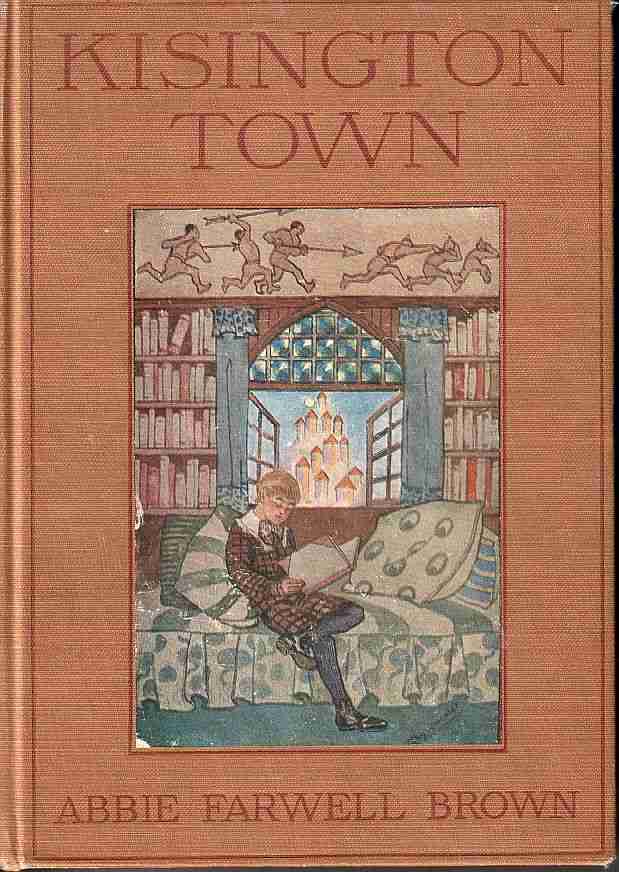
XIII: HAROLD'S LUNCHEON
When Harold finished reading the story of the Hermit Gnome to the Red King, he looked up to see how his listener had enjoyed the tale. And lo and behold! Red Rex was fast asleep! He lay on his back in the afternoon sunshine, and a noise came from his half-open mouth rather like the Gr-r! of the lion-doll, when its tail was screwed.
"Well!" said Harold to himself; "I cannot return to the city until His Majesty wakes up; for that would not be polite, and his bodyguard would not allow it. I may as well make myself comfortable and be patient. The longer he sleeps the longer time we shall have in safety to wait for help from our King."
Harold opened the little covered basket to replace the green-and-gold volume from which he had just been reading, and in doing so caught sight of the luncheon which his thoughtful mother had packed, in the fear that he might be hungry ere his return. He took out the folded napkin and peered eagerly below. There was a huge wedge of apple pie! Harold licked his lips and his eyes sparkled, for there was nothing of which he was so fond as apple pie. "I must have at least a bite this minute!" he said to himself, and opening his mouth very wide he prepared to bite into the juicy wedge.
Just at this moment Red Rex opened his eyes.
"Pitikins!" he cried, "what is going on? Is this part of the story?" For at first he did not know that he had been asleep.
"No, Your Majesty," said Harold; "it is a piece of one of my mother's famous pies. Will you share it with me?"
"That I will!" said Red Rex, sitting upright and stretching out his hand eagerly. "It looks like apple pie. There is nothing in the world I like so well as apple pie."
"Your taste is the same as mine," said Harold merrily, carving the wedge with his knife into two equal triangles. "I believe Your Majesty never tasted better pie than that. It is made by a famous rule."
Red Rex munched his share greedily, sitting opposite the munching Harold. And as they ate they eyed one another, not unfriendly. When he had finished, the Red King said,--"By my sword! That is the best piece of apple pie that ever I tasted, or hope to taste! Your mother must be a wondrous cook, Harold."
"That she is!" cried the proud boy. "And she is the best mother who ever lived. She made six of these wonderful pies for me, because she knows that I like them so much. I saw them this morning on a shelf in the pantry."
"Six juicy apple pies!" murmured Red Rex, smacking his lips at the thought. "Where do you live, boy?"
"I live on the High Street, which leads from the market-place, in a little house next the butcher's shop," said Harold, wondering why the King asked.
"I will remember that," said Red Rex, nodding his head solemnly. "I owe your mother a happy memory for that piece of delicious pie."
"It is made from the recipe for the King's Pie," said Harold. "No wonder you approve it, being like His Hungry Majesty of old."
"The King's Pie!" exclaimed the surprised monarch. "Pray, what do you mean by that?"
"It is another story, Your Majesty," said Harold, grinning. "I think it is the best story of all. But I suppose you would not care to hear it to-morrow."
"Oh, go along with you and your stories, you young beguiler!" cried Red Rex with a great roar, at the same time poking Harold playfully with the point of his sword. "I see that you would keep me here forever at the walls of your city, listening to your tales."
"Not forever," said Harold, with an air of candor. "I do not think that even the library of Kisington could furnish new books for as long a time as that,--though, to be sure, you might hear some of the same ones over again. But, indeed, you have no idea what treasures still remain in that casket! This tale of the King's Pie is one of the rarest, I think."
Red Rex seemed to be thinking very earnestly about something. "The King's Pie," he murmured, more than once. "H'm! H'm! It is of a deliciousness! Ha! Ho!" And he smacked his lips again, thinking of the tantalizing wedge which was now no more. Suddenly he spoke: "I have decided to wait yet another day," he announced. "I will hear that tale to-morrow. And if it contains a recipe for the famous pie, I shall want you to copy it off for me. Bring pen and paper, my lad."
"That I will!" said Harold joyously. For this meant still another day's delay; and the time was now near at hand when they might expect to see help coming from the Capital City where their good King Victor lived. This was Wednesday, when he took leave of the Red King.
XIV: THE ROBBER
Harold was very weary when he returned to the cottage that evening; and he was still more weary before he tumbled into bed. For in the mean time he had to learn his school lessons for the following day, and tell the other boys all about his adventures. He slept like a top; quite like a top,--for sometimes during the night there came from his little room beyond the kitchen a sound like a humming top.
It was about midnight when Harold was awakened by a peculiar noise. It was a queer, clicking, tapping noise that seemed to come from the kitchen close by. Harold sat up in bed and listened. Some one was certainly moving about in the kitchen. It was probably his mother, he thought. And yet, what could his mother be doing there at that time of night? Stealthy steps crossed the kitchen; just then Harold sneezed,--he could not help it. There was silence.
Presently he heard a noise in the pantry, which was next his own little room. Harold rose and crept noiselessly out of his chamber. Yes, there was someone in the pantry. The door was open,--something not allowed in his mother's kitchen rule. An uncertain light flickered behind the pantry door. Harold could not see plainly, but there certainly was some one meddling with the dishes on the shelves. Suddenly a silhouette came between Harold and the light, and he saw the shape of the intruder. It seemed to be a very tall old woman in bonnet and shawl, and her great hand was carrying something from the pantry shelf to the mouth within the bonnet.
Harold felt himself growing very angry. Who was this stranger who dared to force a way into their cottage and eat up the hard-earned victuals which his mother had painfully prepared? Such doings were rare indeed in Kisington. It was a wicked thief, a robber, a house-breaker! Even though it was a woman, she must be punished.
There was a key in the lock outside the pantry door. Quick as a flash Harold made a leap for it, and turned it in the lock. At the same time he shouted to his mother who slept in the room upstairs,--"Quick! Quick, Mother! There is an old woman in the pantry eating up the food! I have caught her at it!"
In a few minutes his mother's feet came pattering down the stairs. But in the mean time what a hubbub was going on in the pantry! Evidently the thief had no mind to be discovered and taken in her criminal act. There was the sound of overturned boxes and barrels, the crash of crockery and glass. The thief was smashing the pantry window!
"Open the door, Harold!" screamed his mother. "She is climbing out the window!"
It did not seem possible that the thief could do this, it was such a tiny window. But, sure enough! when the door was opened, and Harold and his mother crowded into the pantry, they were but just in time to seize the hem of the old woman's shawl, as her last leg squeezed through the casement. Harold held on to the shawl tightly, however, and off it came in his hands. It was a very nice shawl.
"Who ever heard of a thief in Kisington!" exclaimed the mother. "Who could it be? I never saw a shawl like this. Let us examine what she has taken, the wicked old creature!"
Harold got a candle, and presently returned to the pantry, where his mother was groping among the smashed crockery for some other clue to the thief. When the light flickered on the pantry shelves the mother gave a scream of surprise and anger. "My six beautiful pies!" she exclaimed. "The thief has stolen my six beautiful apple pies! Oh, what a wicked old soul!"
"Those lovely pies!" groaned Harold. "See, Mother, she has gobbled one and left the empty plate. The others she has taken away with her."
"I wish they may choke her!" cried the mother angrily. "Now you will have none to take to your Red King to-morrow. I was going to save the finest of all for him, in the hope that it would soften his hard heart."
"It will never soften his heart nor please his stomach now, Mother," said Harold ruefully. "And still more I regret the other five pies which I know you meant for me. When shall we ever see such pies again?"
"They were made from the last of the flour and apples and sugar sent you in gratitude by the Leading Citizens," said Harold's mother sadly. "I am sorry your reward is thus wasted, my poor boy! What spiteful neighbor could have spied them through the pantry window and planned this midnight raid at our expense?"
Harold shook his head mournfully. "I do not know any one in Kisington whom I could suspect," he said. "Come, Mother, let us go back to bed. To-morrow we will look further into the matter. We have at least this handsome shawl as one clue, which if it does not find us the thief will be very nice for you to wear."
They went to bed again, and slept until morning.
Now in the morning before school Harold took the shawl and went to his friend the Librarian and told him what had happened during the night. The Librarian was greatly shocked to hear of a theft in town and went with Harold straight to the Lord Mayor.
The Mayor examined the shawl carefully and shook his head. "This is very strange!" he said. "This is no shawl made in Kisington, or in our Kingdom. It is a strange foreign shawl, and very valuable. I am glad to believe that the thief must have been a foreigner, or a gypsy, or a vagrant of some sort. But how did she find her way into our guarded city? I must look into this! Meanwhile, my lad, since you have suffered loss and damage to your pantry and to your feelings the Leading Citizens will see that you are made whole at their expense; I will answer for their gratitude to you."
"My Lord," said the Librarian, patting Harold affectionately on the head, "our boy has done so well already in handling this savage King, may we not expect still more from him now that the time is so critical? King Victor should soon be coming to our aid. If we can but postpone the siege for at least another day! Suppose Harold should invite Red Rex, under a flag of truce, to visit and inspect our Library?"
"Good!" cried the Mayor. "When you go to Red Rex this afternoon, Harold, my boy, see what you can do further in the matter."
"I will try, my Lord Mayor," said Harold. "But Red Rex is growing very impatient. I fear that I cannot much longer keep him amused with our tales."
"Clever lad! You have already done right well," said the Librarian, embracing Harold proudly. "And I dare say you will be able to do yet more. Now, run along to school; for we must not forget our everyday duties, even in these times of excitement and danger."
So Harold went to school, and you can imagine how many questions he had to answer at recess time. The Librarian went to his books and the Lord Mayor to his desk. And Harold's mother went down on her knees, cleaning up the wrecked pantry.
But where was the strange old woman all this time?
XV: THE BANDAGED HAND
As soon as school was over on Thursday afternoon, Harold started once more on his errand to the War-Lord. As usual, he was accompanied to the city gate by a crowd of schoolboys and girls who envied him his luck and wished that they could go all the way with him. But this, naturally, the City Fathers would not permit. One boy carried Harold's coat, and another his strap of schoolbooks. A third brought the basket with Harold's luncheon, while Robert carried the flag of truce,--proud boy! But Richard, Harold's special chum, was the proudest of all. For he was trusted with the precious volume from the library containing the story of the King's Pie, which Harold was to read to the War-Lord on that day. All gave a great cheer when the gate was unbarred; and all the little girls waved their handkerchiefs when with a gay shake of his hand Harold stepped out into the danger zone.
Red Rex received him as usual, sitting upon the green hillock. Harold noticed straightway that the War-Lord's hand was bound up with a bandage, and that he had a cut over his left eye, which made him look fiercer than ever.
"But I thought there was a truce!" exclaimed Harold, gazing at these tokens of trouble. "How came you to be thus hurt, Your Majesty?"
"Nay; it was an accident," said the Red King gruffly. "Say no more about it, pray. Well! I have no time to waste to-day. Things are coming to an issue. Let me hear your story as quickly as possible,--if you have brought one, as I think."
"Yes, Your Majesty," replied Harold. "I have brought you the spicy story of the King's Pie, which I think you will like. I had meant, in order to illustrate the story, to bring you also one of the veritable pies. But that, alas! I am now unable to do. My mother made a pie especially for this purpose; but it is gone with others which were to be mine, and for which I grieve on my own account. A wicked thief stole them all during last night. So I fear you will not appreciate the story so well as otherwise you might have done."
"Perhaps I shall," said the War-Lord whimsically. "Perhaps I shall appreciate it all the more."
"Now, what means Your Majesty by that?" cried Harold, wondering very much at these strange words. "It was such a fine pie! A large, fat, juicy, rich, crisp, crusty pie,--just such a one as the King enjoyed in the story."
"Yes, I know!" said Red Rex. "Go on with the story, right speedily, with no more details of that tantalizing, vanished pie!" And he licked his lips and shifted his seat as he sat upon his hillock.
Obediently Harold opened the book which his chum Richard had handed to him just inside the city gate, and began to read the toothsome tale of The King's Pie.
XVI: THE KING'S PIE
There was great excitement in Kisington; for the King was coming with his new young bride, and the town was preparing to give them a famous welcome.
Hugh, the Lord Mayor, was at his wits' end with all that must be done. As he sat in the Town Hall holding his aching head, while a mob of decorators and artists and musicians, costumers, jewelers, and florists clamored about him, there came to him a messenger from Cedric, his son. Cedric was one of the King's favorite friends, and he knew His Majesty's taste well. So he had sent to the Lord Mayor a hint as to how the King might best be pleased. Being a man of few words, this is how his message ran:--
"His Majesty is exceedingly fond of pie."
Long pondered the Lord Mayor over this mysterious message, reading it backward and forward, upside down and crisscross, and mixed up like an anagram. But he could make nothing of it except what it straightforwardly said: that the King was exceedingly fond of pie.
Now, in those days pie meant but one thing--a pasty; that is, meat of some sort baked in a dish covered with dough. At that time there was no such thing known as a pie made of fruit or mincemeat. Pie was not even a dainty. Pie was vulgar, ordinary victuals, and the Lord Mayor was shocked at his son's even mentioning pie in connection with the King.
"Pie, indeed!" he shuddered. "A pretty dish to set before a King on his wedding journey! How can pie be introduced into my grand pageant? The King can get pie anywhere, in any hut or hovel along his way. What has Kisington to do with pie?"
The Lord Mayor snorted scornfully, and was about to dismiss his son's hint from his mind, when he had an idea! A Pie! A great, glorified, poetic, symbolic Pie such as could be carried in procession decorated with flowers! That was a happy thought. The Lord Mayor dismissed every one else and sent for all the master cooks of the city.
It was decided to accept Cedric's hint for what it was worth, and make Pie the feature of the day. There should be a grand pageant of soldiers and maskers and music. And, following the other guilds, last of all should come the cooks, with their ideas of Pie presented as attractively as might be, for the edification of the King. Moreover, the Lord Mayor said, in dismissing the white-capped company:--
"To whichever of you best pleases His Majesty with the pie, I will give this reward: a team of white oxen, a hundred sacks of white flour, and a hundred pieces of white silver."
"Hurrah!" shouted the cooks, waving their white caps. Then away they hurried to put on their thinking-caps instead and plan for the building of the King's Pie.
Now, among the cooks of Kisington there were two brothers, Roger and Rafe. Roger, the elder, had one of the hugest kitchens and shops in Kisington. But Rafe, the younger, had only a little old house on an acre of land under a little red-apple tree, with a little red cow who gave a little rich cream every day. Rafe was very poor, and no richer for having a brother well-to-do like Roger. For the thrifty cook had little to do with Rafe, whose ways were not his ways.
Rafe cooked in his little kitchen for the poor folk of the town, charging small prices such as they could pay. Indeed, often as not he gave away what he had cooked for himself to some one who seemed hungrier. This is a poor way to make profit of gold, but an excellent way to make profit of affection. And Rafe was rich in the love of the whole town.
Roger was among the cooks whom the Lord Mayor summoned to consult about the King's Pie. But Rafe knew nothing at all of it, until one afternoon he was surprised by a visit from his brother, who had not darkened his door for many a day.
"Well, Brother," said Roger, briefly, "I suppose you are not busy, as I am. Will you work for me for a day or two? In fact, I need you."
"You need me!" said Rafe, in surprise. "How can that be, Brother?"
"I have a great task at hand," said the master-cook; "a task that needs extra help. You must come. Your own work can wait well enough, I judge."
Rafe hesitated. "I must cook for my poor people first," he said.
Roger sneered. "Your poor people, indeed! I am cooking for the King! Will you hesitate now?"
"Cooking for the King!" cried Rafe. "Ah, but he is not so hungry as my neighbors will be to-morrow without their rabbit-pies."
"Rabbit-pies! It is a pie for the King that I am making!" shouted Roger, in high dudgeon,--"such a pie as you and your louts never dreamed of. Now what say you? Will you come?"
"I must do my own small cooking first," said Rafe firmly.
"Very well then," growled Roger. "Cook for your beggars first; but come to me to-morrow. Every cook in town but you is engaged. I must have your help."
"I will come," said Rafe simply, and Roger bade him a surly good-bye without thanks or promises.
The next morning, when his own simple tasks were done, Rafe hied him to his brother's kitchen, and there he found great doings. Roger was superintending the preparations for baking an enormous pie. A group of masons had just finished building the huge oven out of doors, and about a score of smiths were struggling with the pie-dish, which they had forged of iron. It was a circular dish six feet across and three feet deep; and it looked more like a swimming-tank than anything else.
Rafe stared in amazement. "Is that to hold your pie, Brother?" he asked.
"Yes!" growled Roger. "Now get to work with the other men, for the crust must be baked this morning."
Three assistant cooks in caps and aprons were busy sifting buckets of flour, measuring out handfuls of salt and butter. Others were practicing with long rolling-pins made for the occasion, so big that a man had to roll at each end. On the ground lay a great round piece of tin, six feet across, pierced full of holes.
"What is that?" whispered Rafe to one of his fellow cooks.
"That is to be the lid of the pie," answered the cook. "See, they are lifting it onto the dish now. It will have a strong hinge, and it will be covered with crust."
"And what is to fill this marvelous pie?" asked Rafe, wondering still more. "Tender capon? Rabbits? Venison? Peacocks? What is suitable for a King? I do not know."
"Ah, there you show your lack of imagination!" cried the cook. "Master is a great man. This is a poetic pie. It is to be filled with flowers, and on the flowers will be sitting ten beautiful little children, pink and sweet as cherubs, dressed all in wreaths of flowers. And when the pie reaches the King, the top will be opened, and they will all begin to sing a song in honor of Their Majesties. Is it not a pretty thought?"
"Well, if the King be not too hungry," said the practical Rafe, doubtfully.
"Nonsense!" cried the cook testily. "Would you make out our King to be a cannibal?"
"Nay," said Rafe; "that is why I doubt. However, I am here but to assist in this colossal plan. Hand me yon bag of salt."
All day long at Roger's kitchen the cooks worked over the King's Pie. At noon came a band of ten mothers, each with a rosy, smiling baby. They placed the children in the great shell to see how they would look. Every one cried: "Charming! Superb! But ah! we must not tell any one, for Roger has paid us well, and the other cooks must not know how he is to win the prize to-morrow!"
Weary and unthanked, with his meager day's wage,--a little bag of flour and a pat of butter, sugar, and a handful of salt,--Rafe went home, musing sadly. "A team of white oxen; a hundred sacks of white flour; a hundred pieces of white silver,--what a prize! If only I could earn these, I should be rich, indeed, and able to help my poor neighbors. But Roger will win the prize," he thought.
He spread on the table his frugal supper. He had emptied his larder that morning for a sick woman. He had but a few apples and a bowl of cream. It was the first food he had eaten that day, for his brother had forgotten to bid him to his table.
As he was taking a bite from one of the rosy-checked apples, there came a tap at the door.
"Enter!" cried Rafe hospitably. The hinges creaked, and there tottered in a little, bent, old woman in a long black cloak, leaning on a staff.
"Good evening, Son," she said, in a cracked voice. "Are you a man of charity, or will you turn away a poor old soul who has had nothing to eat for many hours?"
Rafe rose and led her to the table. "Sit down, Mother," he said kindly. "Sit and share my poor supper: a few apples from my little tree, a sup of the cream which my good little red cow gives me,--that is all; but you are welcome."
"Thanks, Son," said the old woman, and without further words she began to eat. When she had finished she sat for a few moments looking into the empty bowl. Then she said:--
"Son, why do you not bake a pie for the King?"
"I!" cried Rafe, astonished. "How can I make a pie? You see all I have in my cupboard. There is nothing but a little bag of flour, a pat of butter, a handful of sugar and salt."
"It is enough," said the stranger. "Son, I will show you a secret. You have been kind to me. Now I will tell you that which until this day no man has known. You shall make the King a pie, indeed!"
"But, Mother," interrupted Rafe, smiling, "you do not know what manner of pies are being made. There will be many, though I have seen but one--a giant pie, a glorious pie, all golden crust and flowers and pink little babies who sing!"
"Humph!" grunted the old woman. "A pie for a pasteboard King. Why not cook a pie to tempt a hungry man?"
"The King is, indeed, a man," mused Rafe. "But how shall I make a pie without viands of any sort?" (As I have said, to speak of a pie in those days meant always a dish of meat or game or poultry.)
"I will tell you," said the old woman. "Have you not a tree of red apples? Yes, luscious apples of a goodly flavor, for I have tasted them." She leaned forward, whispering earnestly: "Make your pie of them, my Son!"
"Apples! A pie of apples!" cried Rafe. "Who ever heard of such a thing!" (And at this time, indeed, no one had.)
"Nay, you need not laugh so scornfully," said the old crone. "You shall see! I will help you."
At her command Rafe fetched out the bag of flour, and the butter, salt, and sugar. Then he went to gather a basket of apples, while the old woman mended the fire and mixed the dough. Wonderingly he watched her pare the apples, core and slice them, and cover all with a blanket of crust laid softly over, but not tucked in at the edges as for an ordinary pasty. Soon the pie was baked, all flaky and brown. When it came smoking hot from the oven, the old woman slipped a knife under the blanket of crust and lifted it aside.
"See," she said, "the apples are steamed and soft. Now I will mash them with a knife and mix the butter and sugar generously therein. This one must ever do, Son, last of all. This is the crown of my secret, the only recipe for a perfect pie."
Rafe watched her curiously, by no means convinced. Then, from a pouch somewhere concealed in her robe, she drew out a strange round nut, such as Rafe had never seen before.
"This is the final blessing," she said. "See, I will grate a little of this magic nut into the pie." Forthwith it was done, and a whiff of spicy fragrance reached Rafe's nose, and, more than anything, gave him confidence in this strange new pie.
"It smells worthy," said Rafe hungrily.
Without a word the stranger drew from under a cover a little pie baked in a tiny tin, an exact copy of the other. "Eat," she said: "eat and judge if my secret be worth keeping."
Rafe sunk his teeth into the warm, crisp crust and ate eagerly. His eyes sparkled, but he spoke no word till the last crumb was gone.
"Oh!" he said, "it is a magic pie! Never such have I met before! Never, in all my life!"
The old woman nodded. "A magic pie," she said. "And still better when you serve it with the yellow cream of your little red cow."
"It is a pie for a King!" said Rafe. "But shall I be allowed in the procession, Mother?"
"All the cooks in Kisington who choose may march with that guild," said the old woman. "Bear your pie proudly in your own hands, wearing your cap and apron. I will send some one to walk beside you and carry the jug of cream. She shall be here to-morrow when you milk the little red cow. Treat her kindly for my sake."
"Mother, how can I ever thank you--" began Rafe. But, with a quickness which seemed impossible to her years, the old woman had slipped out of the door and was gone.
The next morning bright and early Rafe went out to milk his cow. And there beside the cow stood a young maid, the fairest he had ever seen.
"Good morning, Rafe," said the maid, dropping a curtsy. "I am Meg, and I have come to help you carry the King's Pie." She smiled so sweetly that Rafe's heart danced a jig. She was dressed in a neat little gown of blue with a white apron, and had set a dainty cook's cap on her flaxen curls. And she wore red stockings and shoes, with silver buckles. From under her apron she drew a little blue jug. "See, I have brought this to hold the cream," she said, "and it is full of red strawberries for your breakfast. Milk the little red cow, Rafe, and then we can eat and be gone as soon as I have skimmed the cream of yesterday."
In a happy daze Rafe did as she bade. Merrily they breakfasted together on a wheaten loaf and milk and berries which the maid had brought, as if she knew how hungry Rafe would be. Then Meg skimmed the cream for the blue jug, and they were ready to start. Rafe, in his white cap and apron, bore the precious pie, while Meg walked along at his side. A merry, handsome couple they were.
When they came to the market-place they found a great crowd assembled. "Ho, Rafe! Rafe!" people shouted to him, for every one knew and loved him. "Come here! Come with us!"
But Rafe answered: "Nay. I am going to walk in the procession with the other cooks. I have a pie for the King."
"A pie! A pie!" they cried good-naturedly. "Look at Rafe's pasty! Of what is it made, Rafe? Grasshoppers or mice?" For they knew how poor he was. But Rafe only smiled and pushed his way to where the cooks were gathered. They, too, greeted him with jests. But he insisted that he must march with them. So they gave him place at the very end of the line, with the little maid at his side. But when he saw the wonderful pies all around him, he sighed and shook his head, looking ruefully at his own simple offering. The little maid, seeing him so look, said:--
"Never mind, Rafe. You are giving your best to the King. No one can do more than that."
The people waited. The hands of the great clock in the market-place crept slowly around until they marked noon. Every one began to feel uneasy, for it was close upon the dinner-hour, and the long procession had not moved. The King and Queen were late.
At last there sounded the blast of a trumpet, which told that the King and his bride had arrived, and that the Lord Mayor had led them to their seats on the balcony in front of the Town Hall. Every one gave a sigh of relief. But then there was another long wait, while the hands of the clock crept on--on, and the people watched and craned their necks eagerly. The Lord Mayor was making his speech, and it was very long. Finally arose more shouts and huzzas,--not because the speech was good, but because it was ended. And presently another trumpet gave signal for the procession to start.
Off they went, through the streets full of cheering, hungry people. Soldiers and bands of music led the way; then came the maskers and the flower-maidens, the city guilds and all the arts and crafts. Finally passed along the yoke of snowy oxen, with ribbons in their ears, drawing a white wain in which were the bags of flour and silver, the prize to be given the best pie-maker of Kisington. When the company of white-capped cooks came within sight of the King, he laughed merrily, rubbing his hands, and said:--
"Cooks! Now we shall have something worth while, for I am growing hungry, indeed!"
And the young Queen whispered: "So am I!"
Then came the pies. And such pies! Carried on the shoulders of sturdy boys, drawn on floats by teams of ponies, wreathed in flowers and stuck over with banners and mottoes, the pies passed along before the hungry King. And not one of the pies was real! Gradually the King's smile faded.
There was a wonderful big pie fashioned like a ship,--rigged with masts and sails and manned by sailor-dolls. There was a fine brown pasty like a bird's nest, and when it passed the King, off came the cover, and out flew four-and-twenty blackbirds croaking lustily.
"Good-bye, dinner!" sighed the King, looking after them wistfully.
The Queen nudged him and said: "'Sh! Behave, Your Majesty!" But she also began to look hungrier and hungrier.
There passed a pie in a carriage drawn by six mules. It seemed piping hot, for steam came out of it. But when it reached the King it blew up with a bang! scattering showers of blossoms over the royal party.
"My faith!" cried the King; "methought this was the end of all things. But it seems not. Here come more and more empty pies!"
The Queen smelled of her salts and grew paler every moment.
One pie had a musical box inside and played a sweet tune as it passed the King. In one was hidden a tiny dwarf, who popped out like a jack-in-the-box when the Queen pulled a golden cord.
Still the procession moved on, and so did the hands of the clock; and the King's hands moved to his ample girdle, which he tightened sharply. But both he and the pale young Queen were too polite to ask the Lord Mayor for buns or something to sustain them.
The pie which caused the greatest excitement as it passed along, drawn by four white horses, was that of Roger, the master cook, who walked proudly beside it. When it came opposite the King the carriage stopped, the cover was lifted, and ten beautiful babies on a bed of roses waved their little hands and began to sing.
The Queen leaned forward eagerly, forgetting to be hungry. "How sweet! The darlings!" she murmured. "Oh, this is the best of all!"
Roger the cook heard her and flushed with triumph.
But the King grumbled: "Humph! They look good enough to eat, but--my faith! I hope that this is the end, for soon I must eat something, or I shall become a cannibal!"
"Your Majesty!" protested the Queen, faintly.
But the King interrupted her.
"What comes here?" he cried. "This looks sensible!" It was Rafe and the pretty maid bringing up the rear of the procession. Side by side they walked in cap and apron, he bearing the small, delicately browned pie, she with a jug of yellow cream. No one paid any attention to them, but closed in around them, following Roger's chariot.
When Rafe and Meg came opposite the King and Queen, they turned and Rafe bowed low, holding up the pie as high as he could. The pretty maid curtsied gracefully, and offered the cream-jug with a winsome smile. The crowd was fain to hustle them on; but the King struck the floor with his staff and pointed eagerly at the pie.
"Hold!" he cried. "What have you there?" Every one stopped and began to stare. Rafe bowed again.
"'T is a pie, Your Majesty," said Rafe simply,--"an apple pie."
"With cream for the top," lisped the little maid, curtsying again.
"Apple pie!" cried the King. "Who ever heard of an apple pie! A pie should be of savory meat. But of apples!" Words failed to express his astonishment.
"Butter and sugar, Sire, go to the making of it, and the dust of a wondrous nut. Will you taste it, Sire?" Rafe held out the pie temptingly.
"With thick cream to pour on the top--yellow, sweet, rich, thick cream!" said Meg, lingering over each word as if it melted on her lips.
"Give hither that pie!" almost shouted the hungry King. "I will look into this matter." And, drawing a dagger from his girdle, he seized and stabbed the pie to the heart. Sniffing at it eagerly, his eyes grew round, and he smacked his lips. "It is good, I wager my scepter!" he cried. "Hand me the cream, fair maid."
The little maid stepped up and daintily poured cream upon the shattered pie, and without more ado the King began to eat with his dagger. (This was not considered bad manners in those days.) After the first mouthful he stopped only to say: "Food of the Fairies! Pie of the Pixies! Cook, you are a magician!" He went on at a rate which threatened not to leave a mouthful.
But the Queen pulled at his sleeve. "A bite for me, Your Majesty," she begged.
And, with an apology, the King handed her what was left, watching her wistfully till she ate the last crumb.
"Delicious! I never tasted anything finer!" she cried. "I must have the recipe."
"I must have the cook!" cried the King, turning to Rafe, with a broad grin on his merry, fat face. "You must come with me and cook such pies for every meal. Yes, I will have them for breakfast, too," he insisted, in response to a protest from the Queen.
Just then up stepped Hugh, the Lord Mayor.
"Sire," said he, bowing low, "will Your Majesty deign to point out to me the pie which has best pleased you, that I may have it set in the place of honor, and give the prize to the maker?"
"That I cannot do," said the King, "for the pie no longer exists. I have eaten it!" And he slapped his generous waistband. "But give whatever prize there may be to this worthy fellow, whom I now dub Baron Applepy. Baron, wear this ring in token of my pleasure in your pie." He drew a fine ruby from his finger and gave it to Rafe.
"And this is for the little maid," said the Queen, taking a beautiful pearl necklace and tossing it over Meg's curls.
But Roger, the master cook, stood by and tore his hair when he saw what was happening.
Then up came the yoke of white oxen drawing the cart bearing the prize. And the Lord Mayor gave a goad into Rafe's hands, with words of congratulation.
"Now, mount and come with me," said the King.
But Rafe hesitated.
"Your Majesty," he replied, "I see no way to make another pie like this which has pleased you. For I have no more of the magic nuts wherewith to flavor a second."
The King frowned. "What! No more pie! Is this to be the first and the last? Sirrah, I am not pleased!"
Then little Meg stepped forth. "The magic nut is the nutmeg," said she. "My name is Meg, and Granny called the magic nuts after me. I know where is hidden a store of them. These are my dower."
She emptied her pockets of the nuts which they held, and they were a precious handful.
"Ha!" cried the King eagerly, "you must marry Baron Applepy, that he may use your dower in our behalf."
Rafe and the maid looked sidewise at one another.
"You are willing, my dear?" said the Queen, smiling upon Meg.
"Yes," whispered she, with red-apple cheeks.
"Yes, indeed!" cried Rafe when the Queen looked at him.
But again he seemed troubled.
"Your Majesty," he said, "I cannot leave my poor neighbors. There will be no one to cook for them at my prices."
"You shall have your own price from me," said the King.
Rafe bowed low. "You do me great honor," he said humbly. "But I cannot leave my poor people, my house and my cow and my apple tree; indeed, I cannot."
The King looked very angry and raised his staff with a gesture of wrath. But the Queen laid her hand upon his arm.
"Why may he not live where he will and yet cook the pies for us?" she said. "A messenger on a fleet horse can bring them to us every day. We shall then have pies like that first delicious one, made of fresh apples from that very same red-apple tree of his. They would be best of all."
"True," said the King, reflecting for a moment.
"Please, Your Majesty!" said Meg, in her most winsome tones. "I do so long to help Rafe pick the red apples for your pies and skim the yellow cream of the little red cow. And please, I do so long to help him cook for his poor neighbors, who will miss him sadly if he goes. Now that we have the prize, we can do much for them. Please, Your Majesty!"
"Please, Your Majesty!" echoed Rafe.
"Please, Your Majesty!" begged the Queen.
So the King hemmed and hawed and yielded. "But see, Baron Applepy," he said, "that you make me three fine pies every day, for which my swiftest messenger shall call. Now, farewell to you--and to all! We must be off. It is past dinner-time."
"Heaven bless Your Majesties," said Rafe and Meg, bowing and curtsying low.
Then Rafe lifted the little maid into the white cart beside the hundred sacks of flour and the bag of silver, and amid shouts and cheers away they drove the white oxen toward the little house on the acre of land under the red-apple tree, where the little red cow was waiting for them.
And there they lived happily ever after, making three pies a day for the King at an enormous price, and feeding the beloved poor people, their neighbors, for no price at all.
XVII: THE MYSTERY OF THE PIE
Red Rex greeted the close of this story with an enormous sigh. "Three of those delicious pies every day!" said he. "Would I had a messenger to bring such to me!"
"It might be arranged, Your Majesty," suggested Harold, "if our two countries were at peace. I know that my mother would be glad to make such pies for you, even as Rafe and his Margot did for the King of old. The distance from Kisington to your Capitol is not so very great, I think; and doubtless Your Majesty has messengers fleeter than the one of long ago."
"And your mother's pies are quite as good!" exclaimed Red Rex. "I have never tasted better. So fat, so juicy, so generous! The tops fine, rounded hills; the crust so crisp, which your knife crunches daintily; the sight and smell of them is tempting!" The Red King's eyes rolled in his head and he swayed ecstatically, like a poet composing a rhyme.
"And yet you have seen but a wee wedge of one pie!" exclaimed Harold. "It must have pleased Your Majesty, indeed, to make your impression so true."
Red Rex eyed him strangely. "H'm, yes," he said. "I have a vivid imagination in such matters. I can almost fancy I have eaten a whole pie--two--three--four whole pies! What a feast!"
Harold's eyes had been straying toward something white concealed in the grass not far from the Red King's seat. He took a step forward now, bending low. Then he uttered an exclamation.
"Five pies, Your Majesty!" he cried, looking straight at the King. "There were six, which the old woman stole. Here are five empty pie-plates!"
"What a strange coincidence!" cried the Red King, flushing and twiddling at his sword-hilt uneasily. "These coincidences do happen quite startlingly sometimes. Ha-hum!" He coughed and frowned forbiddingly.
"Surely, none of your men could have stolen my mother's pies (and, indeed, one of them was yours), Your Majesty. They would not have been so mean!"
"They would not have been so reckless," corrected Red Rex. "No, no! it took courage to make such an attempt; great courage, my boy!"
"Courage!" cried Harold. "I call it something else,--to steal the pies of a poor widow and deprive her son of his desserts. I call it mean and disgraceful!"
"Tut, tut, boy! You do not know what you are saying!" blustered the War-Lord, growing very red.
"Often it takes courage to do what others call an ill deed. And an ill deed is ill, only as you look at it; so I say! Everything depends upon the point of view; remember that. Suppose the man who stole those pies was starving and needed them for his comfort?"
"Suppose, indeed!" retorted Harold. "Suppose he came to our front door and asked my mother for them, like a gentleman? She would not have refused to sell, if he had money. She would have given, if he had none. She is like that, is my good mother!"
The Red King shook his head. "Suppose the man was an enemy, and too proud to ask a favor? All's fair in war, my boy. Everybody knows that."
"Then war is all wrong, as we always said," Harold replied. "Right is right, and wrong is wrong. Stealing is stealing, and meanness is meanness,--war or no war. If war makes men think differently from the rule of every day, there is nothing to be said for it. Hello!" Harold interrupted himself, for something else had suddenly caught his eye.
He had been making his way toward the pile of pie-plates, and now he stooped and picked up something lying on the grass beside them. It was a queer, old-fashioned bonnet. As he touched it out fell a rolled-up calico apron. One of the strings was gone. Harold's eyes leaped from it to the Red King's bundled-up wrist. The other apron-string was doing duty as a bandage there.
"Ho! Ho!" cried Harold, staring at the Red King's purpling face. "This is the old woman's bonnet, and her apron. A disguise! I begin to see! You, Your Majesty,--you were the old woman yourself!"
"You are very sharp, youngster!" said Red Rex sulkily. "Begone to your home and leave me to finish my work."
"If I go," said Harold slowly, "I shall tell the whole town what I have discovered. The news will travel through the Five Kingdoms--how a King disguised as an old woman stole six pies--"
"Hold!" cried Red Rex sternly. "Enough of this impertinence! Remember to whom you speak, boy! I am a King."
"Yes, you are that King. But I thought always it was the 'Knave of Hearts who stole the tarts,' not the King. How did Your Majesty manage to do it?" asked Harold curiously.
"Aha!" The Red King tried to appear easy and unconscious. "It is my turn now to tell a story, is it? Oho! You want to hear how the old woman got into your careless town, do you? And how she went along your unguarded streets, do you? And how she crept into your unbolted cottage, do you? And how she found the goodly row of pies sitting on the pantry shelf? Ah! I shall never look upon their like again!"
"Nor I," said Harold promptly. "And one was yours, Your Majesty."
Red Rex cast down his eyes. "That is the thing that chiefly troubles me," he said. "I am sorry I did not know the fact. Your mother was very thoughtful, Harold."
"Please tell me all about it, Your Majesty?" begged Harold, settling himself comfortably on the grass before the War-Lord. "I want to hear the story. It is your turn now. You owe me that, at least."
"Well," said Red Rex choosing his words slowly. "You see, I had to have those pies. Kings may take what they choose, because,--well, because they are Kings. That is reason enough,--say I! After that first bite you gave me, I felt that I needed more to make me happy. A King has a right to be happy, whatever happens to another,--say I. I had brought disguises with me; for we have ever found them useful in making war. Last night I dressed up as an old woman, in petticoat and apron, bonnet and shawl. None of my men knew. As soon as it was dark I went to the gate of your town, pretending to be a countrywoman returning to Kisington from a visit beyond the frontier, who had not heard of the siege, and begged the guard to let me in quickly out of danger's way. Oh! You are such stupid, trusting folk in your Kingdom! The men believed me, and let me in because I seemed old and it was late, and they pitied me. The fools! Pity is out of place in war-time. A city so ill-defended deserves to be taken and harassed,--say I!"
"We are trustful in our town because our own hearts are truthful and kind," said Harold.
"When the warders had let me in," went on Red Rex, "I passed along the main street toward the market-place, with my basket on my arm; and no one noticed me, for it was dark. I knew my way; you told me yesterday how the streets lay. Presently I came to a great, handsome building with a ruined porch,--upon my word, huge as my summer palace by the sea!--out of which people passed in a constant stream, with books under their arms."
"It was our library," said Harold proudly.
"So I judged," went on the Red King. "I concealed myself in an angle of the building until it should be darker, and watched. Little children came out of that library, who in my country would be playing at war with guns and toy cannon. Old men and women, whom I should expect to see caring only to smoke and mumble and gossip about past wars, brought out books which they hugged lovingly. Young maids, such as in my land care only to look at the soldiers and dance and prink; and young men who should be drilling or dueling or talking war,--all these came out looking happy and content with the books which they had in hand. I never saw such a sight!"
"Yes," said Harold; "It is always so in Kisington. We have no time to think about war or soldiers or killing."
"Strange!" muttered Red Rex. "I was tempted to go myself into that great building and see if any book might be found with a message in it for me. But I did not take the risk."
"I know such a Book!" interrupted Harold; "a Book of Peace."
"I guess what you mean," said the Red King hastily. "We have that Book in my kingdom, too, of course. We honor it highly,--do not think otherwise! We have it in the churches, and bind it in gold, and keep it as something curious and old. But we do not often read it--why should we? A peace book has no message for our brave and warlike people. To think so is absurd!"
"Oh!" said Harold.
"Well," continued Red Rex; "after a long, long time the streets were quite empty. Presently I heard the chimes of midnight. Then I crept out of my hiding-place and stole along the High Street, of which you had told me, till I came to the butcher's shop. Beside it, sure enough, was a little cottage with a thatched roof which I knew must be yours. The window was open, and I looked in; no one about. The door was unlocked, and in I went. What carelessness!"
"We never lock our doors in Kisington," said Harold. "We think it would be rude not to trust our good neighbors, who trust us."
"Huh!" grunted the Red King. "In my Kingdom every door is double-barred, locked and bolted beside. He who trusts nobody is never disappointed,--so I say."
"I should hate to live in that kind of Kingdom," murmured Harold. "But I know what happened next," he went on, continuing the Red King's story. "You fumbled along the wall with a noise like a mouse. You stepped on a creaky board."
"I crossed the kitchen on tiptoe," said Red Rex. "I challenge any man of my size to go more softly. Not a sound in the little house; no trace of you. My dark lantern showed me two doors. I knew one must lead to the pantry,--but which? Do you know what I did? Ah, I am clever! I put my ear to each door in turn. At one I heard no sound. At the other, presently, I caught the noise of gentle snoring. Just then,--some one sneezed."
"Yes," said Harold; "I tried to smother it, but I could not do so."
"By that sneeze I knew certainly that this was your bedroom, and that the other must be the pantry. I kept very quiet, and there was no more sound from you. I hoped you were asleep. I opened the pantry door very gently, and crept in. I flashed my lantern upon the shelves. Ah! There they were,--six beautiful, brown, luscious apple pies, as you had said. Um! Um! I could hardly wait to begin. I pulled out my dagger and attacked one of them. It melted in the mouth like magic! Just then I heard a hullabaloo from your bedroom. What lungs you have, you rascal!"
"I yelled as loudly as I could," said Harold modestly. "But Robert can make more noise."
"I hope I may never hear him, then!" cried Red Rex. "Well; I heard the key turn in the lock, and knew you had trapped me, you dog! I heard steps on the stair, and knew I had no time to waste. Hastily I put the five remaining pies in my basket and made for the window. I knew it would never do for me to be caught in Kisington! To be sure, there was a truce. But I did not know how your Magistrates might regard the right of a King to take his own way with a truce. What triumph for your city to capture me, the besieging War-Lord! It might not be. But your pantry window is of a smallness! I nearly perished in my attempt to squeeze through. The glass cut my hand and my forehead. I thought once I was stuck for good. Some one clutched at my shawl. I let it go. It is priceless, woven tissue of the East; but I let it go."
"We have it safe," said Harold.
"I shall never claim it," asserted Red Rex. "Well, soon I was safe outside. I found myself in your back garden, on the city wall. You folk are so careless,--to build houses on a city wall! From there one can drop into safety without any trouble. I did so. It is your own fault if fugitives escape from your city,--say I. Whatever happens to you, it is your own fault,--say I!"
"Then it will be your own fault if I tell this tale of you to our City Fathers to-morrow,--say I." Harold looked at Red Rex mischievously.
"Nay," said the Red King hastily. "You must not betray me. This tale must not become common history. No one will understand my point of view. I begin to think that no one will see my bravery in making this attempt. So few persons are open-minded and generous! You will not tell your City Fathers, Harold? Noblesse oblige, remember. You are my guest, and I have told you a tale in return for yours. I could detain you by force, breaking the truce yet once more. But I will not do so. I suppose I am a fool!"
Harold had been thinking hard. "No; I will not tell the story,--but on two conditions."
"What are they?" asked Red Rex.
"The first is this," said Harold. "For the sake of the pies you stole (one of which was your own), during the siege of Kisington you shall spare from force or damage that part of the city in which stands my mother's little house."
"Gladly will I promise that," agreed the Red King.
"Spare the north, then," said Harold, pointing. "You must not aim any weapons against the north."
"The north is safe," repeated Red Rex. "I agree not to point weapon or aim force against the north section of your city."
"Then all Kisington is saved!" cried Harold. "Already, before now, Your Majesty has promised to spare the east,--for the sake of Gerda's garden; the west,--for the children's school, in the name of your Hope. Now you promise to spare the north. The south only remains,--and that is here, Your Majesty, outside the walls!"
Red Rex grinned sheepishly. "Harold," he said. "You have outwitted me, and outplayed me. Kisington is indeed safe from me. I have no choice now but to raise the siege and go my way home. And to tell you the truth, I shall not be sorry to spare the town. Since visiting, even so briefly, within your walls, seeing the kind-faced people, the goodly buildings, and especially the noble library, I have conceived an affection for the place. I am glad of an excuse not to destroy it. If it were possible, indeed, I would that I might see the interior of that house of books. I would fain know more of the Chronicles of Kisington."
"Why may it not be, Your Majesty?" said Harold. "We will say nothing of this night's adventure. Come to-morrow with a flag of truce and be our guest, even as I have been yours. I will show you our library. Maybe you will hear another tale, even in that noble home of books.--But first you must hear to my second condition."
"True; I forgot that," said Red Rex gravely. "What is your second demand, Harold?"
"It is this," said Harold with a twinkle in his eye. "Your Majesty tells a tale so well, I fain would hear another. To-morrow you shall tell me a tale. I make that my second condition."
Red Rex hesitated, hummed and hawed. "Needs must," he said at last. "Though I am no story-teller, I will think up some yarn from the tales I have heard in my travels, and that you shall hear, my boy. But surely, I need tell it to no others than yourself?"
The Red King looked so miserable at the idea of talking to an audience that Harold laughed and said,--"Nay, Your Majesty. Let me have the treat to myself. I will come here as before, after school, hear the story, and then bring you back with me. The town will receive you as an honored guest, and we will make high carnival."
"Agreed," said Red Rex.
"Agreed," said Harold, and they shook hands formally.
The Red King had one last word. "Harold," he said shamefacedly, "I am sorry about the pies. I am ashamed. I would give them back, if I could. I will pay for them roundly."
"Your Majesty," said Harold graciously, "do not mention it!"
Here follows the tale which the Red King told to Harold on the next day; a tale which he had heard in his wanderings in a New World far across the ocean to the west; a tale of the Red People--Little Bear.