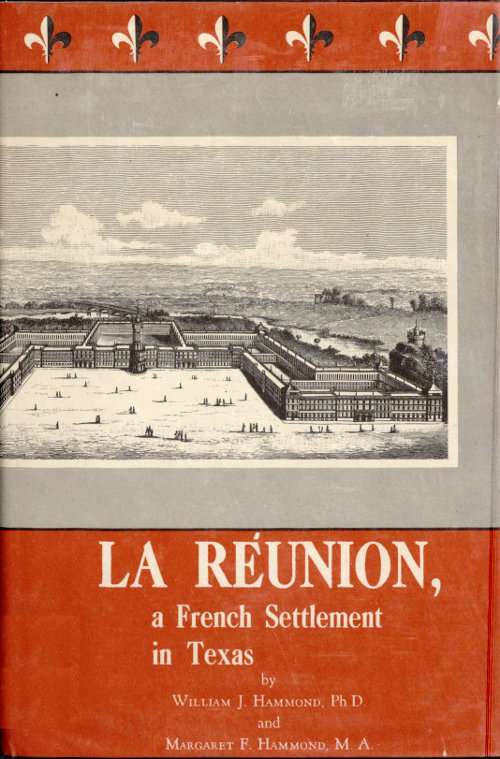
Thus, a fantastic plan of a French socialist colony
came to an end, wrecked upon the individualistic tendencies
and weaknesses of its membership. Texas has
been made richer culturally by the attempts of these
dreamers to better conditions and transform the society
in which they lived, even though no economic gain came
to these individuals.
This list has been compiled from all the bibliographical
data used in this research, including the census report
of 1850 and 1860. There are doubtless duplications
since no effort has been made to check transfer of a son
or daughter from a family list to a new family by marriage,
etc. American reporters of that time and writers
of a later date were not accurate in spelling French
names. A careful check of names has been made on
tombstones in the Old French Cemetery. Many times
names were found such as “Dumirel” with no first name
and no further appearance. In this case the name was
listed just as it appeared. This list is not complete but
it contains more names than any other list known at this
time. The symbol (S) has been used where the spelling
or listing is different but evidently of the same family.
The most helpful list and the most complete is by Eloise
Santerre contained in her thesis, Réunion ... with a
Biographical Dictionary of the Settlers. She also identifies
each settler wherever possible.
Achard, E.
Allen, John
Amyard
Baer, two sisters
Baer, Gaspard, wife and four children
Bar, wife and son
Barbeau
Barbier, Alexander, wife, children: Alexis and François
Barbot
Barret, Francois
Begnier
Belinger
Bernard, wife and mother-in-law
Bessand, wife, son and daughter
Besseraux
Besseron, Adel
Billard, wife and son
Blot
Boger
Boll, Henry, wife Elizabeth, children: Henrietta, Lizatte, Mrs. Ernest Arnold, Charles, and Jacob
Boll (S) Henry, wife Elizabeth, children: Ann and Minnie, (relative) Lena
Boll, Henry, Sr.
Bollanger
Bonneville
Bossereau, Abel
Bossereau, Catherine
Bouge and wife
Boulay, Dominique, wife Isabelle, son Adolphine, sister, niece
Boulay, Francois (uncle of Dominique), children: Domine K. and Adolphe
Boulay, J. F., wife, daughter Louise
Bourgeois, Lucien and wife Louise
Boyer
Brison
Brisson
Brisot, Pere
Brochier, A., wife
Brochier, O. (brother of A. Brochier)
Brochier, P.
Brunet, Eugene (brother of Joseph Brunet)
Brunet, Joseph, Father
Bucher
Bureau, Allyre, wife, three sons and daughter Alice
Burki, Emil
Bussey
Candie, daughter
Cantagrel, Francois Jean, wife, children: Simon and Josephine
Capy, Charles, wife Notiva, (seven children): Mrs. Segarri, Alfred
Carpenter, Noel, wife and daughter
Chamboard, wife and daughter
Charpentier, Joseph, wife Elizabeth and children: Joseph Alfred, and Nativa
Charron
Chavennes
Christian, M.
Christophe, Henry
Cillard, Jules
Coiret, Francois, wife, (two daughters): Mathilde
Coleman, Louis
Colin, Denis
Colm, Francois
Come, Sebastien
Considerant, Francois, wife, daughter and three sons
Considerant, Victor Prosper
Corne
Cousin, Vincent
Cretien, Athanase, wife Augastine, children: George and Emil
Crisset, Josephine
Dailly, Abel, wife Catherine
Daly, Ceaser
Danderet
Debray
De Guelles
Deiterall
Dellard, wife, son and two daughters
Delasseau, Michel, wife Amelee, children: Angele and Anatole
DeLord, Alphonse, wife, son and two daughters
Derigni, wife and son
Destnet, Henri, wife and daughter Marie
Despart, Henry
Dessau, Mlle.
De Vry
Dillard, wife, son and two daughters
Divion
Doderet
Doelly, Abel
Dominique
Drevet
Droxal
Dumirel
Desseau
Duterall
Duythoya, Tristan, daughter
Enginard, (Enginaid)
Ettienne, wife
Eymar
Farine, Nicholas, wife Jeannette, (second wife) Miss Mills, son Albert
Ferguson
Forette, Antoine
Franchot
Frishot, Achille
Frishot, Desire Christophe, wife Susan, children: Laura, Henrietta, and Bertha
Frishot, (S) Christopher Desire, wife, two daughters and two sons
Frishot, D., (S) wife Susana, daughter Laura, (relatives) Pere, D., and Hershel
Frishot, Leontine (perhaps daughter of Phillip)
Frishot, Pierre Philip, wife Marie Adeld Simmonett, children: Achille and Leontine
Frick, Heinrich, wife Barbara, children: Adolph, Otto, and Henry
Frique
Gaudel, Mlle.
Gaudel, daughter
Giard, Pierre, three sons: Pierre, Joseph and Francois
Girard, Francois (S)
Girard, Pierre (S)
Godelle, Mlle.
Goetsels, (Goodseels) John, wife Lucine, children: Philip, Colette, Clemence, and Jennie
Goetsel, Philip (son of John Goetsel)
Goetseed, (Goodseels) (S) Lucine, children: Philip, Colette, Clemenie, Jennie, Ana, Lena, and Jean
Gordia
Goudsill, wife, son and three daughters
Gouffre, A. J., wife and son
Gouhenans (perhaps not a member of colony)
Grimot, Pierre
Grisset, Pierre, wife Josephine, daughter Marie
Grisset, (S) Josephine and daughter
Guerin
Guillemet, August, wife Marie E., children: Angelle, Alexandrine and Augustine
Guillemet, (S) Auguste, wife Marie, children: Angel, Augustine, Alfred, and Amen
Guillemet, Augustine (daughter of Auguste)
Guiller
Guillot, August and wife (son of Maxime)
Guillot, Maxime, wife Mary, son August
Guillot, Remy
Guyot, Remy, wife and son
Gusman
Haeck
Haize, Jules
Henry, (Henri) Paul R., wife, children: Paul, Rene, Marie and Asea
Henry (S)
Hetten, F. T.
Heymens, F. T., A and V. (relatives)
Hitten, Gustavus
Joffre, Christophre
Jones, Samuel S., wife Louisa, daughter Guillilmine
Knopfli, Jacob, wife Barbara, daughter Elizabeth
Lagogae, Jean Baptiste, son and daughter
Lang, Benjamin, wife Eugenia, children: Mrs. Louis F. Rick, Mrs. F. Rick, and Mrs. Anna Lotzinhiser
Lanotte, Jules, wife Josephine, children: Jules and Alice
Lanotte, (Lonet), (S) Alexander, wife
Lassagne
Lavinge
Leinhardt, George
Le Pere, Lagogue
Leray
Lescrenier, (Le Lecrenier)
Lesonier
Long, Ben
Lord, M. D.
Louckx, John B., wife Mary, second wife Louisa, (seven children): Mrs. Thomas B. Matney, Mrs. Willard Boyer, Minnie, and Marie
Louckx, Mrs. Louisa Lenison (S), (perhaps wife)
Louis, Louis, wife Margaret
Loupot, Francois
Loupot, Jean, wife Rosina, children: Rosina, John, Ema, Maxime, and Emile
Loupot, John
McDelore, Aut., wife Augustine, Jennie
Maguet
Manduce, John
Manduel, John (S)
Mansion, Emanuel, wife Jeannie
Marins
Marius, Antoine, accompanied by brother
Marold
Mayrus
Michel, Ferdinand, wife Salomee
Migoureaux
Mique
Monduel, Jean, wife, daughter Julia
Monpate, two sons and daughter
Morize
Moulard, Mrs. Jean, daughter Julia
Moulard, John, wife, daughter and son
Naton, (Newton)
Nicholas
Nusbaimer, Robert Jacques
Nussbaimer, (S) Jacob, wife Dorothes, children: Mary and Theodore
Pascal
Peier, Jacob
Peier, Jean
Peloux, wife and daughter
Pendleton
Perison
Petit, wife, son and daughter
Pierquet
Pierson
Pimpare, (Pinpare), Rene, wife Isabelle
Potevin, (Poitevin), Guillome, wife Anna Dusseau
Priot, (Prict), Jean, wife Leontine, children: Ernest, Ernestine, and two other sons
Protat, (Prota), Antoine, wife and two daughters
Prunet, Joseph
Quinet, Nicholas, wife children: Ledre and Matilde
Raijan
Raizant, (Raizen), (S)
Regnoir
Reinhardt, George
Remond, Emile, wife Cesarine
Renier
Reverchon, Jacque Maximilien
Reverchon, Julian Maximilien, children: Julien and Louise
Roger, (Rogers)
Rose, Jules, wife and son
Rouby
Royer, Julius, wife and son
Royer, (S) Joseph
Santerre, (Saunterre), Francois, wife Marie, children: Apploinaire, Cesarne, German, Luce, Emmanuel, Raphael, and Gustave
Santerre, (Saunterre), Germane (son of Francois)
Santerre, (Saunterre), Gustave (son of Francois)
Savardan, Dr. Augustin
Scherer
Sellier
Steere
Stiffel
Taupin
Thevenet, Michel, wife, children: Marie, Charles, Henry, and Philip
Thivnet, Bessare, wife and daughter
Toidevin, wife
Tourneville
Tuillot, (Teulot), R., wife and son
Vacher, Alexandrine, wife and daughter
Vaizian
Valentine
Vanderbosch, (Van Den Bosch), Guillam (William J.), wife Collet
Vardack
Vigoureaux, Madame Clarisse, daughter
Vilmain
Vogel
Voirin, Charles, wife and two sons
Voision, Pierre
Van Grinderbeck, Guilliame (William), wife Clemence
Van Grinderbeck, Louis
Vreidag, Rudolph
Wealms, John, wife Barbara, daughter and two sons
Wealms, (S) John, wife Barbara, children: Clemantine and John H., (relative) Dominic
Willemain
Willemet, F. L., wife and two daughters
Willis, wife, daughter and two sons
Willdme, Richard
Witiker
Yeuch
Whereas, A company under the name of the European
and American Colonization Society in Texas has
been formed in Brussels between Victor Prosper Considerant,
Allyre Bureau, Charles Francois Guillon, Jean
Baptiste Andre, Goden Lemaire and their associates, on
the 26th day of September, A.D. 1854, as appeared by
an act deposited at the office of Mr. Hedweld, Notary
in said city, and duly legalized and certified on the 20th
day of January, AD. 1855, by the Consul of the United
States at Antwerp, the nature and object of which said
company consists in the Union of intended colonists
creating a joint stock, and constituting an agency to
enable its shareholders to emigrate to Texas to colonize,
to improve lands, to transfer hither their manufactories,
to introduce new culture and new branches of industry.
And whereas, the objects of said association are calculated
to develop the resources and add to the population
and wealth of this State. Therefore, Be it enacted by
the Legislature of the State of Texas,
Section 1. That Victor Prosper Considerant, Allyre
Bureau, Charles Francois Guillion, Jean Baptiste Andre,
Godin Lemaire and their associates, successors be, and
they are hereby constituted a body politic and corporate,
by the name of the European and American Colonization
Society in Texas, with power and authority in said
corporate name to have succession, to make contracts, to
have and use a seal, to acquire by purchase, donation or
otherwise, and to own, manage and alienate property
real, mixed and personal, to sue and be sued, to plead
and be impleaded in law and equity in like manner and
as fully as natural persons, to carry on, conduct and
manage any kind of manufacturing, mechanical or agricultural
business, to issue shares and negotiate them, to
borrow money by mortgage on its property or otherwise;
to have a President, Directors, Secretaries and Treasurers,
and all such officers and agents as the company
may deem necessary, and to prescribe their powers and
duties; to make such by-laws, rules and regulations, not
inconsistent with the Constitution and laws of this State
or of the United States, as they may deem necessary and
proper for the government of said company and the
management of its affairs and interests, and to possess
generally all the powers, rights, immunities and privileges
necessary to carry into effect the provisions and objects
of the said association.
Provided, that a majority of the Directors of said
Company and the President thereof shall be residents
of Texas, and that the principal office shall be kept in
this State, where all writs and citations shall be served.
And further provided, that this act shall not be so construed
as to entitle said company to the benefits of any
law granting lands or money to any railroad, manufacturing
or colonization company, nor shall it authorize
said company to prohibit slavery in any Territory occupied
by it.
Section 2. The capital stock issued by the said Company
shall not exceed one million dollars, to be divided
into shares of such values and entitling the share holders
thereof to vote in such manner as shall be prescribed by
the by-laws of said company; the duration of which shall
not exceed twenty years from the passage of this act.
Section 3. That the shareholders or corporators of
the company, by this act incorporated, shall be liable for
all debts and obligations of said company in the same
manner and to the same extent as general partners are
by law now liable.
Passed, September 1st, 1856.
An Act amendatory of an act entitled an act to incorporate the European and American Colonization Society in Texas.
Section 1. Be it enacted by the Legislature of the
State of Texas, That the third section of the above
entitled act be so amended that the same shall hereafter
read as follows: That the Shareholders or Corporators
of the Company shall be liable for all debts and obligations
of said Company, to the extent of the Capital Stock
subscribed or owned by each.
Section 2. That this act take effect and be in force
from and after its passage.
Approved, January 6th, 1858.
Permit me to introduce to you my friend Mr. F.
Cantagrel of France—He is a gentleman of high standing
and acquirements and goes to Texas to see the
country and may perhaps establish himself there for life—Being
a stranger, he will be thankful for any advice,
aid or consel you may extend to him, will be regarded
a personal favor by me and duly reciprocated by us
both.[1]
Although not acquainted with your Excellency, yet
as the diplomatic representative of our country I take
the liberty of addressing you this note for the purpose
of introducing to your acquaintance and attention the
distinguished Republican, Mons. Victor Considerant of
France; who is about leaving Europe with a number of
his Countrymen to settle and establish a Colony in your
state. Mons. Considerant is an ardent republican and
has not escaped the persecution usually attendant upon
the advocates of these opinions in Europe. Our Countrymen,
I trust, will receive him the more cordially. He is
a gentleman of means education and intelligence, and
will be a most valuable acquisition to your state. Under
these circumstances it is not necessary to commend him
both good office and kind consideration of the governor
of the free and chivalrous state of Texas.
I have the honor to be, Sir, with very great respect
your Countryman & old Servant.[2]
Introduction
[1]For a brief study of socialism see Thomas Kirkup,
A History
of Socialism (New York, 1909); John Spargo,
A Summary and
Interpretation of Socialistic Principles (New York, 1906); Harry
W. Laidler,
A History of Socialist Thought (New York, 1927).
For a more extended study, Donald Drew Egbert and Stow
Persons, editors,
Socialism and American Life (Princeton, New
Jersey, 1952), 2 Vols.
[2]A. C. Pigou,
Socialism Versus Capitalism (London: Macmillan
and Company, 1938), p. 2; Egbert,
op. cit., I, iii.
[4]Egbert,
Socialism and American Life, I, Introduction.
[5]See also Max Beer,
A History of British Socialism, London,
1929, I, 160-180; Egbert,
op. cit., I, 156-172.
[6]H. W. Laidler,
Social-Economic Movements (Thomas Y.
Cromwell, New York, 1946), 98.
[7]Socialism, Utopian and Scientific (Chicago: 1914), 74;
Egbert,
op. cit., I, iii.
[9]This conclusion does not coincide with the discussion in
Socialism and American Life, I, 215-522 by Daniel Bell. It
appears that Bell used an indefensibly wide interpretation of
Marxianism to demand so many pages to relate the actions of
the followers of Marx. An example, from the viewpoint of this
author, may be noted on page 250. The discussion in these two
hundred and fifty pages is a splendid story of American Socialism
but hardly of Marxian Socialism in America.
CHAPTER I
[1]D. O. Wagner,
Social Reformers from Adam Smith to John
Dewey (New York: 1934), 213-239. Harry W. Laidler,
Social-Economic
Movements, An Historical and Comparative Survey
of Communism, Cooperation, Utopianism: and Other Systems
of Reform and Reconstruction (New York: Thomas Y. Crowell
Co., 1946), 44-117. For general discussion concerning the period
see
Revue des Deux Mondes, XXIIIe Annee, Seconde serie de la
Nouvelle Period, III, No. 1, 1853, 320-345, and especially, 1852,
No. 3, 508-545.
[2]For a criticism of Fourier’s ideas and system see Mme. C.
Coignet,
Victor Considerant, sa Vie, son Oeuvre (Paris, France,
1895), 5-9; Frederic Engels,
Socialism, Utopian and Scientific,
translated by Deward Aveling (Chicago, 1914), 63-66; Harry
W. Laidler,
A History of Socialist Thought (New York, 1927).
For a more extensive biography,
La Grande Encyclopedie Nouvelle
Biographie Generale depuis les Temps les plus Recules
Jusqua nos jours, XII; Coignet,
op. cit., 2-5. Fourier’s chief
works are
Le Noveau Monde Industrial et Societaire, 1829;
Traité de l’association Domestiquée Agricole au Attraction Industrielle,
2 Vols., 1822;
La Theorie des Quarte Mouvements
et de Destinées Générales. For materials on related discussions
see A. Grandin,
Bibliographie des Science, etc. For a biography
see F. August Bebel,
Charles Fourier, Sein Leben Und Seine
Theorien (Stuttgart, 1888).
[3]For a plan of phalanstery see
Appendix B. Compare Albert
Brisbane,
Social Destiny of Man: or,
Associations and Reorganization
of Industry (Philadelphia, 1840), 353-354. For an extensive
study see items listed in Egbert,
op. cit., II, 132-135.
[4]Frederic Engels had a very high appreciation of Fourier;
he said: “Fourier is not only a critic; his imperturbable serene
nature makes him a satirist, and assuredly one of the greatest
satirists of all times.... He was the first to declare that in any
given society the degree of woman’s emancipation is the natural
measure of the general emancipation.” See Frederic Engels,
op. cit., 64-65. Ferrari, “Des Idées de L’école de M. Fourier
depuïs 1830” in
Revue des Deux Mondes, XI, August 1, 1845,
No. 3, 389-434.
[5]Eugene Fourniere, “Le Rèigne de Louis-Philippe, 1830-1848,”
in
Histoire Socialiste, 1789-1900, edited by Jean Jaures,
322-326.
[6]Coignet,
op. cit., 1-16. For a list of his writings see
Victor
P. Considerant, in LaRousse du XXe Siécle, II, 425.
[7]Coignet,
Victor Considerant, sa Vie, son Oeuvre, 11-22;
see also Eugene Fourniére,
op. cit.; Savardan,
Un Naufrage au
Texas (Paris, 1858), iii, 11-23.
[8]Coignet,
op. cit., 29-34.
[9]Ibid.; Albert Brisbane,
A Mental Biography With a Character
Study by His Wife, Redelia Brisbane (Boston, 1893),
194; Hereafter cited as
Mental Biography; Savardan,
op. cit.;
Victor Prosper Considerant,
The Great West, A New Social
and Industrial Life in Its Fertile Regions (New York, 1854)
passim. Hereafter cited as
The Great West.
[10]Eugene Fourniére,
op. cit., 444.
[11]Brisbane,
Mental Biography, 195.
[12]Brisbane, in the preface of Considerant,
The Great West;
see also, Considerant,
Contre M. Arago Réclamation addresse
a la Chambre des Deputies par les Redacteurs du Feuilleton de
la Phalange. Suive de la Théorie Droit de Propriété, Paris, 1840.
[13]Albert Brisbane,
op. cit., 315.
[14]New York Tribune, January 1, 1853, quoting the
Allegemeine
Zeitung.
[15]Albert Brisbane,
op. cit., vii. For a short bibliography of
Brisbane see Charles A. Madison,
Critics and Crusaders (New
York, 1947-1948), 114-133.
[16]Albert Brisbane,
op. cit., 177; a further development of
Brisbane’s ideas along this line is found in his
Social Destiny
of Man.
[17]Brisbane,
Mental Biography, xi; For a discussion of Brisbane’s
efforts in literature and propaganda see John Humphrey
Noyes,
History of American Socialist (New York, 1870), xvii,
entitled “Literature of Fourierism.”
[18]Brisbane,
op. cit., 211.
[20]Brisbane,
Social Destiny of Man, or Associations and Reorganization
of Industry (Philadelphia, 1840), 5-40.
[21]Brisbane,
op. cit., 40.
[22]For a full list of writers and supporters see Noyes,
History
of Socialism, 211-231; C. Nordhoff,
Communistic Societies of
the United States (New York, 1875).
[23]For additional information concerning Fourierism in the
United States, see William Alford Hinds,
American Communities
(Chicago, 1902), 221, 254, a list of phalanges on page 224;
Albert Shaw,
Icaire, A Chapter in the History of Communism
(New York, 1884), ii.
CHAPTER II
[1]Victor Prosper Considerant,
Au Texas, 1st, 1-6. There
are two editions of this book, and, unfortunately, notes were
taken from both. The editions will be referred to as 1st and 2nd.
[2]Ibid., 6; Coignet,
Victor Considerant, sa Vie, son Oeuvre,
74, states that Considerant came directly to the United States
in response to an invitation from Brisbane, intending to establish
a colony.
[3]Considerant,
op. cit., 8; Coignet,
op. cit., 175.
[4]Ibid., Part I, especially 16-17.
[5]Picayune as quoted in the
Northern Standard (Clarksville,
Texas), May 21, 1853.
[6]Considerant,
Au Texas (1st ed.), 23-28.
[7]Considerant,
The Great West, 4-5;
Au Texas (1st ed.), 28-29.
[8]Considerant,
The Great West, 6;
Au Texas (1st ed.), 32-33.
[9]“The town of Preston, from which all this misery
for the Red Man emanates, is a collection of low groggeries
and a few stores, lining the high bluff bank of
the River.
It is notorious as the scene of some most cold-blooded
and cruel murders, committed in open day, and with—up
to that time—perfect impunity. This, together with
the detestable traffic I have just alluded, whiskey traffic
has brought such a stigma upon the place, that the
very name is sufficient for all that is ruthless and
vicious.”
W. B. Parker, Notes Taken During the Expedition
Through Unexplored Texas, 72.
[10]Letter written June 9, 1853 from Cooke County, quoted
in the
Northern Standard, June 18, 1853.
[11]Considerant,
The Great West, 9-10;
Au Texas (1st ed.),
37-44.
[12]Ibid., 42. The Icarian movement was an attempt to form
a French colony which had preceded Considerant’s colony by
several years.
[13]Ibid., 10-11. Perhaps the tomatoes were of the climbing
variety.
[14]Considerant,
The Great West, 10-11;
Au Texas (1st ed.),
44-45.
[15]Considerant,
The Great West, 11.
CHAPTER III
[1]Considerant,
The Great West, 27. The whole of
Au Texas
is a defense of the colonization scheme, in which Considerant is
continually reminding the colonists and those who furnished
the money that no golden promises were ever made.
[7]Herman Studer,
Auswanderung nach hoch—Texas, Was
wir in Texas wollen; Andeutungen Ueber Organization der
Arbeit (Zuerich, 1855); Considerant,
Description du Phalanstere
et Considerations Sociales sur l’ Architect antique (3rd
ed.), Libraire Societaire, Paris, 1846, 64.
[8]Considerant,
Du Texas, premier Rapport a Mes Amis,
(Paris, 1857), 7.
[9]Ibid., 8-9. This surprise and disappointment of Considerant
in having all his advice disregarded might explain Considerant’s
attitude toward Savardan’s party at New Orleans and Galveston,
as given in Savardan,
Un Naufrage au Texas, ch. ii.
[10]Considerant,
Au Texas, (2nd ed.), 276. The title is sometimes
written the
Société Europeene de colonisation du Texas.
[11]Savardan,
Un Naufrage Au Texas, 14; see also Coignet,
Victor Considerant, sa Vie, son Oeuvre.
[13]Considerant,
op. cit., 272-274. Agencies were to be established
at No. 2 Rue de Beaune, Paris, France, and in New
York, with Brisbane as agent for the United States—Considerant,
The Great West, 60.
[14]Considerant,
Au Texas, (2nd ed.), 240.
[15]Appendix of statutes of the Society,
ibid., 271.
[16]Considerant,
A Petition to the Honorable, the Senate and
the House of Representatives of the State of Texas (Austin,
December 10, 1855), Enclosure c, 7.
[17]Quoting an extract from a letter to his excellency, the
Governor of Texas, in
ibid., 5.
[18]Considerant,
Au Texas, (2nd ed.), 199-217.
[20]Considerant,
The Great West, 42;
Au Texas (2nd ed.),
127-131.
[21]Considerant,
The Great West, 59-60.
[22]Considerant,
Au Texas, (2nd ed.), 306-310.
[23]Considerant,
The Great West, 28-29.
[24]Considerant,
Au Texas, (2nd ed.), 306-310.
[25]Considerant,
The Great West, 25.
[26]Ibid., 37-38;
Au Texas, (2nd ed.), 320-321.
[27]Considerant,
The Great West, 30-31; see also succeeding
footnote.
[28]Considerant,
Au Texas, (2nd ed.), 189-190.
[29]Considerant,
The Great West, 37-38.
[30]Considerant,
European Colonization in Texas, 15;
The
Great West, 37-38;
Au Texas, (2nd ed.), 167-170.
[32]Considerant,
The Great West, 44.
CHAPTER IV
[1]Considerant,
European Colonization in Texas, An Address
to the American People, New York, 1855, 4-6;
Du Texas, 5-6.
[2]Considerant,
European Colonization in Texas, 5.
[5]Also quoted in Considerant,
op. cit., 31.
[6]For Considerant’s reply see his pamphlet
European Colonization
in Texas; for editorial of
Washington Sentinel, see
Texas State Gazette, October 13, 1855; For the letters see
ibid., June 2, 1855, October 13, 1855.
[7]Texas State Gazette, October 13, 1855.
[8]Letter from J. L. to Editors, dated at Washington, May
2, 1855, as quoted in
Texas State Gazette, June 2, 1855.
[9]European Colonization in Texas.
[11]Austin State Gazette, Aug. 11, 1855; Compare this article
with the one written in the issue of September 22, 1855, wherein
those who had suffered from persecution were advised to,
“Come to the gallant West, where freedom is as expansive as
the prairie, and as generous as the soil. Come to the West and
let the golden grain you raise be sent back to feed the men
whose ruthless hands would, as did those of Cain of old, strike
down the toiling tiller of the soil.”
[12]Texas State Times, August 4, 1855.
[15]Ibid.; For opposition to other foreigners in Texas see
Texas
State Times, June 16, 1855, and also June 21, 1855.
[17]As quoted in
The Standard, February 24, 1855.
[19]Texas State Gazette, October 13, 1855.
[21]Albert Brisbane,
Social Destiny of Man; or
Associations
and Reorganization of Industry, ix, especially pps. 101-102.
[22]Considerant,
European Colonization in Texas, 35-38.
[23]Texas State Gazette, August 11, 1855.
[24]Savardan,
Un Naufrage au Texas, specifically states that
the legislators would have no neutrality but actual participation
favorable to the slavery question.
[25]New York Tribune as quoted in the
Texas Sun, November
17, 1855.
[26]The petition is entitled “
A petition to the Honorable, the
Senate and the House of Representatives of the State of Texas,”
and is in the Library of the University of Texas. Search of the
state archives was made for the original document, with other
information which Considerant referred to in the petition, but
was not found, due to the fact that the records were not systematically
filed at the time of the search.
[27]Considerant,
European Colonization in Texas, 4ff. states
his attitude toward this opposition and the reasons for his
application.
[28]Extract from a letter to his Excellency the Governor of
Texas, as quoted in “
A Petition to the Honorable, the Senate
and House of Representatives of the State of Texas,” 5.
[29]Dallas Herald, August 16, 1856.
[30]State Gazette Appendix, Austin, No. 79, Sixth Legislature,
Adj. Sess. 205.
[31]House Journal, 1856, 566, and
Austin Gazette, Appendix,
No. 70, 205.
[32]Senate Journal, 1856, 340-341.
[34]Ibid.,
Adj. Session, 394.
[35]Senate Journal, 1856, 412.
CHAPTER V
[1]Dallas Herald, as quoted in
The Standard, February 24,
1855.
[2]Dallas Herald, as quoted in the
Clarksville Standard, February
24, 1855.
[3]In preface of Considerant,
The Great West.
[5]Savardan,
op. cit., 37-38; the numbers really indicate livres
instead of pounds.
[6]The account of Savardan’s trip and the others mentioned
above are found in Savardan,
Un Naufrage au Texas, chap. iv.
[7]Savardan,
op. cit., 201-203.
[9]Samuel W. Geiser, “Naturalists of the Frontier,” in
Southwest
Review, October, 1928-July, 1929, XIV, No. 3, 331. An
adequate biography of Julien Reverchon is given in this article
by Mr. Geiser.
[10]Ibid. See also Preston Sneed, “Letter signed by Napoleon
is in Dallas,” in
Dallas News, Sunday, May 8, 1927.
[11]I have been able to locate only a few detached pages of
his diary. These pages were in the possession of a grandson
of the La Notte family or Lanotte.
[12]Esubia Lutz, “Almost Utopia,” in
Southwest Review (October,
1928-July, 1929), Vol. XIV, No. 3, 321-330. Since
writing this article Germain Santerre has died. See also George
H. Santerre,
White Cliffs of Dallas, the Story of La Reunion,
The Old French Colony, Dallas, 1955, 137-142.
[13]Ellis W. Schuler, “The Geology of Dallas County,” in
University of Texas Bulletin, No. 1818, March 25, 1918.
[14]See
Appendix A for a partial list of the colonists and see
also Eloise Santerre,
Réunion, a Translation of Dr. Savardan’s
Un Naufrage au Texas.
[15]Texas State Gazette, February 10, 1855.
[16]The list of names contained in
Appendix A was collected
from articles, papers, and books written concerning the colony
and does not represent any special investigation in unprinted
sources. “The story of Old French Town” in the
Dallas News,
March 26, 1922; and also Santerre,
op. cit., are perhaps the
best sources available for names.
CHAPTER VI
[1]Victor Prosper Considerant,
Au Texas, le premier Rapport
a mes Amis (1st ed., Bruxelles, 1855), 44;
The Great West, A
New Social and Industrial Life in its Fertile Regions (New York,
1854), 9-10;
European Colonization in Texas, an Address to the
American People (New York, 1855), 18. The greater part of
this chapter first appeared as an article in
The Southwestern
Social Science Quarterly, XVII, No. 2, September, 1936.
[2]A Petition to the Honorable, the Senate and the House of
Representatives of the State of Texas, Austin, December 10,
1885; Savardan,
Un Naufrage au Texas ..., p. 30-31.
[3]Deed Record, Dallas County,
Book K, 67-69; also
Book F,
410-411.
[4]Considerant,
Au Texas (2nd ed.).
[5]Savardan,
op. cit., v.
[6]Phalanstery was the name given to a unit of the colony in
writings supporting the movement.
[7]Deed filed in Harris County
Record of Deeds, Book D, 164;
see also County of Dallas,
Deeds Record, Book K, 174-176.
[8]Savardan,
Un Naufrage au Texas, 148-149.
[10]Southwest Review, (October-July, 1928-1929), XIV, 324-325.
A list of the tracts purchased is found in Dallas County,
Deed Record, Book K, 67-73.
[11]Savardan,
op. cit., 244-246.
[12]Compare,
Ibid., 160 ff.
[13]Savardan,
Un Naufrage, 206-213.
[14]Considerant,
Au Texas,
passim, for definite explanation.
[15]Savardan,
op. cit., 179 ff.
[16]Dallas Herald, November 23, 1859.
[17]Dallas Herald, June 1, 1859.
[18]Vincent, “The Story of Old French Town,”
Dallas Morning
News, November 23, 1919.
[19]Savardan,
op. cit., vii.
[24]
- a. Considerant and council of six (supposedly elected by people).
- b. A Director, apparently responsible to the Council.
- c. Worker’s Council (elected from the different groups of workers). Two from this organization were elected to serve in the council of six.
- d. In addition to these committees there were numerous minor groups—one of the store, and one of the hotel—each one exerting some influence on local affairs.
Savardan, Un Naufrage au Texas, passim.
CHAPTER VII
[1]Savardan,
Un Naufrage au Texas, 175-178.
[3]Considerant,
Du Texas, 14-16; Savardan,
op. cit., 188.
[4]Du Texas, 9-13. He died in Paris, France, 1893.
[6]Savardan,
op. cit., 150.
[7]Savardan,
Un Naufrage au Texas, 151-153.
[8]Savardan,
op. cit., 169-170.