
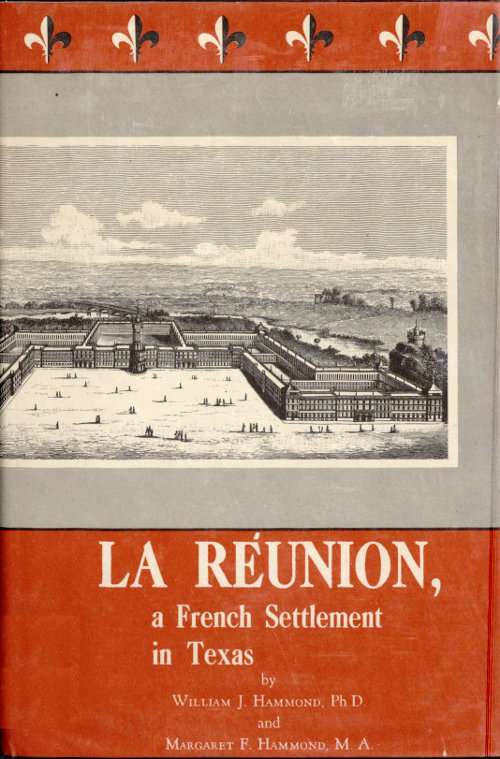
The Project Gutenberg eBook of La Réunion, a French Settlement in Texas
Title: La Réunion, a French Settlement in Texas
Author: William Jackson Hammond
Margaret F. Hammond
Release date: January 1, 2019 [eBook #58590]
Language: English
Credits: Produced by Stephen Hutcheson and the Online Distributed
Proofreading Team at http://www.pgdp.net
Charles Fourier.
Charles Francois Fourier was born in Besançon, France, in 1722. His teachings and writings inspired Victor Prosper Considerant to attempt the establishment of La Réunion, a French Colony in Texas.
LA RÉUNION,
a French Settlement in Texas
by
William J. Hammond, Ph.D.
and
Margaret F. Hammond, M.A.
Royal Publishing Company
Dallas, Texas
Copyright 1958
by
William J. Hammond
Printed in the United States of America
by
Royal Publishing Company
“The Supreme law is liberty and reciprocal adaptation.” Considerant, The Great West, 40.
“We desire the free and spontaneous unison of human forces.” Considerant, The Great West, 47.
“Les principes de liberté, de justice, et d’unité” Considerant, Au Texas, 2 ed., 199.
PREFACE
In presenting this brief history of La Réunion, we realize that the story may appear too long for such a seemingly unimportant event in our state history, but to those who are doing research work, especially years hence, the details can not be too numerous. Even now great difficulties present themselves in tracing down the materials that are now in existence.
Extensive quotations have been used throughout the monograph, too extensive in fact, but the production of these documents in full rather than in part may be justified on the basis of making them available to students of Texas History. Additional material has been given in the appendix where it was deemed too long to include such materials in the story, and it is thus given as a mere narrative of facts of one of the great romantic attempts to settle Texas and the Southwest. We have avoided complicating the story by not discussing socialism per se, dealing with its connection with La Réunion only when necessary for an understanding of the activities of the colonists.
We wish to express our thanks to the librarians of the Public Library in Fort Worth, the Texas University Library, and Congressional Library for the loan of books, and especially to Mrs. Bertie Mothershead, former librarian at Texas Christian University for her co-operation and helpfulness.
The Authors
CONTENTS
- Introduction 9
- Chapter I Founders of the Colony 17
- Chapter II Au Texas 35
- Chapter III The Society 47
- Chapter IV Attitude of Texans toward the Colony 63
- Chapter V The Immigrants 85
- Chapter VI La Réunion, the Colony 95
- Chapter VII The Breakup 107
- The Appendix 117
- A. Partial list of the Settlers 117
- B. Plan of the Phalanstery 126
- C. Acts Incorporating the Colony 127
- D. Letters of Introduction 130
- References 133
- Bibliography 147
INTRODUCTION
SOCIALISM CROSSES THE ATLANTIC
The last half of the eighteenth century was a period of awakening for the masses of western Europe; revolution thundered in Paris and reverberated throughout all Europe. Thrones tottered and fell; others rose to take their places. Republics were created by the revolutions overnight to live and thrive only during the predominance of the French Revolution, and then fade into the kingdoms from whence they had emerged. Peoples were led to believe that the day of Utopia had arrived and they turned upon their masters and oppressors to destroy them, and then, in return, were led to the battlefields and slaughtered for the whimsical desire for glory of the man who rode the waves of emotional fanaticism to power. Out of the mad chaos created by such desires and emotions a new system of economic hope was created. French dreamers and intellectuals had seen, in a short time of twenty-five years, the ultimate hopes of a nation rise to exalted heights in a sort of religious fanaticism and then plunge to depths of despair. A culture or civilization in which such a catastrophe as that could happen, so the philosophers thought, must be faulty beyond repair. Some of these philosophers surrendered to discouragement and pessimism while others sought to rebuild and reconstruct the crumbling ruins of the past. Claude-Henri Saint Simon, Louis Blanc, François Fourier, Pierre Proudhon, Karl Marx, Robert Owen, Charles Kingsley, Saint Jean-Baptiste La Salle, Frederic Engels, and Johann Rodbertus were some of the most prominent socialists and thinkers who attempted to find a solution to the economic ills of Europe and to guarantee an equitable distribution of wealth to the masses of the people.[1]
This new system became known as socialism and was a middle class movement which developed out of the shattered eighteenth century era. Side by side with socialism developed communism, a doctrine developed out of the working class needs which, it was thought by some, neither socialism nor capitalism could satisfy. Socialism, as maintained by nineteenth century philosophers, stemmed not only from the old totalitarian doctrine of the Greek city-state but from the old concept of a universal pattern of cultural religion and economics of the medieval period. The philosophers were only substituting economics for medieval religion in the new social theory. The spirit of co-operative good, of theoretical equality and ultimate perfection of society are common to both Utopian socialism and religion. The socialists visualized a world of productivity sufficient to abolish poverty and furnish abundance to those who worked. The problem, as they understood it, was to prevent the concentration of enormous wealth in the hands of a few individuals by which those who possess wealth deprive the masses of equitable distribution of goods. This concentration could be prevented, so thought the socialist, if production and distribution could remain in control of the people who produced the materials. The socialist dreamed of an economy in which there would be a social development along with the economic but in which all inequality and special privilege would be eliminated from both political and economic life. One writer has defined socialism as:
A socialized industry is one in which the material instruments of production are owned by a public authority or voluntary association and operated, not with a view to profit by sale to other people, but for the direct service of those whom the authority or association represents. A socialized system is one the main part of whose productive resources are engaged in socialized industries.[2]
Over against the socialist theory was the pragmatic theory of capitalism already operating in many parts of Europe and America. The same writer defines capitalism as:
A capitalist industry is one in which the material instruments of production are owned or hired by private persons and are operated at their orders with a view to selling at a profit the goods or services that they help to produce. A capitalist economy, or capitalist system, is one the main part of whose productive resources is engaged in capitalist industries.[3]
Out of the socialist movement there developed three different types: first, socialism as represented by the Utopian idealism which is apparently impractical but which doesn’t encourage hostility between classes, groups or individuals; second, Marxian socialism which theoretically conceives of a classless society and which recognizes a ceaseless war between the so-called privileged and the underprivileged; and third, liberal socialism which involves the gradual socialization of all means of production and distribution by permitting it to remain definitely in the hands of the producer and consumer through governmental agencies or co-operating groups.[4] This latter type of socialism is the kind that many governments of the world are adopting today by the procedure of the established political parties in those states acquiring what appears to them as the practical socialist doctrines as new platforms and policies. These conceptions of socialism are tenets of early socialism and not of the many varieties operating under the name at the present time.
It is Utopian socialism rather than Marxian which developed into a strong movement in Europe during the nineteenth century but failed to materialize as a successful movement. This failure to gain immediate success was accepted by the leaders of socialism as a weakness of society instead of lack of merit in socialism, and the failure was explained as due to the inherent conditions of a traditionally bound European culture. Therefore, success, so the leaders thought, required only the transfer of their efforts to new lands where traditions had not yet been so thoroughly established. America was one of these new lands where Utopias could be built in the vast spaces beyond the frontiers. And so these dreamers turned their eyes toward the United States as a place where doctrines could be established and success could be achieved. However, neither here nor in Europe has the Utopian dream approached realization.
Robert Owen was one of the Utopian socialists who crossed the Atlantic to the United States seeking to escape the inheritance of European culture so that he could develop his socialism in a new world. Owen was the son of a saddler, well-educated, religious, and thoroughly trained in business. He organized New Harmony in the United States, an undertaking which cost him three to five years of his life and four-fifths of his fortune. Another settlement similar to New Harmony, located near Glasgow, Scotland, was attempted by him but also failed. Perhaps due to his eminent success in business in the British Isles, Owen was received by American leaders with more public acclaim than any other socialist. However, due to rash unorthodox religious statements and his temporary denouncement of marriage, he soon became unpopular in the United States as well as in the British Isles.
Owen was absolutely opposed to violence of any kind and was extremely favorable to recognition of the value of capital. He withdrew from the labor movement after the leaders had violated his doctrine expressed in his Address to the Workman, namely, that all workers must renounce hatred and violence directed against the capitalist or ruling class.[5]
While Owen failed to establish a Utopia in Europe or America, he did have great influence as stated by one writer:
And yet, despite his errors in judgment and the failure of many of his plans, the great-hearted and lovable cotton manufacturer and communist did exert a profound influence on the social thinking of the world. His indictment of the present order of society for its waste, its injustices, its tragedy of unemployment; his emphasis on social happiness as the ideal of human progress; his insistence that character was profoundly influenced by social environment; his urgent plea that all co-operate for the common welfare in the production and distribution of wealth, all these left their imprint on future generations. And his life of untiring devotion and sacrifice proved one of the great sources of inspiration to those who followed later in the socialist, co-operative, and trade union movements, as well as those who worked in behalf of child training, of labor legislation, of prison reform, and of similar causes.[6]
Another class of socialists found in the United States who came from across the Atlantic consisted of various religious groups. New Harmony itself had been originally created and founded by the Rappists and later purchased by Owen.
Fourier was to France what Owen was to England. There is a great difference between the position of men like Owen and Fourier and the one assumed by those who accepted Karl Marx, whose doctrines are best represented by Wilhelm Weitling. The communism of the first group was merely the communal possession of goods produced by communal effort with no thought of class conflict or the confiscation of goods produced by other means. This group sought to deny hostility and hatred between classes saying that the wealthy had the same desire to create a perfect society as did those who labored for a living. Marx held to the view that constant conflict between classes was fundamental.
Frederick Engels in evaluating the Utopian socialist wrote:
To all these Socialism is the expression of absolute truth, reason, and justice, and has only to be discerned to conquer all the world by virtue of its own power.[7]
Marxian socialism, on the other hand, is in direct contrast to the Utopian. He says:
From this time forward Socialism was no longer an accidental discovery of this or that ingenious brain, but the necessary outcome of the struggle between two historically developed classes—the proletariat and the bourgeoisie.[8]
Thus, it came about that the United States was fortunate in receiving whatever socialistic contributions it has received from the English and French Utopian socialism of reason rather than from the ruthless Marxian socialism of conflict which never has had any great influence in the United States.[9] All the colonies established by the followers of Fourier and Owen have disappeared. La Réunion, a French colony in Texas, furnishes a splendid opportunity to analyze the reasons for these failures.
Bust of Victor Considerant erected in his native village of Salins, France. From Maurice Commanget, Victor Considerant, sa Vie, son Oeuvre, 1929, Paris France.
CHAPTER I
FOUNDERS OF THE COLONY
La Réunion, a French settlement in Texas, was the result of the efforts and teachings of three men: Albert Brisbane, Charles François Fourier, and Victor Prosper Considerant. These men were all middle-class and all were Utopian socialists. Both Brisbane and Considerant visited the colony but Fourier’s contribution was confined to the promulgation of the ideas and theories which formed a basis of the colony.
Owenism in England and Fourierism in France grew out of the distaste of businessmen for business as it was conducted during the transition period between the dominance of the Mercantile System and the achievement of control of society by the new capitalistic groups. Both Owen and Fourier deserted what promised to be a fruitful and very successful business life in order to project their fantasia of reform. The origin of these doctrines of Utopian socialism in such an environment perhaps explains the non-violent principles insisted upon by both Owen and Fourier.
Fourierism may be better understood when it is realized that Lyon, the home of Fourier, was the most highly industrialized city in France at the beginning of the nineteenth century. There was constant strife between the owners and guild workers, oftentimes developing into open warfare. Poverty and fear of insecurity were general. Thus Fourier was able to observe and to compare capitalism with the co-operative nature of peasant efforts in the rich agricultural area surrounding the city.[1]
François Fourier was born in Besançon, France, in 1772, and while yet a child he mastered Latin and Greek, as was the custom in the educational system of those days. His father was a middle-class merchant who was frugal, if not too honest, and who was able to gather a small fortune of two hundred thousand francs of which François inherited one-half at his father’s death. In 1793 he lost his inheritance in an insurrection of the village against the French Convention then in power in France. In the same year he was forced into the army by a decree of the National Assembly, which provided that every man between the ages of eighteen and twenty-five should be conscripted for service. In 1797 he quit the army and returned to Lyon to enter business as a clerk. While making a living clerking in the store, he amused himself by writing. He published an article in a magazine in Lyon in 1803, another article in 1804; finally in 1808 his first important work, Theory of the Four Movements and the General Destinies, came from the press.
This work was met by indifference and disdain everywhere; even Fourier’s mother tried to persuade him to discontinue his work and make amends for that already published. However, he persisted. During the winter of 1815 and 1816 he left Lyon and retired to Talissier, where he prepared his second great work, Le traité de L’association domestique agricole ou attraction industrielle. It was after the production of these works that Just Muiron, one of his most faithful disciples, came to him. During these years and immediately thereafter, Fourier thought out and planned an elaborate system of socialism, or economic policy, which the world today has rejected as a fantastic Utopia incapable of realization.[2]
Fourier’s idea was one of mass production and systematic co-operation which was to be accomplished by minute organization, the unit of which was to be a phalange or phalanx. People were to be impelled into this system, rather than compelled, as is the method of many Utopian schemes. No force or compulsion was to be used. The whole process of evolving such a society was to be so natural and logical that people would accept the scheme without any persuasion. Happiness and prosperity would be obtained by a minute co-ordination of the various duties of the members of the phalanx, and that without any community of property. The phalanx would, in order to be successful, contain approximately two thousand members, all living in the same huge buildings known as phalansteries, which would contain the workshops as well as living quarters. This settlement was to be surrounded with a few leagues of land which the members worked when desire prompted them to do so.[3]
Under Fourier’s plan, however, work was to be nothing more than organized sport, and thus by competitive effort all necessary work was to be pleasantly done. Each community was to be self-sustaining and each member was to draw from a common storehouse all the necessities of life, provided, of course, that he had agreed to the unity of goods and property. Food and clothing were not to be held in equal share, but to be distributed according to the merits of each member of the phalansteries.
Each person was to gain initiative by the emotional passions which mutual attraction naturally developed. Misery, poverty, and unhappiness, according to Fourier, came from suppression of natural desires and passions. All that was required for perfect harmony in social life was the harmonious development and satisfaction of natural desires. People were misled only because civilization, by its unnatural laws of suppression, prevented men and women from full acquisition and use of their natural talents. Each person and each phalanx was to be brought into competition with others in the arts of commerce, labor, learning, and various activities of life. Then, too, desire for company, for association and union would be fulfilled by the bringing together of several hundred men and women into one phalanx or more. Whenever one form of labor or association became monotonous for the individual, he could easily transfer to another type of work and a new group of associates. Women were to be relieved of the monotony and drudgery of housework and the rearing of children. These duties, which had previously been forced upon the women, would be abolished by the switching from one type of labor to another, and by the organizing of children into special phalanges of their own.
Fourier was neither a clear thinker nor a logical writer.[4] In fact, all his writings are disorderly and his system has no logical outline nor organization. He was never able to impart to his disciples an impulse of victory and desire such as great men are frequently able to do.[5] However, what Fourier lacked, his most prominent follower, Victor Prosper Considerant, possessed.
Considerant was born in Salins, France, in 1808 at the foot of the Jura mountains, of a family belonging to the bourgeoisie. His father was a distinguished humanist, translator of English treatises, librarian for the city, and headmaster of a small school. The family was poor and the parents often had boarders in order to make financial ends meet. Considerant finished school at Salins and then entered the Lycée de Besançon in order to prepare himself for L’Ecole Polytechnique. While attending school in Besançon he met Just Muiron in the home of Mme. Vigoureaux who, with several others, was giving considerable time to the study of the works of Fourier. Mme. Vigoureaux had lived in Salins and had sent her son to Considerant’s father for instruction; it was thus natural for Considerant to spend a portion of his time in her home. Besides the boy, she had two daughters, one of whom later became the wife of Considerant and accompanied him to Texas.
In 1826, at the age of eighteen, Considerant entered L’Ecole Polytechnique and was in due time graduated, whereupon he immediately entered the army and soon attained the rank of captain. After a short service with the army, he felt that he should give all of his time to the spreading of the teachings of Fourier and, finally, after some hesitation, resigned his commission in the army. Marshall Soult, to whom he applied for release, told him that his resignation would not be accepted for the army needed officers of his type, but that he would be granted indefinite leave of absence, and that he might return to the army at any time with the same rank as he then held.[6]
Considerant also attended school in Metz and from there he went to Paris, where he set about his work. In June, 1832, the first number of the Phalanstére, organ of the Fourierists, appeared. The principal contributors to the paper were Considerant, Baudet-Dulary, Jules Lechevalier, Just Muiron, Amédee Paget, Pellarin, Renaud, Clarisse Vigoureaux, and Fourier. The followers of Fourier rejected the name Fourierists and accepted as an official title phalanstériens and the constituent parts were to be known as phalanstére or phalange. The paper soon brought discord, or rather the discord was inherent in the publication. Fourier thought that the whole movement should be advertised or established by an actual experiment, while the disciples thought that conferences, pamphlets, political actions, public speeches, and other means should be used to get the plan before the people. Then, too, besides Fourier, others led a mild revolt from the group which Considerant apparently controlled.
Fourier had an opportunity to see his scheme tested and his idea of propagation carried out when in 1833 Baudet-Dulary, deputy from the Seine-et-Oise, purchased five hundred hectares of land near the forest of Rambouillet and founded a society with a capital of 1,200,000 francs for the purpose of trying out the phalange idea. The subscription did not reach five hundred thousand francs and failure came quickly. The members could not agree, a sad situation which was repeated later at La Réunion, and the company broke up greatly in debt. The disappointment was great to Fourier; “he grew old quickly, his health declined, a bitter disquietude seized him,” and he died at the home of Mme. Vigoureaux, October, 1837. His death freed Considerant from certain restraint which the master had held over him, and permitted Considerant to develop the phalange idea along the line which he thought best to follow.[7]
Great activity of the school now became imperative. The Phalanstére was succeeded in 1835 by the Réforme Industrielle, and in the following year the Phalange made its appearance. On July 30, 1843, the journal announced further changes, and on August 1, there appeared the first number of the Démocratie Pacifique, journal des intérets des gouvernements et des peuples. At first the paper appeared three times weekly, later becoming a daily. This advance and transformation of the journal was made possible by a gift of four hundred thousand francs to the society by Arthur Young, an Englishman. Young, who travelled much in France, had been converted to Fourierism and made this contribution to advancement of the doctrine. The Démocratie Pacifique, in a sense, continued the great work of the St. Simonians, although the Fourierists abstained from all theorizing on the subject of religion or on minor changes in social institutions. The great objective was the organization of the collective life of man strictly on a scientific basis. In 1840 the school founded a society for the propagation of the theories held by Fourier; the capital amounted to seven hundred thousand francs. With the aid of this money, Considerant gathered all the manuscripts which Fourier had left and, combining them into one complete series, published and sold them. Various other materials were sent out over Germany, Switzerland, Brazil, Belgium, and the United States, so that in 1847 in all these countries and in thirty-four cities in France, great banquets were held in celebration of the memory of Fourier.[8]
This was undoubtedly the high tide of Fourierism; in France, and everywhere the propaganda had been spread, people received and held on to it like fanatics. Fourier’s works went through several editions, his bust was sculptured and sold throughout the world; Considerant’s writings were in demand everywhere. Even the government of France feared the Démocratie Pacifique and sought to stem the tide of its influence.[9]
At the time of the publication of the first issue of the Démocratie Pacifique, the disciples of Fourier, thanks to the incessant propaganda of Considerant and his friends, already had a large number of converts, not only in Paris and other cities in France but in other parts of the world.[10] The paper, being most of the time published in secret, was housed in various places, having to be moved frequently with only a moment’s notice. However, the audacity and earnestness of Considerant and his group of young intellectuals kept it alive. Their enthusiasm is well illustrated by an incident told by Brisbane:
Those were happy days—days of faith and enthusiasm, when material obstacles were but straws to be blown to the winds before the vehemence of youth under the inspiration of a grand idea! I remember Considerant rushing into the office one day—a red fez cap, which I had given him to wear to a masked ball a few days before, on his head,—and throwing down upon the sofa a bag of money; “There,” he exclaimed, “is enough to go on with sometime yet! In twenty years we shall be in Constantinople.” Fourier’s idea was that Constantinople would ultimately become the capital of the globe.[11]
Nevertheless, such inspiration and hope could not continue under a despotic government such as ruled France. In 1848, a revolution having dethroned Louis Philippe and established, for the time being, a socialistic republic, Considerant was elected to the National Assembly. Three years later, after Napoleon had been elected president, Considerant, on account of his energetic protest against the French armies’ destruction of the Roman republic and because of his known connection with the Démocratie Pacifique, was condemned to be transported to some French island, but he was successful in escaping in disguise to Belgium where he continued to dwell until he came to the United States.[12]
The incident of the escape is vividly told by Brisbane, who says:
A great many caricatures of Napoleon had been posted up in the editorial rooms of the Democratie Pacifique and these were speedily torn down: I could see that the editors felt that the reign of despotism had come; no one could tell how long he himself would be safe, and every preparation was made to meet an attack on the office. Fourier’s manuscripts and other valuables were removed to a place of safety just in time. The attack came, and Considerant made his escape by disguising himself as a fisherman. Having shaved his long peculiarly-shaped mustache he was unrecognizable, even by his intimate friends, and he thus spent several days fishing under the bridges of the Seine. At length passports were obtained and he made his way to Belgium.[13]
Considerant’s relation to the whole Fourieristic movement is splendidly summed up in an article in the Allgemeine Zeitung, which states:
The overthrow of the St. Simonian School at Paris was the point, as is well known, from which the prevalence of Fourierism commenced. With the failure of its external success, the whole of the St. Simonian School came to an end, both what was true in it and what was false. The person, who was the first, and that after a period of nearly twenty years, to take a lively interest in the ideas of Charles Fourier, was Just Muiron, who in the year 1814 attempted to apply them to the “Communal Comptoir.” He was sincere and devoted, but did not possess the qualities to promulgate and defend the new system of society. It could not succeed, unless a man was found, combining profound convictions with ardent zeal, and the gift of eloquence, demanded by new ideas in order to secure the attention of the public to the question proposed. Such a man was Victor Considerant. His education in Polytechnic school had accustomed him not merely to follow a rigid calculation but to appropriate its results as actual truths; the demonstration in figures for Fourier’s statements of the subversion of the present social institutions as regards the total production was not to be set aside.
It was then but a single step to the idea of an Agricultural Association leading to the practical side of Fourier’s theory. Considerant was convinced: he formed personal relations with Fourier himself; ideas were exchanged; and the chief points of the school, then in its infancy, were established. After Jules Lechevalier (now in exile in London) and Abel Transon were brought into the School, the former lecturing upon its principles in Paris and the other promulgating them by his pen, Considerant repaired to Metz, where he delivered a course on the theory of Fourier, and subsequently became one of the most active contributors to the Phalanstère or Réforme Industrielle, which appeared at the beginning of 1832.
After the failure of a practical experiment at the time of which Reybaud said “There was silence concerning Charles Fourier,” the chief of the later Associative School, took his stand with fresh energy at the head of affairs, collected the scattered remains, and opened a new epoch for the doctrine. Victor Considerant returned to Paris. Young, bold, a fervent and impulsive speaker, he could not persuade himself that the cause which he had embraced and professed as the faith of his whole life was doomed to go down so soon, and with so little effect. He went to work and wrote the book, from which the revival of the Social School is dated, the Destinée Sociale, Exposition Elementaire Complete de la Théorie Societaire. In this, he first of all takes hold of the present condition of Society, showing that the perversion of its institutions was the cause of all misery, and that there was no hope of solving the present problem but in a total transformation of Society. This work contains Fourier’s theory in a comprehensive shape, but surrounded and in fact penetrated by an acute and powerful criticism of the whole social industrial and political condition of France. Considerant thus started the Social School anew, and from him dates the progressive importance of Fourierism.
On the 11th of Dec., 1835, he delivered before the “Congress Historique” his celebrated lecture on the “True position of Fourierism in respect to the Religious and Philosophical Convictions of the Time” which he afterwards sent forth from the press, and which, at that time, caused so much sensation. The Gazette de France and the Univers attacked it with extreme violence. The discussion was pervaded by the spirit of progress, without being absolutely tied down to the dogmas of Fourier’s School. This direction has (been) always maintained by Considerant, and it is this which (has) gained an always increasing number of adherents from among the best youthful intellects to the higher and more abstract portions of social science. Entering upon this field, it contains a germ, which, though still at a distance from its true development, is alone able to secure its future.
Not less important is the second side, which the Social School presents in relation to the times. By the Revolution of July, not merely the political conditions, but also the political consciousness of the French people was thrown into confusion on all sides. Each man followed only himself, claiming the liberty to enforce his convictions by every variety of method. Thus arose the secret unions of Republicans and Communists, amidst the public relations of the ever-changing struggle of parties, which were soon turned into factions, vying with each other for possession of power. Nowhere was peace, nowhere security—the most important interests neglected for questions of party—The welfare of the country was notoriously turned into a game. Disturbances arose at several points, as at Paris, Lyons, Muhlhausen. Then the public sentiment gradually began to react against these merely political movements and to become weary of them. People no longer wanted Revolution, and addressed themselves to other problems. The idea of material welfare emerged from the back ground, presenting its claims in opposition to political movements. But those who took up this direction were in want of an organ, possessing an independent life, and a representative of material necessities among the new parties demanding a Republic, Legitimacy, a Constitution and the Press. For such a position no one was better fitted than the Social School which has always acknowledged the principle that the improvement of the social condition was the true problem of the time without also perceiving the impossibility of such an improvement except in a free political State. Here also Considerant became a leading spokesman, taking his stand for the first time in decided opposition both to the Liberals and Conservatives, who displayed no other desire than to see an exclusive form of Government with a place in it for themselves. Considerant had found the points, which were sought by the general demand for criticism and system, and took possession of them in the name of Fourier. But we must here do justice to the elastic spirit of the school, which is by no means inclined to entrench itself under the dogmas of a master—it acknowledges the possibility of progress, the necessity of measuring with its principles the events of the day, and fairly uniting all in every field. Considerant was the first who gave this political direction to the Social School, which enabled it on a sudden to take such a strong stand at the side of the social parties in 1848, not merely as a theoretical school but as a political power.
The career of Considerant from that time is too well known to those who have watched the social movements of the last three or four years, to need any comment in this place. It is sufficient to have maintained his early influence in respect to the social movements of the last ten years. His observations in the United States will still more forcibly show him the importance of combining political action with social aspirations, since the conviction will be forced upon him that there is no well-founded hope of a possible realization except in a democratic State.[14]
Albert Brisbane of New York was the third man who took a great deal of interest in the establishment of La Réunion. He was Considerant’s chief lieutenant in America, and was also a disciple of Fourier. Brisbane had studied the works of Hegel, St. Simon, and other great social leaders while in Germany and finally, by mere chance, came upon the writings of Fourier. He soon returned to Paris where he placed himself under the direct teachings of the master, to whom he paid five francs per lesson for personal instruction.[15] Here, at the same time, he also became acquainted with Considerant and was closely associated with him and his group. The part of the doctrine which appealed to Brisbane is explained in his own words as follows:
First his idea of attractive industry, bearing directly on the material interest of men. The idea that the productive labors of mankind—those of agriculture, mining, manufacturing, etc.—now so repulsive, so monotonous, so wearing to mind and body, and so degrading to those engaged in them, can be dignified and rendered attractive certainly appears on the surface one of the most chimerical. Still, Fourier did not undertake to do this by any abstract, imaginative means, by persuasion or appeals to moral duties; his process is an entirely new and practical organization of those labors. It is by a minute division of their details; by convenient and labor-saving machinery; by healthy, even elegant workshops, where a certain refinement could be introduced, and scientific thought combined with the pursuit of industry; by short sessions of labor, and the prosecutions of all of its branches by groups of persons united in taste and in sympathy of character, thus bringing the play of the sentiments into industry, and identifying the social and productive life of man; lastly, by a clear appreciation on the part of humanity of the importance of these labors as regards their influence on the cultivation of the globe, and through that cultivation, on the whole economy of the planet, its climates, etc.[16]
After his return from Europe in 1839, Brisbane began propaganda for Fourierism, and by the latter part of that year had won several adherents, the most important of whom was Horace Greeley. Brisbane and Greeley started a paper in New York, called the Future, which lasted only a few weeks. When the paper suspended publication, Brisbane began a column in Greeley’s newly organized Tribune. Brisbane soon withdrew from this assignment and went to the Chronicle which he began to edit, and at the same time, wrote articles for other publications.[17]
The propaganda had great success; the repercussion, however, fell heavily upon Brisbane. Various interests, especially those who saw in socialism an enemy to established customs, began to attack him severely. In his memoirs, Brisbane writes concerning the public attitude toward him at this time as follows:
Gradually, I came to be considered as an atheist, and advocate of theories subversive of all morality; as a fomentor of war between classes, and what not. No color was too black in which to paint my character. For a while I endeavored to defend myself, but the attacks were so varied, the blows came from so many quarters at once, that I soon felt the impossibility of meeting them and gave it up. Bowing to the necessity of things, I accepted the reputation thus made for me.[18]
Not only was he attacked editorially, but on some occasions he would have suffered bodily harm if he had not escaped.[19] Socialism was too new and the principles were too little known for an adherent to have an unbiased hearing in a country seething with nationalism, and in a country where political demagogues would not hesitate to appeal to any prejudice that they might discover in an ignorant people.
Brisbane was a remarkable man who really felt the necessity of revamping the institutions of the world. He was interested in the most minute details of social and economic life; for instance, he writes, “Women ... are absorbed in a monotonous repetition of the trivial degrading occupations of the kitchen and the needle;—degrading because they have to be so continually repeated and on so small a scale.”[20] Moreover, he thought the labor of children under the present system was entirely wasted because of the petty amount of their task. To overcome such “smallness” of chores, he advocated that separate households be abolished and associations of households be created instead. Thus, woman would have time to help produce the material necessities of life and be an equal to man. Such an idea of combinations, Brisbane thought, could be applied to all industries and especially to that of agriculture. There are only two methods to be followed he believed: the incoherent or the combined. In his book, Social Destiny of Man, or Associations and Reorganization of Industry, with the impulse of a fanatic and the learning of a philosopher, he weighs the merits of one against the merits of the other, always with prejudice in favor of the “combined.” With provocative thought and earnest application he creates a favorable impression for “associations” or “combines.” Speaking of agricultural associations, he says,
It is above all in precautions against fire and other accidental waste, that the profits (of the Association) become colossal. All measures of public security are impracticable with three hundred families, some being too poor to take necessary precautions, others too careless or indifferent. We frequently hear of a whole town being consumed by the imprudence of a single family. Precautions against insects, rats, etc. become illusive also, because there is no joint action between these families. If by great care one farmer destroys the rats in his granaries he is soon assailed by those of the neighboring farms and fields, that have not been cleared of them, for the want of a system of general co-operation, impossible with the present diversity of interest.[21]
Therefore, reasons the writer, not only in the matter of fire protection, but in every other form of agricultural work, the advantages of the Fourieristic principle of association are evident, and within the near future all activities must be carried on in such combination of various groups.
Brisbane soon became the center of a brilliant group which believed and taught Fourierism. Some of the others were: John Allen, the Channings, George W. Curtis, Charles A. Dana, John S. Dwight, Parke Goodwin, George C. Foster, Henry James, Horace Greeley, James Russell Lowell, C. Neidhardt, Francis G. Shaw, John G. Whittier, George Ripley and many others.[22]
Hundreds became interested and phalanges were established in many sections of the United States. In fact, the propaganda was so successful that an avalanche of applications fell upon Brisbane before he had worked out any plan of promotion or forms. He warned those who contemplated forming the “associations” not to be hasty and not to make any attempt to put the principles into operation until they had sufficient capital to guarantee some sort of success. However, very little attention was given to his advice and many phalanges were established, but few were successful.[23]
It was from the results of the teachings of these three men, Fourier, Considerant, and Brisbane, and from the direct effort of the last two that La Réunion was established in Texas, on the banks of the Trinity river.
“The best elements of the old world ask only to leave it; let America afford to them a little aid; nothing more is required, for them at once to join forces with her. Europe is now driving from her bosom whatever is good; let America give it a home with herself.”
Victor Considerant, European Colonization in Texas, p. 29.