
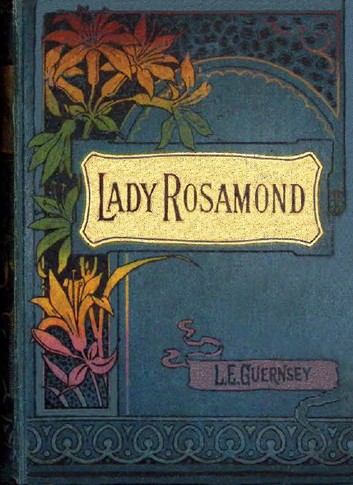
The Project Gutenberg eBook of Lady Rosamond's book
Title: Lady Rosamond's book
or, Dawnings of light
Author: Lucy Ellen Guernsey
Release date: December 15, 2023 [eBook #72426]
Language: English
Original publication: London: John F. Shaw and Co, 1903
Transcriber's note: Unusual and inconsistent spelling is as printed.
She climbed over the wall by the beehives.
The gardener had left his ladder close by.
The Stanton-Corbet Chronicles.
[Year 1529]
Lady Rosamond's Book;
OR,
DAWNINGS OF LIGHT.
BY
LUCY ELLEN GUERNSEY
AUTHOR OF
"LADY BETTY'S GOVERNESS;" "WINIFRED."
NEW EDITION.
LONDON:
JOHN F. SHAW & CO.
48 Paternoster Row, E.C.
CONTENTS.
CHAPTER
I. St. Swithin's Day, in the year of Grace, 1529.
III. Feast of St. Agnes, April 20.
IV. Feast of St. Catherine, April 29.
VII. St. John Baptist's Day, June 24.
X. St. Mary Magdalene, July 21.
XIII. August 12, Feast of St. Clare.
XVI. St. Michael's Eve, Sept. 28.
XVIII. All Saints' Day, Nov. 2.
XXI. Corby End, April 20, 1530.
XXXII. July 20, Tremador, in Cornwall.
XXXVIII. Aug. 30—the day after.
XXXIX. Coombe Ashton, Sept. 10.
XLI. St. Ethelburga's Shrine, Sept. 30.
XLII. Tremador, All Saints' Day, Nov. 1.
XLIII. Stanton Court, May 12, 1590.
THE PREAMBLE.
Stanton Court, August 21.
I FOUND the original of this book (1710) in my father's library. Remembering well, when I was a child, how my dear and honored mother used to value it, and how she used sometimes to read to us young ones little bits therefrom, I was led to peruse it myself; and since that time I have amused my leisure hours by making a fair copy of the chronicle (for such it really is) as a present to my dear child and charge, the Lady Lucy Stanton.
Amy Rosamond Stanton, spoken of at the end of the book, was my grandmother, my father's mother. She was in many respects a peculiar person, very beautiful and accomplished, but uncommonly retiring and serious in her tastes, given to study and solitary meditation, specially after the death of her husband. My mother ever loved her as an own mother, and we have still her portrait. It represents a beautiful woman indeed, but so absolutely fair and colorless as to seem almost unreal.
There is a tradition in the family that this wonderful fairness is derived from a certain personage called "The Fair Dame of Stanton," whom one of the Lords of Stanton married in foreign parts. The story goes that this fair dame was one of those strange creatures, neither quite spiritual nor yet wholly human, a kind of Melusina or Tiphane Le Fee, and that she vanished at last in some strange fashion, leaving two children. The common people, and some who should be above such notions, believe that the Fair Dame doth sometimes return in the person of one of her descendants, and that such a return always bodes woe to the family. But this is all nonsense. So much is true that the lady came from foreign parts, and that she was possessed of this curious fair beauty, which now and then reappears in the person of some descendant of hers, as in the case of my grandame. She had some peculiarities of religious belief, probably inherited from her Albigensian ancestors, and 'tis certain that she possessed a copy of Holy Scripture as done into English by Wickliffe. This book was found concealed in the apartment known as the Fair Dame's bower, and is still preserved in our library.
My mother also wrote a chronicle of her young days, which is one of my most precious possessions. I would fain have my Lucy do the same, but she is a true Stanton, and cares little for books, being a born housewife. Her father has married a second time, and has a son, so that Lucy is no longer the sole hope of the race. She gets on well with her stepmother, who is an amiable young lady, not so many years her senior as I could wish, but still she loves best to pass her time here with me, in this home of my youth, which my Lord has most kindly fitted up and given me for my life. I have a widowed daughter, who lives with me, and plenty of grandchildren to visit me, so that I am never lonely. But I meant not to write the history of my own life, but only to give an account of this book.
DEBORAH CORBET.
LADY ROSAMOND'S BOOK.
Edmund Andrews, for sea fisshe . . . . . . . £0. ivs. xd.
John Earle, for spice. . . . . . . . . . . . ixs. ixd.
Thomas Smith, dried ling . . . . . . . . . . vs. iiiid.
Mistress Ashe, a webbe of white hollands . . xivs.
John Earle, spices, dates and almond . . . . £0. is. xd.
Mistress Ashe, needles, silk and thread. . . viiis.
Mistress Ashe, a webbe of fine diaper. . . . xls. ixd.
CHAPTER I.
I SUPPOSE I had better begin by telling how I came by this book, though that is not the beginning either, but perhaps it will do as well as any other to start from. Dear Mother says I am to write a chronicle of my life, as it seems some ladies of our family have done before me. So here I begin by first putting the date:
St. Swithin's Day, in the year of Grace, 1529.
Dear Mother Superior was in the library this morning, looking at the work I have been helping Sister Gertrude to finish, of putting the books in order, and writing out a fair list of them. Sister Gertrude cannot write on account of her eyes, and she does not know Latin, and as I do, and can write a fair hand, I was able to help her, which pleased us both well.
[I do shrewdly suspect there was another hindrance more vital than the dear Sister's eyes, but I would not have hinted such a thing for the world. If she did not know writing, she knew many another thing better worth knowing.] *
Well, Mother Superior did commend our diligence, and gave Sister Gertrude much praise, which she in turn transferred to me, at which Sister Catherine, who must be on hand as usual, exclaimed:
"What holy humility Sister Gertrude shows!"
"Nay, I thought not of humility, but only of justice, and giving the child her due," answered Sister Gertrude.
"I fear 'twill be long before our dear young Rosamond emulates your example," continued Sister Catherine, as if Sister Gertrude had not spoken. "I fear her gifts are but a snare to her in that respect. Dear Rosamond, remember nothing was so dear to St. Frances as humility."
* The sentences in brackets were writ on the margin of Lady
Rosamond's book, but in transcribing I have put them in the body of
the work. Most of them seem to have been added at a later date.—D. C.
"Sister Catherine, is not your charge in the wardrobe at this hour?" asked Mother Superior (methought somewhat dryly). Sister Catherine retired without a word, but I can't say she looked very humble. If she were not a devoted religious, I should say she looked ready to bite.
"You have made a good piece of work between you, my children," said Mother; "and now we are in order, we must keep in order. 'Tis not often that a lady's house possesses so many books as ours, and we have, I fear, hardly prized them as we ought. When Rosamond comes to be abbess, she will make our poor house a seminary of learning."
"What have you got there, child?"
"'Tis a great book of blank paper, dear Mother," said I, showing this book to her. "It has been begun as an accompt, as I think, and then as a receipt, but it is mostly empty."
"And you would like to fill it?" said Mother, smiling: "Well, well, you have been a good maid, and deserve a reward. You shall have the book, and write a chronicle of your life therein, as did your great grandame of hers. You are a true Corbet, and 'Corbys will have quills,' is an old saying of your house."
I was well pleased, for I do love to write; but what can I say about my own life, only the little things which happen every day, and much the same to every one. To be sure, in the lives of saints, as well as in the history books, I do love best to read about the common things, even such as what they ate, and how they slept, and so on. It seems to bring them nearer to one. Not that I shall ever be a saint, I am sure. Sister Catherine was right there. I should be more likely to make a good housewife. Sometimes I fear I have no vocation at all, though I have, as it were, grown up with a veil on my face. Richard Stanton used to say I should never make a nun.
Now I am going to begin my life. My name is Rosamond Corbet, and I was born in Devonshire. My father is a worshipful knight, Stephen Corbet by name, and my mother Alice Stanton, a niece of my Lord Stanton, at the great house. The Corbets are the elder family, having lived at Fresh Water long before the Stantons, who only came in with the Conqueror. The name used to be writ Corby, and the common folk call it so to this day. The corby, or hooded crow, is the cognizance of our house, and this bird, commonly of evil omen, is said to be lucky to our race. 'Tis not a nice bird, and I could wish we had an eagle or a falcon to our crests; but after all they are alike birds of prey. They say we are not Saxon, but British in descent, and that is how we come by our black hair and eyes. The Stantons, who should, methinks, be dark, are all fair.
I was the youngest of my family. My mother was a great friend of the Lady Margaret Vernon, our dear Mother Superior. It was thought at one time she had herself a strong vocation, but she met with Sir Stephen, and there was an end of that. So to make amends, I suppose, she promised her second girl to this house, or her first, if she had but one. So I, being the second maid, the lot fell on me, and I have spent at least half my time here since I was five years old. I like it well enough too, though I confess I am now and then glad to get back home and run about the woods' and sands, and play with the babes in the cottages. I do love children, specially young children. I think my vocation will be to teaching, or else to the pantry and pastry-room. Once I told Sister Gertrude so, and she said it reminded her of her younger brother, who when asked what he would do when he was grown up, answered that he would be a bishop, or else a fisherman, like old Will Lee.
Once I stayed at home six years. It was then I learned to write and to construe Latin, from my brother's tutor, Master Ellenwood. I was always a great pet of his, and when he offered to teach me Latin, my father made no objection, saying that a little learning would do me no harm, and might sometime stand me in good stead.
That was a happy time. We three young ones and Dick Stanton studied together all the morning, and played together all the afternoon, save for the two hours or so of needlework, and the like, which my mother exacted from us girls. I may say without vanity that brother Henry and I were the best scholars. Alice was passable, but poor Dick was always in disgrace. In all the manly exercises, such as riding the great horse, shooting with both long and cross-bow, sword play, and so on, however, Dick was far beyond any of the other lads. So he was in managing a horse, a dog, or a hawk, and 'twas wonderful how all dumb creatures loved him. Now he is a squire in France, with my Lord his uncle, and I am here. I don't suppose I shall ever see him again in this world.
My mother was alive then. She was a most notable lady, always very still and quiet, but attending well to the ways of her household, and keeping all in their places, not by any assumption of greatness, but by the dignity and kindness of her own manners. She was a most kind mother, but not so fond as some, at least to me. It used to trouble me sometimes, till one day, by chance, I found out the reason, by overhearing some words spoken between her and an old gentlewoman, a kinswoman of hers, who stayed some time with her.
"Methinks Rosamond is no favorite," said my old lady. "And yet 'tis a good, docile little maid, more to my mind than Alice, with all her beauty."
"You are right, kinswoman," replied my mother; "but he who has the keeping of another's treasure, if he be wise, does not suffer himself to be overmuch looking upon or handling, the same. Rosamond is not mine. She is given to the Church, and I dare not give my mother's heart its way with her, lest my natural affections should rise up against my Lord's demands."
[I remember my own heart rather rose against this doctrine, even then. It seemed to me that our Lord cared for His own mother even on the cross. I knew that much, though I had never seen the Scriptures at that time, and I could not see why He should have given people natural affections only to be trampled on. Now I know that St. Paul places them who are without natural affection in no flattering category.]
When I showed this that I have written to dear mother, she said I must run my pen through what I wrote about Sister Catherine.* She said we must concern ourselves with our own faults and not with those of others. But somehow our own faults and other people's will get mixed together.
* So she did, but not so that I could not read it, and I judged
best to write it out with the rest.—D. C.
CHAPTER II.
TO go on with my own life. One year ago my dear mother died, leaving us young ones to comfort my father, who sorely needed comfort, for he and mother were all in all to each other. Alice, who is three years older than I am, was betrothed to Sir John Fulton's eldest son, and by mother's special desire the wedding was hastened that she might have the pleasure of seeing, as she said, both her daughters settled in life. I think she would have liked me to make my profession also, though she would have grieved to part with me, but both my father and our good parish priest were against it, and even Mother Superior did not favor the notion. They all said I was far too young to know mine own mind, and that I ought not to take the irrevocable vows till I was eighteen at the least. So mother gave way.
Her death followed my sister's marriage so quickly, that the flowers I had gathered for her that day were not fairly withered when I plucked rosemary and rue to lay on her winding sheet. She passed sitting in her chair, and so quickly, that there was no time for the last sacraments: for we had not thought her in any imminent danger, though we all knew she must die soon. My father has spent much money in masses, and talks of building a chantry, with endowment for a priest to sing for her soul. The thought of my dear mother in purgatory ought to make me a saint, if nothing else did.
Father clung to me very closely, and could hardly bear me out of his sight after mother died, and yet he himself hurried my return to this place. It seemed hard that I could not stay and comfort him, Alice being away; but when I hinted at it, he reproved me, even sternly.
"Child, child! Would you make matters worse than they are now, by taking back what your mother gave? What is my comfort for a few days or years? Go—go, and pray for your mother's soul!"
What could I say but that I would go? Besides, it really is no great hardship. I love this house, and the Sisters, and they are all very good to me; even Sister Catherine means to be, I am sure, only she is so very strict. She says we are a shame to our order—we are Bernardines—and that if St. Francis were to come to earth again, he would not own us. Sister Catherine says the very fact of Amice and myself being in the house, as we are not novices, nor yet regular postulants, shows how far we have degenerated, and that it is enough to bring down a judgment on us. She talks about going to London and joining a house of Poor Clares, notable for the extreme strictness of their rule. I wish she would, I am sure.
I don't think myself that we are very strict—not nearly so much so as St. Clare was when she was on earth. Still we observe the canonical hours carefully, at least the nuns do, for Mother will not let us young ones be called up at night—and we do a great deal for the poor. Some half dozen families in the village here are clothed and fed by our community almost entirely. That same Roger Smith has help all the time, and yet he will not bring us so much as an eel without having the full price for it.
There are twenty professed nuns in this house, besides the Superior, Margaret Vernon, the Sacristine, Mother Agnes, Mother Gertrude, who has the principal charge of the novices and of us young ones, and Sister Catherine, whose charge is the wardrobe and linen-room and whose business is everyones but her own. Then there are three novices, Anne, Clara, and Frances, and Amice and myself, who for fault of a better name, are called pupils.
Amice Crocker is an orphan girl, niece to Mother Gertrude, and has no home but this. She is very devout, and seems to have a real vocation. She is always reading lives of the Saints, and trying to imitate their example, but her imitations do not always work very well. For instance, the other day Mother Gertrude sent her to the wardrobe to bring down some garments which were wanted in a hurry for a poor woman. She was gone fully half an hour, and at the last I was sent to look for her. I found her coming down very slowly; indeed she was pausing a minute or more on every stair.
"Amice, what makes you so slow?" I exclaimed, rather vexed. "Don't you know Mother is waiting?"
She did not answer me, but continued coming down a step and stopping, till Mother Gertrude herself came to see what was the matter, just as she reached the bottom.
"What ails the child?" said Mother, rather sharply. "The man would wait no longer, and now the poor woman must go without her cloak."
"I am very sorry!" answered Amice, meekly. "I was trying to emulate the example of that blessed young Saint, Sister Catherine was reading of yesterday; who, when he went up-stairs, always paused to say a prayer on every step."
I saw Mother's eyes twinkle, and the corners of her mouth twitch.
"Well, well, I wont scold you, child, but remember the next time you are sent on an errand that your business is to do the errand, and try rather to follow the example of St. Anthony, and be in two places at once."
I saw Amice was mortified. When we went away together she was silent a little, and I could see she was trying to keep back her tears. Presently she said:
"Rosamond, I think it is very hard to follow the example of the Saints. There are so many of them, and they are so very different."
"Perhaps it would be well to pick out one, and keep him for a model," said I.
"But how?" asked Amice. "Now, this same saint, for instance. When he was only five years old, he wanted a friar's habit, and he cried till he got it."
"He would have cried a long time if he had my mother to deal with!" said I. "Or rather, I think his crying would have been cut short rather suddenly."
"Just so!" said Amice. "We were taught to obey our parents in all things. Then, again, when he was eight years old, he saw his mother in a red dress, and reproved her severely, telling her that the color would drag her down to the flames of hell. Now I think (and I can't help thinking), that Sister Catherine's way of snubbing and putting down poor Sister Bridget (though she does say silly things, to be sure), is worse than wearing a red gown: but suppose I should reprove her, what do you think would happen?"
"I can guess!" said I, and we both laughed; but Amice looked very sober again, directly.
"So you see, Rosamond, I don't know what to do, because whatever Saint you choose for a model, you seem to run against somebody. And that makes me say I wish there were not so many."
"If we knew all about our Lady, or one of the Holy Apostles," said I, doubtfully; "or suppose you should take St. Clare, or St. Agnes."
"Well, St. Clare did not obey her parents either; she ran away from her father's house at midnight, and went to St. Frances!"
"Yes, but that was because she had such a high vocation," I answered, "and her parents opposed her. I suppose that is different. Anyhow, Amice, we can do as we are told, and that is always a comfort. Perhaps it is the safest way for girls like us."
"If we had our Lord's life, that would be the best of all," continued Amice, not paying much attention to my words: "but then, of course, we never could hope to follow that, when we cannot even reach the example of Saint Francis and Saint Clare. Anyhow, I wish I could read it for once—all of it."
"Why, Amice, how can you say such a thing?" said I, rather sharply, I am afraid. "Don't you know what Father Fabian said in his sermon—that it was the reading of the Scriptures by unlearned men which made all the heresies and schisms which have come up in Germany and the Low Countries?"
Amice looked so distressed that I was sorry for my words directly.
"I am sure I don't want to be a heretic, or anything else that is wrong!" said she, with tears in her eyes. "I would like to please everybody, but somehow I am always going wrong and making mistakes, as I did to-day. I keep seeing that poor woman going over the moors in the cold wind, without any cloak, and yet I meant no harm."
"I am sure you never mean to be anything but the dearest girl in the world," said I, kissing her. "As to what happened to-day, I wouldn't think of it any more."
"I don't see that I can do anything about it now, only to make it an occasion of humility," says Amice.
"I don't think you can do anything better with it than to let it alone and think about something else," says I, and so the matter ended.
CHAPTER III.
Feast of St. Agnes, April 20.
A YEAR ago at this time I was at home, busily preparing flowers and wreaths for my sister's bridal, under dear mother's eye. I knew Alice wanted violets, and Dick and I went to search for them in the coombe, where the banks being shady, the violets do longest linger. When we had filled our baskets with the flowers, which we found in abundance, both white and blue, we sat down a little on the moss to listen to the singing of the birds and the lapse of the water. These gentle sounds, albeit most sweet and tender, did somewhat dispose us to silence, if not melancholy. Presently Richard said:
"I wonder where we shall be a year from now, Rosamond? You know this same spring used to be a favorite haunt of the Fair Dame of Stanton, my ancestress. They say she used to see in the bosom of the water, as in a mirror, all that was to come to pass."
"I can tell pretty well where we shall be a year from now, without any of the Fair Dame's art," said I. "You know she was said to be a heretic, if not worse."
"Yes, but I don't believe it!" answered Dick, valiantly. "I believe she was a good woman, and a good wife. But since you know so well, tell me where we shall be?"
"You will be in France with my Lord your uncle," said I, "or else attending him at Court, winning your spurs by brave deeds, or dancing with fair dames and damsels; and I shall be at the convent, working of cut-work copes and altar-cloths in silk and gold; or helping Mother Gertrude dry herbs, and distil cordials, and make comfits: or studying the lives of the Saints; or—"
"Be wasting your time and youth on some nonsense or other," interrupted Richard, who never could bear to hear of my being a nun. "It is a shame!"
"It was my mother's doing, and I will not hear a word against it!" said I. "Besides, I don't know why I shouldn't be happy there as well as anywhere else. A great many nuns are happy, and beside that, Dick, to be happy is not the business of life."
Dick received this remark with the grunt which he always bestows on my wise speeches, and we were silent for a time. Then Dick said passionately, all at once—pointing to a chaffinch, a dear little fowl, which sat on a twig singing his very heart out, "Sweetheart! Sweetheart!" over and over again:
"Rosamond, nothing shall make me think that yonder bird does not serve God just as acceptably while he is flitting about gathering food for his young ones, and singing in the free air of heaven, as if he were shut behind the bars of a cage, singing the same song over and over, after the old bird-catcher's whistle."
"The bird is only a bird," I answered, "and, as Master Ellenwood often tells us, comparisons are no arguments. Besides, Dick, I have to go, so where is the use of repining? My mother has promised for me, and I have promised her again this very day (and so I had); so where is the use of an argument?"
"It's a shame!" said Dick, passionately; adding, "If you cared for me as I do for you, you wouldn't talk so coolly of its being an end."
Whereat there was nothing to do but to rise and return to the house.
I don't know why I have written this down, only it is a part of my life. There can be no harm in it, because Richard and I can never be anything to each other—not even brother and sister—because a good religious knows no ties of natural affection. No doubt the coombe is full this very day of violets and primroses, and all other sweet flowers, and the spring is welling up and running over its basin all among the moss and fern, and the brook liverwort; and I dare say the very same chaffinch is singing there this minute. There are violets in our convent garden as well, but they are planted in a straight bed, and Mother Gabrielle uses the flowers to make her sirups, and the leaves are gathered for our sallets. There is a spring, too, but not one bit like that in the coombe. That boils up out of a deep and wide cleft in the rock, filling its basin full and running over the stones in twenty little vagrant streams. Great ferns grow over and shade it, and leaves drop into it in the autumn, and birds and wild-wood creatures come to drink of its waters. This pours in a steady orderly stream from a pipe which sticks straight out from the wall, and runs down a straight course, paved and edged with cut stone, into the stew-pond where we keep our fish.
Still our convent garden is a sweet and pretty place, full of orderly knots and beds of flowers and herbs, chiefly such as are good to distil cordials, or to help out our messes on fast days—rue, and mints, and hyssops, and angelica, and caraway, and burnet—with abundance of roses, and poppies, and white lilies, and a long bed of sweet flowers for the bees.
We have a fine stock of beehives. Then we have plum and pear and apple trees, and a bed of strawberries. At the end of the garden are two most ancient elm trees, and under them a very small, and very, very old chapel of our Lady of Sorrows. Dear Mother says it is by far the oldest part of the convent. It is very small, as I said, built of huge stones, with low heavy arches. Over the altar stands the image of our Lady, rudely carved in some dark wood. It is a very holy image, and used to work miracles in old times. I wish it would again. I should dearly love to see a miracle.
At the back of this chapel, and joining it, so as to be under the same roof, is another building, very low and massive, with no windows, but one very narrow slit, close under the eaves. A heavy iron-studded door opens into it from the chapel itself. Mother Gertrude told me one day that it contained the staircase leading to a burial vault under the chapel, now never used, and that it had not been opened for years and years.
The Sisters are not fond of this shrine, holy as it is, and I think they are afraid of it. Indeed I know Sister Bridget told me that if an unfaithful nun were to watch there over night, she would be found dead on the floor in the morning—if indeed a ghost or demon did not arise from the vault and drag her down to a living death below.
"I should not think a ghost would dare to come into the sacred place!" said Amice.
"Evil spirits have power over the unfaithful, wherever they are—remember that, child!" said Sister Bridget, solemnly.
"And over the faithful too, sometimes," said Amice, who is as usual reading the lives of Saints. "I am sure St. Frances was dreadfully disturbed by them."
"Power to disturb, but not to destroy them, child. But prayers offered at that shrine have great efficacy for the deliverance of souls from purgatory," said old Mother Mary Monica, who is the oldest person in the house, and very fond of the company of us young ones. "If any one had a friend in purgatory, and should watch all night in prayer before that image, it would go far to deliver him."
"Do you really think so, Mother?" I asked.
"Think so, child! I know it for a truth. The blessed Saint Ethelburga herself tried it, and was assured by a vision and a miracle that her prayers were granted. Eh dear, I could tell you many stories of miracles, my daughters. They used to be plenty in my young days. Why, I was converted by a miracle myself."
"Tell us about it, dear Mother, will you?" said Amice and I both together; and Amice added, "See, here is a nice seat, and the warm sun is good for your pains, you know."
So she sat down, the good old soul, and Amice and I on stones at her feet, and she told us the tale. I will set it down just as I remember it.
"You must know, my children, that I was a giddy young girl in attendance on the Queen—not the Queen that now is, but Queen Elizabeth, wife of Henry the Seventh, this King's father—when I went with my mistress to make a retreat at the convent of the poor Clares, in London—"
"The same that Sister Catherine is always praising," said I.
"Yes, the very same; but don't you put me out. Where was I?"
"Where you went with the Queen to make a retreat, dear Mother."
"O yes. Well, I had been a giddy girl, as I told you, but I had been somewhat sobered of late, because my cousin Jack, whom my father always meant I should wed, had been on the wrong side in the late troubles, and was in hiding at that time. Now, I liked Jack right well, and was minded to marry none other; but I was a King's ward, my father being dead, and I having a good fortune. So I had a many suitors, and I knew the King was favorable to a knight, Sir Edward Peckham, of Somerset, who had come to him with help just at the right time. Now, I wanted nobody but Jack; but of all my suitors there was none that I misliked so much as Sir Edward Peckham!"
"Why?" asked I, much interested.
"Because I could not abide him, child. That was reason enough. Well, things being even in this shape, I was glad enough when my mistress made her retreat in the convent of the Poor Clares, and chose me to attend on her, out of all her train. That was a strict order, children. Matins at one o'clock in the morning—not overnight, as we have them here—no food till dinner at eleven, and no flesh meat even on feast days—almost perpetual silence! Well, it was always and ever my way to fall in with whatever was going on, let it be what it might; so I fasted and prayed with the best, and kept all the hours, till I was so tired I could hardly stand. In the midst of it all came a messenger to my mistress from the King, bidding her return to the Court in three days and bring me with her, for the King was minded that my marriage should no longer be put off.
"Children, I was like one distracted, and I was all but ready to cast myself away, body and soul. The Mother Superior marked my grief, and I was won to tell her the whole. She was an austere woman—not one bit like our Mother—but she was very kind to me in my trouble—"
"I am sure our dear Mother Superior is a saint, if ever there was one," said I.
"That she is, that she is, child; but there may be a difference in saints, you know. Well, Mother Superior pitied my grief, and soothed me, and when I was quieted like, she councilled me to watch all night before a shrine in which were some very holy relics—specially part of the veil of St. Clare, our blessed founder."
"'Perhaps the Saint may take pity on you and show you the way out of your present troubles,' said she. 'Fast this day from all food, my daughter, and this night I will myself conduct you to the shrine where you are to watch.'"
"Well, children, I did fast and say my rosary all the rest of the day, till I was ready to drop; and at nine at night the Mother Superior led me to a little chapel off the church, where was the shrine of St. Clare. It was all dark—only looking toward the church I could just see the glimmer of the ever-burning lamp, before the Holy Sacrament of the Altar. Here she left me, and here I was to kneel till daylight, saying my prayers and the seven psalms."
"I don't see how you could kneel so long," said Amice.
"I might lie prone a part of the time, if I would," replied Mother Mary Monica, "and so indeed I did. I don't know what time it was—somewhere before Matins, and I know not whether overcome with fatigue I had not dozed a little, when I was waked by a bright light. I raised myself on my knees, and looking toward the altar, I saw the figure of St. Clare surrounded by a clear but mild radiance, and holding out to me in her hand a nun's veil, while a voice of heavenly sweetness, said to me these words: 'Here, my child, is thy only refuge.' The light faded away, and I sunk down—in a swoon this time, for when some of the Sisters came to seek me at prime, they found me pale and lifeless, while—mark, my daughters—on my head was laid that most sacred relic, the veil of St. Clare—yes, on this unworthy head the blessed veil was laid."
We both looked at the good Mother in a kind of awe.
"Well, I told the good Sisters and my mistress what I had seen. There could be no doubt after that in my mind, especially as two or three days after I had certain news of Jack's death. The King would not hear of my profession at first, but the Prior of the Franciscans took my part, and his Majesty would not have liked setting the whole of the Gray Friars against him; so he gave way, and even paid over my portion, which must have gone hard, for his blessed Majesty was fond of money; and Sir Edward went home riding alone, with a flea in his ear, instead of a bride by his side. Marry him, indeed, with his thin legs and his long lean jaws! So that is the way I was converted, my children, and got my own way, by the help of the Blessed St. Clare, to whom I have always had a particular devotion ever since. And who knows what miracles might be vouchsafed to you, if you were to watch all night before the shrine of our Lady?"
We had no time for any more talk just then, but ever since I have been turning over in my mind what Mother Mary Monica said. It does seem dreadful to me—the thought of watching all night and alone in that dreary place without a light. To be sure, the moon is at the full, and would shine directly into the great window, but then those dreadful vaults, and Sister Bridget's story do so run in my head. Every time the wind shook the ivy or whistled in the loopholes of the stones, I should fancy it a rustle among the graves below, or the grating of that heavy door on its hinges. And then, so cold and damp.
Wretch that I am, to weigh these things one moment in the balance against my dear mother's soul! I feel sure that she could not have died in mortal sin, but to pass without the sacraments, without one moment's warning! Oh, it is dreadful! And then her marrying instead of taking the veil. That I think troubles dear Mother Superior worse than anything. Yes, I am quite resolved. I will watch this very night before the shrine in the garden chapel; but I will tell nobody of my resolve, save Amice and Mother Gertrude. I don't want the whole flock exclaiming, pitying or praising me, or hinting at my setting up for a saint, as some of them do.
[Of course, being now enlightened by Holy Scripture, I do not believe that my dear mother was benefitted by my watching, nor indeed that she needed such benefit; but I will ever maintain that the exertion to overcome my own fears (which were very terrible), for my mother's sake, was of great service to me. 'Twas a true act of self-sacrifice, though done in ignorance, and that not to pile up a stock of merit for myself, but to do good to another.]