
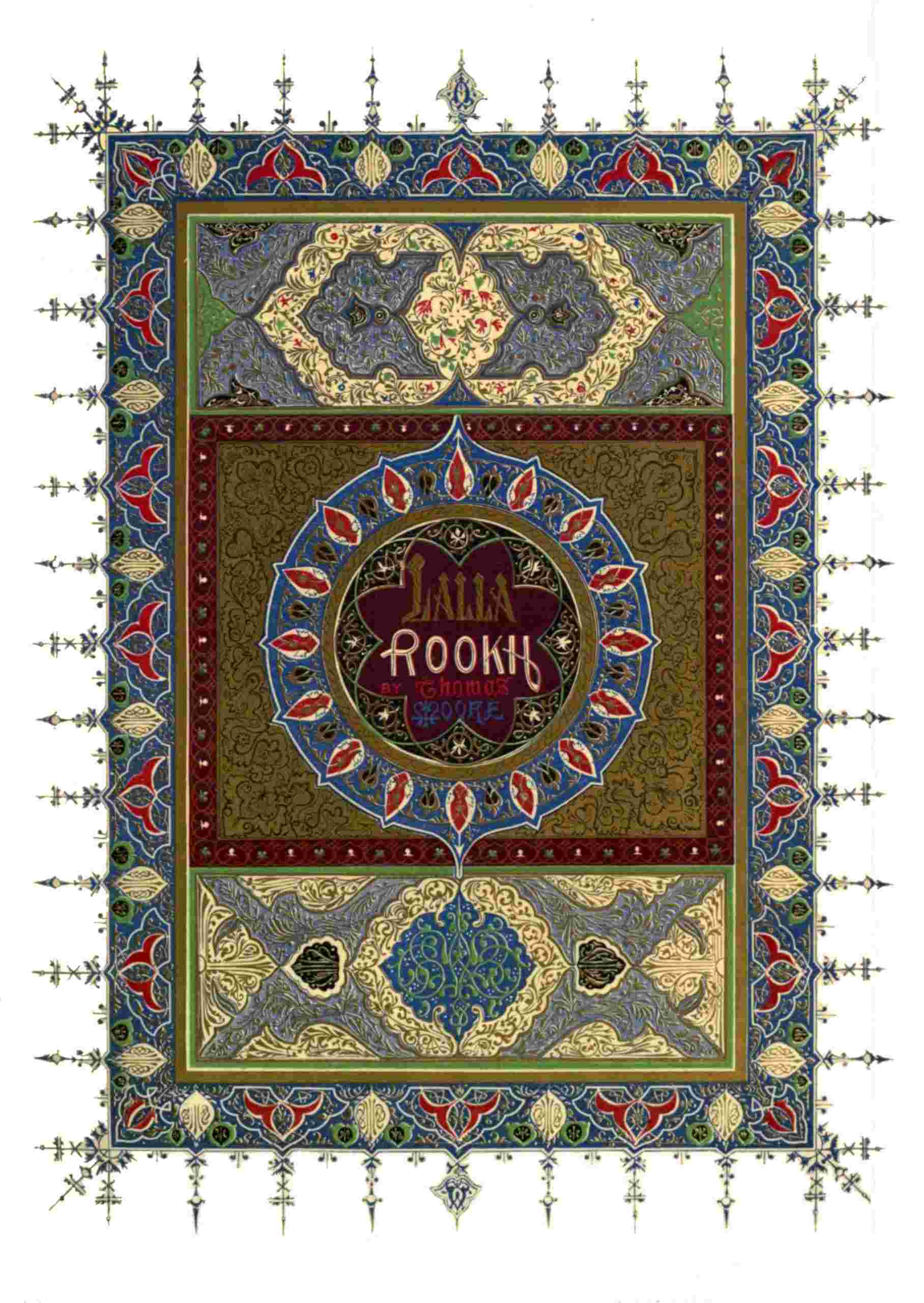
PREFACE.
The Poem, or Romance, of Lalla Rookh, having now reached, I understand, its twentieth edition, a short account of the origin and progress of a work which has been hitherto so very fortunate in its course, may not be deemed, perhaps, superfluous or misplaced.
It was about the year 1812, that, far more through the encouraging suggestions of friends than from any confident promptings of my own ambition, I conceived the design of writing a Poem upon some Oriental subject, and of those quarto dimensions which Scott’s successful publications in that form had then rendered the regular poetical standard. A negotiation on the subject was opened with the Messrs. Longman in the same year; but, from some causes which I cannot now recollect, led to no decisive result; nor was it till a year or two after, that any further steps were taken in the matter,—their house being the only one, it is right to add, with which, from first to last, I held any communication upon the subject.
On this last occasion, Mr. Perry kindly offered himself as my representative in the treaty; and, what with the friendly zeal of my negotiator on the one side, and the prompt and liberal spirit with which he was met on the other, there has seldom, I think, occurred any transaction in which Trade and Poesy have shone out so advantageously in each other’s eyes. The short discussion that then took place, between the two parties, may be comprised in a very few sentences. “I am of opinion,” said Mr. Perry,—enforcing his view of the case by arguments which it is not for me to cite,—“that Mr. Moore ought to receive for his Poem the largest price that has been given, in our day, for such a work.” “That was,” answered the Messrs. Longman, “three thousand guineas.” “Exactly so,” replied Mr. Perry, “and no less a sum ought he to receive.”
It was then objected, and very reasonably, on the part of the firm, that they had never yet seen a single line of the Poem; and that a perusal of the work ought to be allowed to them, before they embarked so large a sum in the purchase. But, no;—the romantic view which my friend, Perry, took of the matter, was, that this price should be given as a tribute to reputation already acquired, without any condition for a previous perusal of the new work. This high tone, I must confess, not a little startled and alarmed me; but, to the honour and glory of Romance,—as well on the publisher’s side as the poet’s,—this very generous view of the transaction was, without any difficulty, acceded to, and the firm agreed, before we separated, that I was to receive three thousand guineas for my Poem.
At the time of this agreement, but little of the work, as it stands at present, had yet been written. But the ready confidence in my success shown by others, made up for the deficiency of that requisite feeling, within myself; while a strong desire not wholly to disappoint this “auguring hope,” became almost a substitute for inspiration. In the year 1815, therefore, having made some progress in my task, I wrote to report the state of the work to the Messrs. Longman, adding, that I was now most willing and ready, should they desire it, to submit the manuscript for their consideration. Their answer to this offer was as follows:—“We are certainly impatient for the perusal of the Poem; but solely for our gratification. Your sentiments are always honourable.”[i]
I continued to pursue my task for another year, being likewise occasionally occupied with the Irish Melodies, two or three numbers of which made their appearance, during the period employed in writing Lalla Rookh. At length, in the year 1816, I found my work sufficiently advanced to be placed in the hands of the publishers. But the state of distress to which England was reduced, in that dismal year, by the exhausting effects of the series of wars she had just then concluded, and the general embarrassment of all classes both agricultural and commercial, rendered it a juncture the least favourable that could well be conceived for the first launch into print of so light and costly a venture as Lalla Rookh. Feeling conscious, therefore, that under such circumstances, I should act but honestly in putting it in the power of the Messrs. Longman to reconsider the terms of their engagement with me,—leaving them free to postpone, modify, or even, should such be their wish, relinquish it altogether, I wrote them a letter to that effect, and received the following answer:—“We shall be most happy in the pleasure of seeing you in February. We agree with you, indeed, that the times are most inauspicious for ‘poetry and thousands;’ but we believe that your poetry would do more than that of any other living poet at the present moment.”[ii]
The length of time I employed in writing the few stories strung together in Lalla Rookh will appear, to some persons, much more than was necessary for the production of such easy and “light o’ love” fictions. But, besides that I have been, at all times, a far more slow and painstaking workman than would ever be guessed, I fear, from the result, I felt that, in this instance, I had taken upon myself a more than ordinary responsibility, from the immense stake risked by others on my chance of success. For a long time, therefore, after the agreement had been concluded, though generally at work with a view to this task, I made but very little real progress in it; and I have still by me the beginnings of several stories continued, some of them, to the length of three or four hundred lines, which, after in vain endeavouring to mould them into shape, I threw aside, like the tale of Cambuscan, “left half-told.” One of these stories, entitled The Peri’s Daughter, was meant to relate the loves of a nymph of this aërial extraction with a youth of mortal race, the rightful Prince of Ormuz, who had been, from his infancy, brought up in seclusion, on the banks of the river Amou, by an aged guardian named Mohassan. The story opens with the first meeting of these destined lovers, then in their childhood; the Peri having wafted her daughter to this holy retreat, in a bright, enchanted boat, whose first appearance is thus described:—
A song is sung by the Peri in approaching, of which the following forms a part:—
In another of these inchoate fragments, a proud female saint, named Banou, plays a principal part; and her progress through the streets of Cufa, on the night of a great illuminated festival, I find thus described:—
There are yet two more of these unfinished sketches, one of which extends to a much greater length than I was aware of; and, as far as I can judge from a hasty renewal of my acquaintance with it, is not incapable of being yet turned to account.
In only one of these unfinished sketches, the tale of The Peri’s Daughter, had I yet ventured to invoke that most home-felt of all my inspirations, which has lent to the story of The Fire-worshippers its main attraction and interest. That it was my intention, in the concealed Prince of Ormuz, to shadow out some impersonation of this feeling, I take for granted from the prophetic words supposed to be addressed to him by his aged guardian:—
In none of the other fragments do I find any trace of this sort of feeling, either in the subject or the personages of the intended story; and this was the reason, doubtless, though hardly known, at the time, to myself, that, finding my subjects so slow in kindling my own sympathies, I began to despair of their ever touching the hearts of others; and felt often inclined to say,
Had this series of disheartening experiments been carried on much further, I must have thrown aside the work in despair. But, at last, fortunately, as it proved, the thought occurred to me of founding a story on the fierce struggle so long maintained between the Ghebers,[iii] or ancient Fire-worshippers of Persia, and their haughty Moslem masters. From that moment, a new and deep interest in my whole task took possession of me. The cause of tolerance was again my inspiring theme; and the spirit that had spoken in the melodies of Ireland soon found itself at home in the East.
Having thus laid open the secrets of the workshop to account for the time expended in writing this work, I must also, in justice to my own industry, notice the pains I took in long and laboriously reading for it. To form a store-house, as it were, of illustration purely Oriental, and so familiarise myself with its various treasures, that, as quick as Fancy required the aid of fact, in her spiritings, the memory was ready, like another Ariel, at her “strong bidding,” to furnish materials for the spellwork,—such was, for a long while, the sole object of my studies; and whatever time and trouble this preparatory process may have cost me, the effects resulting from it, as far as the humble merit of truthfulness is concerned, have been such as to repay me more than sufficiently for my pains. I have not forgotten how great was my pleasure, when told by the late Sir James Mackintosh, that he was once asked by Colonel W—s, the historian of British India, “whether it was true that Moore had never been in the East?” “Never,” answered Mackintosh. “Well, that shows me,” replied Colonel W—s, “that reading over D’Herbelot is as good as riding on the back of a camel.”
I need hardly subjoin to this lively speech, that although D’Herbelot’s valuable work was, of course, one of my manuals, I took the whole range of all such Oriental reading as was accessible to me; and became, for the time, indeed, far more conversant with all relating to that distant region, than I have ever been with the scenery, productions, or modes of life of any of those countries lying most within my reach. We know that D’Anville, though never in his life out of Paris, was able to correct a number of errors in a plan of the Troad taken by De Choiseul, on the spot; and, for my own very different, as well as far inferior, purposes, the knowledge I had thus acquired of distant localities, seen only by me in my day-dreams, was no less ready and useful.
An ample reward for all this painstaking has been found in such welcome tributes as I have just now cited; nor can I deny myself the gratification of citing a few more of the same description. From another distinguished authority on Eastern subjects, the late Sir John Malcolm, I had myself the pleasure of hearing a similar opinion publicly expressed;—that eminent person in a speech spoken by him at a Literary Fund Dinner, having remarked, that together with those qualities of a poet which he much too partially assigned to me was combined also “the truth of the historian.”
Sir William Ouseley, another high authority, in giving his testimony to the same effect, thus notices an exception to the general accuracy for which he gives me credit:—“Dazzled by the beauties of this composition,[iv] few readers can perceive, and none surely can regret, that the poet, in his magnificent catastrophe, has forgotten, or boldly and most happily violated, the precept of Zoroaster, above noticed, which held it impious to consume any portion of a human body by fire, especially by that which glowed upon their altars.” Having long lost, I fear, most of my Eastern learning, I can only cite, in defence of my catastrophe, an old Oriental tradition, which relates, that Nimrod, when Abraham refused, at his command, to worship the fire, ordered him to be thrown into the midst of the flames.[v] A precedent so ancient for this sort of use of the worshipped element, would appear, for all purposes at least of poetry, fully sufficient.
In addition to these agreeable testimonies, I have also heard, and, need hardly add, with some pride and pleasure, that parts of this work have been rendered into Persian, and have found their way to Ispahan. To this fact, as I am willing to think it, allusion is made in some lively verses, written many years since, by my friend, Mr. Luttrell:—
That some knowledge of the work may have really reached that region, appears not improbable from a passage in the Travels of Mr. Frazer, who says, that “being delayed for some time at a town on the shores of the Caspian, he was lucky enough to be able to amuse himself with a copy of Lalla Rookh, which a Persian had lent him.”
Of the description of Balbec, in “Paradise and the Peri,” Mr. Carne, in his Letters from the East, thus speaks: “The description in Lalla Rookh of the plain and its ruins is exquisitely faithful. The minaret is on the declivity near at hand, and there wanted only the muezzin’s cry to break the silence.”
I shall now tax my reader’s patience with but one more of these generous vouchers. Whatever of vanity there may be in citing such tributes, they show, at least, of what great value, even in poetry, is that prosaic quality, industry; since, as the reader of the foregoing pages is now fully apprized, it was in a slow and laborious collection of small facts, that the first foundations of this fanciful Romance were laid.
The friendly testimony I have just referred to, appeared, some years since, in the form in which I now give it, and, if I recollect right, in the Athenæum:—
“I embrace this opportunity of bearing my individual testimony (if it be of any value) to the extraordinary accuracy of Mr. Moore, in his topographical, antiquarian, and characteristic details, whether of costume, manners, or less-changing monuments, both in his Lalla Rookh and in the Epicurean. It has been my fortune to read his Atlantic, Bermudean, and American Odes and Epistles, in the countries and among the people to which and to whom they related; I enjoyed also the exquisite delight of reading his Lalla Rookh, in Persia itself; and I have perused the Epicurean, while all my recollections of Egypt and its still existing wonders are as fresh as when I quitted the banks of the Nile for Arabia:—I owe it, therefore, as a debt of gratitude (though the payment is most inadequate), for the great pleasure I have derived from his productions, to bear my humble testimony to their local fidelity.
Among the incidents connected with this work, I must not omit to notice the splendid Divertissement, founded upon it, which was acted at the Château Royal of Berlin, during the visit of the Grand Duke Nicholas to that capital, in the year 1822. The different stories composing the work were represented in Tableaux Vivans and songs; and among the crowd of royal and noble personages engaged in the performances, I shall mention those only who represented the principal characters, and whom I find thus enumerated in the published account of the Divertissement.[vi]
| “Fadladin, Grand-Nasir | Comte Haack (Maréchal de Cour.) | |
| Aliris, Roi de Bucharie | S. A. I. Le Grand Duc. | |
| Lalla Roûkh | S. A. I. Le Grande Duchesse. | |
| Aurungzeb, le Grand Mogol | { | S. A. R. Le Prince Guillaume, |
| { | frère du Roi. | |
| Abdallah, Père d’Aliris | S. A. R. Le Duc de Cumberland. | |
| La Reine, son épouse | { | S. A. R. La Princesse Louise |
| { | Radzivill.” | |
Besides these and other leading personages, there were also brought into action, under the various denominations of Seigneurs et Dames de Bucharie, Dames de Cachemire, Seigneurs et Dames dansans à la Fête des Roses, &c. nearly 150 persons.
Of the manner and style in which the Tableaux of the different stories are described in the work from which I cite, the following account of the performance of Paradise and the Peri will afford some specimen:—
“La décoration représentoit les portes brillantes du Paradis, entourées de nuages. Dans le premier tableau on voyoit la Péri, triste et desolée, couchée sur le seuil des portes fermées, et l’Ange de lumière qui lui addresse des consolations et des conseils. Le second représente le moment où la Péri, dans l’espoir que ce don lui ouvrira l’entrée du Paradis, recueille la dernière goutte de sang que vient de verser le jeune guerrier Indien.…
“La Péri et l’Ange de lumière répondoient pleinement à l’image et à l’idée qu’on est tenté de se faire de ces deux individus, et l’impression qu’a faite généralement la suite des tableaux de cet épisode délicat et intéressant est loin de s’effacer de notre souvenir.”
In this grand Fête, it appears, originated the translation of Lalla Rookh into German[vii] verse, by the Baron de la Motte Fouqué; and the circumstances which led him to undertake the task, are described by himself in a Dedicatory Poem to the Empress of Russia, which he has prefixed to his translation. As soon as the performance, he tells us, had ended, Lalla Rookh (the Empress herself) exclaimed, with a sigh, “Is it, then, all over? are we now at the close of all that has given us so much delight? and lives there no poet who will impart to others, and to future times, some notion of the happiness we have enjoyed this evening?” On hearing this appeal, a Knight of Cashmere (who is no other than the poetical Baron himself) comes forward and promises to attempt to present to the world “the Poem itself in the measure of the original:”—whereupon Lalla Rookh, it is added, approvingly smiled.
i. April 10, 1815.
ii. November 9, 1816.
iii. Voltaire, in his tragedy of “Les Guèbres,” written with a similar under-current of meaning, was accused of having transformed his Fire-worshippers into Jansenists:—“Quelques figuristes,” he says, “prétendent que les Guèbres sont les jansénistes.”
iv. The Fire-worshippers.
v. “Tradunt autem Hebræi hanc fabulam quod Abraham in ignem missus sit quia ignem adorare noluit.”—St. Hieron. in Quæst. in Genesim.
vi. Lalla Roûkh Divertissement, mêlé de Chants et de Danses, Berlin, 1822. The work contains a series of coloured engravings, representing groups, processions, &c. in different Oriental costumes.
vii. Since this was written, another translation of Lalla Rookh into German verse has been made by Theodor Oelckers (Leipzig, Tauchnitz, Jun.), which has already passed through three editions.