
WeRead Powered by ReaderPub
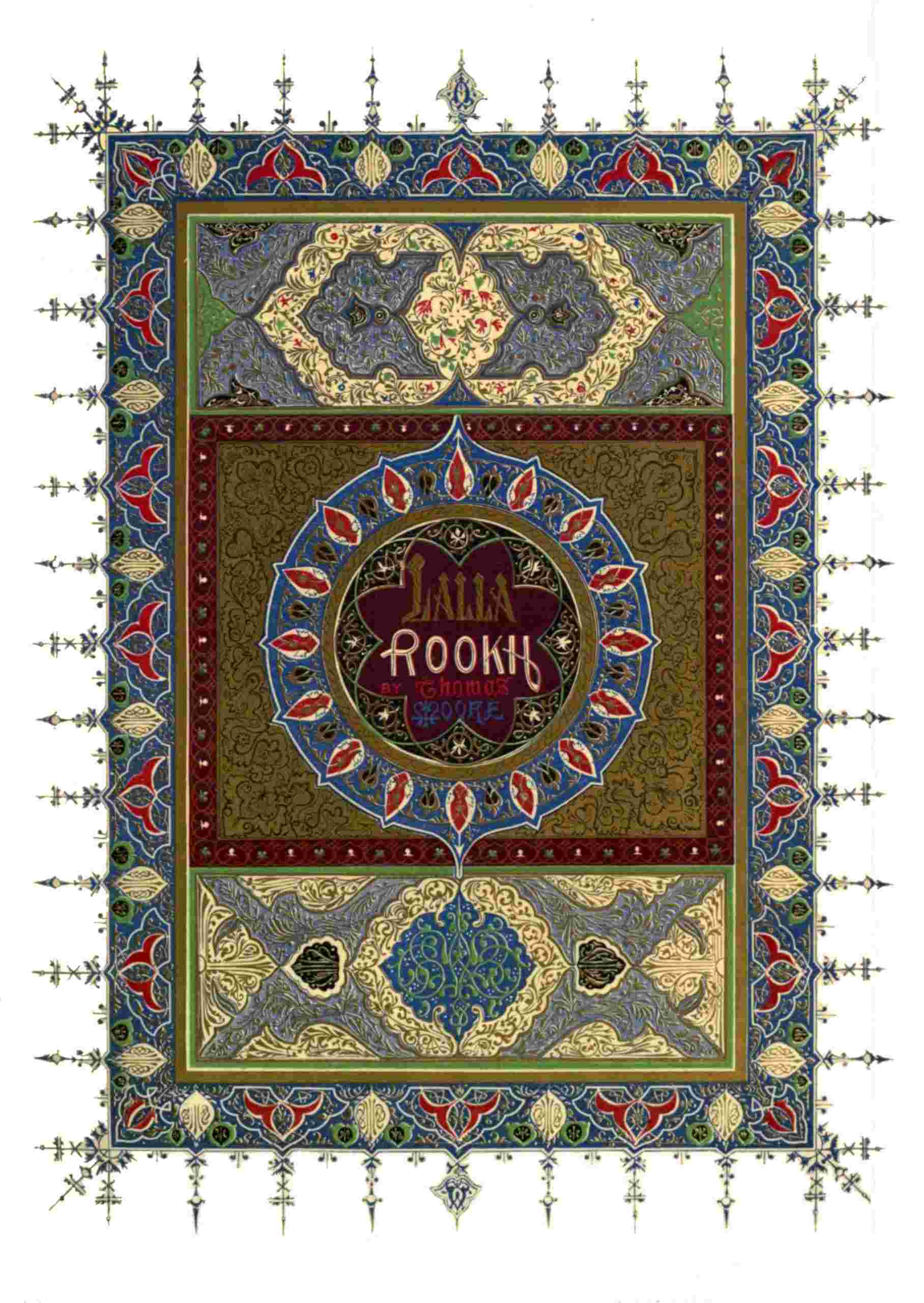
Lalla Rookh cover

Lalla Rookh

Chapter 6: Paradise & the Peri
Open in WeRead

Explore more books like this:

About This Book

A framed poetic romance follows a young noblewoman traveling to a proposed marriage, within which several embedded narrative poems are recited that range from a tale of a veiled prophet and secret identity to a penitent supernatural being, a story of love amid religious strife, and a dramatic harem episode. The work combines lyric description, ornate Orientalizing imagery, and episodic storytelling, exploring themes of love, sacrifice, faith, and revelation while alternating narrative momentum with richly detailed scene-setting and melodic verse.

Paradise & the Peri


One morn a Peri at the gate
Of Eden stood, disconsolate;
And as she listen’d to the Springs
Of Life within, like music flowing,
And caught the light upon her wings
Through the half-open portal glowing,
She wept to think her recreant race
Should e’er have lost that glorious place!
“How happy,” exclaim’d this child of air,
“Are the holy Spirits who wander there,
“Mid flowers that never shall fade or fall;
“Though mine are the gardens of earth and sea,
“And the stars themselves have flowers for me,
“One blossom of Heaven out-blooms them all!
“Though sunny the Lake of cool Cashmere,
“With its plane-tree Isle reflected clear,[159]
“And sweetly the founts of that Valley fall;
“Though bright are the waters of Sing-su-hay,
“And the golden floods that thitherward stray,[160]
“Yet—oh, ’tis only the Blest can say
“How the waters of Heaven outshine them all!
“Go, wing thy flight from star to star,
“From world to luminous world, as far
“As the universe spreads its flaming wall:
“Take all the pleasures of all the spheres,
“And multiply each through endless years,
“One minute of Heaven is worth them all!”
The glorious Angel, who was keeping
The gates of Light, beheld her weeping;
And, as he nearer drew and listen’d
To her sad song, a tear-drop glisten’d
Within his eyelids, like the spray
From Eden’s fountain, when it lies
On the blue flower, which—Bramins say—
Blooms nowhere but in Paradise.[161]
“Nymph of a fair but erring line!”
Gently he said—“One hope is thine.
“’Tis written in the Book of Fate,
The Peri yet may be forgiven
Who brings to this Eternal gate
The Gift that is most dear to Heaven!
“Go, seek it, and redeem thy sin—
“’Tis sweet to let the Pardon’d in.”
Rapidly as comets run
To the’ embraces of the Sun;—
Fleeter than the starry brands
Flung at night from angel hands,[162]
At those dark and daring sprites
Who would climb the’ empyreal heights,
Down the blue vault the Peri flies,
And, lighted earthward by a glance
That just then broke from morning’s eyes,
Hung hovering o’er our world’s expanse.
But whither shall the Spirit go
To find this gift for Heaven?—“I know
“The wealth,” she cries, “of every urn,
“In which unnumber’d rubies burn,
“Beneath the pillars of Chilminar;[163]
“I know where the Isles of Perfume are,
“Many a fathom down in the sea,
“To the south of sun-bright Araby;[164]
“I know, too, where the Genii hid
“The jewell’d cup of their King Jamshid,[165]
“With Life’s elixir sparkling high—
“But gifts like these are not for the sky.
“Where was there ever a gem that shone
“Like the steps of Alla’s wonderful Throne?
“And the Drops of Life—oh! what would they be
“In the boundless Deep of Eternity?”
While thus she mus’d, her pinions fann’d
The air of that sweet Indian land,
Whose air is balm; whose ocean spreads
O’er coral rocks, and amber beds:[166]
Whose mountains, pregnant by the beam
Of the warm sun, with diamonds teem;
Whose rivulets are like rich brides,
Lovely, with gold beneath their tides;
Whose sandal groves and bowers of spice
Might be a Peri’s Paradise!
But crimson now her rivers ran
With human blood—the smell of death
Came reeking from those spicy bowers,
And man, the sacrifice of man,
Mingled his taint with every breath
Up wafted from the innocent flowers.
Land of the Sun! what foot invades
Thy Pagods and thy pillar’d shades[167]
Thy cavern shrines, and Idol stones,
Thy Monarchs and their thousand Thrones?[168]
’Tis He of Gazna[169]—fierce in wrath
He comes, and India’s diadems
Lie scatter’d in his ruinous path.—
His bloodhounds he adorns with gems,
Torn from the violated necks
Of many a young and lov’d Sultana;[170]
Maidens, within their pure Zenana,
Priests in the very fane he slaughters,
And choaks up with the glittering wrecks
Of golden shrines the sacred waters!
Downward the Peri turns her gaze,
And, through the war-field’s bloody haze
Beholds a youthful warrior stand,
Alone, beside his native river,—
The red blade broken in his hand,
And the last arrow in his quiver.
“Live,” said the Conqueror, “live to share
“The trophies and the crowns I bear!”
Silent that youthful warrior stood—
Silent he pointed to the flood
All crimson with his country’s blood,
Then sent his last remaining dart,
For answer, to the’ Invader’s heart.
False flew the shaft, though pointed well;
The Tyrant liv’d, the Hero fell!—
Yet mark’d the Peri where he lay,
And, when the rush of war was past,
Swiftly descending on a ray
Of morning light, she caught the last—
Last glorious drop his heart had shed,
Before its free-born spirit fled!
“Be this,” she cried, as she wing’d her flight,
“My welcome gift at the Gates of Light.
“Though foul are the drops that oft distil
“On the field of warfare, blood like this,
“It would not stain the purest rill,
“That sparkles among the Bowers of Bliss!
“Oh, if there be, on this earthly sphere,
“A boon, an offering Heaven holds dear,
“’Tis the last libation Liberty draws
“From the heart that bleeds and breaks in her cause!”
“Sweet,” said the Angel, as she gave
The gift into his radiant hand,
“Sweet is our welcome of the Brave
“Who die thus for their native Land.—
“But see—alas!—the crystal bar
“Of Eden moves not—holier far
“Than even this drop the boon must be,
“That opes the Gates of Heaven for thee!”
Her first fond hope of Eden blighted,
Now among Afric’s lunar Mountains,[172]
Far to the South the Peri lighted;
And sleek’d her plumage at the fountains
Of that Egyptian tide—whose birth
Is hidden from the sons of earth
Deep in those solitary woods,
Where oft the Genii of the Floods
Dance round the cradle of their Nile,
And hail the new-born Giant’s smile.[173]
Thence over Egypt’s palmy groves,
Her grots, and sepulchres of Kings,[174]
The exil’d Spirit sighing roves;
And now hangs listening to the doves
In warm Rosetta’s vale[175]—now loves
To watch the moonlight on the wings
Of the white pelicans that break
The azure calm of Mœris’ Lake.[176]
’Twas a fair scene—a Land more bright
Never did mortal eye behold!
Who could have thought, that saw this night
Those valleys and their fruits of gold
Basking in Heaven’s serenest light;—
Those groups of lovely date-trees bending
Languidly their leaf-crown’d heads,
Like youthful maids, when sleep descending
Warns them to their silken beds;[177]
Those virgin lilies, all the night
Bathing their beauties in the lake,
That they may rise more fresh and bright,
When their beloved Sun’s awake;—
Those ruin’d shrines and towers that seem
The relics of a splendid dream;
Amid whose fairy loneliness
Nought but the lapwing’s cry is heard,
Nought seen but (when the shadows, flitting
Fast from the moon, unsheath its gleam,)
Some purple-wing’d Sultana[178] sitting
Upon a column, motionless
And glittering like an Idol bird!—
Who could have thought, that there, even there,
Amid those scenes so still and fair,
The Demon of the Plague hath cast
From his hot wing a deadlier blast,
More mortal far than ever came
From the red Desert’s sands of flame!
So quick, that every living thing
Of human shape, touch’d by his wing,
Like plants, where the Simoom hath past,
At once falls black and withering!
The sun went down on many a brow,
Which, full of bloom and freshness then,
Is rankling in the pest-house now,
And ne’er will feel that sun again.
And, oh! to see the’ unburied heaps
On which the lonely moonlight sleeps—
The very vultures turn away,
And sicken at so foul a prey!
Only the fierce hyæna stalks[179]
Throughout the city’s desolate walks[180]
At midnight, and his carnage plies:—
Woe to the half-dead wretch, who meets
The glaring of those large blue eyes[181]
Amid the darkness of the streets!
“Poor race of men!” said the pitying Spirit,
“Dearly ye pay for your primal Fall—
“Some flow’rets of Eden ye still inherit,
“But the trail of the Serpent is over them all!”
She wept—the air grew pure and clear
Around her, as the bright drops ran;
For there’s a magic in each tear
Such kindly Spirits weep for man!
Just then beneath some orange trees,
Whose fruit and blossoms in the breeze
Were wantoning together, free,
Like age at play with infancy—
Beneath that fresh and springing bower,
Close by the Lake, she heard the moan
Of one who, at this silent hour,
Had thither stolen to die alone.
One who in life, where’er he mov’d,
Drew after him the hearts of many;
Yet now, as though he ne’er were lov’d,
Dies here unseen, unwept by any!
None to watch near him—none to slake
The fire that in his bosom lies,
With even a sprinkle from that lake,
Which shines so cool before his eyes.
No voice, well known through many a day,
To speak the last, the parting word,
Which, when all other sounds decay,
Is still like distant music heard;—
That tender farewell on the shore
Of this rude world, when all is o’er,
Which cheers the spirit, ere its bark
Puts off into the unknown Dark.
Deserted youth! one thought alone
Shed joy around his soul in death—
That she, whom he for years had known,
And lov’d, and might have call’d his own,
Was safe from this foul midnight’s breath,—
Safe in her father’s princely halls,
Where the cool airs from fountain falls,
Freshly perfum’d by many a brand
Of the sweet wood from India’s land,
Were pure as she whose brow they fann’d.
But see—who yonder comes by stealth,[182]
This melancholy bower to seek,
Like a young envoy, sent by Health,
With rosy gifts upon her cheek?
’Tis she—far off, through moonlight dim,
He knew his own betrothed bride,
She, who would rather die with him,
Than live to gain the world beside!—
Her arms are round her lover now,
His livid cheek to hers she presses,
And dips, to bind his burning brow,
In the cool lake her loosen’d tresses.
Ah! once, how little did he think
An hour would come, when he should shrink
With horror from that dear embrace,
Those gentle arms, that were to him
Holy as is the cradling place
Of Eden’s infant cherubim!
And now he yields—now turns away,
Shuddering as if the venom lay
All in those proffer’d lips alone—
Those lips that, then so fearless grown,
Never until that instant came
Near his unask’d or without shame.
“Oh! let me only breathe the air,
“That blessed air, that’s breath’d by thee,
“And, whether on its wings it bear
“Healing or death, ’tis sweet to me!
“There—drink my tears, while yet they fall—
“Would that my bosom’s blood were balm,
“And, well thou know’st, I’d shed it all,
“To give thy brow one minute’s calm.
“Nay, turn not from me that dear face—
“Am I not thine—thy own lov’d bride—
“The one, the chosen one, whose place
“In life or death is by thy side?
“Think’st thou that she, whose only light,
“In this dim world, from thee hath shone,
“Could bear the long, the cheerless night,
“That must be hers when thou art gone?
“That I can live, and let thee go,
“Who art my life itself?—No, no—
“When the stem dies, the leaf that grew
“Out of its heart must perish too!
“Then turn to me, my own love, turn,
“Before, like thee, I fade and burn;
“Cling to these yet cool lips, and share
“The last pure life that lingers there!”
She fails—she sinks—as dies the lamp
In charnel airs, or cavern-damp,
So quickly do his baleful sighs
Quench all the sweet light of her eyes.
One struggle—and his pain is past—
Her lover is no longer living!
One kiss the maiden gives, one last,
Long kiss, which she expires in giving!
“Sleep,” said the Peri, as softly she stole
The farewell sigh of that vanishing soul,
As true as e’er warm’d a woman’s breast—
“Sleep on, in visions of odour rest,
“In balmier airs than ever yet stirr’d
“The’ enchanted pile of that lonely bird,
“Who sings at the last his own death-lay,[183]
“And in music and perfume dies away!”
Thus saying, from her lips she spread
Unearthly breathings through the place,
And shook her sparkling wreath, and shed
Such lustre o’er each paly face,
That like two lovely saints they seem’d,
Upon the eve of doomsday taken
From their dim graves, in odour sleeping;
While that benevolent Peri beam’d
Like their good angel, calmly keeping
Watch o’er them till their souls would waken.
But morn is blushing in the sky;
Again the Peri soars above,
Bearing to Heaven that precious sigh
Of pure self-sacrificing love.
High throbb’d her heart, with hope elate,
The’ Elysian palm she soon shall win,
For the bright Spirit at the gate
Smil’d as she gave that offering in;
And she already hears the trees
Of Eden, with their crystal bells
Ringing in that ambrosial breeze
That from the throne of Alla swells;
And she can see the starry bowls
That lie around that lucid lake,
Upon whose banks admitted Souls
Their first sweet draught of glory take![184]
But, ah! even Peris’ hopes are vain—
Again the Fates forbade, again
The’ immortal barrier clos’d—“Not yet,”
The Angel said as, with regret,
He shut from her that glimpse of glory—
“True was the maiden, and her story,
“Written in light o’er Alla’s head,
“By seraph eyes shall long be read.
“But, Peri, see—the crystal bar
“Of Eden moves not—holier far
“Than even this sigh the boon must be
“That opes the Gates of Heaven for thee.”
Now, upon Syria’s land of roses[185]
Softly the light of Eve reposes,
And, like a glory, the broad sun
Hangs over sainted Lebanon;
Whose head in wintry grandeur towers,
And whitens with eternal sleet,
While summer, in a vale of flowers,
Is sleeping rosy at his feet.
To one, who look’d from upper air
O’er all the’ enchanted regions there,
How beauteous must have been the glow,
The life, the sparkling from below!
Fair gardens, shining streams, with ranks
Of golden melons on their banks,
More golden where the sun-light falls;
Gay lizards, glittering on the walls[186]
Of ruin’d shrines, busy and bright
As they were all alive with light;
And, yet more splendid, numerous flocks
Of pigeons, settling on the rocks,
With their rich restless wings, that gleam
Variously in the crimson beam
Of the warm West,—as if inlaid
With brilliants from the mine, or made
Of tearless rainbows, such as span
The’ unclouded skies of Peristan.
And then the mingling sounds that come
Of shepherd’s ancient reed,[187] with hum
Of the wild bees of Palestine,[188]
Banqueting through the flowery vales;
And, Jordan, those sweet banks of thine,
And woods, so full of nightingales.[189]
But nought can charm the luckless Peri;
Her soul is sad—her wings are weary—
Joyless she sees the Sun look down
On that great Temple, once his own,[190]
Whose lonely columns stand sublime,
Flinging their shadows from on high,
Like dials, which the wizard, Time,
Had rais’d to count his ages by!
Yet haply there may lie conceal’d
Beneath those Chambers of the Sun,
Some amulet of gems anneal’d
In upper fires, some tablet seal’d
With the great name of Solomon,
Which, spell’d by her illumin’d eyes,
May teach her where, beneath the moon,
In earth or ocean, lies the boon,
The charm, that can restore so soon
An erring Spirit to the skies.
Cheer’d by this hope she bends her thither;—
Still laughs the radiant eye of Heaven,
Nor have the golden bowers of Even
In the rich West begun to wither;—
When, o’er the vale of Balbec winging
Slowly, she sees a child at play,
Among the rosy wild flowers singing,
As rosy and as wild as they;
Chasing, with eager hands and eyes,
The beautiful blue damsel flies,[191]
That flutter’d round the jasmine stems,
Like wingèd flowers or flying gems:—
And, near the boy, who tir’d with play
Now nestling ’mid the roses lay,
She saw a wearied man dismount
From his hot steed, and on the brink
Of a small imaret’s rustic fount[192]
Impatient fling him down to drink.
Then swift his haggard brow he turn’d
To the fair child, who fearless sat,
Though never yet hath day-beam burn’d
Upon a brow more fierce than that,—
Sullenly fierce—a mixture dire,
Like thunder-clouds, of gloom and fire;
In which the Peri’s eye could read
Dark tales of many a ruthless deed;
The ruin’d maid—the shrine profan’d—
Oaths broken—and the threshold stain’d
With blood of guests!—there written, all,
Black as the damning drops that fall
From the denouncing Angel’s pen,
Ere Mercy weeps them out again.
Yet tranquil now that man of crime
(As if the balmy evening time
Soften’d his spirit) look’d and lay,
Watching the rosy infant’s play:—
Though still, whene’er his eye by chance
Fell on the boy’s, its lurid glance
Met that unclouded joyous gaze,
As torches that have burnt all night
Through some impure and godless rite,
Encounter morning’s glorious rays.
But, hark! the vesper call to prayer,
As slow the orb of daylight sets,
Is rising sweetly on the air,
From Syria’s thousand minarets!
The boy has started from the bed
Of flowers, where he had laid his head,
And down upon the fragrant sod
Kneels,[193] with his forehead to the south,
Lisping the’ eternal name of God
From Purity’s own cherub mouth,
And looking, while his hands and eyes
Are lifted to the glowing skies,
Like a stray babe of Paradise,
Just lighted on that flowery plain,
And seeking for its home again.
Oh! ’twas a sight—that Heaven—that child—
A scene, which might have well beguil’d
Even haughty Eblis of a sigh
For glories lost and peace gone by!
And how felt he, the wretched Man
Reclining there—while memory ran
O’er many a year of guilt and strife,
Flew o’er the dark flood of his life,
Nor found one sunny resting-place,
Nor brought him back one branch of grace!
“There was a time,” he said, in mild,
Heart-humbled tones—“thou blessed child!
“When, young and haply pure as thou,
“I look’d and pray’d like thee—but now—”
He hung his head—each nobler aim,
And hope, and feeling, which had slept
From boyhood’s hour, that instant came
Fresh o’er him, and he wept—he wept!
Blest tears of soul-felt penitence!
In whose benign, redeeming flow
Is felt the first, the only sense
Of guiltless joy that guilt can know.
“There’s a drop,” said the Peri, “that down from the moon
“Falls through the withering airs of June
“Upon Egypt’s land,[194] of so healing a power,
“So balmy a virtue, that e’en in the hour
“The drop descends, contagion dies,
“And health re-animates earth and skies!—
“Oh, is it not thus, thou man of sin,
“The precious tears of repentance fall?
“Though foul thy fiery plagues within,
“One heavenly drop hath dispell’d them all!”
And now—behold him kneeling there
By the child’s side, in humble prayer,
While the same sunbeam shines upon
The guilty and the guiltless one,
And hymns of joy proclaim through Heaven
The triumph of a Soul Forgiven!
’Twas when the golden orb had set,
While on their knees they linger’d yet,
There fell a light more lovely far
Than ever came from sun or star,
Upon the tear that, warm and meek,
Dew’d that repentant sinner’s cheek.
To mortal eye this light might seem
A northern flash or meteor beam—
But well the’ enraptur’d Peri knew
’Twas a bright smile the Angel threw
From Heaven’s gate, to hail that tear
Her harbinger of glory near!
“Joy, joy for ever! my task is done—
“The Gates are pass’d, and Heaven is won!
“Oh! am I not happy? I am, I am—
“To thee, sweet Eden! how dark and sad
“Are the diamond turrets of Shadukiam,[195]
“And the fragrant bowers of Amberabad!
“Farewell, ye odours of Earth, that die
“Passing away like a lover’s sigh;—
“My feast is now of the Tooba Tree,[196]
“Whose scent is the breath of Eternity!
“Farewell, ye vanishing flowers, that shone
“In my fairy wreath, so bright and brief;—
“Oh! what are the brightest that e’er have blown,
“To the lote-tree, springing by Alla’s throne,[197]
“Whose flowers have a soul in every leaf!
“Joy, joy for ever!—my task is done—
“The Gates are pass’d, and Heaven is won!”

“And this,” said the Great Chamberlain, “is poetry! this flimsy manufacture of the brain, which, in comparison with the lofty and durable monuments of genius, is as the gold filigree-work of Zamara beside the eternal architecture of Egypt!” After this gorgeous sentence, which, with a few more of the same kind, Fadladeen kept by him for rare and important occasions, he proceeded to the anatomy of the short poem just recited. The lax and easy kind of metre in which it was written ought to be denounced, he said, as one of the leading causes of the alarming growth of poetry in our times. If some check were not given to this lawless facility, we should soon be over-run by a race of bards as numerous and as shallow as the hundred and twenty thousand Streams of Basra.[198] They who succeeded in this style deserved chastisement for their very success;—as warriors have been punished, even after gaining a victory, because they had taken the liberty of gaining it in an irregular or unestablished manner. What, then, was to be said to those who failed? to those who presumed, as in the present lamentable instance, to imitate the license and ease of the bolder sons of song, without any of that grace or vigour which gave a dignity even to negligence;—who, like them, flung the jereed[199] carelessly, but not, like them, to the mark;—“and who,” said he, raising his voice, to excite a proper degree of wakefulness in his hearers, “contrive to appear heavy and constrained in the midst of all the latitude they allow themselves, like one of those young pagans that dance before the Princess, who is ingenious enough to move as if her limbs were fettered, in a pair of the lightest and loosest drawers of Masulipatam!”

It was but little suitable, he continued, to the grave march of criticism to follow this fantastical Peri, of whom they had just heard, through all her flights and adventures between earth and heaven; but he could not help adverting to the puerile conceitedness of the Three Gifts which she is supposed to carry to the skies,—a drop of blood, forsooth, a sigh, and a tear! How the first of these articles was delivered into the Angel’s “radiant hand” he professed himself at a loss to discover; and as to the safe carriage of the sigh and the tear, such Peris and such poets were beings by far too incomprehensible for him even to guess how they managed such matters. “But, in short,” said he, “it is a waste of time and patience to dwell longer upon a thing so incurably frivolous,—puny even among its own puny race, and such as only the Banyan Hospital[200] for Sick Insects should undertake.”

In vain did Lalla Rookh try to soften this inexorable critic; in vain did she resort to her most eloquent common-places,—reminding him that poets were a timid and sensitive race, whose sweetness was not to be drawn forth, like that of the fragrant grass near the Ganges, by crushing and trampling upon them;[201]—that severity often extinguished every chance of the perfection which it demanded; and that, after all, perfection was like the Mountain of the Talisman,—no one had ever yet reached its summit.[202] Neither these gentle axioms, nor the still gentler looks with which they were inculcated, could lower for one instant the elevation of Fadladeen’s eyebrows, or charm him into any thing like encouragement, or even toleration, of her poet. Toleration, indeed, was not among the weaknesses of Fadladeen:—he carried the same spirit into matters of poetry and of religion, and, though little versed in the beauties or sublimities of either, was a perfect master of the art of persecution in both. His zeal was the same, too, in either pursuit; whether the game before him was pagans or poetasters,—worshippers of cows, or writers of epics.

They had now arrived at the splendid city of Lahore, whose mausoleums and shrines, magnificent and numberless, where Death appeared to share equal honours with Heaven, would have powerfully affected the heart and imagination of Lalla Rookh, if feelings more of this earth had not taken entire possession of her already. She was here met by messengers, despatched from Cashmere, who informed her that the King had arrived in the Valley, and was himself superintending the sumptuous preparations that were then making in the Saloons of the Shalimar for her reception. The chill she felt on receiving this intelligence,—which to a bride whose heart was free and light would have brought only images of affection and pleasure,—convinced her that her peace was gone for ever, and that she was in love, irretrievably in love, with young Feramorz. The veil had fallen off in which this passion at first disguises itself, and to know that she loved was now as painful as to love without knowing it had been delicious. Feramorz, too,—what misery would be his, if the sweet hours of intercourse so imprudently allowed them should have stolen into his heart the same fatal fascination as into hers;—if, notwithstanding her rank, and the modest homage he always paid to it, even he should have yielded to the influence of those long and happy interviews, where music, poetry, the delightful scenes of nature,—all had tended to bring their hearts close together, and to waken by every means that too ready passion, which often, like the young of the desert-bird, is warmed into life by the eyes alone![203] She saw but one way to preserve herself from being culpable as well as unhappy, and this, however painful, she was resolved to adopt. Feramorz must no more be admitted to her presence. To have strayed so far into the dangerous labyrinth was wrong, but to linger in it, while the clue was yet in her hand, would be criminal. Though the heart she had to offer to the King of Bucharia might be cold and broken, it should at least be pure; and she must only endeavour to forget the short dream of happiness she had enjoyed,—like that Arabian shepherd, who, in wandering into the wilderness, caught a glimpse of the Gardens of Irim, and then lost them again for ever![204]

The arrival of the young Bride at Lahore was celebrated in the most enthusiastic manner. The Rajas and Omras in her train, who had kept at a certain distance during the journey, and never encamped nearer to the Princess than was strictly necessary for her safeguard, here rode in splendid cavalcade through the city, and distributed the most costly presents to the crowd. Engines were erected in all the squares, which cast forth showers of confectionery among the people; while the artisans, in chariots[205] adorned with tinsel and flying streamers, exhibited the badges of their respective trades through the streets. Such brilliant displays of life and pageantry among the palaces, and domes, and gilded minarets of Lahore, made the city altogether like a place of enchantment;—particularly on the day when Lalla Rookh set out again upon her journey, when she was accompanied to the gate by all the fairest and richest of the nobility, and rode along between ranks of beautiful boys and girls, who kept waving over their heads plates of gold and silver flowers,[206] and then threw them around to be gathered by the populace.

For many days after their departure from Lahore, a considerable degree of gloom hung over the whole party. Lalla Rookh, who had intended to make illness her excuse for not admitting the young minstrel, as usual, to the pavilion, soon found that to feign indisposition was unnecessary;—Fadladeen felt the loss of the good road they had hitherto travelled, and was very near cursing Jehan-Guire (of blessed memory!) for not having continued his delectable alley of trees,[207] at least as far as the mountains of Cashmere;—while the Ladies, who had nothing now to do all day but to be fanned by peacocks’ feathers and listen to Fadladeen, seemed heartily weary of the life they led, and, in spite of all the Great Chamberlain’s criticisms, were so tasteless as to wish for the poet again. One evening, as they were proceeding to their place of rest for the night, the Princess, who, for the freer enjoyment of the air, had mounted her favourite Arabian palfrey, in passing by a small grove, heard the notes of a lute from within its leaves, and a voice, which she but too well knew, singing the following words:—