
- R
- Race Course, Washington 101
- Rawdon, Lord 60
- Rhett, William, House 14
- Roosevelt, Theodore, President 10
- Roper Hospital 69
- Royal Arms, British 33
- Runnymede 35
- Rutledge, Edward, Signer 11, 26
- John, House 83
- S
- Saint Cecilia Society 19
- Sandford, Robert, Off Coast 1
- Scotch Church 28
- Secession Convention 17, 44
- Chairs 77
- Shaw Memorial School 98
- Sherman, William T., General 38, 45
- Sisters of Mercy 80
- Slave Market 63
- Smith, Robert, Bishop 24
- “Solon Shingle,” John E. Owens 57
- Stuart, John, House 19
- Sugar Factory, Site 96
- Summerall, Charles Pelot, General 53
- Sutherland, Duke of 28
- Sumter, Fort 22
- “Sword Gates” 77
- Synagogue, Beth Elohim 78
- T
- Taft, William Howard, President 83
- Theater, First in Charlestown 24
- Thomas, Albert Sidney, Bishop 39
- Thomson, John, Auditorium 65
- William, Colonel 21
- Timrod Monument 58
- Trott, Nicholas, House 13
- V
- Victoria’s Daughter, Queen 70
- W
- Walsh, Emmet, Bishop 83
- Washington, George, President 40, 63
- Race Course 101
- Square 57
- William, House 73
- Wesleys, John and Charles 30
- White Meeting House 26
- White Point Gardens (Battery) 65
- X
- Xavier, St. Francis, Infirmary 73
An Incomparable Stroll
- 1. Site of Granville Bastion, now Omar Temple of the Shrine.
- 2. The Battery (White Point Gardens).
- 3. Villa Margharita.
- 4. William Washington House.
- 5. Fort Sumter Hotel; site of Princess Louise’s Landing Stage.
- 6. Miles Brewton House.
- 7. William Bull House.
- 8. Lord William Campbell House.
- 9. Nathaniel Russell House.
- 10. First (Scotch) Presbyterian Church.
- 11. Horry (Branford) House.
- 12. South Carolina Hall.
- 13. Postoffice (park to the south).
- 14. County Court House (site of State House burned in 1788).
- 15. City Hall (former United States Bank).
- 16. St. Michael’s Episcopal Church.
- 17. Site of Lee’s Hotel (Mansion House).
- 18. Confederate Home (former Carolina Hotel).
- 19. Chamber of Commerce.
- 20. Site of Shepheard’s Tavern; birthplace of Masonry.
- 21. Huguenot Church.
- 22. Ruins of Planters’ Hotel, including site of First Theatre.
- 23. Pirate Houses.
- 24. St. Philip’s Episcopal Church.
- 25. Grave of John Caldwell Calhoun.
- 26. Nicholas Trott’s House.
- 27. Colonial Powder Magazine.
- 28. Circular Congregational Church.
- 29. Site of Institute Hall in which Secession was signed.
- 30. Gibbes Memorial Art Gallery.
- 31. Charleston Library Society.
- 32. St. John Hotel.
- 33. Unitarian Church.
- 34. St. John’s Lutheran Church.
- 35. Convent of Our Lady of Mercy.
- 36. Crafts Public School.
- 37. Cathedral of St. John the Baptist.
- 38. Formal garden of Irving K. Heyward.
- 39. Site of St. Andrew’s Hall in which Secession was adopted.
- 40. John Rutledge House.
- 41. The Izard Houses.
- 42. James Louis Petigru House.
- 43. Customs House.
- 44. Zig-Zag Alley.
- 45. Catholic Orphanage.
- 46. Site of St. Peter’s Episcopal Church.
- 47. The “Sword Gates.”
- 48. John Edwards House.
- 49. The Old Exchange.
- 50. Carolina Savings Bank.
- 51. South Carolina National Bank.
- 52. People’s State Bank.
- 53. Hibernian Hall.
- 54. Timrod Hotel.
- 55. Quaker Graveyard.
- 56. John Stuart House.
- 57. Fireproof Building.
Prints and Plants of Old Gardens, by Kate Doggett Boggs.
A book for those who would like to produce a border, or a fence, or a complete garden and want an old design. The drawings and illustrations were taken from rare prints and books difficult to find and expensive to buy. The author gathered her data from American and English gardens of the seventeenth, eighteenth, and early nineteenth centuries. The appendix contains a list of thousands of plants. The botanical names were traced and arrangement into groups made by Dr. and Mrs. Bayard Hammond of the Botanical Department of Johns Hopkins University. 10 × 13 inches. Drawings and illustrations. $5.00.
* * * * * * * *
Southern Antiques, by Paul H. Burroughs.
This book covers the field of furniture-making over a period of two hundred years, from 1620 to 1820, and is concerned with that part of the old South which comprised the original colonies of Maryland, Virginia, North and South Carolina and Georgia. The text is arranged by sections according to the kinds of furniture illustrated and described. Profusely illustrated. 8½ × 11 inches. Drawings and illustrations. $5.00.
* * * * * * * *
Homes and Gardens in Old Virginia, edited by Susanne Williams Massie and Frances Archer Christian for the Garden Club of Virginia.
This book tells of more than one hundred and fifty homes and gardens in every part of the Old Dominion. The authors include H. J. Eckenrode, Lyon G. Tyler, Rosewell Page, Alexander Weddell, Harold Jefferson Coolidge, Arthur Kyle Davis, Robert A. Lancaster, Amélie Rives (Princess Troubetzkoy) and many others. 6¾ × 9½ inches. 130 full-page illustrations. $5.00.
* * * * * * * *
Thomas Jefferson: Architect and Builder, by I. T. Frary.
This is the first book published covering Jefferson’s complete work as an architect. The unusually fine photographs were made by the author and include exteriors, interiors, detail studies and landscapes, as well as reproductions of Jefferson’s original drawings. I. T. Frary, author, lecturer, teacher, is an authority on architecture. Covers stamped in gold. Introduction by Fiske Kimball. 8½ × 11 inches. 96 full-page illustrations. $5.00.
* * * * * * * *
In the Picturesque Shenandoah Valley, by Armistead C. Gordon.
The story of the great Valley of Virginia told as only Armistead Gordon could tell it—of its scenery, its streams and mountains, its many caverns, and better than all, its famous people. 6 × 9 inches. Maps and illustrations. $2.50.
GARRETT & MASSIE, Publishers
Richmond, Virginia
$1.00
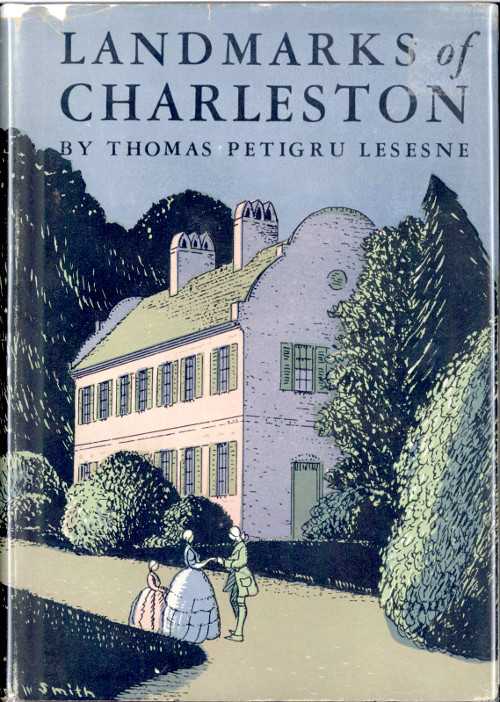
It is said that from the tops of the highest buildings in Charleston come under the eye more historic places than come under it from any other point in the United States. The book tells the history of those places. The Charles Town that was and the Charleston this is are brought before the reader. Names of eminent Carolinians pass in review and the greatness of the lustrous past is linked with the present.
In Charleston survive scars of wars and storms and fires that raged in the long ago. It has had part in Indian, Spanish and French wars. It has had bold adventure with pirates. It was conspicuous in the Revolution and in the War for Southern Independence.
The fame of Middleton Place, Magnolia, and Cypress gardens is world-wide. Annually thousands of people visit Charleston to walk about these wonderful gardens that are a living reminder of the beauty wrought before the American Revolution.
* * * * * * * *
Thomas Petigru Lesesne, author and editor, is a member of a family that has been distinguished in South Carolina since Charleston was a British outpost in a savage land.
Transcriber’s Notes
- Silently corrected a few typos.
- Retained publication information from the printed edition: this eBook is public-domain in the country of publication.
- In the text versions only, text in italics is delimited by _underscores_.